State of Affairs with Steve Adubato
Saymah Nah; Arturo Osorio; Rhonda Auguste
Season 7 Episode 31 | 27m 35sVideo has Closed Captions
Saymah Nah; Arturo Osorio; Rhonda Auguste
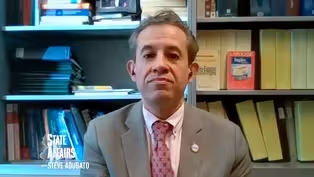
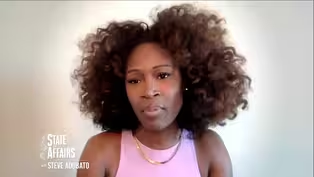
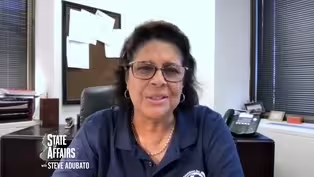
Saymah Nah, Executive Director of Gateway U, discusses Gateway’s mission of providing pathways to education; Arturo Osorio, Ph.D., Secretary of the Board at Statewide Hispanic Chamber of Commerce, highlights the Hispanic community’s impact on the U.S. economy; Rhonda Auguste, Founding Executive Director of The Wight Foundation, discusses their educational opportunities & incentives for students.
Problems playing video? | Closed Captioning Feedback
Problems playing video? | Closed Captioning Feedback
State of Affairs with Steve Adubato is a local public television program presented by NJ PBS
State of Affairs with Steve Adubato
Saymah Nah; Arturo Osorio; Rhonda Auguste
Season 7 Episode 31 | 27m 35sVideo has Closed Captions
Saymah Nah, Executive Director of Gateway U, discusses Gateway’s mission of providing pathways to education; Arturo Osorio, Ph.D., Secretary of the Board at Statewide Hispanic Chamber of Commerce, highlights the Hispanic community’s impact on the U.S. economy; Rhonda Auguste, Founding Executive Director of The Wight Foundation, discusses their educational opportunities & incentives for students.
Problems playing video? | Closed Captioning Feedback
How to Watch State of Affairs with Steve Adubato
State of Affairs with Steve Adubato is available to stream on pbs.org and the free PBS App, available on iPhone, Apple TV, Android TV, Android smartphones, Amazon Fire TV, Amazon Fire Tablet, Roku, Samsung Smart TV, and Vizio.
Providing Support for PBS.org
Learn Moreabout PBS online sponsorship- [Narrator] Funding for this edition of State of Affairs with Steve Adubato has been provided by The Fidelco Group.
The New Jersey Education Association.
PSEG Foundation.
The Russell Berrie Foundation.
Making a difference.
New Jersey’s Clean Energy program.
Lighting the way to a clean energy future.
The New Jersey Economic Development Authority.
Holy Name.
Robert Wood Johnson Foundation.
Working for a more a healthier, more equitable New Jersey.
And by The Port Authority of New York and New Jersey.
Moving the region through air, land, rail, and sea.
Promotional support provided by CIANJ, and Commerce Magazine.
And by BestofNJ.com.
All New Jersey in one place.
[INSPRATIONAL MUSIC] - Hi, everyone, Steve Adubato.
We kick off the program with the executive director of Gateway U, Saymah Nah.
And Saymah, thank you so much for joining us.
- Steve.
(laughs) - Listen, we've been taping all day, and it's like 2:30 in the afternoon, and this is the energy you bring.
You're making my job easier.
Tell everyone what Gateway U is and why it matters.
The website will be put up right away.
- Yeah, for sure, so in a nutshell, right?
Gateway U is a degree pathway program.
We partner with Southern New Hampshire University to provide our community degrees, and that's just, you know, simply put.
But I think the idea of Gateway U and our why is a much more complex picture, Steve.
- Hmm, born and raised where?
- Born and raised in the city of Newark.
I'm from the Spires, the Garden Spires on First Street near (indistinct).
(Saymah laughs) - I know it well.
- Yeah, Steve, I know you're a Newark native as well, so it's nice to be on a call with a fellow Newark native.
- Hey, hold on, before we talk more about Gateway U, isn't there something about those of us from Newark that's special that makes everybody else envious?
Just to confirm, just between us?
- Oh, yeah, for sure, I mean, we're the best in the land.
I mean, I wouldn't wanna be from any other place.
Like what is California, what is San Diego, what is New York City, what is the Bronx?
You gotta- - They're jealous.
They're jealous, but now help us understand.
I'll stop goofing, all right.
My producer's like, "Stop goofing off."
Okay, we'll get back to Gateway U. Connect Gateway U to the city of Newark and the young people of Newark, please.
- Sure, for sure, you know, when I think about Gateway U, I think for me, you know, as a child and as a college student, I believed if you worked hard enough, you would be granted the opportunity to go to college and get into your career of your dreams.
And I think that has been the furthest from the truth, especially from the neighborhood that I'm from, right?
And as I started to grow, Steve, as an adult, and my mind started to develop, and my thoughts started to become my own, right?
My thoughts and my feelings started to become my own, and I was no longer regurgitating information.
(laughs) I started looking around and realizing that how many people around me were not afforded the same thing, regardless of how hard they worked, right?
And that always kind of stuck with me, again especially for the neighborhood that I'm from, right?
When it comes to the conversation around tokenism and what that means, right?
I realized that even if you worked hard, sometimes you just didn't have enough, right?
It still wasn't enough, and you know, college is supposed to be a gateway for opportunities, but you know, college can also be a very hefty, expensive, unaffordable bill, right?
And if we connect that to opportunities, and we say college is supposed to be about opportunities, but it's a hefty bill, that means opportunities cost, right?
- That's right.
- Yeah, and sometimes, you know, the price, also understand, right?
That the price isn't always about money.
Sometimes the price is about privilege, right?
The privilege of having the time to commit to your studies, the privilege of having the ability to sit in a physical classroom, right?
And sometimes the cost is the knowledge, the knowledge and the wherewithal or the understanding to fill out your financial aid documents, right?
Sometimes we don't have that, we don't have that privilege, and we don't have that knowledge.
And you know, sometimes it's dollars, right?
Sometimes it actually is money, and I guess like the point that I'm trying to make, the point that I'm trying to drive here is that whatever the cost, you know, opportunities cost something for our community.
It costs something for the Black and brown kids of Newark, right?
- But I'm sorry for interrupting, but I wanna bring this back to Gateway U, and also the teacher shortage in the state, because there's a shortage, you're trying to address it, opportunity, expense, challenges.
What exactly is Gateway U doing in the city of Newark, also doing across the country and other places to address the teacher shortage?
- Yeah, for sure, so we launched our teacher pathway program, and our teacher pathway program has two entry points.
The first entry point is for teachers who need to be certified, so these are aspiring teachers who need to be certified, so we help them throughout the practice to be able to gain support.
The second piece, right?
The second entry point is the people who need their degree, right?
So there are people that have been in schools for years, your paras, your teacher assistant that have been in front of our kids and teaching our kids for years, right?
And haven't been able to move to the next step because there isn't a flexible option for them to be able to finish their degree in order to take the practice to become a certified teacher.
So we help those two groups of people be able to move into the certified space.
- Why do you care so much about this?
(Saymah laughs) Not just professionally, but personally?
- Yeah, I think that's a great question.
You know, this is my city, and I've been deeply connected, deeply rooted since the time that I can remember, right?
I consider myself to be a very avid community servant to the city of Newark from Big Brother Big Sister, Junior NAACP, New Community, the list goes on, and I've seen- - You were tied to New Community Corporation Reverend Linda back in the day?
You're too young for, did you know who I'm talking about, Reverend Linda?
- Yes.
- Really?
- I went to St. Rose of Lima on Orange Street.
- Oh (Steve applauding) (Saymah laughs) That's beautiful.
So I'm sorry I interrupted you.
- Oh, you're fine.
- So bring it back, and bring it back also, if you could, Saymah, to the lack of representation in the classroom for students who are disproportionately Hispanic and Black, Black and brown students who do not see enough teachers who look like them.
- Yeah, for sure, you know, I think when we talk about representation in education, it's very important to go back to, you know, back to Brown versus the Board of Ed, right?
- 1954 Brown versus Board of Education, Topeka.
- Yeah, for sure, and I'm pretty sure we're probably all familiar with the intention of Brown versus Board of Ed, right?
That the idea, right?
Was to get rid of separate but equal, but simply separate was not equal, right?
We understood that, we were able to know that.
- Separate is not equal.
- Right, and when we did that, you know, Black teachers and Black principals actually lost their job.
That was the turning point, right?
That was the turning point that we saw, and before Brown versus the Board of Ed, for those who don't know, the math was pretty simple.
White teachers taught white children in white schools, and Black teachers taught Black children in Black schools.
But after the Board of Ed, you know, integration cost Black teachers their jobs.
They started to close Black schools, and they started to bus Black children, right?
Into these schools, but they didn't take the teachers with them, right?
They didn't take the teachers with them, and these teachers lost their jobs, so that was the turning point.
So I think when we talk about representation, we gotta talk a little bit about, you know, how did we actually get here, right?
And how did we get to this point?
And, you know, W.E.B.
Du Bois also said, it's my favorite, you know, of all time, that a slum is not a simple fact, right?
It's a symptom, and the lack of Black teachers that we're experiencing right now is a symptom that we've been experiencing for decades.
So when we think about, you know, what's happening in this space right now, we gotta go a little bit back to figure out how we got here to be able to explain where we are.
And the idea is to empower, and I usually hate the word empower, 'cause it means give people power, and people already have the power to do these things, but right?
These powers, these ATs, people have been in the schools for years that tend to be people of color and tend to be people from the community that I- - But they don't have the degree, they don't have their credentials.
- Exactly, right?
- Saymah, I hate doing this, but the one thing I do not have power over is time.
Can you come back and pick up this conversation in greater depth?
And I apologize for cutting you off like that.
- No, for sure, I'm sorry that my questions might be long-winded.
- No, no, that's what passion will do.
(Saymah laughs) I cannot thank you enough from one Newarker to another, and one who's definitely putting in the work and making a difference at Gateway U.
Thank you so much, we'll have you back soon.
- All right, Steve, thank you.
- You got it, take care.
Be right back after this.
(grand music) - [Announcer] To watch more State of Affairs with Steve Adubato, find us online and follow us on social media.
- We're honored to be joined by Dr. Arturo Osorio, who is Associate Professor of Entrepreneurship at the Rutgers School of Business and the Secretary of the Board at the statewide Hispanic Chamber of Commerce.
Good to see you, Arturo.
- Good to see you, Steve.
- We are gonna put up the website for the Hispanic Chamber.
We've had your CEO on, Carlos, talking about a whole range of important issues.
I wanna revisit some of them now.
The Hispanic community and their representation in the business community, how prominent is the Hispanic business community?
- Very good question.
So if you were to take the Hispanic community in the US and put it in a ranking across the world, the Hispanic community will be about the 5th largest GDP of the world.
In other words, if we're lookin' into yes, the 5th, so if we're lookin' into the numbers, the Hispanic community in the US brings about 97 billion, that's billion with a B, billion dollars into the US economy.
This is mostly because the large number of business and the youth of the community.
So we're talking that across the US we have about 140,000 Hispanic business contributing to the economy, providing access to products and services.
In New Jersey alone, that number is about 20,000, I believe.
The chamber represents 6,500, so it's a big number.
- Lemme follow up with this.
As expansive as the Hispanic business community is everyone involved in a business, particularly, small business, but all business, our business, greatly affected by the pandemic.
As we're doing this program March of 2024, will represent four years into this global pandemic.
- Yes.
- How would you argue that, or what would you say the Hispanic business community's greatest challenges are from recovering and the effort to recover from the pandemic based on the incredibly difficult challenges they faced, any different than the rest of us?
- Very different in terms of how it connects and the type of challenges.
So to recover, we need money.
You need to buy materials, you need to bring back marketing, you need to connect people.
So if I am a non-Hispanic business requesting a loan, let's go for a small business.
We know the numbers, the small business is defined by the Small Business Administration of the US, so we're talkin' tiny numbers, $100,000.
I am a non-Hispanic business looking for $100,000 in a loan.
I have about 50% chance to get my loan.
Same business, same amount of money, now the face on the picture is Hispanic, 20% chance to get the loan.
- Why?
- If we go, why?
That's a very good question.
There are multiple elements to it.
Number one, the way that we present ourselves tend to be more shy.
The way that we record the numbers, sometimes it's more difficult.
We tend to be more cautious when we report.
We tend to trust less and tend to work more in close-knit communities.
That is for the inside part of it.
On the outside part of it, there's discrimination.
There is some intrinsic bias that we don't look at it.
There are some product, this has been also translated to artificial intelligence recordings.
So if you are looking for people applying for loans or for jobs and you remove the gender and the name of the person, so it becomes non-denominational in terms of ethnicity or gender, you are equally likely to get it.
You apply gender, you apply name, names indicate ethnicity, you drop the chances.
- So you're saying, gender part of it, but if someone's name is Gonzalez versus Adubato or Jones, and the credentials are the same, the application is the same, the capital formation is the same, finish that.
- This is what happens.
We tend to have certain biases, and these biases imply that we see certain groups more likely, more suited to perform a job.
So for example, I can give you a case that it happened to me, and this is, I'm going to go into gender.
I was working about 10 years ago with an entrepreneur.
This individual had about 10 years work experience running a daycare.
It was a daycare, 15 kids, was looking to grow the daycare, applied for a loan, was denied, problem was a male caregiver.
So we foresee people who provide childcare to be more likely female than male.
If you see a situation in the mall, where a kid is crying, ethnicities not matching, older person happens to be a male, we grow suspicious.
We see a kid crying on the mall, say different ethnicity, younger kid crying, we think that must be a nanny or the mother.
So, we have some biases.
- Arturo, let me ask you something.
- Sure.
- I often ask people, when I feel their passion, how much they believe deeply in the work they're doing and the people they serve, I'm always curious, where does your passion for the scholarship, the research, the work that you do, particularly at Rutgers School of Business, where does that passion come from?
- Before being a professor, I was a CFO for 100 million R and D project, US/Mexico.
The project was phenomenal.
We needed to develop the technology.
We needed to create things that they had never existed before.
We were given one task, do all the technology and don't forget for the nearby local communities.
So how difficult can it be?
We have world class scientists, PhD people, and we were creating things that had never seen before.
We fail on the social.
So at that point, I asked myself, how come when we have all the resources at hand, all the knowledge and even the mandate, we are not able to deliver?
So at that point, I have a conversation with my wife.
She was finishing her PhD at the time, says, "How do you feel if I quit my job and I go back to school?"
(Steve laughs) So, quit my job, and I ask, "What do we do not know?"
Because if we know what we know, we can ask the question, but when we ignore what we don't know, we don't know what to ask.
So, went back to school, and I start asking, "How do we conceptualize businesses?
"How come sometimes we have problems with businesses?"
And the answer was simple, and that's how I became a professor at Rutgers.
Most people see businesses as a tool of exploitation, so you create a business because you want to make money.
So you struck money from communities.
However, and this is one thing that make different Hispanic business and why is allowing Hispanic business to grow despite of.
We see business as the opportunity to provide access to products and services, so when you create business to resolve problems, your business becomes strong.
So that's what I became and that's how I feel passionate.
For me, creating businesses, the opportunity to make communities better by solving problems in exchange for resources.
- This is personal for you.
- Very personal.
- We appreciate you joining us, Professor, and we look forward to continuing the conversation with you because we are not doing enough.
I'll speak on behalf of our production company.
We are not doing nearly enough to explore, to analyze, to make sense of issues disproportionately affecting the Hispanic community.
Thank you, Professor.
- No, thank you Steve, I appreciate the opportunity.
- You got it, stay with us, we'll be right back.
(grand music) - [Announcer] To watch more State of Affairs with Steve Adubato, find us online and follow us on social media.
- We're now joined by Rhonda Auguste, who is the founding executive director of an organization called The White Organization.
Excuse me, The White Foundation.
Rhonda, good to have you with us.
- Thank you so much.
- Now the White Foundation is named after Russell White.
- Yes.
Russell B.
White Jr. - And what inspired Russell to create the Foundation?
- There was a news documentary in 1986 that was highlighting the challenges of Newark.
At the time he was residing in North Jersey.
That's where his office, his office is still in North Jersey.
But he was residing here at that time and he grew up at the Hill School in Pennsylvania.
And he just said, maybe what if we give these young people a chance to be in an environment where they are away from all of the distractions?
So the statistics were frightening back in '86, and he just wanted to make a difference for the city of Newark.
- And I wanna be clear, I think believe that was a public television documentary that he saw.
- It was, yes it was.
- Not that I wanna always plug public broadcasting, but that's where we saw it.
So exactly what does the foundation do?
Who are the young people that are part of it?
And what does the Foundation do for them that often has a great impact on their future?
- So we recruit students in the 7th grade.
Anyone within an hour of Newark is eligible.
They have to be New Jersey residents.
And we are recruiting them for our enrichment program, which starts at the end of their 7th grade year and goes through the entire 8th grade year.
So that is a STEP.
And actually the name of the program is called STEP, is an acronym for Scholars Training Enrichment Preparation.
So we recruit students for our program STEP, and then from that group, from that cohort, we will select our future scholars.
What we do is we place students in boarding schools.
We only work with boarding schools, and they're all within five hours by car radius, from Newark.
And that's on purpose.
We wanna be able to have access to our students, and we want our families to have access and we want our students to have access to home.
So that's what we do, we provide opportunities to give students access to incredible private schools that are all boarding schools.
- So, Rhonda, for those who say, hey wait, isn't the Foundation taking some of the most talented young people at a very young age out of the Newark Public School System and giving them these opportunities, it's a wonderful thing.
But aren't they, some would argue, aren't they hurting the public schools?
Because some of the best and brightest are leaving?
- I've heard that argument over the years.
- How do you respond?
What do you say to those folks?
- Well, first I'll just talk about the numbers.
Our numbers are very small.
I like to say we are a boutique operation.
We average anywhere from 30 to 35 students each year.
So that is a very minuscule number percentage when you look at the numbers of students in the Newark Public School System, for instance, right?
- I think it's between 40 and 50,000 in public schools.
But go ahead, including charter schools.
- Exactly.
So we are talking 30 to 35 students.
What I think, I mean, what I know rather, is that it creates an incentive.
It creates an incentive for the students to work towards something.
And we are very transparent.
We understand that not everyone is made for boarding school.
And boarding school is not for everyone.
But when my colleagues go out into the field, they're educating, they're enlightening students about what are the possibilities in the world.
And so we look at it as a positive, not a negative, but I also like to say that it's important for me as a director to make sure that my young people are grounded.
So we have a community service component in our program.
All of our students are required to complete at least 30 hours of community service each year in their local area.
I have many students who would do a hundred, 200 hours plus.
And in fact, one of those young women who did that, and she was, I mean as a scholar, she worked so hard, extremely conscientious, always about community service.
She was just elected in the last few years as the youngest school board member here in Newark.
So the fact that-- - Wait, hold on.
- A'Dorian Murray Thomas is a White Foundation alum.
I'm very proud to say.
- One second.
Did you know that, did you know Brenda, that we are part of the A'Dorian Fan Club?
- Oh, I didn't know.
I'm not surprised, everyone should be.
- Wow.
She also ran for another office recently as well, right?
- As a county commissioner.
And she won for District 12.
- That's right, formally Freeholder now Commissioner.
So wait a minute, she comes?
- Yes.
Yes.
- What a superstar.
- She came to a charter school here in Newark, that right to go to Northfield, Mount Herman School with our program.
She went on to Swarthmore College.
And while she was at Swarthmore, she earned, there's a special scholarship program they offer where they give their students $10,000 to invest into their local community.
She earned that opportunity and that's the money she used to start She Wins.
So she's just an example of, I have so many alumni who have done incredible things here.
- And by the way, check out our interview with a A'Dorian, because She Wins, a great organization, was also recognized and honored, and we're very much tied to the Russell Berrie Foundation Making A Difference Awards.
I've been honored to host for over 25 years.
She won that award.
She won.
She was a winner of that award for Making A Difference.
I'm sorry, but it's funny.
- No, that's important because she represents, she represents who we are as an organization, is giving a young person an access where, because of one decision, her mother said, you know what, I will have her go actually, take a step back.
My colleagues went to the school, recruited students.
She was one of the students in the audience, followed through.
And now look at the ripple effect.
Like how many lives has she impacted from one decision?
That's why what we do is huge.
- And A'Dorian's a great example because it's not like she did that, had that opportunity and said, let me go to the suburbs.
Not there's anything wrong with the suburbs, but her work is in the city of Newark.
Her work is with young women in the city of Newark whose lives have been horrifically affected by violence.
And she knows personally, personally that she lost her father to violence.
So before I let you go, success rate real quick.
I got a minute left.
What's the success rate of the program?
- I would say 100%, our students who enter our school-- - Hold on.
Nobody's 100%.
- Okay.
Okay.
95, I mean, here's the reality.
The way we measure success is how many of our students actually one, get accepted to the boarding school, which that is 100%.
'Cause I place my students.
So every student I have touched, I have worked with who I have like A'Dorian, they've all received opportunities to go away to boarding school.
We're very proud of that, very proud of that.
But on the other side of it, we have an incredible track record with graduations.
I mean, our students graduate from these very elite boarding schools and go on to college.
Not everyone goes on to college, but by far the majority go on to four year colleges for sure.
- Rhonda, work well done.
- Congratulations.
- Thank you so much.
My pleasure.
- Wish you and everyone at the Foundation the best in helping young people like A'Dorian, who I'm just a huge fan of Making a Difference.
Thank you so much, Rhonda.
- My pleasure.
Thank you.
- You got it.
I'm Steve Adubato, that's Rhonda.
She's making a difference, we'll see you next time.
- [Narrator] State of Affairs with Steve Adubato is a production of the Caucus Educational Corporation.
Celebrating 30 years in public broadcasting.
Funding has been provided by The Fidelco Group.
The New Jersey Education Association.
PSEG Foundation.
The Russell Berrie Foundation.
New Jersey’s Clean Energy program.
The New Jersey Economic Development Authority.
Holy Name.
Robert Wood Johnson Foundation.
And by The Port Authority of New York and New Jersey.
Promotional support provided by CIANJ, and Commerce Magazine.
And by BestofNJ.com.
- Hi, I'm Abbie.
You might see me as an ordinary person, but I've been living with a brain injury since 2018.
Opportunity Project gave me hope and I've gained confidence through job skill training and helping my family.
Despite my challenges with memory, I see a possibility to keep improving.
- [Narrator] If you have a brain injury, you don't have to face your road to recovery alone.
Learn more about Opportunity Project and its partnership with Children's Specialized Hospital.
The Hispanic Community's Impact on the US Economy
Video has Closed Captions
Clip: S7 Ep31 | 9m 37s | The Hispanic Community's Impact on the US Economy (9m 37s)
The Importance of Minority Representation in Education
Video has Closed Captions
Clip: S7 Ep31 | 10m 8s | The Importance of Minority Representation in Education (10m 8s)
The Wight Foundation and the Incentives for Students
Video has Closed Captions
Clip: S7 Ep31 | 8m 47s | The Wight Foundation and the Incentives for Students (8m 47s)
Providing Support for PBS.org
Learn Moreabout PBS online sponsorship
- News and Public Affairs

Top journalists deliver compelling original analysis of the hour's headlines.

- News and Public Affairs

FRONTLINE is investigative journalism that questions, explains and changes our world.












Support for PBS provided by:
State of Affairs with Steve Adubato is a local public television program presented by NJ PBS