
School Resource Officers, Drought, Former Lawmakers
Season 2024 Episode 1 | 56m 44sVideo has Closed Captions
Attorney General Ellison on Medicaid fraud, Osterholm on COVID and a former lawmaker panel
Attorney General Keith Ellison discusses Medicaid fraud, Mary Lahammer dives into debates over school resource officers, updates from Mike Osterholm on COVID and Kenny Blumenfeld on drought, a new women’s pro hockey league, Latin dancers at the State Fair, former lawmaker panel
Problems playing video? | Closed Captioning Feedback
Problems playing video? | Closed Captioning Feedback
Almanac is a local public television program presented by TPT
School Resource Officers, Drought, Former Lawmakers
Season 2024 Episode 1 | 56m 44sVideo has Closed Captions
Attorney General Keith Ellison discusses Medicaid fraud, Mary Lahammer dives into debates over school resource officers, updates from Mike Osterholm on COVID and Kenny Blumenfeld on drought, a new women’s pro hockey league, Latin dancers at the State Fair, former lawmaker panel
Problems playing video? | Closed Captioning Feedback
How to Watch Almanac
Almanac is available to stream on pbs.org and the free PBS App, available on iPhone, Apple TV, Android TV, Android smartphones, Amazon Fire TV, Amazon Fire Tablet, Roku, Samsung Smart TV, and Vizio.
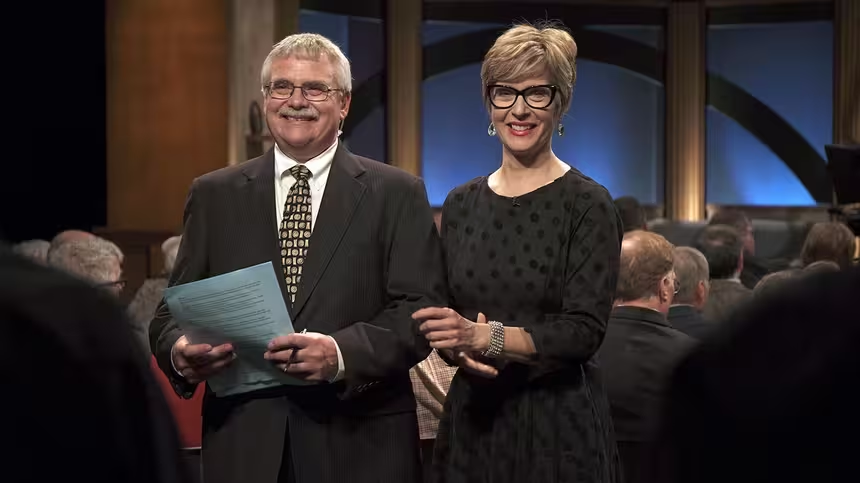
A Minnesota Institution
"Almanac" is a Minnesota institution that has occupied the 7:00 p.m. timeslot on Friday nights for more than 30 years. It is the longest-running primetime TV program ever in the region.Providing Support for PBS.org
Learn Moreabout PBS online sponsorship(uplifting tones) - [Announcer] "Almanac" is a production of Twin Cities PBS for the stations of Minnesota Public Television Association.
- Big holiday weekend show for you tonight.
We will hear about the deepening drought statewide.
Look ahead to the new Women's Professional Hockey League.
A group of former lawmakers fill the couch and Mary Lahammer's been following a capital controversy.
- [Mary] As schools start, student resource officers who used to roam the hallways, may not be there anymore because of a new law.
We'll explore.
- Mary, just for what it's worth, it's gonna be the first hearing I have.
- That's coming up on "Almanac."
(upbeat music) (upbeat music) - [Announcer] "Almanac" is made possible by members of this public television station.
Support is also provided by Great River Energy, providing wholesale power to 27 Minnesota electric cooperatives.
Delta Dental of Minnesota Foundation, improving oral health while advancing social equities.
Delta Dental mn.org/tpt and Education Minnesota, the voice for professional educators and students throughout the state.
More at educationminnesota.org.
One Greater Minnesota reporting on "Almanac" is made possible in part by the Otto Bremer Trust, whose mission is investing in people, places, and opportunities in our region.
(upbeat music) - In the next hour, we'll talk with Attorney General Keith Ellison about the big Medicaid fraud charges announced earlier this week.
Michael Osterholm has an update on Covid variants and fall boosters.
Kaomi Lee introduces us to a dance troupe that will be on stage at the State Fair Saturday.
- But we start tonight with Thursday's National Political News.
Former President Donald Trump pled not guilty to trying to overturn the 2020 election results in Georgia and US Supreme Court Justice Clarence Thomas has disclosed more private trips with Texas billionaire, Harlan Crow.
Those are just two of the topics we'll explore with David Schultz, Political Science Professor at Hamlin University, and a visiting law professor at the U of M, where he teaches Election and Constitutional Law.
Well, let's see.
Justices Thomas and Alito asked for extensions, but Justice Sotomayor was also kind of caught up in all of this.
Gosh, has this always happened?
Were were justices were taking trips and getting money for speeches and that kind of thing?
- Yeah.
It's been going on for an awful long time.
I could tell you that at least going back, let's say 20, over 30 years, almost 40 years ago, Thurgood Marshall was doing this.
It transcends political party, so it's not like it's Democrat versus Republican, but it's very frequent.
They visit law schools, they visit conferences, they go to conventions and so forth.
Maybe it's gotten a little bit more emboldened, but it is a problem.
- Are there ethical standards for Supreme Court Justices, and if so, how are they enforced?
- Well, there are ethical standards for lower court justice or lower court judges.
For the Supreme Court, they would like 'em to follow these rules, the same rules as judges, but it's left up to the justices themselves in terms of policing themselves and for the most part, what we're starting to see here is that the justices may not be doing a very good job in terms of policing themself.
- When we were kids, the Supreme Court, I think generally in America, was held in high regard.
- [David] Correct.
- But I wonder if stuff like this is eroding confidence in the court.
- It is.
We can actually look at it in a couple of different ways.
If we take us back about, let's say 16 months ago, before the Supreme Court overturned Roe vs. Wade, it was starting to see some erosion, but still a majority of the American population trusted the Supreme Court, much better than Congress or the presidency.
- [Eric] Right.
- Post Dobb's decision, it's collapsed quite a bit.
And we have polling data now that is really suggesting that the court's approval rating is way below 50%, which is scary because part of what the court is about, it's about the idea of impartiality.
The idea that, you know, justice is blind equal, you know, equal protection under the law.
That I can go stand before the Supreme Court and have a fair hearing and walk away and feel like, you know, even if I didn't win, I have my fair day in court.
And that's increasingly disappearing because we also know, I get to speak as a political scientist now, is that there's kind of this myth that we've also shattered now.
The myth is that they're politically neutral.
We now know that there's very good evidence that the best predictor of how a Supreme Court Justice will vote is to look at which president appointed them.
So throw in the gifts, throw in, I'm gonna call it political realism or judicial realism.
They're looking awful lot like what, like legislators wearing robes at this point.
- What needs to be done to shore up the cracks in this facade?
- Well, what we really do need to have are binding ethics codes upon them.
Much in the same way, I would argue we probably need better binding codes of ethics for members of Congress too.
But we need something in terms of requirements for disclosure in a timely fashion too, not extension, extension, and also something that is attached with it, rules about recusal.
What I mean by recusal that says that if you've taken a trip, if you have a friend who's giving you something like that, you recuse yourself from deciding the case.
And this is important not just because of real conflicts of interest, because in some cases these justices are taking gifts from people who might be arguing before them.
But it's the perception, remember, for the public perception is reality.
- In the Trump situation in Georgia, I suppose in particular, can attorneys that are indicted say, "Hey, I'm doing what I do every day of the week, which is give advice and map out scenarios for my client."
- No, no.
In this situation here, there's a general rule, you know, I've taught legal ethics rule like a quarter of a century.
There's a general rule called the crime fraud exception.
That if a client comes to me and says, "I committed a crime in the past, can I as an attorney provide legal advice to them?"
Yes, I can, 'cause in our system, what presumption of innocence until proven guilty, everybody's entitled to representation.
But if a client comes to me and says, "I wanna commit a current crime or plot a future crime," we cannot do that.
Because what if we help them do that?
What are we?
Accessory to crime, we are co-conspirator, et cetera, et cetera.
So they cannot hide behind attorney-client privilege in this situation.
- Well, the cases are piling up, aren't they?
- Yeah.
- It sounds like there's so much noise.
Do you think that the public's paying attention?
- I think it's, well, first off, it's still summer technically, so I think the public is kind of zoning out that they'll start to pay a little bit more attention.
But I think at this point, what four indictments?
What is it, nearly a hundred charges at this point?
I think it's overload at this point.
It's getting to be a little bit of, you know, inside baseball or something.
Now, will the public start to pay more attention next year?
What's gonna be fascinating today was announced, you know, on Friday that the trial in Georgia will be televised.
- [Cathy] Yes.
- I mean this is gonna be the OJ Simpson all over again, in terms of how many people watch that.
- [Eric] Yeah.
- Fascinating.
- Getting 'em the hook.
Thanks.
- Sure.
- Thanks.
- Appreciate it.
- Have a good weekend.
- My pleasure.
(upbeat music) - The issue of school resource officers dominated Minnesota politics this week as city and county authorities in many jurisdictions announced they were not sending officers into schools because of new legislation dealing with restrictions on prone restraints used by officers.
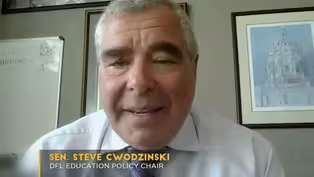
Political reporter, Mary Lahammer talked with the key committee chair about the reasoning behind the law and and what's ahead.
- Awesome, great job.
I get to work with the kids every day.
- [Mary] Hennepin County, once highly touted it's school resource officers.
- [Officer] I walk the halls, you know, in between bells, I try to be present in the hallways.
- [Mary] Now law enforcement agencies across the state are pulling their SROs as they're known, thanks to the interpretation of a new law.
- The way that the law was written on this is prohibiting things like choke holds, neck holds on students, student resource officers, somebody that I've been very supportive of.
I worked in schools my entire career that had police resource officers in the school.
- Governor Walz was a teacher.
So too was the education policy chair.
Let's start with the obvious fact.
You're a teacher, so I'm guessing you worked with student resource officers, correct?
- Yeah, for 33 years.
- And what was your experience?
- Amazing.
They're amazing.
They do their job, they build relationships with kids.
The, I mean, not all kids like them.
- [Mary] So why the changes then in their role in the schools?
- Well, there's a lot going on there.
10 years ago, eight years ago, we passed the legislation on that prone restraint.
And obviously a lot of this came out of the George Floyd murder.
- Republicans who ran on public safety concerns, seized the issue and stood with law enforcement at a press conference calling for a special session to clarify the language about student resource officers.
- We need our governor to go ahead and call a special session, to go ahead and fix this issue.
We cannot have our schools, our students, our staff waiting for six more months to figure out something that we already know is an issue.
- All this response then from law enforcement, from schools, from Republicans calling for special session.
Does this surprise you then?
- It does, because during the session we met with Republicans in my office.
They brought up their concerns.
I listened to them.
I think most- - Did you talk to law enforcement though 'cause Senator Duckworth keeps pointing out in committee, he told you to talk to law enforcement, talk to the schools?
- Never came up.
- My concern is one of the limitations placed upon personnel at schools here has to do with school resource officers.
- [Mary] Senator Duckworth issued a warning in committee back in February and says, Democrats failed to get the necessary input.
- I want to assure you, we hear your concerns.
We are working to address this and fix this as quickly as possible in a truly bipartisan fashion.
- [Mary] The Republican senator has a one page bill for the fix and says, at least one Democrat will sign off.
- Mary, just for what it's worth, you know, it's gonna be the first hearing I have, or not the first, I can't promise that.
I've met with the head of the Chief Police Association, POTs, and I've met with the lobbyists for the League of Cities and I met with them all and they all have my word that if we can't get this right now, I have faith that the Department of Education and Blaine Administration will probably work this out.
- [Mary] The Blaine police chief says almost every jurisdiction in his area are exiting the schools.
- How can we expect our staff to go to the school and work there every day, when they're constantly worried about being sued or whatever it may be, instead of just focusing on their job and developing those relationships and maintaining that safety in the school.
- The community that I serve very, very much supports our law enforcement and our SROs, and they want and expect our SROs to be in schools this fall.
- [Mary] Another lawmaker from a competitive suburban district used to be a school resource officer.
- Mom and dads count on us to safeguard their children.
This law makes our kids, teachers in schools less safe and needs to be fixed before the school starts.
- Is that a problem, that there are not going to be officers it appears in the hallways?
- If you read the language of the bill, it says they, that school resource officers and police officers and somebody, and maybe it's me, or you on "Almanac," needs to tell them, A, if it's an emergency situation, they can use whatever tools they have in their toolbox that they could use before.
- Is there politics and broader things at play here?
- Yeah.
Yeah.
- [Mary] In a state where a police officer was convicted of murdering a man by kneeling on his neck, the issue has broader context.
- It is not being interpreted correctly.
I certainly think we should all agree that we should not kneel on the necks of students unless someone's life is at risk and that is written into the law, to be able to do that.
(upbeat music) - Minnesota Attorney General Keith Ellison has been busy.
Late last week, he issued a legal opinion on the new law regarding school resource officers.
Earlier this week, his office filed racketeering and other charges against 18 people in a Medicaid caregiver fraud case.
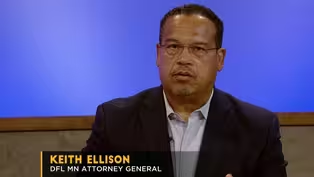
That's the largest case uncovered by the state's Medicaid Fraud Unit and Attorney General Keith Ellison joins us.
Do these standards for the resource officers need some tweaking?
- Well, what we did is tried to clarify any ambiguity or confusion by issuing an attorney general opinion.
Under Minnesota law, the Attorney General is authorized to issue certain opinions and in the case of education, they're binding.
So we made it clear that pursuant to this letter, which was a response to Commissioner Jet, who is our Commissioner of Education, that the amendment, the new law, does not limit the types of reasonable force that may be used by school staff agents to prevent bodily harm or death.
So I think that the, that we've tried to clarify the law.
If a school resource officer or any other personnel needs to use reasonable force to stop bodily injury or death, they can certainly do that.
And if a student is creating a problem or a confusion that is not threatening to bodily harm, they can approach the student.
They can use verbal commands.
They can even put their hands on the student to restrain them.
- [Eric] Oh, they can.
Well, but what they, but it's got to be a reasonable force.
And you know, the- - What is reasonable force?
- You know, it's a fact driven thing.
I mean, you know, in 1989 Cathy, there was a case called Graham vs. Connor, where the United States Supreme Court said, in order to prove a case of unlawful or unreasonable force, or illegal force, unconstitutional force, that the people who would move, the moving party, the plaintiff or the government would've to prove that the force was unreasonable.
Why?
'Cause the fourth amendment to the constitution talks about unreasonable search and seizure.
So the, so that's why the court uses the term unreasonable.
It is fact bound, fact specific, but we do know that if somebody's not threatening to another person, then using deadly force would not be reasonable.
Right?
- [Cathy] Sure, sure.
- And so that's, it's the sort of thing like that.
- So when you hear republicans say, we need a special session to fix this law, what would be the fix?
It doesn't seem like you're, you're saying there doesn't need to be a fix.
- Well, here's the thing, the law is now clarified.
So school resource officers can use reasonable force to stop bodily injury or death and can maintain safety at the school.
There might be a policy decision, you know, that might need to be made and that's for the legislature.
That's for the legislature to decide that.
One of the things I see at the end of this letter is that there were other questions that were posed to us.
They're beyond the scope of the inquiry made to us and they need to be sorted out in the legislative process.
- Medicaid fraud case, nine and a half million dollars, I guess charted in this thing.
- [Keith] Yeah.
- What are the particulars?
- Well, in particular we have about 18 people who pulled together a fraudulent group that was doing false billings, that was saying that they did work that they never did.
That was doing work and saying they had authorized supervision and medical authorization that they didn't have and so we're criminally prosecuting them.
The five mentioned in the complaint are the ringleaders and we're going to continue.
We're gonna hold 'em accountable because look, low income people need healthcare access and if you rip off the program, it won't be there for everybody and so we're gonna protect that program.
- I'm wondering about these companies, these home healthcare companies.
What do you know about how lax some of them might be when it comes to their operations?
- You know, what, they, some, you have some of these companies that are doing the right thing.
Some are doing the right thing in a sloppy way and some are just straight crooks and they're ripping off people and they're does, and so this middle category, we'll work with them, but the thieves and the crooks, we will not tolerate and we're gonna criminally prosecute them and that's what we're doing now.
- How active has you, been your crime prosecution unit helping counties around the state?
- Everybody's busy and I wanna thank the legislature again.
We're helping relieve burdens of small counties, all counties.
And it's one of the things I fought for since my first day and a great, and it was a realization of a dream when we got all of our criminal prosecutors we're full up, full staffed.
We didn't wait around and we started hiring and listing those jobs right away.
- Really appreciate you coming down tonight.
Thanks very much.
- Absolutely.
- Yeah.
Good to see you.
- Thank you.
- Good to see you.
- Thank you.
(upbeat music) - It is September 1st and fall weather is nowhere to be found.
Minnesota's statewide drought continues to deepen with more than 10% of the state now in the extreme drought category.
With record heat, no rainfall in the forecast for this long holiday weekend.
There is just no relief in sight.
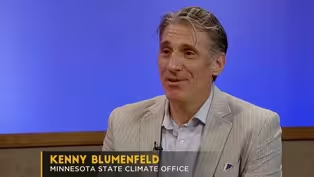
Kenny Blumenfeld is a Senior Climatologist with the State of Minnesota.
He is also a U of M Professor.
Good to see you.
- Good to be on.
- Wow.
More than 10% of the state in extreme drought.
This is September the 1st, we're heading into fall.
This does not look good.
- No, it's not a good situation at all.
We just, we had that nice little interlude in from mid-late-July into mid-August.
We're starting to get wet.
We had some stations that were above normal for the 30 day period and we haven't had a drop of rain in a lot of places in the last three weeks.
And so it just stopped and so this is as bad a dry spell as we've had all year.
- What are the implications for 60% of top soil short or very short of moisture?
- Well, you know, you need that topsoil moisture to feed the crops and we are getting towards the end of the growing season.
But we're hearing this across the land that, you know, farmers are coming up short on moisture.
We've had reports of (chuckling) people turning up some soil and it's just dusty.
Tough conditions, now we should be clear it's not the entire state.
Most, the entire state is short on precipitation and but the western, parts of Western Minnesota, they're doing better.
They've had some big precipitation events.
They're not as far behind as the eastern areas and that includes a east central portion of the state, north of the Twin Cities and then also south of Rochester.
Those are the areas in extreme drought.
And those really expanded, those really expanded in this past week.
- I should say that September is usually a fairly dry month, isn't it?
- What's the- - Can be.
- Yeah, I mean it's the, kind of the last of the wet months basically.
You go from May into September and it's marks the end of the growing season.
So you could get, you know, two and a half to three and a half inches, is kind of average for precipitation around the states.
- [Eric] Can we catch up?
I mean, is there a way to catch up?
- I mean you need a steady diet of than steady rain.
- More than two to three inches I suppose.
- Yeah, and we don't wanna catch up all at once either.
And that's kind of the problem that with drought is it's a long game and we're in a, we're it's a long game to catch up too.
And the problem is, in the wintertime, that's your dry season and typical winter month has about a quarter of the precipitation of a typical summer month.
So making up the deficits in winter can be really difficult and when, and as you saw last year, when you do make up a lot of those deficits in the wintertime you end up with flooding 'cause there's nowhere for the water to go.
And so, you know, we had a conversation just today about how lucky we might be for the flooding that we had early in the season because that actually lifted the river levels up a bit and maybe bolstered us a bit and buffered us against some of the river levels dropping that we've had recently.
- We should say of course that in the fall, you do wanna recharge that those soils before they freeze up.
- Yeah, I mean there's a lot of critical things that happen in the fall.
You want that soil moisture replenishment, you want groundwater replenishment too.
And if you run into a dry period through September and October, you miss those opportunities and so the clock is ticking, definitely.
- Can you get a dartboard out and throw us a winter forecast or?
(Kenny laughing) - Well the climate prediction center sees El Nino coming and El Nino, this is, this would be unfortunate if El Nino plays by the normal script because tends to give us mild winters with kinda low amounts of snow and we don't want snow drought going from regular drought into snow drought 'cause that would put us in a bad situation.
So I can tell you what I want.
- [Eric] Okay.
- I would like steady precipitation that's slightly above normal for the next four months.
- But that, that's what you want.
Yeah, exactly.
- [Kenny] That's what we want.
- Right, but the models are not showing that right now.
- Not yet.
You know, sometimes you get a break in the pattern in, right as you switch out of fall and transition towards winter, the atmosphere kind of decouples and the jet stream changes positions and that's an opportunity for a pattern change.
And hopefully we had that last year.
Hopefully we get that this year too.
And you know, unfortunately we're in a position where we kind of need abundant winter precipitation again to get us out of where we are now.
- Appreciate you coming over and talking to us.
- Good to see you.
- Yeah, always good to talk.
- Good update.
Thanks.
- Thanks.
- Have a good weekend.
Well, we are gonna keep an eye of course on the drought conditions as we head deeper into fall 'cause that's a big story.
We're gonna switch out guests and of course we'll be right back.
(upbeat music) - As we've noted several times tonight, fall is on the way and with the change of seasons comes questions and concerns about rising Covid cases, new variants and the latest thinking on Covid boosters and vaccinations for all respiratory diseases.
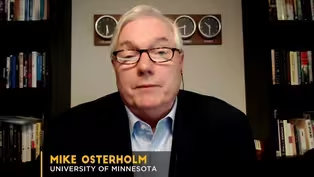
Michael Osterholm heads up the Center for Infectious Disease Research and Policy at the University of Minnesota.
Doctor tell us, glad you're here.
Tell us about the EG 0.6 variant.
What is it?
- Well, first of all, let me just say the last time I was on, you asked me to kind of predict the future and I said I was sleeping with one eye open.
- [Eric] Yeah.
You did.
Yeah.
- And exactly what is happening right now.
We have a combination of things going on.
But first of all, let me just set the tone for how we need to look at this because there's a lot of discussion about how it's all, the whole situation is going back to where we were several years ago.
Right now, we're averaging about 20 new hospitalizations a day in the state of Minnesota, which is surely significant.
But don't forget, that during the Delta surge, we were averaging 260 new hospitalizations a day, during Omicron 220, and even at the beginning of this year, we were averaging about 91 new hospitalizations.
So our numbers are way down with regard to serious illness.
The same thing is even true with deaths.
We're way down in the number of deaths.
But what's happened over the course of the past four to five weeks is we've seen a big uptick in the number of cases of Omicron that are occurring and because, of course, we dismantled most of our testing program, we really don't have good case numbers.
It's all, we all know a lot of people who are infected right now and it's unclear why that's happening.
You asked about the new variant, if you look at EG 5 or you look at the flip variant that we're talking about, they combined only account for about 32% of the variant activity we're seeing here in Minnesota and throughout the country.
And so we can't say that that's it and we can't say that it's a weather change.
We can't say that it's just fall and people are, you know, coalescing more together.
So it's really unclear what's happening.
But this all comes back to the one point, is that we are seeing another new variant emerge.
BA 2.86.
This one is a remarkable variant.
It's one that now has spread to at least 12 different countries in the last three weeks.
And this one has 34 different mutations on the spike protein.
It is more different than its parent Omicron was from Delta.
And I think that's possibly maybe making this a new named variant.
That one, we don't know what's gonna happen.
This is the wait and see.
I'm sleeping with one and a half eyes open right now, knowing that in the next few weeks I could be back saying, well this was not good.
But on the other hand, I've always taken the position with these variants, innocent until proven guilty.
So I don't know what it's gonna do.
- [Eric] Okay.
- Of course we've got these boosters coming down the pike, right?
- Yeah.
- But we don't really know about the formulation, if it would be effective against this new variant.
- Well first of all, let me just say that all the data we have says that it will be fairly good against the ones I just talked about, the EG 5 or flip variant.
What is unclear yet, is how well it'll do against this BA 2.86 and there are studies going on right now trying to understand that.
And so that is important.
Also, again, remember the immunity that we've had from previous vaccinations and previous infection give us some overall protection against serious illness, hospitalizations, and deaths.
Surely doesn't prevent us from getting infected.
We just talked about that.
It doesn't get, keep us from transmitting the virus.
But I think right now, the best hope we have is that when this new booster dose is out, which will be in mid-September, I think right around September 15th, if you are one of those individuals at high risk and today I most emphasize the vast majority of deaths we're seeing in this country, and right here in Minnesota, are those 75 years of age and older.
So we really need to get that group vaccinated.
Much like we talk about vaccinating for flu every year.
- I'm wondering here, and I know that you're at home today and not in studio as you've been the past few times, as I know you're waiting probably to get your own vaccination I'm assuming, right?
- I am.
I'm trying to minimize any public contact.
I don't wanna get my Covid case just days before I'm eligible to get my booster.
So I'm doing what I can to try to protect myself and my family is doing pretty much the same.
- You and some colleagues had an op-ed in the New York Times and you were talking about what's the future of things like masking and shutting down schools and vaccine mandates and all that.
What should the approach be the coming up?
- Well, first of all, that's a really important issue and it's actually a complicated one and I'm writing a new book right now, that'll hopefully be out this winter, that addresses those very issues.
Take schools for example.
You know, we really misfired I think in understanding how to respond to schools.
That first year with the strains of the virus that were circulating, we actually saw a very limited number of severe illnesses in kids, even not that many infections itself.
So everybody concluded, see it's not a problem.
Well then the new variants came along Alpha, Delta and Omicron and kids all of a sudden became really important cases.
And what I mean by that is, in the first year about 97 kids in this country likely died from Covid.
In the year two and year three, we almost approached a thousand kids a year died from Covid.
And so what we did is we kept telling parents, it's not a problem, it's not gonna be an issue.
And when in fact it was.
Right now I think we're out of place, where I would never say close down a school as such.
What I would say though, like snow days, if we start to see activity tick, pick up in a school just like we do, if we see with influenza or RSV, I would say, you know, you may wanna take a two week pause to try to see if you can by not being at school, you can slow down the transmission to kids.
- All right.
- But that could be the case.
- Always a pleasure.
Thank you so much.
- Thank you.
Talk to you later.
- Stay well.
- Yeah, thanks.
(upbeat music) - According to my sister, I have a problem.
Well she probably thinks I have many problems but she loves me, so she keeps those thoughts to herself.
This particular problem must be genetic because my mother has it too.
My sister was spared because she cannot understand the compulsion, the irresistible, all consuming urge to rearrange the household furniture every year, sometimes every six months.
I can't understand leaving it where it is forever.
Don't people's needs change and therefore the room needs to change.
Don't people use the room differently during different periods of their life?
Don't people get bored of looking at the same couch, chair, side table layout day in and day out?
I'm an improver.
I took a personality test because another thing I can't resist is an online personality test that will tell me all my personality secrets in 10 minutes or less.
And this test said that I was an improver, which means I can't help but see flaws and want to fix them.
A trait my husband depreciates very much.
I've been a rearranger ever since I started living on my own and sometimes I wonder if it's a facet of frugality.
I don't wanna go out and buy all new furniture or even one or two new pieces.
So giving the room a refresh gives my brain a little dopamine hit.
I and others get to see the space with fresh eyes.
So, sorry sis.
The house will probably discombobulation you again the next time you visit.
Hashtag can't stop, won't stop.
(Co-workers applauding) (upbeat music) - Minnesota has a deep history of women's professional hockey and an announcement earlier this week means that will continue.
The Twin Cities will be one of the original six teams in the new Professional Women's Hockey League.
League officials announced Minnesota will join Montreal, Toronto, Ottawa, Boston, and the New York City area.
Earlier today, Minnesota native, Natalie Darwitz was named the General Manager of the teams, the Minnesota team, and landed the number one pick in the draft lottery.
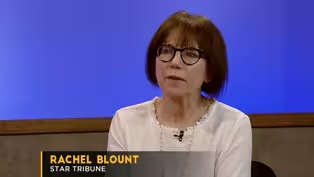
Here with more Rachel Blount and she covers the sports for the Star Tribune and has followed this story from the very beginning.
It is so great to see you.
Welcome back.
- Thank you so much.
- Wow.
So the NHL, I noticed that there's this original six, the NHL had the original six.
Is this intentional?
- It very much is intentional, yes.
This new league wants to show, it's a serious league, it's a professional league, it is a first class league.
And so associating itself with the NHL in that way was very intentional.
- I would think for women looking at the wage and the benefit package.
I mean this sounds, you could almost do this as a day job.
- Yes and that was the point this time.
The group that initiated the discussions to create this new league wanted it to be a professional league where women would not have to have a second job or a third job.
They would truly be professional athletes with wage and benefit packages that would allow them to be just like male professional athletes.
And it appears they now have the financing in place and the support in place to make that happen with this new league.
- Because right now that's not happening in the WNBA.
I mean the women have to go to Europe to play.
- They play overseas.
- Right.
- That is correct.
- You know, I'm wondering be, is there a model here with the NBA support of the WNBA?
Would the NHL have some sort of monetary support of this league going forward?
- They have been known to do that previously and they have said they would not do that until there was one solid professional women's league.
That does not mean they will now jump in and do that.
It was made very clear earlier this week when the announcements were made that the NHL support at this point is simply as advice and moral support and a little bit of collaboration.
They are looking at things, like the NHL will be hosting some games for this new league in some of their arenas and even in cities that are not part of the original six.
So the NHL is helping out, but very much in an advisory role at this time.
- Somebody said to me today, "Well, I mean women's hockey, what's there to watch?"
Which is co completely incorrect.
You know, - Yes.
- I mean women's hockey - Agreed.
- is a good game.
Can you explain that to folks?
- Yeah, it's a terrific game and I think the progress that we have seen in women's hockey from the time it joined the Olympic program in 1998 to now is astonishing.
It's still a very young sport and I think people forget that.
It's an extremely young sport.
Women have not been playing hockey very long at all.
And so the progress that it has made up to this point, and we're seeing that at the Olympics and the World Championships, when folks watch this for the first time, say they tune in NBC, they see a game.
I've heard this from many people.
Oh my gosh, they're physical, they're fast, they can shoot the puck.
Folks have no idea just how advanced they've become.
- They gonna be the White Caps?
- I don't think so.
They have not announced any names yet for any of the teams, nor have they announced where they will play.
But I'm guessing they will not be the White Caps because I think this league wants a clean break from leagues in the past.
- What do you think of Natalie Darwitz as GM?
- Oh, perfect choice.
A perfect choice.
She said today she's a builder.
It's in her DNA and that's absolutely the case.
She's a brilliant hockey mind.
She knows this market as well as anyone.
She's coached for many years and she'll be hiring the coach.
So she, I think she checks all the boxes for being a terrific GM.
- Home ice venue and when do the games start?
- The games will start in January, probably close to January 1st.
It will be a 24 game season in the first year and it will expand to 32 games in future seasons with a couple of rounds of playoffs.
Venues are unclear at this point, but they've made it clear that they will not be at municipal arenas.
They won't be at say a TRIA Rink where the white caps played for a while.
- [Eric] Right.
- They are looking at NHL venues.
I think it's entirely possible some games will be played at Excel Center and larger venues such as say a possibly a Marucci Arena, a Ritter Arena.
That was one of the factors in choosing the six markets was, places that had professional first class venues that this team could play in.
- Where can I get a T-shirt or a sweatshirt?
- No swag yet.
- Oh!
- Oh no!
- You have to wait for the names to be announced I think.
- Alright.
(Cathy laughing) - Thank you Rachel.
- I'm glad to have you come over.
- Thank you so much.
- You bet.
(upbeat music) - Tomorrow, which is Saturday.
The State Fair will host its first ever Pan Latino Day.
It'll be a day to feature cultural acts, representing the state's diverse and fast growing communities.
Reporter Kaomi Lee met up with one of the scheduled performers.
- [Kaomi] Mary Anne Ligeralde-Quiroz sets the intention for the day.
(cultural music) Tradition and ancestral cultural ways take center stage.
The dancers are part of a Mexica Aztec Dance Group.
They practice the dances of an indigenous people of Mexico before Spanish colonization.
Each week dozens gather at a cultural center on St. Paul's East Side.
- We have a lot of first time people here.
Raise your hands if this is your first class.
The name of our Mexica Aztec Dance Group is Kalpulli Yaocenoxtli, which means Warriors of the First Cactus Flower.
- [Kaomi] Quiroz is Filipina-American.
She and her husband Sergio, who immigrated from Mexico, co-founded the group.
- Sergio has been dancing and learning Mexica Aztec Dancing since we were in high school, so around 95.
- He was away in Mexico on the day we visited.
Quiroz explains they met in middle school in East St. Paul after both immigrated from the Philippines and Mexico respectively.
- It's not a contemporary group or anything like that.
It's a traditional group where we learn the dances, a significant of the dances, the songs, the philosophies, and apply them to, you know, everyday life.
- [Kaomi] Drummer Kwat Leeday sets the beat.
Every movement has meaning from respecting ancestors, each other and to living in harmony with Mother Earth.
- What I love about Mexica Aztec Dance is that you can connect with it through physical, mental, emotional, and spiritual.
Like you can choose any of those routes.
Physical, I mean you'll see the dances.
They're very high impact, they're very intense.
And so you're able to just sweat that out.
You know, some people love hitting the gym, you know, some folks come here and dance and just sweat it out and just release what they been carrying all day, whether it's from work or school or whatever.
- [Kaomi] There are a handful of Mexica Aztec Dance Groups in the Twin Cities.
This year Kalpulli Yaocenoxtli will perform at the State Fair.
They'll be part of a Latinx Cultural Showcase put on by La Raza Radio.
Quiroz says she's glad to see Latinx culture seen by more Minnesotans.
- I think it's important to be in spaces and to be represented in all kinds of different spaces.
We've actually, our group has danced at the State Fair many times for the parade and I will say that we've had both positive and negative experiences at the State Fair.
- [Kaomi] Some negatives were dancers being spit on or told to go back to their country.
She knows the fair is a mainstream space.
Many will experience Mexica Aztec dance for the first time and that's why it's important they're there.
(cultural music) Last week, Kalpulli Yaocenoxtli brought their energetic moves to St. Paul's East Side Sculpture Park.
(cultural music) Dancer Samuel Torres says, "Being in the group helps him stay grounded and empowered."
- Being able to continue to grow those roots that in many ways we're disrupted by Colonial Empire.
My great-grandmother, who was in my life till I was 10 years old, spoke to me in Nahuatl a traditional indigenous language.
And to be able to pass that down to my children here is, it's a blessing that I didn't have when I grew up.
(cultural music) - And a reminder that the group will be performing at the first ever Pan Latino Day at the Minnesota State Fair tomorrow, which is Saturday at Dan Patch Park.
In a response to the story, the State Fair says "It does not condone the negative behavior that the group says it experienced."
A spokeswoman for the fair says they take the safety and comfort of all of their performers and exhibitors very seriously.
(upbeat music) - Republican voices for Governor Walz to call a special session got louder this week as their concerns about the new restrictions on school resource officers joins their concerns about the new law legalizing marijuana.
DFL lawmakers join the Governor in saying that all of these issues can be resolved during next year's session.
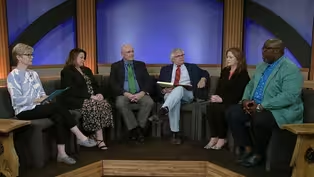
We've got an esteemed group of former state senators to share some opinions on these issues.
DFL is up first, Jeff Hayden, former senate leader, that's a label you can also attach to Susan Kent.
Republicans with us tonight, former Senate Majority Leader, no Senate Leader.
Yeah.
Michelle Benson.
And we round out with the group with the Fritz Knaak, former State Senator.
Special session needed, Senator Benson?
- I think the SRO might rise to the level of needing some fixes.
I'm not a fan of governors or attorney generals writing letters to say, "No, this is what we really meant."
They don't hold up in court very well.
Let's see how these first days of school go.
And if the school boards and teachers really get concerned about what's happening in their schools, then I think they're gonna have to do something.
- Senator Hayden?
- Yeah, I don't think so.
I think that we can just kind of clarify, I mean, you know, Attorney General is on today and they said that the law is clear that SROs can be in the schools and that this is the way that they should conduct themselves, which is no different than any other officer.
So I think that it is actually okay.
I think that there may be some political issues going on behind the scenes, potentially from the police union.
- [Eric] Who's stirring this up?
- Well right now it's actually coming out of the police and there's no surprise that Republicans would take advantage of that as a political issue.
But what I'm seeing, I mean I've been involved as a city attorney for over four decades and I've never seen a hot mess like this quite.
Yeah, it's really nasty and you had people showing up, for example, at a Republican event and they were school officials, police captains and the like, that generally don't like to associate themselves for professional reasons with anything political, much less a political party.
And to me that was an indication of the gravity of the thing.
It's really, really, really a tough situation.
- Well I think it's interesting that Fritz thinks that he hasn't seen many hot messes and- (Fritz and Susan laughing) - I've seen a few.
- I would think so.
- Yeah.
- You know, I really do think partly is thinking about how it would work if they were to try to do it as a special session.
We're already in September, you know, there's gonna be a lot of conversation that takes place to figure this out.
And so if they were gonna do a special session, given that we know that there's a big drumbeat to address the cannabis bill and a bunch of other things.
I, how they could focus this and do it effectively with a good agreement.
I just don't practically see that happening.
So the work, have the conversations, bring the people to the table, make sure everybody feels comfortable with it, and that it's not just some political thing, but, you know, really be prepared to get at it in February.
- [Eric] Yeah.
- This is the second kind of big law that people have got questions about though, you know, of course the marijuana law is the first one.
Did the legislature maybe act too fast when it came to crafting this bill?
- You know, we were over there, they moved at pretty good speed and I think all of us would say that and they would say that.
There was a lot of pent up demand and a lot of new people that wanted to put new things on the table.
As it relates to the cannabis, there's kind of two things.
One, they still have a chance next year as they put together this cannabis working group and the group that's gonna manage this to like kind of change a few things that they think that there is an issue.
I don't think that there is a rush to do that.
The second thing, and I said this to Fritz, maybe the last time we were here, like republicans really didn't participate in it because a lot of them didn't want it at all.
And then when it became law they said, "Oh, here's all the things that we could have done."
So I just think there's a little bit of like, you know, like politics, imagine that, involved in the conversation about cannabis.
- Well Cathy, I think there was a good question though.
I mean I think that, you know, there's a lot of politics in all of this.
I would agree.
But we're former members of the Senate and we all know that there's committees that are specialized to deal with issues and they have to be specialized 'cause the issues are very important.
And the particular issue with respect to SROs really only came up, at least what you saw publicly, really only came up once.
One Republican, you know, and was largely probably being ignored for the rest of that committee meeting anyway, made the point, "Hey, maybe this is a problem."
And it came up in the education committee.
It's the sort of thing that should have probably been in front of another committee and, you know, you ask about whether it's a rush.
Those are the kinds of mistakes and I would argue that this was a mistake that tend to get fixed when there is, when it goes to different committees that should be dealing with the issues.
- A stop in the judiciary committee.
- Right.
- The police watch that committee, they would've said, "Here's how this impacts our ability to be SROs."
One more stop and one more committee.
- [Fritz] Yeah, that's exactly right.
- Would've gotten the language right.
Would've said publicly, this is what we mean, you're misreading it.
Or the comfort language that everybody now says was there, would've been called out and the legislative intent would've been absolutely clear.
- But having served on the education committee for a lot of years, we've done SRO legislation just like this, in different ways, with different aspects to it, going back to 2017, 2018 for sure.
But this is where it happens.
And there are so many stakeholder groups in the education committee that, you know, I'm, there was plenty of opportunity for law enforcement to be aware of what's going on.
- But when we talked about restraints in health committees, and Jeff, you'll remember there was a lot of discussion.
There were multiple committee stops, there were working groups.
Before you make decisions this big, you really need to make sure everybody's involved.
And those were hard decisions about people who were mentally ill and dangerous and how were they gonna be treated and what staff training was gonna be supported.
It was more than a year of conversation.
- Yeah, but I mean, you know, this is why I think that's political.
I mean, the idea that we're just trying to tell officers that like if a kid is mouthy, you don't put him in a choke hold.
However, if he is displaying somewhere, where he is gonna do harm to himself or to someone else that you can, that's how we operate in society today.
So I think that there may be- - And again, - Yeah.
- The education committee does this.
This is not new- - But how long did they talk about it before they made this change?
So the fact that the police were surprised means it wasn't vetted.
If they're impacted- - Well.
- But Michelle, we both have been in the minority, right?
And our job in the minority, we've both been in this and we've all have.
Fritz, you're always in the minority.
But anyways, (laughing) your job was actually to kind of point that out, was to kind of say, listen, you're going too fast.
This is an issue.
I'm gonna bring an amendment.
I'm gonna use my pulpit, I'm gonna use my platform, I'm gonna have a press conference.
And they didn't do any of it.
And then they waited till after session to call the special session.
- Oh now, come on.
Now you're blaming the Republicans for it.
- I'm just suggesting that, listen, when I was in the minority and you've gaveled me down a time or two.
- I did not.
- You did too.
(laughing) When I went too far, right?
And objecting to something.
I mean, you know, and she was probably right to gavel me down.
But my point is that's her job.
Well but Cathy raised a process issue and I think that that's one we can all agree was overlooked.
Here, when you're in a hurry, you tend to probably ignore some of the steps that need to be taken.
And that clearly happened here.
And despite what the Attorney General said, there was no clarification.
I read the thing and I needed to, there was no clarification in that order.
The key was what he said at the end, which is he said, "They got all these parties together, they all met, and oh, by the way, this opinion doesn't apply to anything that they raised."
- [Eric] Right.
- You know, that's a "whoa," you know, that's a key thing.
- But bigger- - Excuse me, speaking of politics for just a moment here.
So the Supreme Court appointments that were made by Governor Walz, they're being kind of poo-pooed by the GOP as being too political.
Why is that?
- I think the Chief Justice was absolutely qualified, and I congratulate her and Lori Gilday stood next to her.
Respectfully, I think that someone should have more experience than Governor Walz's other appointment.
If you look at Paul Tison, well respected, well-known longtime lawyer, I think we need a little more experience than being general counsel for the governor, I think.
- And after Barry Anderson retires in October.
- [Fritz] Right.
- There's gonna be, there'll be another appointment.
There'll be seven Democrats and no Republicans.
And I wonder Lawyer Knaak, if the Republican Convention next year is going to move to endorse a Supreme Court candidate to run against, it would be the Associate Justice.
- Well that's my concern, frankly, is when you appoint somebody as political as this person and that's old school, you know, that's back dating back for decades.
That's the way people used to get appointed.
You appoint somebody like that, that's purely political and you're dealing with a court that now is making major issues.
I mean, we have abortion in Minnesota largely because of decisions of that court.
All of a sudden that becomes political.
And I, by appointing it in this context right now, I think we're gonna end up with a endorsement, frankly.
- It'll be a challenge.
- Yeah, it'll be a challenge.
- I think it's just unfair to say it's purely political, you know, I mean it is very dismissive of, I mean we can talk about whether a candidate has decent qualifications or not.
The governor made his judgment and I'm sure he wouldn't have made a purely political - and I still remember - if he didn't think that - Mr. Procaccini - Timothy Lueck - wasn't capable.
- Made an appointment that was very similar and I forgot the judge's name and he went on the Supreme Court and then went on to the federal judgeship and it was kind of very similar there, where there was some issues about his experience.
So governors, you know, kind of do this all the time.
And Fritz, with all due respect, this is a product of winning elections and Democrats have been winning elections.
- You won't, it's absolutely true.
It's a product of winning elections.
I am concerned that a Republican endorsement of a judge is not going to help a judge win in this.
- You brought this behind the scenes tonight.
A real excellent panel.
(all laughing) Really good stuff.
Thanks.
(upbeat music) - Minnesota history time once again.
Been a few weeks since we first asked our current question, so let's refresh our memories.
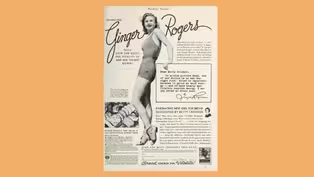
We asked you about a famous vaudeville performer, who successfully transitioned to the silver screen and in 1934 was featured in an ad for a well-known Minnesota brand.
But that wasn't quite enough information the first time around and 'cause nobody had the right answer.
So we had to ask the question again and the producer did add some hints, including pointing out that the actress in question was part of a famous dancing duo and that the ad was for a Betty Crocker product.
The additional info still wasn't enough for these two.
- [Caller 1] This is Mindy and Aaron from St. Paul.
And we would like to answer the Index File question.
We were recently in Grand Rapids, Minnesota.
We were at the Judy Garland Museum and we think the answer is Judy Garland for Betty Crocker.
Her name was Francis Gum at the time.
Thanks, bye.
- Yeah, Judy Garland, not the actress we saw.
Now usually we play a variety of wrong answers, but all of the rest of you got it right.
Here's one of the producer's favorite answers from one of our regular callers.
- [Caller 2] Alright, you made it way too easy.
I feel like I'm cheating.
The answer would be Ginger Rogers and the product she was advertising for was Betty Crocker, probably Bread.
Oh, I just feel cheap.
This is Jeff from Excelsior.
Love the show.
- Yeah, too easy Jeff.
The famous actress we saw was Ginger Rogers.
Here's the ad for Betty Crocker with Rogers proclaiming that bread helps her keep her weight down and her vitality up.
You could even send away for a free cookbook at the bottom of the ad and leads us to remember the days when you had to wait more than a day or two for your packages to arrive by way of snail mail.
Have just enough time left for some show ending music and I have a treat for you.
This week, back in 2015, we did the show from the NPR booth at the State Fair.
Charlie Parr joined us for a couple of tunes.
Take a listen.
We'll see you next week and be careful.
(upbeat guitar music) ♪ Dear, dear, how could it be ♪ You say a lot will go round it ♪ ♪ But you never will love me ♪ Gonna be one more round gone ♪ Dear, dear, she said, I'm all alone ♪ ♪ One of your round is gonna pay my way back home ♪ ♪ Gonna be one more round gone (upbeat guitar music) ♪ He was a gambler and she rambled all around ♪ ♪ She one girl never let that deal go down ♪ ♪ Gonna be one more round gone ♪ I climbed the water house top ♪ ♪ I got as high as I could be ♪ You say you're living more rounder ♪ ♪ But you'll never love me ♪ Gonna be one more round gone (upbeat guitar music) ♪ Can you look in high ♪ Can you look in low ♪ He shot poor Dilya down - [Announcer] "Almanac" is made possible by members of this Public Television Station.
Support is also provided by Great River Energy, providing wholesale power to 27 Minnesota electric cooperatives.
Delta Dental of Minnesota Foundation.
Improving oral health while advancing social equities.
Delta Dental mn.org/tpt, and Education Minnesota, the voice for professional educators and students throughout the state.
More at educationminnesota.org.
One Greater Minnesota reporting on "Almanac" is made possible in part by the Otto Bremer Trust, whose mission is investing in people, places, and opportunities in our region.
"Almanac" is a production of Twin Cities PBS for the stations of Minnesota Public Television Association.
♪ Hold on
Video has Closed Captions
Clip: S2024 Ep1 | 5m 5s | Keith Ellison discusses charges in a $9.5M Medicaid fraud case. (5m 5s)
Video has Closed Captions
Clip: S2024 Ep1 | 6m 16s | Mike Osterholm on new variants, boosters and a rise in COVID cases. (6m 16s)
Video has Closed Captions
Clip: S2024 Ep1 | 4m 48s | Kenny Blumenfeld assesses the deepening drought across Minnesota. (4m 48s)
A Famous Starlet and a Folksy State Fair Performance
Video has Closed Captions
Clip: S2024 Ep1 | 3m 11s | answer index file question & Charlie Parr (3m 11s)
Video has Closed Captions
Clip: S2024 Ep1 | 10m 27s | Former Lawmakers talk special session (10m 27s)
Video has Closed Captions
Clip: S2024 Ep1 | 5m 9s | Star Tribune’s Rachel Blount tells the history behind a historic new league. (5m 9s)
Video has Closed Captions
Clip: S2024 Ep1 | 5m 6s | Mary Lahammer talks with legislators about the debate over restraint use on students. (5m 6s)

Video has Closed Captions
Clip: S2024 Ep1 | 4m 33s | Kaomi Lee talks with dancers performing at a new cultural celebration. (4m 33s)
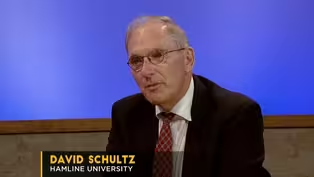
Trump Indictments and SCOTUS gifts
Video has Closed Captions
Clip: S2024 Ep1 | 5m 56s | David Schultz unpacks the ramifications of this week’s national political news. (5m 56s)
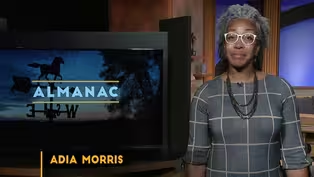
Weekly Essay | Adia Morris | Rearranging
Video has Closed Captions
Clip: S2024 Ep1 | 1m 44s | Adia gives us a life hack for redecorating. (1m 44s)
Providing Support for PBS.org
Learn Moreabout PBS online sponsorship
- News and Public Affairs

Top journalists deliver compelling original analysis of the hour's headlines.

- News and Public Affairs

FRONTLINE is investigative journalism that questions, explains and changes our world.












Support for PBS provided by:
Almanac is a local public television program presented by TPT