
School Safety
2/25/2022 | 27m 29sVideo has Closed Captions
Henderson County schools unveil plan to increase safety across their schools.
Schools are grappling with the topic of school safety from a number of different angles, including increasing school mental health personnel and services, increasing security measures at schools, and decreasing incidents of bullying. ncIMPACT highlights the Henderson County School District and their unique approach of building a plan by strengthening relationships between students and staff.
Problems playing video? | Closed Captioning Feedback
Problems playing video? | Closed Captioning Feedback
ncIMPACT is a local public television program presented by PBS NC
School Safety
2/25/2022 | 27m 29sVideo has Closed Captions
Schools are grappling with the topic of school safety from a number of different angles, including increasing school mental health personnel and services, increasing security measures at schools, and decreasing incidents of bullying. ncIMPACT highlights the Henderson County School District and their unique approach of building a plan by strengthening relationships between students and staff.
Problems playing video? | Closed Captioning Feedback
How to Watch ncIMPACT
ncIMPACT is available to stream on pbs.org and the free PBS App, available on iPhone, Apple TV, Android TV, Android smartphones, Amazon Fire TV, Amazon Fire Tablet, Roku, Samsung Smart TV, and Vizio.
Providing Support for PBS.org
Learn Moreabout PBS online sponsorship- [Anita] Coming up on NCImpact.
Incidents of bullying and violence in schools are on the rise.
How some school districts are taking new approaches and building new relationships.
- [Announcer] NC Impact is a PBS North Carolina production in association with the University of North Carolina School of Government.
Funding for NC Impact is made possible by-- - [Announcer] Changing the course of people's lives, that's the impact UNC Health and the UNC School of Medicine work to deliver every day.
Our 40,000 team members across the state of North Carolina are committed to caring for you, our patients and communities, as well as educating the next generation of health care professionals.
Individually, we can do a little, but collectively, we can do a lot to create impact.
- Hello and welcome to NC Impact.
I'm Anita Brown-Graham.
With school shootings and bullying on the rise, school safety is front-of-mind for many parents across our state.
Two years ago, a survey from the Center for Disease Control revealed a stunning nearly half of US high school students had one or more violent experiences in the previous year.
Those experiences could include bullying, fighting, or being threatened with a weapon at school.
NCImpact's David Hurst joins us in-studio with more on this issue.
David, you talked to a family who is homeschooling their children because of these safety concerns.
What did you learn?
- You know, Anita, every time there's a school shooting, the issue of school safety is thrust into the national spotlight and aside from shootings, when you include bomb threats, lockdowns, bullying, it's care there is a growing urgency to create safe school environments.
It's leading some parents to even bring the classroom into their own home.
- It gives you a timeline.
- [David] 11 years ago when Stephanie Baker's oldest son Levi was starting kindergarten, she decided to homeschool instead of driving 45 minutes to the closest school.
- It wasn't something we had set out to do.
It just kinda happened.
- That's good.
- Yes, vomic, yes.
- [David] Since then, the Fuquay-Varina mother has homeschooled all three of her children.
But two years ago, Baker sent her youngest daughter to public school for a year and a half to get some tutoring help for a learning disability.
Baker says the stories her fourth grade daughter shared of some of the playground interactions were surprising.
- It's just a lot of...
I don't really wanna call them bullies because I feel like had they been raised differently, they might not necessarily be a bully, but there's just a lot of things that go on in the homes that are brought to the schools that affects the classroom and especially playground time when the teachers are not quite as attentive.
- [David] Stephanie Baker's daughter returned to homeschool after COVID-19 shut down schools in 2020.
She says it's doubtful she'll send her daughter back to school in the future because of the bullying coupled with the prevalence of school shootings.
- Every time you see it on the news, even when my children are home, my heart goes out to the staff and the students and the parents for these schools and it is very scary to send your child to school not knowing if there's gonna be any type of bomb threats or shootings or anything like that and you can't protect them because you're not there.
So come here.
- [David] Baker says she understands many parents don't have the time or money to homeschool, but she considers her family lucky to have the flexibility.
And while Baker believes many schools districts do a good job of making school safety a priority, she thinks more work needs to be done before she would feel comfortable sending any of her children back to school.
- So having them home, I feel like I can protect them from things like that more so than if I was to send them to school.
- COVID-19 safety protocols in schools have also played a significant role in parents choosing whether or not to send their students to school.
Census data shows the number of homeschool families nearly doubled in North Carolina during the pandemic.
- David, thank you.
Joining me now is North Carolina representative Ashton Wheeler Clemmon.
Ashton, before we start talking policy, as a parent and educator, what concerns you most about school safety.
- Well, of course...
Thank you for having me, first, Anita.
Of course, when we see these crisis moments of school shootings, it eats at all of our hearts, but actually, what concerns me the most is the day-to-day interactions, stress, anxiety, children and their families being on the verge every single day, those interactions lead to these crisis moments so I think what concerns me, even, of course, the immediate issues but I'm most concerned with what is leading to those crisis issues and how are we building a system that prevents kids from ever getting to that place to begin with.
- So let's talk about it for a moment.
What are some of the unique challenges currently students face that maybe past generations did not?
- Well, I think for sure in this COVID environment, our children are dealing with things that they've never dealt with before.
I have three kids in elementary school myself and it's a constant sense of loss of things that they're planning.
Birthday parties.
My daughter had to miss her first ballet solo because of a COVID outbreak in her classroom, and those things are happening repetitively for all of our children there's a constant sense of loss and an unpredictability that many children have not had to deal with before.
Then many of children in our schools live with a constant predictability so I think that there's an increase in that and I would say that the impact off social media is significant on our children, their ability to interact with each other, both positively and negatively, without the same level of accountability that might happen directly face-to-face or with your neighbor.
Social media has given that there's no off switch for children to take a break when they're having issues so I think those are two, they're not the only, but two unique issues for children growing up right now.
- Yeah, very helpful.
So let's talk about what the broader impacts of this might be.
How are students learning achievement levels shaken when they feel like they're not in a safe learning environment?
- Yeah, so we know, all educators know, that for children or adults to be able to grow and learn, they first have to feel safe and if they don't feel safe, their brains are literally not able to take in new information in the same way and so, we see the impact of achievement already from the COVID environment but it's hard for us to know because our kids are living in these environments every single day exactly the impact of feeling unsafe but any educator or parent knows, if your child is stressed for feeling worried, you can't have a productive conversation with them in the same way and that's what's happening every day for our kids across our state.
- Impacts we'll be seeing and measuring for some time to come.
Communities across the state are responding to school safety concerns by building coalitions of stakeholders.
NCImpact's Evan Howell visited Henderson County where schools and law enforcement created their own unique collaboration.
They included students and their families.
- [Officer Dinnall] So, a Chik-fil-A sandwich with a medium fry and a drink.
- [Evan] Officer Joreeca Dinnall's father was deported back to Jamaica when she was 10, leaving her to grow up with only her mother.
She's been working since she was 14 and now says she gives back by keeping her students safe.
- [Officer Dinnall] Most of our kids are not going home to a safe environment.
When they come to the school, they know that it's safe because they have a school resource officer and we have good staff here as well.
It's only like 20 minutes away.
- [Evan] Officer Dinnall was awarded School Resource Officer of the Year for her recent work assisting a student in a mental health crisis.
She says her past helped her build those important personal relationships.
- [Officer Dinnall] We're still facing those same challenges today.
Homeless youth and kids losing their fathers, growing up in single-parent households, so it's a challenge, but I can relate to what they're going through now because I went through it as well.
[pop music plays] - [Evan] In 2018, Henderson County public schools partnered with county law enforcement to develop a set of protocols to enhance school safety.
This set the stage in 2021 for the Handle With Care program.
An initiative that stresses personal relationships between students and staff.
- [Major Stout] We're the safety, we're the security but we're also the big brother, the big sister, the mentor, sometimes we even take on the role as father or mother for those who may not have that person in their life.
- [Teacher] So the main idea to remember is what the whole story is about... - [Teacher] But social gaps in support for some students are still a driving concern for school officials.
They says several children were hospitalized in 2021 for mental health issues.
- [Matt] And so what would get me on the edge of my seat is to have a school counselor or school social work call me and say that this student is back in her office and she's back in crisis and that we're looking at another hospitalization or intervention.
Those kinds of things are happening with more frequency right now and the student mental health is at a great acuity than I've seen it.
- [Woman] Picking up a student.
- [Woman On Intercom] Provide a name so we can see your ID.
- [Evan] The comprehensive 23 school plan covers not just the students but the buildings themselves.
Nearly all schools by now are being retrofitted to include city vestibules at the entrances, required security badges, and specially designed window film to prevent passersby to see inside.
- [Scott] The hardest part of my job is that I can never tell somebody that I can guarantee that nothing will happen.
That's always the concern.
But the best that we can do to mitigate those concerns is what gives people a sense of safety.
- [Teacher] Let's highlight it.
- [Evan] School officials say it's the inter-agency cooperation that makes any school plan like this work, but say if it isn't based on building relationships with students and families as well, it won't be successful.
- We're talking about human relationships and the ability to know what's going on with an individual student to be responsive to what that is, to have practices in place and training in place that allows adults to be responsive to what those needs are is really our focus.
- [Student] I have a pageant on Saturday.
- [Evan] Officer Dinnall says she's proud Henderson County is one of the pioneers in tackling school safety in a new way.
She says even when she first started as a school resource officer, she knew her job wouldn't match the description.
- [Officer Dinnall] And I knew that the kids needed a good role model in the school system.
With everything going on in the world today, they need someone they can trust.
- [Evan] Officer Dinnall says she's hopeful other communities will take cues from her district.
And that becoming a member of the school family is just part of the job.
For NCImpact, I'm Evan Howell.
- Joining me now is Billy Lassiter, Deputy Secretary for Juvenile Justice with the North Carolina Department of Public Safety.
Billy, we saw in that story a strong relationship between schools and law enforcement.
Tell us why a partnership like that is particularly effective in promoting school safety.
- Well, what we've been doing over the last couple years is doing something called School Justice Partnerships and that's where brought the schools, the community, law enforcement, the courts all together and having these conversations about how do we have discipline in our schools, how do we make sure our schools are safe, but also make sure that we're not kicking kids out of schools that really need to be there.
For a lot of young people, schools are the one protective factor that they have in their lives and we need to make sure that those kids are allowed to be there and they're getting the services that they need and so having a partnership of all those community resources is extremely important.
Mental health, law enforcement and the courts being all involves in our schools to make sure our kids get the services that they need.
- So, Billy, the issue of school resource officers is not without controversy.
What do you think makes the difference between what works and what doesn't?
- Well, it comes down to relationship and it comes down to people and it comes down to training.
Those are the three components that are absolutely necessary.
You've gotta have the right person that wants to be a school research officer, they're interested in how kids are doing, you've gotta have the right training for that school resource officer.
Going into a school environment is very different than working the beat on the street for a law enforcement officer and having those good relationships, an officer that builds those relationships but also the school system having an understanding between those law enforcement agencies and the school districts are really important because it lays out the ground work that that officer will operate in that school.
You can't just send an officer into a school and expect them to know exactly how schools work.
You've gotta train them and have those ground rules in place.
- You also serve as chair for the North Carolina Task Force for Safer Schools, what have been some of the key findings for your task force?
- We've found a lot of things but one of the biggest things that we found is that key between having a good community support for our schools is extremely important.
This has to be a whole community effort, to create safer schools.
What we've learned is that if you have a drug problem or gun problem in your community, most likely that is going to spill over into your schools and so we can't just say that schools end at those borderlines of the school property.
We've got to go out into the community and work with those community partners to make sure that we have the support from them to make sure that those messages are getting home with the kids.
That's one big lesson.
The other big lesson that we've seen is that we need to clear up the data to really know what the picture looks like as far as school safety.
It's unclear across the state exactly are schools measuring things the same way and I always say it's impossible to fix a problem if you don't understand a problem.
And so we need to collect good data on exactly what is going on across the state of North Carolina and that's one of the goals of the task force right now is to make sure that we have a consistent reporting process across the state to get that data so that we know what types of programs and services are needed from a state level and a local level to make a decision about creating safer schools.
- That sounds really important.
Thank you very much.
Gates County is one of three rural counties in North Carolina partnering with RTI International to improve school safety.
NCImpact's Melody Hunter-Pillion visited Gates County and she introduces us to the All Hands On Deck program.
Melody joins us in the studio.
- Anita, the program is working to address a growing need for safer schools across our state.
A recent survey reveals that 10% of North Carolina high school students said they did not go to school on at least one occasion because they felt unsafe at school.
All Hands on Deck is comprehensive professional learning program working to change that statistic.
- [Teacher] Everybody have a finger on when?
- [Student] Yes!
- [Teacher] When he reached his house.
- [Melody] After reaching for nearly a decade, third-grade teacher Ken Moors has learned to spot warning signs with his students.
- [Ken] I mean, you're with the kids a lot so you try and watch closely and see if there's changes.
We were just talking about one of the children today in the lunch room that has changed a lot and discussing, anybody know what's going on at home?
Could there be this, is somebody picking on the kid, that type of stuff.
You're constantly watching and picking up on the signals.
- [Ken] Happy ending or sad ending?
- [Melody] He says he's noticed the increase of bullying and its impact on school safety.
- In terms of the percentage of what we do, it's a tiny percentage, but it's important.
You're talking about, you know, important things.
People's safety and lives.
- [Melody] It's one of the reasons why Gates County chose to partner with RTI International on the All Hands on Deck Program.
They're one of three world school districts in North Carolina, participating in the program in an effort to improve school safety.
- When school safety started becoming a concern and issue several, several years ago, it was an opportunity for us to build and create a better system here within our schools.
- [Melody] The program focuses on social and emotional learning practices that work to prevent potential safety issues and behavioral problems in schools.
- School safety, not only in Gates County, everywhere is extremely important right now, and I think that it all starts with students' mental health and we need to make sure that we're doing everything we can for our students' mental issues that they may have and social-emotional learning.
- [Woman] During their minute, we're just going to sit in silence.
- [Melody] The program includes social and emotional learning training sessions for teachers and staff.
The goal is to improve student behavior through stronger adult-student relationships,, de-escalation strategies and anti-bullying training.
- When parents trust the school district, when they trust the teachers, when students trust teachers, there's a lot that can happen and that's where we wanna go with social-emotional learning because students trust that we want them to be successful, they trust that we're gonna create social connection for them that are meaningful and they're gonna be able to deal with the emotions that come up because we've taught them how to do that.
- [Melody] Teachers like Ken Moors believe that trust extends to the community as well.
He says having everyone invested will lead to a safer learning environment for students to thrive.
- [Ken] Because if you're not sure about something, there's always someone to ask.
As long as you're paying attention, you know who to go to.
You know, we've got a great counselor here and if she can't handle something, she's from the county, she knows everybody, so she can often straighten stuff out just by talking to some folks.
- The program is made possible by a US Department of Justice grant through their Stop School Violence program.
Duplin and Stanly counties are the other two rural North Carolina counties taking part in the program.
Over three years, the All Hands on Deck Program is expected to reach about 6,000 rural students and 600 educators in North Carolina.
- Thank you, Melody.
All hands on deck.
- All hands.
- Let's bring back our wonderful guests for more conversation around school safety and also joining us for our NCImpact round table is Monika Johnson-Hostler, from the Wade County Board of Education.
Monica, I'd like to start with you.
Educators are so very focused on social and emotional learning these days.
What is the connection to school safety?
- Thank you for having me.
The thing that I would say is, as you heard on the last segment, social and emotional safety and wellbeing is really about creating the environment where students feel both emotional and physical safe and security and confident that they can trust the adults in the space with them.
If our brains and our bodies are aligned in safety and feeling confident and trusting their environment, then they are open to learn and that's what our educational environments are for and we can't move student achievement without ensuring our students feel physically and emotionally safe.
- So if it's that important, Ashton, what else can be done to help support the mental wellbeing of our students?
- I believe at the state level, which is where I am now, we have to really prioritize the social and emotional wellbeing of kids as critical to achievement, not in addition to achievement.
That the relationship is we have to support one if we want to see growth in the other, just like Monika said, and so at the state level, that looks like investing in resources to support them that will help the wellbeing of students, kindergarten through 12th grade and even in our pre-K programs.
That can look like mental health counselors in our schools, it can look like social workers not having to split five schools, which is what happens at my own child's school.
The social worker is there one day a week.
It can look like specific programs that we know have success, some of which we've talked about here on this program.
How do we magnify those across the state and increase the amount of districts that are able to access resources like those so I think that we have taken some steps at the state level to really look at crisis moments and how do we make buildings safe, but we have a lot of work yet to do on how do we create safe environments that will protect at an even greater rate than any door key that we can put in.
- Billy, let me turn to you to pick up on this.
The work of the North Carolina Safer Schools Task Force led to the creation of a five-year state action plan for school safety.
Share with us, what are some of the main points of that plan?
- Well, some of them are exactly what Ashton was just talking about as far as making sure that we have additional school social workers, additional school counselors, additional school nurses, those basic resources that need to be on school campuses to make sure that our school staff have the resources to send kids to when they're acting out in the classroom.
Teachers can't have 30 kids in front of them and deal with a mental health crisis of a child at the same time.
We need to make sure that those schools have the resources in place that they can refer those kids to, so that's one of the things that it's found.
Another big thing that the task force is working on in the five-year plan is to make sure that we have mental health training for all our teachers.
We're trying to do mental health first aid training for our teachers so they can recognize the early warning sign of a kid who may be in a mental health crisis so they can make that proper referral and we can be preventative and make sure that these things don't turn into criseses down the road.
- So, Monika you've heard where we can go at the state level, what we can do at the local level.
What do you see as the biggest challenges for creating safer schools?
- Lack of adults in the building, as you heard both Billy and Ashton mention.
What they're doing at the state level directly impacts our ability to create the safe space for our students at the local level.
If we don't have more adults in the building to be able to meet the needs of our students, identify the crisis and actually respond to the crisis, which certainly does not mean one social worker per five schools.
That is critical to implementing a safe space for our students.
The other thing is it creates a safe space for the adults in the building.
Currently, we forget to talk about our educators and our administrators and everyone in the building and what this means for their social and emotional wellbeing and when we give people the best that we have in terms of time to plan, time to take care of themselves, and time to ensure that they are meeting the needs of their students 'cause that's what every adult in that building wants to do then we create the environment where everyone is at their best and we have to acknowledge that that requires more adults so that adults are taken care of so they can take care of our young people.
- This is a heavy topic and one that could leave you feeling a little deflated, what have you seen recently that gives you hope that we will get beyond this moment?
- Well, as I said, I have three elementary school children and you know, for me, there's actually hope in that every single day they are going to a school where there are teachers who love them.
Every day, I drop our kids off, I am humbled by the educators who, this morning were out there in the freezing cold opening the doors saying, "Good morning, good to see you!"
And so, what gives me hope is in all of the crisis that we have faced, teachers are showing up for their kids, principals in Guildford County miraculously reworked bus routes over the weekend and so, my own training as a teacher and administrator and as a mom shows me that educators will rise to meet the needs of our children and it is on us to give them what they need to do so.
- Thank you.
Billy, you have to have hope.
You're running this task force, but what is that you see around you that really fuels your enthusiasm?
- I think there's a couple things.
I think sometimes we see the major incidents that occur across schools and think that schools are just unsafe.
The reality is that for a lot of our kids, school is the safest place that they actually do go.
Our schools are doing an excellent job of engaging kids that are at risk, kids that used to be getting kicked out into the street, schools are doing an excellent job of keeping those kids in school and getting them the knowledge that they need to be successful.
We're seeing our graduate rates increase and those things across the state of North Carolina are really exciting.
The other thing that I would say is on our task force, we see a strong bipartisan support for the idea that we do need to create safer schools across the state of North Carolina and that it's gonna take resources, but it's not just about resources.
It is about human capital and making sure that those humans are supporting our schools to be safe and I see a lot of support across the state as we've gone out and had listening sessions in all communities in the state of North Carolina.
We've seen a lot of support for creating safer schools and I think that that's leaning towards good solutions.
- Monika, you get to have the last word.
What gives you hope?
- It's the little people.
I mean, going into a school building and still seeing the smiles despite the grief and loss that they're experiencing and more importantly, they get in those buildings and people love on them and people love that environment and just to see those smiles are a reminder that while we understand the gravity of what's happening around us, they are just present in their bodies and that is our role to ensure that they continue to be present, continue to smile and push through it and we give them the tools when they can't push through it.
So it's their smiling little faces that remind me why I get up and do this every day.
- Monika, Billy, Ashton, thank you all for joining us and for sharing your work on this important topic and for doing the work on this important topic and thank you for watching and engaging.
Solutions are out there if we work together.
Tell us what your community is doing and how we can help you.
You may email us at ncimpact@unc.edu or message us on Twitter or Facebook, and be sure to join us every Friday night at 7:30 on PBC North Carolina for new episodes of NCImpact.
Coming up on NCImpact.
Expecting mothers rely on the health care system to guide them in pregnancy, but some women say they don't receive adequate care.
[upbeat music] - [Announcer] NCImpact is a PBC North Carolina production in association with the University of North Carolina School of Government.
Funding for NCImpact is made possible by-- - [Announcer] Changing the course of people's lives.
That's the impact UNC Health and the UNC School of Medicine work to deliver every day.
Our 40,000 team members across the state of North Carolina are committed to caring for you, our patients and communities, as well as educating the next generation of health care professionals.
Individually, we can do a little, but collectively, we can do a lot to create impact.
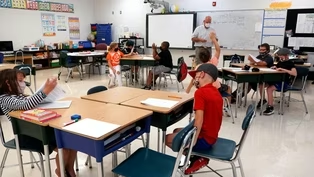
‘All Hands on Deck’ program works to address school safety
Video has Closed Captions
Rural communities improve school safety through social and emotional learning. (2m 49s)
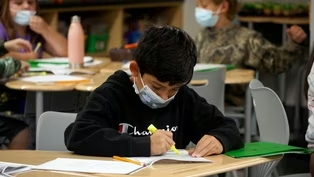
Henderson County implements school safety plan
Video has Closed Captions
Henderson County schools unveil plan to increase safety across their schools. (3m 35s)
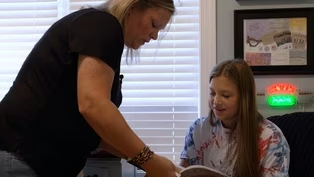
Many NC parents have concerns with school safety
Video has Closed Captions
Parents raise questions about school safety after an increase of bullying and violence. (1m 56s)
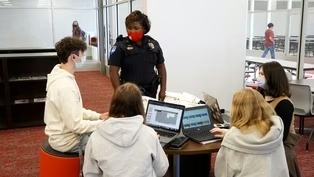
Pressure mounts to improve school safety after the rise of school shootings. (20s)
Providing Support for PBS.org
Learn Moreabout PBS online sponsorship
- News and Public Affairs

Top journalists deliver compelling original analysis of the hour's headlines.

- News and Public Affairs

FRONTLINE is investigative journalism that questions, explains and changes our world.












Support for PBS provided by:
ncIMPACT is a local public television program presented by PBS NC