
School Shooting, Gun Control, Crime in Illinois
5/27/2022 | 26m 46sVideo has Closed Captions
School Shooting, Gun Control, Crime in Illinois
The school shooting in Uvalde, Texas this week increased calls for gun control at the state and federal level, and candidates for Illinois governor are focusing in on their plans to bring down crime rates in Chicago and elsewhere. In addition, we explore how down-ballot races are shaping up in the shadow of a contentious race at the top, and a look at new information from the U.S. Census bureau.
Problems playing video? | Closed Captioning Feedback
Problems playing video? | Closed Captioning Feedback
CapitolView is a local public television program presented by WSIU
CapitolView is a production of WSIU Public Broadcasting.
School Shooting, Gun Control, Crime in Illinois
5/27/2022 | 26m 46sVideo has Closed Captions
The school shooting in Uvalde, Texas this week increased calls for gun control at the state and federal level, and candidates for Illinois governor are focusing in on their plans to bring down crime rates in Chicago and elsewhere. In addition, we explore how down-ballot races are shaping up in the shadow of a contentious race at the top, and a look at new information from the U.S. Census bureau.
Problems playing video? | Closed Captioning Feedback
How to Watch CapitolView
CapitolView is available to stream on pbs.org and the free PBS App, available on iPhone, Apple TV, Android TV, Android smartphones, Amazon Fire TV, Amazon Fire Tablet, Roku, Samsung Smart TV, and Vizio.
CapitolView
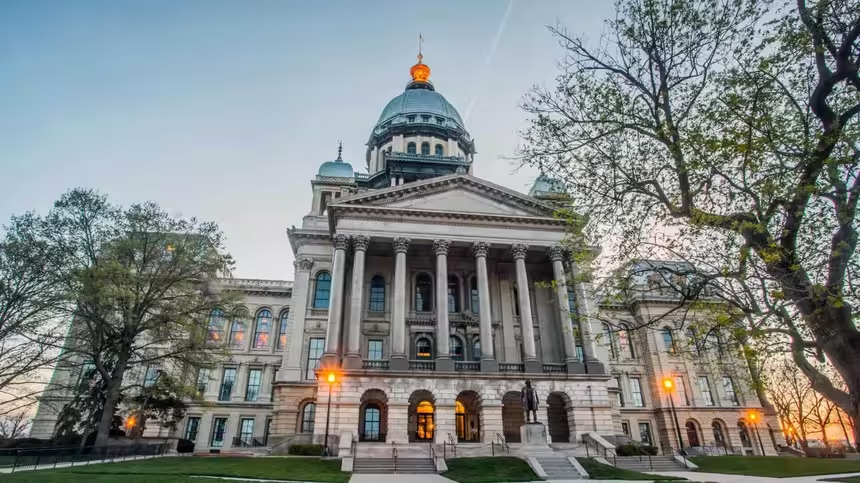
CapitolView is a weekly discussion of politics and government inside the Capitol, and around the state, with the Statehouse press corps. CapitolView is a production of WSIU Public Broadcasting.Providing Support for PBS.org
Learn Moreabout PBS online sponsorship(bright music) (lens beeping) - Welcome to Capitol View, a weekly look at the happenings inside and outside the Illinois State Capitol.
I'm Jennifer Fuller.
Our guests this week are Peter Hancock of Capitol News Illinois and Jason Piscia, the Director of the Public Affairs Reporting program at the University of Illinois, Springfield.
Gentlemen, I appreciate you joining us.
Let's get right to it.
The big news across the nation, really, across the world this week is the massacre in Texas.
Another school shooting and reaction to this on the political line has fallen mainly along partisan lines, as you might expect.
Peter, just judging from what we're hearing in the Illinois congressional delegation, as well as state lawmakers, is there going to be any movement in the near future to change gun legislation, either in the state of Illinois or perhaps at the national level?
- Well, I think the short answer to that is no, certainly not at the national level.
The lines have been drawn.
It doesn't seem to matter how many of these horrific, tragic mass shootings happen around the country.
The people who believe in gun rights say that gun control won't do anything to help.
And the people who want guns more controlled don't have the votes to push it through.
So here in Illinois, we actually do have some pretty strict gun laws.
And in Chicago in particular, they have even more stricter local laws.
And I don't think there are the votes in the general assembly to change any of those.
It was kind of interesting how Chicago got dragged into this.
I think the governor of Texas, Greg Abbott, made some remark about how Chicago has the strictest gun laws in the country, and yet they have all these murders.
And then Governor Pritzker jumped in and said, that's because guns are being taken into Chicago from other states that have lax gun laws.
So really, and this is what is just so frustrating, I think, for everybody is that every single time something like this happens, we get the same arguments and nothing changes.
- Do you think that there's any energizing of the electorate that could change the way that this goes?
Is this the final straw for any people, and it may change the way they vote either in June or in November?
- Oh, you know, I don't know.
I thought Sandy Hook would've done that and I certainly thought that the shooting in Florida at Marjorie Stoneman Douglas High School was going to do that.
The Florida shooting did seem to energize the youth vote across the country.
People 18 to 25 turned out in record numbers, which was encouraging.
It's possible that this one might have the same effect.
It will energize a certain amount of the base, but you know, there can also be a backlash where, you know, if the gun control advocates start making too much noise, that'll cause a backlash for this and the second amendment rights people will get motivated.
So I think it cuts both ways.
- Sure.
Jason, crime has already been a big part of the gubernatorial campaign here in Illinois, with Republicans saying that crime is a problem.
Each one of them having their own remedy for solving some of those crime problems, particularly in the city of Chicago.
Does this change that messaging in your mind?
- Not much, I think the Republicans will still stay with their, you know, talking points of, you know, we're not gonna touch the second amendment.
People have rights to have firearms and we're not gonna do anything to change that, you know.
And I think it all comes down to the national level.
It's, you know, what can we get through the US Senate, which at this point is nothing.
It's a log jam from the get go.
You know, we did hear the Republican candidates for governor speak about crime and you know, this issue as well, mass shootings at their pair of debates earlier this week.
And we'll probably talk more about that later, but, you know, and just what we saw with what those candidates were talking about, really, there's no interest in doing any long, large scale reforms.
There's some minor talk of adjusting, you know, FOID card regulations.
One of the candidates talked about how, you know, we just need to rely on God and fatherhood to help solve this problem.
So, you know, not really much wherewithal to do anything there.
And in terms of crime, you know, Darren Bailey, Republican State Senator from Southern Illinois, you know, sort of had the quote of the night during those debates about calling Chicago sort of a crime infested, you know, corrupt hell hole, which probably can cut both ways for him.
It's really gonna play to his, you know, deep red base in Southern and Central Illinois who already believe Chicago's the worst place in the world anyway.
But I think it could speak to some Chicago residents as well who maybe are tired of that.
Although we did hear a lot of, you know, criticism from, you know, Chicago officials and other Chicago boosters about how that's not fair, you know, we're doing the best we can.
So yeah, I really don't see much of a change in how this is gonna go from a politician standpoint.
- Yeah, you bring up those debates, a pair of debates on one night, two different times, two different stages with the candidates split between those and, you know, one of the other questions that they were asked was, would you call out the National Guard to handle the crime situation in Chicago or potentially in other areas of the state?
Jason, what do you take from the answers to that question?
- You know, there was not, you know, Richard Irvin all along has said, you know, he called out the National Guard when he was mayor of Aurora, you know, during the George Floyd protests a couple years ago.
And there's been fact checks on that, obviously, that mayors can't actually call out the National Guard, that's the governor's job.
But yeah, and you know, there didn't seem to be much agreement on whether, you know, the governors had, they thought Chicago needed it right now.
So yeah, it was just a thought that, you know, the Chicago or the National Guard is needed, but, you know, no one really would commit one way or the other to, you know, having calling them out immediately.
- Peter, when it comes to other issues that were brought up in those two debates.
Do any of the answers, do any of the questions move the needle when it comes to voters in your mind?
Do you see, you know, someone emerging either as the overall front runner or is it still close between Richard Irvin and Darren Bailey?
- Oh, I think it's still close between Irvin and Bailey.
Televised debates like that don't tend to move the needle very far.
They don't get real high ratings for the most part.
And at this point, you know, voting has already started in Illinois.
And I think the people who are going to vote have pretty much made up their mind.
You know, the latest poll we saw showed a significant number of undecided voters.
Those may very well be the people who don't turn out.
There's not a whole lot of error between the two candidates when you listen to them.
They're both tough on crime.
Darren Bailey is outspokenly against abortion rights.
You can't really get much of an answer out of Richard Irvin on that, but within the Republican party, they're going to expect their nominee to be pro-life.
So I think, you know, it's gonna come down to turnout.
I think Darren Bailey is going to be more popular south of I-64.
I think Richard Irvin will be more popular north of I-80.
It's that area in between that has a lot of Republican votes that'll probably decide it.
- You mentioned the undecided in the last several polls and in many cases, it's polling more than 30%.
So more than a third of likely Republican voters still aren't quite sure who they're going to vote for.
How much of a burden is that for whoever the nominee is heading into November?
I'm gonna let both of you answer.
Peter, I'll start with you.
- Well, you know, I think the campaigns have to really be scratching their heads because Richard Irvin and Darren Bailey have both spent a lot of money getting their name and their message out there on television, on radio, through the internet, streaming services, you know, you can't turn around without seeing them somewhere.
And the fact that there's a large number of undecided votes.
I don't know, you know, maybe Paul Schimpf has a pathway to get in there.
It's gonna be very interesting to watch.
- Yeah, and Peter, you mentioned, you know, the great amount of money that's being spent and, you know, on Irvin's side, especially.
The great amount of money comes from the pockets of Ken Griffin, the richest man in Illinois.
So, you know, he's probably also scratching his head about whether, you know, what he can do to sort of break through to that sector of undecided voters.
And it'll just be interesting to see, you know, what tactics they take.
You know, personally, I'd like to see them both on the same debate stage.
I know with the strange way the debates were set up this past week where, you know, NBC5 in Chicago had one, WGN in Chicago also put one together, and WGN put out their invitation first and, you know, Bailey accepted that.
But Irvin didn't, and then Irvin took the NBC5 one.
And then, so we have these two debates and sort of, you know, Irvin wasn't able to defend himself when Bailey called him a mini Mike Madigan, you know, trying to tie him again to that, you know, the thought that Irvin is actually a Democrat in disguise.
So, you know, there is another, I think it's a League of Women's Voter debate coming up next week on Thursday, I believe, June 2nd.
Irvin has accepted, Bailey says he has a date conflict, some sort of a Republican day dinner up in the suburbs.
So I think for the sake of the voters, especially the ones who are, you know, interested in voting early, we can see these two candidates side by side.
Yes, they have appeared side by side in newspaper editorial boards around the state.
But, you know, granted those don't get as much play as a, you know, a wide television audience would.
- It's evidenced here, this issue that the gubernatorial races is taking up most of the time, attention, and money in the races across the state of Illinois, both in the primary and we'll likely see the same thing heading into the general.
I wanted to talk about those down ballot races, still statewide candidates, but a lot of them not getting the attention or perhaps even the traction that they may need to make it through the primary and head into the general.
There is one open seat in this November's general election, that'll be for Illinois Secretary of State.
And both Republicans and Democrats have multiple candidates in that race running.
I don't wanna put a handicap on it, but Peter, how is that race looking?
It appears to me to be one of the more interesting.
- It is, and I think of all of the statewide races, that's the one where Republicans probably have the biggest shot at gaining an office.
You know, right now, every statewide elected office in Illinois is held by Democrats, Democrats hold super majorities in both chambers of the legislature.
But in the Secretary of State's race on the Democratic side, you have Alexi Giannoulias, the former State Treasurer, and Anna Valencia who's the Chicago City Clerk.
Both of them apparently have some significant issues hanging around them.
And most recently, Valencia is being accused of using the City Clerk's office to steer city jobs to her husband lobbyist.
And on the Republican side, the two major candidates are Dan Brady, State Representative from Bloomington, and a former US Attorney, Milhiser.
And both of them seem to be fairly popular and likable people.
Dan Brady's been in the general assembly for quite a while.
I think he's generally respected on both sides of the aisle.
And you know, the former US Attorney obviously has a pretty significant base here.
And so of all of the races, I think that's the one where Republicans might have a shot.
- Jason, do you agree?
- Yeah, like I said, Secretary of State is such a high profile office.
If you pull out your driver's license right now, the Secretary of State's name is across the top of it.
And it's, you know, on the door of every DMV in the state, you know, when you get your license plate renewal envelope in the mail, you know, his name's on it as well.
Jesse White has held that office, the Democrat has held it since what, 1999?
What is that, six terms or something like that?
Which is just crazy to think about.
And, you know, the Secretary of State also is, historically in Illinois, sort of been a stepping stone to bigger and better things.
Jim Edgar, George Ryan.
- George Ryan.
- For example, both of them held that office before they went on to be governor.
So yeah, like Peter was saying, the Democratic candidates sort of have some credibility issues that they need to work through.
John Milhiser, you know, we talked about how they're not getting much name recognition or attention at this point, but you know, they are, John Milhiser especially, is getting some money.
You know, the Griffin-backed Irvin campaign sent a half million dollars Milhiser's way on Friday, and Milhiser is already up on television around the state with an introductory ad talking about himself.
He's well known in the Springfield area.
He was Sangamon County State's Attorney for many years, and then served as a federal prosecutor in the Central District of Illinois in the US court system.
He talks a lot in his ads about, you know, fighting corruption and sort of being, kind of playing off of his law enforcement legal roots.
Doesn't actually match up with the duties of the Secretary of State's office, but, you know, that's okay.
It makes for a good ad, right?
So, yeah, I do think if there can be some, you know, I'd like to see a debate within that race and just talk about some of the issues.
I'd like to hear some issues on how DMV services would be improved.
One of the things that the Secretary of State actually does to give people a better idea of how this race goes.
But yeah, I agree, this will be one of the more compelling races to watch, especially 'cause if you win, you get your name on every driver's license in Illinois.
- Sure.
Still other statewide offices, including the attorney general's office, the comptroller, the treasurer, each of those have an incumbent that likely will be in the general election, but there is also that Republican slate, Jason, you mentioned it, backed by Ken Griffin and the Irvin campaign.
Is that going to be in your mind's what to watch?
Do those candidates who are attached to Richard Irvin make it through the primary if there's a challenge there and then you follow from there?
Are we talking about a coattail effect for lack of a better phrase?
- Yeah, I think definitely on these down ballot races where it's hard to get the general public's attention on, you know, how many people can even name off the top of their head like what the comptroller does.
We all know 'cause we live it every day, but you know, the general Illinois might not have a clear view on what that is.
So it's all gonna come down to name recognition, the money buys that name recognition.
And if, you know, Griffin is committed to funding the slate as much as he has so far with Milhiser and also his attorney general candidate, Steve Kim got another, what was it?
$300,000 last week as well.
So we probably will start seeing some media from him as well, but it's gonna come down to the name recognition and money buys that.
You hate to say that money buys elections.
But sometimes that does, especially in these down ballot races where we don't really, people don't really engage with what the issues are and the functions of the office that they're seeking.
- Peter, is there any opportunity, you talk about a coattail effect and that's from the top down.
But is there any opportunity for some of the issues or some of the candidates to impact things higher up on the ballot when you talk about a gubernatorial race?
- Well, yeah, and I would disagree with Jason just a little bit here.
Yeah, name recognition is important, but more and more these days, it's party identification, people vote for party rather than, you know, for a name that they recognize.
They might recognize the name as somebody they don't especially like.
So I think when you get to the general election, it's gonna be more about party than about particular issues.
And you know, I don't know.
I mean, if you assume for the sake of argument that Governor Pritzker has a leg up going in, he can probably, you know, pull in a number of down ballot Democrats with him.
I have little doubt that Democrats will keep majorities in the state, in the general assembly.
Not quite so sure that they will keep super majorities in both chambers.
That'll be interesting to watch, but generally speaking, I think it's gonna be more about party than about anything else.
- It's easy to spend a lot of time talking about elections, prognosticating about what may or may not happen, what may or may not influence voters.
One of the things that will impact the state for years to come, and we've talked about this in the past, we're gonna continue talking about it, is the US Census and the count that was officially certified and then what the census is finding from additional surveys and counts.
And Peter, you've got a story out this week that takes a look at what many are calling a revision or an update to the 2020 census.
But it showed that there was likely an under count in the state of Illinois.
What's all that going to mean when it comes to how Illinois is represented or how money goes back and forth to Washington?
- Well, it has no impact on representation in Congress.
What the Census Bureau did was, after the survey and they do this after the census, they do this every 10 years, is they go out and do what's called a post enumeration survey.
And it's something they do to try and assess the quality of the data that you have in the actual census.
Governor Pritzker put out a press release saying he's urging the Biden administration to fund Illinois based on the revised or the updated numbers.
There is a lot of federal money that goes out on a formula basis that uses the census as one of the determining things about how much money a state gets.
But the numbers have not been updated, they have not been revised, they have not been corrected.
If you go to the Census Bureau website, it will show and, you know, look up what the population of Illinois was in the 2020 census, they're going to say it was around 12.8 million people.
According to this survey, Illinois did not see a population decline.
If you go by the survey, there may have been an increase in population of as much as 250,000 people.
So some people are now claiming that Illinois's population is actually just over 13 million people.
That's not the number that the Census Bureau is going to report.
Some states were under counted, some states were over counted.
And I think if you want to convince the federal government that states should be funded on the basis of population estimates from this survey, rather than from the actual census, then you have to not only increase funding for the states that were under counted, but you have to decrease funding for states that were over counted.
The most over counted state, according to that survey, was Delaware at a little over 5%.
Delaware is the home state of President Joe Biden.
So, you know, good luck convincing the Biden administration to cut funding for his home state.
- Jason, when you talk about the census, people get very, they get very territorial, but they also get very passionate about, well, that's not entirely accurate, or this is not entirely accurate.
You're seeing communities that may have to be making decisions based on home rule.
Will they still have home rule status or do they have to put it back on the ballot this year?
Does this estimate, in your mind, change how people talk about this?
- You know, it's definitely, we didn't wanna talk about the election much more, but you know, it's become part of the narrative of the campaigns as well.
You know, Pritzker was taking a victory lap this week, you know, how about the economy is booming and the population is up and things are great.
And how dare the Republicans say everything is horrible in Illinois because look, the numbers are better.
But as Peter pointed out, you know, the official census population number of Illinois has not changed.
We are still at, whatever it is, 12.8 million.
And meanwhile, Republicans are using this opportunity as well to remind people, well, you know, the post enumeration survey did look good for Illinois, but you know, Illinois, we still lost a representative in the US House, which reduces Illinois's influence in presidential elections and other things like that.
Illinois still has a high property tax problem, the Republicans say, there're still crime problems.
So, you know, things are not all roses and good times here in Illinois because the population appears to have gone up.
Both sides are sort of using this as a way to still back up their thoughts on where we stand policy wise in Illinois.
- Sure.
Peter, just a minute or so that we have remaining, this is obviously, the census becomes a political issue.
There are people that are talking about it being alternative facts or things like that.
People are choosing which number to believe.
How should people be looking at this if they're not involved in politics?
How should this impact what they see about the state they live in?
- Yeah, it is kind of interesting how the census numbers, people take it as a reflection of the rest of the nation's opinion about your state.
If people are moving to your state, then they must love it.
If they're moving away from your state, then you must have all kinds of problems.
People move, they just do.
And they move for all kinds of different reasons.
And so I think you should just, you know, look at the census numbers as a whole to understand what's happening in the United States.
You know, why are people moving east and south and why are people leaving the Midwest, generally?
There are a million fascinating stories to be found in the census numbers, but don't take it as a personal comment.
- Sure, with that, we're out of time for this edition of Capitol View.
I'd like to thank our guests, Peter Hancock and Jason Piscia.
I'm Jennifer Fuller.
Join us again next week for another edition of Capitol View.
(grand music)

- News and Public Affairs

Top journalists deliver compelling original analysis of the hour's headlines.

- News and Public Affairs

FRONTLINE is investigative journalism that questions, explains and changes our world.












Support for PBS provided by:
CapitolView is a local public television program presented by WSIU
CapitolView is a production of WSIU Public Broadcasting.