One-on-One
Scott Kobler; Kerri Berson Levine; Maria Vizcarrondo
Season 2021 Episode 2390 | 27m 57sVideo has Closed Captions
Scott Kobler; Kerri Berson Levine; Maria Vizcarrondo
Scott Kobler discusses the role of public broadcasting in our democracy and NJTV’s Learning Live initiative; Kerri Berson Levine explains how they expose young girls to new opportunities and the Music, Meals & More for Hospital Heroes campaign; Maria Vizcarrondo talks about the impact of COVID on the philanthropic community and the Racial Equity Task Force to confront institutional racism.
Problems playing video? | Closed Captioning Feedback
Problems playing video? | Closed Captioning Feedback
One-on-One is a local public television program presented by NJ PBS
One-on-One
Scott Kobler; Kerri Berson Levine; Maria Vizcarrondo
Season 2021 Episode 2390 | 27m 57sVideo has Closed Captions
Scott Kobler discusses the role of public broadcasting in our democracy and NJTV’s Learning Live initiative; Kerri Berson Levine explains how they expose young girls to new opportunities and the Music, Meals & More for Hospital Heroes campaign; Maria Vizcarrondo talks about the impact of COVID on the philanthropic community and the Racial Equity Task Force to confront institutional racism.
Problems playing video? | Closed Captioning Feedback
How to Watch One-on-One
One-on-One is available to stream on pbs.org and the free PBS App, available on iPhone, Apple TV, Android TV, Android smartphones, Amazon Fire TV, Amazon Fire Tablet, Roku, Samsung Smart TV, and Vizio.
Providing Support for PBS.org
Learn Moreabout PBS online sponsorship- [Narrator] Funding for this edition of One-On-One with Steve Adubato has been provided by RWJBarnabas Health.
New Jersey Sharing Network.
Horizon Blue Cross Blue Shield of New Jersey.
TD Bank.
United Airlines.
Connecting people, uniting the world.
The Turrell Fund, supporting Reimagine Childcare.
The Robert Wood Johnson Foundation.
Johnson & Johnson.
And by Suez North America.
Dedicated to shaping a sustainable environment.
Promotional support provided by Northjersey.com and Local IQ.
Part of the USA Today Network.
And by NJ on Air.
- This is One-On-One.
- I'm an equal American just like you are.
- The jobs of tomorrow are not the jobs of yesterday.
- Look at this.
You get this?
- Life without dance is boring.
- I don't care how good you are or how good you think you are, there is always something to learn.
- Do you enjoy talking politics?
- No.
- People call me 'cause they feel nobody's paying attention.
- Our culture, I don't think has ever been tested in the way it's being tested right now.
- That's a good question, high five.
(upbeat music) - Hi, I'm Steve Adubato, coming to you remotely with compelling, important educational programming with our good friend Scott Kobler, who is a partner at McCarter and English.
It's a law firm based in Newark, New Jersey and the Chairman of the Board of NJTV.
Good to see you Scott.
- An honor to be with you, Steve.
Good to see you - Scott, we're going talk about the role of public media, public broadcasting in this pandemic, we'll be seen in 2021, we're taping at the end of 2020, and also part of this other series I told you about over the weekend, where we're talking Democracy at a Crossroads.
What do you believe the larger role of public media is in a representative democracy?
- Well, it might sound a little cliched, but I think that the role of public media is to elevate everyone's quality of life, and I think public media does it generally, but I think in New Jersey, we can talk a bit about the specifics.
You know, this past year, the focus has been on the honesty, the reliability of information gathering and information delivery and where every day there are important decisions to make about for whom to vote, whether to get a vaccine, whether a business is to be open, whether my business is open, to know that information and with the regrettable waning of the conventional print journalism in New Jersey, with no commercial TV stations over decades now, because it will be 50 years next year.
Now NJTV, who's been the operator.
- Previously NJN, an extraordinary public television station for 40 years.
- Thank you, Steve, so the news is delivered now on diverse digital platforms over cable, over the air, through our spotlight function, and people can get honest unvarnished reliable information.
and obviously that's critical to the good functioning of a democracy.
- Yeah, to Scott's point, by the way we're not going to turn this into a commercial for public broadcasting, but check out NJ Spotlight News with Briana Vannozzi every night and also Metro Focus, which is on NJTV, WNET, WLIW, and by the way, this conversation, Scott that we're having about the role of public media we've had with our president Neal Shapiro with John Servidio general manager over at NJTV, Bob Feinberg, others, our chief counsel.
Here's the thing that I keep thinking when I hear people talk about fake news enemy of the people.
I try not to be personally offended because it's not personal, I guess, but you know better than anyone with your history with NJN coming over to this new entity, NJTV in a leading role.
We have no horse in the race.
We have no point of view.
We don't have an audience that says, I agree with public broadcasting because what are you agreeing with?
We have every particular, every voice, I'm sorry I am on my soap box.
But for folks who actually think we have a point of view make it clear to them what our point of view is.
- Well, Steve it's undeniable that any of us who uses an adverb or an adjective tense what we say with some level of opinion and the decision is to where news stories are placed, has some tint or perspective of opinion, but the design of public media whether it's delivered through NJTV or it's delivered through the news hour is what you described which is to try to allow people to understand through a deep dive of issues that affect them.
Look, if it bleeds, it leads, we will get that news through major commercial outlets.
- Find it somewhere else.
- If you want a deep dive and we can mutually flatter one another you watch Steve Adubato interview people on his various platforms.
You read the NJ Spotlight newsletter which speaks to issues that are important.
It is difficult to address complicated issues in 140 characters.
And you know, and I know that over decades some of the same gnawing problems continue to affect all of our fellow citizens, whether it's property taxes.. - Infrastructure, the Gateway Tunnel, our economy.
COVID, I mean, you name it, climate change.
- Cannibis, you know, if you look for the outlets to determine what the governor is announcing with respect to businesses or treatments, or now the the delivery of vaccines the likely reliable source will be on an immediate basis.
NJTV in New Jersey and NJ Spotlight combined now is one entity but to be able to get the push page, now one important other component.
We don't have a paywall so that people who want to be better educated and want to discharge their responsibilities as citizens can access us free of charge.
Now there's a civic responsibility.
Of course, we're going to show for support from viewers like you, but it is delivered to the public.
NJN received a substantial state appropriation, NJTV doesn't benefit from an annual appropriation though we're hoping that that may change but we are sadly because we would like to be in a creative part of news delivery.
We're sadly becoming perhaps the most robust news delivery organization for matters relating to the state formerly held by newspapers.
- And by the way, Neal and I talk about this all the time.
Neil Shapiro, we spent so much, and we're not complaining.
We have to spend a lot of our time.
I would love to just interview people, go deep dive public policy, no money, no mission.
So we are fundraisers because we must that being said in the limited time we have left the Learning Live initiative that NJTV was engaged in, remote learning together with the department of education, the New Jersey Education Association give me 30 seconds on why that mattered so much particularly at the beginning of the pandemic Scott.
- Well it was triage because almost immediately when schools went remote there was an identification of about 300,000 students in the state that did not have any kind of device to receive remote.. - Huge digital divide.
Go ahead.
I'm sorry.
- The digital divide, precisely.
So to speak to that very quickly with the NJEA and the NJDOE and NJTV acting in remarkable cooperation and not surprising cooperation.
We were able to put on the air four hours of teaching to younger students who would be the ones who were perhaps greatest at risk.
And we received a great critical review.
In fact, emulation is the greatest form of flattery.
New York City contacted WNET as you know.
to reprise what we were doing in New Jersey and of course was covered by major media nationally.
- So listen, the bottom line with Scott Kobler is that all of us involved in public broadcasting.
It's so corny to say that we believe in what we're doing.
I love being involved in the media but I can't imagine doing it on any other platform.
We're a private not-for-profit, an entity but we could not do what we do without the cooperation of NJTV and WNET the larger public broadcasting family and Scott Kobler has been at this for a lot of years committed to public media, public broadcasting.
Hey, Scott, thank you so much for joining us.
We're honored - Steve.
I'm honored.
Thank you for what my board does to support.
Thank you for management.
Thank you for our on-air personalities, including yourself.
- Scott Kobler, Steve Adubato be right back right after this.
- [Narrator] To watch more One on One with Steve Adubato find us online and follow us on Social media.
- We're now pleased to be joined by Kerri Berson Levine, who is co-founder of GIRLTALK Takeover, and vice-president at the Fidelco group.
Good to see my friend.
- Hi Steve, how are you?
- Doing great, by the way, we should tell everyone every year there's a charity event it's not the GIRLTALK Takeover thing.
Just let's pause there, it's the Opportunity Project golf outing that we're a little remote this year.
Tell folks what that is and why it's so important.
- Opportunity Project is a not-for-profit organization based in Melbourne for people who have survived a brain injury and the golf outing is their one and only fundraiser every year, that raises upwards of $250,000 every year for the organization.
We actually had a successful golf outing this year, albeit the pandemic.
It's a really incredible cause and an incredible event.
- It's an honor to host it and your dad, Mark Berson brings us all together with that.
- Hey, let me ask you, what is GIRLTALK Takeover and why does it matter now more than ever, Kerri?
- GIRLTALK Takeover is an event that a girlfriend of mine, Angela Simmons and I started almost 10 years ago that we have done three of these events in inner cities, starting and piloted in Newark, New Jersey, working with RWJ Barnabas Health boys and girls clubs of America and lots of other partnership organizations for 250 girls ages eight to 16 at one shot, where we host the event at the boys and girls club.
And it has three parts.
We literally take over the clubhouse for one day, almost an eight hour day for the girls.
We have an opening and closing where we expose them to all sorts of female role models throughout the day and show them all different career paths they would take since everyone may not become a doctor or a lawyer.
They can meet anyone and everyone in different fields, and the event has three parts which may help explain it a little more.
The first part is health and fitness, which is hosted by RWJ Barnabas Health, where they can learn about healthy eating from famous chefs, they can learn about sexual education from Angela and some of the practitioners at RWJ, and they can learn about exercise, community empowerment, where we'll work with lots of local organizations, where the girls can see free programs that they can do to help build a college resume after school.
So in Newark, for example, they would work with in the past Clem Price, Glass Roots, - The late Great Dr. Clem Price from Rutgers, go ahead.
- They worked with dancers from NJPAC, and again they were meeting all kinds of role models, but also learning about programs that they could participate in for free with or without the boys and girls club after school to help build a resume or a college resume, or maybe meet a dancer and say, I want to be a dancer or maybe meet a professor and say, Oh, Hey, maybe I want to be a teacher or a professor, or learn more about glassblowing or become an artist.
And the last part was fashion and beauty.
And this, we really watched help build the girl's self-esteem.
The girls got to work with one of our main partners was Essie and Donna Karan, New York, and the girls got to meet people in this industry, which is an industry that some of them are likely to find as they grow up, and we watched their, some girls that would stand like this by the end of the day, they were standing like this, really tall.
They got their nails done, they got their hair done, they got to try on all kinds of clothes.
They walked away with gift bags and they talked to females who were in this industry.
And we also invited lots of friends and family who were females and who are, you know, around Newark or around the other two cities.
We worked in Harlem and Jersey City, and the girls were just exposed to all of this throughout the day.
- Kerri, Kerri, I've known you for a long time because we worked on charity efforts together and mostly around opportunity project.
Why do you care so much about this GIRLTALK Takeover cause it's not just a thing you do, it...
I've known you long enough so it's very personal.
- Yes, so GIRLTALK Takeover started as, as Angela's idea actually she wanted to do something with females and we wanted to do something together.
It became very personal to me, when we started meeting younger girls all around Newark and we decided we were gonna come to Newark, which is my family's birthplace.
We have a lot of history there, we do a lot of work there.
- Particularly around the Newark Beth.
- Particularly around the Newark Beth.
- Go ahead, sorry.
- And we vowed to always, and we started to talk to the girls at the boys and girls club and to Cynthia Banks who is a real stakeholder and a strong person at the boys and girls club in Newark.
And when we asked the girls, first of all, there was a lack of program for females at the boys and girls club in Newark.
We found that there were many more programs for boys than they were for girls.
- By the way Kerri back in the day where I was at the Boys Club on Broadway in Newark only called the, you know what, "Boys Club", so I just wanna be clear, changing the name is one thing, but having programs across the board is another.
I'm sorry go ahead.
- Yeah, and then when we asked a class of 10 girls who were about 10 years old, what they wanted to be when they grow up, nine of them said a doctor and a lawyer, and one of them said a dancer.
And that was, I'll never forget this because then when we spoke to Cynthia afterwards and we said, - Cynthia Banks.
- Cynthia Banks, how many of these girls do you think will go on to college Let alone grad school?
She just said probably not nine of them, but we'll try.
- Wow - It hit us, Okay!
We wanna do something great, but we don't want to start over because there's so many organizations who are doing great things already.
So how can we partner with them and contribute what we can do?
So GIRLTALK is fully based on in-kind donations.
We never fund raised for it.
We just used what we could and the companies and the corporations who we knew to donate products and services to create this depth.
And we wanted to create a model so that anybody could copy this who wants to.
And in fact, I believe Boys and Girls Club of America have created a program for girls that is on a smaller scale.
Something that they now do.
And Angela has done some programs going forward based on this as well.
- That's awesome, before I let you go, Kerri, tell us what Music, Meals and More for hospital heroes.
This is, we're talking, we're doing this at the end of 2020.
It will be seen in 2021.
We cannot thank our healthcare workers enough.
They are heroes.
That's it's a word to a lot of people, but it's very real, Kerri go ahead.
- Yes, so when the pandemic started last year or in the beginning of this year, - As we tape, go ahead - Yeah, North Beth Israel needed help providing meals for the healthcare workers and who are on the front lines, so we wanted to get back together and support them as they had supported us in GIRLTALK, they really needed meals, but really just funding for meals.
So we wanted to use the GIRLTALK name to really help our lead sponsor.
We were able to raise almost $30,000 within two weeks using and help them build a crowdfunding platform so that none of the money went anywhere except directly to the meals.
And we basically provided them with a slush fund to provide the healthcare workers with anything that they needed at any time.
- Wow - So we didn't control the money, we left it to them.
At the same time, we partnered with some of our friends in LA who owned a production company and they had 16 different artists provide 16 concerts to the health care workers, to use music, to uplift them, and this was played over the hospital's internet system and they did shout outs to different doctors, workers, assistants, anyone who worked in the hospital that needed to be uplifted that week, and that was for the 41,000 healthcare workers in the entire hospital system.
- Hey Kerri, I know you're a mom, I know you're a professional over at Fidelco working with your dad, and I know that this isn't just something you do on the side, It is a very real commitment for you.
And you're making a difference every day and keep doing what you're doing, you have an open invitation with us, Kerri Berson Levine and again, it is GIRLTALK Takeover, and then there's a whole bunch of other things we talked about.
Kerri thank you so much, best to you and your family.
- Thank you.
Nice to see you.
- You've got it, I'm Steve Adubato we'll be right back.
- [Narrator] To watch more One on One with Steve Adubato find us online and follow us on Social media.
- We are honored once again to join a friend who's been with us for a long time, we haven't seen her in a while on our program she's Maria Vizcarrondo.
She's President and CEO of a great organization called the Council of New Jersey Grantmakers.
Maria so good to see you.
- Great to see you too Steven, it has been too long.
And in fact I wanna take this opportunity to also offer you my condolences to you and your family for the loss of Big Steve, who was a big part of all our lives so, wanted to make sure to get that in it before we start.
- Maria thank you.
It'll never get old hearing great friends and people who matter saying nice things about my dad, so thank you Maria.
Hey Maria tell everyone what the council is and why it matters now more than ever in the age of COVID.
- So the Council of New Jersey Grantmakers for those who may not know is the membership association for all of the foundations in New Jersey, and our role is to basically help all the foundations to do more effective grantmaking, be able to do programming, learn best practices and operate to whatever is required in the moment.
Why are we so important right now?
We have been able to pivot very quickly during this pandemic and racial strife to help our organizations look at how to best offer services to our organizations.
A very important fact is as you know you write grants all the time, all the foundations have their long processes and protocols that they go through.
One of the things we've been able to do during this pandemic is get all our members to agree to cut, relax all those requirements, so they can process and get money to communities as quickly as possible.
We also all became members of the we all signed off on the council of foundations pledge which specifically indicates relaxing grants, not making demands on the kind of reporting they had to do and finding the fastest way possible to get money where it's needed.
One of the things that we're spending a lot more energy on these days is, what we call data impact grantmaking, which is, we are really using data to be able to make sure that the money is going where it's needed.
And one of the reasons we've done that is that after super storm Sandy, one of the things that we found was that, there were whole communities that never got any dollars because they didn't have the sophistication, they didn't know where to go, they just couldn't deal with whatever process it was to get money.
So one of the things we did in this go round is we've developed working with policy map and with some of our other partners to look where there's gaps, and make sure that dollars are going there.
We've also helped all of the, we've convened all of the funders, all the funds that have been set up for COVID, so we meet regularly, we see what's happening on the ground, we know how to help them reorganize the money as needed.
- So let me ask you this Maria, by the way we're gonna ask Maria to stay right there, we're gonna do a separate conversation with her about leadership for our sister program Lessons in Leadership, but I wanna ask you this Maria, this racial equity task force, we have a series called Confronting Racism.
I have been talking about this with Maria a couple of decades ago it started, but this conversation about confronting racism more specifically about the racial equity task force.
What is it and why does that matter so much now more than ever.
- So, as you say we've been speaking about this for a long time, I grew up in Newark, New Jersey.
I was a kid when we had the Newark uprising.
- The rebellion slash riots, right?
- I call it the uprising.
But anyway, the point is ... - It was a bad situation the summer of 1967, that we know.
- Exactly I was a little kid then, but I remember it well and my whole life has been spent in trying to find ways to find equality.
- That is true.
- And trying to get equal status for folks.
The issue is that the George Floyd situation helped to do two things, obviously makes it realize that there's still a lot of issues, as it relates to equity for people of color in this country.
But what it also did as far as the pandemic because we really are working with this together, is recognizing when it came to the surface the people that were most vulnerable with this pandemic has been people of color.
- That's right.
- So we have to look at it, not just saying, All racism is bad and we have to be anti-racist but, - It's more than that.
- How do we deal with the systematically?
And systematically means that we're looking at all of the issues with the foundations, from a very basic level, all the foundation, the racial equity task force was established to address the fact that foundations recognize that they also have contributed to the problem and have to be part of the solution.
- That's right.
So what the racial equity task force does, if you go on our website you'll see our statement for that is we're being front and center saying, all foundations have to become anti-racist.
They have to work towards equity, which means they have to look at who they're giving money to?
Who are they hiring as far as staff?
What does their board look like?
Are they representative of these communities that they're supporting?
- That's right - So we're at the very early stages of that, one of the other things we did was ... - A few seconds Maria and a few seconds but we'll continue by the way we're gonna finish this with Maria in a few seconds but then check out our sister program Lessons in Leadership for a follow-up conversation.
A few seconds left go ahead Maria.
- So, we have put out a statement with the council with the center for non-profits, deploring racism and over this next year in 2021 is gonna be critical for the council to do two things, to provide a lot more best practices about how foundations are dealing with racism, and number two is to develop more programs to help our organizations become anti-racist.
- That's right.
That's Maria Vizcarrondo.
She is the President and Chief Executive Officer at the Council of New Jersey Grantmakers.
I wanna thank Maria so much for being with us, as I said we're gonna keep it right there for just a few more minutes to talk a little bit more about leadership.
You can catch that program with Mary Gamba and I on Lessons in Leadership.
Hey Maria, thank you so much wish you all the best and we look forward to talking to you soon.
- Thank you, Steve, take care.
- I'm Steve Adubato thank you so much for watching, we'll see you next time.
- [Narrator] One-On-One with Steve Adubato has been a production of the Caucus Educational Corporation.
Funding has been provided by RWJBarnabas Health.
New Jersey Sharing Network.
Horizon Blue Cross Blue Shield of New Jersey.
TD Bank.
United Airlines.
The Turrell Fund, supporting Reimagine Childcare.
The Robert Wood Johnson Foundation.
Johnson & Johnson.
And by Suez North America.
Promotional support provided by Northjersey.com and Local IQ.
Part of the USA Today Network.
And by NJ on Air.
- [Narrator] If you need to see a doctor, RWJBarnabas Health has two easy ways to do it from anywhere.
You can see an urgent care provider 24/7 on any device with our Telemed app, or use our website to book a virtual visit with an RWJBarnabas Health medical group provider or specialist.
Even as a new patient, you've taken every precaution.
And so have we.
So don't delay your care any longer.
RWJBarnabas Health.
Let's be healthy together.
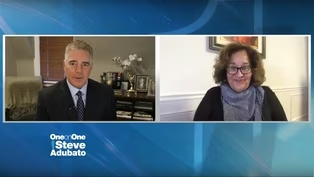
Confronting COVID & Institutional Racism in New Jersey
Video has Closed Captions
Clip: S2021 Ep2390 | 8m 55s | Confronting COVID & Institutional Racism in New Jersey (8m 55s)
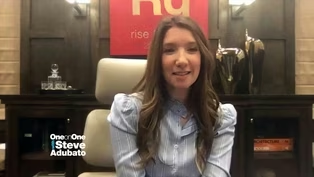
GIRLTALK #Takeover Exposes Young Girls to New Opportunities
Video has Closed Captions
Clip: S2021 Ep2390 | 10m | GIRLTALK #Takeover Exposes Young Girls to New Opportunities (10m)

The Role of Public Broadcasting in Our Democracy
Video has Closed Captions
Clip: S2021 Ep2390 | 9m 52s | The Role of Public Broadcasting in Our Democracy (9m 52s)
Providing Support for PBS.org
Learn Moreabout PBS online sponsorship
- News and Public Affairs

Top journalists deliver compelling original analysis of the hour's headlines.

- News and Public Affairs

FRONTLINE is investigative journalism that questions, explains and changes our world.












Support for PBS provided by:
One-on-One is a local public television program presented by NJ PBS