
Sean Spiller; Andrew Kirtzman; Julie Roginsky
12/16/2023 | 27m 12sVideo has Closed Captions
Sean Spiller; Andrew Kirtzman; Julie Roginsky
Steve Adubato goes to the NJEA Convention in Atlantic City to talk with NJEA President Sean Spiller about some of the issues facing educators today; Andrew Kirtzman, Author of "Giuliani," examines Giuliani’s responsibility in the January 6th resurrection and his inflammatory history; Democratic Strategist Julie Roginsky provides a personal perspective about the conflict between Israel and Hamas.
Problems playing video? | Closed Captioning Feedback
Problems playing video? | Closed Captioning Feedback
Think Tank with Steve Adubato is a local public television program presented by NJ PBS
Sean Spiller; Andrew Kirtzman; Julie Roginsky
12/16/2023 | 27m 12sVideo has Closed Captions
Steve Adubato goes to the NJEA Convention in Atlantic City to talk with NJEA President Sean Spiller about some of the issues facing educators today; Andrew Kirtzman, Author of "Giuliani," examines Giuliani’s responsibility in the January 6th resurrection and his inflammatory history; Democratic Strategist Julie Roginsky provides a personal perspective about the conflict between Israel and Hamas.
Problems playing video? | Closed Captioning Feedback
How to Watch Think Tank with Steve Adubato
Think Tank with Steve Adubato is available to stream on pbs.org and the free PBS App, available on iPhone, Apple TV, Android TV, Android smartphones, Amazon Fire TV, Amazon Fire Tablet, Roku, Samsung Smart TV, and Vizio.
Providing Support for PBS.org
Learn Moreabout PBS online sponsorship- [Narrator] Funding for this edition of Think Tank with Steve Adubato has been provided by NJ Best, New Jersey'’s five-two-nine college savings plan.
PSE&G, committed to providing safe, reliable energy now and in the future.
Wells Fargo.
New Jersey Sharing Network.
PSC.
Where your story is our business.
Englewood Health.
Robert Wood Johnson Foundation.
Working for a more a healthier, more equitable New Jersey.
Prudential Financial.
And by The Fidelco Group.
Promotional support provided by CIANJ, and Commerce Magazine.
And by Northjersey.com and Local IQ.
Part of the USA Today Network.
[MOTIVATIONAL MUSIC] (upbeat music) - Fresh off an interview with the great Spike Lee, we have Sean Spiller, the president of the NJEA.
Now, let me get this straight.
You come from an interview that you're doing with one of the keynote speakers here, Spike Lee at the NJEA Convention here in Atlantic City.
What was it like interviewing the Spike Lee?
- Well, it's exactly like you just set that up.
It's the Spike Lee, right?
We're out there, we're sitting down, and "Mr. Spike Lee," you know, "here's my first question."
You know, as you sit here, you know this whole time, right?
- By the way, I got list of some of Sean's questions.
- You got the questions there, right?
And I probably get two words into the first question before he is like, "And another thing."
- Hold on, don't tell me he was wearing his Knick stuff.
- Oh, full on, full on.
Absolutely.
- He's the greatest Knick fan of all time.
- Yep, no question.
- So you talked about the Knicks, talked about what else?
- Well, listen, we were trying to talk a little bit about education, right?
- Oh, that?
- That too, right?
But he's a professor, college professor, and certainly he gets that.
- Doesn't have he have, I'm sorry for interrupting, he has his mother, grandmother, both educators?
- Yeah, both educators.
And really helped inspire him in the work that he does and it encouraged him.
You know, he spoke about that a little bit, and I think it's important as we're here at convention, just that encouragement he got from his mother, grandmother to say, "Go into the arts.
Focus on that.
You want to do film?
That's excellent."
And he just highlighted that we should make sure we're encouraging kids to go into these spaces and not cutting these programs from schools, you know, which we often see are the first to go with budgetary cuts.
- And it's not an accident that Spike Lee is in fact here at the NJEA convention, let me disclose NJEA has strong support, a longtime supporter of the Caucus Educational Corporation, and the family of public broadcasting, and a lot of our programs and public broadcasting.
Let me try this.
Spike Lee, his art, his films, right?
There's a film festival going on, but they're not indiscriminate films about any topics.
There are themes, talk about them.
- Yeah, we're talking really about celebrating our rich diversity, right?
Exploring social conversations, talking about cultural intersection points, talking about how we engage in important conversations in our classrooms in an appropriate way.
Talk about how these things are all connected.
And what's happening here at convention is there's a number of films.
Oftentimes, we've got the producers or others who are part of it.
- We've interviewed several of them here.
- Who are affiliated with, who then can speak to the audience afterwards.
So we're having our own little film festival, if you will.
But really it's an opportunity to talk about how are we engaging in the work in our classrooms with our students, but talking about important conversations in a way that oftentimes, I don't want to say relaxes people, but it's a way to talk about something, sometimes it's a little easier through film or through art that it's a little different in conversation.
- But you know, one of the themes beyond the social justice, the racial, very honest conversation about race, racial equity and racial justice, et cetera.
One of the other themes that I've been wanting to talk to you about has to do with mental health.
The mental health of our educators.
To use the term burnout is people may not really, because it's used a lot, "Like what do you mean burnout?"
It goes so far beyond that, talk about the wellness of our educators, Sean.
- Well, I appreciate you asking that.
In that way too, because I think, and rightfully so, there's so much focus on student mental health, which is huge and unbelievably important.
But the very people really on the front lines trying to help our students with that student mental health crisis that we're facing are also suffering from mental health challenges right now, right?
We all experienced COVID and, you know, are coming through that in a way that we're traumatized.
We're talking with educators who are doing more and more as society demands more and more of our schools and our educators.
That's a heavy burden in many ways where, you know, we're responsible to make sure students are fed, we're responsible to make sure we're identifying points of crisis in a student or family.
We're charged with how do we make sure our communities as a whole are succeeding?
But there's a lot of stress that goes with that.
And I think it's important for educators to understand, just like you hear when you first get on that plane, you've got to put that oxygen mask on yourself first before you can help the person next to you.
And we've got to make sure we're focusing on our educators mental health as much as we are as students and others.
- But there's a follow up to this because it's even more complicated on so many levels shown and you live it, tell everyone as an educator, you have, it's not just that you're an officer of the high school?
- Right, right, high school science teacher as well.
You know, and certainly in that capacity, and as you know, a couple other hats as well, but yes.
- I'm a Montclair resident, this is the mayor, okay?
Not here in that capacity.
But here's the other thing.
You and I have never shied away from talking about some tough stuff, like how political discussions about education have become, in boards of education, in classrooms, parents' rights, students' rights.
What the heck position does that put our educators in?
- Yeah.
Our educators and our students, right?
I think important because... - And parents.
- And parents, all of us, right?
And by the way, we're the partners in all of this work together.
I'll start with this, it's been extremely frustrating to see, certainly inspiring in ways when we look at recent election results.
- We're taping just a few days after the November 7th legislative election.
Let's just say the NJEA, involved.
- Okay?
- Involved.
- And culture wars.
People use the term culture wars, what the heck are they talking about?
And what does that have to do with education and educators?
- Right, and well, the ones who were talking about it first off, it certainly showed that it didn't play well in their, I think their goal, which was political.
It wasn't about education, right?
That's the problem.
- So, hold on, to be clear, you're arguing that Republicans who engaged in issues around, "Hey, our parents should know if a fifth grader is telling a teacher, or an educator, an administrator, that they're thinking about changing their gender, parents have a right to know," which is a legitimate issue.
You say, "Okay, didn't play well.
The results are what they are.
People can determine what that means."
Democrats picked up more seats than they had before.
Complicated stuff.
Going back to educators.
What does it all mean for an educator?
- Right.
Well, that's why it's frustrating because, and here's why I say it's political, because the answer, when you talk to any educator, any teacher is gonna say, "Of course, we want parents to know everything about their student.
Of course, we want to interact and make sure."
I mean, we're the first ones calling home, trying to engage in these conversations.
"Here's how your child's doing."
You know, "they did wonderfully on this.
We need some help here."
Those are the conversations that have always happened, right?
Anyone who's been a parent.
- But it feels different now, Sean.
- It does, but that's why it's frustrating, because to say in the instances where an educator is worried about a student's safety, that we have to go talk to a parent.
In that rare instance, where the parent might be part of a household that is not safe for that student.
We wouldn't put a student in harm's way anywhere.
And I think parents get that, right?
They want to know, I'd want to know.
- But who determines that?
I mean, this is where it gets tricky.
Is it the educator's responsibility to make a determination as to whether a parent could, should know?
- No, I think that's why we look at it and say, "Listen."
When a student would come to you on any issue, you talk to that student.
You have, hopefully, a relationship, a trust there.
- Right, we have a daughter in the eighth grade in the Montclair Public Schools, go ahead.
- And oftentimes they're talking to their teacher because they might be trying something out that they want to bring home to their parents next.
Or they want to walk through something in their mind, right?
They're growing, you know, kids, and we're here to listen to that, hear them.
And, "Okay, that's great."
You know, "Where are you at?
Are you ready to go talk to your parents about that?
What are you thinking next?"
And we help coach them through that.
Now, if in that rare instance they go, you know, "Please, please, Mr. Spiller," you know, "do not say anything to my parents, my God."
You know, they sometimes talk a little hyperbole, but you know, who knows what could happen?
We have to honor that and respect that.
You know, we have to assess that, of course, in a way, but you know, it starts from a place of the students have to be safe.
And I think the public, by and large, absolutely comes down on that side.
Parents want to know, I want to know as a parent, right?
I've got kids, I want to know what's going on.
But I also know that if a student, my student, my kids don't feel safe in a certain space, I want them always to be safe, right?
And I want their teacher, their educators, always to keep them safe, no matter what that is.
And I hope I can help support that as a parent.
- Last question.
With everything going on in the world of education, how political it's become for so many, you're out beating teacher shortage, teacher burnout, mental health issues of all ranges.
- All connected.
- All connected.
- Yeah.
- You're bullish on education because?
- Well, we've got the number one schools in the nation, right?
Over and over and over, number one in the nation.
And I'm bullish on it because we've got the very best educators who understand that we have to be engaged in politics and in so many spaces to get pro-public education individuals elected so we can lobby them and push for what our schools need, what we need as educators, what our students and our communities need to keep the very best schools in the nation, right?
It's that cycle that I think works.
I'm bullish on that and right now, we need to use that leverage to say, "Here are ways we can get more people into the profession and keep more people."
'Cause we're just not recruiting and we're not retaining.
- Let me disclose one more time, if we missed it earlier.
The New Jersey Education Association, longtime supporters, underwriters, if you will, of public broadcasting and of our production company, the Caucus Educational Corporation.
Mr. Mayor, Mr. President, Sean, thank you.
- Always great to see you.
- You got it.
- Thanks for having me.
To watch more Think Tank with Steve Adubato, find us online and follow us on social media.
- We're joined by Andrew Kirtzman, the author of this book, "Giuliani The Rise And Tragic Fall of America's Mayor."
Andrew, thank you for joining us.
- Thank you.
- Can you do this, you have a chapter in the book called "Combat, Trial by Combat," which is exactly what, January 6th, before the riot, the insurrection and the insanity of January 6th took place.
Trial by Combat.
Why do you think he said that?
And do you believe he had... Doubled sided question, do you think he had any idea how that could have potentially incited that crowd?
- I don't know that he wanted them to storm the Capitol, but I think that he and Trump were- - What did he mean by trial by combat?
Did we ever have any sense of that?
- I think he was ginny up the crowd and getting them as angry as possible.
- Right.
- And I think that he didn't necessarily care about the repercussions.
They were trying to get this kind of major, major backlash by the bait to cause that election to be completely upended.
And Giuliani doesn't do anything halfway, so he was trying to work up the anger in that crowd as much as possible.
And he's sure he contributed to it, no question.
- Curious about this.
There's a big section of the book, and Andrew has written about Giuliani before, he's a Giuliani biographer, the best, if you will, of many people who've written about Giuliani.
So Rudy Giuliani, New York City, race relations, David Dinkins.
- Right.
- Back in the day.
Please, Andrew, talk to us.
- Well, David Dinkins was New York City's first black mayor.
He was a historic figure because of that, and Giuliani ran against him twice, once unsuccessfully and once successfully.
And there was such a major racial schism between his supporters and Dinkins that race became a major issue in both elections.
Giuliani is Italian American Catholic from the outer boroughs, raised also in Long Island, very white background.
His political base is mostly white.
There was just kind of a lack of interest, you might say, in kind of the needs of minority communities, because that was not his political base.
And he was very happy to play an inflammatory role in the matter of race relations.
There was a famous incident in which the police murdered a man named Patrick Dorismond, who was perfectly innocent.
They did a sting, and he just kind of got caught in the middle, and Giuliani went on to completely excoriate him, and damage his reputation and go after his reputation as though he was some kind of common criminal, which he wasn't.
- Why, why?
- Well, on one hand he was defending his belief in that action, but on another, Giuliani is kind of from the shoot to kill kind of school of politics, in which he wanted to kind of demonize whoever was making his police force look bad.
But I think you could argue that there was also just an intrinsic racial insensitivity in Giuliani.
And fast forward a couple of decades later, during the Black Lives Matter movement, Giuliani took almost pleasure going on "Meet the Press," and other programs, and just hurling one kind of bomb after another at the Black community, urging the leaders of the Black community to kind of get control of your people.
There was completely inflammatory rhetoric about that.
I mean, to say that Giuliani is insensitive to the black population sentiments would be an understatement.
- At the core, is Rudy Giuliani, formerly America's Mayor after 9/11, from your view based on his public rhetoric at critical times, both in New York City and nationally, as you talked about the Black Lives Matter movement, murder of George Floyd on camera, knee on his neck, a police officer and others watched, Rudy Giuliani, his rhetoric racist?
- I think that his rhetoric has come as close to racism is possible.
- You think at the core he's racist?
- I can't answer that.
You can only look at his actions.
I think his actions were sometimes almost designed to create friction between the Black and white communities.
- Last question, this.
How much do you think Donald Trump learned from Rudy Giuliani about dealing with the Black community, and, quote, race, not to mention polarizing, or some might argue adding fuel to the racial divisions that already exist, please?
- Right.
Well I think Donald Trump is as transactional a politician as you'll ever meet.
Minorities are not part of his base.
You could argue that he got to where he is by kind of inflaming the anger and insecurity of middle America, middle American whites against minorities, against immigrants, people of color, anyone trying to kind of take away what the shrinking American middle class, the Middle America has held onto.
- Is that what Rudy Giuliani did in New York City?
- I think Giuliani catered towards his white base in a major way.
- That's Andrew Kirtzman, the book is "Giuliani The Rise and Tragic Fall of America's Mayor."
Andrew, we've been colleagues for a long time, like I said, this is one of those books cover to cover marked up and learned from you, particularly as a student of leadership, and having a great deal of respect for Rudy Giuliani at a different time, for different reasons after 9/11.
Thank you so much, I appreciate it, Andrew.
- Thank you.
I so appreciate the opportunity, Steve, appreciate it.
- We appreciate you, thank you.
Stay with us, folks, we'll be right back.
To watch more Think Tank with Steve Adubato, find us online and follow us on social media.
- We're joined by our good friend, Julie Roginsky, Democratic strategist and principal at BARO Strategies.
Good to see you, Julie.
- Great to see you, Steve.
We're not here to debate or discuss the Middle East 'cause I don't understand it on so many levels.
I'm just trying to learn like everyone else.
But I will say we need to discuss this.
When you see protests on college campuses, where is the line in your mind between pro-Palestinian rallies versus an anti-Semitic, anti-Israel, dangerous to Jewish students protests?
Where's that line for you?
- Well, you know, much like that old adage about pornography, you kind of know it when you see it.
But I will say this, if you are marching and you're saying, "From the river to the sea, Palestine will be free," I'm gonna say two things about that, either you don't really understand what that means and you're getting caught-- - Explain it.
- Well, what it basically means is that from the river, which is the Jordan River, to the sea, which is the Mediterranean Sea, that land is the state of Israel that is populated by Jews.
And when you're talking about liberating, what used to be known as Palestine, not just the West Bank, and not just the Gaza Strip, but that entire piece of land from the river to the sea, what you're basically talking about is the eradication of the state of Israel.
And what you're talking about is the genocide of Jews from their ancestral homeland.
And the one thing I wanna add about that is, you know, there's this whole phrase about, on college campuses, which really just drives me crazy, about how Jews are some sort of colonial occupier.
That's the other big thing on college campuses, that you see this white colonial occupier.
First of all, 50% of the Jews living in Israel are what's known as Mizrahi Jews, which means that they come from the Middle East.
So if you believe that Palestinian Arabs are not white, neither of these people, they come from places like Iraq and Iran and Egypt and other places that Jews were chased out of, and no longer exist in those countries, despite the fact that they lived in those countries for millennia.
The other thing I wanna talk about is the fact that what kind of occupier are you talking about?
If you know your Bible, you understand that Jews have been in what is now Israel for thousands and thousands of years.
Jesus Christ was a Jew, he lived there.
Even before Jesus Christ obviously, there was a huge Jewish presence there.
So if you think a bunch of Holocaust survivors coming back, bedraggled and on the verge of death, coming back after the war to their ancestral homeland and building something out of the desert that not only bloomed, but prospered and became an incredibly powerful, you know, they call it the startup nation, that's not being a colonial occupier, that's people coming home and-- - Why is this personal for you, Julie?
- It's personal for me... Look, I was born in the Soviet Union.
I'm a Soviet Jew, right?
So I've seen this movie before, and I grew up living in the Soviet Union in the '70s as a Jew.
And I cannot describe to you the horrible discrimination, the horrible, just really state-sanctioned discrimination and aggression towards the Jewish minority in the Soviet Union back then.
I used to see, because it wasn't so long after World War II, people with numbers on their arms, many more than you see here in the States.
I mean, it's Holocaust survivors who somehow made it back alive.
And to me, it's personal because I see how it ends, and it ends as it always does for the Jews, whether this goes back to 80 years with the Holocaust or 800 years, or thousands of years, where you feel very alone, right?
Because you're considered not a minority by people who are screaming about how you're a white colonial occupier.
But yet everybody else considers you as the Charlottesville, you know, as the Charlottesville marchers did about how, you know, "Jews will not replace us."
You're always the other.
And what upset me is the constant contextualization, I guess.
No sooner were these people murdered on October 7th, than on October 8th, people started talking about how the Jews deserved it and how this was some sort of war of retaliation.
Nobody deserves that, nobody deserves that, and that's-- (indistinct) - But Julie, stay on this.
We're taping this on...
This is where it gets tricky because this program will be seen later.
- Right.
- Again, the war is raging between Hamas and Israel.
But to those who argue, as we do this program on the 14th of November, enough, meaning for Palestinian women, children, babies in hospitals, and the suffering going on there, the message has been sent by Israel.
How the heck do you eradicate Hamas, a terrorist organization, without thousands and thousands of innocent Palestinians being killed just by living where they live, Who can't, quote, get out so easily?
There's no question.
But that question really should be posed to Hamas.
Why are they building bunkers underneath hospitals and daycare centers?
- But why can't we pose it both to Netanyahu and Israel and to Hamas?
- You're not gonna get an argument from me about Netanyahu.
He should have been gone, not yesterday.
He should have been gone years ago.
So you're not gonna get an argument from me that part of the reason that there's so much anger at the Israelis right now, is because you have a racist government in place, a really, Jewish supremacist government in place that has been doing everything they can to oppress the Arabs in the West Bank and even those living in Israel, and-- - But what message would you send to those Palestinian Americans and others who say, "Hey, you know what, we're... " Again, October 7th spoke volumes in terms of this horrific massacre of innocent Israelis.
But now you've got this going on in this ongoing situation where thousands and thousands of innocent Palestinians are being killed.
What would you say to those folks right now?
- Well, what I would say is, look, there was a ceasefire in place.
Hamas broke it, right?
So it's not like if we put a ceasefire in place, there's any guarantee that if Hamas remains in the Gaza Strip, it won't be broken again.
- Right.
- I'll also say that Hamas is basically ISIS, right?
You can't be a free person living in the Gaza Strip.
You can't be gay, you can't be a woman walking around the way I'm walking around.
You can't have plurality of religion.
It's basically ISIS.
So I say that because, let's work together to eradicate Hamas slash ISIS.
Get rid of Hamas, and then let's work together to lean on the Israelis to really have a two-state solution that links the West Bank, Gaza, and parts of Jerusalem.
All of us should have a vested interest in this.
None of us wants to see this kind of carnage happening on either side, but it's going to continue to happen until you stop empowering the worst elements of this.
This is... Hamas is funded by Iran.
It is funded by the Russians.
It is funded against the most autocratic regimes in the world for one reason and one reason only.
They want dissent and they wanna sow discord.
These are not people in the community of nations who wanna build something better.
- Before I let you go, Julie, is there any part of you that's optimistic about how this ends?
- I'm optimistic only in one sense.
This was so jarring and so awful, that the only solution to this, from my perspective, and I think from the perspective of probably even many Israelis, is that there's only a two-state solution that's possible after this.
And that was very much stalled.
And as you saw, the Israelis were annexing and annexing and annexing, and they were building more and more settlements in the West Bank.
And the Netanyahu regime was obviously secretly cooperating with Hamas to keep them in place.
So there are no angels on either side here.
I fully acknowledge this.
I'm hopeful that this will finally have the accountability for this right-wing Israeli government that they require, and that somebody more rational comes into place on both sides.
And that includes the Palestinian Authority who's given up the opportunity to have a two-state solution every time it's been presented to them.
I'm hoping that cooler heads will prevail.
And I'm hoping that this is kind of the slap in the face for both sides that both need to finally come to the table and say, "Enough is enough.
We've had 80 years of this, we've gotta stop.
We've gotta work on something better."
- Thank you, Julie.
- Thank you.
- We'll keep talking.
I'm Steve Adubato.
More importantly, Julie Roginsky, see you next time.
- [Narrator] Think Tank with Steve Adubato has been a production of the Caucus Educational Corporation.
Funding has been provided by NJ Best, New Jersey'’s five-two-nine college savings plan.
PSE&G, Wells Fargo.
New Jersey Sharing Network.
PSC.
Englewood Health.
Robert Wood Johnson Foundation.
Prudential Financial.
And by The Fidelco Group.
Promotional support provided by CIANJ, and Commerce Magazine.
And by Northjersey.com and Local IQ.
- [Announcer] What is your child's dream for the future?
Doctor?
Teacher?
Architect?
Whatever they aspire to be, a college education may realize those dreams and NJ Best can help.
It's the college savings plan specifically designed for New Jersey families.
Start saving today with as little as $25, because now is the time to invest in their future.
To learn about NJ Best 529 college savings plan, its investment objectives, risks and cost, Read the investor handbook available at njbest.com.
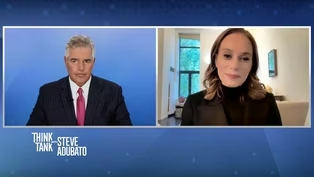
Democratic Strategist Examines Conflict with Israel & Hamas
Video has Closed Captions
Clip: 12/16/2023 | 9m 15s | Democratic Strategist Examines Conflict with Israel & Hamas (9m 15s)
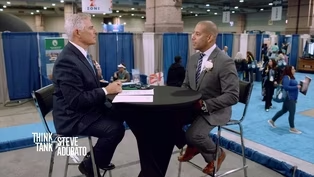
NJEA President and the 2023 NJEA Convention
Video has Closed Captions
Clip: 12/16/2023 | 10m 50s | NJEA President and the 2023 NJEA Convention (10m 50s)
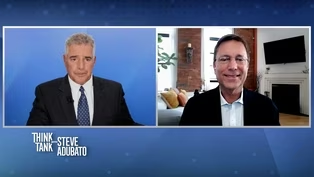
Rudy Giuliani's Role in the January 6th Insurrection
Video has Closed Captions
Clip: 12/16/2023 | 7m 53s | Rudy Giuliani's Role in the January 6th Insurrection (7m 53s)
Providing Support for PBS.org
Learn Moreabout PBS online sponsorship
- News and Public Affairs

Top journalists deliver compelling original analysis of the hour's headlines.

- News and Public Affairs

FRONTLINE is investigative journalism that questions, explains and changes our world.












Support for PBS provided by:
Think Tank with Steve Adubato is a local public television program presented by NJ PBS