One-on-One
Sean Spiller; Christine Girtain; Ewa Dziedic-Elliot
Season 2023 Episode 2623 | 27m 30sVideo has Closed Captions
Sean Spiller; Christine Girtain; Ewa Dziedic-Elliot
Steve goes to the NJEA Convention to talk with NJEA President, Sean Spiller, about the issues facing educators today. Jacqui Tricarico is joined by the State Teacher of the Year, Christine Girtain, to discuss her plans for representing NJ educators. Lastly, Jacqui speaks with Ewa Dziedic-Elliot, President of the NJ Association of School Librarians, about the challenges facing school librarians.
Problems playing video? | Closed Captioning Feedback
Problems playing video? | Closed Captioning Feedback
One-on-One is a local public television program presented by NJ PBS
One-on-One
Sean Spiller; Christine Girtain; Ewa Dziedic-Elliot
Season 2023 Episode 2623 | 27m 30sVideo has Closed Captions
Steve goes to the NJEA Convention to talk with NJEA President, Sean Spiller, about the issues facing educators today. Jacqui Tricarico is joined by the State Teacher of the Year, Christine Girtain, to discuss her plans for representing NJ educators. Lastly, Jacqui speaks with Ewa Dziedic-Elliot, President of the NJ Association of School Librarians, about the challenges facing school librarians.
Problems playing video? | Closed Captioning Feedback
How to Watch One-on-One
One-on-One is available to stream on pbs.org and the free PBS App, available on iPhone, Apple TV, Android TV, Android smartphones, Amazon Fire TV, Amazon Fire Tablet, Roku, Samsung Smart TV, and Vizio.
Providing Support for PBS.org
Learn Moreabout PBS online sponsorship- [Narrator] Funding for this edition of One-On-One with Steve Adubato has been provided by RWJBarnabas Health.
Let'’s be healthy together.
New Jersey Sharing Network.
Wells Fargo.
NJ Best, New Jersey'’s five-two-nine college savings plan.
The Healthcare Foundation of New Jersey.
Horizon Blue Cross Blue Shield of New Jersey.
Here when you need us most.
The Turrell Fund, supporting Reimagine Childcare.
New Jersey Institute of Technology.
NJIT makes industry ready professionals in all STEM fields.
And by NJM Insurance Group.
Serving New Jersey'’s drivers, homeowners and business owners for more than 100 years.
Promotional support provided by Northjersey.com and Local IQ.
Part of the USA Today Network.
And by New Jersey Globe.
- This is One-On-One.
- I'm an equal American just like you are.
- The way we change Presidents in this country is by voting.
- A quartet is already a jawn, it'’s just The New Jawn.
- January 6th was not some sort of violent, crazy outlier.
- I don't care how good you are or how good you think you are, there is always something to learn.
- I mean what other country sends comedians over to embedded military to make them feel better.
- People call me 'cause they feel nobody's paying attention.
-_ It'’s not all about memorizing and getting information, it'’s what you do with that information.
- (slowly) Start talking right now.
- That's a good question, high five.
(upbeat music) - Hey, everyone.
This is Steve Adubato.
More importantly, this is Sean Spiller, who is the president of the New Jersey Education Association, also the mayor of my hometown.
Not originally 'cause I'm originally from Newark, but now, it's Montclair, where you're the mayor.
Good to see you, Mr. President.
- Great to see you always.
- We are here just hanging out at the NJEA Convention.
- Yeah.
- What's it feel like to be here?
- Oh, it's great.
It's great to be back and, you know, building on as we come outta the pandemic.
Certainly what we saw last year, but even more, the energy coming back, the people, it's great to see.
We know it's the largest professional development opportunity probably in the world for educators, and this is a great space to be in, and we're seeing the excitement.
- Sean, we're gonna talk about school violence just a moment.
Right outta the box, I wanna talk about the teacher shortage.
Task force just announced as we're doing this, in November of 2022.
This'll be relevant for a long time afterwards.
The governor has announced his task force to look at teacher shortage.
It's a national issue, but how does it affect us in New Jersey, A, and B, what needs to be done?
- I'll work backwards.
The answer is we need to do everything.
It's a huge issue.
We've seen for the last decade now, the number of educators going through the teacher prep programs in New Jersey has been declining.
Another big problem we've seen, though, a lotta people talk about this in the context of the pandemic, thinking there's so many more people retiring, not really.
It's people leaving the career mid-profession.
- Mid?
Because?
- Mid, mid-profession.
Well, that's the issue, right, so we've gotta look at why is it that people aren't staying in?
And when we started to look at some of that data, and we polled our members.
We've asked, "What's going on?"
The inundation with paperwork and just things that keep you busy but don't have that relationship to your student success.
The stresses that everyone's facing.
We're short staff, so that means you're missing your prep period.
You're missing your lunch period to go cover a class to try and fill in for a colleague.
That adds more stress when you can't prepare for your classes.
You're being asked to cover more and more, right, so there's that added layer to it.
You're also talking about right now, a climate where you go to a board meeting.
It might be a tough situation.
- Let's talk about the.
Politics has always been.
Sorry for interrupting.
- Always, yeah.
- So politics has always been a part, but.
- Always.
- The level of politics, the level of intensity, the level of anger at school board meetings and directed toward public education has never been what it is, whether it's about critical race theory or the perception of what it is versus what it is.
Health/sex education courses, what it is and what the perception of what it is is.
What does that do to a teacher?
- Yeah, well, we're seeing it.
You leave the profession for many, and unfortunately, we see the stressors that those who still remain face.
It's a challenge.
You know, no one likes the acrimony you see.
We all are passionate about our kids, so that's a given, and we all want parents involved in our children's education.
That's top priority, but coming to a meeting, making accusations, wild accusations, attacking educators for teaching the curriculum that's their job to do.
- Attacking them personally sometimes?
- Yeah, often personally, often personally, and I think it's a space we've gotta get away from to say, "We all want what's best for kids here.
Let's come at it from that perspective and see how we can work together on issues," but if we don't change the climate, the very educators who've been doing a great job helping us have the number one schools in the nation are going to be leaving, and that's a big problem for all of us.
- Let me ask you this: in other states, I think in Florida, possibly in Texas as well, there's an effort to change the process of becoming a teacher, the certification process.
- Yes, yes.
- Should it be easier to become a public school teacher in the state of New Jersey, and if so, what would that mean?
- Yeah.
The answer's yes and no.
Yes, if there are barriers or obstacles that slow people down to get in who should be getting in, meaning right now, we've got student teaching that goes a year long.
You look at any internship or anything to on-board into a profession, no one has to work for a year, not get paid.
(laughs) Let me repeat that.
Work for a year.
- They don't get paid.
- Don't get paid, right.
Do that for a year, and then come on in.
That's a barrier for a lotta people.
How do you do that, right?
No other thing has these exams after exams after exams after you've passed a college preparation program, after you've got, you know, success in high school and beyond, now, you've got all these other tests, which all cost money, that you've gotta pass to come into the profession.
These are barriers that yes, we should eliminate.
We still, at the state level, have residency requirements.
You can't become an educator if you don't live in New Jersey, right.
We're trying to attract people.
We should eliminate those types of barriers, and there's plenty of other things, but it doesn't mean we should do what we are seeing in a lot of other states, which, they're literally just throwing up their hands and saying, "Anyone can come in and teach, literally anyone."
- That's a problem.
- That is a problem.
You don't maintain your top schools in the nation if anyone can just come in and do it.
- But Sean, also make it clear, your background as an educator, beyond being the president.
- Yeah, I'm high school science teacher for many, many years, and, you know, that's the passion people come in with, but yes, you want make sure people are coming in who are competent, that know it, but also know how to be an educator.
You know, just because you know content doesn't mean you're gonna be able to connect with the kids or be an effective teacher, so we've gotta maintain high standards, but we do need to eliminate barriers.
- The other piece of this, some people think it's connected.
Some people don't, but school violence, mass shootings.
One of the people I'll be interviewing here at the convention is David Hogg, a survivor from Parkland, horrific Parkland murders, the horrible situation there.
David's one of the keynote speakers there, but school violence, shootings, mass murders.
First of all, is it overstated in any way?
B, is there a connection between that and teachers saying, "Hey, wait a minute, I'm tapping out."
- There's definitely a connection when you talk about the social and emotional health of both students and the staff who work in schools.
- Sure.
- I would say add to that the trauma, yes, from the shootings and the violence and the murders, but add to that the trauma of constantly having to drill, where you're told to hide in a corner, where you're told to be really, really quiet, where they don't tell you it's a drill because they can't, right?
They've gotta have you practice.
Someone shaking the door violently to even simulate somebody who's entered the building.
You don't know exactly what that is.
You don't know if it's real or not real.
You do that over and over and over.
I mean, the trauma that our students, that our staff are facing, the trauma from, of course, the violence that's actually occurring, it obviously takes a toll.
And to say that's our solution, you know, to keep hiding in corners versus let's get some logical, common-sense gun control, you know, gun reform packages that we know make sense, it's a shame we aren't getting there where we need to be as soon as possible.
- Well, along those lines, you know, the gun control, it's gun safety, gun control.
It's defined and framed differently by different people.
There are some who'll argue, "Let's just arm our teachers.
Let's give them an opportunity to protect themselves and their students."
You say?
- Terrible idea.
- Terrible?
- Terrible idea.
You know, first off, any educator I've talked to does not wanna be armed, right.
That's not our job.
That's not our role.
We know professionals, professionals who are trained in this: police officers, law enforcement, who do countless hours of training, who recognize the stress of a situation.
Even they, in high-stress situations, constantly will make an error, human error, right, will accidentally harm someone else.
The worst thing I can think of is a number of weapons, way more than we have now, in a school, sitting where?
On a teacher's desk?
In their pocket?
In a drawer?
Where, right?
And I know what that leads to, when you have more weapons around, more guns around, with close proximity to children.
- It will not.
Sorry for interrupting.
- No, no.
- It will not make it safer for those teachers - Will not.
- and those kids?
- No, I don't think so.
Not at all.
I think- - Can you envision yourself, as a science teacher, with that gun?
- No, I'd be terrified.
The power of a weapon to take a life sitting right there, having it there, I mean, it takes away from the learning environment first and foremost, but I would not want that near my students in any way, let alone the bigger problem after some period of time, forgetting you really have it in the proximity, and the student finding it or getting access to it.
It's not a good idea.
- Finally, on the issue of school violence, school shootings, you're not willing to accept that it's a part of educational life.
- No, not at all.
I gotta tell you, when I walked the floor here, and it was before, and we have service dogs that are here, right, emotional support.
- And some are from Parkland and Uvalde?
- Yes, yes, and you talk to, you know, the individuals with the animals, and certainly know what the animals themselves and their handlers and others have to go through, but the fact that we're trying to comfort students and more students and more students from these shootings, it's just heartbreaking, and that's not what we have to accept.
We can do better.
- Sean Spiller is the president of the New Jersey Education Association and the mayor of Montclair, and this is the 2022 NJEA Convention.
A lot of interesting and important things going on, the future of our kids, the future of our schools, future of education at stake.
Thank you, Mr. President.
- Thank you.
Thanks so much for having me.
- That's great.
- [Narrator] To watch more One on One with Steve Adubato find us online and follow us on Social media.
All right, folks.
Jacqui Tricarico, the executive producer of Think Tank and Remember Them joining me down in Atlantic City for the NJEA, that's the New Jersey Education Association Convention.
Jacqui sat down with Christine Girtain from Toms River, a teacher there.
She is the New Jersey Teacher of the Year.
And here's Jacqui.
- Hi, I'm Jacqui Tricarico, on location at the NJEA Convention in Atlantic City, and so honored to be joined by Christine Girtain who is this year's NJEA State Teacher of the Year and a science teacher in Toms River.
It's so nice to meet you.
- It's nice to meet you.
- Thank you so much for taking the time to chat with us here at the convention.
Talk about your passion for science and STEM, and how that has evolved over the years, teaching for so many years in Toms River.
- Sure, I started off teaching biology and earth science, and I taught earth science for about 22 years.
And then I had the opportunity to learn about doing research with students, and I was the first research teacher at Toms River High School South.
And now, I teach research at both Toms River High School South and Toms River High School North.
When I get to speak with the students and really hear their interests, and then also get to expose them to possibilities that they don't even know are possible is really when you see that a-ha moment and you see them get excited about something new that they didn't know existed and that they didn't even know that they would like.
So for me, that is a powerful place to be, to be able to have that ability to open doors for them and to be able to give them more choices so that they can really experience who they can become.
- Your students, I've seen some video clips of them, especially after you won NJEA Teacher of the Year, talking about you.
They refer you as Mama G, right (laughs)?
- Yeah (laughs).
- And you could just tell how much they love you, and appreciate you, and respect you in the community.
How does that make you feel?
- It's great, it is.
And it's hard when they graduate, right?
Because they leave and they are my children, right?
But (laughs) it's a special, sorry, it's a special relationship with those kids because I teach them for three years, and when I taught earth science, I taught them for four years.
It was really special to teach my daughter's friends because she just graduated.
So that group of kids that graduated last year was amazing.
I knew some of them since kindergarten, and that's a bond that you don't usually have with individuals.
And I've had a lifetime with some of those kids.
They, you know, they call me when there's exciting things.
One of my students, Grace (indistinct), she's going to get her PhD, and she's originally from Nigeria.
So she got engaged and she messaged me and said, "You know, be prepared.
You're going to your first Nigerian wedding."
(Jacqui laughs) So those types of things - How fun.
and being able to share that with them, their lives and then also what they're becoming, you know, she's getting her PhD in psychology, and is going to herself, then, influence so many other people.
- I'm sure that just makes you so incredibly proud.
And having those students reach back out to you after graduation just shows how much you were dedicated to them and how much they wanna still involve you in their lives and their big moments.
It's so incredible.
Talk about too, creating opportunities for your students.
I know you've been able to do that in some really unique ways, including traveling to Costa Rica and Europe.
Can you talk about some of that?
- Sure.
So it's predicted that we'll run into a lot of antibiotic resistance by 2050, and working with Seeds of Change, which is a group that is working with the University of Wisconsin-Madison and then also the University of Costa Rica, we were able to bring 17 students, three of which were underserved students that were sponsored by a private funder, the Grunin Foundation, down to Costa Rica so that they could do hands-on research with leaf-cutter ants and the fungus that they farm.
The ants don't have any cases of antibiotic resistance and so, we're looking to them as a model and also looking to insects to be able to find new antibiotics to be able to, you know, offset disease not only in humans but also in crops and in livestock, because it's an issue as far as feeding and fueling the world in the future.
- Talk about feeding and fueling the world in the future.
I know you've said as teachers, it is part of your responsibility to make sure that your students' basic needs are met.
And during this time, you know, post-pandemic and during the pandemic, food insecurity was such a huge issue across New Jersey, across the nation.
How important is it to you to spread that message to make sure that teachers are looking past just the classroom, to make sure that your students are getting taken care of and helping them in those other areas of their life?
- Sure.
They can't learn if their basic necessities are not being provided for, and food is a necessity for life.
When you have students in your classroom that don't have that food, you can't concentrate, then, on homework or, you know, inspiring them to do some project that's after school because they haven't even eaten.
So addressing the food insecurity not only for our individual students but also in what is, like, causing that to happen, right?
Is it, you know, not having sustainable jobs, or not creating a sustainable workforce, or, you know, in the future, not having, you know, food being supplied.
We need to make sure that the students are learning that connection to their food, the high-tech and high-paying jobs that are in agriculture, because there's so much science involved in it.
And that was really new to me in the last two years and I got to connect with Nourish the Future, and then also a program called On the Farm.
So the National Corn Growers Association, the American Soybean Board, they both sponsor Nourish the Future.
And it educates teachers that aren't agricultural teachers to incorporate agricultural themes into their regular science classes, so that when you're teaching about antibiotic resistance students realize that there's diseases in crops and diseases in plants that they could be investigating and, you know, researching for their projects or even just to, you know, learn more about and have a connection to their food.
Most of us don't realize that popcorn's a whole separate plant than sweetcorn, especially in Jersey because we're the ninth largest producer of sweetcorn in the country.
And so when we see corn, you know, we think that's the corn on the cob that we're eating.
And sometimes it's popcorn growing in a field and sometimes it's, you know, field corn growing in a field.
I didn't know those things two years ago and if I don't know these things to pass on to my students, then they don't know them.
- And you touched upon job creation, job security, and just, job opportunity.
STEM being one of the several fields in our area in New Jersey, the tri-state area, where it can really give your students great opportunities for fantastic jobs after graduating high school and going on to college.
How important is that to you to spread that message, to get kids really engaged and excited about the STEM fields?
- I love that.
I love to teach them micropipetting and introduce them to biotechnology.
And we have large corporations in New Jersey that I would love to partner with to be able to reach more students and do more things across the state, so that we are, you know, building that sustainable pipeline of students that then stay in New Jersey for those biotech jobs.
I think that's super important.
- Yeah, great for the economy here in New Jersey and around our area.
And being named the NJEA State Teacher of the Year first, what was that like for you?
- It was crazy.
And I have to say I really wanted it.
I definitely, I wanted to have a voice.
I wanted to be able to speak with people like you and to be able to create change, right?
And be able to, just, not only make opportunities for the students that I teach, but for the other teachers that I teach with, you know, the county teachers of the year.
Those are great teachers that have all been recognized in each of their counties as superior educators.
And having them to work with, and being with that cohort, and being able to accomplish more across the state is pretty powerful.
So I really look forward to, like I said, having a voice and being able to make those networking connections so that, you know, our vision for education becomes more powerful when we work together.
- Beautifully said.
Thank you so much for taking the time to chat with us, and congratulations again on becoming the NJEA State Teacher of the Year this year.
- It's pretty cool.
I won't lie.
(both laughing) - Thank you so much, Christine.
- [Narrator] To watch more One on One with Steve Adubato find us online and follow us on Social media.
- All right, folks.
My colleague, Jacqui Tricarico, joined me down in Atlantic City for the New Jersey Education Association Convention.
And Jackie sat down with Eva Elliot, who is the president of New Jersey Association of School Librarians, to talk about a whole range of important issues affecting school librarians and students in our public schools who rely on those libraries.
Here's Jacqui.
- Joining me now is Ewa Dziedeic-Elliot who is the President of the New Jersey Association of School Librarians, has over 10 years experience as a school librarian and is here today at the NJEA Convention.
Thank you so much for taking the time to speak with us.
- Thank you for having me here today.
- So let's describe the Association of School Librarians.
What is that in here at New Jersey?
- We are NGA members and what we do is we provide professional development and support for school librarians across the state of New Jersey.
What that means is that if the school district, let's say is writing new curriculum or if they are hiring a new librarian and that librarian needs additional training, we're able to provide that training.
We're able to provide that professional development.
We're able to provide mentorship but also in the light of the latest book challenges, we have created a task force and the task force is able to provide resources to support school districts, school administrators, school board members and the school librarians across the state of New Jersey.
- Well, let's talk a little bit about that.
We're hearing that word book banning, that term, a lot now in the media.
What does it mean for a school librarian the role that they play in terms of book banning or specific issues that community members, parents, caregivers, bring up about the books that are being presented on the shelves in the libraries of our schools.
- This is actually very complex problem and I think that at the core of it is something that shows very negative impact on our librarianship as a profession because we as school librarians, we have teaching certifications and on top of that we have library certifications.
So we are dually certified and here we have community members coming to our libraries and saying that we don't know what we're doing.
And we are specialists in the field.
We are trained to provide expertise and proper materials for our school libraries.
And this is something that we have to remember.
School librarians materials are supplementary materials and they support state standards.
So anything and everything that we provide in our libraries is to support already existing policies and curricula and state standards.
We don't come up with these recommendations and with these books out of thin air.
If there is a certain book in the library, that book was purchased keeping in mind that we have to provide some level of support for classroom or for some kind of lesson plan.
So it's a well thought out process.
When it comes to book banning, it's again, very very complex issue, but it's greatly under reported and our biggest problem here right now is that a lot of school districts are not following their school policies and are not following the state standards and laws.
So the issue is very under reported.
We as an association receive information from our members that school administrators or school board members come into the library space and make requests to remove something out of fear of potential book challenge.
That's sweeping the problem under the rug.
- Well, yeah, and playing devil's advocate a little bit, what do you say in terms of parents who say let's leave it up to the parents to decide if these books that are causing these issues or that are coming up in a lot of these school board meetings as books that should be taken off the shelves, leave it up to the parents to make that decision if the kids can have access to them.
- I would say to those parents if you are not comfortable for your child to read that, you have the right to do it but you cannot make this decision for all of the children because there are children out there who look forward to have these resources in their hands.
They really need it.
In some cases, seeing a protagonist struggling with the same problem that the child or the student is struggling, it might be life saving.
So I would say to those parents, if you are not comfortable having these conversations with your child, if you are not comfortable with your child to be exposed to certain subjects, you have right to do it.
But take care of it with your child.
Don't put this on everybody else because remember if you are putting that pressure on yours or my child, another parent may do the same to your child.
They may put something that is not compliant with your belief system.
So it works both ways.
- It's a challenging conversation and something that we're consistently hearing.
Lastly, how important is the role of the school librarian?
How important is it for us as a community, for parents, to support the librarians that are in our children's lives as part of their education?
- So there is a lot of studies.
Librarians love data.
We love studies and data.
There is a lot of studies that are showing that having a school librarian actually increases all kinds of scores in all state standards if they're properly aligned.
And what happens is having a school librarian actually helps with literacy more than having early interventions which basically means that if you're talking about money if you're talking about hiring someone as a school administrator, you are better off hiring skilled librarian with proper certifications who can provide support for your child, for your student, rather than even having certain programs.
Then, on top of that we are providing all kinds of research assistance.
Our job changes from grade level to the grade level.
Elementary school librarian has completely different job description than middle or high school.
Elementary school librarian is more like an intervention teacher for library literacy, skill reading literacies, and then middle and high school is more college prep oriented.
We are the only people in school buildings who actually work with everyone who knows the curricula and lesson plans across the board.
We are prepared and ready and trained to work with absolutely any department in a building.
I can provide assistance to art teacher I can provide assistance to science teachers, to math, english, social studies because I'm trained to do it.
We are the only people in a building who can also provide IT help.
So we are very diverse in that.
- Ewa, thank you so much for giving us some more insight into the challenges right now facing school librarians and just how important that role is in our children's lives.
Thank you so much.
- Thank you.
- [Narrator] One-On-One with Steve Adubato has been a production of the Caucus Educational Corporation.
Funding has been provided by RWJBarnabas Health.
Let'’s be healthy together.
New Jersey Sharing Network.
Wells Fargo.
NJ Best, The Healthcare Foundation of New Jersey.
Horizon Blue Cross Blue Shield of New Jersey.
The Turrell Fund, supporting Reimagine Childcare.
New Jersey Institute of Technology.
And by NJM Insurance Group.
Promotional support provided by Northjersey.com and Local IQ.
Part of the USA Today Network.
And by New Jersey Globe.
- I am alive today thanks to my kidney donor.
I am traveling and more active than ever before.
- I'm alive today thanks to my heart donor.
I'm full of energy and back singing in my church choir.
- I'm alive today thanks to my lung donor.
I'm breathing easy and I'm enjoying life'’s precious moments.
- They are about 4,000 people in New Jersey waiting for a life-saving transplant.
- Donation needs diversity!
- For more information or to become an organ and tissue donor, visit NJSharingNetwork.org.
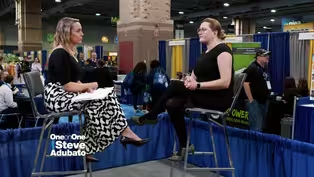
How Do Librarians Feel About Book Banning in NJ?
Video has Closed Captions
Clip: S2023 Ep2623 | 8m 25s | How Do Librarians Feel About Book Banning in NJ? (8m 25s)
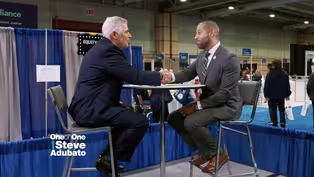
NJEA President Discusses the 2022 Annual Teacher Convention
Video has Closed Captions
Clip: S2023 Ep2623 | 9m 45s | NJEA President Discusses the 2022 Annual Teacher Convention (9m 45s)
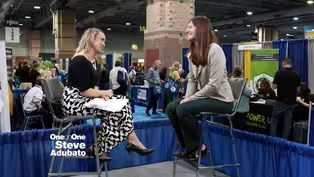
NJ Teacher of the Year Discusses her Future in Education
Video has Closed Captions
Clip: S2023 Ep2623 | 9m 46s | NJ Teacher of the Year Discusses her Future in Education (9m 46s)
Providing Support for PBS.org
Learn Moreabout PBS online sponsorship
- News and Public Affairs

Top journalists deliver compelling original analysis of the hour's headlines.

- News and Public Affairs

FRONTLINE is investigative journalism that questions, explains and changes our world.












Support for PBS provided by:
One-on-One is a local public television program presented by NJ PBS