One-on-One
Sean Spiller & Steve Swetsky; Michael Maron; Andra Garner
Season 2021 Episode 2460 | 27m 16sVideo has Closed Captions
Sean Spiller & Steve Swetsky; Michael Maron; Andra Garner
Sean Spiller & Steve Swetsky discuss the greatest challenges educators and students are facing with in-person learning; Michael Maron talks about the connection between the vaccine mandate for healthcare workers and the nursing shortage; Dr. Andra Garner shares the connection between climate change and flood risk and the ways we can make communities more resilient to natural disasters.
Problems playing video? | Closed Captioning Feedback
Problems playing video? | Closed Captioning Feedback
One-on-One is a local public television program presented by NJ PBS
One-on-One
Sean Spiller & Steve Swetsky; Michael Maron; Andra Garner
Season 2021 Episode 2460 | 27m 16sVideo has Closed Captions
Sean Spiller & Steve Swetsky discuss the greatest challenges educators and students are facing with in-person learning; Michael Maron talks about the connection between the vaccine mandate for healthcare workers and the nursing shortage; Dr. Andra Garner shares the connection between climate change and flood risk and the ways we can make communities more resilient to natural disasters.
Problems playing video? | Closed Captioning Feedback
How to Watch One-on-One
One-on-One is available to stream on pbs.org and the free PBS App, available on iPhone, Apple TV, Android TV, Android smartphones, Amazon Fire TV, Amazon Fire Tablet, Roku, Samsung Smart TV, and Vizio.
Providing Support for PBS.org
Learn Moreabout PBS online sponsorship- [Narrator] Funding for this edition of One-On-One with Steve Adubato has been provided by The Healthcare Foundation of New Jersey.
Johnson & Johnson.
NJ Best, New Jersey's five-two-nine college savings plan.
The New Jersey Board of Public Utilities, Clean Energy program.
Valley Bank.
The New Jersey Economic Development Authority.
Summit Health a provider of primary, specialty, and urgent care.
The North Ward Center.
And by The Adler Aphasia Center.
Promotional support provided by Jaffe Communications.
Supporting innovators and changemakers with public relations and creative services.
And by The New Jersey Business & Industry Association.
- This is One-On-One.
- I'm an equal American just like you are.
- The jobs of tomorrow are not the jobs of yesterday.
- Look at this.
You get this?
- Life without dance is boring.
- I don't care how good you are or how good you think you are, there is always something to learn.
- I did do the finale, and guess where my trailer was?
A block away from my apartment, it couldn't have been better!
- People call me 'cause they feel nobody's paying attention.
- (slowly) Start talking right now.
- That's a good question, high five.
(upbeat music) - Steve Adubato here.
Everything you ever wanted to know about education, teaching, educators.
We have Sean Spiller, President of the New Jersey Education Association and Steve Swetsky, Executive Director of the NJEA.
Good to see you gentlemen.
- Good to be on.
Good to see you as well.
- Good to be here.
- I want to disclose that Sean is also the mayor of my hometown, beautiful Montclair, New Jersey.
Hey, listen gentlemen, we're doing this show at the end of September being seen a little later, later.
Sean, let me ask you, as an educator as well.
No way to predict how this school season, school season will go, the school year will go.
What do you say where we are, as to where we are right now, and what are the greatest challenges moving forward?
- I think we're in a good position right now, you know, kudos certainly to the governor, but also everybody involved with education for getting us to where we are now.
It's been ups and downs.
It's been twists and turns, which I think we all know we've got to be able to adapt with the changes around the virus and what's going on in the pandemic, but by instituting things like a mask mandate with the vaccinating or testing policy that's in place.
I think we've tried to be as safe as possible to get us back to in-person instruction.
I think it's a good place to be.
We're all going to be watching to see what happens in the next few weeks.
All already going to be ready to be able to pivot as needed, if needed.
But, I think for starters right now in the position that we're in, probably as good as it could be while we're still in this pandemic, and hopefully it continues.
- Steve let me ask you, describe the NJEA for those who do not know.
A, how many members?
- NJEA is roughly 200,000 members working in schools across the state and the 600 plus school districts.
We have about 900 different affiliate organizations and that's, we're comprised of teachers, ESP members, bus drivers, secretaries, cafeteria workers.
So, everyone who works in public education.
- By the way, the NJEA is not just a supporter of public broadcasting with the Caucus Educational Corporation as well, to disclose that.
Steve, let me ask you, do you have a really good sense as to when we're taping on the 28th of September, how many educators are vaccinated as we speak?
Because there's a, there's a requirement to be vaccinated, but there's also the option of being tested on a regular basis, please, Steve.
- Yeah, so, we don't have the exact data for New Jersey, but NEA has done some polling and - The National Education Association.
- Yes, correct.
And we're probably in the, in the 90% range for members being vaccinated.
And so our, our members have been vaccinated at a higher, certainly a higher rate than the general public.
- Let me follow up on that.
Sean, our daughter in the public schools here in Montclair, we, we talked every day to her about her experiences so far.
What's gone well, what's been more challenging.
As an educator, what would you say for educators as well as for students, the greatest challenges in those classrooms are right now?
Our daughter brings a plastic shield.
She has her mask.
Challenging enough, but safety first, please, Sean.
- Yeah, I think that's still the focus, you know, it's about safety, right?
First and foremost, we've got to make sure kids are safe, staff are safe.
And I think when you talk about the challenges it's coming back, but it's coming back to that uncertainty.
You know, we talk often and rightfully so about the social-emotional wellbeing of our students, but it also applies to educators.
You know, people who have been stressed.
People are wondering, you know, is this safe?
What's, what's it going to be like?
But there's a desire to connect with kids and, and, and that's the joy of it.
So, I think everyone's trying to navigate that space.
What does a classroom look like?
You know, how did the interactions happen?
How do you make sure that you're able to connect still with some of these barriers, literally and figuratively, that are in place to help keep us safe?
And, so, I think a lot of that is going on.
There's that feeling out process both ways, but, but I think the hope is that as things keep moving and people get comfortable with these things, it gets easier.
And also, you know, hopefully as the, as the pandemic dictates, but more importantly, as we get more and more people vaccinated and people doing, hopefully what they should, we get to a place where we can start to ease some of those restrictions as appropriate.
- And again, changing landscape every day, new information.
Steve, you and I actually talked about flying the other day.
The convention is coming up, the annual NJEA convention.
We don't know what it's going to look like.
How much is in person?
How much is remote?
We've done a lot of broadcasting from there.
It's been great talking to individual educators from across the state.
Steve, let me ask you this, from your perspective, the theme at the convention has always focused around racial and social justice issues.
Regardless of the pandemic, that will not change, correct?
Talk about it.
- Yeah, no, absolutely not.
I mean, that's a focus of the organization and it should be, it is, and should be a focus of our public education system.
You know, there are inequities throughout public education, throughout New Jersey.
You know, once again, New Jersey was just recognized as the top ranked public school system in the country.
And we're proud of that and we are proud of the part that our members play in that.
But, we also look around and we see great inequities throughout New Jersey, throughout the country.
But in New Jersey that, you know, really provides opportunities and provides places for our members to engage with each other and with their communities around those issues.
And so, yes, the convention will continue to be a place where we engage with those issues.
Where we bring, you know, a place for people to come together, talk about, and move to action.
- And the great leaders who come from across the nation as well, whether remotely or in person.
And I'm not going to give anything away because you're still working that out, Steve.
Hey Sean, in light of the conversation that we just, that I just had with Steve, regarding racial and social justice, you're the first African-American man to be president of the NJEA.
A, what does that mean to you in the organization?
And b, continue the conversation about racial and social justice, please?
- Yeah.
You know, I think it, I think it means a few different things.
There, there are moments when you look at it and I guess maybe it's a half full, half empty type mindset.
But you know, you look at it and say, wow, you know, here we are, how many years later?
And this is only the second African-American ever.
And first African-American male to be president of the organization and first time ever in our history.
We've got two officers of color serving at the same time.
You know, it's, it's, you know, you're thankful and happy that we're here, but also, you know, a little bit maybe surprised.
But, also the challenges of how long it took to get here.
But, but I think also, and I'll give full credit to our previous president Marie Blistan, for really leaning in and engaging in the work of racial social justice.
Because I can tell you that having a, a white ally, I really leading the charge in some of these things was, was really important.
I think it was really important for our 200,000 members to see that this isn't just a look.
You know, here's our African-American president moving forward around these issues.
It was a, this is an organizational commitment.
And certainly now I'm pleased to be able to move that and bring that even, you know, more forward in terms of the work we do.
And when we talk about being a justice centered union, and sometimes we hear the criticism, you know, it, it takes us into places where we're fighting for our communities and the communities our students live in and that we live in.
When we say, we've got to have employment opportunities, we've got to have appropriate health care, we've got to have the challenges that are facing our students that are barriers to them learning, and we've got to be in those spaces as well, trying to, trying to create that equity and to create that justice so that our students have the best possible opportunities at success.
So, we're going to be there.
We're going to be leaning into that work, and that's something we're committed to.
- You know, Sean talks about this, people just, again, we've done a lot of work on learning loss and, and the academics of this.
But Sean talks about the larger context in which education takes place in people's lives.
Childcare issues, a whole range of complex issues.
But Steve, I wanna ask you about this.
In terms of mental health, social-emotional learning, forget about just learning, just development, the wellbeing of our children.
How are teachers dealing with that, in addition to the fact that they have their own issues to be dealing with?
Steve Swetsky, go ahead.
- Yeah, that's a very, a good question and a very difficult issue.
A lot of credit goes out to our members and educators everywhere for how they have stepped up to deal with not only their own issues at home, but always with the focus on the children that they teach.
I had the opportunity yesterday.
My, my grandson's pre-K program is, is closed because of COVID.
So they're, they're working from home and my daughter-in-law sent a video and I watched him, you know, do two minutes with his, with his teacher, it was amazing.
And, and, you know, the caring and the, and the voice that came, you know, off of that iPad.
And I just watched, you know, Charlie, he was, he was captivated, right?
Because that was the person that he's already connected with a week and a half into the school year, right?
He's three and a half years old.
And so, you know, regardless of whether we're in buildings or whether we're doing it remotely, that's the care and the passion around the work that, that educators have always had.
And it's been amazing.
- Hey, final word here, Sean.
And it, follow up on what Steve just said.
The connection between students and teachers, while it's been affected and there have been barriers, et cetera, et cetera.
In-person, remote, shields, masks, all of it.
For you personally, as a longtime educator, what's that connection like?
30 seconds, please.
- It's the, it's the best.
It's the best.
It's why we do what we do.
I know Steve and I had a chance to visit a lot of schools starting this school year.
And you just see that it is, that, we're excited.
We're excited to be with our kids.
It's what a, it's why you do this work.
It brings a smile to your face every day.
And it's an opportunity to see them learn and grow.
And it's, you know, it's the impact you're having, but it's rewarding.
It certainly is.
- By, by the way, Sean, real quick, you've been an educator for more than a couple of years, right?
- Yeah.
Go ahead.
Time goes by really quick.
Wait, 20, 20 something years.
So, it goes really quick.
Yeah.
- And teaching what subject?
- Anatomy and physiology, biology, as well as some other life sciences, but that's been my focus.
- Just want to clarify that.
Hey, Steve and Sean, thank you so much for watching.
Thank you for, no, thank everyone for watching.
Thank them for sharing with us.
And Steve we'll follow up and see what happens with the convention.
We'll look forward, whether it's remote or in person, we're going to be ready to talk to the great educators every day, who help our children in so many ways.
Not just teach them, but support them.
Sean, Steve, thank you very much.
- Thank you.
- I'm Steve Adubato.
Thank you, I'll get this right it's only been 30 years, for watching.
We'll be right back.
- [Narrator] To watch more One on One with Steve Adubato find us online and follow us on Social media.
- We want to welcome back Michael Maron who is President and CEO of Holy Name.
Hey, Mike, good to see you.
- Good to see you, Steve.
Thanks for having me back.
- You got it, hey, Mike, listen, as we do this program late September, there was just an article I believe on nj.com/thestarledger, a detailed article about the vaccine mandate in most healthcare systems.
And by the way, Holy Name, one of the many healthcare organizations that support what we do, all of them, as I understand, have a vaccine mandate, but the article talked about the connection between the vaccine mandate for healthcare workers, particularly nurses, and the shortage, the staffing shortage of nurses.
Please talk about that and help people understand why it's so real.
- Well, so put vaccine controversy aside for a second, COVID burnout has caused an incredible shortage of personnel in all the hospitals.
And so when you're looking for talented nurses now, and you're looking for the caregivers that are absolutely essential to make any of our organizations run, they are in very, very short supply.
COVID has given people a reason to do a reset and a rethink about their entire career, their life path, and people are leaving the profession.
They're tired.
They're burnt out.
You throw on top of that now the complexity of a COVID mandate that- - A vaccine mandate.
- Vaccine mandate, yes, I'm sorry.
That just adds another level of complexity for the few people who don't.
Now, Holy Name, we're blessed here.
We have 89.6% vaccine rate amongst our employees.
And in that mix is the 11%, 10.4% who are not.
Majority of them really don't work here.
They're per diem employees who work somewhere else, and their paperwork just hasn't caught up with them.
So we suspect that the actual true vaccine rate here is significantly higher.
So we don't have the problem with our existing staff.
I absolutely have the problem with burnout, and I absolutely have the problem with now trying to recruit in the right mindset person who's gonna fit into Holy Name's culture that defines who we are.
- Mike, I'm gonna ask you about Haiti in a minute, because a Holy Name, Haiti, and you directly very much connected to Haiti and the crisis, the multiple crises there.
But I just want to follow up with you.
You've said many times about the COVID burnout.
What exactly are you and your colleagues doing, but more importantly, the larger healthcare system?
What needs to be done for healthcare professionals and the burnout they're experiencing.
What do they need?
- So a lot of them we've been offering support and counseling to people that saw all the tragedy.
A lot of it is just inner fear and anxiety.
So every day you're coming to work, especially in the room where you don't know who's walking through the door.
And so the risk levels and that that fear factor is as high as I've ever seen it.
Most people, most of the nurses, the physicians, the staff who sign up to work in an emergency room, they like that excitement.
They like the unknown.
They like the fact that no two hours are the same, let alone two days.
And they thrive on that.
But this has been a consistent drain, an emotional drain where people start to think, "I am putting myself at risk.
"I'm putting my family at risk."
When you start to see vaccine breakthrough cases increasing, and people are wondering now like in challenging questions, is the vaccine really all that helpful, because we're seeing a significant increase in breakthrough kind of cases.
- So, what do you think, Mike, because you had COVID very early on, for those who say, come on, people are still getting it who had the vaccine, I have the vaccine, I worry about it, but, Mike, isn't it also fair to say that the level of illness and the seriousness of it is very different for vaccinated versus unvaccinated as a non-clinician?
- Correct.
- Which I am.
Go ahead, Mike.
- Yeah, so let me put it to you this way, Steve, and make it try to...
I always try to keep it simple and to the point.
In all the thousands of people, tens of thousands of people with COVID that we have treated and successfully treated and the ones we've lost and died, vaccinated or not, it was COVID that killed them.
We have not had a single admission, a single case related to someone having an adverse reaction to the vaccine.
And so, as someone who had COVID and someone who's fully vaccinated, I tell you and I tell everybody who's listening, the risk of getting sick and dying from the virus is significantly greater.
So the vaccine may not be perfect, but it absolutely helps.
And you need that every ounce of help you can get.
- But, Mike, I wanna clarify, you got COVID pre-vaccine, correct?
- Pre-vaccine.
I was early on.
I was March, 2020.
- Believe me, I remember.
We were about to tape, and it was happening literally at that time.
Hey, Mike, help us on the cutting edge technology.
Standardized vaccination verification, what do we need to know about this?
- So important here in that I think it's important for people to be able to have his secure vaccine record that's portable that they can take with them.
This is not gonna go away.
This is going to be a new norm.
It could be for the rest of our lives, definitely for the next five years.
So the ability to be able to call up your vaccine record on your iPhone at a moment's notice, not worry about where the paper card is to us is essential.
It's just going to be part of life.
And so we designed and developed software to do that.
We partnered with a company that's based in Switzerland, but also has offices in Virginia, SCIPA, S-C-I-P-A.
They are software security experts.
And we put a blockchain security on it, so you don't have to worry about your personal information ever being hacked into or displayed erroneously where it doesn't belong.
- Hey, Mike, just got a couple minutes left.
Haiti and Holy Name, yourself.
I always ask you this.
How many trips do you think you've taken there?
Dozens and dozens and dozens.
- Yeah, typically I go every six weeks.
- And Sacre Coeur, if I said it correctly, there's a hospital there that you and your colleagues are key to building, running.
Question.
The situation in Haiti, describe it from a healthcare perspective, A and B.
What should the rest of us need to know, potentially do to be helpful?
- So Haiti obviously's suffering a lot.
They have the political unrest.
They had the earthquake again.
Thank God, nowhere near as devastating as the one in 2010.
And COVID has run rampant through the country.
It is currently like everywhere else.
It's on a downtick.
So when you look at the COVID waves, every country as poor as Haiti to the wealthiest United States, and then state by state in the US, we all go through these cycles of peaking of cases, and then they precipitously drop off.
- By the way, we're taping on the 28th of September.
Mike is not saying what it's going to be three months from now.
It's where it is today.
Go ahead, Mike, I'm sorry.
- So Haiti now is on a downturn on the number of cases people presenting.
It doesn't have the sophistication that we have, or any other developed country has in terms of accurately tracking it.
But I know from a daily census, so we went as high as 25 people a day being in the hospital with COVID to we're get back down to three.
So it is not as prominent in the community.
It has taken a turn.
We don't know if it's going to uptick again, but at the current moment it's at its lows.
- Answer the last part, Mike, what can people do?
We'll put up a website, but also Jacqui, our executive producer makes sure there's a Haiti connection, so if people want to be helpful.
Go ahead, Mike.
- So if you want to be helpful, the best way to do it is go to holyname.org.
We have a whole section on our website around our hospital in Haiti.
It's a 200 bed, one of the most advanced hospitals in all of Haiti.
200 beds treating two and a half million people to put it in perspective.
And so, financial donations, anybody who wants to volunteer or help, we welcome all of it.
You can sign up.
You can donate right there on the website.
We appreciate any support we can get.
- And by the way, as we, as we leave this segment, there've been many physicians connected to your team who have gone there again and again and again to try to make a difference in a country that has experienced, it's not fathomable, at least to me, the degree of devastation and pain and heartache they've experienced.
Hey, Mike, thank you for joining us.
- You're, welcome, Steve, thank you.
- Stay with us, we'll be right back.
- [Narrator] To watch more One on One with Steve Adubato find us online and follow us on Social media.
- We're now joined by Dr. Andra Garner, who is a professor of environmental science at Rowan University.
Good to see you doctor.
- Yeah, nice to meet you.
- As succinctly and clearly as possible.
Make the connection between climate change and all the incredibly horrific, devastating floods and hurricanes we've been having.
- Right.
Well, we know that climate change is here now.
It's no longer a problem of the future.
It's something that is here now, and it is going to impact all of us.
And we are seeing that very clearly in a lot of the recent events that we've been experiencing.
A good example is Hurricane Ida that came through here recently.
We saw record-setting rainfall in Northern New Jersey and Central Park in New York City.
And that's something that we do expect in a warmer climate.
A warmer climate means we have an atmosphere that can hold more water.
So it makes those types of really intense rainfall events, which of course, correspond to flooding as well, much more likely and more intense when they do happen.
- In terms of where we are right now, Dr. Garner, is it inevitable that this will continue A?
and B, if it's not, what can and should we do playing catch up right now, specifically?
- Right, so we know that right now, we are already committed to some additional warming.
We can think of it, as we've already put the carbon dioxide into the atmosphere.
And so we've kind of already paid for that warming.
it's on order and it's going to happen.
So we are going to see additional things like future sea level rise, to some extent.
And so it is very important that we start to prepare to deal with those challenges that we are inevitably going to face.
But it's also really important that we remember, that we do have some hand in our own future, and we definitely have some control over how bad those future impacts become.
So it's equally important, if not more, so that we also work to reduce our emissions to try to limit future warming and avoid some of those worst case future scenarios.
- So doctor, I don't want to be a hypocrite.
I want to be part of the solution.
I can say, I believe in climate change, I want to be supportive.
But we also have a home at the Jersey Shore, pretty close to the beach, like right there.
So A, should we have built it after Sandy?
B, should we be looking to sell it, knock it down?
I mean, you tell me.
- Yeah.
I mean, that's a really big challenge for us.
And you know, certainly here in New Jersey and around the world, we have, you know, a lot of coastal infrastructure around the world.
That's where a lot of our biggest population centers are.
As you said, you know, we have lovely beach towns and coastal homes that we like there.
And so it is a challenge that we need to be thinking about.
I think we need to recognize that we will be dealing with additional kind of exacerbated impacts in some of those coastal communities, as far as, you know, sunny day flooding as sea levels get higher.
And certainly flooding when we have storms come by as sea levels continue to rise and storms get potentially more intense.
But it's also, you know, I don't think we necessarily need to resign ourselves to the fact that we're no longer going to have coastal communities, but we do need to be thinking very seriously about what ways we could potentially protect that infrastructure that was built during a very stable climate.
And now is undergoing rapid climate change.
- And in the limited time we have left, I'm want to ask you this doctor, specifically policy changes that need to be made on the federal and the state level as it relates to climate change and everything you're describing, name a couple of things we need to do.
- Yeah.
So this is, you know, a little bit outside of my area of expertise.
I definitely focused on ... - But from a scientific point of view.
Forget about policy and politics.
What do we need to do?
- Right, we do definitely need to be thinking about taking those large scale actions that will work to reduce our emissions.
You know, we can all talk about taking small actions in our home, which are great and important, you know, using more efficient energy, light bulbs and solar panels, things like that.
But we also need broad scale societal change.
And that's only going to come about by, you know, adopting those policies at the state level, certainly where we work to get towards, you know, zero emissions future, and really invest in green energy and renewable energy.
But it's also going to need action at a national level and an international level, because this is a worldwide problem.
And as the developed world, we all need to be working towards policies that will result in large cuts to our carbon emissions so that we can take those emissions down to a safe level.
Down to really zero in the future.
- And not to mention how much concrete is where it is, and what that causes when there is a flood or a hurricane.
I'm not gonna simplify this.
Dr. Garner, I want to thank you so much for joining us and also our friends down at Rowan University.
One of our higher ed partners.
Thank you, Dr. Garnder, we appreciate it.
- Yeah, thank you very much.
- We'll continue the discussion, I promise in another segment.
I'm Steve Adubato.
We thank you so much for watching, because last time I checked, climate change is pretty real.
See you next time.
- [Narrator] One-On-One with Steve Adubato has been a production of the Caucus Educational Corporation.
Funding has been provided by The Healthcare Foundation of New Jersey.
Johnson & Johnson.
NJ Best, New Jersey's five-two-nine college savings plan.
The New Jersey Board of Public Utilities, Clean Energy program.
Valley Bank.
The New Jersey Economic Development Authority.
Summit Health The North Ward Center.
And by The Adler Aphasia Center.
Promotional support provided by Jaffe Communications.
And by The New Jersey Business & Industry Association.
- [Announcer] What is your child's dream for the future?
Doctor?
Teacher?
Architect?
Whatever they aspire to be, a college education may realize those dreams and NJ Best can help.
It's the college savings plan specifically designed for New Jersey families.
Start saving today with as little as $25, because now is the time to invest in their future.
To learn about NJ Best 529 college savings plan, its investment objectives, risks and cost, Read the investor handbook available at njbest.com.
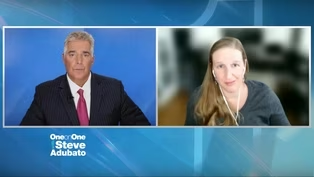
Climate Change, Flood Risk and Making Communities Resilient
Video has Closed Captions
Clip: S2021 Ep2460 | 6m 34s | Climate Change, Flood Risk and Making Communities Resilient (6m 34s)

COVID Vaccine Mandates' Impact on the Healthcare Industry
Video has Closed Captions
Clip: S2021 Ep2460 | 10m 11s | COVID Vaccine Mandates' Impact on the Healthcare Industry (10m 11s)

The Need for Social-Emotional Learning Post COVID
Video has Closed Captions
Clip: S2021 Ep2460 | 11m 16s | The Need for Social-Emotional Learning Post COVID (11m 16s)
Providing Support for PBS.org
Learn Moreabout PBS online sponsorship
- News and Public Affairs

Top journalists deliver compelling original analysis of the hour's headlines.

- News and Public Affairs

FRONTLINE is investigative journalism that questions, explains and changes our world.












Support for PBS provided by:
One-on-One is a local public television program presented by NJ PBS