Adelante
Season 26 Premiere
Season 26 Episode 1 | 26m 46sVideo has Closed Captions
Bembé Drum and Dance, FAST Fund Local 212, Vote 2024 Table Talk
Bienvenidos al primer episodiode la temporada 26 de Adelante! Bembé Drum and Dance es una organización cultural comunitaria que promueve las artes afrolatinas, Tambien ya son cientos los estudiantes que reciben ayuda de Local 212/MATC Fast Fund y en la cuarta parte de la serie “Vote 2024 Table Talk” una producción de Marquette University, Milwaukee PBS y Adelante! hablamos del tema: Inmigracion.
Problems playing video? | Closed Captioning Feedback
Problems playing video? | Closed Captioning Feedback
Adelante is a local public television program presented by MILWAUKEE PBS
This program is made possible in part by the following sponsors: Johnson Controls
Adelante
Season 26 Premiere
Season 26 Episode 1 | 26m 46sVideo has Closed Captions
Bienvenidos al primer episodiode la temporada 26 de Adelante! Bembé Drum and Dance es una organización cultural comunitaria que promueve las artes afrolatinas, Tambien ya son cientos los estudiantes que reciben ayuda de Local 212/MATC Fast Fund y en la cuarta parte de la serie “Vote 2024 Table Talk” una producción de Marquette University, Milwaukee PBS y Adelante! hablamos del tema: Inmigracion.
Problems playing video? | Closed Captioning Feedback
How to Watch Adelante
Adelante is available to stream on pbs.org and the free PBS App, available on iPhone, Apple TV, Android TV, Android smartphones, Amazon Fire TV, Amazon Fire Tablet, Roku, Samsung Smart TV, and Vizio.
Providing Support for PBS.org
Learn Moreabout PBS online sponsorship[LOGO SONORO] [MÚSICA DINÁMICA] PATRICIA GÓMEZ: Hola, soy Patricia Gómez.
¡Bienvenidos!
Bienvenidos a este primer episodio de la temporada 26 de Adelante.
Bembé Drum and Dance es una organización cultural comunitaria que promueve las artes latinas.
También ya son cientos de estudiantes que reciben ayuda de Local 212 MATC FASTFund.
Y en la 4ta parte de la serie Vote 2024 Table Talk, una producción de Marquette University, Milwaukee PBS, y Adelante, hablamos del tema inmigración.
[LOGO SONORO] PATRICIA GOMEZ: Bembé Drum and Dance es una organización cultural comunitaria que promueve la conexión intergeneracional a través de las artes afrolatinas.
Fue fundada en el 2015 y creada con educadores y artistas locales.
[DRUMS] JOHANNA DE LOS SANTOS: When we're thinking about the original use of the drum in communities where people were enslaved, they were coming from many different ethnicities from the African continent.
They were not all speaking the same languages.
They were coming from different cultures within the African continent, and drumming allowed those communications to take place.
It's an historical example of how communication was created between people who literally couldn't communicate with language in terms of freeing the spirit and freeing the body and the mind of stress of communicating in ways that are possible with words.
Music created through the drum, it's medicinal in many ways.
And then we also think about rhythm in our lives.
You know, our seasons are rhythmic, our 24 hours are rhythmic, the sun, our heartbeat, our breathing.
It's all rhythm.
So, everyone can drum.
BONI BENAVIDES: Yo empecé a tocar tambores desde que tenía 13 años en Bogotá, en mi colegio.
IMANI JALIL: I developed a passion for dance at a very young age just from just kind of seeing dance in the community.
JOHANNA DE LOS SANTOS: In my college years moved to the Caribbean and New York City where I spent many, many years studying, working in the Afro-Latino community.
BONI BENAVIDES: Es súper importante para nosotros que esas tradiciones continúen.
Continuamente estamos también investigando, estudiando, asegurándonos de que lo que estamos compartiendo con la comunidad, con nuestros estudiantes, sea, sea real y sea verdadero y sea lo que es.
NAZARETH SAAVEDRA: This is Casa Bembé, and this is, has been one of our goals for the past few years is finding our own space, and you know being able to make it a home for us.
And I think that that is, and we're going in a really great direction.
IMANI JALIL: We teach musical and dance traditions of the African diaspora particularly Afro-Latino music and dance, and the techniques and the cultural traditions that we teach come from places such as Puerto Rico, Brazil, Cuba, and Colombia.
BONI BENAVIDES: Muchos de nuestros niños, la verdad, no tienen referencia de estas tradiciones.
De pronto escuchan ciertas cosas en la radio, pero no, están conectados pero nunca de verdad lo han vivido.
Hoy empezamos a trabajar en ritmos de Colombia y siempre, a veces hay alguien como que yo creo que mi abuela era de Colom... o empiezan ellos como a hacer esas esas conexiones y eso es super bello y super importante para nosotros.
JOHANNA DE LOS SANTOS: It's so much more than a folkloric tradition.
It's a way of living or a way of being.
That was the connection that the community was making through Bembé.
IMANI JALIL: So for me, dance has always been the way that I connect to my roots and my culture, and I think a lot of our students relate to that as well.
And so not only are they maybe connecting to their own heritage or their own culture through our classes, but they're also learning about an art form.
BONI BENAVIDES: En el afán de uno como acoplarse a la nueva, al nuevo estilo de vida en un país nuevo, hay pocas escuelas que de verdad tienen un programa así por nuestra comunidad latina.
Si se pierde un poco.
NAZARETH SAAVEDRA: It's beautiful to see that you have families, adults participating with their children.
I think that's what really makes it special about Bembé.
IMANI JALIL: Music or dance can just be a vehicle of self-expression.
If you're finding you know that you're struggling with something or are struggling to communicate something.
JOHANNA DE LOS SANTOS: But we've also found a way to help foundations understand the importance of our work as a performing arts organization, as a cultural arts organization, and we have also received a lot of support from academic institutions in Milwaukee -- Marquette University, Medical College of Wisconsin, and University of Wisconsin -- Milwaukee -- who understand the health impact of what we're doing.
So, we've conducted some of our own studies on the impact that drumming and culture and connectedness as a community has on the mental health and stress loads.
BONI BENAVIDES: Es medicina, es algo de verdad que te cura el alma, te llena de felicidad, te da mucha seguridad.
Lo vemos en los niños, les cambia.
Ya sonríen, ya no están tan tímidos.
Quieren hacer solos.
[DRUMS] BONI BENAVIDES: Cuando lo empiezan a hacer la confianza, la autoestima crece de verdad.
Es tanto lo que tradiciones, la música, el tambor, el baile, todo lo que nos da.
JOHANNA DE LOS SANTOS: The name Bembé really came from it doesn't matter where you are or who you are, but coming together with rhythms and each other, if you have drums amazing, but if you don't, you have your palmas, you have your feet, you have your voice, and you have each other.
And that is something that I think is so important for us to remember and really, again, as I mentioned, it starts with our kids and for them to learn from the very beginning of their lives.
[MUSIC] PATRICIA GOMEZ: Local 212 MATC FASTFund es una organización sin fines de lucro que provee ayuda a estudiantes de MATC.
De acuerdo con este fondo, cientos de estudiantes han recibido apoyo, lo que ha ayudado a que la mayoría de ellos se gradúe y mejore sus fuentes de trabajo así como su condición económica.
VOICES: 87654321...there she goes!
[MUSIC] LIZ FRANCZYK: Lo que nosotros hacemos es intentar ayudar a estudiantes en MATC con emergencias.
Por ejemplo, si un estudiante está eligiendo entre pagar el alquiler o pagar por sus libros o sus clases, o nosotros podemos pagar una de esas cosas.
MICHAEL ROSEN: Well, the origins are that Professor Sara Goldrick-Rab from the University of Wisconsin Madison was doing research on economic crises and problems and security that a working-class students face.
LIZ FRANCZYK: Muchas de nuestros estudiantes viven en la pobreza y la ayuda del gobierno federal y de la universidad no, no alcanza con lo que necesitan, así que hay mucha necesidad.
MICHAEL ROSEN: The main reason students don't complete at MATC, the main reason is this basic needs and security.
They don't have enough money to pay their rent, and they get evicted, or their car breaks down and they can't fix it or their lights get cut off and so they're electricity is cut off, so they don't have internet access.
And when that stuff happens those students who are almost entire all parents they have to make choices and the choice is to take care of their families and themselves rather than their academics.
LIZ FRANCZYK: Casi 45% de los estudiantes ganan menos de $10.000 al año, pero más de 65% pagan casi la mitad de su sueldo en la casa.
O sea, cómo van a vivir, o sea, cómo van a comer e ir a la escuela y poner gasolina en el coche o sea, el alquiler, sin duda.
Y luego también otra cosa que es súper difícil es deudas que estudiantes tienen con MATC.
Por ejemplo, un estudiante empieza a estudiar aquí con 20 años, deja sus clases por no sé por qué y a los 40 años quiere seguir estudiando.
Ya está como en otro punto de su vida.
Intenta volver, pero tiene deudas que no sabía y para poder seguir tiene que pagar una cantidad y muchas veces no tienen esa cantidad y no hay ningún otro recurso en la MATC que ayuda con eso.
Este año pasado, del 2023 al 2024, nosotros ayudamos a 2.300 estudiantes con $700.000, así que mucho.
Así estamos básicamente cada año doblando la cantidad de estudiantes que ayudamos y el dinero que damos.
MICHAEL ROSEN: The biggest area of support has always been the faculty and staff at MATC and the MATC retirees.
They are exceptionally generous because they know the hardships that our students experience.
LIZ FRANCZYK: Pero hay mucho dinero también, que viene de fondos públicos de la ciudad de Milwaukee y del condado, de nuestros senadores y Congresspeople del gobierno federal también.
MICHAEL ROSEN: We don't only provide money amounts of money to help people overcome an economic hurdle, but we are able to advocate for them and connect them to resources that they might not have relationships with.
VANIA BUCZYNA: Me siento muy respaldada desde el principio, desde el principio del proceso cuando pedí la ayuda, tuve muy buenas respuestas hasta el final del proceso.
LIZ FRANCZYK: Hay estudiantes que necesitan $50.
Hay otros que necesitan $600.
Depende del caso.
El promedio es de $275.
VANIA BUCZYNA: En ese momento estaba en una situación un poquito difícil en mi vida con, tenía unos problemas con unos billes.
LIZ FRANCZYK: Muy poco para muchas personas, pero para otras personas es la diferencia entre seguir estudiando o no seguir estudiando.
VANIA BUCZYNA: Gracias a este programa se me abrió la oportunidad de que pueda concentrarme más en los estudios y pudiera hacerlo más fácil.
MICHAEL ROSEN: You know we help all students they can be English as a second language, they can be recent immigrants or refugees, they can be from anywhere in the world, they can be studying in any of our programs.
We're much less restrictive than some of MATC's programs.
LIZ FRANCZYK: Ahora tenemos la aplicación en español y es muy fácil.
O sea, tienen que hacer como una cuenta y luego rellenar el formulario que es, no sé, cinco minutos e intentamos llamar o mandar un mensaje de texto o un email ya ese mismo día si podemos.
VANIA BUCZYNA: Llené una solicitud, me tomó cinco minutos máximo.
Envié el correo y la respuesta fue inmediata.
MICHAEL ROSEN: Because we were less restrictive, we've gotten MATC to drop some of their requirements, like initially, DACA students were not eligible at MATC for their emergency program.
They've changed that now, and I think part of it was the example that we set and maybe some of the pressure that we put.
LIZ FRANCZYK: Yo quería hacer algo diferente y decidí hacer algo con eso porque conozco a mucha gente en este mundo, porque tengo muchos contactos.
Y también quería educar la cantidad de gente que sabe lo que pasa aquí en MATC, así que lo que decidí hacer, que es un poco ahora locura, pero lo hice ya, es andar en mi bici durante 24 horas.
MICHAEL ROSEN: It was a crazy idea, and I think that's it was so successful because everybody does galas every you know, there's traditional fundraising ideas, but the idea the executive director of a non-profit would ride their bike for 24 hours to raise money was so unique that attracted a lot of publicity, of course, got us a lot of donations.
It was a tremendously innovative idea on Liz's part.
LIZ FRANCZYK: La mayoría de la gente en plan, ¡pero qué loca!
O sea, ¿por qué haces eso?
Incluso mi mamá.
Mi mamá, que siempre me ha apoyado en todo, me dice, "no, esa es muy mala idea."
MICHAEL ROSEN: I have to admit when she first raised it, I was kind of skeptical, and I know her mom was too, actually.
She told me that.
[MUSIC] LIZ FRANCZYK: Queremos que los estudiantes puedan seguir estudiando y tener éxito en MATC.
MICHAEL ROSEN: It's very gratifying because I know I built something that started, I initiated something I shouldn't say I built it, but I initiated something that others also joined in on and together we created an institution that is really helping to change the lives of people in this community who are trying to do the best they can.
LIZ FRANCZYK: Yo quiero que esa gente tenga todo lo que necesita.
Esto es como mi sueño.
Yo sé que es como un sueño un poco, aaaah.
Pero, sabes, o sea, como la universidad gratis y que la universidad ayuda a sus estudiantes, así que ya veremos algún día.
[MUSIC] PATRICIA GOMEZ: En la 4ta parte de la serie VOTE 2024 Table Talk, una producción de Marquette University, Milwaukee, PBS y Adelante, hablamos del tema: inmigración.
[MUSIC] PHILL ROCCO: I'm Phil Rocco.
I'm a professor of Political Science at Marquette University, and I'm excited to talk to some voters tonight about immigration.
TAMMIE XIONG: I'm Tammie Xiong, raised in Milwaukee, Wisconsin, and I am excited to have a conversation around immigration.
STEPHANIE SALGADO: Hi.
My name is Stephanie Janet Salgado Altamirano.
I'm originally from Tegucigalpa, Honduras, and have been living for a decade in Madison, Wisconsin and I'm looking forward to hearing from our community members tonight about immigration.
PENNY PIETRUSZYNSKI: I'm Penny Pietruszynski from West Bend, Wisconsin.
I'm looking forward to this opportunity to discuss the immigration policies.
AL HAMDAN: Hi, I'm Al Hamdan, and I'm from Franklin, Wisconsin, and I'm here to talk about immigration.
MARK HOLLAND: My name is Mark Holland and I'm from Germantown.
And I'm really looking forward to having a conversation about immigration today.
PHILL ROCCO: According to public opinion polls, immigration is a top issue in this election.
The Pew Research Center noted that a growing number of migrants seeking entry into the United States at its border with Mexico has divided congress and has emerged itself as a top issue in the 2024 election.
Do you personally consider the situation at the border a crisis, a major problem a minor problem, not a problem and some people have argued that what we have at the southern border is not a border crisis, but an asylum crisis.
STEPHANIE SALGADO: For me being an immigrant is like the elephant in the room because from what I understood growing up, I always had this idea of like, wow, the United States is the greatest country of the world!
There's so many opportunities I can walk on the streets and not get kidnapped.
MARK HOLLAND: It is important to me, and I do believe that United States needs immigrants in order to survive.
AL HAMDAN: I feel like the politics sometimes demonize immigration more than it should.
I mean, I think 90-95% of immigrants are hardworking people.
Maybe you do have you know a few, you know, bad apples, but every society has bad apples.
It's not relevant to you know immigration, migrants, or other natives.
TAMMIE XIONG: It's not just what's happening on the southern border.
Children of refugees like we have, you know, thousands of, you know, Southeast Asians that are being deported that nobody really knows about.
And these are children that came here as children like refugee kids to experience that and to face that and through no fault of their own, you know, have to be having to be facing deportation to be sent to a country that they didn't even grew up in.
STEPHANIE SALGADO: I think everyone wants peace and wants freedom for their own community to be safe to walk around and to not feel like if you are a target or if you are seen as an alien.
What can that look like for you if the world politics becomes sour, like, can you imagine for immigrants that came from the middle east during 9/11 being from those places and then carrying that identity with you was so dangerous.
Or Asian folks during the pandemic, that was so dangerous because you were seen as foreign.
PENNY PIETRUSZYNSKI: I believe that it is a crisis because people are coming, and we need to protect our citizens.
We need to protect the people of America, and there's a lot of people that are coming in that don't have that agenda, that they're here to sell their drugs.
They're here to traffic people.
And I believe that we need to keep our Americans safe.
MARK HOLLAND: We need to monitor and vet the people that are coming in.
You just can't open the border and say, "Come on in."
You need to have a program, a system.
TAMMIE XIONG: I've never, you know, I guess I'm not in the spaces, and I don't hear the conversations of people saying, "Oh, you know, these people that are coming over here are like traffickers and bringing in drugs."
I think the more the spaces that I'm in are like sheer desperation, right.
What are people experiencing in their home country?
Why have they made that trek here?
Yeah, and I can't help but see my own humanity in that and say like, this is horrible, and we need to figure out, like a process.
But at the same time, we need to like treat people with, like, kindly and with respect and holistically because it's not okay how we're treating families that are arriving here on the border.
STEPHANIE SALGADO: I see the border and "border," right, man made borders that we created.
And I see my cousins.
I see brothers and sisters.
I see aunts.
I see families.
I see fathers.
How can I tell myself that I deserve to be here over them just because my parents had the privilege to pay through the process?
Just because I'm now a naturalized citizen just because I was able to make it out and not them?
And all this emotional vulnerability that I think I'm showing and feeling safe to do is because it affects me, it affects my communities who are from mixed status family.
It affects the people who are working in restaurants, maybe even the people who picked up our food and we had dinner tonight.
It's all those people who I see a hardworking people.
In the previous jobs I had, I was a community organizer for the Latinx community.
I've been a youth counselor for youth, and the trauma they just bring is so heavy that for them is survival at this point.
The idea of separation of families is beyond the not okay because we also realize how this separation of families have been done in so many different communities.
I was reading a book about Clint Smith about how the word is passed, and he was showcasing at one point the similarities between slavery in the United States and the same oppression tactics that is used today on how they were separating families who were brought in from multiple communities in Africa to then here and they were separating them by selling them, a human being, and then now here separating them telling, who is the criminal, who is going back.
Like you mentioned, it's unfortunately very polarized, but we really have to connect on our humanity that even if that person looks different from you.
PHILL ROCCO: What would a solution, right, to improving those pathways look like to you?
AL HAMDAN: This idea that you can just apply and just come, it's a misconception.
It's very difficult to immigrate to the United States, so you have people that are desperate.
And that's what we've talked about that solution in the mother country and the home country maybe is a is a better way to do it.
They have no opportunities, there's political persecution, there's murders, and then they're just rushing the border.
And they're rushing the border because there is jobs here.
To me, maybe a work permit program might make some sense.
MARK HOLLAND: Why are you coming to steal cars?
Why are you coming to commit murders, to rape, and all these things?
Why are you coming to the United States to do that?
My thing is, yes, you should get deported in that case.
You're not a benefit to society if you're doing those things.
Granted, it's not everybody.
The majority of people aren't doing that, right, 5% maybe?
That's a very small amount of people, but when you invite masses amount of people, and you don't do the vetting, but if you don't do the vetting, you're going to get more that do that.
TAMMIE XIONG: So much of the conversation about immigration then becomes around the 5%, and it didn't make enough room and space for like the 95% of people that are coming here to flee, you know, for safety, for jobs, for all of that.
STEPHANIE SALGADO: Yes, Latinx people were given jobs because this is where the United States have jobs, but those jobs were not necessarily 40 hours per week, were not necessarily $20 per hour, were not salaried jobs, were not jobs with benefits.
And we're also many, many times subjects of abuse, discrimination, racism, and then also stolen wages.
If you made all that track to have money to then afford with your family to bring them here for yourself or bring money back home, and your wage is being stolen, but then you don't think you have rights because you're maybe be undocumented.
It's a sad reality that we have to confront, the why.
AL HAMDAN: Technically, immigrants are not qualified for social programs.
I mean, you gotta be a U.S. citizen or you've got to be, you know, a green card holder, otherwise you're not gonna get social programs, you know.
And if you get sick and you go to the hospital, they gotta treat you, but as a as a as a general rule, and you guys can correct me on this, you can't go apply for like food stamps.
You can't go apply for unemployment benefits.
If you don't have, if you have legal, you just can't do it, you know.
STEPHANIE SALGADO: And you still pay taxes.
AL HAMDAN: And you still pay taxes.
PENNY PIETRUSZYNSKI: I have a question.
PHILL ROCCO: Yeah.
PENNY PIETRUSZYNSKI: What does everybody think?
Um.
Do we need a wall?
AL HAMDAN: I think we need to govern and know who's coming in, and it should be channeled the right way.
MARK HOLLAND: And so in some ways I think, yeah, a wall would be good.
But then in some cases, I think, um, it's not very inviting, right.
It's like saying, stay out.
STEPHANIE SALGADO: I don't think we need a wall.
I think with a wall or not, people are still going to come in.
PHILL ROCCO: My hope for the future of American politics is: AL HAMDAN: I'd say, civility.
PENNY PIETRUSZYNSKI: United.
TAMMIE XIONG: That people really see each other's humanity.
MARK HOLLAND: Bipartisanship.
STEPHANIE SALGADO: Equitably.
[MUSIC] PATRICIA GÓMEZ: Y con un "hasta pronto" nos despedimos, invitándolos a que nos dejen saber sus comentarios por el teléfono cuatro 414-297-7544, a que visiten nuestro sitio de internet en milwaukeepbs.org y en las redes sociales.
Soy Patricia Gómez, deseándoles paz y bendiciones.
[MÚSICA]
Video has Closed Captions
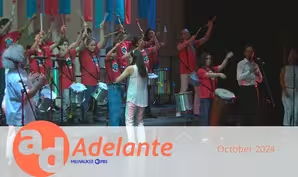
Clip: S26 Ep1 | 6m 5s | Bembé Drum and Dance is a community-based cultural organization that promotes intergenerational art (6m 5s)
Video has Closed Captions
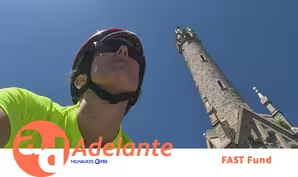
Clip: S26 Ep1 | 7m 55s | Local 212 MATC Fast Fund is a non-profit organization that provides assistance to MATC students. (7m 55s)
Vote 2024 Table Talk on Immigration
Video has Closed Captions
Clip: S26 Ep1 | 9m 57s | 4th part of the series “Vote 2024 Table Talk” - focus on Immigration (9m 57s)
Providing Support for PBS.org
Learn Moreabout PBS online sponsorship













Support for PBS provided by:
Adelante is a local public television program presented by MILWAUKEE PBS
This program is made possible in part by the following sponsors: Johnson Controls