
Season 4 Episode 1
3/11/2023 | 27m 40sVideo has Closed Captions
Alex Duran, NJCU's Andres Acebo, mental health professionals Anna Flores-Locke & Jen Libby
Carlos chats with NJ restauranteur Alex Duran (Son Cubano, Ventanas); New Jersey City University Interim President Andres Acebo and mental health professionals Dr. Anna Flores-Locke and Jen Libby.
Problems playing video? | Closed Captioning Feedback
Problems playing video? | Closed Captioning Feedback
¿Que Pasa NJ? with Carlos Medina is a local public television program presented by NJ PBS
Season 4 Episode 1
3/11/2023 | 27m 40sVideo has Closed Captions
Carlos chats with NJ restauranteur Alex Duran (Son Cubano, Ventanas); New Jersey City University Interim President Andres Acebo and mental health professionals Dr. Anna Flores-Locke and Jen Libby.
Problems playing video? | Closed Captioning Feedback
How to Watch ¿Que Pasa NJ? with Carlos Medina
¿Que Pasa NJ? with Carlos Medina is available to stream on pbs.org and the free PBS App, available on iPhone, Apple TV, Android TV, Android smartphones, Amazon Fire TV, Amazon Fire Tablet, Roku, Samsung Smart TV, and Vizio.
Providing Support for PBS.org
Learn Moreabout PBS online sponsorship- [Announcer] Funding for this episode of "Que Pasa NJ?"
with Carlos Medina has been provided by Horizon Blue Cross Blue Shield of New Jersey, the New Jersey Economic Development Authority, Hackensack Meridian Health, the Engineers Labor-Employer Cooperative 825, PSE&G, "ROI-NJ Business Magazine."
- Hola, familia.
Welcome to the Season Four premiere of "Que Pasa?"
Thank you for all the letters, for all the emails that you sent, and thank you to NJ PBS for renewing our contract for this fourth season.
This episode, you're lucky to have Alex Duran, the owner of Duran Entities, which include the famous Son Cubano restaurant, you have Andy Acebo, who's the interim president at NJCU University right here in Jersey City, and Dr. Anna Flores Locke, and Jen Libby, who are both mental health experts.
Thank you, and don't forget, que pasa?
(energetic Latin music) And our first guest for Season Four is Alex Duran of Duran Entities.
Welcome to "Que Pasa?"
- Thank you, Carlos.
Good morning to you and congratulations on your fourth year.
- Tell me about the companies that encompass Duran Entities.
- You know, Carlos, we first started the thought in New York City with a restaurant by the name Son Cubano, which many of you are aware of, in the Meatpacking District.
And then when the lease ran out, Apple came in and offered him a little more money than we could, and so we decided to relocate it and bring it onto the Jersey side, and by doing so, we started to create in our minds a bigger picture of more restaurants growing into the field of what my wife does, which is she was a teacher and then principal, administrator, and assistant director.
She was the director, so we also said, "Let's do some schools," like daycare schools, and so we came up with the name Duran Entities to cultivate and put it all together as a holding company.
And that's where Duran Entities started.
- Tell me more about Son Cubano.
It's a very well-known restaurant, views of Manhattan and West New York, New Jersey.
- Yes, it is.
Thank you for that.
Yeah, we kind of symbolize, growing up in West New York where I grew up, it was mostly Cubans.
Although I'm Colombian, I thought I was Cuban, so we didn't know really many more than the Hispanic other than the Cubans, so my sisters and my brother-in-law and my brother and myself, we all decided to joint venture of a restaurant business.
It's kind of what we went to school for.
So, we decided New York City being that there wasn't such a Cuban community and the food would fare well, and it went off in New York City.
We did it for 13 years.
We're located right next to The Lotos Club.
So, everything, they refused, we started getting.
- I like that.
- And then we added the Latin flavor with the dancing, and it took off.
I mean, I can only tell you, glory to God, because there's nothing we did that was so much more special.
We had a touch to it, and my sisters, of course, were amazing, and it took off and then we just said it was a great run for 13 years, and then as I said, Apple Store came in, offered the landlord a little more money.
and click, out you go.
- Tell me about your family's, you mentioned Colombia, your immigration story.
Tell me about that.
- So, Carlos, my parents, like most immigration stories, came to this country for a better life.
So, my father actually followed my mom.
My mom used to work for Avianca in Colombia, Avianca Airlines, and he followed her to the States, 'cause my grandfather didn't want my father marrying my mom, so he proposed and married her here, and then their intention was to go back, and lo and behold, yours truly, I come in, so my mom gets pregnant with me, and that's what, '62?
And they didn't have the money to go anywhere at that moment, and it was just like, come here, survive, and live it up.
And you know, it's funny, you have a picture of Roberto Clemente, and my father's first wish was to see the Yankees against the Pirates, and I believe it's 1960, and that's why he really came here.
So, he ends up seeing the World Series game, and he's enlightened, and he says, "Forget it, I'm just gonna stay here now."
Mom was pregnant, my mom was pregnant with me, and then they made a life here in West New York.
- That's great.
Tell me about the newish venture in Fort Lee, Ventanas Restaurant.
You're also partnered with David Burke, the chef?
- Right, so David Burke, who has joined the the team, is my chef, per se.
He handles all the kitchen situation, hiring and firing and so forth, and the menu, and we have very talented chefs that come around along with him, and prior to him, like Cardona, Ricardo Cardona, which is very familiar.
It's a good team.
It's a great team.
He's not my partner as a ownership, but he's my partner in making decisions with the restaurant as far as the kitchen.
It's been a blessing.
I can't tell you anything other than that.
We've been at it five years.
So, we waited eight years, almost 10 years before I decided to start a new restaurant in Fort Lee.
We wanted to kind of stay on the Gold Coast of the whole Hudson River, so we went with Ventanas and the location was awesome.
We built that from beginning, took the property from SJP.
They actually elected my team and not David Burke's team, and he introduces us both, and that's how we ended up meeting, and then say, "You know what, Burke?
You didn't get the property, but why didn't you stay on-board anyway?
Let's do something bigger."
And we have, and I've stayed with him consulting and doing other projects around Jersey, so.
- That's a great story.
- It's a blessing.
- And I understand you have plans for a Jersey City location?
- That's correct.
So, we've been looking at a place, not going to disclose it, but it's right on the water.
Again, stay on the Gold Coast.
We may bring a little twist to it with adding golf simulators.
- Oh, cool.
- Yeah, so making more family, and because with it, it comes other games that you get to join in, so we're looking at a couple of these golf simulators and see which one fits the best scene.
But again, bringing it with a Latin flavor.
We're going to have dancing, live music, Sunday brunches, Saturday brunches, and from here on, for me, I'm cruise control in a sense, but I'm also waiting for my two boys to step in, Travis and Tristan, and take over and do what they want to do now.
- As a child of immigrants who succeeded and faced a lot of hurdles in life, what would you tell entrepreneurs that are coming up, maybe new to the country or first, second generation?
Give me some words of wisdom to share with our viewers thinking of taking on an entrepreneurial journey.
- Sure, Carlos.
You know, this is the country of freedom.
It's a country you could do anything you put your heart to.
It's a lot of work.
Sometimes people get the impression that you can come here and have it and not do the work.
No, you're going to work your butt off, and when you do that, it will pay off, but you have to understand something in the way we've always raised our kids.
We put God first and then, when you put God first through the Holy Spirit, he's going to open up to you and tell you what are the right things to do.
What happens is that we think we know everything so we start stumbling along the road, and there's a lot of times we can save ourself a lot of time, heartaches, if we do the right thing by listening.
So, what I would tell them is, you come here, work hard, I'm all for education.
Get an education with it and listen and get connected to people who have been successful, and when you do so, when you do become this entrepreneur, you have to know you have to give back.
Give back to the community that helps you because we forget those.
Sometimes we are like, "Well, they don't need it."
And Latinos, I tell you something, if I depended just on my close-knit friends to support my business, I would be closed today.
(both laugh) It's just the nature is, versus the Jewish people.
They help each other out through years and years and years.
So, you know, I think the lesson we need to do is if you're going to be an entrepreneur, help your community, give back to your community and expect nothing in return.
Just give back and somewhere else you'll get something in return.
- That's great.
Thank you for being a role model and thanks for joining "Que Pasa?"
- Always a pleasure.
Thank you for having.
Good luck for the season.
God bless you, my friend.
- Thank you so much, Alex.
And up next, we're happy to have with us today the interim president of NJCU University, Andy Acebo.
(upbeat salsa music) Welcome back, and our next guest is Andy Acebo from NJCU right here in Jersey City, New Jersey, the new interim president.
Welcome to "Que Pasa?"
- Thank you for having me.
- Tell me a little bit about this journey from, what were you, General Counsel?
- I was, yes.
- Chief of Staff and now- - Chief of Staff, General Counsel.
- Big jump to Interim President.
- Yes, yeah.
It would be underserving the path to say that it's anything sheer of humbling and a grand honor to have been bestowed.
I'm Hudson County through and through, proud product of its public schools, deep ties to the community, first-generation son of Cuban exiles, and so much of that mission of this institution and what it's meant for so many people, I've been a direct beneficiary of it, right?
I've said publicly that teachers that graduated from NJCU educated me, nurses that graduated from NJCU nursed me, and police officers and public safety that graduated from that institution protected me, so I've been a direct beneficiary of it.
My wife's an alum of that institution.
My mother-in-law who put herself through college as a single mother, bringing her daughters in tow with her sometimes to class, right?
That story isn't unique on my campus.
And so being able to be someone that can safeguard that mission, to shepherd it during these particular moments in its history, it's been an amazing honor and privilege.
- What's it about the water here in Hudson County?
I know we have a very young congressperson now in Rob Menendez and now we have a very young president.
- Yeah.
I think there's something about Hudson County and I think the rich diversity of our community that we're poised to break molds, right?
And I think we honor that because of the sacrifices that those that came before us forged.
I stand on the shoulder of great community leaders that paved ways, right?
But also in a community of immigrants and working class folks that started their lives anew in this place, right?
With nothing many times but the clothes on their backs and take leaps and bounds to achieve what we've achieved, and the way I think you honor that is by how you commit yourself to service.
- Sure.
Refresh our viewers' memory.
I know you were on when we talked about the crisis in Cuba last year, but tell our viewers a little bit about your family's immigration story.
- Sure.
So, in a way that is uniquely American, right?
Is that my story and my family story didn't begin in this country.
I'm a first-generation American, the son of Cuban exiles.
My father came in the mid-1960s on a raft with a compass that I still have to this day that is proudly displayed in my office with just the aspiration, right?
That he charted for himself to pursue something better.
My mother joined, arrived into this country with her family, similar experience, but on the Freedom Flights from Cuba in the late 1960s and early '70s, and found themselves from two polar opposites parts of the island in Miami where they fell in love and had a son in Hudson County, New Jersey on Havana in the Hudson, right?
And that experience, deeply tethered to my culture and my roots being very intentional from a very young age about being proud of that culture, and that's a gift that I've inherited in real-time, right?
That my parents have passed on to me in their life to be an ambassador for my community, that as I enter spaces and places that weren't historically meant for folks like us, that I bring my community with me.
- Tell me some of the facts and figures of NJCU.
I know they're pretty impressive.
What's the Hispanic student population?
- Sure.
The Hispanic population, so we're the oldest public university that's designated as a Hispanic-serving institution.
Over 40% of my students identify as Hispanic.
21-plus percent identify as Black or African American.
So, we're the oldest minority-serving, Hispanic-serving institution.
The socioeconomic profile of my students is nothing sheer of impressing when you consider what they overcome, the systemic marginalization and economic hurdles that they overcome.
We're the most socioeconomically diverse campus of any of the four-year public universities.
The median household income, Carlos, of my students is $42,000 a year, median in North Jersey.
60-plus percent of my students, undergrads, come from Hudson County.
Their path and their trajectory, right?
In pursuing a better life through higher education is anything but linear.
Many of my students are, they're what we call non-traditional students.
They're working adults, right?
That work hard to provide for themselves and their families, so they have to take time off from school.
We're a high-access institution with a mission of economic mobility, right?
And I think that that's something to take pride in as a community and something that is worthy of investing in and championing and saving.
- We've had Hudson County Community College here in the past.
Tell me about your relationship with that two-year institution.
- It's phenomenal.
So, another HSI, right?
That serves a very similar demographic of students.
Deep partners.
I've said this privately and I'll say it publicly, that Chris Reber, President Reber has become a friend, someone who walks the walk and talks the talk about our students.
We share and we have alignment in that higher education because we've lived it ourselves, is a pathway to the American dream, and our institutions are indispensable to the community we serve.
We're indispensable to one another.
A significant amount of students transfer from Hudson County Community College to NJCU right down the street every year, hundreds, in pursuit of their four-year degree and graduate studies.
That relationship of being an economic engine, a steward of economic mobility, are things that our institutions are intertwined in, and I can't think of a better partner to have as a newcomer to the higher education leadership space.
- Tell our young viewers how easy it is to transfer from a two-year college to NJCU.
They may not be familiar with the process.
- Yeah, it's smooth because of the partnership we have, particularly with Hudson County Community College.
We've done things to make access more affordable, so NJCU, long before I was even a thought on our campus, launched something called the Debt-Free Promise back in 2016 that makes debt-free education, four-year education, for any household income under 65,000.
With the investments from the this administration and the state in community college and becoming free, those are things that we've intertwined ourselves to create a natural pipeline to virtually free public higher education, but more importantly, I think, is the streamlining and something that we will be announcing in the coming weeks of a Hudson Promise of connecting and making it even more seamless, that transition, that students at Hudson Community College see themselves finishing a degree just down the street, right?
And mastering their fate in real-time and that we block and tackle for them life's obstacles that disproportionately impact them.
- Thanks for joining us, and continued success at NJCU.
We'll be monitoring your progress over there.
- I appreciate that.
Thank you very much.
- And up next, we have Dr. Anna Flores Locke and Jen Libby who are both mental health experts.
(upbeat salsa music) Welcome back, and we have mental health experts Dr. Anna Flores Locke and Jen Libby.
Welcome to "Que Pasa?"
- Thank you.
- Thank you.
Thank you for having us.
- Anna, tell me a little bit about your practice, Charlandra Consulting.
- Yes, well, Charlandra Consulting and Counseling Services was actually named after my twins, Charles and Alejandra, who were conceived through IVF because I live with infertility and struggled to get pregnant, and we started this business to be a mental health community resource for our communities, not only for moms struggling with mental health, but also for adolescents and men and women and teens.
- Jen, tell me about your practice.
- Sure, thanks, Carlos.
Well, I'll say this.
I moved to New Jersey probably about 20 years ago, and I started private practice in Morristown, New Jersey, and I was known as the therapist that would treat a lot of the difficult-to-treat issues, so kids who were high-risk, self-harming, suicidal, eating disorders, that sort of thing, and unfortunately, really watched the mental health crisis emerge over this last 20 years, and it became obviously difficult to watch as we watched the suicide rates really increase very dramatically I would say between the years of 2009 to 2019, and really at an exponential level in 2020.
And probably I would say about in 2015 or '16, kids would say to me routinely, my clients would say, "Jen, adults created social media.
They know it's harming kids.
They know it's killing kids.
Why aren't the adults stepping up to fix it?
Do they just not care what happens to us?
Are we just some kind of experiment generation?"
And I'd look at them and I'd say, "Guys, I'm sure there's really smart people at Google, at Facebook, at all these big tech places.
There's good people that work there.
I'm sure somebody's working on a solution."
And then it became very apparent as we see kids struggling more and more, they're not really seeming to work on a solution very quickly and kids were getting more frustrated, And so I really just pushed it back on the kids to say, "Well, guys, what would you do if you were going to fix the social media problem?"
And so we really started a small group to kind of brainstorm how to come up with a solution that would be scalable and provide access to mental health resources, which is really important to kids, and so we created Promly, which is a new social ecosystem really specifically built for 13- to 19-year-olds.
We also have a college version coming out, but empowered by Gen Z empowered by this generation of kids that felt really abandoned by what social media has done to them, but then really wanted to empower them to create an impact, and fortunately we've been able to really do that in a pretty big way.
- What has been some of your experience during COVID for your clients and your colleagues?
- Yeah, and Jen, and I just want to commend you for what you're saying, 'cause the reaction I felt was really how our teens are dispensable.
- Yeah.
- Which is a shame.
And unless they have that power to get off social media or regulate themselves, which is hard for any of us to do because it's meant to draw us in in a very neurological way, they are susceptible to the negative effects of social media.
So, some things that I've also seen, especially with COVID, because of the COVID crisis, we have to social isolate.
Social media, ironically, social isolates us, so it's a double whammy that really affects mental health because the way I think of mental health is from that wellness perspective, and one of those domains of wellness is social connection, and COVID has really taken that from us as well as socia media.
So, I have really seen that increase of depression, anxiety, because we all are in this kind of posttraumatic stress, I like to call it.
COVID was really a mass trauma and we're still in it.
We're still facing it, and I know we haven't seen all the ramifications of what that even looks like, and it's across all ages, and my kids, I have 10-year-old twins now, and one thing that they are telling me now, they're back in piano lessons, drum lessons, doing soccer, and my daughter will tell me, "Mom, it feels so good."
- Right.
- And that's what they're commenting about, that oxytocin.
"It feels so good to have eye contact with my piano teacher.
She's so friendly.
She's so nice.
And to be playing music and doing something with with your muscles."
Right, again, with mental health, it's about wellness.
Another domain is physical movement, music and dance and using our muscles beyond our thumbs.
- And for adults as well, right?
- Let me ask each of you if you could give our viewers one strategy to combat the mental fog that many people are in the past 2-1/2 years with COVID, what would each of you give as a- - I would say eye contact, I would say.
- [Carlos] Okay, that's fair, that's fair.
- Even just, I joke 'cause they say, they did that study, I don't know if it was the "New York Times" or something like that, and it was having conversations, let's say with strangers, and I think they asked 35 questions or something, and then it followed by four minutes of sustained eye contact.
Okay, that's a lot.
I would even say that solid 10 seconds of sustained eye contact.
When we talk to people that just practice that for just a few minutes, they feel it, right?
And kids are so, it's hard to pull them away from their phones.
It's hard to pull parents away from their phones.
I know I have to check myself on I'm doing 45 things on my phone, but just conscientious eye contact is a healer.
- And I would also say the physical movement or outdoor activity together in connection in community.
Our kids are telling us what they need.
They want to be off the social media.
They want to have their time, including the eye contact and physical touch, I would add, the hugs, the kisses, right?
One thing Latinas are known for, kissing and hugging and shaking hands, and again, COVID told us, "Don't do that."
And now we're in this awkward transition of like, "Can I kiss you?
Do I fist-bump you?
What do I do?"
But yet we need that social connection through physical contact and that outdoor experience together as family I think would be wonderful for the mental health of the parents as well as the children, and the phones stay at home.
- So, Jen, tell me about this Promly Music Festival coming up in April.
- Thank you, Carlos, and we are very excited.
One of the things that, obviously, Promly, we're an app, but we also, through our nonprofit, do a ton of outreach events.
But the whole idea is to really bring events to the community to empower and really engage kids in a memorable way around youth mental health, so we've been working with the Prudential Center to come up with an amazing show.
April 22nd is the date, and we are planning on Pitbull headlining, which is very exciting.
We picked Pitbull because of his philanthropic work and his real commitment to youth already through the SLAM!
schools.
We'll be honoring for Gen Z change-makers who have done really exceptional things in the world to empower other kids, to empower adults through various channels.
We're also working with the NBA, the NHL, the New Jersey Devils Youth Foundation, as well as up-and-coming Gen Z artists.
So, we're fired up.
It's going to be great.
- Sounds great.
- Great.
Great.
- Yeah.
- Mark your calendars.
- Yes.
- April 22nd.
- Yes.
- I'll be there.
- Yes, with bells on.
Yes.
- Dr. Anna, Jen, thank you for joining "Que Pasa?"
You've given us a lot of good information.
- You're welcome, and I can't wait to be at the music fest with my kids.
- Same.
Same.
Same.
- Thank you, Carlos.
- Thank you.
- Ladies and gentlemen, that's a wrap.
Thank you for joining us on Season Four, Episode One.
I have a little new segment I'm going to do here called "Carlos's Rant" or "Words of Wisdom from Carlos."
I'm just going to talk about New Jersey drivers.
I know we're world-famous, but if you're on Route 80 in particular and if you're in the left lane, please remember that's a passing lane.
If you're not passing, kindly move to the middle or right lane.
Thank you, ladies and gentlemen, and I hope you enjoy this episode of "Que Pasa?"
- [Announcer] Funding for this episode of "Que Pasa NJ?"
with Carlos Medina has been provided by Horizon Blue Cross Blue Shield of New Jersey, the New Jersey Economic Development Authority, Hackensack Meridian Health, the Engineers Labor-Employer Cooperative 825, PSE&G, "ROI-NJ Business Magazine."
Thanks to the Statewide Hispanic Chamber of Commerce of New Jersey.
Find out more about our familia at shccnj.org.
This has been a production of the Modesto Educational Foundation.
(upbeat salsa music)
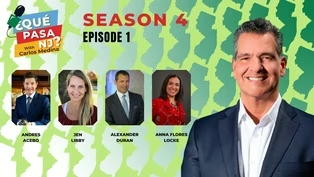
Preview: 3/11/2023 | 22s | Alex Duran, NJCU's Andres Acebo, mental health professionals Anna Flores-Locke & Jen Libby (22s)
Providing Support for PBS.org
Learn Moreabout PBS online sponsorship













Support for PBS provided by:
¿Que Pasa NJ? with Carlos Medina is a local public television program presented by NJ PBS