
Season 4, Episode 5
Season 4 Episode 5 | 26m 46sVideo has Closed Captions
We’re headed back to the late-’80s and early-’90s on Retro Tennessee Crossroads.
This time on Retro Tennessee Crossroads, Al Voecks will get us in the Valentine’s Day spirit at a candy kitchen, Jerry Thompson will take us to see some turtles, Janet Tyson visits with some good old Western cowboys, and Susan Watson flies a kite!
Problems playing video? | Closed Captioning Feedback
Problems playing video? | Closed Captioning Feedback
Retro Tennessee Crossroads is a local public television program presented by WNPT
Season 4, Episode 5
Season 4 Episode 5 | 26m 46sVideo has Closed Captions
This time on Retro Tennessee Crossroads, Al Voecks will get us in the Valentine’s Day spirit at a candy kitchen, Jerry Thompson will take us to see some turtles, Janet Tyson visits with some good old Western cowboys, and Susan Watson flies a kite!
Problems playing video? | Closed Captioning Feedback
How to Watch Retro Tennessee Crossroads
Retro Tennessee Crossroads is available to stream on pbs.org and the free PBS App, available on iPhone, Apple TV, Android TV, Android smartphones, Amazon Fire TV, Amazon Fire Tablet, Roku, Samsung Smart TV, and Vizio.
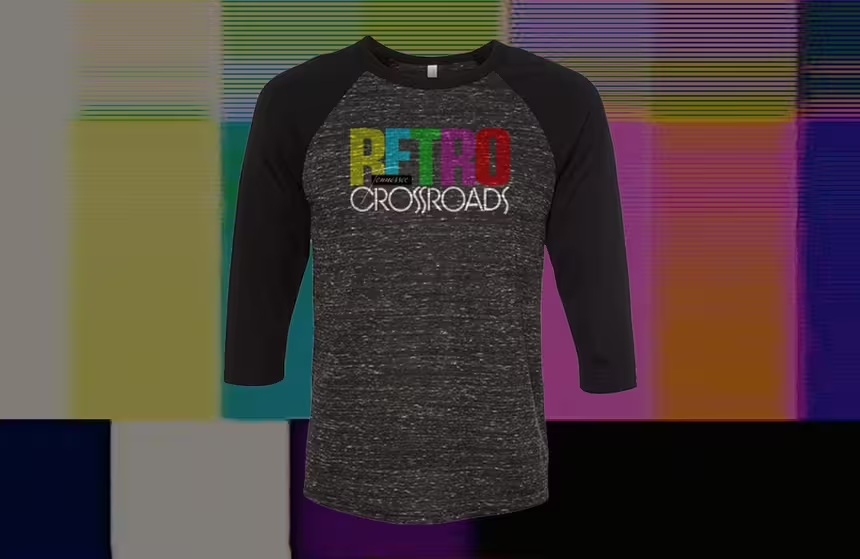
Rad Retro Tennessee Crossroads Tee
Show your love for your favorite Nashville Public Television show by donating and you'll get this limited edition Retro Tennessee Crossroads baseball shirt.Providing Support for PBS.org
Learn Moreabout PBS online sponsorship- This time on "Retro Tennessee Crossroads" Al Voecks gets us into the Valentine's Day spirit at a candy kitchen.
Jerry Thompson will take us to see, of all things, some turtles.
Janet Tyson visits with some good old Western cowboys, and Susan Watson flies a kite, but it's not just any kite.
Hi everybody, I'm Laura Faber.
- And I'm Miranda Cohen.
Welcome to another episode of "Retro Tennessee Crossroads".
(gentle music) (film reel beeping) (gentle music) Up first, this time, we have a sweet old story about a beloved candy maker in Murfreesboro.
- That's right, Miranda, and just in time for Valentine's Day.
Well, back in 1991, Al Voecks found Eddie Taylor making candy in his shop in Rutherford County, and he brings us the story of Old Taylor's Candy Kitchen.
- This is a tough time of year.
Most people for the past few weeks have been desperately trying to get rid of the excesses of the holidays.
You know, that period between Thanksgiving and the first of the year when everything tastes so good.
Most people have been fairly diligent and have shown a lot of willpower to stay with the program that they have chosen to shed a few pounds.
And just when we start feeling good about ourselves again, lo and behold, look what time of the year it is.
It's Valentine's Day.
Now Valentine's Day is love and cards and flowers and candy.
Well, no one said life was fair.
So let's concentrate on the candy part of the Valentine's Day observance.
We go to Murfreesboro, and Old Taylor's Candy Kitchen.
Now, this is strictly a family operation, has been for the past 31 years when Weldon Taylor founded this organization.
Currently, the kitchen is under the direction of Eddie Taylor, Weldon's son.
There are bigger candy makers of course, but size is not important to Eddie.
- [Eddie] No, it's really not, Al.
We pride ourselves on being small and being able to maintain our quality.
We are able to use real butter, real cream.
Our fudge has pure whipping cream in it, so we can control it.
If we're small, we can control the shelf life.
We make small batches.
We really enjoy being unique and small.
- [Al] Is Valentine's Day a big time of year for you?
- It's probably our second or third biggest holiday.
Christmas is first of course, and then Valentine and Easter are real close together as far as size and sales.
Each piece of candy has its own recipe and just like you make candy at home, we have to follow the recipe, which we've been making candy a long time.
We pretty much know most of the recipes, but the ones that we're not familiar with, we for sure follow a recipe.
You know, it's sugar and corn syrup and, you know, egg whites if it calls for it, just like you making candy home.
- [Al] The age old question, your cream filled candies, all cream filled candies, are always the same shape and size.
How do you do that?
- [Eddie] We've got a machine in the back that is called a cream former.
And when we make a cream, it's in the dough stage, it looks like dough, biscuit dough.
It's that consistency.
And we'll put it on this machine and it's got cogs that turn it, and you push it through a dye, it shapes it, and then there's an arm that comes and cuts it off and drops it on the board.
So every cream, as you say, is the same size and shape.
- [Al] I guess then the other question of a secret of the trade is how do you get the chocolate on the bottom and then also on the top?
- [Eddie] Well, in our operation, we have a machine called an enrober, which it enrobes candy in chocolate.
Okay, and it runs, the chocolate runs first over a pre-bottomer, which gets a coat of chocolate on the bottom side of the caramel if we're making caramels.
Then it'll go over a cold plate where the belt is cold and allows the chocolate to get firm and stick to the piece of candy instead of to the belt.
And it goes from the cold plate into the coater part of the enrober.
And then it goes through a, the candy goes through a curtain of chocolate and gets covered completely on the top, actually gets another coat of chocolate on the bottom.
So it's really kind of two coats on the bottom in this machine.
And then comes out on the other end where there's a lady that either is stringing it with white chocolate or marking a special mark on the candy.
- [Al] Is there any finger licking going on back there?
(Eddie chuckling) - We oftentimes give tours through the kitchen and well, I'll always tell, especially the children to watch the lady that's doing the hand dipping 'cause she oftentimes wants to lick her fingers and we don't like for her to do that.
And they get a big kick out of that.
But yes, we always nibbling on candy around here.
- The nineties have been referred to as a decade to get rid of the excesses back to health and nutrition.
Some might put candy in that excess category, but Eddie totally disagrees.
- [Eddie] As people are getting more intelligent about nutrition.
And there are articles coming out all the time that we, there was an article out in one of our trade publications that noted that chocolate is really not as harmful as once thought for tooth decay.
Chocolate has a part of it that really aids in keeping teeth from decaying.
A square of chocolate, an ounce of chocolate, for example, just pure milk chocolate probably only has about 80 or 90 calories in it.
You know, there's a lot of foods that have more calories than that.
So again, if you eat in moderation, you know, you don't have to be concerned.
- [Al] It's hard to imagine anyone who would fall in this category, but for those who might prefer something other than chocolate, well there's always this, cinnamon hard candy.
And that of course calls for a totally different process.
- [Eddie] Hard candy's cooked obviously hard.
It's cooked high.
It's cooked to like 320 degrees.
We pour it out on a marble slab, work in the flavor and the color on the marble, while it's actually on the marble slab.
And when we first pour it out, it's a liquid.
So we've got to keep working it up and cool it down until it gets again in that dough stage consistency.
And then we run it through a little mill that shapes the hard candy.
And then after it comes out of the mill, we break it up and rub all the rough edges off of it.
And we'll wet it, you can just pick lemon drops in your now, we'll, you know, get those lemon drops wet and we'll tumble 'em in granulated sugar.
And that granulated sugar sticks to it, the wet lemon drop, and then the candy was originally called Sugar Sanded Hard Candy and that's where it gets its name.
- For many people, the ideal job would be a clerk in a candy store, or better yet, go ahead and own the whole candy store.
Anyway, this is a sweet time of year, so go ahead and indulge yourself.
Mm.
By the way, Happy Valentine's Day.
All right guys, now let's do this, let's do this again.
I wanna make sure this closing is just right, so we might have to do it again.
In fact, we might have to do it, one, two, three.
How about four more times?
Mm.
- Okay, candy always looks so good when it's being made.
- Yes, yes, homemade.
- Now the Old Taylor's Candy Kitchen closed in 1995, but that thing was open for 35 years.
I'm sure people miss that.
- That is a long time and it looked amazing.
You know, you and I have both done stories on chocolatiers, on candy makers.
I'm sure they were inspired by that.
You know, just making it the good old fashioned way out of your home, thinking, if I love it, if our family loves it, people will love it.
- Just full of sugar.
- That's good.
- You can't go wrong.
- Full of goodness.
- Yes.
- What's not to love?
- Okay, Miranda, now that we're full of candy, where are we going next?
- Would you believe of all places, the Cayman Islands?
- What?
- The Cayman Islands, that's right.
Now if you've been watching our show since the very beginning, you know that in the very first season the crew took a trip to the Cayman Islands.
It was a Sister City partnership.
Tough assignment, right?
But while they were there, Jerry Thompson got to visit a farm that is very different than what we see in Tennessee today.
It's a turtle farm.
- The sign is pretty indicative of the Caymanian life here.
The turtle is the national symbol.
Slow is sort of a national pastime.
There's very little use to put this sign up because people go slow here.
However, upon a close examination, I noticed that the second S is turned back.
Maybe that means turtles cross the road here in both directions.
(upbeat music) That sign aroused my curiosity.
So I rented a van and drove to the west end of Grand Cayman Island to take a tour to see for myself.
(upbeat music) I found a man who knows more about turtles than anyone I've ever met.
Shirley Delbert loves turtles.
He takes tour after tour through the farm, carefully explaining each phase of turtle growth.
- This is a one-year-old turtle.
It's a green turtle.
It gets its name from the drab olive green fat.
And from that fat is where they obtain turtle oil for making cosmetics.
Turtle meat here is one of the stable meats used here on the island of the Caymanians.
The turtle farm here is supplying about 10% of the local demand for turtle meat.
It's not feasible to meet the local demand for turtle meat 'cause they would build up such a high volume of the byproducts it would be phenomenal as they're shipping no turtle products off the island.
You'll notice they're very docile.
- [Jerry] Shirley Delbert knows they're harmless, but the only turtles I've ever had any experience with are the old Tennessee snapping turtles.
So I looked at catching a turtle, kind of like I would trapping a porcupine.
Once you get 'em hemmed up, you plan your next move very carefully.
- Those over there in the pond, they're here for one purpose only, and that's mating or breeding.
It's up on the sand there where the females lay their eggs and you can see the tracks over there where the females go up to lay their eggs.
Immediately the eggs, the females lay their eggs, they're taken out of the sand.
They're taken over to the hatchery where they're hatched under controlled temperature.
- [Jerry] Turtles seem to have it worked out better than humans when it comes to choosing the sex of their offspring.
- At 82 degrees Fahrenheit, they will get an equal number of males and females.
From 83 to 90, it'll be all females.
From 81 to 75, all males.
- Once the young turtles are hatched, they're transferred to holding tanks.
A stroll through the tanks reveals tiny turtles from about the size of a half dollar to year old turtles that weigh 15 to 20 pounds, or to the huge breeding stock that weigh several hundred pounds and are probably 40 years old.
Interestingly enough, we found that the old turtles were about as curious about our cameraman as we were about them.
Are any released into the wild?
- About 40% of the hatchlings bred here each year, ranging in age from six weeks to one-year-old.
So far a turtle that has been released around the island here has been found as far away as just outside of Panama City, Florida, or 950 miles away.
The Bay Islands of Honduras and the coast of Cuba.
- Turtles are pretty much the same the world over.
The turtles here at the Cayman Island Turtle Farm are not unlike the turtles we have back home in Tennessee.
But here at the Turtle Farm also we found a Caymanian rabbit.
Now it has the traits of Caymanians.
You notice they're not too active, they're kind of laid back, but it's the only wild animal that exists in the wild here that Caymanians are allowed to hunt.
It is edible, they say.
Of course I'm not that hungry.
These rabbits are ugly.
They got little short stubby ears, a face like a rat, rear legs like a Tennessee cottontail, but they don't have a cottontail.
Now they raise turtles to transplant to improve the wild population.
If they do that with these rabbits, I sure hope they don't bring any to Tennessee.
(upbeat music) - Okay, so when do we get to start the Sister Cities programs again?
- I know we're checking off stories that we need to redo.
- Yes.
- This is another Sister Cities trip that we need to redo.
- The Caymans, we've never, you've occasionally left Tennessee.
- Right.
- I don't think I've ever left Tennessee to travel.
- Yeah, it's neat.
- Not that I'm complaining.
- And that story was great.
I'll never unsee Jerry Thompson in shorts again.
However, the Cayman Turtle Farm, there is a Cayman Turtle Center.
We're not sure if it's in the same place.
- Yeah.
- But you can go and swim with turtles.
I actually, I did not do this in the Caymans, but on our honeymoon in Hawaii, snorkeled and saw the big green sea turtles.
- Yes.
- Swimming alongside us and it was the coolest thing ever.
- So beautiful.
- So beautiful.
- Absolutely, well, you know, and turtles live a long time, so I'm sure some of the turtles in that story, probably still out there today.
- They probably are.
- Okay Laura, we have been on a very fun trip to the Caribbean, but now something a little closer to home.
- Definitely closer to home.
There are a lot of musical groups in Nashville, but there aren't many who can conjure up the old West as well as these folks back in 1988.
Janet Tyson caught up with the Riders in the Sky.
(gun cocking) (sound of gun firing) - Riders Radio Theater is on the air.
(upbeat music) (audience applauding) - [Janet] Return with us now to the thrilling days of yesteryear when cowboy heroes rode the radio airwaves.
Corral all your cow pokes around the warm glow of your radio dial, or join the ever increasing crowds at the Tennessee Performing Arts Center for a weekly roundup with Riders in the Sky.
Too Slim, Woody Paul, and Ranger Doug.
♪ We're gonna ride and rope and ranglin' too ♪ ♪ We're gonna hoot and holler and howl at the moon ♪ (singers howling) - [Janet] You probably haven't heard anything like this since the forties when cowboy radio shows enjoyed their greatest popularity.
- Too Slim, the man of many hats.
- I feel a lot of radio shows were all kind of dramatic serials and all the great comedy shows, you know?
- Right.
- It was what America listened to.
- Variety shows.
- Well, is Riders Radio Theater a parody of those days?
Or is it?
- Oh no.
- No?
- It's loving homage.
- Yes, with an eighties twist.
- [Janet] The show has all the elements of its predecessors.
A sidekick announcer named Texas Bix Bender.
- Fortunately they were rescued by side meat in a small, leaky, dingy.
- [Janet] Sound effects.
- [Bix] Sounded like it's got engine trouble.
(blender whirring) - [Production] Yes, it does, doesn't it?
(blender whirring) - [Janet] And a dedication to a higher cause.
- Go to the west, it's great.
And it's refreshing to people because for years they haven't turned on the radio, you know, and they haven't had to make the pictures in their mind that goes with it.
And we're finding out how much fun it is to take in a sound effect of a sponge dropping into a bucket of water at the radio show.
And at home people are seeing a guy bounce around in the ocean in the middle of a typhoon.
- [Janet] You'll also hear those vocal aerobics known as yodeling.
♪ Time bells are ringin' ♪ (singer yodeling) ♪ Mocking birds singin' ♪ (singer yodeling) ♪ Sing my little lover ♪ (singer yodeling) ♪ Upon the summer's eve ♪ (singer yodeling) - [Janet] If the pioneers had made commercials, they'd have sounded something like this.
♪ All the wagons they're the toast ♪ ♪ Studebaker ♪ ♪ Mormons, Jews, and Quakers ♪ ♪ Love the one when they're needing a wagon ♪ ♪ Studebaker today, Studebaker today, Studebaker today ♪ - Studebaker, four wheels and a tongue will get you clear to California.
- Of course, there's always Campfire Light Records, which has a number of incredible deals in spoken word and musical albums.
- Yes.
- Including Call of the Wild and a side of Shakespeare.
To be or not to be, that is the question.
- Friends, what comes to mind when you hear the words Keats, Shelley, Coleridge, and Wordsworth?
If you are like me and Mama, you immediately think of some lily livered, prissy dove tonsils type wearing a cravat and sipping Anisette, right Mama?
- Right Dr.
Basil.
- Sit down, Mama.
In fact, in fact, Mama and I went to a poetry reading once and all the coffee in Columbia couldn't keep us awake.
Right, Mama?
(Mama snoring) Wake up, Mama.
That was of course before Campfire Light Records retained me to introduce you to their great new eight track collection, A Side of English Poetry.
- Mo.
- Yes, friends.
The foppish words come alive and leap off the page like runaway mustangs when interpreted by the inimitable side meat in genuine western palaver.
Just listen to Keats in the hands of a master.
- One, mo, shoo.
When I behold the flippant, vain, inconsistent, childish, proud and full of fancies, mo.
(audience laughing) - That's telling him, side meat.
Just wait 'til you hear him read from.
- [Too Slim] Pretty dame sins or Mercedes.
- Or.
- I owed what the Grecian earned.
(audience laughing) - [Janet] The Riders Radio Theater hit the trail last October over Nashville's Public Radio Station WPLN.
Why did these veterans of the Grand Ole Opry stage and the Nashville Network choose radio and not television?
- Our show, our stage show has been modeled after a radio show from the very beginning and it's just, it's a completely natural extension to do it that way.
Plus it's a whole lot cheaper and a lot easier to get it out there than doing a TV show, you know, so it's a practical as well as an aesthetic choice.
- [Janet] Brenda Loftus, executive director of WPLN Productions, thinks our city should be proud of the show's success.
- We are just thrilled with the response we've gotten over the nation from all the stations.
We have 77 stations right now that are running the show and many more that are going to pick it up.
And we've gotten some national publicity and we're just thrilled that it can come here out of Nashville and yet be appreciated by the whole nation.
- [Janet] Why does this show ride so tall in the saddle?
- Well, ma'am, there's a little cowboy inside of all of us.
- Just waiting to get out.
- Just waiting to get out.
- It's been that way for a hundred years.
People have read the dime novels and gone to see the Buffalo Bill Wild West shows and the silent movies and the radio shows and the records and it's just evolved up to today.
And there's something about a cowboy out there by himself, self-reliant, in touch with nature, that appeals to a little bit of every one of us for a while anyway.
(gentle music) ♪ Where are the pals I used to ride with ♪ ♪ Gone to a land so strange ♪ ♪ This ain't the same old range ♪ ♪ This ain't the same old range ♪ - Thank you saddle down.
(audience applauding) - Now Riders in the Sky are still performing and of course members of the Grand Ole Opry.
And Miranda, you've interviewed them.
- I have many times.
Too Slim, Ranger Doug, Woody Paul, all of them, great, great, great guys.
And they're just, they are, you know, from a bygone era, but so relevant.
They did the music to "Toy Story".
- It's so great.
- It is amazing.
- They still sound so good.
- Yes, yes, they're funny, they're fun, they're nice guys.
- Fun, fun, stuff.
Okay, onto our final story this time.
What have you got for us to close it out this week, Miranda?
- This is a good one.
We have a story all about kites, but not just any kites.
These are very special ones that you may not want to allow your kids to take out in the yard on a windy afternoon.
Susan Watson can explain.
(gentle music) - [Joy] It is interesting that Westerners think of kites as toys for children or as for research in science and in aerodynamics.
But in the Eastern countries, including Japan, it goes back for two or 3000 years.
These were used as part of their religious ceremonies.
- [Susan] A sunny second floor studio is Joy Smith's workshop and gallery.
Her artistic hands sculpt paper and stone into unusual and beautiful forms of her own design.
But these talented hands also faithfully reproduce kites according to ancient Japanese methods.
- [Joy] I got interested in it myself because it is like sculpture and it is like a sculpture that uses the entire sky as its environment.
I looked at kites that were already made and then I got some books on Japanese kite making and I followed the directions.
- [Susan] It all sounds simple enough, even the materials are simple.
Bamboo, paper, string, and glue.
- That's part of the appeal to me is the fact that the craftsmanship is so simple, but it's so well done.
You don't have to have high tech materials or high tech process to make a functional item here.
- [Susan] Each frame begins with bamboo that must be split and carved until a very narrow piece is produced.
- And then each piece must be balanced on the finger.
But each piece has to be balanced so that when it flies in the air, it will fly evenly and not be heavier on one side than it is on the other.
Each one of these pieces was balanced that way.
The idea is to keep it as light and as flat as you can.
And that's why these Japanese kites fly well, because they're so light.
- [Susan] Joy uses natural bristle bamboo brushes to glide the colors onto the handmade paper.
The thick black Sumi ink made of charcoal magically separates the bright colors of the design.
- This kind of painting, it's like calligraphy.
It's like a one shot deal.
If you do this and you mess up on the mustache, then that's, you have to start over again 'cause there's no way you can go back and cover that up.
It not only gives you an appreciation for what these people did traditionally, but there's something just in using the materials that's very soothing and relaxing.
- [Susan] Even the potentially frustrating task of tying and knotting the linen twine around the kite must be approached serenely.
- All of this requires a calm attitude.
You can learn a lot about Japan, the culture of Japan, the people of Japan, the religion and their art, by looking just at this one art form.
- [Susan] You can also learn about patience, balance, and stability, about fragile elements that bond in quiet strength to withstand rough winds and passing time.
About being tethered to the earth, yet able to reach great heights.
You've got a lot of hours of working here.
It's a lot of trouble to go to.
How long does this last?
- It takes me about 40 hours to make a kite, the traditional one.
- [Susan] But will it be here for?
- Then it will be here for a long time and it's well made and it will fly.
And it's just a way to, it's a way to use your hands and your eyes together the way any craft does.
And this is something that's beautiful 'cause when it goes up in the sky, it floats up there and it pulls on the string and it's sort of like it has a life of its own.
There is something sort of magical when you look up in the sky and see this kite making connection with you through the string, but it's going on somewhere, you know, carried by the wind.
Yes.
(gentle music) - You know, I'm so envious of people.
She said she wanted to know how to do that, so she read a book.
She just got a book, got some materials, and it looked so simple.
I mean, today we would like watch a video, but it was absolutely beautiful.
Such an incredible artist to be able to do that.
- And well, I'm not sure I would fly them.
I think I'd use them as artwork.
You know what I mean?
- I would, yes.
- And display them that way.
- I would be devastated if someone let it go.
- Yeah, I know.
- After all that work.
Such beautiful work.
And another great episode of "Retro Tennessee Crossroads" comes to an end.
- Of course, the fun doesn't have to end though.
You can always go to our website at tennesseecrossroads.org and keep watching our old segments and shows.
- And of course you can join us here next time.
Thanks for watching, everyone.
(gentle music) (bright music)














Support for PBS provided by:
Retro Tennessee Crossroads is a local public television program presented by WNPT