
Season 4, Episode 6
Season 4 Episode 6 | 26m 46sVideo has Closed Captions
We’re headed back to the late-’80s and early-’90s on Retro Tennessee Crossroads.
This time on Retro Tennessee Crossroads, Joe Elmore will take us to an annual Irish barbecue picnic, Susan Watson visits with the legendary Phil Ponder, Jana Stanfield shows us a miniature horse, and Al Voecks takes us on a tour of Nashville as it was in 1989.
Problems playing video? | Closed Captioning Feedback
Problems playing video? | Closed Captioning Feedback
Retro Tennessee Crossroads is a local public television program presented by WNPT
Season 4, Episode 6
Season 4 Episode 6 | 26m 46sVideo has Closed Captions
This time on Retro Tennessee Crossroads, Joe Elmore will take us to an annual Irish barbecue picnic, Susan Watson visits with the legendary Phil Ponder, Jana Stanfield shows us a miniature horse, and Al Voecks takes us on a tour of Nashville as it was in 1989.
Problems playing video? | Closed Captioning Feedback
How to Watch Retro Tennessee Crossroads
Retro Tennessee Crossroads is available to stream on pbs.org and the free PBS App, available on iPhone, Apple TV, Android TV, Android smartphones, Amazon Fire TV, Amazon Fire Tablet, Roku, Samsung Smart TV, and Vizio.
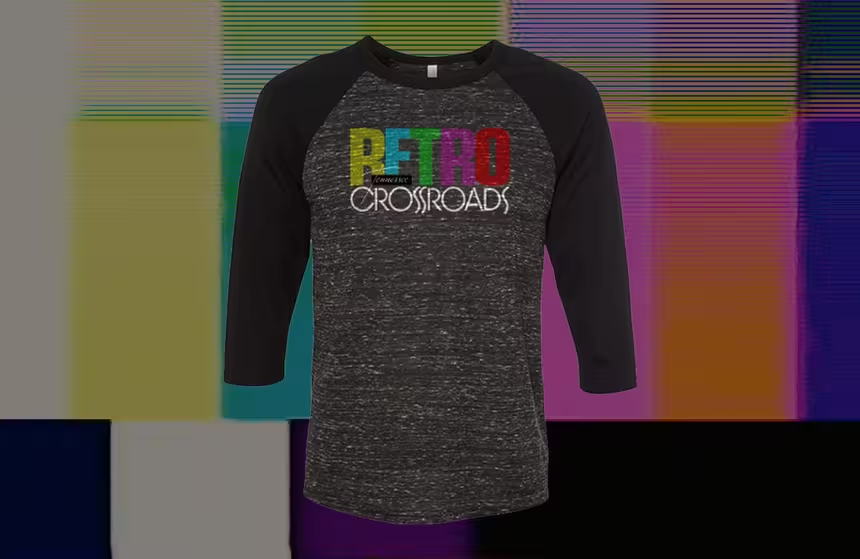
Rad Retro Tennessee Crossroads Tee
Show your love for your favorite Nashville Public Television show by donating and you'll get this limited edition Retro Tennessee Crossroads baseball shirt.Providing Support for PBS.org
Learn Moreabout PBS online sponsorship- [Laura] This time on "Retro Tennessee Crossroads," Joe Elmore will take us to an annual Irish barbecue picnic, Susan Watson visits with the legendary Phil Ponder.
Jana Stanfield shows us a miniature horse, and Al Voecks takes us on a tour of Nashville, as it was in 1989.
- Wow, lots of great memories.
I can't wait to see that.
Hi everybody, I'm Miranda Cohen.
- And I'm Laura Faber.
Welcome to another episode of "Retro Tennessee Crossroads."
(bright music) (bright music continues) - All right, Laura, it's a new "Retro Crossroads" episode.
How are we going to kick this one off?
- How about with a segment about our favorite food?
Barbecue.
- Barbecue.
- But this isn't just another barbecue restaurant.
This is the story of a community coming together to raise money for a local school, and of course, enjoy a little pulled pork while they're at it.
- St.
Patrick's Catholic Church has been a community fixture of McEwen Tennessee since 1849.
And for almost that long, an annual Irish picnic has been held to raise money for St.
Patrick's.
These days, it's an event that helps support St.
Patrick's School here and attracts as many as 30,000 people to tiny McEwen, that come to help a good cause, renew old acquaintances and taste the best barbecue east of the Mississippi.
(upbeat music) (upbeat music continues) Is this the best barbecue there is?
- In the world, sir.
- In the world?
- I think so.
But everyone does enjoy it.
We've had lots of compliments on it and it must be good.
I think it is.
- And many thousands would agree.
These volunteer cooks have 136 years worth of practice.
Just how do they do it?
Well, they start by building huge fires with hickory and oak.
Then they shovel the hot coals from here into these pits.
16,000 pounds of pork shoulders are wrapped in string nets and then salted to seal in the juices just before they begin a 26 hour slow cooking.
Meanwhile, 3000 chicken halves are unloaded to begin their own journey to barbecued perfection.
All of the meat is basted in a sauce that's almost as famous as the barbecue itself.
It's a secret recipe that's been used for decades of Irish picnics.
For about the past 40 years, the keeper of the magic sauce has been Mr.
Frank Walsh here, a lifelong resident of McEwen.
Mr.
Walsh, what makes this sauce so good?
- Well, it's just what we put in it, I guess.
- And you don't tell anybody what's in it.
- Don't tell anybody what's in it.
- How do you keep it a secret?
- I just don't talk.
- [John] On Friday night, folks come from miles around to line up for barbecue chicken.
They arrive hours before the well basted birds are wrapped, sacked, and ready for sales.
What are you guys gonna do if they run out of chicken by the time you get up there?
- Scream and yell.
We'll wait for some more.
There's more coming.
- [John] Barbara Hooper is a St.
Patrick's alum who now has children in the school.
She and her husband are major volunteers and glad to see the massive turnout.
- If they ever come one time, they always come back.
I don't know whether it's the people, the warmth, but they always come back for the barbecue, the sauce.
Those are the two things that you'll see that everybody's gonna carry back home with them, and the chickens.
But basically, I think to be with family and friends and to have a good time.
- My name is Ron Hooper.
I'm from Mojave, California.
I came for the barbecue and the see old friends and family.
- [John] Are you gonna get some of this barbecue?
- Yeah.
- You better get in line.
- She's already had it.
- Two chickens.
- [John] All night long, the barbecue shoulders cook in preparation for the big day of the Irish homecoming on Saturday.
(bright music) (people cheering) This year, every ounce of the barbecue pork was either sold by the shoulder or chopped and served in plates piled high with all the fixes.
This year, they broke all sales records, but every year, the luck of the Irish has been with the picnic.
Even when storms threatened, St.
Patrick seemed to be bringing blessings of good weather.
- I can remember one year, it was early morning and we were doing chickens around four o'clock in the morning and it was just coming.
I thought, well, this is the year that it's gonna, you know, the rain's gonna hurt us.
And at seven o'clock it quit raining and there was a beautiful rainbow right behind the school, just perfectly behind the school.
We have a cross that's right in behind it, and it was, the cross was in the middle of that rainbow.
- After getting their feel of great food and fond memories, the folks enjoy a good old fashioned square dance to work off this year's feast.
(energetic music) By the end of the day on Saturday, the barbecue's always sold out.
A lot of friendships have been renewed and well, the school's gotten money to educate the kids with once more.
And with the luck of the Irish, this old fashioned event will continue for at least another 136 years.
(bright music) - Okay, that Irish picnic has been going on for 170 years, still happens every July and attracts over 20,000 people over the weekend.
Incredible.
- And it looks absolutely amazing.
You know, our own, Cindy Carter revisited that story.
She redid it in 2024, and it still looks absolutely amazing.
- Amazing.
Okay, well I can't stand to see another plate of food.
How about if we see something else?
- Okay, let's move on to art.
How about we look at some beautiful artwork instead?
There are only a few artists in Nashville whose name is almost synonymous with the city itself.
The great Phil Ponder is one of those artists, and Susan Watson caught up with him and has this segment from 1994.
(gentle music) - [Phil] Nashville is just completely full of interesting buildings.
It's amazing.
And when you have company that comes for instance, and you take 'em around town to show 'em, they say, oh gosh, I thought Nashville was some low hick city.
Well, it's not, it's a great city and it's full of very interesting historical buildings for sure.
- [Susan] And perhaps no one knows that better than Nashville artist, Phil Ponder.
His pen and ink and watercolor works of art are known and prized not only for their beauty, but for their exacting accuracy and detail as well.
- This is a print of West End High School that's just been introduced recently.
And I used my smallest scale possible on doing the bricks.
That's 48 rows of bricks per inch.
Can you imagine that?
Three rows in a16th.
And to do that, I have to use an extremely, extremely small pinpoint.
- [Susan] Now, so what you're saying is you count the bricks and they're all here?
- Yes, I take a lot of photos to begin with.
So I've got closeup photos and I get my magnifying glass out and I actually count because I wanna be historically correct, as well as artistically correct.
- [Susan] It all began 16 years ago when he decided to paint Market Street as a Christmas gift for his children.
It took almost a full year to complete.
- [Phil] It was a challenge to myself, and it was something I wanted to just prove to myself that I could do something that would be lasting.
- [Susan] An art dealer saw his work when he took it into to be framed and encouraged him to have prints made.
The rest, as they say, is history.
He recently completed the original artwork for print number 51.
And through the years, he's been commissioned to do numerous special projects.
- And this one is kind of the unreal one.
This is Market Street, and I did it the second time.
And these are the photos that I made of the bottoms of the buildings at Market Street.
And you can see this thing goes on forever and ever and ever.
- [Susan] Capturing his subject on film is the important first step for Phil.
He took more than 100 photographs for his latest version of the Nashville skyline.
- In the skylines, of course, there's a lot of changes that take place in the skylines.
When I did "Nashville Live," which is the latest of the skylines that I've done, I had to go back at the last minute to make some more photos because of the fact that the old Keystone building was imploded, and it left a vacancy in the skyline.
And I had to go take pictures because then it showed up the buildings across the street that were not there originally.
And of course, this is where Hard Rock is now located.
- [Susan] Mm-hmm.
So it's always changing, I mean.
- Thank goodness.
If it didn't change, I would have a very dull subject.
- [Susan] The city is constantly changing, but even the oldest of facades can still sometimes surprise us.
- That's the story right here of the Savage Home, which is located on 8th Avenue between Church and Commerce.
I used to work half a block down the street from that for several years when I was with Genesco.
And I just never had noticed it until I went around town a few months ago when I was doing the preparation for this particular picture, taking pictures of all the doorways I could find and all of a sudden this door just popped out to me 'cause it was so interesting.
That's McKendree Methodist Church downtown and when I made my photographs, I came back and I said, what in the world is that in the reflection?
And all of a sudden it hit me that that's Harvey's, one of the signs left from Harvey's across the street.
And I said, eh, we'll just leave it in there because that's a history part of Nashville also.
- [Susan] And it was that painted like it is philosophy that led to the creation of Phil's now familiar trademark.
- [Phil] My trademark is a pigeon.
It's in every photo, I mean, in every print, except for the first three.
The fourth one I did was the Silver Dollar Saloon.
- Mm-hmm.
- That pigeon was sitting on the corner and just at the last minute I thought, eh, I'll put him in the picture.
- Mm-hmm.
- Everybody liked it so he is been in every picture since.
- [Susan] The little fellow looks right at home on those buildings.
But I'll bet he's especially fond of Phil's latest subject.
- I decided it was time for me to do it.
So I selected 12 trees that are native to Tennessee.
I used the same pen and ink and watercolor process.
It's just, it's not structured like buildings.
- [Susan] And you didn't count the leaves now, did you?
- I did not count leaves.
- Whether it's native trees, antebellum homes, or Nashville landmarks, seeing them through the eyes and art of Phil Ponder can help us keep Nashville close no matter how far we roam.
- The main thing that I really hope happens when somebody takes one of these pictures and puts it up on their wall is that it reminds them of a very special event.
And whether this event is particularly happy, which we hope it is, or in the case of somebody leaving Union Station to go away to war, which I've heard a lot of those stories, that's kind of a sad event, but it's means something special to these people.
And that's really neat.
It really gives me a special feeling.
And I feel like it's bringing purpose and meaning to my life by what I'm doing.
And you know, it's really, really special when somebody comes up from a foreign country, for instance, at one of our shows and buys one of the prints to take home with 'em, whether it's Greece, or Australia or Japan or wherever it might be.
So I feel wonderful that I have contributed a little bit to spreading the news of the great city of Nashville around the world.
- Okay, Laura.
So it's no secret, Phil Ponder is one of my favorite people on the planet.
So talented.
But I have to show you this.
So Phil Ponder gifted this to "Tennessee Crossroads."
I redid the story on him in 2024.
He is still going strong.
And when I say strong, I mean amazing.
He is still creating, still such an, incredibly gifted artist.
But we redid the set for "Tennessee Crossroads" in 2025, and he gifted us this skyline.
He does a skyline every four years.
- Right.
- This is his 12th skyline.
It is called "Nashville Horizons."
And he gifted this to the set and it just.
- It's incredible.
It almost looks like a photograph.
I cannot believe that he does that by hand.
- Every brick.
- I know.
- By a calculator, it's amazing.
And I loved in this story, I love the photograph of Happy the Pigeon.
It wasn't even named then, but there is a little pigeon named Happy in every single one of his works.
Absolutely incredible.
And we got to see the photograph where Happy came from in that story.
- Okay, he's a legend.
- He is a legend.
- Yeah.
- Okay, I could talk about Phil Ponder all day, but we need to move on to the next story, but he truly is amazing.
- Yes, he is.
Well, next we're gonna watch a segment about a special horse, Miranda.
Back in 1990, Jana Stanfield showed us the story of Baby the miniature horse.
(bright music) - [Jana] There's something magical about a horse, something that makes the child within us want to reach out and touch the animal's shiny coat and soft nose.
Some horses are big though, and a little scary to a child, but not this one.
This is Baby.
Baby waking up in the morning and stretching.
Baby sleeps in Donna Owen's garage close to his buddy, a banty rooster.
When it's cold, Baby sleeps in Donna's house, but today it's not cold, it's a great morning to be a horse and to go outside and play.
(bright music) Baby's favorite playmates are a dog named Lady and a half Arab colt named GI Joe.
A few months ago, the children in Baby's neighborhood in Fairview asked if Joe was Baby's baby.
Soon they'll be asking if Baby is Joe's baby, because GI Joe will be a big horse, but Baby is a miniature horse.
Baby is already full grown at 210 pounds.
He's 33 inches tall, small enough to be a house horse.
- He's a pet.
He's definitely a pet.
- [Jana] Donna Owens loves animals.
(puppy barking) She has a puppy, a Guinea pig, and a bird named Chiquita Banana.
But Baby is the main attraction.
- He's very personable.
He'll come, you know, in the house, and he'll sit with us, and he'll watch TV and he's basically just a member of the family.
- [Jana] When Baby's not watching TV or hanging out by the refrigerator, he works.
Baby makes paid appearances here and there at birthday parties and grand openings.
But most of his work is charity work.
Donna Owens has a scrapbook full of thank you letters from schools, nursing homes, and hospitals.
And he's one house pet who also makes house calls.
- He goes into private homes, terminally ill kids, and stays with them for an hour or two.
And it's just a feeling that you get when you see the parents as well as the kids, and they're standing back there, I can't believe there's a horse in here.
(Donna laughing) It's just something that, it just gives you all those cold chills.
- [Jana] Baby seems almost human sometimes.
He can ride an elevator and eat salad at a restaurant.
And when Baby goes to work, (engine revving) he travels in style.
- I know it's slippery, be careful.
- Today, Baby is getting gussied up for a visit to children at a Franklin elementary school.
Baby goes to schools not only to entertain, but to educate.
Of course, he can answer the easy questions like, Baby, how old are you?
One, two.
He can also answer the harder questions like, Baby, should kids get in the car with a stranger?
No.
That's horse sense.
(hooves clicking) - A horse.
- A pony.
(children chattering) - [Donna] Hello boys and girls, this is Baby.
(children laughing) - [Jana] After all the visits they've made to children who are hospitalized or handicapped in some way, Donna Owens believes that Baby can tell if a child has special needs.
- He knows.
Animals know, they really do.
He's a real special little guy in that respect.
- What is it that makes it worth it to you to do this?
- The look on the children's face is basically what the bottom line is.
If you've ever been in a situation that you had no control over for just a few minutes, then that's the way these children we visit are all the time, see?
So if we can change that situation for just a few minutes, that gives me a feeling of happiness and gladness, and glad for them to have a little bit of happiness for a while.
(gentle music) - It's always so incredible to me what people find and pick is their passion.
- Yes, yes.
- And for this woman and this miniature horse, but how much joy it brought to everybody in that community.
I mean, it's pretty special.
So not sure I can have a horse sleeping in my house, but you know.
- Yeah.
But it's beautiful.
- Yeah.
- It was really beautiful.
And just a darling horse, Baby.
- Baby, the special miniature horse.
Okay, how about we gonna wrap up this episode?
- Okay, how about we take it way back and see what Nashville used to look like?
We all know Nashville's downtown changes almost weekly with constant construction and new shops and restaurants opening all the time.
So we thought it would be interesting to take a tour of Nashville like it used to be way back in 1989 with Al Voecks.
(gentle music) - [Al] For our tour, we chose one of the mini buses operated by Country Western Tours, headquartered on Music Valley Drive.
14 others were on board with one family coming all the way from Norway.
Now, a tour is only as good as the tour guide.
And on this trip, we were fortunate to have veteran guide, Joe Soles.
- And I do wanna welcome all of you to Nashville.
My name is Joe and we're gonna be taking a little tour of downtown Nashville, showing you some of the sites downtown, the historical places.
- [Al] Following the trip down Interstate 40, we were treated to the sites of downtown Nashville.
- Gimme a show of hands.
How many of you, this is your first time to be in Nashville, huh?
Oh, great, I like that.
I can tell you anything, you'll believe it.
If you'll look in front of you up there, to your right a little bit, you'll see a beautiful old building that's called Union Station.
One of the buildings that everybody likes to see and go through is the old Ryman Auditorium where the grand old Opry was held for so many, many years.
As you can see from the outside, they're doing a facelift on it.
Also, on the inside, they're doing the same thing.
- [Al] The Ryman is one of those places where tour buses stop to allow passengers to walk through The Mecca of country music.
There is a small charge to do that, but for the true tourist having come all this way, there is no objection.
Once back on the bus, other notable sites are pointed out such as Printer's Alley, where most people will come back when things get just a little wilder at night.
There's Fort Nashborough where it all began for the city on the Cumberland.
And of course, no trip to downtown Nashville would be complete without pointing out Tootsie's Orchid Lounge.
It is also pointed out that Nashville is the seat of state government.
- Hell, I gotta run on out here.
Now, I wanna show you our State Capitol Building.
It is also made of our native limestone.
- [Al] From the Capitol, it's onto music roll with a stop at the shops of the stars, The Country Music Hall of Fame, and the other activities of the industry.
Going down 17th Avenue, we are shown the studios and the buildings that have become synonymous with country music.
After all, for the majority of the visitors who come to Nashville, it was country music that brought them here.
But it's the homes of the stars which draw the most reaction from those on board the bus.
Definitely, it's the highlight of the tour.
Cameras are aimed at the home of Tammy Wynette on Franklin Road.
And from there, it's onto more famous homes.
- Hell, let's circle on around Curtis Wood here.
Now, really, we have no idea who lives in most of these places out here.
We do know that most of 'em are millionaires who live on Curtis Wood Lane.
This little house on the right, folks is our governor's mansion, built in 1950 at a cost of $125,000.
Then right on past the Governor's mansion is the home of my favorite lady.
This is the home of Cousin Minnie Pearl.
And we're going- - [Al] At the end of Curtis Wood Lane is the first home of Webb Pierce, and across the street from that, the home of Ronnie Milsap.
Waylon Jennings lives on Old Hickory Boulevard in Brentwood.
One of his neighbors up the street is Johnny Rodriguez.
A little farther out of Brentwood is the home of the late Marty Robbins, but it seems the best is left for last.
- Well, we're headed out now to the home of Dolly Parton.
Dolly is married to a young fellow named Carl Dean.
Carl Dean is quite a home builder around the Nashville area, and he built the house and he and Dolly live up here.
Dolly's always wanted to have another old home like the one that was in "Gone with the Wind," that old plantation terra.
And if you'll notice when we get up here that there's another terra sitting up there on the hill.
And that's the home of Miss Dolly Parton.
And like I say, we're gonna stop now, and let you get out and take a little look at Dolly's house.
The only thing she ask you to do is please do not lean against the gate.
Now, you can get off and take some pictures if you want to, okay.
- [Al] More pictures of this stately mansion have been taken than of any other home in Nashville.
You know, we've seen a lot in three and a half hours.
Some things I already knew about the city, a couple of other things I didn't know.
And for the true tourist on the bus, they all walked away with a good feeling about our city thanks mostly to the efforts of Joe Soles.
- Okay folks, I want to thank you for being such a special group this afternoon.
This has kind about wrap up our little tour for us.
We want to thank you for choosing Country Western Gray Line for taking you around Nashville.
And you have been a awfully nice group this afternoon.
Thank you for choosing us and we are going to take off now and get you back home.
(bright music) - Okay, we know that Nashville has changed certainly, but I came to Nashville in 1990.
- Yeah, right.
- So it was very similar to what we saw on that tour bus from 1989.
Union Station is still around.
Of course, I had our wedding rehearsal there.
- Yes, I thought about that.
- And of course now it's the big, you know TikTok.
- Yes.
- Like, the young people love Union Station.
I was there when it was cool, before it was cool with all the youngsters and of course the Ryman and Tootsie's and all those things still around, and that, you know, places that make Nashville special.
- And very historical.
- Yeah.
- And I didn't know, I was a little starstruck.
I didn't know all about the star homes.
I've been here since '97, I didn't know all about the star homes.
Really beautiful, great tour.
And what a great guy.
- I know.
- What a great tour guide they had.
- Well, it was a line in the story, Al Voecks said a tour, it boils down to how good the tour guide is.
- Yes, how good the guide.
- And he was great.
He was a good one.
- He knew his stuff.
So Nashville was beautiful then and it's certainly beautiful now.
Well, we've certainly come a long way since then, haven't we?
- We sure have.
And unfortunately, we've come to the end of another episode.
- But you can watch all of your favorite Crossroads segments at our website, tennesseecrossroads.org.
- And be sure to join us again next time on "Retro Tennessee Crossroads."
(gentle music) (gentle music continues) (bright music)













Support for PBS provided by:
Retro Tennessee Crossroads is a local public television program presented by WNPT