
Season 5, Episode 1
Season 5 Episode 1 | 26m 14sVideo has Closed Captions
We’re headed back to the late-’80s and ’90s on Retro Tennessee Crossroads.
The Crossroads Crew takes us back to the second season of the show with an episode featuring ways to get around.
Problems playing video? | Closed Captioning Feedback
Problems playing video? | Closed Captioning Feedback
Retro Tennessee Crossroads is a local public television program presented by WNPT
Season 5, Episode 1
Season 5 Episode 1 | 26m 14sVideo has Closed Captions
The Crossroads Crew takes us back to the second season of the show with an episode featuring ways to get around.
Problems playing video? | Closed Captioning Feedback
Where to Watch Retro Tennessee Crossroads
Retro Tennessee Crossroads is available to stream on pbs.org and the PBS app.
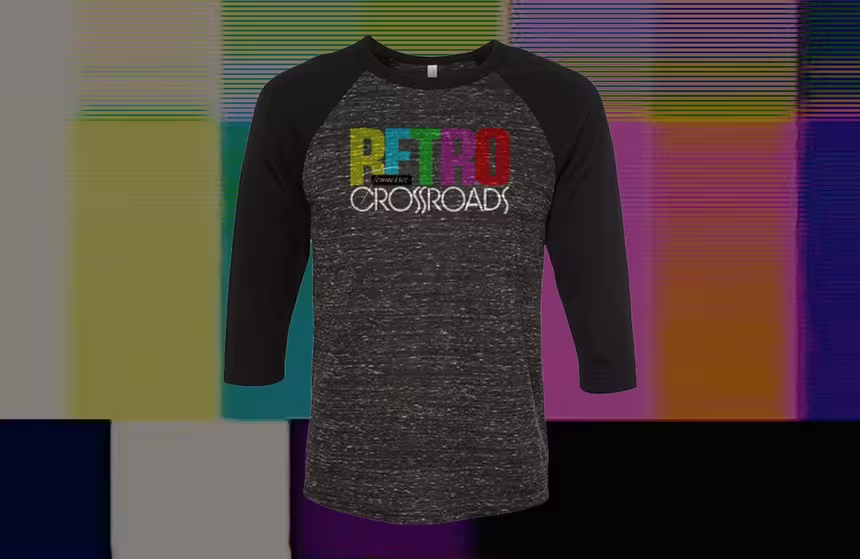
Rad Retro Tennessee Crossroads Tee
Show your love for your favorite Nashville Public Television show by donating and you'll get this limited edition Retro Tennessee Crossroads baseball shirt.Providing Support for PBS.org
Learn Moreabout PBS online sponsorship- Howdy, I'm Ketch Secor, and I'm here to share one of your favorite shows from our Crossroads vault.
This one is from our second season and feature stories all about ways to get around.
Trains, boats, airplanes, hot air balloons.
We got it all.
Let's take it on back to 1988 for this retro Tennessee Crossroads episode.
(bright gentle music) - Hi, everybody.
I'm Joe Elmore at Union Station, your home base for this edition of Tennessee Crossroads.
And it's a show that's really on the move.
You're gonna meet some people who have a big love for tiny trains.
Then you'll go for an adventure in the air in a hot air balloon.
You'll follow Jerry Thompson along on his first ride on a tugboat.
And you'll meet Al Voecks in Tullahoma at the Staggerwing Museum.
Tennessee Crossroads from Union Station.
Glad to have you aboard.
(bright gentle music) Union Station here near downtown Nashville is a reminder of perhaps the most romantic means of transportation in America, the railroads.
Oh, in case you haven't noticed, all of the encore stories in this edition of our show are about interesting ways of getting around.
In our first story, Janet Tyson catches up with some grown-up boys whose dreams of engineering a train have come true in a small way.
(train whistle trumpets) - If you've ever come down on Christmas morning to find a train set under the tree, or if you've ever heard the distant whistle of a locomotive and suddenly had the urge to go wherever it was going, then you probably have a love for locomotives way down deep in your soul.
There are a group of people in the area who have allowed that love to become a passion, a passion called outdoor model railroading.
In real life, Scott Baxter is an electrical engineer for a communications company.
But in his Brentwood backyard, he's a big boy in love with little engines.
- I think after a childhood exposure to railroading, riding on a business trip to Texas with my father at age five and back, I had the feel of railroading.
I wanted to run on the railroad, work on the railroad.
I'd love to be a railroad engineer.
I know that that's not practical or possible for me in today's railroad industry, and so this is the closest thing I can come to it.
It's the ideal family hobby.
They love it.
I can be interested in making the signals operate and fixing a broken locomotive.
The younger ones are interested in running, and all of us fit in one way or another.
- [Janet] Scott got hooked on the hobby of large-scale model railroading about two years and $15,000 ago when he and his family went to Columbia, Tennessee for a meet of the Mid-South Live Steamers Club.
The erstwhile spectator is now vice president of the group.
Their meet earlier this month attracted locomotives and enthusiastic engineers from 15 states.
Hank Sherwood of Nashville is the club's president.
- When we have a meet like this, we've probably got over 40 locomotives.
And it gets a little crowded on the track, so everybody tries to take their little turn and not everybody get out there at the same time because they just end up in one big line and, you know, you don't go very far.
Especially when we have a lot of people showing up to ride with their kids.
And I think the adults enjoy it more than the kids do sometimes, so.
- [Janet] The Columbia track located at the Murray County Fairgrounds is one of about 250 such setups across the country.
- [Hank] We have a little over of a mile of track in scale, that would be about eight miles for this size.
And counting the switch yards and the passing sightings, we have enough track and it's fun to run around.
If you've been around it and seen the loop and the bridges, it's just like a real railroad.
♪ Here she comes, look at her roll ♪ ♪ There she goes, eating that coal ♪ ♪ Watch her fly, look at her sail ♪ ♪ Let her by, by, by, the fireball mail ♪ ♪ Watch her go, look at her steam ♪ ♪ Hear her roll, whistle, and scream ♪ ♪ Like a hound dog wagging its tail ♪ ♪ Dallas-bound, bound, bound, fireball mail ♪ - Some people come from the railroads, some are doctors.
All walks of life.
It's just that they share the common interest of this hobby, which is growing quite rapidly, you know, as far as the miniature steam locomotives.
I think most of the people here have had a model train set at some time in life.
And as they get older, their toys get bigger.
And I think that's what happened to me.
(laughs) - I'm 91 years old.
And this is what keeps me going right here, period.
I'm too old for women, so I got on this.
(laughs) - [Hank] The diesel locomotives some are battery-operated.
They are charged or have a generator that charges them and they run on a battery.
And some basically have like a lawnmower engine in them.
Well, most of the trains here are steam-powered.
That's how the hobby originally started back in the late '30s.
And they burn coal.
We like to burn a clean burning coal, which we use here.
We have a fellow bring down from West Virginia.
It's Pocahontas Coal and it's a clean-burning coal.
So it doesn't make a lot of smoke and soot that gets you all black from running on it.
You know, some of the engines here burn propane, which is just a clean fired gas.
But the diehards like to burn the coal because you get the smell and it's more of the realism.
But the secret of a locomotive is not how fast it can go.
It's how much it can pull, which they call the tractive force.
We don't encourage, you know, they say high-balling, too much around here because the track does have a few kinks in it.
But really it's the pride is in how much it can pull.
And that's when you get the chug, chug, chug, chug, chug.
- [Janet] These engines can build up from 100-130 pounds of pressure in their boilers.
- This is the boiler, and it'll be full of water up to about here.
The rest of this is steam.
By the way, there is a steam dome in there with the pop valves.
That makes a steam.
The steam comes over here, runs down into the cylinders.
It'll squirt some in here.
It'll push the cylinder back, it'll quirk some there.
It just makes it go back and forth.
This is a Johnson bar that makes it go forward or backwards.
This is the throttle.
This is the water glass, which is very essential.
You don't wanna run out of water.
Here's a whistle.
(train whistle blows) - I tell you, the thing about it, they enjoy working on them and building them a lot more than they do riding them, I think.
I think riding them is just something to entertain kids and entertain the wives and stuff.
But I think working on them and building them is the main thing.
- Well, yeah, they say the only difference in men and boys is the price of their toys.
And that's about true.
We have lots of fun.
- [Janet] Young or old, there's a lot to love about these locomotives.
If you're seven, a ride on these trains is a pleasant trip back to a time of which you have no memory.
If you are 76, it just doesn't seem all that long ago.
- Oh Lord, yeah.
Lots of memories, yeah.
I used to run up and down on railroad tracks when I lived here in Columbia when I was a little girl.
And I'd have to jump out of the way of the big old trains, you know.
It reminds me of lots of way back.
♪ Barely no more trains to ride ♪ ♪ No more trains to ride ♪ ♪ I'd like to live like daddy did ♪ ♪ But there's no more trains to ride ♪ (bright gentle music) - Right now, our next story is about a means of getting around that's a little less down to earth than riding on a train.
You know, just a few years ago, it seems that hot air ballooning was a thrill enjoyed only by a fortunate few.
These days, anyone with a little cash and a spirit of adventure can enjoy this breathtaking view of the landscape.
We're going to take a hot air balloon ride south of here near Franklin, Tennessee, and enjoy the thrill of Middle Tennessee from way above.
(burner hissing) - Ballooning gives you a chance to fly and enjoy what God has created in this natural state without having to worry about a fuse of lodge surrounding you and you can just be out in the open.
Let all your cares go away.
- It's early in the morning here in Franklin, Tennessee, and we're getting ready to go on a hot air balloon ride.
Our hosts say the weather is perfect for ballooning, and for Paul and Lindsay Wolsner, it's all in a day's work.
Paul and Lindsay make their living getting people high.
You see, they have a ballooning business that includes a $100 champagne flight.
And although Paul has won several national championships, he says every flight like this is an adventure.
- Because ballooning, it never gets old and you never go to the same place twice.
It really is an adventure.
It's sort of like lightning striking.
We rarely, while we take off here all the time, the local peoples in this immediate area see us a lot, but our destination point is wherever Mother Nature takes us.
So it's always new.
It's always fun.
It stays fun.
You light so many people up when you fly.
That sort of gives you a nice charge.
(generator rumbling) We're gonna probably just try to fly kind of formation so you can stay close to us.
You're flying in this balloon over here with Lou Bottigi, Captain Lou.
And we're taking some, a couple, I think, are celebrating their anniversary or something today.
- [Joe] Should be a happy anniversary.
- Yeah, should be.
- Let's go.
- All right.
- [Joe] Are you excited?
You're not scared, are you?
- No, I'm not.
- I am.
I admit it.
- [Operator] Here we go.
(burner hissing) - Bye.
- Bye.
- Bye-bye.
(gentle sanguine music) - [Joe] While Paul and Lou commandeer the balloons, Lindsay and the chase crew will be equally busy below.
- So what we do is with radio contact, we stay in radio contact with the balloon, and we just drive the different back roads and stuff and try to meet them where they're gonna land.
(gentle sanguine music continues) - [Joe] Except for an occasional burner firing, you never hear anything, except the wind, a few farm animals below, and if you feel daring enough, the sound of trees against your basket.
- Got to be able to see downtown here in another 200 or 300 feet.
- [Joe] I couldn't quite see downtown, but who cares?
From here, you can see a clear view of Middle Tennessee's countryside.
It's a vantage point only birds and balloonists are privileged to witness.
(gentle sanguine music returns) About an hour and a half after liftoff, we passed Leipers Fork.
When you're ballooning like this, the wind pretty much determines where you go and how fast.
You have a couple of gauges for altitude and vertical speed.
And when you descend, you try to land in a friendly field.
We found one about a mile from where Paul landed.
Now we've landed, and luckily these folks here in the farmhouse don't mind a bit coming down.
Is that the way it is most of the places?
- 95% of the time you'll find that people are very, very friendly around this area.
There are a few, like, we mentioned earlier, dairy farmers.
We try to stay above dairy farms because the balloons do scare cattle and that does cause a problem upon their milking process.
And we try to stay up above and don't land near dairy farms.
- No bulls around, are they?
- No, we landed in a field, I guess it was about a year ago, we landed in a field with a, we though it was a beautiful field.
And out from one of the trees, this bull that stood 12 hands of the shoulder came trotting over to us.
- Did you go back up?
- We went back up.
We decided we didn't like that field.
- [Reporter] In a minute, the chase crews arrived and that's when the real work begins, deflating and compressing the voluminous envelope, and eventually packing it inside a little bag.
- Winds have welcomed you with softness.
The sun has blessed you with his warm hands.
You have flown so high and so well that God has joined you in your laughter and sent you gently back into the loving arms of Mother Earth.
(group clapping and cheering) - [Reporter] This is why they call it a champagne flight.
And after the official pinning ceremony and the victorious toasting, there are a lot of memories to take home.
- I thought it was great.
It wasn't as scary as I though it was gonna be.
And it was really neat going over really slow around the countryside.
I don't know, I though it was really great.
- The thing I liked about it was the calmness.
You've got the burner there, but most time when you fly, you're in an aircraft or something with a lot of noise, but it's real silent when you're just kind of drifting along over the little rolling hills.
It was really nice.
We enjoyed it a lot.
- It's tough work, you know.
It's so much fun, it's hard to tolerate sometimes, but we feel like it's our duty.
And what we've got, we've gotten a lot of practice at it, so we know how to do it pretty well.
We're enjoying every day.
(gentle sanguine music slows) - When you take a balloon ride, what goes up must come down.
But I guess I should tell you that one of the best seasons ever is coming up for ballooning when all the leaves change their colors and you can get a special, unique view of the Middle Tennessee landscape.
Well, from the air to the water, we head to the Cumberland River.
That's where Jerry Thompson is about to catch up with a father and son tugboat team.
- [Jerry] Almost as far back as I can remember, I've watched the huge tugboats as they moved up and down the river, moving ever so slowly, placing barges here and there.
I've also had a longing to ride on one, to meet the people who work on the river, and to see if it's really as much fun as I've always thought it would be.
Well, I finally got my chance.
I hitched a ride on the Charlie Everhart, a tug owned by Ingram Materials Company.
And I met L. B. Edgin, a boat captain, who has spent most of his life on the river.
He fell in love with the river as a child, watching the boats come and go from his grandfather's tie yard near Ashland City.
- I think I'm one of the very few people in the world that could say if he had his life to live over, you know, he'd do the same thing, but I would.
I mean, I'd do the same thing.
I mean, I've enjoyed it.
And had a big time and told a lot of tales and heard a lot of tales.
But I mean, you know, I've really enjoyed it.
I've been out here 40, a little over 40 years and never a dull moment.
There's always something going on.
There's always some excitement going on.
And it's just a great place to be, I think.
- [Jerry] During his 40 years on the river, L. B. has seen a lot of changes, both in the boats and barges and in the river itself.
- The river's like everything else.
People don't realize it.
But it's done like everything else.
It's gone high tech now, and you know, it's like I say, the boats are more comfortable.
More horsepower.
And it's just, you know, it's just like everything else, like automobiles.
- A modern river boat has all the conveniences of home and more.
A fully stocked and equipped galley, comfortable bedrooms, and a multi-talented captain, even if some of his talents are just temporary.
There's some things that are necessary in the wheelhouse of every river boat.
One of those things is the pilot.
He must be there at all times.
Since he must be there at all times, there are other necessities too.
Like the necessity in this cabinet, for instance.
It's just like home.
The boat we were on is 80-feet long, 30-feet wide, and with a full load of 30,000 gallons of fuel.
It still stands 42 feet out of the water.
It's powered by two huge 600-horsepower diesel engines.
And with a full tow, it stretches down the river the length of two football fields.
And when fully loaded, it could take more than a mile to stop.
(barge whistle trumpets) L. B. wasn't at the wheel today, but another Edgin was.
His son, David.
Tell me a little about this boat.
It looks like it's awfully complicated here with all these knobs and levers and gauges and everything.
- Oh, it's not complicated at all.
These two sticks here are your steering rudders and your flanking rudders.
The top, your flanking rudders, if you wanna back up.
Use these control the way your boat goes, the pitch of the boat.
And these are your steering rudders.
If you're going forward, you control the boat with these.
And these are your throttles.
You know, they're self-explanatory really.
They just come ahead, that's forward, and reversed or whatever.
And here you have a swing indicator here, and it tells you the pitch of your swing, how fast your tow is swinging.
And it really comes in handy at night.
- David literally grew up on the river, but he's a little uncertain about what the future holds.
Do you plan to stay on the river as long as your dad did?
- I don't know about that.
I plan on stay on for a while, but I don't know if I'll stay on it 35 years or not.
I kind of doubt it.
- [Jerry] LB, your son now is running this boat.
How do you feel that he's kind of following along in your footsteps?
- Well, you know, I don't have any reservation about him doing it at all.
I mean, because it's like I said, I mean, that's what I've done all my life and I've made a good living.
And I think it's great.
- Sitting here in the pilot house of a river tugboat, it's very easy to see how riding the river gets in a man's blood.
It's evident that the character of a river is not made by the current or the trees on the shore, or the sky.
It's made by people like L. B. Edgin, David Edgin, the men who run that river, who run the boats that float on it.
That's where the real character comes from.
- I live on the river.
My home's on the river.
And unless I have a change of heart, that's where I'm gonna be from now on.
I've always been a river rat.
And that's the way it is.
(lively gentle music ends) (bright gentle music) - For our final story, we're heading down to Tullahoma, Tennessee.
But we're going back up in the air, so to speak.
You see, years ago, an unusual breed of aircraft dotted the skies of America called a Beech Staggerwing.
You won't see them around anymore unless you go down to a museum that Al Voecks discovered.
This is a place that's dedicated to preserving a colorful chapter in the history of American aviation.
- Southern Middle Tennessee is known for a number of things.
Two that immediately pop to mind are Tennessee walking horses and Tennessee sipping whiskey.
But Southern Middle Tennessee is also the heart of antique airplane country.
And nestled in the hills around Tullahoma is the Staggerwing Museum, an aviation show place dedicated to the preservation of the Staggerwing era.
The president of the foundation, and one of those instrumental in starting the museum, is Tullahoma businessman John Parrish.
- All started with the Staggerwing Club, a bunch of aviation enthusiasts who were interested in one particular breed of aircraft, the Beech Staggerwing.
Well, several of us got together and said, "Hey, let's start a museum.
This is significant enough to warrant preserving.
Besides, we do need a place as a repository for all of the data that one needs to rebuild, restore, fly safely an old airplane that was built in the '30s."
So that's what stimulated us.
And we formed a charitable institution and went out and said, "Hey fellas, this is an idea that'll help us maintain our airplanes and really preserve a very significant part of aviation history.
- You say significant.
Why is the Staggerwing significant?
- Well, the Beech Staggerwing was the first fast, comfortable executive aircraft built and one of the first retractable gear airplanes.
It did many significant things in establishing records for speed and it filled a special purpose for the corporate world, in that it flew fast, 200 miles an hour, but it would also fly slow and be able to get into the short dirt strips that were around the country.
- [Al] You called them Staggerwings.
The novice would look at it and say that's a biplane.
Is there a difference?
- Yeah.
You know, it's interesting, when you say Staggerwing, you're exactly correct, most people think you mean an old bi-plane.
Well, the Staggerwing, which is the name was coined by somebody saw one fly by and say, "Look at that airplane with that negative stagger."
And most airplanes, the old bi-planes, the upper wing was forward of the lower wing.
But Walter Beech, who was born right here in Tennessee, had a unique idea that, hey, I can increase the safety and stability of the airplane by putting the upper wing to the rear of the lower wing.
The idea being that, when an airplane quits flying and stalls, on the Staggerwing, the lower wing stops flying first and the nose will pitch down a little bit.
When the nose pitches down, it picks up airspeed.
And before the upper wing is in stall, it's picked up another airspeed that the lower wing is, again, flying and all you have is a nice, smooth porpoise.
So we think it's worth restoring and preserving.
They were the Learjet or the Duesenberg or Cadillac of the '30s.
And we wanna make sure that they're around for many, many more years for other people to enjoy.
- You are a pilot.
- Yes.
- [Al] Would you fly every airplane that you have here?
- [John] Yes.
- They're all airworthy?
- Yes.
(plane engine rumbling) - For any aviation buff, this Staggerwing Museum is an absolute must place to visit.
The public is invited.
The museum is open every Saturday and Sunday.
So eat your heart out, Charlie Brown.
(mimics plane engine rumbling) (lively upbeat music) (upbeat music continues) (light music)














Support for PBS provided by:
Retro Tennessee Crossroads is a local public television program presented by WNPT