
Second Ebenezer Church
Clip: Season 49 Episode 52 | 17m 41sVideo has Closed Captions
Second Ebenezer Church | Episode 4952/Segment 2
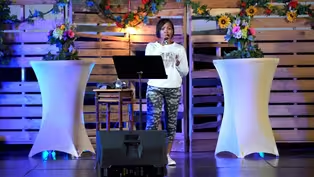
What role do pastors' spouses play in growing and supporting the church ministry? American Black Journal host Stephen Henderson connects with Bishop Edgar Vann and First Lady Elder Sheila Vann from Second Ebenezer Church to hear what's expected from each of their roles as pastor and first lady in the church, and how they work together as a team to support their congregation.
Problems playing video? | Closed Captioning Feedback
Problems playing video? | Closed Captioning Feedback
American Black Journal is a local public television program presented by Detroit PBS
Second Ebenezer Church
Clip: Season 49 Episode 52 | 17m 41sVideo has Closed Captions
What role do pastors' spouses play in growing and supporting the church ministry? American Black Journal host Stephen Henderson connects with Bishop Edgar Vann and First Lady Elder Sheila Vann from Second Ebenezer Church to hear what's expected from each of their roles as pastor and first lady in the church, and how they work together as a team to support their congregation.
Problems playing video? | Closed Captioning Feedback
How to Watch American Black Journal
American Black Journal is available to stream on pbs.org and the free PBS App, available on iPhone, Apple TV, Android TV, Android smartphones, Amazon Fire TV, Amazon Fire Tablet, Roku, Samsung Smart TV, LG TV, and Vizio.
Providing Support for PBS.org
Learn Moreabout PBS online sponsorshipSo, I want to start kind of at the beginning and go back to the place where the two of you had to prepare for these dual roles, these dual responsibilities, and just have you talk about the things that came to your mind, the things that you had to think about, and the way that the two of you wanted to frame this.
Reverend Sheila Vann, I'm actually going to start with you.
>>Okay, well, we started the journey very, very early.
We've known each other since we were 12 years old.
I was 12.
He was a little bit older than I and we were in music together and then started dating and then he was called to a church a year before we married.
So, the preparation road was, at that time, it's kinda you chart it as you go.
We kind of have to figure it all out.
Bishop's father was a pastor, had been in the pastorate for years.
So, he kind of had a guideline and, for myself, I kind of had to figure it out as I go.
I had a very good role model though.
My first lady was a wonderful, wonderful woman, a woman I gleaned from not even knowing that I would be a first lady and so charting the course is really, 'cause every church is different and you really kind of have to gauge with the people that God has given you and see what their needs are and base that course on the need, because ministry is about meeting needs.
And so, we kind of had to figure it out as we went along.
What you think, Bishop?
>>Well, we were extremely young and, again, we got our start in music.
I was a musician and she was a choir director and that's how all of the magic got started and we learned how to work together from there and the role playing really ends up being, getting the job done, whatever it takes to get the job done.
And we learned that very, very early, not knowing, again, that these skills would be so basic for what I would do and what she would do for the rest of our careers and it sort of gave us preparation, again, with some good role models.
It helped us to arrive at a place of competence in terms of working with people and leadership, of course, but also the hard work and the sacrifice that is necessary in order to be successful.
>>Yeah, I wonder if you can talk about the stress perhaps that this dual role puts on your family, on you as a unit and just the things that everybody is used to trying to manage inside of a marriage?
Can you remember times when the work was maybe too much for the relationship?
Bishop, I'll start with you this time.
>>Yeah, I mean, that is all part and parcel of what this journey is about and it is a journey where it's a bit unique because, in most people in their occupations, they don't necessarily work with their spouses.
There's a demarcation line between what each person in the relationship does and they come home and talk about it.
Well, my wife has to see me work.
That's a little different.
A doctor can take people through many, many examinations and the wife never sees what the doctor really has to do.
Well, she sees and knows the things I have to do, the people I have to work with, the struggles that I have, the stresses that I've had, for 45 years of pastoring a church that I found that was very distressed to where I am today and so that's been a journey that's required us to have, I believe, a very unique bond and a very unique relationship as we tackled all the tough stuff and as we enjoyed the joys as well.
>>Yeah, Reverend Vann, what about you?
>>You were talking about the stresses and that what we had to learn how to do is not to bring it home.
Because we worked together, because I had an opportunity to see him work, there were always some times where it will evolve because I'm emotionally attached to him and I love him so much and I had to see people and the things they would do that were right and wrong and it got pretty stressful sometimes because I'm the emotional creature here.
So, there were times where I really felt, even though we had a very good journey, I must say, but there were some times that it got pretty emotional for me when I see things he had to tackle.
And so, like he said, seeing him work, I'm always at work with him because we're a team and that's how we developed the strength.
Even with the dual roles, my husband did most of the things at the church and, when my kids was growing up, I did most of the things at home.
I literally stopped working and I was like, "Okay, somebody has to be here in the house, has to be present" because the demand was so great for the congregation.
He was growing the church, so the demand was really, really great.
So, he had a lot of things he had to do.
He was very young.
He had to prove himself.
Like I said, we were very young.
He started pastoring when he was 21 years old.
So, there are those people that want to be your parents and that's not why we're here.
He's been called to be the pastor.
So, there are a lot of peaks and valleys that we had to navigate through, but we did it and we did it well because we operated as a team.
We really did this thing as a team and we did it together and we talked about it and we talked about the rough spots and the good places and the hard places and I always worked where I felt I was gifted.
He's the head.
God called him to the church, not me.
I am the supporter.
I play the supporting role.
And I think that's how we manage to do things so well.
>>So, Reverend Vann, I also want to give you a chance to talk about your ministry and that's kind of unusual that you have your own ministry in the church and that you're also the wife of the pastor.
What made you decide to do that and talk about how that fits into the relationship and into the church?
>>I really feel when I began that journey with him, I knew that, as again, I was in the supporting role.
Anything with two heads is a monster.
So, I felt it was always as a wife to find out the place where his heart is and what he's trying to do and what the vision is and how I fit into that vision and so, once I saw the direction he was going, or the direction God was leading him I put myself in places where I felt that I was gifted.
I'm very creative, extremely, and so I would create things that he would vision and I would be a part of that.
Or, I came in as a choir director.
I left my church as a choir director and came in as a choir director.
I started a new choir.
I was very good with young people.
I knew that was the place I belonged.
So, I started a youth choir with 10 young people, which grew to 125 young people.
We recorded an album.
We won the MacDonald Gospel Fest.
That was my gift.
So, that's where I fit in with young people, grooming them, mentoring them, counseling them.
A lot of their parents weren't even in church, so even spiritually parenting them.
So, that's what I started as a choir director, a directress, I'm sorry, and then I kind of moved forward from there being really creative in creating conferences and in leadership role.
I was the chief ministry officer at one time.
I would do ministry and plan events for our ministries to do and head that up and do budgets for 'em and different things.
I've been almost in every department of the church and just wherever I fit in, just wherever I fit in, I would jump in.
I wasn't the first lady that sat on the third row with the big hat on.
That was not me.
I came in as a worker.
So, I would get in where I fit in and I would make it work and I think that has been one of the greatest parts of our ministry is that we compliment each other.
We don't compete with each other.
We complete each other.
>>Wow, Bishop Vann, as you said, when you started, the church was small and in distress, now it is a beacon of hope and strength, and it so symbolizes, I feel, Detroit and Detroiters.
But, talk about what Reverend Vann was just talking about, the way that she has sort of changed roles over time to support that and how important that was to the growth that you've experienced at Second Ebeneezer.
>>Well, I think she's being very modest, Steve.
Yes, the choir directress.
Yes, the creative person, but she's also a very, very strong preacher herself, in great demand throughout the country herself, and a real spiritual mother to a lot of other first ladies as well, who look up to her for guidance, for support, or counsel.
I think we're both at that sort of legacy place in our ministries where a lot of the generation under us and others look to us for guidance and strength and that's a very important role.
I think that she has complimented what God has given me to do in so, so many ways, because, as you know, what I do is not just in the pulpit, it's not just in the four walls of the church, but it's far beyond that throughout our city and state and far beyond and she's complimented that extremely well and been very, very supportive while also exercising her various gifts as well.
But, she's a strong, strong, very spiritual woman who has been a beacon light to so many, as well.
>>Yeah, Reverend Vann, I know that you work with young women in particular in the church and I want to give you a chance to talk about what that work looks like and how important that is to, again, this dual role that you two have.
>>I, back in 2001, created a ministry called Women of the Word and we call it WOW, just for short, and I was just seeing a lot of things that were missing in women.
Just things that, I mean, motherhood, being wives, just all types of, just being a woman period, out here was difficult and what I really believe my strength is for women was what I call being a safe place.
Women need a safe place to talk to someone, to someone who will not judge them, someone that will give them some advice, someone that would lead them in the right direction, that won't get the emotional about it.
But, someone that they can really, really trust and I felt that that was my role with women to be a place, a safe place, I like to call it, where they could really come to me and really trust me and really know that I'm never going to judge them, good or bad, but I am going to tell them the truth and that is where the spiritual mothering comes in.
I used to be very, very upset that people would call me mom.
I was like, "I don't know.
I'm a diva woman.
I'm not everybody's mom."
But, it was a term of endearment and it was a term of respect and I wear that just so honorably now.
As Bishop said, we're in that season now we're counseling and mentoring and everything and so, for the women, I would say that I always have been a safe place, a trusted partner, a friend, a woman that would walk alongside of them until they could get on the right path.
>>Yeah, so, Bishop Vann, as you referenced, you're not just a minister in the pulpit or inside the church.
I mean, you're somebody who does a lot of work in the community here in Detroit.
You have influence in political circles and on policy matters.
I wonder if you can talk about the role of partnership in that sphere and how important it is to have someone like Reverend Vann at your side as you go beyond the church.
>>Well, when I look at her legacy working with women, working with other first ladies, working with young women, as you say, I mean, she started another ministry for young women called Dream Girls, which really, really has a great alumni.
They've gone on to do great things, many of these young women, in the world and yet I was always stretched beyond just the church as a part of my call, really, as a community steward, as a liaison in civic circles, business circles, policy circles, et cetera.
It's always good to know that when you are leading and leading other people, that you have a very comfortable place to call home.
It is always very, and I know that people sometimes minimize that.
She fulfilled all of her public roles: her public role as a leader, her public role as a minister, her public role as a preacher, her public role as a counselor, as a guide.
But, she was also my wife and that, for me, is what I needed to have the strength, the energy, and the focus to be able to share myself with the rest of the world in all of the circles that you know I am in.
And I think that what a blessing it is for me and what a blessing it would be for anyone who matriculates in multiple circles to have the type of partnership that is not just public, but it is also private, as well.
A lot of people that we see in public don't have the private together and I think it's very, very important for the relationship to not only be something where someone is out there doing their thing, or I'm out doing my thing, but there comes a time where we come together and really do life together.
>>Hey, Bishop Vann and Reverend Vann, it was really great to have you here to talk about both your relationship between the two of you, but also your relationship to this wonderful church that you guys have built.
So, thank you so much for being with us on "American Black Journal."
>>Thank you, Steve.
>>Thank you so much.
Video has Closed Captions
Clip: S49 Ep52 | 5m 12s | Detroit Church | Episode 4952/Segment 1 (5m 12s)
Providing Support for PBS.org
Learn Moreabout PBS online sponsorship New Episode
- News and Public Affairs

Top journalists deliver compelling original analysis of the hour's headlines.
 New Episode
- News and Public Affairs

Today's top journalists discuss Washington's current political events and public affairs.


 New Episode
 New Episode
 New Episode
 New Episode

 New Episode
 New Episode
 New Episode
Support for PBS provided by:
American Black Journal is a local public television program presented by Detroit PBS