
Seeds of Change
Season 8 Episode 7 | 26m 47sVideo has Closed Captions
Visiting the Milwaukee Rotary Centennial Arboretum, Angela travels through an urban oasis
We head into the city and the forest as host Angela Fitzgerald visits the urban oasis of the Milwaukee Rotary Centennial Arboretum. Once an industrial waterway, the riverfront park has transformed into a beautiful, thriving treescape. We then travel outside of the city to meet others in the state who share their talents, stories and lives.
Problems playing video? | Closed Captioning Feedback
Problems playing video? | Closed Captioning Feedback
Wisconsin Life is a local public television program presented by PBS Wisconsin
Funding for Wisconsin Life is provided by the Wooden Nickel Fund, Mary and Lowell Peterson, A.C.V. and Mary Elston Family, Leon Price & Lily Postel, Stanley J. Cottrill Fund, UW...
Seeds of Change
Season 8 Episode 7 | 26m 47sVideo has Closed Captions
We head into the city and the forest as host Angela Fitzgerald visits the urban oasis of the Milwaukee Rotary Centennial Arboretum. Once an industrial waterway, the riverfront park has transformed into a beautiful, thriving treescape. We then travel outside of the city to meet others in the state who share their talents, stories and lives.
Problems playing video? | Closed Captioning Feedback
How to Watch Wisconsin Life
Wisconsin Life is available to stream on pbs.org and the free PBS App, available on iPhone, Apple TV, Android TV, Android smartphones, Amazon Fire TV, Amazon Fire Tablet, Roku, Samsung Smart TV, and Vizio.
Providing Support for PBS.org
Learn Moreabout PBS online sponsorship- Announcer: The following program is a PBS Wisconsin original production.
- Angela: Coming up on Wisconsin Life: meet an artist who turned a funeral home into an art gallery, a fast-talking auctioneer, a student of Japanese swordsmanship, an archeologist studying an ancient civilization, and a retired priest running a chicken chapel.
It's all ahead on Wisconsin Life!
[upbeat music] - Announcer: Funding for Wisconsin Life is provided by Lowell and Mary Peterson, Alliant Energy, Stanley J. Cottrill Fund, American Transmission Company, Focus Fund for Wisconsin Programs, and Friends of PBS Wisconsin.
- Hi, I'm Angela Fitzgerald.
Once again, we're hitting the trails, but this time in the heart of the city as we check out the Milwaukee Rotary Centennial Arboretum.
Running alongside the Milwaukee River, this greenspace combines land from Riverside Park and the local branch of the Urban Ecology Center.
The Arboretum is known as a tree museum, and it's earned that name with more than 70 species of trees indigenous to Wisconsin.
But that wasn't always the case.
Parts of this post-industrial land needed to be reclaimed, and the park brought back to life.
Now, the property is managed by the Urban Ecology Center and Milwaukee County Parks, with volunteers working to keep the area thriving.
And it is thriving as an outdoor classroom and place to escape from the city.
This iconic arch welcomes guests into this beautiful green space, a space we're sure to venture through later.
But let's see what else our state has to share.
As we stay in Milwaukee, where an artist has turned a once well-known funeral home into a thriving art space.
[gentle music] Life is full of layers.
[bag crackling] - Fatima Laster: My art is usually absence of form, so that falls in the category of abstraction.
I do more gestural work, and so it's about movement and color.
- Angela: Stripping away one layer to get to the next.
- People really have to get comfortable, with being uncomfortable, without being told what the piece really is.
- Angela: Until finally revealing what's hidden within.
- There's many layers that are hidden in the work.
You know, you have to really study it and look at it to appreciate it.
[car engine chugs] - Angela: Fatima Laster did just that when she purchased this abandoned building in 2018.
[light music] - Prior to now, the space was built in the 1920s, and it's always been a funeral home.
Most people current day know it as a black-owned funeral service facility.
- Angela: And transformed it into an art gallery.
- I wanted to make it a very communal space and share a space with other artists with a mission and focus of highlighting artists of color and other marginalized artists who still have under-representation issues in our industry at large.
- Angela: Located on the north side of Milwaukee in the Five-Points neighborhood, buying the building was an opportunity to give back to the community Fatima grew up in.
- This is my childhood neighborhood, and it's a conscious reinvestment in that.
When you look at fine art-- which this is a fine art space-- you're going elsewhere.
You're going downtown.
You're going to the suburbs.
You're going to another city.
You're going to another country.
And so, I sought to make this place as like a globally-appreciated space that you have immediate access to.
- Angela: The gallery allows her to display underrepresented forms of art.
[electronic music] - So I might gravitate what to some people might call "weird," but I show the range.
I've done attractions; I've done realism; I've done sculptures.
- Angela: Support from the community has helped fuel the project.
- And I got a lot of support through everyone who came through this space and they liked and appreciated the new use.
[electronic music] - Angela: Fatima's been stripping away misperceptions of art her whole life.
- And so, we just try to create a new experience and a new concept of what art and art-making is and what is considered art for the space.
So, then, there should be something for everyone.
- Angela: And revealing the value hidden within.
- So, this was the goal.
I feel accomplished with this.
And it's just allowed me, you know, evolve from here and grow from here like I want to.
[light music] - Angela: Now it's time to meet up with a swordsman who's working to master an ancient Japanese martial art.
[locker opening] [gentle music] - Carlos Frick: So, when I was very young, one of my uncles introduced me to karate.
That got me interested in Japanese martial arts.
[traditional Japanese music] My name is Carlos Frick.
I'm Venezuelan.
I've been living in the United States about 19 years.
Iaido is basically Japanese swordsmanship.
It comes from a line of more than 500 years of fighting.
The Samurai were warriors.
The Samurai were soldiers.
I was fascinated with the sword and how the sword was used.
The forms look elegant and beautiful but also very intense in a way.
So, I was fascinated with that.
We recommend not using sharp swords.
I have a sharp sword, and I started using it when I started at Iaido.
And fortunately, I still have my fingers.
[soft music] [bell chiming] So in Iaido, every form is performed solo.
You are conscious of everything that is happening around you.
You sense danger.
You respond to the danger.
You try to do one cut, one kill.
That is the whole point of Iaido.
[sword swooshing] I call it "meditation in motion."
It's about stopping everything that is happening and being able to concentrate.
You're thinking of, "Did I turn off the light "when I left home?
Is the door open?"
All those things that are everyday things that tends to distract us from what is in front of us.
Ideally, you clear your mind, and nothing else matters but the moment.
No single movement is as simple as it looks.
Every time you move, you try to move better than the time before.
For perfectionist, [laughs] this could be a dream and a nightmare both at the same time because you will never be perfect at it.
But that's the point.
You can always do it better.
[upbeat music] [sword swooshing] One of the things that fascinates me about Iaido is the personal challenge.
You cannot be mediocre with the Iaido.
[sword swooshing] I can silence the instructions and then just focus.
Understand that what is in front of me at that moment is what is important.
And it's something that you can always translate to life.
How much of you are you putting in what you're doing at every single moment?
It's a strange way of having fun.
[light music] - Angela: Next, we catch up with a champion auctioneer in Hartland as she prepares to bring her vocal talents to the stage.
[auctioneer calling bids] It's a big night, and Jenny Markham-Gehl's got to be ready.
- $10, $10, $20, $20, $90, $90, $100, $100, $10, $10.
Tommy Tatmus took two T's, tied 'em to the top of two tall trees.
Two hundred, want to get two, want to get two, want to get two to three.
Sold it, your way $275.
[cheers] - Angela: Jenny is a professional auctioneer and was named the 2019 Wisconsin Auctioneer of the Year.
- We all have unique creative abilities.
We all have passions.
And when we can really put our all into that passion and into that ability, that just naturally shines.
- Angela: Jenny's been in the bidding game since she was a child.
Her family ran an auction company, and every weekend, it was all hands on deck.
- Host: Ladies and gentlemen, please welcome Jenny Gehl.
- I started out, I believe I was ten years old.
I was running sheets for the auction company.
And over time I moved, up into the position of cashiering.
And I also worked as a clerk, and eventually, a ringman.
If it was on a Saturday or Sunday, no matter what day, we were expected/required to be there.
Anybody else?
- Angela: She stepped away from the family business and tried her hand at finance and real estate.
But as the years passed, something was missing.
The auctioning world was calling her back home.
- You know, I've always had the itch for auctions, but I never knew exactly how I could get back into it, but I knew I had a lot to offer.
...Humane Society, I really liked-- - Angela: Combining her passion for auctions and helping worthwhile organizations, she joined forces with her brother Tim, and her father Jim, to form Bravo Benefit Auctions.
- Jenny: Lots of energy tonight.
Yeah.
- Always do.
- Always bring it, yeah.
We have this talent.
We have this energy and excitement when we can share our knowledge with other nonprofit organizations.
And I felt like that was really the space for us to make a difference.
- Angela: Tonight, the family is helping to raise funds for the University Lake School in Hartland, Wisconsin.
- Third and final call, 2-2-9, bids $100.
An auction together as a family, so many times, I'm behind the mic as the auctioneer, and my brother and my dad will be out in the audience as ringmen.
Put your hands together.
This is kind of fun.
Then there's that extension of the auctioneer, which kinda takes that excitement, and that energy out on the floor.
And they're able to get more bids and maybe talk 'em into bidding one more time.
- Tim: Fifty, $25, $25, $25... - Angela: Tim, Jenny's brother, shares auction duties.
So when she's not behind the mic, she's on the floor with her dad.
- Tim: One last call and I have... [laughter] Sold it at $50.
$50, get on up here.
- Working with my dad and brother and coming in as a family unit, for me, it makes my heart smile.
It's just really a full heart because all three of us have such passion and energy and love for this business, and being able to raise money for deserving organizations.
It's just full circle.
Anybody else?
- Angela: Jenny has high hopes for the field of auctioneering, and she wishes more women would consider this career.
- There's been occasions where I show up, and they're like, "A female auctioneer?
This is so cool!"
Yes, he says!
I hope to create a legacy where people remember me as that person that really made a difference or I've trailblazed a way, you know, for more women to get into the industry.
That's what I'd like to be remembered for.
- Angela: Sold on a lifetime of using her unique talents to make a difference, she's found her calling.
- ... this bid $750; what do you think?
I keep just paving my way, and I keep that persistence, you know, and I have a goal, and I'm gonna reach it.
Moving on, thank you again, one more round of applause because that is amazing.
[cheers and applause] - We're going to learn more about the Milwaukee Rotary Centennial Arboretum with an organization that's a steward of the land, the Urban Ecology Center.
Within Riverside Park, the Milwaukee Rotary Centennial Arboretum has witnessed a transformation.
To discover how this industrial land turned into a lush green bio-diverse space, I'm meeting up with Kim Forbeck, Manager of Land Stewardship.
- The sort of six acres of land that was the new Rotary Centennial Arboretum land, we sort of formed and then planted over the years of 2010 to 2013.
So, I've been with the Urban Ecology Center over 20 years.
And when I first came into Riverside Park, the ravine area that's just beyond us, was covered in garlic mustard.
We've gone through and hand-pulled garlic mustard and planted in additional species.
So, now we have bloodroot and Jack-in-the-pulpit and Jacob's ladder and spring beauty and all sorts of wonderful wildflowers that come up in the spring and throughout the season, instead of that one monoculture of invasive species.
So we have less than 0.01% of Oak Savannas left in Wisconsin from what had previously existed.
So, when it was a blank slate, and we could put whatever we wanted into it, we ended up planting an Oak Savanna.
But of course, it's always a work in progress continuously.
I think one of the things that sometimes people are surprised is that the Milwaukee River is right there.
So, when I first came to Milwaukee in the late '80s, you know, the Milwaukee River was considered kind of a dirty place to go.
There were only about two species of fish in the river at that time.
Now we have 30-some species.
- Wow.
- And there are people standing in waders fishing all throughout the seasons from early spring to late fall.
It's really impressive.
- So, people can use the river?
- They can use the river for boating, fishing, all sorts of things.
- Wow, so years and labor of love and sweat equity has literally transformed that space-- - Yes.
- From what it was before.
A beautiful park in the city full of amazing people.
Now, let's head in a different direction where an archeologist is working to uncover a hidden history of an ancient and thriving civilization.
[instrumental music] Here in Wisconsin, there was one place like no other.
- Sissel Schroeder: It was a special place in the ancient world.
And it's a special place today.
[ethereal music] - Angela: A place where nearly a thousand years ago, the land laid witness to a native culture.
- Sissel: Before sustained European presence in this continent.
- Angela: A culture of sun worshippers.
- Sissel: There's no other site like this in Wisconsin.
- Angela: This place is Aztalan.
- Sissel: I think there are many people who would argue that this is the most important archeological site in Wisconsin.
- Angela: It's where archeologist Sissel Schroeder has dedicated a career to discovery.
- We're standing on top of the southwest mound, which was a mound that supported structures that we think elite people may have lived in.
- Angela: Today, there are echoes of this ancient civilization if you simply know where to look.
- It's challenging.
We're just working with small shards and pieces of the past to try and build a picture of the people who lived here.
You know, I try to close my eyes and think, "What would that have been like?"
trying to understand what their day-to-day life was like.
"How did they get food?
How were children raised?"
- Angela: Sissel chairs the University of Wisconsin Anthropology Department and has done extensive research on this site.
- I just can't think of a better life or career for myself.
I grew up in Wisconsin, and being able to come back here and teach at the flagship university was beyond my wildest imaginings.
It's a great field to be in if you have a relentless curiosity.
- Angela: Sissel first started working here as a graduate student attending UW-Milwaukee.
- Sissel: So, if you look down on the site from a bird's-eye view, probably the most prominent thing that you might initially notice is the wall.
Offered a real kind of, sense of protection, but there could have been as many as, you know, maybe 600 or more people living inside the walls of the site.
- Angela: After years of research, there is still a wealth of answers for Sissel to uncover.
- Seven percent of the site has been excavated.
There's much that we are still trying to understand about the social groups that lived here.
This would have been a diverse multi-ethnic community.
People that archeologists would call Late Woodland, and then migrants that we would call "Mississippian."
And it appears that they lived together, that they forged some kind of peaceful coexistence for multiple generations at this site.
- Angela: Walk through Aztalan, and the mounds evoke a spiritual mystery rising from the earth.
Below ground, subterranean secrets unfold, opening a window into this ancient world.
- People's trash is very informative.
[laughs] - Angela: Think of it as archeological dumpster diving into the unknown.
- One aspect of my research is that I'm interested in everyday life.
But there are aspects of everyday life that are sacred as well.
And I'm really respectful of native people's concerns.
This is their heritage, their past.
I find it really interesting and fascinating.
- Angela: Advances in technology also make it easier to unearth what's hidden underground without having to disturb this sacred site.
- We've applied ground- penetrating radar on this site, as well as magnetometer survey.
Both have been really helpful in focusing our attention on areas that look to be residential that are really of great interest to me.
We have a gray line here on this image.
Is it a Palisade wall that no one has ever noticed or mapped at the site before?
- Angela: Exploring and mapping takes many hands and many minds.
Sissel hopes to inspire her students.
And they, in turn, inspire her.
- Students have transformed the trajectory of my research.
I stand out there as students are working on excavations and think, you know, "They're excavating a house."
They bring new perspectives and new ways of thinking to the questions that I've been investigating for a long time.
- Angela: Sissel feels a strong sense of pride for her students and her home state.
- One of the things that is incredibly special about being an archeologist in Wisconsin is how enthusiastic people in Wisconsin are about everything having to do with Wisconsin.
I've been really struck by this the first day I set foot on campus.
[child squeals joyfully] And it really doesn't matter where I go in the state.
People are just fascinated and intrigued about what I'm learning about the past.
People in Wisconsin love Wisconsin.
- Angela: Our last story takes us to Door County, where a retired priest shares his hobby of raising birds in his chicken chapel.
[light music] - Father Tony Birdsall: Door County has so much to offer in its waters and shorelines.
But also the uniqueness of the different types of agriculture.
I'm proud to say I'm a Door County native, a farm boy.
I love nature.
I love the farm.
But I also love the Lord, also.
[choir singing] I am Father Tony Birdsall, a Catholic priest, and Diocese of Green Bay.
The Bishop saw fit to move me to Corpus Christi in Sturgeon Bay, close to the parish that I was born and raised and baptized.
So special.
And at 74, I decided to retire.
So, you add all these years up.
Yes, I'm 85.
That's where I'm at.
[playful instrumental] Last name of Birdsall, and I love birds.
So, it's "birds" and "all," and you have it.
That's it.
[laughs] And, of course, I saw fit to name my little place here as The Chicken Chapel.
A chapel is a place to honor and pray to God.
And I go over there and enjoy myself, and here or there, maybe say a little prayer also.
Breakfast for tomorrow morning.
[rooster crows] There's a vast difference between the breeds of chickens.
This would be a Black Wyandotte.
See, they're quite docile.
As you'll notice, I can hold them.
There isn't much fighting.
The Light Sussex, they get underneath your feet and do not seem to fear mankind very much.
A very good bird.
He was hatched this last January and will be my breeding male for this coming year.
I love the Australorps.
I have a very good strain, I think, of Australorps.
I have won many prizes with them.
This past year, I had over 50 from my barn at the county fair.
[rooster crows] All you have to do is look at a perfect feathered chicken, and there's something of great beauty there.
From a tea kettle to cookie jars to pictures, if there's any chicken paraphernalia that I haven't got, it isn't much because I have a lot of it.
I did not purchase a single thing.
"What can they get Father Tony?"
Well, give him something that reminds him of chickens, and he's always a happy man.
Thank you.
[laughs] - The Milwaukee Rotary Centennial Arboretum is a great example of a thriving green space in a bustling city.
If you were inspired by the people we featured today and want to learn more, visit wisconsinlife dot org.
You can also share your life with us or just check-in by emailing stories at wisconsinlife dot org.
Perhaps I'll see you in the great outdoors, or in this case, around the city block.
I'm Angela Fitzgerald, and this is our Wisconsin Life.
Bye.
♪ ♪ - Announcer: Funding for Wisconsin Life is provided by Lowell and Mary Peterson, Alliant Energy, Stanley J. Cottrill Fund, American Transmission Company, Focus Fund for Wisconsin Programs, and Friends of PBS Wisconsin.
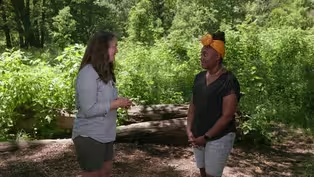
Angela Visits the Milwaukee Rotary Centennial Arboretum
Clip: S8 Ep7 | 1m 58s | Visiting the Milwaukee Rotary Centennial Arboretum, Angela travels through an urban oasis. (1m 58s)
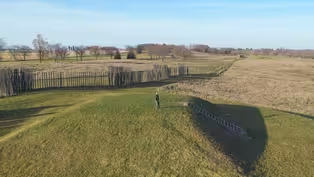
Archaeologist Sissel Schroeder
Clip: S8 Ep7 | 6m 3s | UW Archaeologist Sissel Schroeder has made a career out of studying Aztalan. (6m 3s)
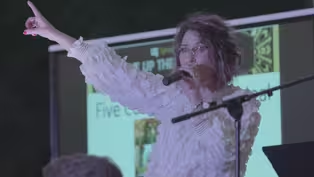
Clip: S8 Ep7 | 4m 13s | Jenny Markham-Gehl is a Wisconsin State Auctioneer Champion. (4m 13s)
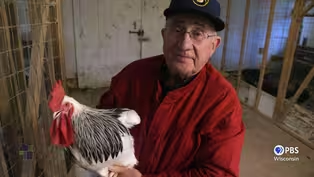
Video has Closed Captions
Clip: S8 Ep7 | 2m 58s | Retired priest Father Tony lives happily in Door County among his flock of chickens. (2m 58s)
Video has Closed Captions
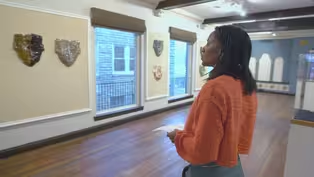
Clip: S8 Ep7 | 3m 35s | Fatima Laster's art is full of layers. She uses paints and canvas to make abstract art. (3m 35s)
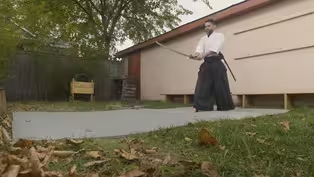
Clip: S8 Ep7 | 3m 34s | Carlos Frick is learning to master the art of Iaido, a form of Japanese swordsmanship. (3m 34s)
Providing Support for PBS.org
Learn Moreabout PBS online sponsorship













Support for PBS provided by:
Wisconsin Life is a local public television program presented by PBS Wisconsin
Funding for Wisconsin Life is provided by the Wooden Nickel Fund, Mary and Lowell Peterson, A.C.V. and Mary Elston Family, Leon Price & Lily Postel, Stanley J. Cottrill Fund, UW...