Utah Insight
Seeking Solutions for Police Reform
Season 2 Episode 1 | 25m 26sVideo has Closed Captions
Utah has more than 20 new laws relating to police reform. We evaluate their impact.
It’s been one year since protests demanding police reform erupted across the country. Since then, Utah lawmakers have passed more than 20 bills relating to the criminal justice system. So, what’s really changed? Community activists and law enforcement experts discuss what still needs to be done, the impact here at home, and how our experiences in Utah are influencing a national conversation.
Problems playing video? | Closed Captioning Feedback
Problems playing video? | Closed Captioning Feedback
Utah Insight is a local public television program presented by PBS Utah
Utah Insight
Seeking Solutions for Police Reform
Season 2 Episode 1 | 25m 26sVideo has Closed Captions
It’s been one year since protests demanding police reform erupted across the country. Since then, Utah lawmakers have passed more than 20 bills relating to the criminal justice system. So, what’s really changed? Community activists and law enforcement experts discuss what still needs to be done, the impact here at home, and how our experiences in Utah are influencing a national conversation.
Problems playing video? | Closed Captioning Feedback
How to Watch Utah Insight
Utah Insight is available to stream on pbs.org and the free PBS App, available on iPhone, Apple TV, Android TV, Android smartphones, Amazon Fire TV, Amazon Fire Tablet, Roku, Samsung Smart TV, and Vizio.
All Episodes Now Streaming
Hosted by Jason Perry, each week’s guests feature Utah’s top journalists, lawmakers and policy experts.Providing Support for PBS.org
Learn Moreabout PBS online sponsorship(upbeat music) - [Male Narrator] Funding for Utah Insight is made possible by viewers like you.
Thank you.
- [Liz Adeola] On this edition of Utah Insight, we're seeking solutions for police reform.
- [LT. Travis Lyman] Never in the 25 years I've been doing this, have I seen as many people as interested in the ways we conduct ourselves as they are now.
- [Liz Adeola] What has changed in Utah after a year of protest and public outcry?
Here from local leaders and activists pushing for progress, plus your take on what Utah and the nation needs right now to unite and heal.
(upbeat music) Welcome to Utah Insight, I'm Liz Adeola.
Killing, protest, violence.
This is a cycle that we've seen play out over and over again in America.
A seemingly minor event leading to a permanent consequence, another black or brown life taken too soon.
A national statistics show the fatal blow for people of color during police stops and interactions is disproportionate when compared to the rate of fatal police interactions with white people.
Last year, it happened on camera and people vow this time to do something different.
So what is different this time around?
Joining us to answer that very question, we have Verona Sagato-Mauga, who serves on Salt Lake City's Commission on Racial Equity in Policing.
Verona is also the co-owner and executive director of Renew Wellness & Recovery.
Joining us on the phone, we have Jeanetta Williams, who is the president of the NAACP Salt Lake Branch.
Jeanetta is also a member At-Large on the Utah Department of Public Safety's Peace Officers Standards and Training Council or POST, and Salt Lake County, Sheriff Rosie Rivera, who also serves on the National Task Force for Police Reform.
Welcome to you all, and I wanna thank you all for being here.
I wanna start with that first question.
Jeanetta, what have you noticed has been different with this response?
- [Jeanetta] I think what I've noticed is that folks are coming together and talking more.
And when I say folks, I'm talking about law enforcement, the community, the legislators.
Everybody coming together to try to see exactly what can we do collectively to resolve this problem.
And so we don't have so much of it happening here in the State of Utah.
Communications is one key element of this whole thing.
- [Liz Adeola] Absolutely, and Verona, what have you noticed?
- You know, I noticed in the last year important conversations are being had, and people are being forced to take a stand to show action behind their words and we're seeing it happening.
And it's a really good thing.
- [Liz Adeola] And sheriff, did you wanna add onto that?
- [Sheriff Rosie Rivera] Sure, since the George Floyd incident occurred, law enforcement has come together with not just the community, but political leaders, advocates, researchers, and our community to try to find a better way to what we are required to do on a daily basis.
And really what we're trying to do is reduce the violent encounters that our communities have with police.
And by taking a look at our training, our policies, our procedures, and just on a broad level of what changes can be made, so these violent encounters are reduced or don't happen.
- [Liz Adeola] I know a lot of people were wondering like why is this happening in Utah?
Why are people protesting and marching here?
And it seems like a lot of people have shared that, it was the pandemic; people being at home and being able to see that video in that footage over and over again that played a role in that.
Your thoughts on that?
- [Sheriff Rosie Rivera] Well, my thoughts are, you know it happened all over the country and when something happens across the country it has a huge impact on all law enforcement.
What we did see though is the negativity that was going across the country, came here to Utah the day of the riots.
And the impact is going to be a long time to heal, take a long time, because when you get your community out there, and it turns into a violent situation, now you have police having to do something, having to take action.
And we had officers who were assaulted, officers who are dealing with some PTSD from those incidences.
Because there was some real violent crime occurring there, and our communities were impacted.
So I think the best thing for us to do is all come together and talk about that incident.
What did that bring to the State of Utah?
Whether or not we have those issues here, there's still impact here.
And maybe we do have those issues and nobody's talking about them, and we're not seeing them, but it may bring something to light, and if there's good change for law enforcement, we're all willing to take a look at it, have the conversation, make those changes.
What we don't wanna see is knee jerk reactions that impact policing, and if police aren't safe, our communities aren't safe.
- [Liz Adeola] Yeah, well, one group that has been talking about an issue, Verona, is your commission that has pointed out that there's a lack of data when it comes to talking about police, and what has been happening in holding them accountable for their actions.
They voiced a concern that more data is needed in order to hold police officers accountable.
And this is not just an issue here in Utah, but an issue that is nationwide.
We've heard about the use of force complaints for years coming from individuals.
Why has it taken so long to require that this data be shared and tracked?
- [Verona] You know I can't answer why it's taken so long, but the truth is it's taking a very long time.
And so that's why commissions like the Racial Equity in Policing Commission came about because that data is so important.
If we're ever gonna make the shift and make these changes in our communities and hold each other accountable, we have to have that data.
We can't do the work, and we can't put forth real policy and changes if that information is not available to us.
And so that's what we're working on and that's what we're fighting for right now.
- And Jeanetta, did you have any thoughts on that as well?
- [Jeanetta] Well, yeah, data is extremely important, and I know some of the departments, they were collecting data.
But we wanted to have everybody to collect the same data so that it could be into a database, where one officer maybe being disciplined is not able to, maybe, quit that department go to another city in another town and get you know reinstated or new job there.
And so just different things that is happening is very important to receive and get the data.
- Sheriff Rivera, can you talk a little bit about how your office is tracking that data, or what they're doing now in order to answer that call?
- What I can talk about is the data has changed the data requests because years ago, crime stats is what our community was asking for.
So that's what we were really providing.
The only time we ever provided any other data was when the FBI asked for to provide data to them.
So a lot of the law enforcement agencies don't have a way to provide the data that is being requested now.
And so we are getting together, and saying what data can we provide and how can we provide it so everybody is consistent?
And what is the cost?
Because if you're in a rural area, a County that's rural, and very, you know, maybe a nine-person department, how do you capture that data, and what is the cost to you?
Where Salt Lake County may be able to have that same system, but afford that type of data gathering.
And that's what we're discussing now, and how do you track?
How do you define it?
All police agencies weren't on the same page as how do you define use of force?
Is it anything beyond routine handcuffing?
Not every agency was doing it that way.
So we need to define that first, and then tell us what data you want extracted out of that.
- [Liz Adeola] That's right.
Well, that was data collection, one of the laws that Governor Cox recently signed into laws, one of the bills.
But another bill that was stalled was House Bill 245; dealing with no-knock warrants.
And that was a police tactic that drew lots of scrutiny after the Breonna Taylor incident.
No-knock warrants now illegal in Louisville, but still legal here in Utah.
Jeanetta, why is that?
- [Jeanetta] Well, what we found that I did work a lot with the sponsor of this particular deal and wanting to get some changes done.
He did make some changes, but it was actually not that it wasn't a no-knock deal you might wanna say, it was a name only.
And so that's why we were trying to get some things changed.
And I think during the next legislative session, the sponsor of that particular bill will go back and put some more information in that particular deal, where it's actually a no-knock bill warrant.
And so that's one of the things that we were looking at.
- I wanna get to some of our viewer questions.
We asked you on Facebook when it comes to police reform, is Utah doing enough?
What do you think our state needs to do?
We got this comment from Lewis Downey who wrote; "Training, training, training and the necessary equipment for law enforcement so that use of lethal force is absolutely the last option."
We've heard a lot about training and the need for it, but training did not prevent the death of Daunte Wright, who was fatally shot by a police officer in a Minneapolis suburb.
Kim Porter served 26 years on the force when she said she accidentally reached for a gun instead of her taser.
And so a lot of people say, this goes beyond training, it points to different issues that are at the foundation of the system issues with race, culture, exploitation, and all of that.
And now you have people that are asking for a true transformation with the system.
Can you talk a little bit about, Verona, why people are asking and calling for more than just reform and more than just training, but a transformation?
- You know I think anyone can go through a program and be trained and be educated.
But the real change is gonna come from individual transformation, that's what I truly believe.
I think one thing that we can do as a community and as law enforcement is really check ourselves and ask ourselves, like, why are we here?
Are we here to serve?
Are we here to help other people?
And the only way we can truly serve one another is if we truly try and understand each other.
And so it's so much more than training.
Training is great, training is gonna help along the way, but it's up to each individual to really make the change within themselves.
And again, decide if you're in the right field, if you're doing, if this is the job for you, if this is what you're passionate about.
- [Liz Adeola] And Sheriff, what are your thoughts on that?
- Well, training is just one piece of it, it's even broader than that.
And an alternatives also to what law enforcement is responding to because we really get called on everything.
There are situations that we probably don't need to respond to, and some of those situations are what escalate.
So we need to keep looking at those alternatives, but it doesn't help when our budgets are decreased, where our training is impacted, our equipment, and we have to keep that communication with our community and keep asking what is it that you want from law enforcement?
Public safety is one thing, but we're not always asked to do the public safety piece we're asked to a barking dog.
You know those kinds of calls is not something that we really should be working on, or should we focus what law enforcement is doing on other things, and just have alternatives such as mental health issues.
You know that's a big discussion right now, and we're not the mental health professionals but we have to respond on mental health calls and we need to be prepared.
So training's really important, but it's the whole conversation.
- [Liz Adeola] I'm glad you mentioned that, the mental health calls because another case that has people demanding change, happened right here in Utah last year.
A Salt Lake City police officer shot a 13-year-old boy who has autism.
You can see on the body cam footage what happened on that scene.
The boy survived, but his mother was left wondering how 911 call for help with a child experiencing a mental health crisis could end with that child being shot by police.
RaeAnn Christensen takes us inside a week long training program in Davis County for officers throughout the state.
They meet face-to-face with mental health patients, run through field exercises, and learn in the classroom how to respond to mental health crises.
(police radio muffling) - [Male Officer] Law enforcement is very aware of the climate that we're operating in and the community's expectations of us to do things a little bit differently than we've always done them.
- [Dr Todd Souter] And what we're trying to do is change the culture of responding to mental health and crisis situations.
The C-I-T stands for crisis intervention team.
When you approach people who have mental health or substance use condition... And figure out ways to get our folks into treatment rather than to funnel them through the criminal justice system because of their mental health condition or their substance use condition.
- Here's just a minute... - [Derick Taysom] There's a lot to know, but I also know that there's a responsibility put on us and a trust by the public.
And so when it comes to opening themselves up, officers who are more additional trained to better serve the public, to help people in crisis, to help people that are having an addiction, to help those people, because ultimately that's what we want.
I mean they are our community members, we want everybody to succeed.
We had the microphones and the ear pieces and we heard the voices.
That's not something you experience on a day-to-day basis.
I was able to put myself in somebody's shoes experiencing voices like that.
- [Man In Orange Shirt] When you guys happen to come across a person or multiple people who have mental illness, like, try to be as, like, non-confrontational as possible.
- They said I was diagnosed with schizophrenia and then... Getting to meet officers, getting to meet some you know new people, new faces, and you know something new in my life and their life too.
So we can make a change.
- Do you have any advice for people that are in a manic state?
- It can be as easy as if it's, let's say it's like snowing or raining and it's cold and they don't have a jacket like giving them a jacket because then that lets the person with the struggles with the mental illness know that you care.
- [Man In Black Hat] I can't hear.
- I'm gonna jump because I (mumbles) - [Man In Black Hat] You're scaring me when you say stuff like that, man.
- [LT. Travis Lyman] I think some of the narrative and conversation about police are responding to so many of these types of calls that they really shouldn't even be involved in.
Because they're certainly not the best equipped to handle, primarily you know mental health-related calls, law enforcement agrees.
We're not trying to hang on to those types of calls for service.
... you're on the edge of a roof, we gotta start trying to negotiate that situation.
We welcomed the conversations around, alright, really should we be handling these types of calls for service or not?
- Has he been diagnosed with anything?
- [Man With Hat] Yeah, he has been recently diagnosed with dementia.
- Dementia, okay.
- [Blonde Girl] Open the door, Shawn.
My brother's learning disabled, he's locked himself inside the bathroom.
- People with mental illness are not more dangerous than the general population.
Statistics tell us that, they're not more dangerous - We're here because someone said there was a loud noises.
- But they can be more unpredictable, when they're going through a crisis time period.
They're vulnerable to misunderstandings and misinterpretations, which could lead to that distress and unpredictability.
- I can't talk to you with that knife in your hand.
I can't get close to you.
I can't help you man.
- [LT. Travis Lyman] It's working, yeah.
But I don't recall having as much discussion about these issues as certainly as we do now.
It's without failing every day, every shift.
Our officers are interacting with people in crisis and every day, every shift we're having positive outcomes.
And I think the C-I-T program, we can point to that as having a big impact on why that's the case.
(upbeat music) - [Liz Adeola] And Donna Summers had this to say about police reform laws in Utah.
"I worry police officers won't be protected.
What's the state doing to protect the safety of police officers these laws are so encompassing."
And Sheriff, you had some thoughts on the story we just saw, and also if you could share your thoughts on what Donna has a question about?
- Right, law enforcement, we're pushing to be part of the conversation so that when legislation is made, we know that it does keep law enforcement safe, but we have to stay engaged in those conversations, and we have to be included.
As far as, you know law enforcement dealing with mental health issues, C-I-T has been around since 2000.
And so I went to the Academy, I believe in 2001 so 20 years, and things are still occurring.
So it's not just C-I-T, that's a good piece but we need more.
Right now with the Unified Police Department, we have what's called a mental health unit, it's a corresponding unit.
So we have a therapist that goes on the calls, and then we have detectives who actually do case management and it's across the County.
So we can keep track of individuals who are struggling and truly get them the help they need rather than just the initial response to the call.
And I think that's gonna be very helpful too.
But yeah, law enforcement, you know, we've said all along, if we aren't safe, our community isn't safe.
So we will continue with those conversations.
- [Liz Adeola] I'm wondering, are there enough mental health therapists to go out on the calls with the officers?
- There is not, that is our challenge.
We have many detectives right now.
We have 12, and a one therapist to go out every day so.
And I know Salt Lake City has a different program; they have social workers who go out as well.
So it's a combination, we're all trying to do something, but you know if we can figure out what truly works.
And like I said, C-I-T is a good program, but it's not the only solution.
- And Verona, you worked in the mental health field for years, what are your thoughts after seeing that story?
- You know it's upsetting obviously, but I can speak to the change that's happening.
I have seen a shift in the way an officer treats someone, an incident where they're dealing with a mental health, someone with mental health issues.
In the past, I've seen officers come in very aggressive and dominant.
But I wanna say in the last two years, I've seen this shift or I've seen a police officer come in and sit on the floor with a client or you know just really be very thoughtful.
And you know that has a lot to do with the training, and that's happening around Utah and with all the different agencies.
With the Commission on Racial Equity in Policing, we are making recommendations on increasing the budget because we can't, we need more therapists and social workers, and there just needs to be a strong infrastructure there.
And it's not gonna work with the way things are right now.
- Jeanetta, from your perspective is Utah just scratching the surface, or are we really taking steps to reshape the foundation that got us to where we are today?
- [Jeanetta] No, I think Utah is far ahead of a lot of the other States that I've seen.
They are having these problems and having more problems than they have here in Utah.
For instance, going back to the social workers and going back to mental health issues, then there's also domestic violence.
And police are called out, Law enforcement are called out on every case, every different, everything, you know just like dogs barking or you know loud music in the neighborhood and just everything.
And so we have to realize that the police and law enforcement can't be everything to everybody.
And then I think once people realize that, and when they were talking about defunding the police, defunding the police is not the remedy, and we need to make sure that we can give more funding so then we can get more social workers to be able to go out on these different cases when police are called, instead of having police go out, having some social workers go out.
And so I see that Utah and all the bills as well that we had this past legislative session, we had 21 law enforcement bills passed, and it's probably more than a lot of other States had the bills passed.
We still had some good ones that didn't get passed, and some of those will come back again next year.
But Utah has been leading on a lot of different issues when it comes to law enforcement here in the State of Utah.
- And before we wrap up, I really do wanna hear your final thoughts on this, and what people who are watching at home should be doing or could do to help out with this situation.
Sheriff, starting with you.
- I think what people could do is continue to stay engaged and engage with law enforcement in the conversation.
Let law enforcement know what their concerns are, and what law enforcement can do, is continue to have the conversations and be willing to make change if change is needed.
- Because sometimes it seems like people are heavily divided on one side or the other, but I think for the most part everyone wants improvements in the community and everyone wants people to be able to live and enjoy life.
- Right, yes, I agree with that.
And you know the overall goal is to have our community safe.
- Right.
And Jeanetta, what are your final thoughts?
- [Jeanetta] My final thoughts is that if folks wanted to see change and then they don't wanna really get involved, but they're talking, they can talk to organizations like the NAACP where we've been around since 1909, and we can be their voice for change.
And we can go in and talk, and we had meetings throughout last year after all of the unrest, meeting with law enforcement, meetings with legislators.
Well, we can make change.
But if people don't get involved or don't try to get their voices, heard, everything will stay the same.
- And Verona.
- I think we need to start listening to each other.
We constantly talk about change and all the things we want.
But I think at the end of the day, we probably all want something very similar, but we're not listening and hearing each other.
And I think that's such an important aspect.
Of course, there's commissions and organizations and groups that you can work with, but there's small things that you can do right at home, listening to your neighbors, understanding each other's differences, and showing respect and love towards each other.
- Okay.
Well, thank you all for sharing your perspectives on this edition of Utah Insight.
Coming up next week on Utah Insight, the COVID vaccine rollout.
It's been a few months, since Utah offered COVID-19 vaccinations to all adults.
So how is the state doing?
You can join the conversation using the methods that you see on your screen.
And also if you have thoughts on what we discussed today, you can give us a call and share your thoughts and concerns, and they might be featured on the next episode of Utah Insight as well.
Thank you so much for watching Utah Insight, we'll see you again next week.
(upbeat music)
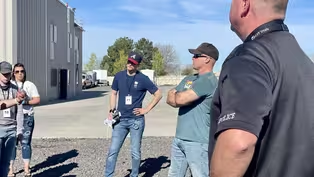
Crisis Intervention Training for Police
Video has Closed Captions
Clip: S2 Ep1 | 3m 50s | Police officers learn new tactics to use when responding to mental health crisis calls. (3m 50s)
Seeking Solutions for Police Reform - Preview
Preview: S2 Ep1 | 30s | On the next Utah Insight, we look at the more than 20 new laws relating to police reform. (30s)
Providing Support for PBS.org
Learn Moreabout PBS online sponsorship
- News and Public Affairs

Top journalists deliver compelling original analysis of the hour's headlines.

- News and Public Affairs

FRONTLINE is investigative journalism that questions, explains and changes our world.












Support for PBS provided by:
Utah Insight is a local public television program presented by PBS Utah