
Dr. Hasan Jeffries on hip hop’s history, political messages
Clip: Season 51 Episode 4 | 12m 30sVideo has Closed Captions
Dr. Hasan Jeffries on hip hop’s political messages, PBS ‘Fight the Power’ documentary.
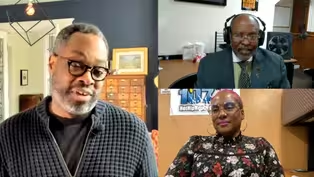
Hip hop turns 50 this year. To celebrate, “American Black Journal” host Stephen Henderson talks with The Ohio State University Associate Professor of History Dr. Hasan Jeffries about his participation in the PBS “Fight the Power: How Hip Hop Changed the World” documentary, executive produced by Chuck D of Public Enemy, and the history of hip hop’s political messages.
Problems playing video? | Closed Captioning Feedback
Problems playing video? | Closed Captioning Feedback
American Black Journal is a local public television program presented by Detroit PBS
Dr. Hasan Jeffries on hip hop’s history, political messages
Clip: Season 51 Episode 4 | 12m 30sVideo has Closed Captions
Hip hop turns 50 this year. To celebrate, “American Black Journal” host Stephen Henderson talks with The Ohio State University Associate Professor of History Dr. Hasan Jeffries about his participation in the PBS “Fight the Power: How Hip Hop Changed the World” documentary, executive produced by Chuck D of Public Enemy, and the history of hip hop’s political messages.
Problems playing video? | Closed Captioning Feedback
How to Watch American Black Journal
American Black Journal is available to stream on pbs.org and the free PBS App, available on iPhone, Apple TV, Android TV, Android smartphones, Amazon Fire TV, Amazon Fire Tablet, Roku, Samsung Smart TV, LG TV, and Vizio.
Providing Support for PBS.org
Learn Moreabout PBS online sponsorship- Dr.
Hasan Kwame Jeffries, welcome to American Black Journal.
- Well, thank you very, very much.
Great to be with you.
- Yeah, it's great to have you here.
So, 50 years.
Boy, that makes me feel a little old.
I won't say how much older I am than that, but let's start with where that places hip-hop.
I think there's always a debate about when hip-hop starts when it kind of diverges from other forms of music.
How do we pinpoint that 50 year year anniversary?
- Yeah, I mean, so hiphop's chronological roots, certainly need to be connected to the 1970s.
So that puts us into that half century mark.
But of course, as you well know, I mean, music is informed and influenced by that, which comes before it.
And with hip-hop, we certainly see that made manifest in the use of sampling, for example.
I mean, the throwback, the inheritance.
But it is a unique form of black cultural expression that is born in the post civil rights, post black power, really almost post disco age.
And it is now much to the chagrin of of many doubters early on half a century old.
- Yeah.
Yeah.
I mean, I can remember arguments, and debates about whether this was music.
I can remember arguments and debates about whether it was appropriate because of the lyrics.
There were stations that said, we're not doing that.
We're not doing this.
Black stations that said they wouldn't play it, but white stations, I can remember these advertisements that would talk about what kind of music they did play.
And then they would say, and no rap.
It was instantly this kind of lightning rod for a cultural moment really I think in our country that this was something so different than what people, black people, white people, what anybody was used to.
- It was.
And on one hand it was something that was unique, and different.
It offered a critical biting commentary on the times.
And especially when we move out of that sort of initial dance party, celebratory art as escape music as escape in sort of the 1970s.
So by the time we hit the early 1980s, and the Reagan era and this cultural critique, political critique, economic critique.
So it wasn't just sort of the language and the use of words.
It wasn't that it was just black folk, although that had always been a problem.
There had always been race music put off in the corner.
But it was especially so because of the powerful and direct critique that rap music offered almost from the very beginning that only gets more strident as we move through the 1980s, and we're introduced to rap groups like NWA, and the critique of police power and the war on drugs.
- Yeah.
And of course all of this fits into the context of, the importance of music in the movement, right.
Civil rights and the advancement of black people in this country has always had a soundtrack.
And for the last 50 years that soundtrack has been hip-hop.
But before that, there was always music sort of aligned with it, and emanating from it, and helping to shape that movement in important ways.
- Steven, you're spot on.
Black folk have always produced music.
They've always produced music with meaning and feeling and emotion.
And it's always been tied, as you said, to the revolution the soundtrack of the revolution whether that was old negro spirituals or deep stirring gospel music, even into rock and roll and R&B when we think of dancing in the streets and some of those Motown songs that we think were just party music really had political messages buried with inside them to hip-hop.
So hip-hop becomes a sort of a logical extension of the African American tradition of drawing on music to express opposition to the status quo in addition to providing relief and escape from the woes of the day.
- Yeah.
So let's talk about this documentary that looks at this 50 year evolution.
What's fascinating to me is, again, I can remember the kind of early days of hip-hop and rap in particular, and how different the things that my children are listening to today are from that, it has come a really long way just in terms of an art form.
- Absolutely.
Part of what is captured, I think in the film is the evolution of the art form, not only in terms of the messaging, but then also the production, also the commercialization.
And so one of the things that's pretty cool about the documentary is that you're able to see these various influences over time, so that by the time we get to the present, you're kind of able to see, oh, I see where a turn had occurred.
I see where this moves from basement parties to corporate headquarters.
I see where some of the political messaging was lost, but yet it's still always, always there.
50 years is a long time.
And the music isn't static just as the world that produces the music isn't static - 2020 and the Black Lives Matter protest wouldn't have happened if it wasn't for hip-hop.
- ♪ What am I.
- The culture informed and brought together generations of people from different backgrounds for this moment.
- ♪ My baby.
- Rappers have tried to highlight injustice in their art since day one.
(people protesting) - 2020 it's very much a reflection of hip hop.
Because hiphop had been that CNN, these are the issues, these are the problems.
(hip-hop music playing) - Hip-hop is a part of a movement of black music that started in slavery.
There's always been some kind of protest in music.
(hip-hop music playing) - This music, this culture.
It would not look sound, taste, smell like it does today if it were not for history.
- When we think about the groups that exist now that are most carrying that message I mean, it's a much broader spectrum of art now than it was when it started.
And I mean, I think there's some argument about whether some of it is too commercial or not black enough or all these other things, but when you think of who's carrying that message now, and kind of at the core of that, who comes to mind?
- Well, in the protest tradition, I think you have to look to Kendrick Lamar, for example, in terms of an artist who is more than just sort of underground, more than just, you know somebody that black folk listen to, actually has popular appeal, but yet his music, you can turn it up in the car, you can play it in the club, but you can also just listen to it to hear the sounds of that protest tradition.
And so he immediately, I think, jumps to mind, thinking back to the Ferguson uprising.
And of course, you know, everything's going to be all right.
I mean, it becomes a chant, becomes a anthem much in the tradition of fight the power back in 1989.
- Yeah.
Yeah.
So, are we at a point where we have to worry about hip-hop, and worry about its future and the role that it's played?
I mean, as I said, in one way it's a good thing that it's as ubiquitous as it is.
I mean, I think, much of American culture right now is shaped by hip-hop.
Things that don't have anything to do with music, things don't have anything to do with black people.
But like with other things that come from our community that become mainstream, do we have to worry about the ways in which we preserve it's bare essence, the things that mean so much to us, and carry us forward, are we losing those?
- I think looking at the history of the music over the last 50 years tells us that organically hip-hop is here to stay.
Certainly there is commercial crossover appeal.
I remember, and I'm sure you do too, joking as a youngster, like, oh, wouldn't it be funny if you saw Big Daddy Kane or some of these early artists, right?
Like rapping 50 years later, right, like 40 years later and now, you know, their headliners at the Super Bowl.
So, generationally it has had staying power, but despite the commercialization, despite the crossover appeal, we still see generation after generation of young artists reflecting and carrying on that message of critique of society.
And I think that's because whether or not we're here in the United States or even globally because hip hop really has proven to be sort of the language of the oppressed, the language of the marginalized, an artistic expression of those who are dissatisfied with the status quo.
That was its roots.
And it continues to be, I think the source of new blood, and new energy, despite the commercialization, sometimes the crafts commercialization of the art form today.
- Yeah.
So I've been waiting for a long time to talk to somebody about this.
What do we do with Kanye?
What do we do with someone like Kanye who look when he was younger, and newer on the scene, I think everybody was really moved by the way he could put words together, the rhythm and all that sort of thing.
And of course, he's produced so much of other people's great contributions to hip-hop, but boy, it's really hard to know what to make of him now, and what to make of him in the context of the movement.
The movement that hip-hop is escorting through history.
What do we do?
- You know, it's one of those questions that gets to the heart of any revolutionary movement.
And I think we need to put hip-hop in that particular context.
You create space for not just those who are going to further the revolution but you create space for everyone.
Now that being said, I think it is important to recognize the artistic contributions and in many ways the artistic creativity, and genius of somebody like Kanye West.
But that should not blind us from the problematic commentary the problematic politics that he has embraced over the last five or six years or so, that needs to be critiqued by those outside of the hip hop community, but also by those inside the hip-hop community.
You don't get a pass because you can drop a good beat.
You need to be critiqued if you really begin to move away I think from what hip hop really offered this nation as a gift, and he's doing that not just in a way that is, I mean, it is one thing if you just go commercial, it's another thing, if your politics then reflect this anti-black, anti-democratic bias, that to me is especially problematic.
And we shouldn't shy away from critiquing that.
Hot 107.5 FM, Michigan’s only all hip-hop radio station
Video has Closed Captions
Clip: S51 Ep4 | 9m 42s | HOT 107.5, Detroit’s only all-hip-hop station and Michigan’s first Black-owned FM station. (9m 42s)
Providing Support for PBS.org
Learn Moreabout PBS online sponsorship New Episode
- News and Public Affairs

Top journalists deliver compelling original analysis of the hour's headlines.
 New Episode
- News and Public Affairs

Today's top journalists discuss Washington's current political events and public affairs.


 New Episode
 New Episode
 New Episode
 New Episode

 New Episode
 New Episode
 New Episode
Support for PBS provided by:
American Black Journal is a local public television program presented by Detroit PBS