
Sen. Andrew Zwicker addresses pivotal issues in NJ
Clip: 1/31/2026 | 12m 19sVideo has Closed Captions
Sen. Andrew Zwicker addresses pivotal issues in NJ
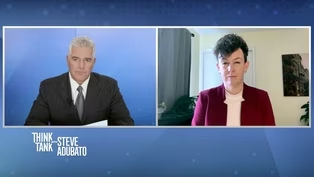
Steve Adubato welcomes Sen. Andrew Zwicker (D) - NJ of the 16th Legislative District to discuss pivotal issues in the Garden State such as the future of public media, rising energy costs, affordability, and first-rate higher education.
Problems playing video? | Closed Captioning Feedback
Problems playing video? | Closed Captioning Feedback
Think Tank with Steve Adubato is a local public television program presented by NJ PBS
Sen. Andrew Zwicker addresses pivotal issues in NJ
Clip: 1/31/2026 | 12m 19sVideo has Closed Captions
Steve Adubato welcomes Sen. Andrew Zwicker (D) - NJ of the 16th Legislative District to discuss pivotal issues in the Garden State such as the future of public media, rising energy costs, affordability, and first-rate higher education.
Problems playing video? | Closed Captioning Feedback
How to Watch Think Tank with Steve Adubato
Think Tank with Steve Adubato is available to stream on pbs.org and the free PBS App, available on iPhone, Apple TV, Android TV, Android smartphones, Amazon Fire TV, Amazon Fire Tablet, Roku, Samsung Smart TV, and Vizio.
Providing Support for PBS.org
Learn Moreabout PBS online sponsorship- Welcome back, folks.
We are honored to be speaking to State Senator Andrew Zwicker from the 16th Legislative District.
Senator, thank you for joining us.
- Thanks for having me, Steve.
- Senator, tell folks where the 16th district is.
- We're Central New Jersey.
Yes, of course it exists, but it's parts of Mercer, and Hunterdon, Somerset, and Middlesex counties, from South Brunswick, Princeton, all the way up in the south part of the district to Clinton in the northern part, 14 towns in total.
- Okay.
I was just saying to you before you came on the air that, on behalf of those of us connected to public media, even a not-for-profit media production company like ours affiliated with public broadcasting, we appreciate the fact that you and your colleague, Senator Burzichelli, and others, Senator Ruiz and others, held an oversight hearing.
The Senate Oversight Committee held a hearing, and a graphic will come up for a mini series we're doing, simply called "Media Matters."
Because media matters.
What was the goal, what is the goal that oversight committee, A, and B, what did you come away with, Senator?
- The goal of what we came away with worked perfectly.
The goal was to highlight the issue, because, as you know well, but people across, not just my district, but across the state know well, Public Broadcasting is a part of our daily lives.
It's a part of our childhood, certainly.
If we're of a certain age, we grew up with public media, public broadcasting, but it provides a unique resource, this show and others, that are focused in particular on New Jersey.
Unique programming that is, whether it's for children, whether it's for the arts, or whether it's specifically about New Jersey.
The financial pressures that it has been under are not unique to New Jersey.
It's happening nationally.
There's been federal pressures, state pressure.
The point of the oversight committee was to, and I'm the chair of the oversight committee, so I worked hand in hand with Senator Burzichelli in particular on this topic.
But he and I were talking that we could use a committee hearing to highlight the topic, number one, bring many of the experts in New Jersey to come and testify, and then be charged with, now is the time to now bring everyone back together after this oversight hearing to talk about the path forward.
How do we prepare public media in New Jersey for not one year, two years, but 10, 20 years into the future?
And frankly, that includes making sure that public media not just has a structure around it, but has the resources it needs to provide the programming that you do every single day.
- Well said, and let me also be clear that our not-for-profit media production company does not have a line item in the state budget, but we're very acutely aware of the role the state has played, and PS, the federal government as well as it relates to underwriting, supporting funding on the federal level for the Corporation for Public Broadcasting, which is what it is right now given the policy decisions made by the Trump administration and then the dollars that pass through to PBS.
That being said, there's gonna be a significant change on July 1st, 2026.
Our longtime partners at WNET, who for 15 years, without going into the details, governor Christie in 2011 opted to no longer fund what was then New Jersey network.
WNET stepped up and with our production company as part of that effort, they took over the responsibility for 15 years, and they've opted not to continue that, mostly for economic reasons.
And here's the question, Senator, what role do you believe, given the fact that state funding has also been cut to public media in the state, in addition to federal money, money's tight.
We got a new governor, governor Sherrill, how the heck can the case be made that the state has a role here?
- Well, Steve, I would say this, that since the Corporation of Public Broadcasting was created back in the late 60s, there has always been a role for the public and the private.
Public dollars with corporate or foundation dollars coming together to provide unique programming.
That's what the mission has been from the start.
It's what it continues to be.
I would argue that the programming that we're fighting to protect is part of the infrastructure of New Jersey.
We want to have educated and informed citizens, and public broadcasting fits into a role and a place that no one else does.
And because of that, I think it's beholden upon us as a state.
Right now, look, the federal government has taken a political position.
The pressure of the state was, in my opinion, inadvertent.
It wasn't based upon politics, but money was cut in the last state budget.
- Yes.
- We need to not just put that money back in, but figure out how we don't have to have, every single year, a fight for a shrinking piece of this pie.
The way to do that is you leverage state dollars with private and philanthropic dollars to create the ecosystem that is public broadcasting.
- One more quick question, then we'll move to a couple of other issues.
So people say, "Hey, wait, I don't need public broadcasting.
I get my information on my phone, I'm on Instagram, I'm on Facebook, I'm on TikTok, and they know what I want.
So they give me what I want.
They figured out the algorithm.
So what's this thing with public media?"
You say, Senator?
- Well, I say that social media, for all of its positives and its entertainment value, is not the place where we're gonna get news.
It's not the place we're gonna have an in-depth conversation on the future of public broadcasting in New Jersey.
Right?
And so.
- Hey, hold on, Senator, you're saying we wouldn't get a lot of clicks?
- I'm counting on you to get us the clicks, right?
Your popularity.
- Yeah, we don't wanna go there to try to get clicks, 'cause that's the wrong direction.
But go ahead, Senator.
- Right.
You know, I mean the reality is that social media wants us to have these ten second, 15 second little sound bites, and here comes AI talking robots.
I mean, I get it.
There's a place for that.
But that's not a place for news.
That's not a place for education.
That's a place for small bits of entertainment.
This is a unique, unique ecosystem, and it needs to be not just protected, but supported.
- Let's shift gears and thank you for indulging me talking about the future of public media.
Hopefully it didn't feel self-serving to folks because it's a much bigger issue.
- It is a big issue.
Yeah.
- Sorry for interrupting, this is a big issue.
By way of background, your professional background is not in politics, it's in what, Senator?
- Physics.
- Oh, that.
- Where I'm working on alternative advanced forms of nuclear energy when I'm not in the legislature.
- You too?
Me too!
No, I'm joking.
- Aren't we all?
- Stop, stop.
Hold on, do this for us.
In reading about the work you're doing, you're very involved in a legislative agenda, leading legislative agenda, community college to career pipeline.
What the heck does that mean?
- So the reality is that when you have some sort of degree, some sort of credential, now for some it's a college degree.
For others it's a two year community college degree.
Others may be getting a certification, maybe an apprentice going into the trades, but some sort of certification or degree leads to a good paying job that is going to take you into a career where you can support a family.
So the goal is now to increase the number of New Jerseyans significantly, from roughly where we are right now is I think close to 50%, towards 75% of all New Jerseyans having some sort of certification or degree.
That's good for our economy, it's good for families, it's good for people.
- This is another area where you've taken the lead.
Neurodiversity.
What is neurodiversity?
- Well, first thank you for just bringing this up.
So neurodiversity are individuals who, quite frankly, they think differently than you or I might.
Their brains are wired differently.
It could be autism, but it could be a range of other afflictions that, you know, in the end is just how they think through different processes.
And the goal of this package of legislation that you're referencing is to do everything we can to ensure that neurodiverse individuals have opportunities to join the workforce, have opportunities to be in a place that is supportive of whatever environment that they may need.
Some folks have auditory issues, so they may need some accommodations for their auditory issues, but neurodiverse folks are highly, highly skilled and just need opportunities like everybody else.
And what we found, and research has shown, is that when it comes to things like AI, when it comes to some of the fields under the umbrella of STEM, science technology, neurodiverse individuals are leading the pack.
And so this package of bills is to sort of level the playing field and ensure that they can be productive members of New Jersey's economy.
- Well said, got a minute and a half left.
A new governor is taking office.
Governor Mikie Sherrill.
What would you say, this is an unfair question, top two or three agenda items she should focus on together with the state legislature, Senator Zwicker?
- Yeah, number one, overall, we see this everywhere is affordability.
But in particular, and she's highlighted it, energy affordability.
We need a short, medium, and long-term plan so that we have reliable energy, but we have affordable energy.
That's number one.
Number two I would say is we need a strong emphasis on ensuring we have a robust public higher education system.
Governor Murphy worked hard on our K through 12 system.
- Right.
- I would urge her to focus on our publics.
Our two and four year publics are amazing institutions, but they need some focus over the next few years.
- Number three?
- What did I say?
Higher education.
Oh, housing.
Number three has gotta be housing.
I've got, you know, 20 something year old kids, they can't afford to buy a house right now.
We've gotta do something about what I would say, we call it affordable housing, but really it's housing that is affordable, and we all want the American dream of buying a house.
We gotta figure out how we can ensure that young people can do that as well.
- Absolutely.
Senator Andrew Zwicker from the 16th legislative district is also the chair of the Senate Oversight Committee doing important work on the future of public media.
And you heard him talk about a range of other issues.
Senator, I cannot thank you enough for joining us.
We look forward to future conversations.
- Thanks for having me, Steve.
- You got it, I'm Steve Adubado, that's Senator Zwicker.
We'll see you next time.
- [Narrator] Think Tank with Steve Adubato is a production of the Caucus Educational Corporation.
Funding has been provided by The New Jersey Education Association.
Community FoodBank of New Jersey.
IBEW Local 102.
NJ Best, New Jersey’s five-two-nine college savings plan.
Hackensack Meridian Health.
New Jersey Board of Public Utilities.
The Turrell Fund, a foundation serving children.
Horizon Blue Cross Blue Shield of New Jersey.
And by South Jersey Industries.
Promotional support provided by ROI-NJ.
And by NJ.Com.
- [Announcer] What is your child's dream for the future?
Doctor?
Teacher?
Architect?
Whatever they aspire to be, a college education may realize those dreams and NJ Best can help.
It's the college savings plan specifically designed for New Jersey families.
Start saving today with as little as $25, because now is the time to invest in their future.
To learn about NJ Best 529 college savings plan, its investment objectives, risks and cost, Read the investor handbook available at njbest.com.
Examining the rise of political violence and polarization
Video has Closed Captions
Clip: 1/31/2026 | 14m 39s | Examining the rise of political violence and polarization (14m 39s)
Providing Support for PBS.org
Learn Moreabout PBS online sponsorship
- News and Public Affairs

Top journalists deliver compelling original analysis of the hour's headlines.

- News and Public Affairs

FRONTLINE is investigative journalism that questions, explains and changes our world.












Support for PBS provided by:
Think Tank with Steve Adubato is a local public television program presented by NJ PBS