State of Affairs with Steve Adubato
Sen. Britnee Timberlake; Sen. Holly Schepisi; Amir Jones
Season 9 Episode 19 | 27m 48sVideo has Closed Captions
Sen. Britnee Timberlake; Sen. Holly Schepisi; Amir Jones
Sen. Britnee Timberlake (D) of the 34th Legislative District, discusses accessible child care and improving maternal health in NJ. Sen. Holly Schepisi (R), Senate Republican Conference Leader, talks about the importance of respectful political discourse and the growing energy crisis. Amir Jones, Essex County Sheriff, examines the relationship between local, state, and federal law enforcement.
Problems playing video? | Closed Captioning Feedback
Problems playing video? | Closed Captioning Feedback
State of Affairs with Steve Adubato is a local public television program presented by NJ PBS
State of Affairs with Steve Adubato
Sen. Britnee Timberlake; Sen. Holly Schepisi; Amir Jones
Season 9 Episode 19 | 27m 48sVideo has Closed Captions
Sen. Britnee Timberlake (D) of the 34th Legislative District, discusses accessible child care and improving maternal health in NJ. Sen. Holly Schepisi (R), Senate Republican Conference Leader, talks about the importance of respectful political discourse and the growing energy crisis. Amir Jones, Essex County Sheriff, examines the relationship between local, state, and federal law enforcement.
Problems playing video? | Closed Captioning Feedback
How to Watch State of Affairs with Steve Adubato
State of Affairs with Steve Adubato is available to stream on pbs.org and the free PBS App, available on iPhone, Apple TV, Android TV, Android smartphones, Amazon Fire TV, Amazon Fire Tablet, Roku, Samsung Smart TV, and Vizio.
Providing Support for PBS.org
Learn Moreabout PBS online sponsorship- [Narrator] Funding for this edition of State of Affairs with Steve Adubato has been provided by The Turrell Fund, a foundation serving children.
Congress Hall.
A Cape Resorts property.
New Jersey Manufacturing Extension Program.
Myron and Elaine Adler private foundation, in support of the Adler Aphasia Center.
RWJBarnabas Health.
Let’s be healthy together.
New Jersey Sharing Network.
Kean University.
Where Cougars climb higher.
Johnson & Johnson.
And by New Jersey Public Charter Schools Association Promotional support provided by NJ.Com.
Keeping communities informed and connected.
And by New Jersey Globe.
[INSPRATIONAL MUSIC] - Hi everyone, Steve Adubato.
We kick off the program with an important conversation with one of the ranking members of the state legislature.
Senator Britnee Timberlake is a Democrat representing the 34th District in Essex County.
Good to see you, Senator.
- Nice to see you too, Steve, thanks for having me.
- You got it.
Hey, listen, we are talking childcare right out of the box and part of a series, and the graphic will come up, Start Strong NJ, which is a public awareness initiative that deals with childcare issues, affordability, accessibility, quality childcare.
You have a playpen behind you?
- I do have a playpen behind me.
- Talk about that.
- Absolutely.
I've birthed three times since being in the legislature, and my husband and I may not even be done yet.
We may birth some more.
And I designed my office to be able to incorporate my children and my family.
I'm a working mom and I believe very deeply that we need a ecosystem that supports families and working mothers and children, and that includes supporting our daycare sectors in which I have children of daycare age, and we rely very much so on our daycare providers, which are primarily women-owned businesses throughout the state of New Jersey.
And right now they're at risk of having to potentially close their doors because of different changes at the state as well as unfortunately, people who do not have the money or making low income are at risk of losing their subsidies.
And it's going to cause a big issue for our economy as a whole, because we're talking about workers having to make the decision as to whether or not they can provide childcare for their children, or decide to go back to work.
Not everyone is able to build in, incorporate their children into their offices like I have been able to.
- But you're taking the lead here along with Senator Ruiz, who we've talked to many times.
Please check out our previous interviews, steveadubato.org is up right now.
We've had many interviews with Senator Teresa Ruiz on this issue, a leader, along with Senator Timberlake.
Be specific, what exactly are you and your colleagues engaged in to change policy, to change funding patterns on the state level to improve the childcare situation, Senator?
- Sure, so short term right now, there was a shortfall of about $30 million that has resulted in the state freezing the applications for subsidies.
So that means that there is a woman who is low to moderate income or the working poor, United Way did a report called ALICE, that stands for Asset Limited Income Constraint but Employed.
Then, unfortunately, if they're pregnant right now, they are more than likely not going to be able to get the subsidy needed to send their child to daycare.
And that's a problem.
Not everyone has a grandmother, an abuela, a nona at home who can help out with that.
Not everyone has extended family or friends who can step in.
The high cost of inflation has made it to where people have absolutely got to drive income into their households just to be able to afford life's basic necessities.
I mean, look at the prices of energy, which is another issue that I've been fighting very hard on, so- - We're talking about the money.
I'm sorry for interrupting, Senator.
There's real money you're looking to increase state dollars.
How much, and where do those dollars go?
- $30 million.
- To where?
- $30 million to infuse into the department that handles all of the childcare.
- Is that Human Services?
- Yeah, that's it.
It's Department of Human Services.
- How the heck, Senator, does it get down into the community and directly impacting childcare in the most vulnerable communities, how does that happen?
- Absolutely, well, they, it starts with them unfreezing the applications.
They're saying that they had to freeze the applications because they had a $30 million shortfall.
So if they can unfreeze those applications, it gets into the community because if a woman needs to put her child in daycare and this is the first time that she's been on subsidy and was relying on that in order to go back to her job, right now, there's a freeze in those applications, so it needs to unfreeze right now.
The other thing that they did was they increased the actual copay, which is difficult.
Have you seen the price of eggs?
Have you seen the price of, you know, your PSEG or JP&L or whoever you have as bill?
Elizabethtown gas, you know, it's the cost of living is astronomical and people are absolutely struggling, and now we have this as a crisis.
- So talk about the disparities.
We've had many conversations about this, but put it in perspective because your perspective is particularly important.
The disparities and the health and survival of Black mothers and their counterparts following birth, it's disproportionately not good.
- This is correct, and we have taken the lead as a legislative Black caucus to introduce legislation, pass quite a bit of legislation to help close that gap.
And unfortunately, these gaps exist not just in childcare as it relates to Black and brown peoples, but also the wealth gap.
So there are so many different gaps that are unfortunate to our community that myself as a legislator, being an African American woman, have dedicated my life and my time to help close.
So making it safer for women to birth in New Jersey has been absolutely paramount, and I have a number of bills to address that issue, starting with every single hospital that has a maternity ward ought to be Mommy Baby certified, which is a special designation that will increase the chances that a woman is being heard when she speaks and says that something isn't right.
And it also incorporates more of a holistic approach, such as skin-to-skin contact as soon as the baby is out of the mother's body and which promotes bonding, milk production.
And it also involves being visited by a lactation consultant at least twice, there's another bill for that before a person is discharged from the hospital.
These are very important things.
- Real quick follow up, totally different subject.
Maybe it's not totally different.
The Affordable Housing Trust Fund, what is it, and why are you looking to restore a significant amount of money to it and what the heck does that have to do with affordable housing?
- Yeah, absolutely, great question.
Affordable Housing Trust Fund is a pool of money at the state that developers are able to apply for and tap into in order to create and incorporate affordable housing in their housing development.
New Jersey has a housing shortage, a vast housing shortage of affordability, and I do believe myself to be an expert in affordable housing.
That's my background long before I ran for office, so I understand what it takes in order to produce it.
But the number one question that we get as housing professionals is, "Okay, so where do I get the affordable housing?"
And the answer to that is that the lists are long and that the resources are scarce.
But with the Affordable Housing Trust Fund, we're supposed to be incentivizing developers to be able to offset the cost and incorporate that affordable development into their actual project.
Unfortunately, dollars were diverted, and we are fighting hard for about 130 million to be placed back in, where there was a victory of some millions being placed.
But it's still not enough, we need more.
We're talking about our Habitats for Humanity, we're talking about our New Jersey Citizen Actions, La Casa de Don Pedros.
I'm thinking of various CDCs throughout our state who need this money in order to build.
We're also talking about the for-profit builders who- - That's right.
- Would apply for that to incorporate at least 20% or so affordable housing into their projects.
- Senators talking about not-for-profit organizations and for-profit organizations involved in development housing.
Senator Britnee Timberlake from the 34th District, I wanna thank you so much for joining us.
Thank you, Senator.
- Thank you, good to see you, Steve.
- Stay with us, we'll be right back.
(grand music) - [Announcer] To see more State of Affairs with Steve Adubato programs, find us online and follow us on social media.
- We're now joined once again by State Senator Holly Schepisi, Republican, who is the Republican Senate Conference Leader.
Good to see you, Senator.
- Great to see you, Steve.
- We're gonna talk about childcare in a second, but I wanna do this with you.
You and I, it's interesting.
You and I have had so many conversations over the years, particularly on "State of Affairs," but political violence.
How concerned are you and what can members of the legislature do to tamp this down?
- It's incumbent upon every single one of us to say, "Enough."
It doesn't matter if it's a Democrat or Republican, there is no situation ever that it is acceptable to resort to violence because you disagree with somebody's position.
I've been horrified by some of the comments, even on my own social media pages, people cheering this young man's death as he was- - Holly, I apologize for interrupting.
Charlie Kirk is just the latest, and I pray that as this airs, it's still the latest and there's not another horrific situation, but there have been many more before that.
What should the message be to everyone right now?
- The message right now is it is okay to disagree.
It is okay to debate policy and efficacy of policy.
It is never, ever okay to cheer, or hope for, or say it's a good start for somebody to be assassinated.
Charlie Kirk, whether or not you agreed with him or vehemently disagreed with him, our entire nation is built upon the ability to express one's opinion.
There is never a place for political violence in such a situation.
- And along those lines, and I like to keep reminding people, not that, somehow it got forgotten that a leading member of the state legislature in Minnesota and her husband were killed, that Paul Pelosi, the husband of the former Speaker of the House, attacked in the middle of the night.
Political violence is not new, and it goes on back and forth.
But finally, Senator, you don't believe that the left nor the right have cornered the market on this and anyone, any group, is any more responsible than any other.
Is that fair to say?
- It's fair to say with one caveat.
I didn't see anybody on my side of the aisle expressing, you know, glee or saying "good job" when the Minnesota representative and her husband were executed.
I didn't see one instance of that.
- I agree, Senator, and sorry for interrupting, but I will say this.
In doing the research for this, I went back and I saw a tweet put out by Donald Trump Jr.
with a picture.
People can check it out.
With a hammer with Paul Pelosi's name and said, "See?"
Translation, it has happened.
It does happen.
And even with prominent people like the son of the current President of the United States.
Meaning, no, you're right about Minnesota.
And I didn't wanna go back and forth, but people have, and by the way, I'm sickened by people who try to minimize or make light of or celebrate a 31-year-old man, who has two children who were there with his wife, assassinated speaking at a college.
Holly, I apologize for going into this.
It's just that you understand this better than most.
Can we talk about this transition?
Utility rates in New Jersey.
Out of control.
Talk about it.
- So I've been really strongly opposing a lot of the policies that were done in a vacuum in New Jersey that we all knew was gonna cause a current crisis.
And to be able to say, "Oh, we're going to have the most aggressive environmental kind of package.
We don't care about utility rate increases.
This is what our goal is.
This is what we're gonna do, and so we're not gonna have a plan B."
And you know, whether or not it was the BPU and continuously without transparency to the public on approving rate increases, whether or not it was shutting down all of our alternate traditional energy supply in New Jersey without having a plan B. This was something that, at least on my side of the aisle, we've been kind of screaming from the rafters for the past several years saying, "We are going to end up where we are today."
And so of course now everybody's going, "It's an election cycle.
The gubernatorial race is up, the whole assembly is up.
And although these are our policies that cause this, we're gonna blame it on Donald Trump who's only been in office for a couple of months as we've been fighting about this on the floor for the past several years.
Or we're gonna blame PGM because of their auction."
No, it's something whereby, as a mother, of course I want clean energy, I want a clean environment, I want a clean planet for my kids.
But you can't set forth policy without thinking about the consequences of it.
- You've talked to us about childcare many times.
A graphic will come up.
There's an initiative called Start Strong NJ, which is a public awareness initiative we're involved in.
The number one concern you have about affordability regarding quality accessible childcare is?
- Gosh, all of the above.
As a working mom, I paid the several thousand dollars a month for my child to go to preschool.
I, you know, pay amongst the highest property taxes in the entire nation for our public school system.
We have to fix our school funding formula as we're looking to help with affordability in general.
And particularly if we're gonna expand our programs within the public school system, we really have to kind of blow up the current school funding formula and make it more equitable around the state.
We're seeing many districts are being devastated by cuts that are taking place.
They're having to eliminate teachers, programs, as we also are trying to implement a policy of expanding out childcare through a public school system.
- Before I let you go, you're up in Bergen County, right?
Immigration a big issue up there?
ICE?
- It is.
- It is.
- It's a big issue I think everywhere in the state.
And it's one that I think, surprisingly or not surprisingly, a lot of people in our area are actually supportive of ICE and the policies that have taken place.
Are there one-off examples and a couple that I've actually been actively engaged with myself where I believe it's gone too far and, you know, we do need to ensure a balance with this.
But I think for people who have been charged criminally, people who have committed crimes, people who are being shielded by New Jersey's policies, that is what almost everybody I've spoken to, regardless of what side of the aisle they're on, that they agree that we should not be affording protections to people who harm our residents, our businesses, and our communities.
- Well, before I let you go, Senator, someone who's been here 30 years, running a business, family, pay their taxes, they're engaged, they're helpful in the community, going after those folks?
- I agree.
That is not something that I am supportive of.
- Senator Holly Schepisi, Republican, Senate Republican Conference Leader, been in the legislature for a couple years.
How many years, Holly?
- Dog years or human?
I've been in the Senate for four, and prior to that I was in the Assembly for nine.
- Excellent.
Holly Schepisi.
Thank you so much for joining us, Holly.
See you soon.
- Thank you.
See you.
- You got it.
Stay with us, we'll be right back.
(grand music) - [Announcer] To see more State of Affairs with Steve Adubato programs, find us online and follow us on social media.
- We are joined for the first time.
It will not be the last time, talking law enforcement with one of the top law enforcement professionals in the state nation.
He's Amir Jones.
He's the sheriff of Essex County, New Jersey.
Good to see you, Amir.
- Good to see you as well, Steve.
Thanks for having me.
- You got it.
Sheriff, we were together at a recent 9/11 ceremony at Eagle Rock Memorial up here in Essex County.
You spoke, I'm honored to be a part of that event with a whole bunch of other folks led by the county executive Joe DiVincenzo.
You spoke about law enforcement professionals and the heroes that they were on 9/11, and they are every day.
To what degree do you believe we still, as a society, respect and admire our law enforcement professionals and see them for the heroes they are?
- I think we do.
You know, that's one of my goals here, you know, Steve, as a sheriff is to, you know, bridge that gap and, you know, engage with our community.
Community engagement is very important to me.
That's something I'm passionate about, and that's something that's one of my main priorities here as the sheriff.
- But, you know, along those lines, there's some degree of, there's a chasm, there's a disconnect, and some are not just critical of the police, but distrustful of the police.
You've talked about your son, you told our, one of our producers in a pre-interview about your son.
Talk about your relationship with your son, teenage son, right?
- He's 17 years old.
He's a senior in high school right now.
I tell you, you know, about five years ago, you know, just having this conversation with my son during the George Floyd era and COVID at the same time.
You know, I remember picking him up, you know, from school the day that that happened.
He was 12 years old at the time.
And, you know, he expressed his disgust and concern for law enforcement, which, you know, truly hurt me because, you know, I'm his father, number one, and I'm a law enforcement officer.
And, you know, we live in the same home.
And I felt if my son, Amir Junior, felt this way, then there's thousands of other kids that feel the same way.
So, you know, it was very disheartening.
It was very hard to hear that coming from my own son.
- What'd you say to him, sheriff?
- I said, you know, I said, "Amir, don't judge the, you know, 99% by the, you know, the 1%, the one bad percent that we have here.
You know, that guy made a mistake, you know, and he-" - And other officers did not step in.
- No.
- Go ahead.
- And that was a mistake that they made as well.
I explained to him, I said, "Listen, you know," and I, you know, I expressed a quote that, you know, from Dr.
King.
I said, "Injustice anywhere is a threat to justice everywhere."
You know, what happened in Minnesota does not happen here in New Jersey.
We police differently here, and you know, it won't happen here, especially while I'm here.
And at the time, I wasn't the sheriff.
I was an undersheriff, but, you know, still a symbol of authority here in this county.
So, you know, I explained to him that that won't happen here.
And he's still, you know, he's still having a hard time, you know.
- That's not easy.
- No, it's not.
- Let me ask you this.
As things get tighter, more intense as it relates to who's, quote, in control, I've asked some of your colleagues in the law enforcement community, if the feds come in, if ICE comes in, and they're dealing with a situation regarding immigration or someone who they're trying to take off the street, or they go into a whatever it is, and they're looking for folks and, but your folks are in charge, or the local folks in the municipality are in charge, and the feds come in.
Who's got the lead on this, sheriff?
- It's, you know, it's, listen, ICE is a federal law enforcement agency.
Their focus is to enforce immigration.
We do not assist with them at all whatsoever.
They haven't asked for assistance.
We cannot interfere with an ICE investigation.
Like I said, they're under their federal authority.
We don't assist.
We don't interfere, so they are the lead.
- They're the lead.
But when the president talks about going into certain urban communities, Newark could be one of them, Paterson could be one of them, but Newark is the largest community in the state and obviously in Essex County.
President comes in and says, "National Guard coming in, gotta clean up Newark because they don't have it together.
Mayor Baraka, plus he's been critical of me, so I'm gonna go in and send our guys in and women."
Really?
Who is responsible for law enforcement in the community?
- To us, it's to me it's the local municipalities, it's the sheriff's office and the local municipalities.
And quite frankly, I don't, you know, my opinion, I know we don't, we don't need, we don't need the National Guard here.
We do a great job here.
You know, crime is down here.
You know, we have, we, you know, we have, you know, a great law enforcement community here.
We have great chiefs, we have a great prosecutor.
We don't need help here.
- Let me ask you something.
The statistics often show what you just said, that crime is down.
Why do you believe, sheriff, that there's a perception on the part of many, that that is not the case?
I've got the horrible case that happened recently down in North Carolina of a 22-year-old woman who was attacked on a train by someone who was in and out of the mental health system, in and out of the criminal justice system, and stabbed her in the neck.
And the president says, "You see?
There it is, out of control."
Incidents like that, high visibility, horrific murder like that, and the statistics don't match up.
You know where I'm going with this?
- Yeah, listen, I think, you know, that's the world we live in and, you know, everyone wants to point out the negative, you know, you know, there are things that happen, you know.
Yeah, things are gonna happen.
But listen, there's so much good that happened in this community, especially in the law enforcement community.
And here, I can only speak for New Jersey and Newark, you know, in Essex County, we have a great relationship with our community.
You know, knock on wood, we don't have those incidents to happen.
We can, and I'm sure it will, and we, you know, we deal with it accordingly.
But we are, you know, the officers here are highly trained to deal with high crisis intervention, deescalation, our Attorney General mandates those trainings.
So listen, I hope, you know, we don't have these issues that we see around the world.
- Yeah, before I let you go, you have a, what is the public awareness initiative that you have?
It's called Ask the Sheriff.
What is it real quick?
- So Ask the Sheriff is something, again, where I can, you know, engage with community.
It's something that where, you know, you can go on our social media platform or askthesheriff.com, ask any question related to the Sheriff's Office, ask any questions related to me.
We've had several questions about, you know, simple questions about what does the sheriff's office do?
What's the difference between the sheriff's office and the local municipality?
Can you come to our building for a meet and greet, which, you know, we're setting up by the end of this week.
So, you know, it's a great way to engage with the community.
- Amir Jones is only 37 years of age.
One of the youngest sheriffs, not just in the state, but in the nation.
He's a sheriff of Essex County.
The most populated, I think.
- 41, 41, Steve.
I gotta correct you, I'm 41.
Not that young, I wish I was.
(Amir chuckles) - Oh, I'm changing my age too.
Okay.
Good to see you, my friend.
- Good to see you, Steve.
- All the best, Amir.
- Thank you.
- You take care.
I'm Steve Adubato.
That's 41-year-old sheriff of Essex County, Amir Jones.
See you next time.
- [Narrator] State of Affairs with Steve Adubato is a production of the Caucus Educational Corporation.
Funding has been provided by The Turrell Fund, a foundation serving children.
Congress Hall.
A Cape Resorts property.
New Jersey Manufacturing Extension Program.
Myron and Elaine Adler private foundation, in support of the Adler Aphasia Center.
RWJBarnabas Health.
Let’s be healthy together.
New Jersey Sharing Network.
Kean University.
Johnson & Johnson.
New Jersey Public Charter Schools Association And by these public spirited organizations, individuals and associations committed to informing New Jersey citizens about the important issues facing the Garden State.
Promotional support provided by NJ.Com.
And by New Jersey Globe.
- How long you been waiting?
- About a half hour.
- Brutal.
This keeps up, I'm gonna miss my pickleball game.
- I've been waiting eight years for a kidney.
What can you do?
(gentle music) - [Narrator] Over 100,000 people in the US are waiting for a life-saving transplant.
But you can do your part in an instant.
Register as an organ donor today at NJSN.org.
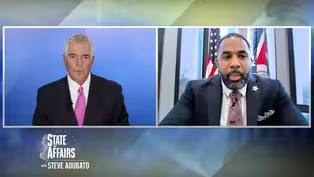
Essex County Sheriff discusses improving public trust in NJ
Video has Closed Captions
Clip: S9 Ep19 | 8m 52s | Essex County Sheriff discusses improving public trust in NJ (8m 52s)
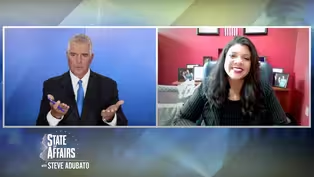
Sen. Britnee Timberlake (D) addresses childcare access in NJ
Video has Closed Captions
Clip: S9 Ep19 | 9m 57s | Sen. Britnee Timberlake (D) addresses childcare access and maternal health in NJ (9m 57s)
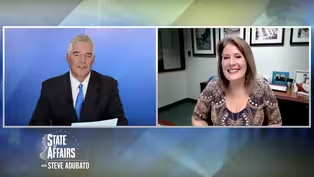
Sen. Holly Schepisi (R) discusses civil political discourse
Video has Closed Captions
Clip: S9 Ep19 | 10m 13s | Sen. Holly Schepisi (R) discusses civil political discourse (10m 13s)
Providing Support for PBS.org
Learn Moreabout PBS online sponsorship
- News and Public Affairs

Top journalists deliver compelling original analysis of the hour's headlines.

- News and Public Affairs

FRONTLINE is investigative journalism that questions, explains and changes our world.












Support for PBS provided by:
State of Affairs with Steve Adubato is a local public television program presented by NJ PBS