State of Affairs with Steve Adubato
Sen. Holly Schepisi (R); Ben Dworkin; Sen. Bob Smith (D)
Season 7 Episode 26 | 27m 58sVideo has Closed Captions
Sen. Holly Schepisi (R); Ben Dworkin; Sen. Bob Smith (D)
Senate Republican Conference Leader Holly Schepisi addresses what went wrong for NJ Republicans in the recent legislative election; Ben Dworkin, Ph.D., Director of the Rowan Institute for Public Policy & Citizenship, discusses the recent legislative election and the reality of clean energy in NJ; Sen. Bob Smith, Chair of the Environment & Energy Committee, addresses NJ's future in clean energy.
Problems playing video? | Closed Captioning Feedback
Problems playing video? | Closed Captioning Feedback
State of Affairs with Steve Adubato is a local public television program presented by NJ PBS
State of Affairs with Steve Adubato
Sen. Holly Schepisi (R); Ben Dworkin; Sen. Bob Smith (D)
Season 7 Episode 26 | 27m 58sVideo has Closed Captions
Senate Republican Conference Leader Holly Schepisi addresses what went wrong for NJ Republicans in the recent legislative election; Ben Dworkin, Ph.D., Director of the Rowan Institute for Public Policy & Citizenship, discusses the recent legislative election and the reality of clean energy in NJ; Sen. Bob Smith, Chair of the Environment & Energy Committee, addresses NJ's future in clean energy.
Problems playing video? | Closed Captioning Feedback
How to Watch State of Affairs with Steve Adubato
State of Affairs with Steve Adubato is available to stream on pbs.org and the free PBS App, available on iPhone, Apple TV, Android TV, Android smartphones, Amazon Fire TV, Amazon Fire Tablet, Roku, Samsung Smart TV, and Vizio.
Providing Support for PBS.org
Learn Moreabout PBS online sponsorship- [Narrator] Funding for this edition of State of Affairs with Steve Adubato has been provided by PSE&G, committed to providing safe, reliable energy now and in the future.
New Jersey Sharing Network.
The Port Authority of New York and New Jersey.
Moving the region through air, land, rail, and sea.
Holy Name.
PSC.
Where your story is our business.
Robert Wood Johnson Foundation.
Working for a more a healthier, more equitable New Jersey.
IBEW Local 102.
Lighting the path, leading the way.
Eastern Atlantic States Regional Council of Carpenters.
And by New Brunswick Development Corporation.
Promotional support provided by Insider NJ.
And by CIANJ, and Commerce Magazine.
[INSPRATIONAL MUSIC] - Hi everyone.
Steve Adubato.
We kick off the program with State Senator Holly Schepisi, the Republican conference leader in the Senate.
You are in an undisclosed location.
Is that true senator?
- (chuckles) That is correct.
- You got it.
And thank you so much for joining us.
Hey, listen, we are taping this program in mid toward the back end of November, but on November 7th, there was an election.
The Republicans lost seats in the senate and the assembly after winning legislative seats the last time the legislature was up.
What went wrong for the Republicans?
- I think it was a perfect storm of three factors.
This was the first time in the history of the state where solely the legislature up for election with a new vote-by-mail system that Democrats have embraced and Republicans and a lot of unaffiliated have not.
And so walking into election day, even in places like my district, where I won, I was, on paper, down by over 4,000 votes.
And I think until and unless we really get our own to embrace it, particularly the voters who may vote one in every four, two in every four election cycles, we'll continue to see these trends.
I think the second factor is the Republican Party has been very poor on reproductive rights.
And a lot of people, particularly women of all ages, have grave concerns because of the court overturning Roe v. Wade.
And I think that really did play against us.
And then the third was this improperly named Election Transparency Act, where we saw the most money ever flood into legislative races.
And you know, unions, the NJEA, Planned Parenthood, a whole host of special interest groups, pumped tens of millions of dollars into some of these races.
- Many of the Republicans in competitive districts focused on so-called culture wars.
Hey listen, don't parents have a right to know if their sixth grade child is talking to a school administrator and potentially discussing gender confusion or potential gender change?
Parents have a right to know.
what about books, banning books in certain schools?
Or excuse me, in schools having to do with certain LBGTQ plus issues.
Why run on those issues when affordability is the issue in New Jersey?
Taxes, can't afford to rent here.
Can't afford to buy here.
Why did so many Republicans get it so wrong on the so-called culture wars?
- I don't think they necessarily got it wrong.
I think we just didn't get enough people to turn out.
Nobody, and that's what's interesting too.
It's all about the messaging.
Nobody wants to ban books, and somehow this has been transformed into Republicans want to ban books.
There's a huge difference.
- Some of you do, Senator.
Senator, no disrespect.
But we had Senator Ed Durr, who's no longer a state senator because he lost his seat after winning the seat from former State Senate President Steve Sweeney.
There are books he wants to ban.
There are books he wants to ban that have to do with certain issues, dealing with homosexuality and transgender issues.
I'm not talking about you, but some of those, some of your Republican brethren see it very differently than you do.
- I never saw that interview.
At least the super majority of people who I speak to on my side of the aisle, we support libraries, we support the First Amendment, we support, you know, even things we wholeheartedly disagree with, to be able to have availability for people to read and have access.
I think the argument was really focused on age appropriateness.
And just because something merely may have an LGBTQIA theme in it doesn't mean that it has to be hypersexualized for inappropriate ages, and the nuances of that argument, it's just easier to go out and go, oh, Republicans wanna ban books rather than having a true intellectual discourse on the efficacy of a policy of allowing books that, you know, if they didn't have those themes and were available for kids that age, people would be up in arms.
And so, you know, but it's tough sometimes to articulate, particularly when you have tens of millions of dollars coming after you in some of these races, what a reasonable person, oftentimes, if not most of the time, would actually agree with.
- Senator, let me ask you this.
Orsted, after a billion dollar, potential billion dollar bailout that Governor Murphy had advocated along with other Democrats, bailed out, they're out of the wind industry.
As we tape this program, there's a huge question as to what wind energy will look like in the state.
When Orsted, the largest company, I believe, in the world, who is involved in wind energy, they're out.
Where do you believe Governor Murphy's wind energy, larger clean energy initiative is?
- I think in light of the election results, he's gonna double down.
He's too far into this.
His wife is now running for US Senate on kind of this platform.
He, regardless of whether or not it's something that is feasible, sustainable, or is even able to be done, I think he's gonna go all in on it, and.
- What does that mean?
What does it mean to go all in if the economics don't work for wind energy?
If Orsted said we can't make money on this deal, bailout, subsidy, give us, no, now we're out.
Where are the economics on this, A?
And B, if that doesn't happen, what happens to the clean energy program in the state?
- Well, I think the energy master plan, as it currently is, is untenable and not sustainable.
We still have not received from anybody in the administration any sort of real idea as to how many hundreds of billions of dollars it's gonna cost the taxpayers of the state.
And I think everybody can agree, particularly me as a mom, that we want a clean environment.
We want a future for our children, our grandchildren, but it's how we implement and how we do this.
In my other life, I'm a corporate attorney.
I represent an outside small municipal utility company, and the infrastructure upgrades that we are grappling with just for a small little utility, in order to even be able to service a small portion of EV and some of these new requirements, is in the tens of millions of dollars.
So you replicate that all over the state without a grid, without a current infrastructure able to handle it, with moving up timelines and goals that aren't realistic, you know, it's, outside of the cost factor, where transmission costs have already increased by two to 300% in the past couple of years alone, we're gonna be pricing people out of their homes while also collapsing the grid if we don't do this properly.
And I think right now there's too much at stake where it's we wanna be the leader in this that nobody's thinking about the practical implications of how we actually do it.
- Senator, let's do this.
I wanna talk to you about fentanyl.
We got real, time is tight here.
We'll have you back to talk more about this.
30 seconds on the fentanyl crisis, A and B, the role of the legislature in addressing it.
- Fentanyl is one of the biggest risks to our kids right now.
People don't understand that a large portion of fentanyl now is being put into counterfeit pills.
So people think, ah, you know, it's not heroin, it's not cocaine, it's not this, it's not that.
And think that they're getting a Valium or Ativan, or something like that on college campuses.
70% of those pills are counterfeit.
They're being manufactured in China, coming up through Mexico.
Our border is completely open.
And many if not most of those pills contain a lethal dosage of fentanyl.
- And the role of the legislature in dealing with it.
300 young people are dying every day in the United States from fentanyl.
Real quickly, the role of the legislature in this.
- Enhanced penalties coupled with enhanced education and more mental health resources across the state for our young who are struggling.
- Senator Holly Schepisi, the State Senate Republican Conference Leader.
Senator, thank you so much for joining us.
We look forward to talking to you next time.
Thank you.
- Thanks Steve.
- You got it.
Stay with us.
We'll be right back.
(grand music) - [Announcer] To watch more State of Affairs with Steve Adubato, find us online and follow us on social media.
- We're now joined by Dr. Ben Dworkin, Director of the Rowan Institute for Public Policy and Citizenship.
Good to see you, doctor.
- Good to see you, Steve, good to be back.
- You got it.
We had an election on November the 7th, 2023, all 120 seats in the state legislature are up.
Democrats picked up seats in the Senate and the Assembly.
Forget about, the polling, the politics locally or what other, otherwise, what issues mattered Ben in that race, and why did the Democrats gain more seats?
- Well, I think what we saw, is that the Republicans ran in a number of very cutting issues, and had really percolated, over the last, up into the public consciousness, over the last six months.
They were talking about dead whales, they were talking about issues involving students and schools, they were talking about gas stoves.
A lot of these things ginned up some of that Republican bait, and in a low turnout election, as it was, as was expected, that might've pulled it out.
But what we found, is that the democratic issues, that they primarily focused on, the "double a" battery as I call it, (Steve chuckling) affordability and abortion, they were really the two moving forces, and generated far more.
Nobody really expected the kind of democratic sweeping victories that we saw.
I think most people like me thought, all right, can win a few, they can lose a few.
We'll see where we are.
Maybe even end up at the exact same place where we were, the day before the election.
But, to see the Democrats, with several seats in the legislature, really just, and the Republicans, effectively shutting out the Republicans, it's like pitching a shutout in the World Series.
This was really something that was surprising, and I think it was those issues, of affordability and abortion, that made the difference.
- Yeah, so, it's interesting, Ben, you mentioned the dead whales, right, and a lot of Republicans, particularly down the Jersey Shore, said, look, the governor, Governor Murphy's clean energy program, had a lot to do with wind energy, Orsted, the largest wind energy producer in the world I believe Ben, pulls out of the New Jersey project.
The question becomes, and they have these wind turbines that they're building.
You know, those dead whales are because of the wind turbines.
We don't even know if that's true or not.
Did you think the Republicans counted on that issue, particularly down the Jersey Shore, influencing people saying, yeah, the Democrats and Murphy are responsible for dead whales, which sounds compelling, we don't even know if it's true or not.
Did they overestimate the value of that, Ben?
- I think they overestimated, yes, the value of it.
It clearly did not resonate enough.
The fact is, the Republicans, largely in terms of legislature, control the Jersey Shore.
(Steve chuckling) I mean everybody.
Until you get to- - Ocean and Monmouth County voted for Trump, huge.
- Huge, right, - Go ahead, I'm sorry, - Until you get to one district, district 11, which was obviously a very competitive, that was where the only Democrat representing the Shore, Senator Vin Gopal.
- Senator Vin Gopal.
- And he won- - And his two assembly, his two assembly candidates - Yeah.
- won too.
- Exactly.
He didn't just win.
We thought this was, and this is a race where millions of dollars have been spent between both sides.
Everybody knew this was gonna be ground zero.
This was a very targeted district, but I don't think anybody really expected Vin Gopal to win with 60% of the vote, which he did.
And that was stunning.
So I think that was a real rebuke to the whole, tying it to whales kind of stuff, but we shouldn't forget, I mean, abortion remained an issue there for Steve Dnistrian, the Republican candidate, who had a hard time articulating what his position was there, and for voters who are still dealing with a post Dodds world, you know, the aftermath of the overturning of Roe v. Wade, this is a primary issue for them.
And it got them out to vote, certainly.
- You know, we had several Republicans come on, I think it was John DiMaio, the Assembly Minority Leader, who writes, we were taping an interview earlier today, Ben, and he said, you know, they, the Democrats, they use the issue of abortion, they manipulate the issue of abortion because we don't have the votes to do anything anyway.
And I threw out, without going through all the details of the interview, Ben, I said, yeah, but Assemblyman, if you had control of the Assembly and the Senate, and you could make the choice, would you not change abortion, attempt to change the legislation, the law of the land in New Jersey, as it relates to abortion and being able to have abortion in ninth month?
And he said, yes, but we don't have the numbers.
I said, yeah, but if you won, you would've done that.
And I'm not saying right or wrong, that's not my place.
But my point has been, do you believe Republicans are perplexed, as a party, as to where they wanna be on abortion, other than just saying what they really think, because it's not a winning issue, per se?
Does it make any sense?
- I think it was a lot easier when you had Roe v Wade, as the law of the land, and you got to then say, I am pro-life, I'm ready to overturn it.
Because it didn't mean much, you weren't gonna be held to account.
You know, and I've written about this, you know, several months ago, and I think many other observers have noted it too.
The moment you took the decisions about how to regulate the use of this procedure, of abortion, and put it back to the states, you can have states like Alabama, you can have states like Texas, which are gonna impose severe restrictions.
You can have places like New Jersey, where it's not popular.
The problem was, that now legislators, it's in their court.
And so they had to come up - It's real.
With, it's real.
- It's real now, Ben.
- And now they have to be called to account.
And so people are saying, well, what is your position?
And you had several, any number of Republicans who tried to deflect, who tried to pivot, to talk about the other things that they wanted to talk about.
You had Democrats hammering, then you had outside groups getting involved, because it's suddenly, no, this is not some thing that is getting decided by nine people in black robes anymore.
Now, the decisions like this, whether we're gonna be a state like Texas, or whether we're gonna be a state like Florida, whether we're gonna be a state that is in tune with the people of New Jersey, these issues, like abortion, are really coming home, and I think it's gonna generate a number of folks who wanna get involved and I think that's why we saw the results we did.
- Before I let you go, Ben, we're doing this program in November, toward the back end of November.
It looks like Tammy Murphy's gonna run for the United States Senate seat.
Bob Menendez, eight, nine, 10% approval rating in the last poll I saw.
Question, got a minute left.
Tammy Murphy, running for the US Senate, the wife of Governor Murphy, the First Lady.
She has every right to run, but for those who say, "Hey, wait a minute, where's this coming from?"
Tom Moran and nj.com, Rita said, "Can't we do better?
Shouldn't we do better" Thoughts on this?
Is it a lock?
- No, it's not a lock, it's never been done.
I mean, that's the thing that we're talking about.
You've seen, we've seen spouses, who replace a, their husband, a female spouse who replaces the husband, who died in office.
And so you have Lindy Boggs, in Louisiana, taking over for Hale Boggs, - Yep, Hale Boggs.
- who was a sort of a legendary Majority Leader of the House, when he tragically died in a plane accident.
So you have things like that.
But this, to sort of have a sitting governor, and have his wife, who is a qualified candidate.
I mean, she has been - Very.
- involved in this administration, she has - Maternal health.
- staked out, maternal health has been a big issue for her.
So I think she has a lot to bring, and that's when we're gonna turn it over to the voters.
For people who say, who aren't gonna buy it, who don't like her, or don't, or choose somebody else, then they'll get to choose.
That's the way this will work and that's the way it should be.
- Ben Dworkin, talk about democracy and where we are.
I talked to Dr. Ben Dworkin, Director of the Rowan Institute for Public Policy and Citizenship.
Rowan, a higher ed, one of our higher ed partners.
Ben, thanks my friend we appreciate it.
- Thank you so much, Steve.
- You got it.
Stay with us, we'll be right back.
(grand music) - [Announcer] To watch more State of Affairs with Steve Adubato, find us online and follow us on social media.
- We're honored to have the Honorable Senator Bob Smith, who's chair of the Senate Environment Education Committee.
Good to see you, Senator.
- Good.
Environment and Energy Committee, yes, sir.
- I screwed up.
It's, actually, back in the day I served on the assembly, Environment and Energy Committee and I just screwed it up.
- It's okay.
- Maybe that's why I lost the election.
- If that's the worst mistake you make in 2023, you're in great shape.
- Thank you, and we're moving into 2024.
This will be seen in a little bit later.
Hey, do this for us.
I'm gonna talk about the power grid in a second, which you're the leading member of the legislature talking about it.
We'll make sense of it.
But Orsted, four months before they decide to leave, Governor Murphy proposes a $1 billion tax credit to keep Orsted here involved in wind energy.
And they go, "Listen, we can't make this work.
"Supply chain, inflation.
We're outta here."
Did they give New Jersey the shaft, A, and B, what the heck happens to wind energy now, Senator?
- So A, they did give us the shaft.
I don't think they were dealing with our government in an honest way, all right?
They were the ones who brought to us the fact that the interest rates had gone up by six percentage points, blockchain was a nightmare, getting materials was a nightmare, and they needed extra help.
So we did it.
We allowed them to get the tax credit.
And by the way, none of that money's got to them.
You know, the taxpayers of New Jersey are gonna ultimately benefit from it.
But we listened to them, and we tried to get them because they were the, at the moment, they were the biggest single vendor of wind energy off the Jersey coast.
And we've already got a port for wind energy facilities, Paulsboro, New Jersey, and we saw tremendous benefits to our jobs and revenues in the state of New Jersey.
But if you're not gonna do it, don't tell us a lie.
Tell us the truth, because it just ended up with a lot of egg on everybody's face.
But to answer your second question, we're not giving up on wind.
We have one of the best offshore wind resources in the world.
Not in the United States, in the world, so you will see wind energy in our future, but it won't be Orsted.
- So, Senator, hold on, a quick follow up to that.
Sorry for interrupting.
People say, "Hey, wait a minute, what about the whales?"
Wind energy.
Could you clarify what's real and what's BS?
- Sure.
So the real is that there are more than four studies by different agencies, different groups, scientifically based, with real scientists doing the math, the investigation, and every single one of them says there's no impact on whales from windmills.
And by the way, we have no windmills up at this point, as well, as everybody knows, so it's not any current windmills that are hurting them.
In Europe, they didn't have that experience.
And the truth of the matter is, there are, I hate to say it in American politics, I don't wanna be a conspiracy theorist, but you have the whole fossil industry not wanting to see windmills and wind energy take off, so they have a couple of operatives in this game who are trying to scare the public that somehow we're hurting our fisheries, and we're not.
You know, the legislature, the governor, we're all in this together, and we love our coast.
We love the Jersey shore.
We're not gonna let it get hurt by anything.
- Real quick follow up.
Senator, Tony Bucco, your colleague, has come on many times saying, "Yeah, climate change is real.
"We wanna be a part of the solution.
"But the governor, Senator Smith, and others," he doesn't mention you by name, "But the Democrats won't tell us "the real cost of this, A, "and B, plus, you know, the governor wants to come "and take your stove anyway."
What's real?
What's BS again?
- Baloney on top of baloney on top of baloney.
Nobody wants to take anybody's stove or any of their appliances.
What the governor and the legislature are trying to do is to provide incentives.
Incentives, not demands.
Not laws saying you have to change anything over, but giving you incentives for you to use electric appliances and more electrification of buildings, but not penalties against you if you don't.
And the reason for that is, the way that we make serious progress on the carbon emissions in the Garden State is by electrifying everything, but having the source of electricity be renewable electricity, not from burning coal or oil or even natural gas.
- All right, the power grid.
What is it, Senator, and why should we be concerned, please?
- So, it's bobby pins and chewing gum.
Now, you have to be old to remember bobby pins, but it is very ad hoc.
It's always been ad hoc.
It's been for whatever was needed in Town 27 or over here on the western side of the state.
It's very, very fragile, and that's a problem because before, as an example, you could install a grid-scale solar facility with lots of renewable energy you have to arrange for what's called an interconnection.
You have to be able to connect to the grid so the renewable electricity can go all over the state or into the PJM system.
The way electricity, the rules work, you have to be very careful when you interconnect into a grid, because if you imbalance the grid, you're gonna get a blackout.
Not a meltdown, but a blackout.
And so the answer is that when you try to do the interconnection, it's gonna take you a year to get an approval, at least a year, and by that time, the deal is dead.
That's the problem.
We have to make our grid resilient.
We had an opportunity after Sandy.
We didn't take it.
If you remember, BPU said to all the utilities, "Tell us what you need to make a sustainable grid."
They did, and then the ratepayer advocates said it cost too much, and they were all cut back tremendously, so we don't have a resilient grid.
We don't have a grid that right now, if you had a grid scale plan together for an enormous open space out in the western side of the state, you wouldn't be able to get it set up.
You can't- - Okay, Senator, it's really cold right now, but summertime, this is real.
- Yeah.
- This is real, and this could impact people's lives.
- Big, Big time.
- Before I let you go, how high a priority is this for the legislature and the governor right now?
- It's not the highest.
I'm gonna try in the next term to make it the highest priority.
Because the truth, if wanna survive as a species, we better get going.
Global climate change is real and it's killing us.
I mean, think about the 29 people who died in that rainstorm that we got from Mississippi about two years ago, all right?
There's no reason they should have died.
Water was coming down in a place in New Jersey where it had never fallen before, and that's because we've changed the planet.
The planet, the atmosphere, is now holding more moisture as it warms up, and when it comes down, it comes down in ocean loads.
- We'll keep talking with State Senator Bob Smith, the Chair of the Senate Environment and Energy Committee.
Good to see you, Senator.
- Good to see you.
- All right, Steve Adubato.
Senator Smith.
See you next time.
- [Narrator] State of Affairs with Steve Adubato Is a production of the Caucus Educational Corporation.
Funding has been provided by PSE&G, New Jersey Sharing Network.
The Port Authority of New York and New Jersey.
Holy Name.
PSC.
Robert Wood Johnson Foundation.
IBEW Local 102.
Eastern Atlantic States Regional Council of Carpenters.
New Brunswick Development Corporation.
And by these public spirited organizations, individuals and associations committed to informing New Jersey citizens about the important issues facing the Garden State.
And by Employers Association of New Jersey.
Promotional support provided by Insider NJ.
And by CIANJ, and Commerce Magazine.
Every person and organization has a story to be told.
Not just famous people, but business leaders, public servants, doctors and nurses, educators and coaches.
At PSC, your story is our business.
For more information, visit Princeton SC.com.
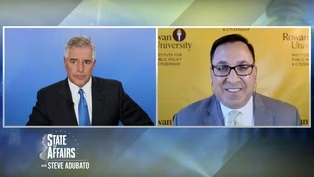
The 2023 Legislative Election and Voting Flaws
Video has Closed Captions
Clip: S7 Ep26 | 9m 49s | The 2023 Legislative Election and Voting Flaws (9m 49s)
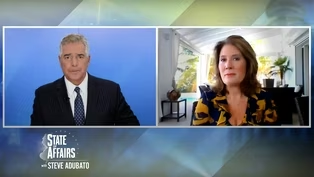
Sen. Schepisi Talks "Culture Wars" in Politics
Video has Closed Captions
Clip: S7 Ep26 | 10m 20s | Sen. Schepisi Talks "Culture Wars" in Politics (10m 20s)

Sen. Smith Address NJ's Future in Clean Energy
Video has Closed Captions
Clip: S7 Ep26 | 8m 48s | Sen. Smith Address NJ's Future in Clean Energy (8m 48s)
Providing Support for PBS.org
Learn Moreabout PBS online sponsorship
- News and Public Affairs

Top journalists deliver compelling original analysis of the hour's headlines.

- News and Public Affairs

FRONTLINE is investigative journalism that questions, explains and changes our world.












Support for PBS provided by:
State of Affairs with Steve Adubato is a local public television program presented by NJ PBS