State of Affairs with Steve Adubato
Sen. Jon Bramnick; Christina Tan, MD; Rep. Mikie Sherrill
Season 7 Episode 5 | 27m 15sVideo has Closed Captions
Sen. Jon Bramnick; Christina Tan, MD; Rep. Mikie Sherrill
Sen. Jon Bramnick, 21st Legislative District, joins Steve for a discussion about the Republican brand and childcare reform; Christina Tan, MD, MPH, New Jersey State Epidemiologist, discusses long COVID, the challenges of misinformation, and preparing for the next public health crisis; U.S. Rep. Mikie Sherrill addresses the war in Ukraine, immigration policy, and the Jersey STRONG agenda.
Problems playing video? | Closed Captioning Feedback
Problems playing video? | Closed Captioning Feedback
State of Affairs with Steve Adubato is a local public television program presented by NJ PBS
State of Affairs with Steve Adubato
Sen. Jon Bramnick; Christina Tan, MD; Rep. Mikie Sherrill
Season 7 Episode 5 | 27m 15sVideo has Closed Captions
Sen. Jon Bramnick, 21st Legislative District, joins Steve for a discussion about the Republican brand and childcare reform; Christina Tan, MD, MPH, New Jersey State Epidemiologist, discusses long COVID, the challenges of misinformation, and preparing for the next public health crisis; U.S. Rep. Mikie Sherrill addresses the war in Ukraine, immigration policy, and the Jersey STRONG agenda.
Problems playing video? | Closed Captioning Feedback
How to Watch State of Affairs with Steve Adubato
State of Affairs with Steve Adubato is available to stream on pbs.org and the free PBS App, available on iPhone, Apple TV, Android TV, Android smartphones, Amazon Fire TV, Amazon Fire Tablet, Roku, Samsung Smart TV, and Vizio.
Providing Support for PBS.org
Learn Moreabout PBS online sponsorship- [Narrator] Funding for this edition of State of Affairs with Steve Adubato has been provided by The Turrell Fund, supporting Reimagine Childcare.
New Jersey Institute of Technology.
NJIT makes industry ready professionals in all STEM fields.
New Jersey Sharing Network.
Horizon Blue Cross Blue Shield of New Jersey.
Here when you need us most.
IBEW Local 102.
Lighting the path, leading the way.
Operating Engineers, Local 825.
Eastern Atlantic States Regional Council of Carpenters.
Veolia, resourcing the world.
And by The Port Authority of New York and New Jersey.
Moving the region through air, land, rail, and sea.
Promotional support provided by AM970 The Answer.
And by New Jersey Monthly.
The magazine of the Garden State, available at newsstands.
[INSPRATIONAL MUSIC] - Hi everyone.
Steve Adubato.
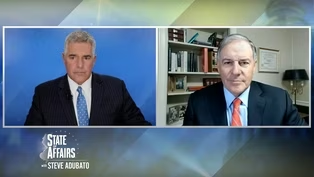
We're honored once again to be joined by State Senator Jon Bramnick.
Jon, good to see you.
- Good to see you, Steve.
Thanks for having me on.
- You got it.
Senator, let's kick this off in a certain way because we're taping on the 21st of March.
If, and again, this will be seen after, if the former President Donald Trump, the titular head of the Republican Party in this country is in fact indicted in New York by the DA, what would it mean, not just for the Republican party, but more importantly, for the country?
- Well, I have two opinions.
The first opinion is anytime Donald Trump is in the news, it's bad for Republicans in New Jersey.
To me, he's a terrible image for Republicans in New Jersey.
The things he did on January 6th, the way he talks to people, his hateful rhetoric.
So I think it's bad that he's in the news.
With respect to the New York indictment, assuming it occurs, the bottom line there is it's probably good for Donald Trump and it's probably not the best way to start an offense by prosecutors against the former president because it's a New York grand jury.
It's basically a Manhattan prosecutor.
and I think that helps him with his base and it's probably something he'll use to raise money, but it's, none of it's good for the country.
- You know, Senator, you talk about the base.
With all due respect, the base, say it's 30, 35% of the Republican party that is loyal to Donald Trump, as he said back in, I think 2016, if he were to go out and shoot someone on 5th Avenue, they'd still be with him.
I don't know if that's true.
That's not really the point.
But the question is, you don't feel part of that base, do you?
You've never felt part of that base.
And it seems to those of us who observe politics in this state and nation, you're less a part of that base than ever as a moderate reasonable Republican.
- Well, when I speak to people about this, other than what I think are the extremists, they'll whisper to me, "Hey, thanks for saying those things."
But they're afraid to do it too loudly because of these, in my judgment, extremist voices in the Republican party.
I still think that most of the Republicans are not extremists, and most of them don't really respect the way Donald Trump handles himself.
But they're afraid to say so.
When I did that, the Trumpers ran against me in a general election just so I would lose.
They knew they couldn't win, but they wanted to pull Republican votes from me.
So I understand why Republicans are afraid.
I'm not afraid.
To me, he's an embarrassment to the Republican party.
He's dangerous in terms of what I saw on January 6th.
And he's a problem for New Jersey Republicans.
I'm not afraid to speak out.
I've been in this business for a while.
I respect people like Ronald Reagan, George Bush, people who showed civility, respect, but were conservative, and to me, policy-oriented, not about themselves.
- As we are into the spring of 2023 and bring it back home to New Jersey, the biggest beef or the biggest concern you have about the Murphy administration, governor Murphy's administration, on public policy is?
- Well, he's an extremist also.
I like Bill Murphy.
But when you see what he does in terms of his policies, in my judgment, it's way too far to the left.
And what happens is, the only reason I think somebody like Murphy gets reelected, though as I said I like him personally, is because they don't trust the Republicans.
The Republican brand has, in my judgment, been injured and hurt by people like Trump.
So what happens is in this last election, we lost because they don't trust Republicans, not that they love Democrats.
So we've seen him sign legislation that allowed a police officer, okay, that actually put a police officer in a criminal situation if he told parents of a 10-year-old that the 10-year-old was drinking beer or smoking marijuana.
That's extreme.
So we've seen it over and over again from the Murphy administration, but we can't win because the moderate independent voters don't trust the Republican brand.
And I'm gonna fight like hell.
I'm gonna fight to make sure that brand is a brand of civility, respect, and moderation.
- Senator, I appreciate you bringing up that particular example.
However, isn't it fair to say that Governor Murphy has tried to strike a balance between being progressive, but also being sensitive to the business community, to be supportive of affordable, accessible quality childcare.
We'll have a graphic up that talks about our Reimagine Child Care initiative.
I mean, isn't the governor in many ways reflecting the will of most New Jerseyans who are moderate and want a government that's active but doesn't overreach, but also is concerned about small business?
Hasn't the governor in many ways struck that balance?
- Not really.
I think people in his own party, if you listen to Democrats in the Senate and the Assembly, they believe he's too far to the left.
We had a meeting recently with Judiciary, and if you listen to the members, they believe- - You mean the Judiciary Committee on the Senate?
- I'm sorry, Judiciary Committee.
And they're not happy with a lot of the policies that actually favor the extreme wing of the Democratic party.
You know that as well, Steve.
So bottom line here is, yes, I saw him now end the sunset, or should I say not renew the CBT tax that corporate- - The corporate business tax that many on the left are peeved at the governor for doing away with, but many in the business community say, "All right, the governor hears us."
That's what I mean by some arguing that there's a balance, you say.
- Well, I think he's starting to move a little bit.
He may run for national office.
He's showing a little moderation now.
But historically, I don't think if you polled the people in New Jersey that you would find that he's a moderate.
You know, as I said, he wins and he wins because of the Republican brand and not because most New Jerseyans think he is the voice of New Jersey.
But nice man, and I have to give him credit for this, he doesn't pick fights and he's able to be balanced when someone criticizes him.
So in a certain sense, he's been successful, and a lot of it has to do with he's got a really good personality.
I remember he studied acting at Harvard and, you know, he's pretty good at it.
And as I said, I'm not criticizing him individually, but I've seen many of his policy far to the left.
- All right, before I let you go, two things.
Number one, the senator mentions the governor's background in drama.
The senator fails to mention that he has been selected, I'm not sure who committee was, he is the funniest, as the funniest lawyer state senator in the nation.
I'm not sure the bar is particularly high, Senator.
- But I didn't study it, I didn't study it.
He actually, I believe he majored at Harvard in drama.
- Senator, how high could that bar be to be the funniest legislator, senator, and lawyer in the country?
Seriously, how high could that bar be?
- It's a little higher than the funniest accountant in New Jersey, but I agree with you.
The competition's very light.
- Got it.
Senator, real quick, 30 seconds.
On our initiative Reimagine Child Care, the reason quality affordable childcare is so important, party aside, politics aside, is?
- Well, because we want everyone to have an opportunity to work.
Childcare is absolutely essential for people who wanna work.
So yeah, that's something we all need to work together on a bipartisan basis, absolutely, Steve.
- Check out our website in terms of Reimagine Child Care to find out more.
State Senator Jon Bramnick, we wish you all the best to you and your family, and check him out because he also does some work on the road as a comedian.
Thank you, Jon.
- Thank you, Steve.
I appreciate it.
- Stay with us.
We'll be right back.
(grand music) - [Announcer] To watch more State of Affairs with Steve Adubato, find us online and follow us on social media.
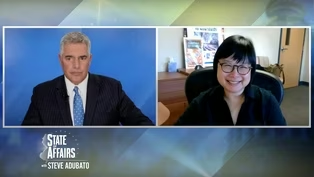
- We're now joined by Dr. Christina Tan, New Jersey State epidemiologist.
Good to see you Dr. Tan.
- Good to see you too, thank you.
- Is it about "Living with COVID," which is a new series on NJ Spotlight News, people should check out every night or is COVID over, living with it, post, what is it?
- We are living with COVID-19 right now.
We have many years of experience with and COVID-19 and we're still just starting to learn more and more about COVID every single day.
But, yes, we're in a stage where we're living with it.
- Biggest lessons, three years plus into this pandemic, biggest lessons in terms of the role of state government as it has to do with a pandemic, an epidemic, a health crisis.
- Our role as in state government with working on the COVID Pandemic is to monitor the trends of COVID disease so that we can hopefully be able to offer good and sound public health recommendations for people to take actionable items so that they can protect themselves from COVID.
I think, we have been very lucky to be living in a time where we have terrific vaccine technology and we were lucky that we were able to characterize what was going on with COVID-19 in a fairly rapid clip and then develop vaccines so that we have a very valuable tool to help prevent disease moving on into the future.
- Dr. Tan, how challenging is it for a public health professional in government to get out accurate, useful, relevant information when there's so much "misinformation, disinformation" on the internet, social media platforms that often confuses people?
- It's very challenging to get information out there because as we know about how science works, is that science evolves based on new information and new data on a day-to-day basis and sometimes much faster than that and it's important for us at the governmental level, whether it's at the local, the state or the federal level, to make sure that we try to get the information out as quickly as we can, accurately, and also be willing to accept that things are evolving and sometimes we may not get things completely correct at the time, but we try to work at our hardest with the best knowledge that we have at any given time.
- Do you believe that the FDA, the Food and Drug Administration is anywhere close to coming up with or whomever in government or in the world of science innovation, coming up with a single COVID vaccine?
- Well, we do know that FDA working along with their scientific experts are working their best to try to understand more about the science about COVID-19, the epidemiology, to be able to inform them to move toward understanding what are gonna be the best strains moving forward to include in the vaccine, number one.
Number two, to try to determine when is the best time to give the vaccine, is it going to be in the fall?
Is it gonna be some other timing?
And then, finally, also considering things like scheduling and what we mean by scheduling is that there may be some populations based on what we understand about COVID-19, there may be some groups that may benefit from more doses of the vaccine, such as older individuals, children, individuals who are living with immunocompromise.
So our FDA, our vaccine experts are all working really hard on all those fronts to make sure that we have an appropriate vaccine that works for our population at large.
- Dr. Tan, I know this is not a decision, I don't know if you're involved in but I know you didn't make a final decision, we had Governor Murphy and I asked people to check out our website, steveadubato.org, it'll be on your screen.
I asked the governor, I think, in three separate interviews in the last couple of years about the role of state government in making the decision that was made as it relates to people in nursing homes, going back into nursing homes those who were treated for COVID going back and the 9,000 plus people who died in those nursing homes.
The governor believes that the right decision was made with the information that was had, that was in hand at the time.
In retrospect, was that a mistake?
- I agree with the governor.
We had rapidly evolving information about the disease and progression and it wasn't just an issue that was solely here in New Jersey, but we were seeing that long-term care facilities, nursing homes, were impacted in a big way nationwide and that this was something that we had to devote more attention and resources to moving forward.
- How prepared do you believe government is and, again, you mentioned local government, local public health officers, the state government, county government, federal government, how prepared do you think government in terms of public health policy and implementation, how prepared do you truly believe we are for a potential "next pandemic?"
- With every single new pandemic or emerging infectious disease, government agencies as well as all of our partners in healthcare and other sectors do come together and try to learn from those particular experiences and I think where we benefit the most from preparedness is making sure that we foster those relationships among all of our partners.
I would say that probably it's the building of those relationships among healthcare, among public health that has been one of the greatest strengths of this pandemic response and that hopefully will serve us well moving into the future.
- I wanna thank Dr. Christina Tan, the state's epidemiologist for joining us, also for those suffering, dealing with Long COVID, again, check out NJ Spotlight News.
They kicked off this series, "Living With COVID," looking at the implications, the impact and actually the experience of those who are living with Long COVID, Many of us want to "get beyond this," we're past it, but for many, they're living with it, dealing with it and still suffering from the effects of Long COVID.
Dr. Tan, thank you so much for joining us.
- Thank you.
- Stay with us, we'll be right back.
(grand music) - [Announcer] To watch more State of Affairs with Steve Adubato, find us online and follow us on social media.
- Hi folks.
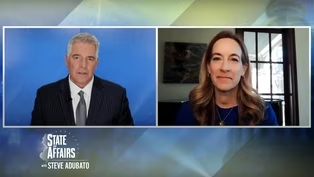
We are honored to be joined by United States Congresswoman Mikie Sherrill.
Congresswoman, good to see you.
- Nice seeing you.
Thanks for having me.
- As always.
Let me ask you this.
Your colleague from California, Katie Porter, Congresswoman Katie Porter, has written a book and I know you know the book.
It's called, "I Swear, Politics is Messier Than My Minivan."
How messy is politics these days, 2023 in DC and Congress?
- You know, that's a really interesting question because I was just speaking to someone who was a chief of staff in the '70s when he felt that politics worked a lot better, when Congress worked a lot better.
He said it was messier.
He said members of Congress were less busy, but that passing legislation was actually messier, which I found very interesting.
I think what we have today though, is people have a great deal more insight into how we pass legislation than they did in the '70s.
- Along those lines, whole range of critical issues.
Inflation, concerns about a recession.
Ukraine, you've been very involved, very committed, and very clear on where you stand on this.
Where do we as a country need to stand, particularly given your background in military service and understanding these issues from a perspective that most of us who have never served do not.
Where do we need to stand, shoulder to shoulder with Ukraine?
- Well, that's exactly where we need to stand, shoulder to shoulder with Ukraine and the Ukrainian people.
One of the great leadership moments of the United States of America was coalescing our democratic allies in NATO, and that really ensured that until 2014, we hadn't seen a nation overtaking the sovereignty of another nation in Europe, which was really amazing because the United States, the world had been drawn into endless cycles of war originating in western Europe and that ended that effectively for many, many decades.
Unfortunately, with the encroachment of Russia into Ukraine and the nations around the world watching carefully, other would-be autocrats or nations that would like to take over the sovereign territory of other regions, they are watching this very, very closely.
So it is imperative that Ukraine win this and that Russia understand at the end of this that this was a huge mistake and they cannot continue to do this.
They can't, you know, take a period of time off as they did after 2014, reassess, and then come back and do this again.
We need to make sure that we can build a lasting peace after this.
- Congresswoman, follow up on that real quick before we move to immigration.
The biggest difference in terms of our national policy as it relates to the war in Ukraine and its inter, our interaction with Russia and Vladimir Putin between Donald Trump and Joe Biden is?
- Well, I think what you've seen is Donald Trump, and this was one of my great concerns about his presidency, and as you probably know, I had many concerns but this one, I think really was shaking some of the foundations of our relationships around the world, is Donald Trump was far more attracted to autocrats like Putin, like Xi, very impressed when Xi became President for life.
You could probably see in some of that the idea that he would try to carry out on January 6th when he tried to stay in office.
So I think it was very dangerous that he was forming closer relationships with people and countries that stood contrary to our values and pushing aside those key democracies that have stood with us so many times over the last several decades since World War II in promoting democratic values across the world.
President Biden has not done that.
In fact, I will tell you before my first trip to Kyiv in the weeks leading up, it was about a week and a half before the war started, I went to Kyiv, we spoke to President Zelensky.
We stopped in Brussels on the way there and I spoke with our NATO allies in Brussels.
The sense of relief was palpable that the United States was ready to lead again.
We are the key leader in NATO, and you could tell that our NATO allies were very relieved to have us back and then very willing to coalesce behind our leadership to support Ukraine.
- I'm gonna get to immigration in a second, but the Jersey STRONG agenda, dealing with the SALT deduction, saving SALT deduction, taking care of veterans and dealing with auto thefts, optimizing women's healthcare, and nominating more labor representatives, getting quote, stuff done.
Question, we have an initiative called Reimagined Childcare.
The website will be up.
Where does childcare, affordable accessible childcare, fit into this Jersey Strong agenda?
- The Jersey Strong agenda is based on what I hear directly from my constituents.
So of course, childcare is enmeshed in that.
I have to tell you that I, my oldest is 17 years old and I still remember 17 years ago desperately trying to find childcare somewhere that was safe and affordable and it turned out I found somewhere that was safe but certainly, I wouldn't call it affordable because I was paying my entire paycheck at different times into childcare.
That has not changed.
It's grown worse for working families today.
In fact, a single parent pays about, the median income pays about 40% of that income in childcare.
That's unacceptable, and that's why I've put together legislation that would result in no one paying more than 7% of their income in childcare.
So that would take a family earning $130,000 down from over $2,000 a month to about $200 a month.
- By the way, go on the Congresswoman's website to find out more about her policy initiatives.
Real quick on this, not that it's a real quick subject, American immigration policy.
What exactly do you believe we need to be doing as a country on the southern border?
- You know, I believe we need to do what I've been talking about for years now and come up with a comprehensive solution, and I think we are now closer to that.
I wouldn't say we are close to that.
We are closer to that than we've been in five years.
We've seen bipartisan efforts.
Those are continuing to build.
My friend Veronica Escobar, who I sit on the House Armed Services Committee with, is working with Maria Salazar and the Republican Party to come together on what we can do to address security at our southern border, to make sure we have a pathway to citizenship for people who are here, to address international criminal syndicates in South and Central America, the things we need to do to make sure that we have a more fair immigration system and also protect what comes in and out of our borders, because at our southern border, at many of our ports, we are seeing an uptick in fentanyl from China that is really devastating here in this country.
- Congressman, shift gears dramatically.
The CHIPS and Science Act, what the heck does it have to do with semiconductors and what does semiconductors have to do with inflation in our economy, please?
- Sure, so as everyone's aware, our supply chains were really put in danger over COVID, and we were seeing huge problems getting these semiconductor chips, and so that's why you see the pictures of Ford F150s on the tarmac in Michigan.
We simply couldn't have those chips which run so many things across our economy.
What the CHIPS and Science Act is doing is reassuring American manufacturing, especially in those very high end chips.
So while semiconductor chips come from all over the world, the very high end semiconductor chips are very tightly controlled.
There are very few people that have the know-how how to make those, and so we are making sure that not only do we produce them here but we also are making sure that we can control that technology because we have learned in, you know, we just can't trust China in some of these national security spaces to be good partners.
We've seen too much technology transfer, force technology transfer, too much espionage, IP theft.
So that's why we are fencing off certain national security areas where we will only produce those with trusted partners and much of that we are now reshoring home to produce those here in this country.
- You've been listening to United States Congresswoman Mikie Sherrill, happens to be the member of Congress who represents the community I live in, and I, we appreciate you joining us, Congresswoman, and we'll continue the conversation with you in the future, and while we're not a political program that does political prognostication or horse racing, or what's coming up in a future election, I just wanna disclose that there are a fair number of people who talk about the Congresswoman as a potential candidate for governor in the great state of New Jersey in 2025.
Doesn't feel that far off.
Congressman, thank you so much for joining us.
We appreciate it.
- Thanks so much for having me.
- I'm Steve Adubato, that's the Congresswoman.
See you next time.
- [Narrator] State of Affairs with Steve Adubato Is a production of the Caucus Educational Corporation.
Funding has been provided by The Turrell Fund, supporting Reimagine Childcare.
New Jersey Institute of Technology.
New Jersey Sharing Network.
Horizon Blue Cross Blue Shield of New Jersey.
IBEW Local 102.
Operating Engineers, Local 825.
Eastern Atlantic States Regional Council of Carpenters.
Veolia, The Port Authority of New York and New Jersey.
And by these public spirited organizations, individuals and associations committed to informing New Jersey citizens about the important issues facing the Garden State.
And by Employers Association of New Jersey.
Promotional support provided by AM970 The Answer.
And by New Jersey Monthly.
- I am alive today thanks to my kidney donor.
I am traveling and more active than ever before.
- I'm alive today thanks to my heart donor.
I'm full of energy and back singing in my church choir.
- I'm alive today thanks to my lung donor.
I'm breathing easy and I'm enjoying life'’s precious moments.
- They are about 4,000 people in New Jersey waiting for a life-saving transplant.
- Donation needs diversity!
- For more information or to become an organ and tissue donor, visit NJSharingNetwork.org.
NJ State Epidemiologist on the Challenge of Misinformation
Video has Closed Captions
Clip: S7 Ep5 | 7m 41s | NJ State Epidemiologist on the Challenge of Misinformation (7m 41s)
Rep. Mikie Sherrill Addresses Issues Impacting Our Nation
Video has Closed Captions
Clip: S7 Ep5 | 10m 48s | Rep. Mikie Sherrill Addresses Issues Impacting Our Nation (10m 48s)
Sen. Jon Bramnick Discusses the Current Republican Brand
Video has Closed Captions
Clip: S7 Ep5 | 9m 44s | Sen. Jon Bramnick Discusses the Current Republican Brand (9m 44s)
Providing Support for PBS.org
Learn Moreabout PBS online sponsorship
- News and Public Affairs

Top journalists deliver compelling original analysis of the hour's headlines.

- News and Public Affairs

FRONTLINE is investigative journalism that questions, explains and changes our world.












Support for PBS provided by:
State of Affairs with Steve Adubato is a local public television program presented by NJ PBS