One-on-One
Sen. Loretta Weinberg; Ken Blanchard; Jeff Jarvis
Season 2021 Episode 2423 | 27m 52sVideo has Closed Captions
Sen. Loretta Weinberg; Ken Blanchard; Jeff Jarvis
Sen. Loretta Weinberg discusses her lessons learned during her 29 years as part of the NJ Legislature; Ken Blanchard talks about how the human ego plays a role in leadership and the keys to ethical leadership; Jeff Jarvis shares the role of the media in politics and social movements throughout the pandemic and the need for transparency in the media.
Problems playing video? | Closed Captioning Feedback
Problems playing video? | Closed Captioning Feedback
One-on-One is a local public television program presented by NJ PBS
One-on-One
Sen. Loretta Weinberg; Ken Blanchard; Jeff Jarvis
Season 2021 Episode 2423 | 27m 52sVideo has Closed Captions
Sen. Loretta Weinberg discusses her lessons learned during her 29 years as part of the NJ Legislature; Ken Blanchard talks about how the human ego plays a role in leadership and the keys to ethical leadership; Jeff Jarvis shares the role of the media in politics and social movements throughout the pandemic and the need for transparency in the media.
Problems playing video? | Closed Captioning Feedback
How to Watch One-on-One
One-on-One is available to stream on pbs.org and the free PBS App, available on iPhone, Apple TV, Android TV, Android smartphones, Amazon Fire TV, Amazon Fire Tablet, Roku, Samsung Smart TV, and Vizio.
Providing Support for PBS.org
Learn Moreabout PBS online sponsorship- [Narrator] Funding for this edition of One-On-One with Steve Adubato has been provided by The New Jersey Education Association.
Horizon Blue Cross Blue Shield of New Jersey.
Here when you need us most, now and always.
Atlantic Health System.
Building healthier Communities.
The Russell Berrie Foundation.
Making a difference.
The New Jersey Board of Public Utilities, Clean Energy program.
New Jersey Sharing Network.
The Fidelco Group.
Summit Health a provider of primary, specialty, and urgent care.
And by NJM Insurance Group.
Serving New Jersey'’s drivers, homeowners and business owners for more than 100 years.
Promotional support provided by Northjersey.com and Local IQ.
Part of the USA Today Network.
And by BestofNJ.com, all New Jersey in one place.
- This is One-On-One.
- I'm an equal American just like you are.
- The jobs of tomorrow are not the jobs of yesterday.
- Look at this.
You get this?
- Life without dance is boring.
- I don't care how good you are or how good you think you are, there is always something to learn.
- Do you enjoy talking politics?
- No.
- People call me 'cause they feel nobody's paying attention.
- Our culture, I don't think has ever been tested in the way it's being tested right now.
- That's a good question, high five.
(upbeat music) - Hi, I'm Steve Adubato, but way more importantly, it is my honor and pleasure to introduce a giant in the New Jersey State Legislature, and in the state of New Jersey.
Yeah, she's rolling her eyes but she is State Senator Loretta Weinberg, she's a Senate majority leader and how dare she, after nearly 30 years in the legislature, decide that she's stepping down and moving on to other things?
How are you, Senator?
- I'm doing well, thank you Steve.
Busy trying to finish up legislation that everybody's counting on me to get passed before I serve in whatever will be the final legislative session of the Senate.
It's really been a great run and I don't wanna say all those things that kind of sound trite but I can't imagine being in a position to lead a life that you actually can act on your passions, that you can actually change things and then bring you along a very adventuresome path, full of adventures, some good, some bad, but always challenging.
- And it's been great.
- Senator, I'm sorry- It's been great but I wanna push you a little bit.
What are you most proud of after nearly 3 decades in the state legislature?
- Well, that's a question that's been put before me before, but it's not something that I can pick out one thing.
I have a group of things other than my family, and as I said, the two perfections in my life, my two grandchildren.
But things like the 48-Hour Bill goes way back, where we required insurance companies to pay for, big deal, 48 hours of aftercare for new moms and their babies.
It really changed things when we were in a period of time of the so-called 'drive-through deliveries.'
Banning smoking indoors, that took 10 years.
I was the primary sponsor in the assembly and then became a co-prime when I moved into the Senate.
Issues around earned sick leave, family care, which gave people time to take care of their relatives who were sick or if there were new parents.
And I learned so much, just my own life, from being the daughter, taking care of the frail elderly mother, being later widowed but taking care of my husband, who did pass away of cancer and when I thought of that Family Leave Bill, I was in a period of life where, first of all, nobody questioned my ability to make healthcare decisions on his behalf, hence marriage equality.
Nobody questioned.
I didn't have to punch a time clock.
So nobody questioned my ability to be able to stay home in his last weeks of life.
So those were all the things that I'm most proud of and hope I contributed to.
- Well, it's not my job to say so as a broadcaster with public broadcasting but you'd be hard pressed.
Even those who have disagreed with some of your positions to say anything other than you've made and continue to make a meaningful contribution.
Senator, let me ask you this, you and I have had so many conversations over the years both on the air and privately, but I'm curious about something.
At a time when so many young people, younger people, let's say, turned off the government, people are polarized, divided, family members don't even talk to each other, friends have decided not to be friends, not to have dinner together, not to bring up certain topics, certain whatever, are you optimistic about our ability to move forward as a nation but more importantly, as a people, even if we disagree on the issues?
We're so polarized.
- I am an optimist about life in general, - That's why I asked you.
- and I have to say if I wasn't I wouldn't have been able to stay in this long, long range.
Yes, I am optimistic.
It's going to be difficult.
We're fresh off the prior national administration which played in such a negative way, played into our differences.
And I have in my own family, not me, because I love my cousin, even if she's a Trumper,(laughs) but I actually in my own family have people who don't talk to each other or blocked each other on Facebook due to these kind of political differences.
But I think as time gets a little more distant that we will definitely overcome that.
I think young people being involved in whether it's Black Lives Matter, gun safety issues, women's access to health care, all those things that bring us together it's gonna help and I am optimistic about the future.
I kidded about my grandchildren, but I look at them, they're teenagers so I look at their friends, I see what they write on social media and this is a new generation that I have a lot of confidence in.
- Senator, again, it often strikes me that I served one term in the legislature, was out quickly after two years, you've served and I always wondering what would it have been like to serve all those years?
But for you, it's a little bit different in this way, a woman in a male-dominated world, having significant influence, sitting at the bargaining table and bargaining.
Why are you looking like that?
Did I get that wrong?
- Because I get criticized for being at the bargaining table.
I get criticized coming - Go ahead.
from the more purist folks who are engaged in politics, but if I had to sum it up, I think of the phrase and it's really an art form; "How do you get along without always going along?"
So, there are really no textbooks written on that subject and that's what interchanges that I have with particularly many women's groups, young women I've spent a lot of time over the last year on Zoom doing these meetings with a whole variety of women's groups, certainly the center for American women in politics.
- At Rutgers at the Eagleton Institute- - But, you know if you want to get something done, you have to find the levers of power that enable you to get bills posted, that enable you to get 21 votes in the Senate and 41 votes in the assembly, that enable you to reach out to advocates to join in.
So it's not a business for purists.
It is a business to keep your eye on what your goals are, what it is you want to do, what you want to accomplish.
Hey Senator, on behalf of everyone in the world of public broadcasting and media, just thank you for being accessible, available, speaking your mind and helping us understand better.
Thank you, Senator.
- Thank you Steve.
And thank you for running these kind of public affairs programs that help educate our public.
Thanks so much.
- Lot of work to do.
That's Senator Loretta Weinberg.
Thank you so much.
We'll be right back right after this.
- [Narrator] To watch more One on One with Steve Adubato find us online and follow us on Social media.
- Hi, I'm Steve Adubato.
And I don't wanna waste any time because we've been wanting this gentlemen on with us for a long time.
And we have him.
He is Jeff Jarvis journalist, author, professor at the Newmark Graduate School of Journalism at CUNY City University of New York.
Also has a media blog BuzzMachine.com and the author of this book.
I love this book.
He's got many books, but this one Public Parts, How Sharing in the Digital Age Improves the Way We Live and Work.
Hey, what year was this published Jeff?
- Oh, it's been a while.
Probably about six years.
- Okay, so here's the setup question.
Six years after the digital age, does it improve in your view the way we live and work together particularly a year plus into this pandemic?
- Yes, I think it does.
That's a minority opinion.
I know 'cause these days only dystopia and moral panic tend to sell about the internet.
But I think very importantly, Steve, to look at the last year, not in the last four years of Trump the internet had the opportunity to answer him.
Yes, he used it for his ill, but we got to use it as well.
But far more important than that I think with the movements of Me Too and Black Lives Matter.
Mass media, the media that I've worked in my whole career run by people who look like me and you all white men.
I'm older than you.
Did not give proper representation to all kinds of communities.
And social media did.
The hashtag is a platform.
Black Lives Matter.
I hope leads finally to a racial reformation in America and that's made possible because the internet gave people a way to speak that media didn't.
And these days we hear media trying to dismiss the internet and everyone on it.
And I think that would be a dire mistake.
- Follow up on this on the media.
Friend of mine the other day said, "You guys on PBS.
You lean to the left, right?"
I said, I'm sorry what?
"Well, whose side are you on?
Are you with Biden?
Are you you're against Trump?"
I said, no, no.
We actually try to talk about what's going on and make sense of things.
No, no, seriously who's side are you on?
Here's the question?
Have we gotten to the point where the vast majority of Americans simply consume Jeff Jarvis what they want to consumer need to consume in their minds via the media that simply reinforces what they think they already believe verses we don't have a horse in this race.
We just want to talk about what's going on and try to make sense of it.
Or am I being too idealistic, Jeff?
- That belief in echo chambers and filter bubbles I think was the common belief around the net.
But this last year I read a book by an Australian researcher named Axel Bruns.
The book's title is the question, Are Filter Bubbles Real?
And his answer is no.
He pulled together tons of research out there that says that people don't just make, befriend the people who agree with them, they don't just listen to one side.
They are aware of other sides.
Do we have a problem in internet discourse?
Yes, we do, but I think that's early days, Steve.
I think that in a sense I'm working on the book about the end of the Gutenberg age and what I've learned I think is the early days of media were conversational.
And somewhere along the line with mass media we lost that ability.
We are a society relearning how to hold a conversation with ourselves.
- Hmm, so may I ask you.
Trust, distrust of quote mainstream media, President Trump, Enemy of the People Jim Acosta's book of the same title, fake news, all of that.
What impact do you believe Jeff has it had on people's ability to trust us?
- I think it's a malign influence but there's more than just that.
Trust in American journalism started falling in the 70s.
I've never fully understood why it could be because papers became monopolies in a lot of towns by then.
It could be because the news destroyed Richard Nixon.
I don't know why it is, but it started falling then.
And there's other factors today.
I think that there are malign actors within the media.
People say often, "Well, I don't like the media", but they do like one outlet or another.
They like you, Steve Adubato and they trust what you have to say, but they the same breath could say they dislike the media.
I dislike what Fox News has done to American democracy.
I dislike what Rupert Murdoch has done to it.
That's my view of the media.
And actually I think that in all honesty the majority of media do have a liberal worldview.
And in fact, what that results in is, Gallup had a survey about two years ago that said that the single most trusted outlet news was Fox News.
That's because there's one of them and then all the rest of liberal media.
So I actually believe we need more conservative media to compete with Fox to change the balance of the ecosystem.
- But Jeff, respectfully, because I have so much respect for you.
People say that as a cliche, but in your case, it's true but don't we need more and I'm not going to turn this into a commercial for public broadcasting.
You say, we need more conservative media.
There's America One News, whatever the heck it's called there's Newsmax, don't we need more public broadcasting or broadcasting that does not have an agenda that does not have a horse in the race that does not have a point of view but it's breaking things down and having other voices heard.
Isn't that what we need more of?
- I think media with a public agenda.
Yes, that's true.
But I also think that one thing we've lost in media is a certain transparency, is a certain honesty, right?
The New York times is basically liberal in its viewpoint.
The fact that it wouldn't say that means that a lot of people would not trust it.
If I can't trust you to say that then what else can I trust you with?
So I think that transparency is the new objectivity as a friend of mine once said and that we've got to be honest about our own worldviews our own perspectives and our own lived experience.
And then we have to value other lived experiences.
There's an author named Louis Raven Wallace who wrote a book as a transgender journalist who was fired from NPR because he wouldn't hold up to NPRs standards of objectivity, Wesley Lowery former Washington post journalist wrote a great op-ed in the New York times, a few months ago, who said that objectivity is fundamentally a racist construct.
Because again, it's people who look like us who get to decide what is objective and what is biased.
So I think we've got to value other people's lived experiences and perspectives more and recognize that we all come to the news with different perspectives.
Then we can try to find where we have common ground.
I re-read recently Steve, Hannah Arendt's Origins of Totalitarianism.
And there was one particular piece in there that really instructed me where she said that people under a totalitarianism give up their everyday concerns for abstract notions.
That's what I think we see happening in politics today.
I don't believe that the second amendment and guns and abortion or cancel culture is the most important thing in people's lives.
I think the most important people, things in people's lives is the same for you and me.
It's about our family and their welfare.
And if we can have media talk about those real concerns and people's lives, then I think we can start to see change.
But political coverage is too often an agenda set around abstract notions.
- Before I let you go.
Are you optimistic or hopeful about the quote next generation of media in our country?
- Very, I teach at the City University of New York at the Craig Newmark Graduate School of Journalism to get that plug in.
I created a new degree in social journalism there with my colleague, Carrie Brown.
These are journalists who, when they come in we tell them, all right, learn what we teach you.
And then question everything we teach you.
And they do that.
Oh, they do that.
And they come up with really creative new ways to imagine serving the public through journalism.
They are the ones who make me very optimistic.
- Jeff Jarvis, when you're optimistic, it gives reason for the rest of us to be optimistic as well.
Jeff Jarvis journalist, author, professor at Newmark Graduate School of Journalism at City University of New York, Jeff, all the best.
Thank you so much for being a role model for all of us who try to do the best we can in media.
Thanks, Jeff.
- Thank you for the conversation.
- You got it, I'm Steve Adubato we'll be right back.
- [Narrator] To watch more One on One with Steve Adubato find us online and follow us on Social media.
- We are honored to be joined by a giant in the world of leadership and management, and as a student of leadership, which we all are.
This gentleman, Ken Blanchard, has made a big difference.
He's the co-founder and Chief Spiritual Officer of the Ken Blanchard company, the author of this extraordinary book, The One Minute Manager.
I don't want to kiss up to you too much, Ken Blanchard, but, you know, as someone who's done leadership development and coaching over the years, you are the giant in our business.
You know that, right?
- Well, I appreciate that.
I've been very blessed that I got a chance to work with a lot of wonderful people, that's for sure.
- Yeah.
Let's talk about this.
We'll use some of this for our sister program, Lessons in Leadership, but let me ask you - Your interest - bordering on a healthy obsession around leadership - comes from what?
- Well, it really comes from my father, who ended up retiring as an admiral in the Navy, and I, I'll never forget, I won the president of the seventh grade in New Rochelle, New York, and I came home, and I was all pumped up, and my father said, "Well, Ken, your leadership training begins today.
"Now that you're president, don't ever use your position, "because great leaders are great "because people trust and respect them, "not 'cause they have power."
And he said, "You might think that's surprising, "coming from a military officer, but "if I acted like a big deal "and I was more important than my men, "they would have shot me before the enemy."
(laughs) - Yeah.
Hey Ken, let me ask you this: So many leaders that I would work with over the years - and you've worked with many, many more than that - Why do so many leaders have such a difficult time simply saying, "I own it.
I was wrong.
My mistake, I'm responsible.
"Here's what we need to do."
in spite of all the advice that you and others who are really smart about leadership have given them?
- Well, I think the biggest thing, Steve, that we've found, is the human ego, which is, you know - two ways that that shows up - one is false pride, when people act like they have a "more than" philosophy - "I'm brighter than," "I'm smarter than," and "You ought to listen to me."
And a lot of things, people don't know that this is an ego problem, which is fear and self doubt.
When they really think that, you know, they don't know everything and they have a "less than" philosophy.
It's interesting, the guy that wrote "I'm OK - You're OK" years ago said the worst life position was "I'm okay, you're not."
And all the research shows that people that act like that are really covering up not okay feelings about themselves.
And so, I think leaders that I've run into, which have high control needs are afraid that people will realize they don't know everything.
But they don't understand - I wrote a book with Colleen Barrett, the president of Southwest Airlines, when Turb stepped down down, and she said to me, she said, "Ken, people admire your skills, but they love your vulnerability.
When you really know that you don't know all the answers, they get excited, because now we can really be a team."
- "We" rather than "me" is the important ingredient.
But, I tell you, a lot of people, because of their ego, don't get it.
- So well said, Ken, and the follow-up to that is this: A definition from your perspective of quote unquote "servant leadership" - Servant leadership is... - Well, it's when you really think that you're there to serve rather than be served.
That's the most important thing, and, you know, Steve, when I talk about servant leadership, a lot of times, people think that I'm talking about inmates running the prison or trying to please everybody, but there's two parts of servant leadership: One is vision, direction, values, and goals, you know, and that's really the responsibility of the hierarchy.
It doesn't mean you don't involve people, but if people don't know what business you're in, what you're trying to accomplish, and the values that drive - shame on you.
But once that "leadership" part of servant leadership is taken care of, now you're traditionally, you know, turn the pyramid upside down and you work for your people.
So that, eventually, everybody works for the people who take care of the customers, and so, that's why a company like Nordstrom's, you know, you've got a problem, then people say, "No problem, I'll take care of it."
They don't say, "Let me talk to my supervisor in there."
And so, that they can really do that in the same way.
Southwest, you know, they can actually make decisions.
- You know, as you're talking about servant leadership, there's another aspect of leadership that I struggle with, because, in my other life, in doing leadership and conducting leadership seminars, one of my students said, "Why don't you talk more about morals and ethics in leadership as a leadership trait?"
And the answer is, I'm not really sure how to do it.
So, you understand ethical leadership better than most.
Define it, and help people understand why it's so incredibly important, now, more than ever.
- Well, it's interesting, I wrote a book called "The Power of Ethical Management: Integrity Pays!
You Don't Have to Cheat to Win" with Norman Vincent Peale, who wrote The Power of Positive Thinking.
He was 86 years old at the time.
But we said that there's three questions you need to ask around ethical.
The first one, "Is it legal?"
You know, in other words, "Is it really - The second one, "Is it fair to all involved?"
'Cause sometimes, something is legal, but it's not really fair.
And the third one's a powerful one.
It is, "Would you like it discussed in the newspaper?"
You know, "How will it make you feel about yourself if you do that?"
And if you do that "ethics check," we call it, it's a pretty powerful one to say, "Well, is this legal?"
Well, it is legal, but, you know, is it really going to be fair?
And how will it make me feel about myself?
And so, people just need to think through decisions to make sure that they are ethical and they just don't make a decision right away for expedient reasons.
- Ken, I think a lot about the concept of feedback - giving constructive, often hard-to-hear but important feedback to people.
And again, you've been doing it for years - A, some advice for people who are giving feedback to other people about their performance - maybe - they're on the team.
They want to be constructive.
They want to be positive.
But they also have to be candid about someone not getting the job done.
They don't want to hurt their feelings, et cetera.
Is there a balance that you have found in all that?
- Well, it is.
And you mentioned "The One Minute Manager," you know, because, the first secret is one minute goal setting.
All good performance starts with clear goals.
But then the last two secrets, one minute praising - and we changed it for the new "One Minute Manager" to one minute redirects - that's really about feedback.
And one of the key things as a manager, as a parent and all, is you gotta be observant of what's going on.
And so, if people are doing things well and things are progressing, we need to get out there and say, you know, "I really noticed that things are going really well, "And I wanted to tell you, it's just fabulous.
"And I hope you feel good about it.
"How are you feeling?"
you know, and you praise them, and - And if their performance isn't doing as well, now you're in for a one minute redirect, but you don't charge in and say, "You idiot, "how could you be so stupid?"
You say, "You know, I noticed that the performance "in this area is not quite as good as we had hoped.
"Do you agree?"
you know, and if you put it like that, they're going to say, "Yeah, I know."
"Is there any way I can help you "get back on focus?"
you know, and so - remember that feedback is the breakfast of champions, a colleague of mine, Rick Tate, said.
But you want to make sure that you have a relationship with the person, you know, and you're not just coming off the wall.
One of the biggest questions we get, Steve, is, "How do you get feedback up the hierarchy?"
you know, - (laughs) Wow.
- Because that's really important, but I'll never forget, I was teaching in a business school - - By the way, do me a favor, Ken, could you stay right there?
I'm going to end this segment.
But if you don't mind, I'm going to keep the conversation going with you for a couple of minutes.
You okay with that?
- Sure.
- That's Ken Blanchard.
He is an icon in the world of leadership and management.
And for people like me - and there are many - who are always working on our leadership skills and making mistakes every day, you learn a lot from this guy.
That's it for this segment with Ken Blanchard, but, truth is, we're going to keep the cameras rolling.
I'm Steve Adubato.
Thanks for watching.
We'll see you next time.
- [Narrator] One-On-One with Steve Adubato has been a production of the Caucus Educational Corporation.
Funding has been provided by The New Jersey Education Association.
Horizon Blue Cross Blue Shield of New Jersey.
Atlantic Health System.
The Russell Berrie Foundation.
The New Jersey Board of Public Utilities, Clean Energy program.
New Jersey Sharing Network.
The Fidelco Group.
Summit Health And by NJM Insurance Group.
Promotional support provided by Northjersey.com and Local IQ.
Part of the USA Today Network.
And by BestofNJ.com.
- [Young Girl] I was diagnosed with Cystic Fibrosis when I was two.
It's hard to grow up with CF.
But I have an awesome care team at Goryeb Children's Hospital.
Helping me do the things I want to do, like play lacrosse.
And now, I've been recruited to play in college.
- Where you go for pediatric care matters.
- [Announcer] Atlantic Health System, because every moment is a moment that matters.
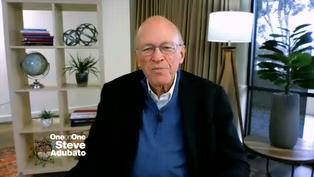
The Importance of Ethical Leadership
Video has Closed Captions
Clip: S2021 Ep2423 | 9m 31s | The Importance of Ethical Leadership (9m 31s)
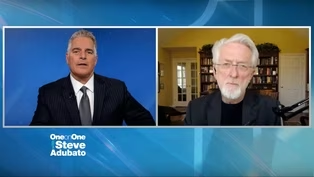
Media's Role in Politics & Social Movements During COVID-19
Video has Closed Captions
Clip: S2021 Ep2423 | 9m 16s | Media's Role in Politics & Social Movements During COVID-19 (9m 16s)

Senator Weinberg Reflects on 29 Years in the NJ Legislature
Video has Closed Captions
Clip: S2021 Ep2423 | 9m 42s | Senator Weinberg Reflects on 29 Years in the NJ Legislature (9m 42s)
Providing Support for PBS.org
Learn Moreabout PBS online sponsorship
- News and Public Affairs

Top journalists deliver compelling original analysis of the hour's headlines.

- News and Public Affairs

FRONTLINE is investigative journalism that questions, explains and changes our world.












Support for PBS provided by:
One-on-One is a local public television program presented by NJ PBS