State of Affairs with Steve Adubato
Sen. Nicholas P. Scutari (D); Asm. Brian Bergen (R)
Season 9 Episode 3 | 27m 8sVideo has Closed Captions
Sen. Nicholas P. Scutari (D); Asm. Brian Bergen (R)
Senate President Nicholas P. Scutari (D) joins Steve Adubato to discuss the effects of the Trump administration on New Jersey, the importance of preserving democracy, and the fiscal impact of legal cannabis. Then, Steve Adubato sits down with Asm. Brian Bergen (R), Minority Whip, to explore federal job cuts, New Jersey’s fiscal health, and how changing tariffs affect businesses.
Problems playing video? | Closed Captioning Feedback
Problems playing video? | Closed Captioning Feedback
State of Affairs with Steve Adubato is a local public television program presented by NJ PBS
State of Affairs with Steve Adubato
Sen. Nicholas P. Scutari (D); Asm. Brian Bergen (R)
Season 9 Episode 3 | 27m 8sVideo has Closed Captions
Senate President Nicholas P. Scutari (D) joins Steve Adubato to discuss the effects of the Trump administration on New Jersey, the importance of preserving democracy, and the fiscal impact of legal cannabis. Then, Steve Adubato sits down with Asm. Brian Bergen (R), Minority Whip, to explore federal job cuts, New Jersey’s fiscal health, and how changing tariffs affect businesses.
Problems playing video? | Closed Captioning Feedback
How to Watch State of Affairs with Steve Adubato
State of Affairs with Steve Adubato is available to stream on pbs.org and the free PBS App, available on iPhone, Apple TV, Android TV, Android smartphones, Amazon Fire TV, Amazon Fire Tablet, Roku, Samsung Smart TV, and Vizio.
Providing Support for PBS.org
Learn Moreabout PBS online sponsorship- [Narrator] Funding for this edition of State of Affairs with Steve Adubato has been provided by RWJBarnabas Health.
Let’s be healthy together.
The Turrell Fund, a foundation serving children.
United Airlines.
Rowan University.
Proudly serving New Jersey for 100 years.
Johnson & Johnson.
New Jersey Sharing Network.
NJM Insurance Group.
Serving New Jersey’s drivers, homeowners and business owners for more than 100 years.
IBEW Local 102.
Celebrating it’s 125th Anniversary.
And by Operating Engineers, Local 825.
Promotional support provided by NJ.Com.
Keeping communities informed and connected.
And by New Jersey Globe.
[INSPRATIONAL MUSIC] - Hi everyone.
Steve Adubato.
We kick off the program with the second most powerful person in the state of New Jersey politically.
He is the Senate president, Nick Scutari.
Mr. President, good to see you.
- Good to be back.
Nice to see you too, Steve.
- You got it.
Hey, Senator, let's do this.
The greatest concerns you have about the Trump administration's policies as it relates to New Jersey and is it cuts in programs?
I'm sure you hate to answer the question I asked you.
Is it cuts in certain programs that impact state funding?
- Well, that's certainly a big concern.
I mean, my biggest concern is a national concern where we don't follow the rule of law, we don't follow court decisions anymore.
If that really happens, we don't have democracy anymore.
That's the biggest concern I have, that the whole democracy goes down to tubes, which-- - Oh, really?
Seriously?
Because that's real stuff.
So for people who think seriously, Senator, "Oh, come on.
"The Senate president is engaging in hyperbole.
"Democracy's not at risk."
You say?
- It is if you don't follow the rule of law anymore, if you just say, I'm doing this no matter what a court says, I'm doing it anyway.
Because the court doesn't have the power to have the police come and stop the administration from doing something.
So that's how you end up with no longer a democracy, with a dictator, essentially in charge.
And that's my biggest concern.
I mean, the cuts are the cuts, that'll be difficult as well.
That'll be huge.
But if we don't have a democracy anymore, then I don't know.
None of this means anything.
- And along those lines of cuts, let's talk specifically about Medicaid.
Is it fair to say that of 9 million people in the state, 2 million people currently rely on Medicaid, A, and B, how concerned are you that the federal government through the Trump administration could be cutting those Medicaid benefits to those people?
- Close to 2 million.
It's about 1.8 million.
And yeah, it would be devastating for those folks, elder folks, folks with disabilities, seniors, children that rely on this for their healthcare.
It would be completely devastating.
There wouldn't be anything the state could really do.
We can't plug the hole of the federal government.
That's part of what the federal government's supposed to do.
- What would happen to those people, Senator?
- They would be uninsured.
They would not be able to get their necessary services.
They would not be able to go to the doctor.
They would not be able to go to the hospital.
They would not be able to get potentially lifesaving care when they need it.
And the state couldn't really do anything about it.
- If Elon Musk and the Republicans in Congress and President Trump say, "We are not cutting Medicaid, "we are not cutting Medicare.
"We are just cutting waste, fraud and abuse," you would say?
- Well, tell us what that is and we'll cut it.
I mean, no one's interested in having waste or fraud or abuse of these programs or any programs.
We've got more watchdogs in New Jersey than most states.
We've got the state auditor, we've got the state controller, we've got the Office of Public Integrity.
We have State Commission of Investigation, we have every county prosecutor's office, the special prosecutions unit.
We have more folks looking at waste, fraud, and abuse than I think probably any other state in the union.
So we've got probably more than we need.
So I think New Jersey doesn't have a lot of waste, fraud, and abuse in terms of what their spending is.
- Senator, to what degree do you believe that the goal of the federal administration, Trump administration is to quote, as some have said, "Privatize Social Security, Medicaid, and Medicare," meaning move it out of the government and have it handled by the private sector.
To what degree do you believe that's really what's going on?
- Well, it's certainly possibility for sure.
I don't know for sure that's the end goal.
I'm a state legislator, not federal one.
- But if that were to happen, what would that mean?
- It would be dramatic changes for folks and it would be probably much more difficult for folks to survive in a situation like that.
I don't disagree with streamlining government.
We've had our own issues with state workers here.
But I think we're being surgical would be more appropriate than firing folks.
And then having them realizing that the federal atomic stockpile is no longer guarded because we laid off folks that are supposed to be guarding our nuclear weapons.
So, I think they've gotta be a little more...
I would appreciate if they were more surgical because the stock market's been crashing, prices have not gone down.
There are significant issues since the new administration came in for sure.
- We're actually taping on the 18th of March.
This will be seen later.
But to put things in perspective let's talk about education cuts.
What connection from your perspective, Mr. President, do you see between the Trump administration saying, we wanna do away with the Federal Department of Education, or at least cut it in half or slash this percentage or that percentage, get rid of the percentage of the workers, et cetera.
Cut back on many programs.
How much is the state of New Jersey and the children of New Jersey and public schools dependent upon the Federal Department of Education, Senator?
- Well, they set a lot of guidelines.
We obviously have, and I would say one of the best teaching workforces in the country.
Partially because we have a strong board of education in the state of New Jersey.
We've got strong union that provides really good teaching.
But guidelines that come from the federal government are essential, especially when it comes to funding of certain things.
If they're gonna cut the funding, that's gonna change education as we know in New Jersey.
- Shift gears.
So I'm curious about this.
You've been a leader in the legislature well before you became president of the Senate in the fight to legalize cannabis.
Where are we and where aren't we?
- Well, I think we've done pretty well with getting a legal industry stood up and running.
You can now buy legal marijuana in a variety of places.
More places are opening and they're real.
Most of them are very nice locations, nice places.
They're providing excellent products.
We are also continuing to provide medical marijuana for folks with significant disabilities.
But we've got a lot of work to do because we've got a really vibrant illegal market still out there selling marijuana illegally.
Not product that's tested, not product that's regulated.
Obviously, there's a lot of reasons why we put all these rules in place that makes it expensive for business owners to open up cannabis shops.
And there's a whole group of folks that are just not following those rules that are continuing to sell it illegally.
- How are we dealing with that?
With the illegal trade?
- I recently introduced new legislation to crack down on, because I think right now there's not a priority amongst law enforcement to do anything about the illegal sale of marijuana.
And that's something we really need to do before something goes terribly wrong.
Their product is not tested.
It's out in the stream.
People are still purchasing it, utilizing it.
And because it's less expensive and it's less expensive because it's not regulated.
They don't test the product.
You don't know what's in that product.
- It's dangerous.
- Yeah, it's dangerous.
And there's a reason why you can buy it legally and you shouldn't buy it illegally.
And we're going to crack down that.
- Senator, let me ask you this.
We're involved in, and for several years we've been involved in an initiative to help folks better understand the need for accessible, affordable childcare.
A graphic will come up, it's called the First 1000 Days Policy Coalition.
And here's the question.
From your perspective as president of the Senate, what is the highest priority?
And I know Senator Teresa Ruiz has been a leader in this front.
What is your highest priority as it relates to childcare as New Jersey elects a new governor in 2025, taking office in January, 2026.
But as a president of Senate, what's your highest priority?
- Well, I depend a lot on Senator Ruiz as my majority leader and the number two in the Senate.
And she's been a leader in childcare issues and childcare tax credits, helping parents get to work and not having the burdens of childcare as a continuing.
It's a lot of responsibility raising children and working at the same time.
Folks don't have the luxury to be able to stay home anymore.
So the state has to continue-- - Is that legislation moving Senator?
- We've moved several pieces.
We've increased childcare tax credits over time and we're gonna continue to work on those things if we can afford them.
I'll tell you one of the other things, and I thought it's not related, but I mean, the population of our country and our state is growing dramatically.
And folks of our age group are now being the caregivers.
We're not even young anymore.
And we've got folks that are still alive.
Our parents and our grandparents and our uncles and our aunts.
And we have that responsibility.
The state has to do more to try to help folks.
'Cause this is gonna be, as the baby boomers start retiring and are not able to take care of themselves, but are not passing, this is going to be a real big issue for folks that are of working age, but are not really young anymore with trying to balance the needs of their continuing careers and taking care of the elderly.
- Last issue I wanna raise with you, and you understand this better than most.
The so-called magic mushroom issue.
You're leading an effort that would legalize the production use of, I don't wanna mispronounce it.
- Psilocybin.
- Psilocybin, right.
What the heck is a magic mushroom and why should it be legalized, Senator?
- Well, psilocybin is proven to be very successful in treating a variety of conditions: PTSD, depression, even alcoholism.
And I'd like to see New Jersey be at the forefront, one of the first states to legalize it for medical purposes so we can test it and utilize it and see how it can be done under strict doctors' guidelines to see if we can help it get through and get it past the finish line.
Maybe by the end, by the summer break, so that we can see doctors being able to utilize this in the treatment of patients.
- But only.
Senate President Scutari.
Only medical use, correct?
- At this point, yes.
Only medical use.
- How hard has it been to move that initiative?
- I think people are reasonably open-minded after how much work it took me to get marijuana legalized.
This is a little bit-- - How many years?
Let everyone know, Senator.
We must have done a dozen interviews over the years with you.
- Yeah, I don't even know if it-- - Was it at least, was it a decade?
- It was more than a decade.
- More than a... - Yes.
I introduced it in 2006, I believe, and by the time it's now really opened up, it's been almost 20 years.
And when I started, it was me.
That was it.
- Yeah.
It was just you.
Senator, give me 30 seconds on the cost of energy in the state.
- We've been conducting hearings in terms of that.
I mean, energy costs has to be at the forefront of the legislator's minds.
Not that we can do tons about it, but we certainly wanna find out why.
And the blame lies in a variety of different places.
But we've gotta continue to make sure that we analyze how we can produce energy in New Jersey for folks that is affordable.
- Senate president Nick Scutari, dealing with a whole range of issues.
There'll be a new governor in New Jersey in January, 2026.
We'll follow the election and continue talking to the Senate president.
Thank you Senator.
- Good to see you, man.
Thanks a lot.
- You got it.
Stay with us, we'll be right back.
(grand music) - [Announcer] To see more State of Affairs with Steve Adubato programs, find us online and follow us on social media.
- He's back.
He's state assemblyman Brian Bergen who is the minority whip which means he's the whip, the head of the Republican party in the state assembly.
Good to see you, Assemblyman.
- Hey, thanks for having me.
- Listen, there's a whole bunch of things I wanna talk about, but I heard from our producers, you wanna talk about tariffs.
We're taping on the 18th of March.
We're not trying to time anything.
Big picture.
What's your greatest concern about President Trump's initiatives around tariffs and its impact on the nine and a half million people of New Jersey?
- It's really difficult.
I don't agree with what's happening right now with tariffs.
With any business thing, my goal is to give as much certainty as possible to the people.
And what's happening right now with President Trump's administration around tariffs, there's a lot of uncertainty.
So what happens there is you don't know when you're buying products now and you're quoting them for sale in the United States, you don't know what the tariff's gonna be, what you're gonna owe and those fees coming down.
So it's causing a lot of chaos in the business community right now.
Look, I'm okay with tariffs.
I understand they have a role to play in this world economy, but they gotta be transparent.
It's gotta be predictable.
It can't be 25% one day, 50% the next day, and 0% the next day.
If it was 1,000%, I don't care, as long as we know the game we're playing so we can adjust business-wise.
- This time, why don't we hear more Republican members of Congress?
And I know that you are not in Congress, but why don't we hear more Republican members of Congress who are concerned about business as you are stating this?
- I have no idea.
- Yeah, you do.
Respectfully, respectfully, you do.
- Well, I can- - Because they don't wanna be primaried.
- Well, sure, of course, of course.
They don't want to go against the Trump administration, that I understand, but this isn't- - But if it's hurting businesses.
- Yeah.
Oh, I know, but I don't think this is going against anybody.
I mean, this is the way I think.
You know this by now- - You've always said what you thought.
- Right, you gotta say what's true.
And what's true is uncertainty in the business market creates a bad business climate.
That's just a fact.
And the way the tariffs are being handled right now is causing that uncertainty.
Everybody should be telling the president that right now.
I'm certainly saying it out loud where I can, you know, and again, if he wants to put tariffs to equalize the treatment of the United States around the world, that's fine.
But put 'em in place, leave 'em in place, and let's start doing business within those limits, not changing your mind every five minutes.
- Let me ask you this, in terms of uncertainty.
The president, President Trump and Elon Musk have been very clear about their desire to reduce the size of the federal workforce, the size of federal government.
What is your greatest concern, if any, Assemblyman, around the potential cuts in Medicaid, which could potentially, as Nick Scutari, the Senate president just said in the previous segment before you, could affect 1.8 million New Jerseyans who are enrolled in Medicaid?
- Yeah, at this point, I think the talks around the cuts in Medicaid, social security, and Medicare, I think they're just talking points.
From what I've seen so far and heard the president say in multiple occasions is that there will not be cuts to these programs.
So if there ever were, I'd be firmly against it.
I think those are three bedrocks of what make our nation awesome.
And so they should not be touched.
They would have a devastating impact to answer your question, if they were touched, but I don't think they're gonna be.
I think it's just- - You don't?
- I don't, no, I really don't.
I think it's a talking point by people who are opposed to all the cuts that are going on, that they're focused on the potential for that, because that draws the most attention and fear.
- Let me ask you this.
You've served our country and tell folks how and where.
- I served while I was in, from 2001 until 2009, I served in Iraq in 2005.
I was a attack helicopter pilot.
- And I said it last time, I'll say it again, thank you- - Oh, you're very welcome.
- For your service in the military, and along those lines, one thing we do know is the Trump administration is looking to cut approximately 80,000 jobs in the Department of Veteran Affairs.
More than 25% of the VA's workforce is comprised of veterans.
That's not a hypothetical.
- That's true.
- What are your concerns, if any, Assemblyman, around those policies?
- There are, quite frankly, a lot of people who I know, West Point classmates of mine, fellow West Pointers, fellow veterans are losing their jobs.
There's no doubt about that.
And I don't like that to any degree.
And I honestly struggle a little bit with how to balance this.
And you'll see kind of my internal struggle here, because there's part of what you have to do to reduce the size of government, you have to make cuts.
It's the only way to reduce the size of government.
And they will always hurt no matter when you make 'em.
So I'm firmly for reducing the size of our government and it's gonna impact people and it's gonna impact veterans because there are a lot of veterans are in federal jobs.
That's where they seem to find themselves so- - Are they losing those jobs for cause?
- Say again?
- Are they losing, are those veterans losing their jobs because they're poor performers?
- No, they're not.
It's a reduction in force.
That's what's happening.
And it's not unheard of to happen in order to make cuts like that.
But I also empathize with them because it's not fair.
The ones that it really bothers me of all of them, what really bothers me, a lot of people were in transitionary positions.
They took a new job and they were, quote, probationary.
And those people who, that they're getting cut, I don't agree with that because they just changed a job.
They're probationary only because they just made a change.
But reductions in forces hurt, cuts hurt, and I don't like it, but it also kind of has to be done.
- When Elon Musk has a chainsaw and he says, you know, it speaks for itself.
It's not surgical at all.
It is these massive cuts.
And in the case of this Federal Department of Education, the goal is to eliminate it.
Do you agree that while everyone says waste, fraud, and abuse, yes, we want to cut it out.
That's one thing.
But does this feel different to you?
- It does.
- That there's a different agenda other than simply cutting waste, fraud, and abuse?
- Oh, there's no doubt.
It's more than that.
It's about reducing the size of the federal government.
- To what end?
To what end?
- I'll tell you the barrier for me which will make it worth it, okay?
And justify, the ends justifying these means.
And that's if Trump can produce a balanced budget.
If he can make cuts that equate to helping balance the budget of the United States, and this is what it takes, in my opinion, that is worth it for the greater good of the future of our country.
If all these cuts are happening and the chainsaw is coming out and we do not have a balanced budget, in my opinion, then it was not worth it.
- Speaking of balanced budgets, by constitution, by the Constitution of 1947, New Jersey has to have a balanced budget by the final day of June of 2025.
What is your greatest concern about the proposed budget from Governor Murphy?
- Well, the proposed budget's a total train wreck.
And what we've seen historically is it never gets lower.
Once it gets in the hands of legislature, they just start bolting all kinds of stuff on.
Somebody gave a speech recently- - Hold on, are you saying you weren't able to get any items?
And when I was in the legislature, they used to call it the Christmas tree list.
- They still do.
- I don't know what they're called now.
Are you saying it's harder for Republicans to get those while the Democrats are in control of the Assembly, the Senate, and the governorship?
Is it harder, Assemblyman?
- Let's put it this way.
First, I'm not asking for 'em, and second, I could ask for a no.
2 pencil, they would've put that in the budget for me.
- You're not getting, you're not, okay.
You're not asking and you know you're not getting, go ahead.
- That's the truth.
But so it's only gonna grow and it's $58 billion, but you said, constitutionally, we have to have a balanced budget.
But what we actually have is this, what's called a structural deficit.
So we are spending more money in this budget than we are taking in.
And the reason they can get away with that constitutionally, as long as there's enough surplus to cover the gap, you're okay.
Like last year, the one we passed was 2.1 billion.
We spent $2.1 billion more than we took in in revenue.
That's legal because we had $2.1 billion to steal from the surplus to make us whole.
So this has been a trend where they're actually spending more money than they're taking in and eating away at the surplus that was built up during COVID.
So this is eventually gonna break.
It won't be this year.
- When and if it breaks, sorry for interrupting you, Assemblyman.
When and if it breaks, what is the practical impact of that on the citizens of New Jersey?
- It's gonna be a raise in taxes.
Huge raises in taxes.
Because it's the only way- - Wait, hold on.
You're saying whoever becomes the next governor is going to face a deficit, will be in the red no matter what, and that money's gonna come from somewhere and you think it's gonna be increased taxes?
- Yes.
They're doing it this year.
They're raising all kinds of taxes this year.
You know how, Steve, you know how when you trade in a car, you do not pay taxes on what you traded in?
This year's budget proposes now you do.
There's all kinds of little items in there like that that are gonna impact everyday people just to get to be able to do this year's budget.
Next year, it's gonna be even worse.
The new governor is gonna inherit a disaster.
It's unfortunate, it really is.
- Okay, let me try this.
Last time you were with us, we had a great discussion around immigration, but a lot more is clear to us in terms of the federal government's policies regarding immigration.
But I want, help us understand this.
We had the attorney general on, Matt Platkin, and we've been talking about who controls the deportation process.
ICE, the folks on the federal government who are responsible for federal immigration policy.
But then you've got state police, you have local police.
To what degree do you believe, Assemblyman, that the federal government, the state government, the local, the county government, that they're in sync on the same page when it comes to deportation of those who are here illegally?
- When you say they're in sync, are they currently working together?
- Are they on the same page while the attorney general is engaged in a series of lawsuits against the Trump administration in this regard, and a whole bunch of others are saying, "We're not gonna comply with whatever the Trump administration calls for."
"No, we're not going into that church.
We're not going into that school.
We're not going into that restaurant to pull people unless we know there's a crime that's been committed," and that crime cannot be, according to the attorney general, the civil crime of being here illegally.
- No, so to answer your question, no, I don't think there's broad in-sync between the state local governments and the federal government right now in New Jersey, because the attorney general is where the buck stops for law enforcement here in the state and he's given directives.
And the governor has also said that we are a sanctuary state.
So there's a lot of things- - You think that's a mistake?
- Yeah, oh yeah, it's a big mistake.
I think I might have said it to you last time that- - You did.
- The law enforcement has to work together.
This is what caused 9/11.
Not hyper-local, but on a larger scale.
That all the agencies in the government, in the law enforcement space have to work together, have to see eye to eye.
And the federal law is the law of the land.
If ICE is coming in and they're legally authorized to take people, there's no reason why local law enforcement should get in their way or not support them.
It's just not, it's not the way it supposed to work.
- But what if they don't believe that, but mistakes are being made consistently, Assemblyman, by picking up the wrong person who's done nothing wrong.
A woman in Haddonfield who owned a restaurant, you know the story.
She just was there and they picked her up and took her out.
She was away for a week from her family and her business.
Those mistakes are happening.
- Well, so yeah, I guess they could happen.
Mistakes will happen in anything, but I don't think that we just don't comply with the law because there's a chance there might be some kind of mistake.
We have to push back on the federal government not to make those mistakes.
And if there's one person that you mentioned, it's very unfortunate and I get it and I don't like that.
But I mean, that's one out of how many.
- The Feds are in control of this.
- And they should be.
No, they should, and they should be in control.
It's their space to operate, yeah.
- State assemblyman Brian Bergen, he never holds back on what he believes.
And we've had his information up if you wanna communicate with him.
He is the minority whip in the state assembly.
And we thank you so much for joining us.
Assemblyman Bergen, thank you so much for joining us.
We appreciate it.
- Thanks for having me, man.
- You got it, always have important conversations.
Always civil though.
See you next time.
- [Narrator] State of Affairs with Steve Adubato is a production of the Caucus Educational Corporation.
RWJBarnabas Health.
Let’s be healthy together.
The Turrell Fund, a foundation serving children.
United Airlines.
Rowan University.
Johnson & Johnson.
New Jersey Sharing Network.
NJM Insurance Group.
IBEW Local 102.
Operating Engineers, Local 825.
And by these public spirited organizations, individuals and associations committed to informing New Jersey citizens about the important issues facing the Garden State.
Promotional support provided by NJ.Com.
And by New Jersey Globe.
(warm strings music) - [Narrator] No one plans on heart disease, but everyone should have a plan for it.
We help patients of all lifestyles and medical histories plan for healthy hearts.
We offer convenient screenings without judgment, hundreds of preventive programs, and women's heart specialists.
And we're the largest cardiac surgery program in New Jersey.
Make plans for a healthy heart with RWJ Barnabas Health.
Let's be healthy together.
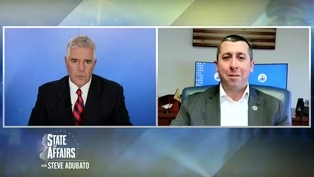
Asm. Bergen addresses tariffs and federal job cuts
Video has Closed Captions
Clip: S9 Ep3 | 13m 54s | Asm. Brian Bergen addresses tariffs, federal job cuts, and our state's fiscal health (13m 54s)
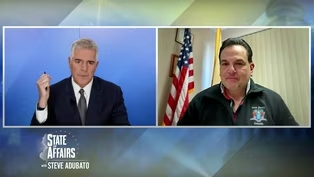
Sen. Nicholas Scutari talks about preserving democracy
Video has Closed Captions
Clip: S9 Ep3 | 13m 2s | Sen. Nicholas Scutari talks about preserving democracy (13m 2s)
Providing Support for PBS.org
Learn Moreabout PBS online sponsorship
- News and Public Affairs

Top journalists deliver compelling original analysis of the hour's headlines.

- News and Public Affairs

FRONTLINE is investigative journalism that questions, explains and changes our world.












Support for PBS provided by:
State of Affairs with Steve Adubato is a local public television program presented by NJ PBS