State of Affairs with Steve Adubato
Sen. Paul Sarlo; Dr. Shereef Elnahal; Ashley Koning
Season 5 Episode 34 | 26m 56sVideo has Closed Captions
Sen. Paul Sarlo; Dr. Shereef Elnahal; Ashley Koning
Sen. Paul Sarlo shares the lessons learned from the 2021 election, tax policy in state and the future of New Jersey politics; Dr. Shereef Elnahal discusses the importance of the COVID vaccine for children and the role of the media in putting out credible information about COVID; Dr. Ashley Koning talks about the major issues with pre-election polling, especially during the 2021 election.
Problems playing video? | Closed Captioning Feedback
Problems playing video? | Closed Captioning Feedback
State of Affairs with Steve Adubato is a local public television program presented by NJ PBS
State of Affairs with Steve Adubato
Sen. Paul Sarlo; Dr. Shereef Elnahal; Ashley Koning
Season 5 Episode 34 | 26m 56sVideo has Closed Captions
Sen. Paul Sarlo shares the lessons learned from the 2021 election, tax policy in state and the future of New Jersey politics; Dr. Shereef Elnahal discusses the importance of the COVID vaccine for children and the role of the media in putting out credible information about COVID; Dr. Ashley Koning talks about the major issues with pre-election polling, especially during the 2021 election.
Problems playing video? | Closed Captioning Feedback
How to Watch State of Affairs with Steve Adubato
State of Affairs with Steve Adubato is available to stream on pbs.org and the free PBS App, available on iPhone, Apple TV, Android TV, Android smartphones, Amazon Fire TV, Amazon Fire Tablet, Roku, Samsung Smart TV, and Vizio.
Providing Support for PBS.org
Learn Moreabout PBS online sponsorship- [Narrator] Funding for this edition of State of Affairs with Steve Adubato has been provided by The Turrell Fund, supporting Reimagine Childcare.
PNC, Grow Up Great.
Fedway Associates, Inc. MD Advantage Insurance Company.
PSE&G, committed to providing safe, reliable energy now and in the future.
Operating Engineers, local 825.
IBEW Local 102.
Lighting the path, leading the way.
Eastern Atlantic States Regional Council of Carpenters.
And by The Fidelco Group.
Promotional support provided by Insider NJ.
And by Jaffe Communications.
Supporting innovators and changemakers with public relations and creative services.
[INSPRATIONAL MUSIC] - Hi everyone, I'm Steve Adubato.
We are honored to be joined by State Senator Paul Sarlo, he's a Democrat, he is the deputy majority leader, and the chair of the Senate Budget and Appropriations Committee.
Senator, good to see you.
- Good to see you, Steve.
It's great to be back with you.
- We're taping this on the 16th of November.
Happy Thanksgiving, before, but you'll see this after.
All right, Senator, here's the deal, November 2nd, big election, historic election, both in New Jersey and Virginia.
The biggest message that you, as a independent conservative, if you will, fiscal conservative Democrat, what did you take from this election?
- Steve, I'm gonna start by answering that question with a 30 second story.
Born and raised in Wood-Ridge.
My bedroom was my older brother and my younger brother, I was on the top bunk bed.
We all played three sports in high school.
My dad came back from the Korean War, was a non-union fitter.
5:30 in the morning, his bedroom was right next to ours, he would get up, you hear him rumbling out, walk into the bathroom.
He would put the heat up first, 'cause we would keep the heat low at night.
We'd all freeze, 'cause he didn't wanna spend the heat at night.
He'd go in, do what he had to do in the bathroom.
He go, he take his lunch box out, make a pot of coffee, wake up the house, lotta noise, and he would go out and work a hard day out, whether it was in the heat or in the cold, he would bowl at night to make a little extra money in the winter.
He would umpire in the summer, to make a little extra money for the family.
Those, my dad is no longer with us, but that group of men, those folks deserted us in this election, those hardworking folks deserted us in this election.
- Why, Senator?
- They just felt we forgot, the Democratic Party forgot the working man.
- And woman, and woman.
- And woman, Democratic Party forgot hardworking men and women, the suburban moms, and the hardworking dads and moms, who live in our communities around the state.
The suburban folks kinda deserted us here.
And I was preaching to the choir.
I was speaking about- - What were you saying?
What were you saying to the Democratic Caucus in the Senate?
- I was saying it to my members of the Caucus of my Senate, I was saying it to the Governor Murphy staff, is don't turn your back on the suburban voter.
Don't turn your back on my dad, who's no longer with us, who grew up as a Democrat.
You know, the Reagan Democrats, that's what my district is, Reagan Democrats.
People who care about good education, they care about helping the less fortunate.
They know some people are dealt a bad deck of cards, and they wanna help that person, they want government to step in and help that person.
They want good education, they want good healthcare.
They wanna make sure that the police are there for them, and then support their law enforcement.
They're not a lot about all of the national policy, and the progressive policies that are out there, where they feel that it's a giveaway, and there's no skin in the game.
And I know I'm really sounding like a very, very middle of the road conservative Democrat, but I'm being practical.
We need to get back- - But Paul, - To being practical.
- Let me push back in this way, The governor said, Governor Murphy said, first of all, he said the message he got in the election was to keep doing what he's doing, so that's number one.
Two days after, because it took a couple of days to determine who won the election, Governor won, first Democratic governor won in 40 plus years, a reelection.
- And I'm glad he won, I'm a big supporter, big supporter of the governor.
I'm glad he won.
- Okay but, increasing the minimum wage, increase childcare, universal pre-K, promotion of community college being free, paid family, whole bunch of things.
The governor says, "That's for the middle-class."
You're now saying that the governor's agenda, or the democratic agenda moves so far to the left, so progressive, that it abandoned people like your dad, who represents so many suburban, if you will, Democrats, Reagan Democrats.
The governor will say he never abandoned them.
Who's right?
- Well listen, some of the issues, listen, I supported many of those issues, I supported increase to the minimum wage, and paid family leave, to a point.
But some of our policies have gone even beyond that.
Some of our policies sometimes are even more to the left of what our federal government is doing as well.
Listen, we need to be just practical.
We need to be very practical, and moderate of how we approach things.
Government needs us, but we also need to make sure the levers of government work, making sure our DMV, our unemployment, all of the levers of government are working for our people.
People don't mind government expanding.
They don't mind government being there to help them, but they want it to work for them.
When you put that in combination with them feeling like they were forgotten, we end up with good friends of ours losing elections here.
- Including Senate President Steve Sweeney.
- Including Senate President Steve Sweeney.
- What was the message there?
Because he's not a progressive liberal Democrat.
He was a middle of the road, more conservative Democrat, who lost this race to someone who spent a couple grand, never really ran for the legislature before.
Most powerful member of the Senate gone.
- Well listen, I'm not real familiar with all of Steve's district.
I do know Steve's district is a lot more conservative, and rural than other parts of the state.
It's a much different than my district as well.
Clearly the Trump vote, plus the suburban vote, in combination turned out, to the detriment of our good friend, Steve Sweeney.
So I'm not saying we need to abandon who we are as Democrats, we don't.
We need to continue to help those who are less fortunate.
We need to help our cities, and our urban areas, but we can't just turn our back on the suburban Democratic voter.
Be practical, be as practical as possible.
Everything that we vote on, make sure it's working for the people.
- When the governor said, and I asked him about this in a one-on-one interview, you can look on our website, steveadubato.org, check out the interview I did with him, and Republican Jack Ciattarelli, 1/2 hour policy oriented interview.
I asked the governor about this, and he didn't back down.
He didn't change it.
I said, "Governor, when you said 'If taxes are your issue, New Jersey is probably not your state,'" He goes, "Yeah, I said it, but I meant that we have great services.
We have great schools."
When he said that, when you heard it, your district, what you think would happen?
- Listen, I have great respect for our governor.
I'm a big supporter of the governor.
I wanna make that clear to our viewers out there.
And I'm glad he's back for another four years.
I look forward to working with him.
But when he said that, I think he just went out a little bit too far, and I think he even recognizes that resulted in a lot of video clips, and a lot of commercials that were just slammed into people's living rooms, and on social media, throughout parts of Bergen County, parts of Southern New Jersey, and our suburbs.
Look at some of the towns, Secaucus just outside of my district, another hard working district, Democrat, solid, solid Democrat, Democrats winning there but just 100 votes, or 200 votes.
Mind boggling.
In a town like Secaucus, where Democrats would only win by 100 votes.
- So what happens moving forward, in the second Murphy term, with the legislature, with a new president of the Senate, Nick Scutari, is there a different dynamic, Senator, between the governor and the legislature, all controlled by Democrats, in terms of policy?
Significantly different?
- No, listen, I know we've had some conversations.
Of course there's always the post-mortem, and there's gonna be internal conversations among ourselves.
I've had great conversations with Nick Scutari.
Nick and I came in together.
Sometimes people think we were brothers, we look alike.
He's been the judiciary chairman- - That happens with Italians sometimes.
- Yeah, he's been chairman of the judiciary.
I've been chairman of Senate Budget Appropriations Committee.
I think we both have 12 years.
I'm gonna be right by his side.
And he knows, and then we've talked about this, and he's asked me, you know, "At times, try to be the voice of reason, try to be the practical guy in the room."
And I think we're gonna have those conversations.
Listen, we need to be a big party, right?
Democrats need to be a big party.
- Are you one party, Senator?
Are you one party- - Sure.
- Or is there the Congresswoman Ocasio-Cortez party, along with others on the far left, and then you, and some others on the more moderate end?
Is it two parties?
- So Steve, and you know what, I'm actually falling into that trap right now, 'cause I'm calling myself a moderate, and I'm calling myself a practical moderate.
I am a Democrat, and we need to be a party of a big 10.
We need to include our union brothers and sisters.
We need to include those who are progressives.
We need to include those who are moderate, and more fiscally conservative.
We're one party, we are Democrats.
We need to stop- - But you don't all believe in the same thing, Senator.
- I'm sorry, Steve- - You do not all believe in the same things.
- We don't have to all believe in the same thing.
But as my dad always used to say, when he would come home from work, "Remember, I worked really hard today, but there are those who are less fortunate.
When you go to church, pray for them, and when you go to church, make sure you help those who are less fortunate."
Government needs to be there to help those who were dealt a bad hand.
Those, the developmentally disabled community, those, the poor, the immigrants who were coming in here, we welcome our immigrants, give them a chance, give them a chance to start a new business.
That's who we are as Democrats.
But when we just keep talking about no skin in the game, and free everything, and we talk about defunding our police- - That was a bad message, wasn't it?
- Very bad.
We talk about police officers, who are unable to stop a teenager on the corner, who is smoking marijuana, that he has to drive by, that hurts us as Democrats.
We need to get beyond that.
That hurts us as Democrats.
And I'm gonna continue to be as vocal as possible.
I know we have suburban Democrats throughout the state, in every county, Hudson County, Middlesex, Essex, up and down the northern parts of states, as well as South Jersey, we know which is a lot more conservative and rural.
We are one party, we need to start thinking like one party.
We can't let what happens at the federal level inject themselves into our politics here.
They are really divided up at the federal level.
- In Congress, yep, yep.
- I don't think the most liberal Democrat in my caucus, and the more conservative Democrats in my caucus, like myself and Senator Sweeney and others, there's not a lot of difference between us.
We can get in a room and figure this out.
And we're gonna work with our governor.
We'll push back where necessary, and we're going to support things where we feel we can.
We have an opportunity here.
The voters sent us a message.
- Senator Paul Sarlo, we will monitor that, and look forward to having you back in the new year.
We're taping at the end of 2021.
Paul, all the best to you and your family.
- Thank you.
- I'm Steve Adubato, that's Senator Sarlo.
We'll be right back.
(grand music) - [Announcer] To watch more State of Affairs with Steve Adubato, find us online and follow us on social media.
- We're now joined by Dr. Shereef Elnahal, President and CEO of University Hospital, former Commissioner of Health in the great state of New Jersey.
Doctor, good to have you with us.
- Thanks so much for having me, Steve.
- Doctor, we were talking before we got on the air.
Your daughter, five years old, she got the vaccine, turning six right after we tape this program, actually, as you said, on Thanksgiving, but let me ask you something.
Why was it so important for you to do that in a public way?
- Well, first of all, I want to say, Steve, that I thought it was the best thing for her, her safety, and her health.
And it's one of the most important things for anyone to do for their health is to get vaccinated.
And now that kids age 5 to 11 can do so with a vaccine that's over 90% effective and overwhelmingly safe, I thought it was important for her.
But secondarily, I thought it was important for me as somebody who is talking to the community about doing the same to show publicly that we're doing so for our own kids, my wife and I.
And so that's something that's been a theme from the beginning.
Everyone asked me, "Hey, have you taken the vaccine?
Have your loved ones?"
So this was really important for us to have the credibility of doing that.
- Yeah, I don't have the credibility you have in this arena, but our daughter on the outside end of that at 11, just had the vaccine.
I'm gonna put that out there and people decide for themselves.
Our job is to put information out there that is credible and scientific.
Let me ask you this.
Again, impossible to predict where we're gonna be, but what do you believe that in the first quarter of 2022, we need to be looking out for or concerned about regarding COVID?
- Well, the same trends last year, Steve, are happening this year in terms of more people going indoors and folks gathering again because of the colder weather.
And so we will probably see an increase.
However, I do not think the increase will be nearly as high as it was last year for one reason and one reason only, and that's the availability of vaccines.
And the fact that New Jersey has made so much progress with vaccination and continues to make progress with boosters, so I think we'll see an increase in cases, hopefully not a sharp increase in hospitalizations, and hopefully we can keep deaths down, as well.
- Let me do this.
First, I wanna disclose University Hospital, a significant underwriter of the work we do in the area of healthcare.
The followup is this.
You were one of the first healthcare leaders, first hospital or hospital systems to mandate the vaccine.
There are some who have argued across the country "How could you do this to healthcare workers?
They're the ones who put themselves on the line.
Now they have to choose between getting the vaccine and losing their job."
How many have lost their job, A, and B, what is the response rate to the mandate at University?
- Well, my simple response to that, Steve, is getting vaccinated and protecting yourself from getting COVID-19 is a fundamental part of your job as a healthcare worker.
Folks have to remember that we see the most vulnerable patients and vulnerable people in the community, people who if they get COVID-19 are much more likely to get very sick, hospitalized, or die from the disease.
And it's a very central part of our mission for folks to protect themselves and prevent spread among our employees and, of course, spread to our patients and families.
So that's why we did it.
- How much progress do you think we've made and what do we still need to do, particularly in black and brown communities regarding vaccine resistance, getting close to two years into this pandemic?
- The good news, Steve, is that, at least for primary vaccinations, we're seeing a significant catch-up of people of color getting vaccinated.
In fact, a lot of surveys show that acceptance rates are now on par with white Americans when it comes to people of color, which is great news.
However, we do still have some progress to make.
And remember that our community here in Newark, in Essex County, was among the most devastated in New Jersey and throughout the country in the beginning of this pandemic.
So all of the inequities that have been built into our society and certainly into healthcare have led to this.
So getting vaccinated is all the more important for communities of color.
- You know, I've asked you this before, we've talked about it offline, online, as well.
The misinformation out there, and some of it intentional, some of it because people actually believe what they believe and they put it out there, in terms of public health, in terms of the vaccines, in terms of COVID, how sick you can be, what medicine, what works, what doesn't work.
Aaron Rogers uses the term "immunized", and he was talking about other medication.
Here's the point.
What is the appropriate role for the media, from your perspective, as a public health professional, in terms of making sense of all this and not having a point of view, but putting out credible health education and information?
I know it's a loaded question, but I keep thinking about it.
- I think it's absolutely essential, Steve, for our partners in the media to be spreading the truth and emphasizing the truth relative to the misinformation and disinformation circulating on social media.
I think the media has done a great job of that.
We're having this discussion right now, which is a great thing.
But I also think it's incumbent upon leaders, both formal and informal, including influencers, including athletes, to also know the truth and they can make their personal choices, but certainly they should not be spreading disinformation on social media because that ends up harming so many more people than they think.
And so I think the responsibility that we carry as a result of having influence, part of that is spreading the right information during this health crisis.
And you can't really separate yourself from that as a person of influence.
- Biggest plans for University Hospital in 2022 and beyond.
- We're so excited, Steve, our agenda now, after having improved quality, improved our financial performance, is growth and expansion of services.
Our community is one that needs more healthcare and not less, and so that's a major part of our agenda.
But something we're really excited about is a new building that we're planning for as we speak.
We're about to finalize a request for proposals for a master planner.
We have support from the state, we have support from local officials, and we are finally going to give the infrastructure that the community deserves and our talented workforce and physicians also deserve, in serving them.
And we're so excited about that.
- What's that building gonna be?
- It's gonna be right on our campus.
It's gonna be an entirely new infrastructure, modern, one that is commensurate again with the talent of our clinicians and one that finally remakes the appearance of the campus in such a critical part of the Newark community.
Remember that we are among the most poor parts of Newark, and at the end of the day, we serve the most vulnerable and they deserve the best, highest quality healthcare and the best infrastructure possible.
- Dr. Shereef Elnahal, former Commissioner of Health in New Jersey, the President/CEO of University Hospital.
Doctor, thanks so much for joining us.
- Thank you again, Steve.
- You got it.
Stay with us, we'll be right back.
(grand music) - [Announcer] To watch more State of Affairs with Steve Adubato, find us online and follow us on social media.
- We're honored to be joined by Dr. Ashley Koning, who is the director of the Rutgers Eagleton Center for Public Interest Polling.
Good to see you.
- Thank you so much for having me, Steve.
- Ashley, I've known Eagleton for a long time.
You know I graduated from there a long, long time ago.
And polling has been a huge part of the Eagleton brand.
It wasn't just the Eagleton poll, it was so many polls that were off in this New Jersey gubernatorial election.
We're taping this toward the end of 2021.
Why?
- Yeah, so I think that's a big question, right?
This is something we've faced since 2016.
For any pollster, I think there's a lot of challenges, especially when we talk about doing pre-election polling.
Number one, we don't know who likely voters are, right?
This is a population that is unknown that is becoming more and more difficult to provide an educated guess for, especially in the light of certain things like, let's say it, Trump.
In the Trump era, we know that polling has become increasingly difficult.
We have skyrocketing cellphone rates, lowering response rates rapidly declining since 2016.
And we have likely voters who we don't know who they are, or frankly, how they're going to vote in terms of the system we have now.
Whether mail-in or early voting or in-person day of voting, there are a lot of factors that are hard to control for and getting harder to control for with every new election.
- Given everything you just said, has the demand for and the credibility of polls gone by the boards?
- So I would like- - Why do we need them?
- So I think, I like to be a romantic for this, I'm not one for pre-election polling so much.
I'm more about doing general public opinion polling because there are issues that never get their day at the ballot box.
And we've seen polling on those issues really have an effect on public policy.
First and foremost, let's talk about same-sex marriage a decade ago, and how polling on that really propelled US Supreme Court decisions and decisions across a variety of states.
So I think we need polling, and we know who the general public is when we poll them.
I think we need polling for moments like that.
Pre-election polling, I think we all get caught up in the horse race.
Polls are not meant to predict, they're not crystal balls, they're in the moment, the here and now of what respondents are thinking at that very second.
And it's explaining the why and the how of voter behavior.
It shouldn't be explaining who is ahead and who's behind, and focusing on those numbers as if they're do or die gospel of what's going to happen on election day.
- Well, and I don't wanna get into the weeds here, but one of my mentors at Eagleton, the great Dr. Cliff Zukin, taught me about polling.
And I often realized as he was teaching us at Eagleton that it is more complex than people think.
And the reality is, we in the media, we wanna get the numbers, we wanna put the grid in.
And by the way, public broadcasting tries to be different, but you put the numbers up, who's ahead?
Okay.
And that impacts fundraising, which impacts who's gonna vote for... Oh, he's too far ahead.
She's behind.
She's not gonna win.
Is polling too complicated for the average person to understand?
Which begs my question again, polling in elections, has it become outdated?
- Yeah.
So, first of all, we had the same advisor.
So I know we're both on the same page regarding this.
He's incredible, and we're now, as a center, turning 50 years old, we were the first of our kind in its niche.
So of course, we wanna make sure that we get it right.
We have a big legacy to keep up.
I think in pre-election polling, we need to understand it more.
Giants like Pew Research Center and Gallup have stopped horse race polling altogether.
Maybe that's the way we even go, or maybe we try to talk more about how the voters are feeling, and not necessarily who's ahead and who is behind.
Or maybe what I would like to see all of us do, including myself, is really report the margin of error better, and try to explain to the press and the public what it actually means.
We had an 8-point margin for Murphy ahead of election day.
If you apply that margin of error, that really could have meant anything.
We had a plus or minus margin of error of 4.1 percentage points, meaning it could have been a tie.
- He won by three.
- And he won by three.
And so, if we apply that margin of error and talk a little bit more how to understand it, we might be in a better place than reporting these numbers as if they are the be-all-end-all.
Again, this is statistics, right?
We have to embrace uncertainty more and the possibilities of what can happen almost like a weather forecast.
A meteorologist doesn't say, it's going to rain today.
They tell us a probability and a chance of if it's going to rain.
I think we need to try to understand polling a little more like that.
It takes more education on behalf of the pollsters.
It takes more understanding and comprehension on behalf of the press and the public.
Maybe idealistic, but I always hope for that.
- Ashley, a simplistic question, I need a 30-second response, which is unfair.
Do you think more and more people are lying to pollsters?
- I would not doubt it.
I think that's one of the biggest challenges we face.
I think we've seen that time and time again in 2016 and 2020.
We did see very accurate polling in 2018 midterms.
We saw accurate polling in the Virginia gubernatorial.
So I think there's this common denominator of Trumpism that has really been through a lot of these election cycles.
I do think that can become a problem if we're talking to the Republicans who are different from the Republicans who are voting specifically among that subgroup.
- Complex stuff.
Hey, Ashley, I want to thank you so much for joining us, you and the team at Eagleton doing important work.
One of our higher ed partners that we try to learn from, Dr. Ashley Koning, who is the director of the Rutgers Eagleton Center for Public Interest Polling.
All the best, Ashley.
- Thanks for having me, Steve.
- You got it, I'm Steve Adubato.
Thank you for watching, and we'll see you next time.
- [Narrator] State of Affairs with Steve Adubato Is a production of the Caucus Educational Corporation.
Funding has been provided by The Turrell Fund, supporting Reimagine Childcare.
PNC, Grow Up Great.
Fedway Associates, Inc. MD Advantage Insurance Company.
PSE&G.
Operating Engineers, local 825.
IBEW Local 102.
Lighting the path, leading the way.
Eastern Atlantic States Regional Council of Carpenters.
And by The Fidelco Group.
Promotional support provided by Insider NJ.
And by Jaffe Communications.
- Choosing a new family doctor can be confusing.
Check with your health insurer to see which physicians near you participate with your plan.
Find out which hospitals the doctor uses, and who covers when the doctor is away.
And remember to schedule an appointment with your new doctor in advance, to fill out any paperwork without the added stress of being sick.
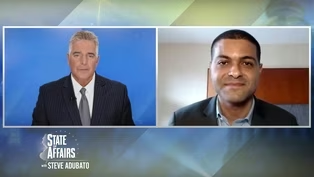
How the COVID-19 Vaccine For Children Will Make an Impact
Video has Closed Captions
Clip: S5 Ep34 | 8m 8s | How the COVID-19 Vaccine For Children Will Make an Impact (8m 8s)
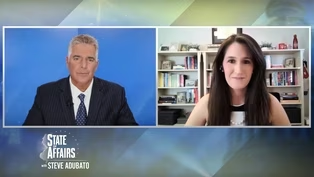
The Issues with Pre-Election Polling
Video has Closed Captions
Clip: S5 Ep34 | 7m | The Issues with Pre-Election Polling (7m)

Senator Sarlo Shares Lessons From NJ's 2021 Election
Video has Closed Captions
Clip: S5 Ep34 | 12m 38s | Senator Sarlo Shares Lessons From NJ's 2021 Election (12m 38s)
Providing Support for PBS.org
Learn Moreabout PBS online sponsorship
- News and Public Affairs

Top journalists deliver compelling original analysis of the hour's headlines.

- News and Public Affairs

FRONTLINE is investigative journalism that questions, explains and changes our world.












Support for PBS provided by:
State of Affairs with Steve Adubato is a local public television program presented by NJ PBS