State of Affairs with Steve Adubato
Sen. Ruiz Talks Literacy Rates & Learning Gaps in NJ Schools
Clip: Season 8 Episode 2 | 14m 21sVideo has Closed Captions
Sen. Ruiz Talks Literacy Rates & Learning Gaps in NJ Schools
Sen. Teresa Ruiz (D) - NJ, Senate Majority Leader, sits down with Steve Adubato to discuss the devastating impact of the pandemic on literacy rates and the latest efforts to help close the achievement gaps for NJ’s elementary school students.
Problems playing video? | Closed Captioning Feedback
Problems playing video? | Closed Captioning Feedback
State of Affairs with Steve Adubato is a local public television program presented by NJ PBS
State of Affairs with Steve Adubato
Sen. Ruiz Talks Literacy Rates & Learning Gaps in NJ Schools
Clip: Season 8 Episode 2 | 14m 21sVideo has Closed Captions
Sen. Teresa Ruiz (D) - NJ, Senate Majority Leader, sits down with Steve Adubato to discuss the devastating impact of the pandemic on literacy rates and the latest efforts to help close the achievement gaps for NJ’s elementary school students.
Problems playing video? | Closed Captioning Feedback
How to Watch State of Affairs with Steve Adubato
State of Affairs with Steve Adubato is available to stream on pbs.org and the free PBS App, available on iPhone, Apple TV, Android TV, Android smartphones, Amazon Fire TV, Amazon Fire Tablet, Roku, Samsung Smart TV, and Vizio.
Providing Support for PBS.org
Learn Moreabout PBS online sponsorship[INSPRATIONAL MUSIC STING] - Hi, everyone.
Steve Adubato.
We kick off the program once again, and joining us is State Senator Teresa Ruiz, who is the Senate Majority Leader, the Leader of the Democratic Party in the Senate in the great State of New Jersey.
Good to see you, Senator.
- How are you?
- I'm doing great.
How are we doing as a State of New Jersey as it relates to one of your many priorities, the top priority, the learning loss of our children in our public schools, particularly in the lower grades?
Please, Senator, talk about it.
- Well, we're not in a great state, all puns intended Not something that's unique to us in the Garden.
It's something, a crisis, an epidemic, if you will, that's facing this country and the nation.
The President during his state of the union actually started talking about literacy and high dose tutoring.
And we did hear it in the governor's state of the state address.
I feel like it's nearly four years too late, but at least everyone is talking about the issue.
And I wanna put a pin in that for one second, because I think folks in the space who've been in the work for over decades recognize that the achievement gap in our literacy rates facing particular students in the state and in this country have always been far from their other student counterparts.
What happened during the pandemic was that it exploded and impacted general population numbers.
So when we look at those third and fourth grade readers, the most critical space for looking at that data point, you have nearly 50% of that base not reaching grade level, which is epic.
When you peel back and you look at African American Latinos, it's 75 and 76 hovering.
- So Senator, you're not simply talking about it.
You're doing something about it.
You have a four-bill package in the state legislature right now dealing with literacy and learning loss.
Be specific.
And I know that sometimes in the State House there can be insider lingo, but you'll translate it for the rest of us to understand, please.
- I'll try as best as I can.
So the key here was just to elevate the level of attention to it.
We have an informal working group that we've all met with, all stakeholder groups, from experts in dyslexia to teachers in the classroom to union representative to school board members, to really focus on how we can improve literacy.
So, the bills generically, I can parse 'em out separately.
It's to have a curriculum in reading that it goes back and includes phonics, but is not limited to one thing.
In discussions with practitioners, what we've heard was we went in one direction entirely through new literacy methods, that we left behind phonics, which is clearly indicating that it's working.
So it's collaborating using all those measures, because not every student is going to react the same way to different methodology.
So, to have teachers have that kind of creative base to use what they can to improve reading, to create professional development.
To have a reading screener, which is critically important.
It's that- - A reading screener?
- A screener, a test, if you will.
Some kind of a checkpoint for students.
Most states do do this, and districts do this on their own, but this is to have a uniformed one so that the state department can also collect that information and data, so that when we're going through the budget process, people often wonder is why do we need to have all those checkpoints and these data points?
It's really to navigate policy and then to help me make a claim to say, "Look at these statistics and numbers.
"$2 million towards a reading initiative "is not going to be enough."
And so that helps us fight for more funding and resources to try and mitigate the issue.
The reading screener will help the teacher, it will help the district create programs, and it will help newcomers.
What we did in our bill was, and I think people who cited this, different districts experience different droves of students who don't speak English at different times during the school year.
It's not like they're getting that zero to three here and then going through a preschool program.
They're coming in in third and fourth grade and beyond not speaking any English.
- Let me follow up on this, and I wanna talk about the First 1000 Days NJ initiative, which you're well aware of.
It's are in fact the longtime public awareness initiative we've been involved in regarding Reimagine Child Care is morphing into First 1000 Days NJ, which talks about important issues impacting families and children.
I'm gonna get to that in a minute.
Senator, but also by way of background, some folks may not know that you talked about practitioners.
You in a previous life, you're smiling because you know I know, a practitioner of pre-K students in the City of Newark.
You understand this not just as a senator, as a teacher, as a mother.
Explain to folks the devastating impact for children who struggle with the kind of literacy issues you're talking about and the learning loss exacerbated by COVID.
Long-winded question, I know.
Please.
- No, it's very simple.
From the womb or zero to third grade, you learn to read.
Identification of letters, sounds, putting things together in context.
From third grade and beyond, just you and I, even today, when you're prepping for your interviews, you're reading to learn.
If you just from a common sense approach look at that and say, from zero to third grade, you learn to read.
From third grade and beyond, you read to learn.
What happens to that child who doesn't have the infrastructure and the foundation to read to learn?
They're destined to an obstacle, an academic career lifespan that will be filled with obstacles because everything transitions.
Math begins to present itself in reading context with word problems, science.
Everything is based on the science and reading and fundamentally secured in that.
So if we're socially promoting students who are not prepared to move on, then we are complicit in a behavior of creating a pipeline of next generation that will not be looking to meet and reach STEM jobs that are available, but perhaps, going down pathways that we don't even wanna talk about.
- Lifetime implications.
Senator, I mentioned the Reimagine Child Care initiative, which you've been on many times with us talking about.
You've been a leader in the state legislature on childcare related issues, expanding that public awareness initiative from Reimagine Child Care to the First 1000 Days NJ, dealing with critical issues impacting families and children.
Top two issues in that regard, families and children, protecting them, particularly in the most vulnerable communities and urban communities, disproportionately Black and Brown.
- That is such a pregnant question filled with so many opportunities for answers.
Look, I think making investment in human capital, so that's making sure that the woman who, you're talking globally here, right?
You want a global- - We're talking about pregnancy, say pregnancy to age two.
- Right, okay, so pregnancy to age two.
When the woman is pregnant, making sure she has access to prenatal care, postnatal care.
That when that person comes home, they're living in...
I can't just answer this in two ways.
- It's ridiculous asking you to have two, so just go ahead- - Correct, so I'm just gonna tell you, that making sure that that parent is going back to an apartment or a house where they feel safe and secure, that's free from lead.
That when that parent is ready to go back to work, that there's accessibility to high quality preschool and infant and toddler programs, which we know there are not, and that is an infrastructure that is at the brink of crumbling if we don't continue to support it.
Making sure that we make our efforts to roll out universal preschool in a very responsible way so there isn't an unintended to current programs, that really are helping the most at-risk students.
And then ensuring that that child then, regardless of zip code, is going into an institution that is supporting their needs, and that is mega filled with a lot of opportunities for different answers.
But we're falling short in each one of those spaces, and the data points to that.
- You know, Senator, I want to ask you about school funding in just a second, the state school fund.
Well, let's just deal with that right now.
You've mentioned in previous interviews on "State of Affairs."
Follow up on this.
We just had your colleague in the Senate, we just interviewed Senator Jon Bramnick.
He said, "Steve, this is ridiculous.
"150 school districts in the state are losing funding.
"Toms River losing tens of millions of dollars."
Why?
What is wrong with the current formula, where the state provides funding to local school districts, and why are so many school districts feeling as if they're quote, getting the shaft, to use a New Jersey expression, please?
- So, so to pretend that I understand the school funding formula, it would be a lie- - You're the former chair of.
- so I can only- - Senator, if you don't, what about the rest of us?
- Well, because- - You're the former chair of the Senate Education Committee.
- Right, it was instituted before I came in, and there's a lot of different variables that come up with a sum at the end.
And so if you tinker with one thing, it could set off an unintended somewhere else.
When the creators of the school funding formula, they were looking to really make sure that students who were most in need, that those wraparound services were going to be financed and resourced, so that artificial wraparound program could exist.
Prior to the funding formula getting to the number that it is, so many districts, SDA districts, were underfunded decades in perpetuity over and over and over again.
And I'm not making an argument for one thing being better or not.
So we did have an extraordinary hearing, and I'm still learning about all of this.
It is shocking to have a district go over one timeframe to lose $10 million, because- - What needs to be changed?
- So, what happens is there are real estate values in the formula.
That can swing the pendulum, and we know that real estate values here throughout the entire state are skyrocketing.
That could be a lever.
Under enrollment.
So, public schools across the state and the country, you are losing students.
That's also one of the kickers.
And so I don't know if there's enough time for districts to right-size themselves.
What I will tell you, this is one issue that the Chairman of the Budget Committee and I have talked about for some time- - Senator Gopal, who we're actually interviewing today.
Go ahead.
- No, it's, no.
The Chairman of the Budget Committee- - Oh, I apologize.
- And I'll tell you why.
- Senator Sarlo?
- Senator Sarlo and I have had this discussion, except we haven't figured out a way.
The way New Jersey budgets for schools is irresponsible.
So in February, the governor comes out and gives the state of the budget address.
Two days after that, and this is not unique to this administration.
This is just common practice since before I was elected.
Two days or so after the state of the budget is presented, districts are notified with their numbers.
About five days after that, they have to present their budgets to their county executive superintendents, and then figure out, if you're getting a dramatic cut, that means also right-sizing your district.
Giving pink slips to people within two months' timeframe doesn't make any sense.
And so I think we need to start exploring ways where we do a two-year budget cycle, which has several implications.
It makes a determination that if I tell you, Steve, you're getting this amount of money, I certainly cannot cut it for next year, regardless as to what the budget looks like, which I would love.
Because the first place administration is cut are at the school level.
It might have to be somewhere else.
We have to make a common sense approaching and commitment to budgeting and making sure that whatever we say sticks.
- And if not, how the heck are school districts supposed to plan, coordinate, figure out?
- Yeah.
You can't.
It's just, it's physically impossible.
And it goes both ways.
If there's a district that gets a huge lump sum of money, wouldn't you want some timeframe to figure out what are the needs of the district so you can really use that investment to create the best return on it?
So it's something, we have to look at the school funding formula without a doubt, and we have to look at the way we budget.
- And we'll continue that conversation, not only with Senator Ruiz, but with Senator Sarlo, the Chair of the Senate Budget Committee, and Senator Vin Gopal, who's the Chair who succeeded Senator Ruiz as the Chair of the Senate Education Committee.
Senator, thank you so much for joining us.
We appreciate it.
- Thank you for having me.
- You got it.
We'll be right back after this.
- [Narrator] State of Affairs with Steve Adubato is a production of the Caucus Educational Corporation.
Celebrating 30 years in public broadcasting.
Funding has been provided by New Jersey Sharing Network.
The Turrell Fund, a foundation serving children.
Hackensack Meridian Health.
Kean University.
Veolia, The Port Authority of New York and New Jersey.
IBEW Local 102.
The Healthcare Foundation of New Jersey.
Eastern Atlantic States Regional Council of Carpenters.
And by these public spirited organizations, individuals and associations committed to informing New Jersey citizens about the important issues facing the Garden State.
Promotional support provided by BestofNJ.com.
And by Northjersey.com and Local IQ.
- Hello, I’m Donald Payne, Jr.
Congressman for New Jersey’s 10th District.
One organ and tissue donor can save as many as eight lives, and improve the health of another additional 75 people.
That is why I encourage everyone to register as an organ donor.
For more information about organ donation, please visit www.NJSharingNetwork.org
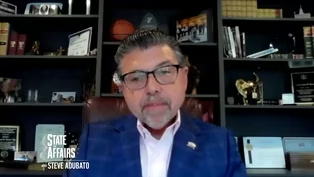
Sen. Bucco Examines the Fiscal Future of New Jersey
Video has Closed Captions
Clip: S8 Ep2 | 12m 24s | Sen. Bucco Examines the Fiscal Future of New Jersey (12m 24s)
Providing Support for PBS.org
Learn Moreabout PBS online sponsorship
- News and Public Affairs

Top journalists deliver compelling original analysis of the hour's headlines.

- News and Public Affairs

FRONTLINE is investigative journalism that questions, explains and changes our world.












Support for PBS provided by:
State of Affairs with Steve Adubato is a local public television program presented by NJ PBS