
Sen. Steven Oroho; Idana Goldberg, Ph.D.; Linda Schwimmer
6/24/2023 | 27m 58sVideo has Closed Captions
Sen. Steven Oroho; Idana Goldberg, Ph.D.; Linda Schwimmer
State Senate Minority Leader Steven Oroho sits down with Steve to discuss his decision to retire and the need for civilized public discourse; Idana Goldberg, PhD., CEO of the Russell Berrie Foundation, highlights the 2023 Russ Berrie Making a Difference Awards; Linda Schwimmer, JD, President & CEO of NJ Health Care Quality Institute, shares a conversation about racial disparities in healthcare.
Problems playing video? | Closed Captioning Feedback
Problems playing video? | Closed Captioning Feedback
Think Tank with Steve Adubato is a local public television program presented by NJ PBS
Sen. Steven Oroho; Idana Goldberg, Ph.D.; Linda Schwimmer
6/24/2023 | 27m 58sVideo has Closed Captions
State Senate Minority Leader Steven Oroho sits down with Steve to discuss his decision to retire and the need for civilized public discourse; Idana Goldberg, PhD., CEO of the Russell Berrie Foundation, highlights the 2023 Russ Berrie Making a Difference Awards; Linda Schwimmer, JD, President & CEO of NJ Health Care Quality Institute, shares a conversation about racial disparities in healthcare.
Problems playing video? | Closed Captioning Feedback
How to Watch Think Tank with Steve Adubato
Think Tank with Steve Adubato is available to stream on pbs.org and the free PBS App, available on iPhone, Apple TV, Android TV, Android smartphones, Amazon Fire TV, Amazon Fire Tablet, Roku, Samsung Smart TV, and Vizio.
Providing Support for PBS.org
Learn Moreabout PBS online sponsorship- [Narrator] Funding for this edition of Think Tank with Steve Adubato has been provided by The Turrell Fund, supporting Reimagine Childcare.
Veolia, resourcing the world.
Horizon Blue Cross Blue Shield of New Jersey.
Here when you need us most.
The North Ward Center.
IBEW Local 102.
Lighting the path, leading the way.
PSEG Foundation.
Newark Board of Education.
The Healthcare Foundation of New Jersey.
And by RWJBarnabas Health.
Let'’s be healthy together.
Promotional support provided by ROI-NJ.
Informing and connecting businesses in New Jersey.
And by CIANJ, and Commerce Magazine.
[MOTIVATIONAL MUSIC] - Hi, everyone, Steve Adubato.
A giant in the state legislature is choosing to step down and he's shaking his head, but he knows, he is.
He's state Senator Steve Oroho, Republican, Republican leader who has served 22 years in public service and has chosen to step aside and retire.
First of all, thank you for your service, Senator.
- Steve, thank you so much.
In elected office, it's an honor to serve the people.
People thank me all the time for my service but, Steve, I have a younger brother, Tommy, seven combat tours, three Bronze Stars, the Soldiers Medal, those veterans and stuff like this.
When they say, "Thank you for your service," it really goes to people like that.
I've been elected in office and I'm glad to serve and it's an honor, but really it's... those kind of service hours put in by those veterans go a lot higher.
- Well said, but also thank you for your service and for your brother's service.
But let me ask you this, Senator.
- Thank you.
Hmm hmm.
- How much of your decision to retire and what you choose to share is yours and your families, it's highly personal, but to what degree, and you and I have had so many conversations on the air and off, and one of the things we have in common even if we don't see things from a policy point of view exactly the same way, it's not my job to express my opinion here, is that we believe in very civil public discourse and to be awfully candid with you, Senator, it strikes me that your tone, your demeanor, your ability to engage with people who have different points of view in a very civil and respectful way is not the norm.
Long-winded question, I know, how much of that has to do with you stepping down, the nasty negative vitriol, the divisiveness, the polarizing environment of politics?
Or is that just in my head, Steve?
- No, no, no, no, it definitely.
I'm sure it weighs on a lot of people and it's difficult because, I mean, first of all, I like to consider myself a Christian.
And quite frankly, the two most important business books I ever read weren't even really business, is "How to Stop Worrying and Start Living" by Dale Carnegie and "How to Win Friends and Influence People" and it's not that, I know when I started my career early, I used to worry about everything and used to think about things out of my control.
So that book was very important to me and the other one, "How to Win Friends and Influence People," but you know what it comes down to?
You read the Bible, you read any of the good books or whatever.
It's treating people with respect.
The Golden Rule, if we really followed the Golden Rule, really followed it and I've said this on the Senate floor, love your God and love your neighbors and stuff, we wouldn't need all these other different rules and stuff.
So to say it would have no impact, it wouldn't be truthful.
It certainly had impact because that's what raises the stress level and Steve, I always say, it's a lot harder for elected officials who do the job to get elected than it is for politicians to get elected.
- A good point and I just wanna also jump into this and make it clear that over 20 members of the state legislature, members of the Senate, members of the Lower House in the Assembly have chosen not to run for reelection.
That's a very high percentage of the 120 members of the state legislature.
Do I have that right, Senator?
- Yeah, I'm not sure how high.
I know when I started in 2008, I think there were either the senator or eight or it could have been even nine, new Republican senators at the time and that was pretty high.
Now, some had come from the legislator on the assembly side up to the Senate.
- I'm sorry to interrupt, these are people who have just chosen not to run.
Some are running for higher office, but I'm not gonna make too much of this, Senator, but it strikes me that a very high, a disproportionate number of legislators are just stepping away but everyone has their own personal perspective.
I wanna ask you this, on policy, you've argued that New Jersey is not affordable, others agree.
You can check out my interview with the governor who has a different point of view about how affordable New Jersey is.
What's your biggest beef with the Murphy administration on affordability in New Jersey?
- Well, Steve, a lot of the things, and it's been on my beef for a lot of administrations, that, look, right now sitting with close to $15 to $16 billion in cash and quite frankly, I firmly believe and I've always talked about the attraction and keeping up capital in the state of New Jersey.
And quite frankly we're sitting in it, we had the businesses that are affected, we had the schools districts affected.
Why are we sitting on so much cash when out in the economy or out helping our nonprofits and quite frankly, I think done a lot better in keeping people employed and keeping businesses open.
So, that's obviously been, lately, our biggest beef.
- You've also been very outspoken, Senator, on the issue of the Governor's Clean Energy Plan, green initiative, if you will.
You have piece of legislation, the Energy Security and Affordability Act.
What is it and how is it different from the Governor's Green Energy Plan?
- Well, I think the governor's plan requires a lot of mandates and I think they need to be a lot more transparent about what the true cost is.
For example, going to the full electrification that the governor's plan wants by 2035 is like five times more expensive.
They haven't really come out with all the capital costs.
Others have said that the, say commercial building, like hospitals, schools and stuff that have to go to electric boilers, there's estimates that it'll cost about $2 million each building.
We got about 10,000 of those buildings.
- But, Senator, don't we have climate control, climate crisis, climate change crisis?
Doesn't it require radical policy changes to catch up with where we are right now?
- You know what I don't think it does?
See, I don't think what their plan does is really look at the innovation and stuff.
Recently in the number of articles that came out, you look at the idea of carbon capture out of the ocean so the ocean can actually absorb more carbon.
You look at the idea of the hydrogen, the fusion, and all the new things.
What I disagree with is the mandate and put your eggs all in one basket that say wind and solar and yet they're gonna also allow nuclear, which is very important as well, but obviously what about hydrogen?
What about fusion?
What about all the rest?
And the idea would be only have 50% on non-intermittent.
'Cause look what happened during Sandy, wind and solar.
What happened during Sandy to be able to get those lines, all those power lines back.
If everybody had to plug in their cars, they wouldn't be able to get the work.
- Senator, one more quick question before I let you go.
One of the initiatives we have, the website will come up, Reimagine Childcare, talking about the importance of affordable, accessible, quality childcare.
It's a nonpartisan issue.
We're not advocating for anyone or anything, but childcare, I mean.
We need to have legislators making policy that makes a difference.
How important is affordable, accessible, quality childcare?
- Absolutely critical.
Because the first and one example is when Senator Paul Sarlo, Senator Ruiz and Senator Singleton and I were- - Two Democrats in the Senate, go ahead.
- Right, right, three Democrats in Senate were asked by Senate President Sweeney at the time to hold these reopening the economy.
What was the first one we had?
First one we had was how the childcare industry could reopen safely and that's why it was so critically important and not only, obviously, the governor has done a lot with the universal pre-K, but we also have to put in at the last budget meeting I brought up the fact that Senator Ruiz was very supportive of- - Senator Teresa Ruiz.
- Yep, Senator Teresa Ruiz, supporter, as well, is that we would have to make sure that the private childcare industry which is a big industry also gets acclimated into when we're bringing more into the universal pre-K, so they have to make sure that we keep those jobs in the private sector as well.
- That is Senator Steve Oroho, after 22 years of public service, stepping down.
Again, we do thank you for your service.
We also thank you for every time you've joined us, Senator, to be engaged in a serious substantive policy conversation about the issues that matter most in people's lives.
We wish you all the best in your next chapter and I know you'll be spending more time with your family.
Thank you, Senator.
- Thank you, Steve.
And I hope in the next chapter, I'll still be able to come on your show.
(laughs) - Always.
Stay with us.
We'll be right back.
To watch more Think Tank with Steve Adubato, find us online and follow us on social media.
- We are pleased to be joined by Idana Goldberg who's CEO of the Russell Berrie Foundation.
Idana, good to see you.
- Good to be here with you, Steve.
- I was remiss, that is Dr. Idana Goldberg, my apologies.
- No problem.
- Idana, we're putting up the website for the foundation.
We have been longtime partners with the Russell Berrie Foundation.
I've been honored for well over two decades, 27 years I think hosting, emceeing the Making a Difference the Russell Berrie Making a Difference Awards.
Tell everyone what the foundation is and what the awards are.
- So the Russell Berrie Foundation comes out of the vision of our founder Russell Berrie and his passions and interests.
I don't think we have enough time to go into all of the many things that we fund which often is common when you're based on the passions of an individual.
But we invest in visionary people and visionary ideas around the interests of our founder.
And that includes health, it includes the Jewish community it involves supporting a strong and secure Israel.
But most importantly we really love to invest in the people of New Jersey.
And that has led to the Making A Difference Awards which for the last 27 years has identified and honored over 400 heroes across the state of New Jersey.
- And we have featured many of I apologize, Idana we've featured many of those.
Actually we're taping today two leaders who received the Russell Berrie Making A Difference Award in the area of fighting gun violence.
That's just an example.
But can I throw a couple at you and tell me a little bit about this?
There was a grant provided to SciTech Scity.
- Yes.
- Tell us about that.
- Sure.
So the foundation has been a longtime supporter of Sheba Medical Center.
In particular the medical simulation work that the hospital does.
We learned of the visionary work that Paul Hoffman at Liberty Science Center is doing to expand into Jersey City and build SciTech Scity.
And we connected Paul with Sheba Medical Center and we've been really pleased to make a grant to bring Sheba together with Liberty Science Center to bring medical innovation from Israel into real life healthcare issues facing our modern world.
So hopefully with our support Sheba will be bringing examples of Israeli technology to address the challenges of today.
And what we're really excited about is the ways in which New Jersey hospitals, New Jersey companies New Jersey School children will be able when this building is completed in a few years and the SciTech Scity campus to experience the medical innovation that comes out of Israel brought into our backyard here in New Jersey.
- You know, I'm about to ask you about the Greater Bergen Community Action Grant that the folks there received from the Russell Berrie Foundation, but also as disclosed the Russell Berrie Foundation supports our programming around making a difference honorees to recognize, to honor, to feature those leaders for one simple reason, because we are trying to promote the idea of making a difference in your community.
And you go on the website of the Russell Berrie Foundation to find out more when that portal opens to potentially nominate someone in your community making a difference.
Let's go back to this the Greater Bergen Community Action acronym, excuse me, GBCA.
What is this $750,000 grant intended to accomplish at Bergen County?
- Sure, this is another grant we just recently made that we're very excited about.
This is a grant to something called the Unity Health Partnership.
Greater Bergen has brought together five organizations the Bergen Volunteer Medical Initiative, community Food Bank, CBH Care which brings mental health together into one space to provide social services and medical care to those at risk in Central and Southern Bergen.
What we love about this is the way in which this is gonna provide holistic care to those most in need.
And once again it's an opportunity to leverage groups' expertise in new ways.
And in this case we've actually offered this grant as a leveraging opportunity.
Greater Bergen has already received tremendous support from city, state and even national funding opportunities.
But we'd really like to help them bring in additional funding from local philanthropy other funders to match our grant to enable them to complete the capital needs for this project because we know it's gonna bring needed healthcare, needed mental health services, meet the food insecurity needs of those in our backyard who really need this at this moment.
And it's again, something that we see because for us giving back to the community in which we live and which we operate is really important.
- Idana, let's bring it even closer to home.
There are people that have been recognized over the years with Making A Difference Awards and one of them is Pino Rodriguez.
I went down to Camden to meet Pino.
And I know that Pamela Johnson over in Jersey City involved in Anti-Violence Coalition Hudson County is someone you're very aware of as well.
But I remember going down and seeing Pino on the streets of Camden making a difference in his community, cleaning up the community with volunteers and others, improving the community.
People like Pino are real leaders, aren't they?
- They are and I think Pino was awarded the Making A Difference Award my first year at the foundation.
And he just really stuck out for me because it was such an example of the way an individual took his own situation, he was somebody who if I remember it correctly, actually he had been told he wasn't able to have visitation rights with his own children, because the community in which he lived was deemed too dangerous by a judge.
- Too dangerous.
There were gunshots he heard every hour.
- Exactly.
- And he started the Block Supporter Initiative.
I'm sorry.
- Exactly.
No, he created this Block Supporter Initiative in which he mobilized the people in his neighborhood to take responsibility.
And they beautified their neighborhood.
They planted gardens, they cleaned up their houses.
They cleaned up the garbage from the streets.
And they were able to turn around their own streets.
And that then led not only to their own neighborhood but to him that getting a job with Camden and expanding the initiative across the state.
And I think it's such a great example the kind of heroes that we love to honor through the Making A Difference Award.
Those who see something in their own lives say, "this isn't okay," take action and then from that we see the ripple effects across their communities and then across the state.
- Angelica Berrie, the president of the foundation talks about that ripple effect.
And so whether it's Pino Rodriguez or Pamela Johnson in Jersey City, the Anti-Violence Coalition which by the way, check out the website the Russell Berrie Foundation website to find out more.
Dr. Idana Goldberg, the CEO of the Russell Berrie Foundation thank you so much for joining us, really appreciate it.
- And thank you, Steve, for all you do to partner with us on the Making A Difference Awards.
- We're doing the easy part.
Stay with us, we'll be right back.
To watch more Think Tank with Steve Adubato, find us online and follow us on social media.
- It's been too long, but she's back.
Linda Schwimmer, President and CEO of New Jersey Health Care Quality Institute.
Good to see you, Linda.
- Good to see you, Steve.
- Go back and see some previous interviews we did with Linda.
Linda, as we put the website up, tell everyone what the institute is and why you matter.
- We are a non-profit organization based here in New Jersey.
We're unique in that we have all of the stakeholders in healthcare working together in our membership at our table to work on safety, quality and affordability in healthcare.
So we ask them to kind of take off their day hat and work together for the greater good.
- In New Jersey, really?
- In New Jersey.
- So the members include, what?
You've got hospitals.
You've got what, who else do you have?
- We've got hospitals, health plans, pharmaceutical companies, doctors, nurses, consumer groups.
Really, you name it, they're at our table if they're even thinking about healthcare and working on healthcare.
- One of the areas we've talked to, the First Lady, Tammy Murphy about a lot is maternal mortality.
Tell us where we are in New Jersey and what we need to do to improve the horrific situation disproportionately for African American mothers who die at a, I believe, seven to one rate compared to white women giving birth to a child, please.
- Right.
No, I'm glad you raised that topic.
It's an issue that is really important to me on a personal level as a person who's given birth and raised two kids in New Jersey.
And it's something that the Quality Institute's been working on for a very long time.
Unfortunately, we've been going in the wrong direction for the last couple of decades, rather than the right direction.
And so I appreciate First Lady Murphy's focus on this issue and highlight it.
- Nurture NJ.
I'm sorry for interrupting, Linda.
It's Nurture NJ.
We'll put up the website so you can find out more.
Why does Nurture NJ matter, Linda?
- Well, Nurture NJ matters a lot, because Tammy Murphy has the bully pulpit as the First Lady.
And that's really important, because a lot of this comes down to focus and leadership.
And then with focus and leadership follows the resources and the attention.
So she put out, along with the help of a lot of others, a strategic plan called Nurture NJ It's huge.
It's comprehensive.
It really is a fundamental change of our systems in New Jersey and really across the country.
It takes on racism head-on, and it really addresses, tries to tackle all of the systemic issues that are leading to that disparity that you mentioned at the top of your question.
What the Quality Institute did was kind of boil down a lot of what's in Nurture NJ to what are, I would say, top four issues that people can work on and focus on no matter where they're sitting.
- Sorry for interrupting Linda, what are they?
- Okay, so top four issues are, first of all, the healthcare workforce itself.
We need to have the right healthcare workforce to really address maternal infant health and to get at these disparities.
So that means supporting, having midwives in every hospital in New Jersey, having policies that allow for doulas and are welcoming to doulas, and to really getting at changing the culture around the education within the people serving in those hospitals so that they're more aware of providing respectful care.
We know that they're providing great care for the most part, but really focusing on cultural needs and delivering care in a respectful way.
Listening to patients.
The heartbreaking part of a lot of these deaths is that such a huge percentage of them were preventable just by listening to patients.
- I'm sorry for, you're talking about deaths of women giving birth to a child.
Heartbreaking in and of itself, but I believe you're gonna be talking about how some of it's avoidable or preventable.
Please, go ahead.
- Right.
So a lot of this, the vast majority of this is preventable had the providers listened to the patient when they said, "I have a headache, I've had it for days.
Something's not right.
I don't feel right.
I need you to check me out.
I don't want to be discharged yet."
I mean, the list goes on and on.
But really there's a whole campaign that the CDC has called "Hear Her," and it really, you know, it has the warning signs listed and instructions of what to do.
And it's really as basic, but also as critical of that, that we really need to center the patient and listen to what she's saying when she's saying something's not going right.
So that's a big part of it is the healthcare workforce.
- And because I want to get to mental health.
So, what are some of the other issues, real quick?
- So the three other issues, the workforce, it's data.
It's looking at data and then using it, particularly the patient experience.
It's the payment system.
It's really paying for higher quality care.
The way our system is set up now we actually reward and incentivize a lot of the care that we don't want to be seeing more of.
And the fourth, is social supports.
Really supporting the types of social supports that really make a difference in terms of healthy pregnancy outcomes, but then just healthy care in general for women and infants.
- So important.
Again, go on to the Nurture NJ website.
It'll be up right now for people to find out more.
Linda, the time we have left.
Mental health, always a concern, but the situation exacerbated in the last several years, largely because of the pandemic, but not exclusively.
What is the role of the institute in trying to understand the mental health crisis that we are facing?
- So what we're trying to do is to look at, what are the barriers to providing integrated care?
We know there's never gonna be enough mental health providers in New Jersey to take care of everybody who needs mental health.
So there's a lot of different things that we could just do by breaking down some of the barriers to providing mental health.
Within settings, people are already going for getting care, such as integrating primary care and mental health together.
That's really the gold standard of care.
Why we've broken apart mental health and physical health?
There's a long history there.
It has to go to stigma, being uncomfortable with providing that type of care.
But we're looking at, what are the barriers?
And again, you know, some of those are payment system, some of those are regulatory licensing.
We have laws on the books that just haven't been implemented yet.
So we are convening our members to, many of whom are primary care providers, as well as mental health providers, to really get together, come up with a list of actionable things that they're gonna work on to tackle this.
- Linda Schwimmer is the president and chief executive officer of a really important organization in this state, particularly if you want to understand what's going on in the world of healthcare, the New Jersey Healthcare Quality Institute.
And I thank you for joining us.
Every time you're with us, we learn more about this complex, but incredibly important system of healthcare.
Thank you, Linda.
- Thank you.
Thanks for having me.
- You got it.
I'm Steve Adubato.
That's Linda Schwimmer.
See you next time.
- [Narrator] Think Tank with Steve Adubato has been a production of the Caucus Educational Corporation.
Funding has been provided by The Turrell Fund, supporting Reimagine Childcare.
Veolia, Horizon Blue Cross Blue Shield of New Jersey.
The North Ward Center.
IBEW Local 102.
PSEG Foundation.
Newark Board of Education.
The Healthcare Foundation of New Jersey.
And by RWJBarnabas Health.
Let'’s be healthy together.
Promotional support provided by ROI-NJ.
And by CIANJ, and Commerce Magazine.
(Sounds of Water) - (Narrator) Most people don'’t think of where there water comes from.
But we do.
Veolia, more than water.
Resourcing the world.
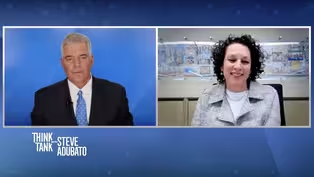
CEO of Russell Berrie Foundation Talks About the 2023 Awards
Video has Closed Captions
Clip: 6/24/2023 | 8m 47s | CEO of Russell Berrie Foundation Talks About the 2023 Awards (8m 47s)
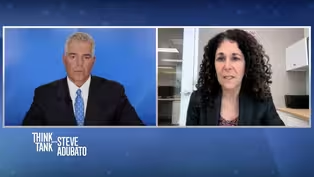
The Prevalence of Racial Disparities in Healthcare
Video has Closed Captions
Clip: 6/24/2023 | 9m 18s | The Prevalence of Racial Disparities in Healthcare (9m 18s)
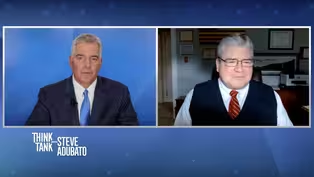
Sen. Oroho Discusses the Need for Civilized Public Discourse
Video has Closed Captions
Clip: 6/24/2023 | 10m 30s | Sen. Oroho Discusses the Need for Civilized Public Discourse (10m 30s)
Providing Support for PBS.org
Learn Moreabout PBS online sponsorship
- News and Public Affairs

Top journalists deliver compelling original analysis of the hour's headlines.

- News and Public Affairs

FRONTLINE is investigative journalism that questions, explains and changes our world.












Support for PBS provided by:
Think Tank with Steve Adubato is a local public television program presented by NJ PBS