State of Affairs with Steve Adubato
Sen. Troy Singleton; Sean Spiller
Season 7 Episode 33 | 26m 52sVideo has Closed Captions
Sen. Troy Singleton; Sean Spiller
Steve Adubato and Mary Gamba talk with State Senator Troy Singleton, Senate Majority Whip, about leadership, job creation, and recruiting and retaining a talented workforce; Then, Steve goes on-location to the NJEA Convention in Atlantic City to talk with NJEA President Sean Spiller about some of the issues facing educators today.
Problems playing video? | Closed Captioning Feedback
Problems playing video? | Closed Captioning Feedback
State of Affairs with Steve Adubato is a local public television program presented by NJ PBS
State of Affairs with Steve Adubato
Sen. Troy Singleton; Sean Spiller
Season 7 Episode 33 | 26m 52sVideo has Closed Captions
Steve Adubato and Mary Gamba talk with State Senator Troy Singleton, Senate Majority Whip, about leadership, job creation, and recruiting and retaining a talented workforce; Then, Steve goes on-location to the NJEA Convention in Atlantic City to talk with NJEA President Sean Spiller about some of the issues facing educators today.
Problems playing video? | Closed Captioning Feedback
How to Watch State of Affairs with Steve Adubato
State of Affairs with Steve Adubato is available to stream on pbs.org and the free PBS App, available on iPhone, Apple TV, Android TV, Android smartphones, Amazon Fire TV, Amazon Fire Tablet, Roku, Samsung Smart TV, and Vizio.
Providing Support for PBS.org
Learn Moreabout PBS online sponsorship- [Narrator] Funding for this edition of State of Affairs with Steve Adubato has been provided by PSE&G, committed to providing safe, reliable energy now and in the future.
PNC Foundation.
Johnson & Johnson.
Hackensack Meridian Health.
Keep getting better.
NJM Insurance Group.
Serving New Jersey’s drivers, homeowners and business owners for more than 100 years.
The Russell Berrie Foundation.
Making a difference.
The New Jersey Economic Development Authority.
New Jersey Sharing Network.
And by New Jersey Instituteof Technology.
NJIT makes industry ready professionals in all STEM fields.
Promotional support provided by ROI-NJ.
Informing and connecting businesses in New Jersey.
And by New Jersey Monthly.
The magazine of the Garden State, available at newsstands.
[INSPRATIONAL MUSIC] - Hi everyone, Steve Adubato.
I'm about to introduce you to a segment that we did on our Lessons in Leadership program with a state senator by the name of Troy Singleton.
He's from down in South Jersey.
I've known Troy for over 20 years.
Worked with him before he got into the legislature.
He's with the Carpenters Union, still is.
Troy's an extraordinary public official, not just a great state senator, in the eyes of many, an up and coming young leader who has potential to go beyond.
But we talked to him at length about our series 2024, Decision 2024, Democracy in Danger, not with a question mark, but Democracy in Danger.
We talked to the Senator about how we're in danger, why we're in danger, and what we need to do to improve our democracy and get back to a place where people trust elected officials just a little bit more than we do because democracy in the eyes of many, it's in big danger.
Hi everyone, welcome to Lessons in Leadership, Steve Adubato with my colleague Mary Gamba.
Mary, how are we doing today?
- It's a really good day, Steve.
How are you?
- It's a really good day on a lot of levels.
Not a great day for democracy, if you will.
Lessons in leadership, not a political program at all, but we do talk about political leadership.
Who better than to have on Senator Troy Singleton, Senate Majority Whip in the New Jersey State Senate.
A long time friend, we've worked together before he was in elective office.
And by the way, identify the the trade union you were connected to for many years.
- Sure, sure.
I'm still a card carrying member of the Carpenters Union here in the state of New Jersey.
- Yeah, Troy, let's do this.
I know that there are a whole range of things we could and should be talking about in terms of public policy in the state of New Jersey.
We'll get to it.
But the graphic is about to come up on the screen in post-production, Decision 2024, Democracy in Danger.
No question mark, no nothing, in danger.
Premise of the question is this.
There are so many Americans, Mary being one of 'em, we had a conversation yesterday who are losing faith in our representative democracy and our elected officials.
We're taping at the end of September, it is what it is.
People know is going on.
That being said, what do you say to millions and millions of Americans who think about 2024 and the decision that we may have to make and the choices that are out there and in fact they've lost faith that our representative leaders will do what is right and not simply what is in their self-interest?
Loaded question, I know.
And not to mention, Democrats and Republicans don't seem to work together on very much anything.
Go ahead.
- So no one can object to the cynicism that so many in the the public have around our body politic currently today.
But as the eternal optimist, I'm always heartened by the fact that it's still, we the people, and the engagement of the citizenry of this country is going to be what is going to pull us back on the brink of our democracy, moving to some sort of autocratic society.
And I say that because it is still the people, when they decide to sort of come together, that have actually helped shift elections and help shift the tone and tenure of our country.
Almost having to put aside who's the players in front of them as the elected officials, but really deciding upon the principles that still matter in our country, the principles of fairness, the principles of ethical behavior, all those things that we still teach our children at our core that we want them to understand.
We're gonna ask people to put that on the ballot.
But if you look at it through those types of prisms, then you don't really get caught up in this idea of the Democrat or Republican.
My mother, God rest her soul, used to say to me all the time, I always vote for the best people.
And I've jumped around for various political parties in the effort to do that.
But when you stop looking at the nature of what the fancy soundbite is, or the commercial that comes up that tries to scare you into not voting for this person or that, but really get to the core of the things that make you who you are and see who best embodies those things, I think the overwhelming majority of individuals will step forward and make the right choices in this 2024 election cycle that we see coming up.
'Cause it's so critically important.
- You know, Troy, before Mary jumps in, I need to say this because we've known each other for 20 plus years, and you've always been an optimist, even before you got into government.
And the fact that you are now speaks for itself.
However, there's a big part of me that sees you as not the norm.
What I mean by that is you've always been someone who tries to get things done, reaches across the aisle.
Such a cliche but true.
Just focuses on what needs to be done on behalf of your constituents.
Senator, that is not the case with a vast majority of Democrats and Republicans who often look at the actions of someone in the opposite party and call it horrific, you're not fit for public office.
But if someone in their own party does the exact same thing, we need that vote.
Gotta protect that person that is not in the interest of the constituents they serve.
No disrespect my friend, but you seem like you're in the minority in more ways than one.
But in this case, just trying to do the right thing.
I don't wanna make you a saint, but you're usually trying to do what's right.
- Yeah, definitely not a saint.
But in a sense, I'm trying to be a realist in this discussion though, I do think there are more individuals who do embody that spirit in what you just talked about.
The problem is, frankly, the headlines don't come from folks working in bipartisan ways these days, right?
Right now, we're seeing too many people who are willing to play this idea of pointing fingers and being antagonistic to one another.
And that is like click bait, and that's selling shows, and that's getting people where they wanna be as far as in the public eye.
But the hard work, right, the work that still needs to go on to move government forward, there's still those of us who are in, not just involved in doing that, but get excited about doing that regardless of our label.
The idea though is for us to have opportunities like this to talk about that and talk about how I work closely with my Republican colleagues and my Democratic colleagues because there's just so much work that needs to be done.
And no one, no party has monopolized good ideas.
- One second, before, I'm sorry.
I'm sorry, Troy, before Mary jumps back in.
You think that's happening in Washington?
Really?
- I think that it's happening everywhere, right?
But here's the thing.
- That's not in everywhere.
That's the nation's capital.
- It is the nation's capital.
- Are they doing the people's business?
- It is the nation's capital and the frustration I think that you are exhibiting, and so many, frankly others when I go out and talk to 'em, when I go door knocking or out at the store, is that they feel like Washington has stopped listening to all of us, about just trying to get things done.
Again, I think the way to change that has been twofold.
And we're seeing an example of that in Alabama, a pretty conservative court just decided that the way that the district is constituted in Alabama, were gerrymandered, and it was diluting voices, especially of minority voters.
- That's right.
- They're pushing back and making that happen, right?
And, and, and they're being fought right, locally, but they're still doing that.
But in order for us to change that sort of culture there, we have to start changing the people who are going there.
Some of that means making these gerrymandered districts less focused on putting us against each other, but truly trying to put people in places that really wanna see things get done.
I still believe we can do that.
- Real quick 'cause Mary, and gerrymandering, for those who do not know, is simply carving up districts, congressional legislative districts that are intended to get certain kinds of folks elected and deny other folks an opportunity to be elected.
It is unconstitutional, wrong, but there's a tradition in our country of it.
Please, Mary.
- Yeah, definitely.
You talked a little bit about the fact that yes, there is click bait out there, there's a lot of finger pointing, a lot of political ads.
But let's flip the switch.
What about where it's not necessarily somebody trying to blame someone or make up something about someone.
We're seeing so much in the news today about politicians or people really just making egregious mistakes, trying to cover things up.
For lay people, for people who do just tune into the news, what hope can you give to us?
And I do say me, because Steve and I were just talking about it the other day.
We want a better world.
We want our children to look up to our politicians and these leaders as role models.
What do we do when they're not role models?
- Well, I think our process, especially our judicial process, will hold those individuals to account who are making the really egregious things that cross the line beyond, just doing bad acts in government, but also illegality.
So I think we still have to have faith and trust that that process will play itself out in one regard.
But secondarily, I think, Mary, I think we have to really focus on the fact that when we have elected officials who've lost the public trust, no matter their party, no matter their longstanding in anybody's eyes as who they are, we have to call it out.
I think that's important.
And we've seen some of that in this state and other states.
And too often individuals, to Steve's point earlier, are reticent to say, "Hey, in my political party, we don't do that."
Like we've seen some of these issues here in New Jersey.
I've not been shy of calling it out and I will continue to call it out because it's important for our public to have that trust in government, no matter the nomenclature behind our names, that we're working in their interest and not anyone else's.
So that's where it begins, right?
Letting the judicial process play itself out for those who crossed the line.
But also all of us who are in government standing up because it's a stain on all of us when we're silent.
And that almost makes people think we're being complicit in those acts.
- The issue of race, race relations in our country, particularly post a historic significant decision by the United States Supreme Court on affirmative action as it relates to college admission.
It's only a piece of a much larger equation.
Share with us your view on race relations and the view of many that were as polarized as we've ever been, and democracy potentially being in danger, please.
- Well, it starts fundamentally with the concept of the original sin of our country, which is slavery.
And how we as a nation have not had a true reckoning around that topic.
It's almost as if we're fearful to say that yes, in this country, one sect of people enslaved another sect of people and the remnants of that we still see and have seen, whether it's in housing policy, whether it's an electoral, economic, education policy, you name it, we have to call that out.
That doesn't mean that someone who lives today should be held accountable because their grandfather's grandfather's grandfather's grandfather held slaves.
But it is frustrating to a lot of us when we don't acknowledge that painful history of our country that still has remnants today.
So we have to start.
- But who's not acknowledging that?
Respectfully, who's not acknowledging?
Take the Proud Boys, take white supremacists off the page for a second.
Ignore them.
For the vast majority of non-African Americans, for those of us who are white, do you believe the vast majority of whites somehow deny or don't acknowledge the original sin of our country is slavery?
- I don't think the vast majority do, but too many do.
And I think that's where my point is, it's not the vast majority, it's not the overwhelming majority, it's not probably even a simple majority.
But there are several people, and frankly, in positions of influence, who will not acknowledge that simple point and the fact that ramifications are still felt today.
That's where we gotta have that really uncomfortable conversation around that.
And then talk even a step further.
What is it that we're prepared to do to recognize that challenge and utilize the tools of our government and industry to try and rectify that wrong to a way that is equitable and fair to everyone?
- You're talking about reparations?
- I'm talking about a broader conversation around how we look at public policy moving forward and its ramifications on communities that have been adversely affected over the course of time.
- One more.
- So I think addition- - No, Troy, one more on this.
Do you acknowledge and understand, even if you don't agree with or appreciate the degree of, quote unquote white resentment on the part of many who ask the question, what about my kids?
What about my kids' opportunity?
And then they will look at the affirmative action decision by the courts and ask the question, will that potentially hurt my child?
And should the response be, or is the response, well we've suffered for too long, not that it's publicly stated, but now it's your turn.
- So I think in the way we frame that thought leads us to a discussion that actually doesn't help us progress beyond that.
And that is not a disparity about the question.
It's more along the terms of there's a difference between equality and equity.
And I think when we frame it in such a way that folks, all of us, all of us, regardless of our color, wanna see our children have a equitable opportunity to move forward, doesn't mean all things are equal, - It never will be, it never will be.
- And I think we start from that premise, moving a different.
But yeah, if we start from that premise, we end up with a different sort of outcome.
Because equity, for me, is the same for a white family in my similar class.
'Cause I wanna see the same things for children, whether they're white, black, Hispanic, Asian, across the board, you name it.
But when we don't frame it the right way, we get in this thing, that I'm almost being pitted as neighbors against neighbors.
And that's where we lose sight of the bigger picture of trying to create a more equitable society.
- Boy, Mary, it's hard to talk about hard stuff, but it's important to talk about hard stuff.
State Senator Troy Singleton, it says title, Majority, Senate Majority Whip in the New Jersey State Senate, but he's a lot more than that.
He's a leader who we're gonna hear a lot from in the future because we need to.
Political leadership, potentially state, national leadership.
We appreciate it.
- Thank you, Senator.
- Thank you.
- You got it.
Stay with us, we'll be right back.
(grand music) - [Announcer] To watch more State of Affairs with Steve Adubato, find us online and follow us on social media.
(upbeat music) - Fresh off an interview with the great Spike Lee, we have Sean Spiller, the president of the NJEA.
Now, let me get this straight.
You come from an interview that you're doing with one of the keynote speakers here, Spike Lee at the NJEA Convention here in Atlantic City.
What was it like interviewing the Spike Lee?
- Well, it's exactly like you just set that up.
It's the Spike Lee, right?
We're out there, we're sitting down, and "Mr. Spike Lee," you know, "here's my first question."
You know, as you sit here, you know this whole time, right?
- By the way, I got list of some of Sean's questions.
- You got the questions there, right?
And I probably get two words into the first question before he is like, "And another thing."
- Hold on, don't tell me he was wearing his Knick stuff.
- Oh, full on, full on.
Absolutely.
- He's the greatest Knick fan of all time.
- Yep, no question.
- So you talked about the Knicks, talked about what else?
- Well, listen, we were trying to talk a little bit about education, right?
- Oh, that?
- That too, right?
But he's a professor, college professor, and certainly he gets that.
- Doesn't have he have, I'm sorry for interrupting, he has his mother, grandmother, both educators?
- Yeah, both educators.
And really helped inspire him in the work that he does and it encouraged him.
You know, he spoke about that a little bit, and I think it's important as we're here at convention, just that encouragement he got from his mother, grandmother to say, "Go into the arts.
Focus on that.
You want to do film?
That's excellent."
And he just highlighted that we should make sure we're encouraging kids to go into these spaces and not cutting these programs from schools, you know, which we often see are the first to go with budgetary cuts.
- And it's not an accident that Spike Lee is in fact here at the NJEA convention, let me disclose NJEA has strong support, a longtime supporter of the Caucus Educational Corporation, and the family of public broadcasting, and a lot of our programs and public broadcasting.
Let me try this.
Spike Lee, his art, his films, right?
There's a film festival going on, but they're not indiscriminate films about any topics.
There are themes, talk about them.
- Yeah, we're talking really about celebrating our rich diversity, right?
Exploring social conversations, talking about cultural intersection points, talking about how we engage in important conversations in our classrooms in an appropriate way.
Talk about how these things are all connected.
And what's happening here at convention is there's a number of films.
Oftentimes, we've got the producers Who can then speak to the audience afterwards.
So we're having our own little film festival, if you will.
But really it's an opportunity to talk about how are we engaging in the work in our classrooms with our students, but talking about important conversations in a way that oftentimes, I don't want to say relaxes people, but it's a way to talk about something, sometimes it's a little easier through film or through art that it's a little different in conversation.
- But you know, one of the themes beyond the social justice, the racial, very honest conversation about race, racial equity and racial justice, et cetera.
One of the other themes that I've been wanting to talk to you about has to do with mental health.
The mental health of our educators.
To use the term burnout is people may not really, because it's used a lot, "Like what do you mean burnout?"
It goes so far beyond that, talk about the wellness of our educators, Sean.
- Well, I appreciate you asking that.
In that way too, because I think, and rightfully so, there's so much focus on student mental health, which is huge and unbelievably important.
But the very people really on the front lines trying to help our students with that student mental health crisis that we're facing are also suffering from mental health challenges right now, right?
We all experienced COVID and, you know, are coming through that in a way that we're traumatized.
We're talking with educators who are doing more and more as society demands more and more of our schools and our educators.
That's a heavy burden in many ways where, you know, we're responsible to make sure students are fed, we're responsible to make sure we're identifying points of crisis in a student or family.
We're charged with how do we make sure our communities as a whole are succeeding?
But there's a lot of stress that goes with that.
And I think it's important for educators to understand, just like you hear when you first get on that plane, you've got to put that oxygen mask on yourself first before you can help the person next to you.
And we've got to make sure we're focusing on our educators mental health as much as we are as students and others.
- But there's a follow up to this because it's even more complicated on so many levels shown and you live it, tell everyone as an educator, you have, it's not just that you're an officer of the high school?
- Right, right, high school science teacher as well.
You know, and certainly in that capacity, and as you know, a couple other hats as well, but yes.
- I'm a Montclair resident, this is the mayor, okay?
Not here in that capacity.
But here's the other thing.
You and I have never shied away from talking about some tough stuff, like how political discussions about education have become, in boards of education, in classrooms, parents' rights, students' rights.
What the heck position does that put our educators in?
- Yeah.
Our educators and our students, right?
I think important because... - And parents.
- And parents, all of us, right?
And by the way, we're the partners in all of this work together.
I'll start with this, it's been extremely frustrating to see, certainly inspiring in ways when we look at recent election results.
- We're taping just a few days after the November 7th legislative election.
Let's just say the NJEA, involved.
- Okay?
- Involved.
- And culture wars.
People use the term culture wars, what the heck are they talking about?
And what does that have to do with education and educators?
- Right, and well, the ones who were talking about it first off, it certainly showed that it didn't play well in their, I think their goal, which was political.
It wasn't about education, right?
That's the problem.
- So, hold on, to be clear, you're arguing that Republicans who engaged in issues around, "Hey, our parents should know if a fifth grader is telling a teacher, or an educator, an administrator, that they're thinking about changing their gender, parents have a right to know," which is a legitimate issue.
You say, "Okay, didn't play well.
The results are what they are.
People can determine what that means."
Democrats picked up more seats than they had before.
Complicated stuff.
Going back to educators.
What does it all mean for an educator?
- Right.
Well, that's why it's frustrating because, and here's why I say it's political, because the answer, when you talk to any educator, any teacher is gonna say, "Of course, we want parents to know everything about their student.
Of course, we want to interact and make sure."
I mean, we're the first ones calling home, trying to engage in these conversations.
"Here's how your child's doing."
You know, "they did wonderfully on this.
We need some help here."
Those are the conversations that have always happened, right?
Anyone who's been a parent.
- But it feels different now, Sean.
- It does, but that's why it's frustrating, because to say in the instances where an educator is worried about a student's safety, that we have to go talk to a parent.
In that rare instance, where the parent might be part of a household that is not safe for that student.
We wouldn't put a student in harm's way anywhere.
And I think parents get that, right?
They want to know, I'd want to know.
- But who determines that?
I mean, this is where it gets tricky.
Is it the educator's responsibility to make a determination as to whether a parent could, should know?
- No, I think that's why we look at it and say, "Listen."
When a student would come to you on any issue, you talk to that student.
You have, hopefully, a relationship, a trust there.
- Right, we have a daughter in the eighth grade in the Montclair Public Schools, go ahead.
- And oftentimes they're talking to their teacher because they might be trying something out that they want to bring home to their parents next.
Or they want to walk through something in their mind, right?
They're growing, you know, kids, and we're here to listen to that, hear them.
And, "Okay, that's great."
You know, "Where are you at?
Are you ready to go talk to your parents about that?
What are you thinking next?"
And we help coach them through that.
Now, if in that rare instance they go, you know, "Please, please, Mr. Spiller," you know, "do not say anything to my parents, my God."
You know, they sometimes talk a little hyperbole, but you know, who knows what could happen?
We have to honor that and respect that.
You know, we have to assess that, of course, in a way, but you know, it starts from a place of the students have to be safe.
And I think the public, by and large, absolutely comes down on that side.
Parents want to know, I want to know as a parent, right?
I've got kids, I want to know what's going on.
But I also know that if a student, my student, my kids don't feel safe in a certain space, I want them always to be safe, right?
And I want their teacher, their educators, always to keep them safe, no matter what that is.
And I hope I can help support that as a parent.
- Last question.
With everything going on in the world of education, how political it's become for so many, you're out beating teacher shortage, teacher burnout, mental health issues of all ranges.
- All connected.
- All connected.
- Yeah.
- You're bullish on education because?
- Well, we've got the number one schools in the nation, right?
Over and over and over, number one in the nation.
And I'm bullish on it because we've got the very best educators who understand that we have to be engaged in politics and in so many spaces to get pro-public education individuals elected so we can lobby them and push for what our schools need, what we need as educators, what our students and our communities need to keep the very best schools in the nation, right?
It's that cycle that I think works.
I'm bullish on that and right now, we need to use that leverage to say, "Here are ways we can get more people into the profession and keep more people."
'Cause we're just not recruiting and we're not retaining.
- Let me disclose one more time, if we missed it earlier.
The New Jersey Education Association, longtime supporters, underwriters, if you will, of public broadcasting and of our production company, the Caucus Educational Corporation.
Mr. Mayor, Mr. President, Sean, thank you.
- Always great to see you.
- You got it.
- Thanks for having me.
- [Narrator] State of Affairs with Steve Adubato is a production of the Caucus Educational Corporation.
Celebrating 30 years in public broadcasting.
Funding has been provided by PSE&G, PNC Foundation.
Johnson & Johnson.
Hackensack Meridian Health.
NJM Insurance Group.
The Russell Berrie Foundation.
The New Jersey Economic Development Authority.
New Jersey Sharing Network.
And by New Jersey Instituteof Technology.
Promotional support provided by ROI-NJ.
And by New Jersey Monthly.
- I'm Tim Sullivan, CEO of the New Jersey Economic Development Authority.
Since joining the NJEDA, I've been struck by the incredible assets and resources that New Jersey has to offer.
The NJEDA is working every day to grow New Jersey's economy in a way that maximizes the values of those assets to benefit every single New Jersey resident.
This includes more support for small businesses and a focus on reclaiming New Jersey's position as a leader in the innovation economy.
Visit njeda.com to learn more about how NJEDA is building a stronger and fairer New Jersey economy.
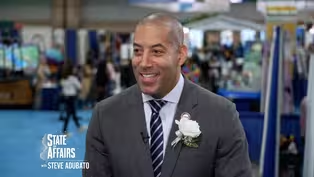
NJEA President Sean Spiller Discusses the 2023 Convention
Video has Closed Captions
Clip: S7 Ep33 | 10m 52s | NJEA President Sean Spiller Discusses the 2023 Convention (10m 52s)
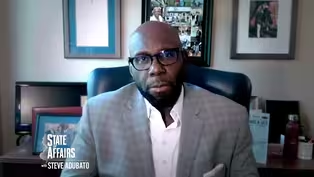
Sen. Singleton Discusses Hiring & Retaining a Talented Team
Video has Closed Captions
Clip: S7 Ep33 | 15m 39s | Sen. Singleton Discusses Hiring & Retaining a Talented Team (15m 39s)
Providing Support for PBS.org
Learn Moreabout PBS online sponsorship
- News and Public Affairs

Top journalists deliver compelling original analysis of the hour's headlines.

- News and Public Affairs

FRONTLINE is investigative journalism that questions, explains and changes our world.












Support for PBS provided by:
State of Affairs with Steve Adubato is a local public television program presented by NJ PBS