
Senator Harry Reid’s Legacy, Challenges in Rural Nevada
Season 4 Episode 26 | 26m 46sVideo has Closed Captions
We examine the legacy of the late Sen. Reid and rural Nevada towns face unique challenges.
Senator Harry Reid left a lasting legacy in Nevada. We’ll explore the impact the late senator had, plus we’ll examine the challenges that rural Nevada faces.
Problems playing video? | Closed Captioning Feedback
Problems playing video? | Closed Captioning Feedback
Nevada Week is a local public television program presented by Vegas PBS
Senator Harry Reid’s Legacy, Challenges in Rural Nevada
Season 4 Episode 26 | 26m 46sVideo has Closed Captions
Senator Harry Reid left a lasting legacy in Nevada. We’ll explore the impact the late senator had, plus we’ll examine the challenges that rural Nevada faces.
Problems playing video? | Closed Captioning Feedback
How to Watch Nevada Week
Nevada Week is available to stream on pbs.org and the free PBS App, available on iPhone, Apple TV, Android TV, Android smartphones, Amazon Fire TV, Amazon Fire Tablet, Roku, Samsung Smart TV, and Vizio.
Providing Support for PBS.org
Learn Moreabout PBS online sponsorshipSenator Harry Reid loomed large in Nevada.
From his time on the Gaming Commission to his years as Senate Majority Leader, the senator worked tirelessly for the people of Nevada.
We look back at his legacy.
While Las Vegas comes to mind for most people when they think of Nevada, the state is dotted with small cities and towns throughout its rural areas.
"We want to just keep to ourselves and live in a peaceful place that is full of nature."
This week on Nevada Week, we explore two rural towns with different ideas on growth and what they and their futures are going to look like.
Plus, we look at the unique challenges rural areas in the state face.
♪♪♪ Support for Nevada Week is provided by Senator William H. Hernstadt and additional supporting sponsors.
(Kipp Ortenburger) Welcome to Nevada Week.
Whether you liked him or not, Senator Harry Reid was an important force in Nevada for decades.
The senator of course died last week after a battle with cancer.
This week on Nevada Week, we look back at the life and legacy of Harry Reid.
Joining us for this conversation are Michael Green, history professor at UNLV, and David Demore, political science professor, also at UNLV.
Thank you so much for joining us.
We really appreciate it.
I want to start our conversation, I'm sure you both have been doing the same, there's so much out there right now to read and to watch on Senator Reid's life.
I want to maybe start the conversation by talking about some things that maybe aren't getting the press, aren't getting the attention right now that are very critical you believe to Senator Reid's legacy for us to understand.
Michael, I want to start with you.
(Michael Green) Well, a couple of things, and I think we go back before he was even in Congress, and you look at him losing two major elections in two years.
Everybody said he's finished.
We're done with him.
He manages to come back and he comes back as chair of the Gaming Commission, and he would tell you he had no idea of what he was getting into and boy, did he get into it.
It was an incredible time, a difficult time.
You had federal, state and local investigations going on.
He's part of the whole thing.
And I think trying to understand how the Mob is driven out and his role in that is important, but also tying it to that kind of origin story where this was his comeback position.
Well, it worked, but he didn't really expect the life he ended up leading.
-A very turbulent time.
But this is-- what was it, 1978 that he was appointed to the Gaming Commission?
-He's appointed in '77, and he's told the story that a previous commissioner got together with him and was saying, you know, they follow me, I get threats, and he's thinking, what?
You must be kidding.
This is normally a sane person, what could be happening here?
And at that point, you had Gaming Control beginning to go after the Stardust crowd depicted in Casino, and now they're going to head into the Tropicana and the Aladdin and all of these Mob outfits, and the Gaming Commission ends up hearing these cases, and some of them become fairly famous, some of them show up in movies.
Again, Ned Day, probably one of the greatest reporters we've ever had here, called it "a rite of civic purification," and there we were in the middle of a rite of civic purification.
-Yes.
David, I want to come to you.
Obviously his role in the Gaming Commission is big, but as Michael mentioned, a couple huge losses politically early on in his career.
Then he becomes part of the Gaming Commission, then he's a Representative and eventually in the Senate.
I mean, how did those early days in the Gaming Commission kind of set what type of politician he was later on, or any other type of experience he had?
(David Damore) Well, I think what Michael hit on and I think is an important part of the Reid story is he's sort of ahead of the transformation to some degree, right?
The change from the old Vegas to the new Vegas, right?
The change from a Republican-leaning state to a Democratic-leaning state.
Someone who was able to see the demographic change coming and instead of ignoring it, embrace it, and along with that, change his own politics, right?
So that was the thing that struck me was he was someone who was willing to sort of see the future and adapt his own behavior to it.
I think, you know, clearly we see that he ended up by the end of his career being more partisan than certainly when he started, and that came with obviously being in leadership but also the changes in the state.
Nevada became a bluer state from when he started there.
But he always had that sort of old Nevada to him, right?
I'm thinking when I started really taking an interest and following his career was in 2010 following that epic election, and you had something which would be unthinkable today, Republicans for Reid, right?
This idea that he had sown so many relationships and was so instrumental for decades that when he was in this toughest fight of his life, he was able to draw on that and get him over the top.
-Yes.
In addition to Nevada politics too, a lot of changes in the Senate during his leadership as well, and he broke a lot of norms, a lot of traditions in how the Senate was being conducted as well.
-Yes, and to some degree that was reflecting the broader changes going on in our politics there.
You think about when Reid came in and even when he started being in leadership, Democratic senators from these states, we would no longer think of Democratic representatives.
We had a much broader coalition.
He had a less ideological coalition, and then all of a sudden, you see it narrowing.
The red state/blue state dynamic takes hold and, you know, the Senate is not favorable to the Democrats, just the organization of it.
So if you want to get that agenda through, he's got to go ahead and sort of buck those norms as the politics are changing and this sort of consensus-based politics that he had grown up in and came of age in no longer are going to work, so you've got to sort of adapt to that and I think he did that.
And he's obviously taken a lot of heat for what he did on the federal courts, but he defends that, right?
Otherwise Obama would have had no appointments and remember, these are lifetime appointments.
This is the most treasured appointment that a president can make, and if you're going to essentially have opposition that's not gonna allow that to go forward, you're essentially stifling a president in the short term and the long term.
-Right.
Some have argued a lot more partisanship during his leadership as well.
How much can we attribute that level of partisanship to his leadership?
-I mean, I think it's a two-way street, right?
I mean, you sort of had this breakdown.
I remember I was back in D.C. and I had the opportunity, one of my students was interning for Reid and he got me in the Senate, the opening of the Senate, and Reid walks out and gives his remarks.
Then Mitch McConnell walks out, they don't look at each other, don't speak to each other, and it's total partisanship.
And I'm thinking this is a very different Senate, and certainly he's embracing this.
The Democratic Party's becoming more liberal, becoming more activist, right, and he has to sort of-- he's got to lead that caucus, and I think that goes with that.
At the end of the day, that's where we are in our politics and he had to adapt to that otherwise he was not going to be able to hold the party and Obama wouldn't have been a successful president.
-Yes.
And I want to come back to the filibuster specifically in this part of the conversation too, but Michael, I want to come to you.
There's nothing it seems, here in Southern Nevada, maybe the state, maybe the U.S. really, that Senator Harry Reid hasn't touched and influenced in some way of our lives and livelihoods and I want to come to that.
What really stands out to you?
What are some of the biggest ways that Senator Reid has influenced our lives today in the present?
-I'll start with the environment, and we are talking about massive wilderness land that he got set aside.
Great Basin National Park was his baby.
He gets more land for Red Rock.
Talk about Gold Butte, other conservation and recreation areas, and he was vital to that, no question.
Another thing to think about is he's Majority Leader at the time and MGM is trying to finish City Center in a recession, and he calls their lenders.
Now, so did his Senate colleague John Ensign-- I don't want to minimize Ensign-- but this is the Majority Leader, and I can hear in my mind's eye, Harry Reid in that quiet voice: "I'm sure you're not going to foreclose "on my friends at MGM."
Well, he would say that, and that's his job as a senator.
I don't care what state you're from.
That's what you do.
-And at the time this was unprecedented, right?
I mean, we didn't have senators calling the heads of banks.
-Probably not but there's an old line in the Senate that the senator from Georgia is the senator from Coca-Cola, and there were senators from Nevada whose nickname was the senator from Kennecott Copper or whatever.
So you are in a sense an ambassador from your home state.
So there are things going on.
He was in a position to do it.
He's the first Nevadan really in a position to do it.
Now, the airport was a recent controversy in terms of changing the name, and I spoke about it and I was in favor of taking McCarran's name off it, that's for sure.
Reid really got Terminal 3.
We probably don't have that terminal without him.
-And the new tower.
-And the tower and all kinds of things.
You know, there are senators where they can point and say that's my building, that's my project, whatever.
He could do that.
But he could also point to things and say oh, yes, I got a couple hundred thousand for that.
We have at UNLV the Technology Park.
This is about 120 acres he got set aside that seemed to be in the middle of nowhere that's now becoming the center of the universe, frankly.
So there are lots of ways you can find Reid's thumbprints, fingerprints all over the place.
-Yes, absolutely.
David, I want to come to you.
I want to come back to that filibuster-- we've got a couple minutes left here-- because the filibuster is so connected to so much decision-making that's happening on Capitol Hill right now legislatively, but as you mentioned judicially and some of the presidential appointments and how the filibuster is affecting that or not affecting that in this case.
I mean, how much of this can we attribute to Senator Reid's leadership too?
-That's a great question and again, he's in the context, right?
This is the endpoint of a very long fight, right, that really goes back to the '70s starting with Nixon into the '80s and where the judicial wars heat up, right?
This is not something that just happened when Harry Reid became the Senate Majority Leader.
This was the tool available to him to advance that and, you know, you sort of see the filibuster as an anachronism, right?
You look at the history of the filibuster, it was never really used, right?
It's been there but you have these sort of great episodes during the civil rights, you know, but those are sort of the outliers.
It's now become a common tool, right, and that's what's changed.
It used to be something very reserved, now it's for everything, an appointment, right, which would have been unheard of.
But there was a breakdown in the process before that for judicial appointments, right, removing the blue slips for example, not allowing home state senators to put a veto on an appointment, those kinds of things.
The changes in the judicial committee, that's what led to that part, and this was the only tool available, and again, do I allow Obama to be a failure and not have this legacy?
Do I do this, and obviously now it's escalated to the Supreme Court, right?
Now we're talking about, you know, certain legislation and certainly obviously if you do this for certain legislation, that creates that precedent, and there goes the filibuster.
-Well, also one of the main threads of Senator Reid's life story was of course his rise from a rural Nevada town to the halls of power in Washington D.C. Then as now, Nevada's rural areas face unique challenges.
The Nevada Week team visited two different towns, one looking to grow and one looking to stay about the same.
We start with Laughlin, a town looking to bring in more customers and grow its economy.
Ninety-five miles south of Las Vegas is the unincorporated township of Laughlin, Nevada.
It's a small community with big aspirations.
The town's slogan is smart and direct: "Laughlin is open and welcomes you safely."
(Jacalyn Wallin) You'd be surprised to know that during the shutdown, people were still coming.
I think overall rural areas in the state of Nevada, we were highlighted as one of the ones that had the largest occupancy right after the shutdown and we're very proud of that because we made people feel welcome.
There are fewer than 10,000 residents in Laughlin which is the southern gateway to the Lake Mead National Recreation Area and Lake Mojave.
It sits at Nevada's southern tip where Arizona, California and Nevada meet.
(Sean Hammond) We've got a unique destination here that not only offers the casino resort environment, but a lot of natural beauty and wonder in the tri-state area that the guests really flock to.
Laughlin attracts two million visitors each year as well as many retirees.
There are places to live, and we can sell this beautiful paradise, this beautiful valley, to anybody who wants to come here and start a new career.
The hardest part is we can get them in the job, but we need to find them a place to live.
Like many rural towns in Nevada, there's a need for affordable housing.
Nearly 90% of Laughlin's workforce lives in Arizona.
We can't put any more workers in Laughlin until we get some more low-income housing, affordable housing.
Laughlin has jobs to offer, an ample infrastructure, lots of land and some community amenities, but this small town depends on partnerships with surrounding states to provide some critical services, and Laughlin's economy is dependent on its resort casinos like Golden Properties.
I think the Golden Properties in Laughlin are significantly important not only as far as offering a place of work, but also for the community and what we give back through our community connection.
We're very involved on both sides of the river.
The township of Laughlin benefits from some of the bed tax dollars paid by the resorts.
That money is used to sponsor large events that increase occupancy and tourism.
The town's ten casino resorts also support Laughlin by investing in and updating their own properties, which enhances the Laughlin experience.
For those who live in and love Laughlin, there's high hopes for the future.
Once we get past the pandemic fears and the restrictions, I think we'll see a lot more developers coming here.
And more developers means more of everything that a growing community needs.
It's dawn in Goodsprings, Nevada and the sunrise reveals this tiny slice of desert paradise.
Goodsprings is an unincorporated community 29 miles southwest of Las Vegas.
Fewer than 200 folks live here, and that's how some residents like it.
(Debbie Smith) I kind of keep to myself, and I think that's what the people that live here want.
We want to just keep to ourselves and live in a peaceful place that is full of nature.
Goodsprings is full of nature and history.
It was once a booming mining town.
(Stephen Fleming) In 1892 a gold mine was struck just about five miles from Goodsprings, from the townsite of Goodsprings, and that brought a tremendous number of people.
The town, which was founded in 1900, thrived throughout the early 20th century.
However, whenever rules changed for the mining of gold and owning of gold in the late '30s, that kind of shut down the mining in the area, and basically that is why the population of Goodsprings kind of went down.
And the population continued declining over the years as did Goodsprings' businesses and services.
Today, residents comprised mostly of retirees depend on nearby towns to provide many community resources.
You better like camping, I guess, if you like it out-- if you want to be out here.
Small as it is, Goodsprings still has a local governing body.
Its Citizen Advisory Council is comprised of several area residents who work with the Clark County Commission to make decisions for the town.
The County Commission is the final decider on anything that happens out here, so we don't have as good input as we would like to have.
Like many small rural towns, Goodsprings is facing significant challenges; for example its only school, which is Clark County's oldest, is at risk of closing.
Goodsprings' population continues to decline, some of its historic structures are facing demolition, and with no new mining operations on the horizon, there is no industry.
But Goodsprings does have the Pioneer Saloon.
The Pioneer Saloon is the number-one draw to this town.
(Stephen Staats) We are the oldest operating, continually operating bar in all of Southern Nevada and the Las Vegas area.
We're also the oldest small business in all of Clark County as well.
The Pioneer Saloon, which opened in 1913, is a rustic desert rest stop famous for its Old West ambience, food and drink.
It's a mecca for area residents, tourists, film producers, history buffs, ghost hunters and video gamers.
The saloon was featured prominently in a popular video game.
♪♪♪ Despite the Pioneer Saloon's success, it was not spared the effects of the COVID pandemic.
Rural towns are affected far more than the big cities are when inflationary events occur.
We have the same global supply chain shortages and labor shortages as everybody else is facing, but as you can imagine if there's a national labor shortage, out in Goodsprings it's even that much harder.
But Staats is optimistic that the Pioneer Saloon will survive and thrive.
We have the luxury of being one of the few businesses that can say this could potentially be the second roaring '20s for us.
Historian Stephen Fleming has high hopes for the saloon and the town too.
He envisions the creation of a local museum and a historic business district.
I think it could be done with private enterprise but with help from a county entity that would basically support that kind of a development.
While some Goodsprings residents crave change, there are others who don't.
Goodsprings probably should stay close to the way it is right now.
More people sometimes bring bigger problems.
In Goodsprings, Nevada, everything hinges on balance: Balancing economics and growth with preserving history and solitude.
For Nevada Week, I'm Heather Caputo.
Thanks, Heather.
Well, the rural areas in Southern Nevada are divided between Congressional District 3, represented by Congresswoman Susie Lee, and Congressional District 4, represented by Congressman Steven Horsford.
I spoke with Congressman Horsford earlier in the week about the challenges rural areas face and how lawmakers in Washington are addressing them.
Congressman Horsford, it's so great to have you in person, and thank you for hosting us in your offices.
We really appreciate it.
-It's great to be on; thank you for having me.
It's the start of a new year, so we're looking forward to crushing this virus so we can all be back in person for everything.
-For sure, and the main point of our conversation here is talking a little bit about the rural areas, and let's talk about the pandemic.
Of course throughout the pandemic, you have conducted a lot of town halls, you've done a lot of listening sessions yourself within your district, and for context your district really is North Las Vegas and above, all the way almost to Carson City in the west, beyond the Great Basin National Park in the east, a huge swath of rural area.
What are you hearing?
(Rep. Steven Horsford) Well, you're right, my district covers currently 52,000 square miles.
It's half the state of Nevada geographically.
North Las Vegas and Las Vegas here in Clark County and then six other counties throughout rural Nevada, and no community is the same, particularly a rural community.
There's some that are a little bit more frontier even in the fact that they don't have a lot of the basic infrastructure and necessities.
So whether it's working in Nye County to help bring a full-service hospital to Tonopah, which is in the center of our state, they've been without a hospital since 2015.
We've been successful in getting a $2 million appropriation in the appropriations process to help get that hospital reopened, to the Infrastructure Investment and Jobs Act to bring broadband infrastructure to Lincoln and White Pine counties.
I was just talking to a number of the mayors and county commissioners from the rural areas, and every one of them talk to me about what this Infrastructure Investment and Jobs Act will mean to them and how they plan to use the funding to meet the needs of the residents in those counties.
-And you're speaking of two of the funding streams that we're seeing here, and I want to come back to the healthcare.
You mentioned the hospital too, something we've covered on the show a lot and just the gaps that we are seeing, the challenges that we see in rural areas related to healthcare and as you mentioned, hospitals being one of them, just being viable and being able to keep their doors open is important.
Lack of professionals is another big gap, and then access to even the smallest of community-based healthcare centers are also challenges.
On the other side, we've got CARES Act money that has come in; billions of dollars have come in there.
We have our American Rescue Plan Act money, $6.7 billion the state is getting, municipalities are getting part of that money as well.
And now as you mentioned, the infrastructure bill as well-- law, I should say, that is now in place.
How is some of this money going to be used to specifically close some of these healthcare gaps?
-Yes.
So it is one of the most important things that we can accomplish.
So when we talk about equity in the implementation of these policies, what we're saying is areas that have been historically underserved even before the pandemic and that were disproportionately affected during the pandemic, and we have to be very intentional about how we ensure the services, whether it's in healthcare or in other areas, receive those benefits.
And there's a lot of intersections to these issues so you can't really address healthcare in rural Nevada without addressing broadband because a lot of it is about access to healthcare through telemedicine.
When you have a healthcare shortage of workers in rural Nevada, it's about affordability of getting people with the healthcare certifications or degrees out into rural or frontier communities maybe through loan forgiveness programs or other tax credits that they can receive in order to open a healthcare service in a rural community.
It's also about connecting the other institutions whether it's education, the state colleges or community colleges to that effort as well.
So it's a lot of intersectionality to serve the rural community needs, and it's really important for me that my rural constituents understand that I'm advocating for them too.
Whether they supported me or not, it's my job to represent every corner of my district, and a big part of that is listening to what it is they're telling me in my office that we need to do for them, and the biggest issues we've heard are healthcare, housing, broadband access and of course helping to crush this virus and get our economy back on track.
-I want to switch gears; we've got about a minute left.
Of course this week some of the big news is the passing of Senator Harry Reid, and I want to get your reflections on that as well, both his legacy and what the senator meant to you personally.
-Well, Senator Reid was, is and always will be to me a mentor, a friend.
He was a bigger than life, you know, elected leader and someone who I respected greatly.
He's an honorable man who cared deeply about his family and our state and this country.
I remember before I ever got elected to anything watching him advance in his career, and he was a fighter and a champion to the very end.
Because of Senator Reid, 31 million Americans have access to healthcare today through the Affordable Care Act that would not have had it without his leadership of the United States Senate at the time.
There are people who have benefited from civil rights to immigrant rights to labor rights because of his leadership on those important issues, and the fact that Nevada has avoided becoming the nation's nuclear waste dumping ground is in large part because of Senator Reid's leadership in ensuring that people's waste elsewhere didn't become Nevada's problem and storage problem.
So I'm going to miss him dearly.
I obviously extend my condolences to his family, his wife Landra, all of his children and grandchildren and everyone who loved him.
I've gotten calls and texts from people who worked for Senator Reid.
You know, they were always referred to as the Reid Machine or Team Reid, and it's because they learned so much from him and were provided a lot of opportunities, and we're all going to carry on his legacy.
-Congressman, thank you.
We appreciate it.
-Thank you.
-Well, thank you as always for joining us this week on Nevada Week.
For any of the resources discussed on this show, please visit our website at vegaspbs.org/nevadaweek.
You can also follow us on Facebook and Twitter at @nevadaweek.
Thanks for joining us.
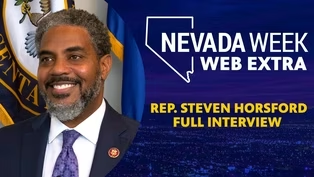
Rep. Steven Horsford, D-NV, Full Interview
Video has Closed Captions
Clip: S4 Ep26 | 11m 56s | The entire interview with Rep. Steven Horsford, D-NV. (11m 56s)
Video has Closed Captions
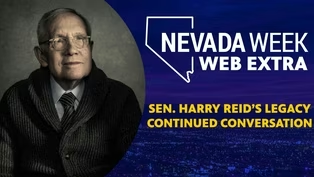
Clip: S4 Ep26 | 5m 21s | The conversation continues with Michael Green and David Damore about Sen. Reid's legacy. (5m 21s)
Providing Support for PBS.org
Learn Moreabout PBS online sponsorship
- News and Public Affairs

Top journalists deliver compelling original analysis of the hour's headlines.

- News and Public Affairs

FRONTLINE is investigative journalism that questions, explains and changes our world.












Support for PBS provided by:
Nevada Week is a local public television program presented by Vegas PBS