Unspun
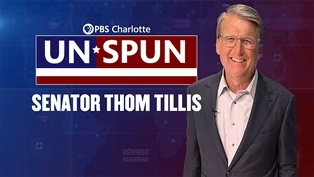
Senator Thom Tillis | Unspun
Season 2 Episode 202 | 27m 26sVideo has Closed Captions
Unspun asks Senator Thom Tillis where NC can grow, compete, and serve people better.
Where does North Carolina have the greatest opportunity to grow, compete, and better serve its people? Tonight, we ask U.S. Senator Thom Tillis, whose experience at both the state and federal levels gives him a unique perspective on legislative priorities. Plus, we break down the top five divisions within the Republican Party and explore the challenges of being an independent thinker in politics.
Problems playing video? | Closed Captioning Feedback
Problems playing video? | Closed Captioning Feedback
Unspun is a local public television program presented by PBS Charlotte
Unspun
Senator Thom Tillis | Unspun
Season 2 Episode 202 | 27m 26sVideo has Closed Captions
Where does North Carolina have the greatest opportunity to grow, compete, and better serve its people? Tonight, we ask U.S. Senator Thom Tillis, whose experience at both the state and federal levels gives him a unique perspective on legislative priorities. Plus, we break down the top five divisions within the Republican Party and explore the challenges of being an independent thinker in politics.
Problems playing video? | Closed Captioning Feedback
How to Watch Unspun
Unspun is available to stream on pbs.org and the free PBS App, available on iPhone, Apple TV, Android TV, Android smartphones, Amazon Fire TV, Amazon Fire Tablet, Roku, Samsung Smart TV, and Vizio.
Providing Support for PBS.org
Learn Moreabout PBS online sponsorship(uplifting music) - [Narrator] This is a production of PBS Charlotte.
(inspiring music) Welcome to "Unspun."
Why is Washington broken?
And where does North Carolina have the greatest opportunity to grow, compete, and better serve its people in the coming year?
Tonight, we'll ask that question to US Senator Thom Tillis.
Tillis has served North Carolina at the state and federal level, and he knows how to get legislation passed in both; that makes him uniquely positioned to discuss what politicians should prioritize next.
Plus, I'll unpack the top five divisions in the Republican Party that politicians won't talk about, but voters need to know, and we'll get real about how hard it is to be an independent thinker in politics.
In today's America, welcome to the spin game.
Believe me, I know.
I'm Pat McCrory.
When I was governor and mayor, I played the spin game.
I was played by the spin game.
But aren't we all done being spun?
Let's take the spin out of the world we're in, here on "Unspun."
Good evening.
I'm Pat McCrory and welcome to "Unspun," the show that tells you what politicians are thinking, but not saying.
North Carolina stands at a political inflection point with an open US Senate seat on the 2026 ballot in a state already being called a battleground.
After voting against President Trump's one big beautiful bill, US Senator Thom Tillis announced he will not seek reelection in 2026.
Tom, appreciate you coming on "Unspun."
First of all, the question and theme of our show is we'll tell you what politics are thinking, but not saying.
What are senators thinking but not saying in DC right now?
And let's start with the Republicans.
- I think they're concerned about the environment next year.
They should be, if for no other reason than the off year election after a presidential election.
But there are other headwinds that they have to take a look at.
Some of that's the healthcare policy that I underscored in the HR1.
You know, it's officially not called the one big beautiful bill that was taken out of the title.
It's called HR1, and it had healthcare provisions that are gonna create headwinds.
And I think we're starting to see the Democrats using that.
So that's probably the best example of things that they're thinking but not saying.
I feel like we need to address it.
I believe that it's fixable between now and then, and we can make it a non-issue, but it means that we've gotta step up and recognize we have the challenge.
- What are the Democrats thinking but not saying?
- I think the Democrats are thinking their party is going crazy, and that the single greatest risk they have to take an advantage of, what should be a negative environment for Republicans is sending people like AOC to Tennessee and Texas to campaign for Democrats, because that liberal progressive far right Mamdani AOC vision is gonna be rejected even more so than some of the challenges that we have with the voters right now.
- So what I get you saying is the Republican senators behind the scenes are going, what are we doing as Republicans?
We better be worried.
And the Democrat people like yourself are going, not Democrats like you, but your democratic peers, they're saying, what are we doing?
- What are we doing?
- They're afraid of primary challenges.
So both actually, both parties right now are worried about primaries.
They're not really worried about generals, and their behavior is just the exact opposite of what their instincts should be.
Their instincts should be, when one party moves too far or too close to their poll, that's the time to move, in our case, to the center right.
Then you own the issues.
But if both parties go to either extreme, then it's a jump ball.
- But the Senate didn't used to be like this.
The House has always been like this, at least for the last, in our lifetime.
- The Senate statewide races.
But now you can almost predict which Senate races are gonna be in play and therefore the logic is they're more worried about their primary.
- Yeah, I think so.
And I also think that, you know, we're talking about races over the last 10 years that have dramatically changed.
Almost all races are nationalized now, and it used to be just a handful, but now with social media and targeting, and all these entrepreneurs out there making money, taking donors' money and not really putting much lead on target, but they're creating messages and they're creating headwinds for candidates that make it very difficult in some cases for them would win a primary.
And it's just the opposite.
You know, you have a primary prone, if you have a member that's at risk of losing a primary in a purple district in this cycle, that's gonna be a real challenge.
I hear a lot of people talking about challenging Republicans for not being purist, and I think that that's at the risk of probably getting an unelectable winner and a primary, we've gotta watch out for that.
That's how waves happen if you take your eye off that ball.
- Well, I was an example when I ran for US Senate, how much a Trump endorsement meant, at least back in 2022.
I mean, and I had no idea I was blindsided by it.
Does the Trump endorsement still scare the Republicans in a possible primary at the Senate level?
- I think at the Senate level it probably does.
Primary, it really, it comes down to turnout.
You know, in North Carolina, since we have open primaries and states that have closed primaries, game, set, match, and states with open primaries, probably a little less so.
- Now, a lot of people have told me, well, Tillis is saying what he wants to say because he is not running for reelection.
I've never seen you do that.
You were speaker of the house when I was mayor and when I was governor.
You've never held back anytime.
And I've always impressed, I've always been impressed by you even when you were mad at me, that you didn't hold back.
- That's always been what's made me laugh about these people.
I ran into somebody at Boone on Sat or Friday and he was saying, you know, I really like, you know, how you've opened up over the last year and a half.
And I had a reporter a year or so back when I was doing some of these bipartisan bills, said, when did you, you know, when did you have this revelation?
He was basically asking how I had this revelation became bipartisan.
I said, you really have not spent a lot of time looking at my record, have you?
Because you, if you had, you would've known my first big bipartisan bill was six months into the state legislature.
So, you know, hey, look, I'm a pretty direct person.
You and I had a couple of disagreements.
I do think I overrode two of your vetoes, but anyway, let's- - Undefeated, been running for office.
- Yeah, yeah.
- You remind me of these often, but I was right and you were wrong.
That's the only difference.
So President Trump has been attacking you lately, and you have voted with President Trump probably 90% of the time, but the five or 10% of the time you haven't.
Tell me about those interactions.
The phone calls and the, from both him and the staff.
Tell me the dynamics about this.
- Well, first, I mean we had to, we had to go back and think about what attacked means.
He may have said I was grandstanding, I never read the TruthSocial.
I think he said I was grandstanding.
If you take a look at things that he's said or names that he has called people, I think it was probably pretty mild.
But probably the most important thing people need to know in North Carolina is President Trump and I have a great relationship, but it's on our terms, each of our terms.
I've communicated with him sometimes two or three times a week.
We talked just last Saturday, we have a good relationship based on mutual respect.
And I have made it very clear to the president that I believe he has a lot of people advising him that are not particularly interested in his legacy.
And I am, he's a Republican president.
I'm a Republican senator, I want him to be successful and I'm not gonna knowingly let bad advice go unchecked.
I'm gonna give him my advice.
He's the president of the United States.
He can make a decision ultimately, but I'm not gonna hold back and make it seem like a good idea is a bad idea if I can look around a corner and try to help 'em out.
- So who's giving 'em bad advice?
You talk about him getting bad advice.
Is that within the White House?
Are there individuals?
- Yeah, there are.
I mean, first and foremost, there are a number of people, Susie Wiles, I'm so glad she's there.
She's a good steady influence.
But there are people that I'll be focusing on in the remaining time that I'm in the Senate to call them out for what I think is bad advice at a place, at a time of my choosing.
But it's just very important for me to make sure that the president's successful to make sure that we get a majority back in the Senate.
- Is it bad advice based upon politic, political hardball on ideology, on sometimes pure politics?
Why the bad advice?
- I don't think, you know, pat, when I was, I was a management consultant for the majority of my career.
I was in management consulting longer than I've been in politics.
Management consulting's all about executing.
So when you have that experience and then you come in and you're a legislator, you're a speaker of the house and you're a senator, and you understand legislating, it just gives you a unique perspective that I try to offer people.
But you got these 30 somethings and 40 somethings that are advising the president, and I really don't believe that they care much about his legacy.
They care about how this wave gets them to the next one as they surf through their career.
And they're the ones that have a problem, with most of the cabinet level picks, save one or two are great, they're doing a good job.
You don't see 'em in the news because they're doing a good job.
But there are people around him that need to be held accountable for decisions that they've made that I believe are having the consequence of headwinds that we can avoid if we just get things right over the next few months.
- Okay, you've got healthcare coming up, which is a total mess.
There's no easy solution.
No.
- I mean, I know this is a governor.
There is no - Obamacare created these problems.
Obamacare created these problems.
We have tried to fix Obamacare, and it has become so ingrained in healthcare coverage for about 25 million people.
We've gotta fix it.
We're not gonna, if we just have a precipitous withdrawal of providing a healthcare solution to people now who have become dependent on policies that they can get off the exchange, I think we're making a mistake.
- Alright.
Real quick, who are the coalition of senators who are come in a room and get over the hump to make this happen?
Because you know, the two extremes won't do it.
Who's gonna come up with a solution?
Or are there four or five senators that will get in the room and go, we gotta pass something?
- Yeah, there are, and I'm a part of that group.
The question is whether or not the Democrats are prepared to do the right thing.
This is a great, this next year in the Senate's gonna gimme an opportunity to see if Democrats are prepared to do what I and a dozen over Republicans have done.
And that's be bipartisan.
They never have been, I've been there for 11 years, I've never seen them walk the plank on a tough issue where they vote with a majority of Republicans, if we're gonna fix healthcare, they're gonna have to demonstrate that they will be bipartisan, they will take the tough vote, and they will get things done.
- And they've got pressures from the left not to compromise.
- And it's not like I didn't have pressure from the left when I did respect for marriage, Bipartisan Safer Communities Act, Bipartisan Infrastructure Bill, Electoral Count Act.
I could go on.
But the point is, all of those were minority Republicans voting with the majority of Democrats.
Now it's time for Democrats to prove that they can be bipartisan.
A dozen or so of us have.
- Alright, the political experts are looking down the road, whether the Senate will turn, whether the house returns.
I don't predict things.
I have no idea.
But will that impact, for example, a Supreme Court justice retiring in anticipation of maybe the Senate, Senate losing, you're on the judicial committee.
Very important committee by the way.
One of the only non-lawyers on that.
I've always been, we need non-lawyers on that committee occasionally.
Do you think you gonna come and play between now and the time you retire from the US Senate?
- Oh, it's very possible we could have a Supreme Court justice retire in this timeframe.
I hope it's just because you're ready to do it and not for a partisan reason, to be honest with you, and I'll give you a good example of why I find just disdain, that sort of decision making.
Judge went on the fourth circuit, announced his retirement until the election results were different, and then he withdrew his retirement.
That is a blatant partisan political act for a supposedly nonpartisan position.
Now- - Some of our, we're seeing that in the House occasionally too.
- Some of our Supreme Court justices are getting up there in age.
So I think that they may, there may be a natural decision to move on, but I don't think it would be based on any sort of predict.
It's the Ruth Ginsburg prediction of the future.
- The Ruth Ginsburg effect may be on the right side of the aisle.
- Could be, could be, could be.
- Are you getting ready for that or are there people preparing for that possibility?
- You can't prepare for that?
That's just like, you've gotta be ready to go into the committee and see all the dynamic at the time.
I'm sure it will be about as rowdy as the other three Supreme Court justices, the Republican Supreme Court justices.
It'll create for, it'll make for good TV.
- All right, the remaining two to three minutes, I wanna talk about the state.
You were Speaker of the House when I was governor.
I loved our partnership even when you were wrong.
I loved our partnership.
I really did.
And we did a lot.
I'm very proud of what we accomplished.
The Senate and House can't get together a budget with the governor.
That's from looking from the outside in, where I think we're the only state who hasn't passed a budget.
What feedback would you give them?
- I think it's dangerous.
You should never have gone out.
I mean, we never, in the four years that I was there, we never went beyond about June without a budget.
We've gotta do the CRs at the state level make no sense.
They're inherently inefficient.
They're actually mimicking bad behavior in Washington.
Don't do that.
Get together, resolve the issues, pass a budget, give North Carolinian certainty.
And you know why?
One of the reasons why we went from the fourth quartile to top four or five by any measure, is that we provided certainty, legislative certainty on taxes, on regulations, and our own spending in our budget.
We need to get that checked off.
- The biggest race in North Carolina this year, maybe not, might not just be the Senate race between most likely Watley and Cooper, but we actually have a primary race in March in Rockingham and Guilford County, Phil Berger, some would say the most powerful person in North Carolina government versus the sheriff, the local sheriff there.
What impact does that have, do you think, on North Carolina politics?
- It's gonna be fascinating.
I think that, I think Senator Berger may have received President Trump's endorsement.
- He called him.
- Sam Page is definitely beloved in that county.
You know, he's a good guy.
He strikes a kind of a Dudley Do-Right image, and he's a good solid conservative.
So it's gonna be an interesting primary to watch.
And you know, I understand, I think the burger campaign, or at least their supporters have already spent millions of dollars before the filing, which suggests to me they consider Sam to be a serious contender.
- What's next for Thom Tillis in a remaining minute?
More after this year?
- More grandkids, more Susan, more family, and more business.
I'm not gonna quit.
I'm gonna go back into business, and probably work another 10 or so years.
But I'm looking forward to actually not having my calendar and everything dictated to me to be able to work where I wanna work, focus on things and continue to play a role in supporting good candidates and targeting bad candidates.
- Well Tom, I wanna personally thank you.
You've been a friend, you've been a colleague, you've been a great public servant, and you've been ethical.
And I'll tell you that's something to be proud of with the time you've been in both state legislature and now the federal government.
And thank you for being on "Unspun" too.
And we wish you the best for the future.
- I enjoyed it.
Let's have a great year.
- [Host] God bless buddy.
(upbeat dramatic music) Alright, tonight on our "Unspun" countdown, the top five divisions within the Republican Party.
Now in a future show, we're gonna talk about the divisions within the Democratic Party.
But tonight, the divisions within the Republican party, starting out with number five.
Number five, of course, MAGA, Make America Great Again.
These are the voters that will vote for Trump no matter what.
The downside of this is, some of those voters don't vote on off year elections when Trump is not on the ballot.
Number four, America first, this is Marjorie Taylor Greene's now new motto, American First, America first.
And these are the Republicans who don't want America involved in any wars overseas.
They're more isolationists and all of a sudden they're mad at some of the MAGA voters for not pushing the America first agenda.
Number three, the Reagan Republicans, the traditional Reagan Lincoln Republicans.
These are what used to be called the Country Club Republicans, but now they're kind of cast as outsiders.
It's very interesting, will they vote for Trump or will they stay home?
Especially during the off year elections in the Senate, North Carolina race.
Number two, the anti-Trump Republicans, they're big time Republicans, but they dislike Trump.
The question for them, will they stay home in future elections?
And number one, straight ticket Republicans, they don't care who's on the ballot, as long as they're Republican, they're gonna vote for the Republican.
(upbeat dramatic music) Alright, time now for "Unspun" one on one.
Andrew Dunn, a journalist turned political strategist, joins me now as our special guest on "Unspun" one-on-one.
- Thanks for having me on.
You know, I enjoyed your top five.
Where do you think you fit in that list?
- Among the top five divisions within the Republican party?
- That's right.
- Probably all five, according to some critics.
But I've probably always been more of a Reagan Republican.
I used to say I was an Eisenhower Republican, which just goes way back.
I was actually a young man when he was president, but I was an Eisenhower Republican because I believed in infrastructure.
- But Reagan had this positive attribute about him that made me change to the Democratic, to the Republican party when I was just outta college moving to Charlotte.
- Yeah, I mean there's certainly been a ton of changes in the Republican party since you've been in elected office.
But I wanted to start with something from Senator Tillis's interview.
You know, in his statement announcing he wouldn't seek reelection, he said quote, it underscores the greatest form of hypocrisy in American politics.
When people see independent thinking on the other side, they cheer.
But when those very same people see independent thinking coming from their side, they scorn, ostracize, and even censure them.
Now, governor, you've plenty experience with that at both the city and the state level, how much truth do you see in what Senator Tillis said and how should leaders navigate that tension between party loyalty and doing what they believe is right?
- Well, Tom's dead on, I call it a purity test.
You know, every party has this.
They ask you 10 questions and if you get one of them wrong, they'll say, you're not a real Democrat or real Republican, and you better not go work the other side.
And yet they tell the public, the general public that I'm gonna go work across the aisle.
But when they get a threat of leadership, either from the president or their congressional leader, what you don't know behind the scenes is you are actually are threatened.
You go, if you go jump to the other side in these congressional negotiations in DC, you'll have a primary or we'll cut all your money off in the future.
So it's almost a quid pro quo threat.
It's a blackmail type of threat that's occurring in politics like we've never seen before.
- So what's harder to do, to battle the opposition party or to take a stand against your own party?
- Well, a lot of it depends whether you're in a safe district or not.
And what's ironic is most congressional people live in a safe district or work in a safe district.
But that's why they're even more afraid of getting hit from either the left or the right in a primary.
It's those people who tend to work across the aisle are the ones in a competitive state or a competitive district in the general election.
But because of gerrymandering in the Congress, you don't have many of those anymore, including right here in North Carolina, and in the Senate, all but one or two races are competitive races, even in the US Senate.
And that's a big change now.
So that dynamic has kind of flipped during the last 20 years.
- I think you had it right when you said divisions in the Republican party.
And I think naturally parties are always gonna have some differences of opinion or even factions.
And I think that can be healthy.
But I think we're at a point now where we have gone to division, that's unhealthy.
How do we get back to, you know, allowing some disagreement within the Republican party?
- Well, I think part of the problem is we also have division in the media.
So people are only listed to their silo.
And therefore it's hard to reach outside the silo of whether it be Fox News or CNN news, because they're talking to the audience that wants that person to represent them.
And so we're actually more politically segregated than ever before, partially due to politicians, but also due to the media and what the viewer wants from the media.
And now social media is segregated all the way due to, what do we call when the social networks?
- Oh, the algorithm, - The algorithms.
- So the algorithms will tell you immediately whether or not you're a conservative or a liberal or a socialist or a communist or whatever.
And they'll only send you information that you want to hear.
And I think that's one of the big things that's causing some of the dilemmas of working together on the hill now or in Raleigh.
- Yeah, I think you're right.
I might add one more division to your list.
Oh, you know, there's political figures who focus on short-term and political figures who focus on the long-term.
How in your career, how did you strike a balance between short-term priorities versus long-term priorities?
- Well, my fault politically was I probably concentrate too much on long term and it cost me the next election.
And the dilemma is, as the dilemma in business right now, people look at the next quarterly report on whether or not you're doing a good job.
Now people are looking at, can you win the next election and can I raise money for the next election?
And that's what it comes down to is raising money.
So a lot of people are thinking short term battles will raise me money, especially on controversial issues, because it'll get you on TV more.
And you see that with Marjorie Taylor Greene, you see that Donald Trump, you see that with AOC.
Both parties now know how to get on TV.
And usually you're not talking about a long-term problem, you're talking about a short-term controversial issue in politics.
- Yeah.
We've just got about a minute left.
I wanted to ask you, you know, governor Jim Martin just had his 90th birthday.
I believe you've talked with him recently.
- I went to his party.
- Yeah.
How was that and what have you learned from Governor Martin, how he's dealt with all these issues?
- You know, first of all, I thought, I think he was the smartest president, smartest governor we've ever had.
And the smart thing that he did that I didn't do is when he was governor, he picked three battles and focused on education, transportation, economic development.
That was it.
Anything else he wouldn't talk about.
I didn't do that.
I picked more than three battles.
And I really credit Governor Martin for doing a great deal for Mecklenburg County as a county commissioner, being a US congressman and being a great governor, and happy birthday to Jim Martin.
- That's right, Happy Birthday.
- And thank you very much for being our guest journalist today on "Unspun."
- Yeah, thanks for having me.
- Thank you very much.
(upbeat dramatic music) You know, one would think that the most impactful primary race this year would be for the US Senate in March now that Thom Tillis is not running for reelection.
Well, it's not.
The most important primary election in North Carolina is for a state senate seat in Rockingham and Guilford counties.
The seat is currently held by Republican Phil Berger, the president of the Senate.
And without question, the most powerful politician in North Carolina during the past 15 years.
The Senate president isn't just another legislature, he's the traffic cop for every major bill, budget and policy decision in the state.
A challenge to that role is a challenge to the system itself.
His opponent, popular Republican Sheriff Sam Page, who argues that Phil has lost touch with his constituents back home in Rockingham County.
Page points to Berger's push for a gambling casino in Rockingham County despite overwhelming opposition from local residents.
Berger has already spent over $1 million on negative campaign ads against the sheriff, and they've landed with all the impact of a damp firecracker.
But now, President Trump has endorsed Phil Berger, the President has endorsed a state senate candidate despite also saying that Sheriff Sam Page is a great guy.
And in classic Trump fashion, he's trying to have it both ways, even dangling a job in Washington if Sam will just step aside.
The sheriff is not backing down, so what's really going on here?
Is the President rewarding Berger for engineering an additional Republican congressional seat, you think?
Yep.
The answer is yes.
This is hardball politics and not in a governor's race, not in a congressional race, not in a Senate race, but over a single state senate seat.
We've never seen anything quite like this in North Carolina, because if Phil Berger loses, the entire power structure in Raleigh shifts overnight, budget priorities, legislative strategy, and political alliances all get rewritten.
And if you're wondering what that says about the year ahead, buckle up.
Well, that's the truth as I see it.
I'm Pat McCrory and thanks for watching "Unspun."
(uplifting music) - [Narrator] A production of PBS Charlotte.
Senator Thom Tillis Preview | Unspun
Preview: S2 Ep202 | 30s | Unspun asks Senator Thom Tillis where NC can grow, compete, and serve people better. (30s)
Providing Support for PBS.org
Learn Moreabout PBS online sponsorship
- News and Public Affairs

Top journalists deliver compelling original analysis of the hour's headlines.

- News and Public Affairs

FRONTLINE is investigative journalism that questions, explains and changes our world.












Support for PBS provided by:
Unspun is a local public television program presented by PBS Charlotte