
Senior Stories & Superintendent’s Student Advisory Council
Season 2 Episode 9 | 26m 46sVideo has Closed Captions
Meet a Legacy HS Senior with heart & students who help advise the Superintendent
Meet a Legacy HS Senior who got a second chance at life. Then, sit in on the Superintendent’s Student Advisory Council to learn how high schoolers provide valuable input to the Superintendent and staff. The Vegas PBS Media Crew reports on Hope Squad and dual credit programs. And a one-on-one interview with new District D School Board Trustee Brenda Zamora by a student in her district!
Problems playing video? | Closed Captioning Feedback
Problems playing video? | Closed Captioning Feedback
Student Spotlight is a local public television program presented by Vegas PBS
Senior Stories & Superintendent’s Student Advisory Council
Season 2 Episode 9 | 26m 46sVideo has Closed Captions
Meet a Legacy HS Senior who got a second chance at life. Then, sit in on the Superintendent’s Student Advisory Council to learn how high schoolers provide valuable input to the Superintendent and staff. The Vegas PBS Media Crew reports on Hope Squad and dual credit programs. And a one-on-one interview with new District D School Board Trustee Brenda Zamora by a student in her district!
Problems playing video? | Closed Captioning Feedback
How to Watch Student Spotlight
Student Spotlight is available to stream on pbs.org and the free PBS App, available on iPhone, Apple TV, Android TV, Android smartphones, Amazon Fire TV, Amazon Fire Tablet, Roku, Samsung Smart TV, and Vizio.
Providing Support for PBS.org
Learn Moreabout PBS online sponsorshipThis program brought to you in part by the Erika Lewis Endowment Fund.
♪♪♪ CCSD is the fifth largest school district in the nation, with student success as its number one goal.
Join us as we meet student go-getters and goal setters and discover their skills, talents, and drive.
Plus meet the incredible staff who are helping students shine.
It's all here in Student Spotlight.
-Hi, everyone, and thank you so much for joining us for this edition of Student Spotlight.
I'm Maria Silva.
Thanks for joining us.
We have a lot to share with you in the next half hour.
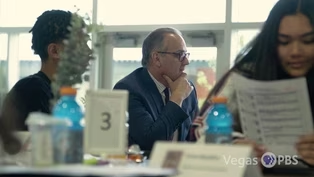
These high school students from across the district are some of the Superintendent's most valuable advisors.
(Kelechi Odunze) They really take our feedback to heart, and that is something that's actually important to them.
-Learn more about this council and how their input makes a difference.
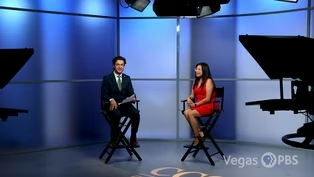
Plus a one-on-one interview with a new school board trustee, Brenda Zamora... -Hello, Trustee Zamora.
Thank you for talking with us.
- ...by a student in her very own district.
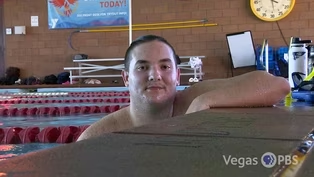
But first, meet a Legacy High School senior who started high school with a new heart.
Now he is about to graduate happy, healthy, and grateful for his second chance.
(Cameron Durieux) I'm a proud coach, that's for sure.
He's a great guy.
-The Legacy High School Boys Head Swim Coach, Cameron Durieux, has coached a lot of athletes... [cheering] - ...but few have the heart of senior Osker Gamboa.
-Osker has such a gentle heart.
He's the guy that-- Everybody tries to strive to be like Osker, wants to be Osker's friend.
And he's the guy that everybody loves.
-Osker's mom, Kim Blas.
(Kim Blas) To see him in the pool and swimming is incredible.
-That's because after years with a bad cough and thinking he had asthma, Osker was diagnosed with a congenital heart defect.
(Osker Gamboa) What I had was called hypertrophic cardiomyopathy.
And so essentially, your muscle fibers are kinda supposed to look like this so it can pump blood throughout the body very easily.
Well, hypertrophic cardiomyopathy is, it makes those fibers all tangled up.
So essentially, it stresses the heart a lot.
-And in April of 2017, Osker got a new heart.
-I mean, the gift of life is amazing.
It truly is.
I can't be thankful enough for the donor I received the heart from.
(Christina Hernandez) When you get to see people like Osker and see what that second chance has given to him and what his family is now, his parents get to see him get his diploma on graduation.
There's so many more memories that are going to be made.
-Now, not only is Osker swimming, he was named team captain.
-I mean, when I found out I was like, I'm so proud of you!
Then I went to the closet and cried for a bit.
It was like, it's just, it's a huge thing.
-He is a leader in the pool and in life.
-He's the one that comes out and says, Hey, Coach, do you need flyers put up?
Yes, let's go get more swimmers.
Coach, do you need something for practice?
And yeah, okay, I'll need a Gatorade.
What do you got?
Whatever it is, he's always willing to help out.
-Osker is looking forward to what comes next.
-And I think at the end of the day when I walk across that stage, I'm gonna be extremely proud of myself, knowing that, you know, I did it and I'm here.
I can move on to the next chapter in my life.
-He just has such a positive outlook on life.
He knows that if you may not be able to do it today, you can do it tomorrow or maybe the next day.
He's really, he's really my hero.
-Congratulations, Osker, on all of your success.
As for what comes next, Osker wants to become a pediatric nurse so he can help kids who face similar medical challenges.
Osker, you are definitely an inspiration.
Congratulations and good luck.
Well, they give advice to the Superintendent and other district leaders on policies, problems, and possible solutions.
The Superintendent's Student Advisory Council is made up of high school students from across the Clark County School District.
They meet once a month, and their input is invaluable.
(Jesus Jara) You guys are my customers, right?
We work for you.
(Isabella Cordoba) So the Student Advisory Council, we assist the Superintendent with, like, kind of understanding who students are and what our perspectives are on school policies.
-The Council is a way for students like me to help share the viewpoints and opinions of our peers to members of our district so they can help fix problems that students like me may see at our schools.
(Alexis Morada) Something that we all shared in common was chronic absenteeism.
And essentially, we are trying to figure out what is causing that problem.
How can we make change in order to help solve that problem in a way?
(Econia Mandefero) And we figured that there wasn't just one reason.
Obviously, things like mental health go into it.
- I want your input.
Because I wanted to empower them to say, Well, what's in the school system?
You've been here 11 years, 12 years.
Tell me what needs to change, right?
Coming out of COVID, to me, was really important to hear their voice.
And we've empowered them to come in and say, What problem are we going to fix?
And get their voice to then help me address the challenge.
-I definitely think it's important for us to have a voice just because it's hard for like adults, I guess, to understand what we go through.
Although they were us at one point, it's just that we go through things that are hard to kind of understand as like the times change.
So when they, when a policy is implemented or something new happens in the district, they don't understand fully how that has impacted us.
-CCSD is doing a better job of having, like, resources and wraparound services that we can use, but not enough students know about them.
So what we do is come together, discuss, then try to take ideas to our schools so that we can share what we learn here and talk about things that other students might not know.
-It's a huge privilege.
And it's an honor to be able to be a part of, like, this council and just take back all this information and be able to be a voice for my peers.
-He listens to us tell him what we think should be changed around the district.
-I think it's really important for students to voice their opinion and also, like, empower student voice in general.
-I'm excited that they're feeling empowered, because that was my goal.
-Members of this year's Superintendent's Student Advisory Council will share some of their feedback about chronic absenteeism with trustees at an upcoming school board meeting.
Now let's head to Gilbert Academy of Creative Arts for our first "News Break."
-Hi.
I'm Miguel from Gilbert Academy of the Creative Arts.
-And I'm Mackenzie, here with your first "News Break."
-A few weeks ago, CCSD students were part of the largest student-run farmers market in the United States.
The giant student farmers market was at Downtown Summerlin and was hosted by the nonprofit Green Our Plant.
Students from the market, selling fruits, veggies, and herbs grown in their school gardens.
(Ayreli) Well, you can see that we're selling vegetables and stuff.
We're also selling stuff like bee homes so then they could put, like, their honey inside of the bee homes.
And we're also selling for the hummingbirds so they can eat and you could get them so full.
So yeah, that's mostly what we sell.
-All the money earned will be reinvested back into school garden programs.
-Are you looking for something to do this summer?
The school district is offering opportunities at every single school!
That's pre-K to high school, and there are different programs available.
To learn more about all of the summer learning options, visit ccsd.net or check with your school.
-That's it for now.
Some of our classmates will appear later for more about our school.
-Now let's take it back to the PBS studio and Maria.
-Thank you, Miguel and Mackenzie!
Now let's toss it over to Adam from the Vegas PBS Media Crew, a crew of former and current CCSD students who produce special content just for teens.
Hi, Adam!
-Hi, Maria.
Mental health is on the minds of many students in the Clark County School District.
Ezekiel at Sierra Vista High School asked to feature the Hope Squad at his school so we could learn more about this peer-to-peer program.
(Ezekiel) What is Hope Squad?
(Jade) So Hope Squad is a peer-to-peer suicide intervention group, and it helps to reduce the stigma behind mental health and help promote healthy conversation among youth and our peers.
-How does Hope Squad work exactly?
(Shayna Segal) So Hope Squad is completely student based.
It's peer to peer.
Trusted students are voted by their peers, and then we go through and we vet the kids and we figure out who might be a good fit and who is, you know, dedicated to promoting positive mental health and breaking the stigma.
-So I was nominated as somebody that if someone were to have a mental health crisis, they would feel comfortable coming to me to talk to me about it.
And then I'm then trained on how to handle such a situation if I am ever having to deal with it.
-How is Hope Squad's approach different from other approaches?
-So the thing that I really love about Hope Squad is that it kind of takes the focus away from the school counselors or the adults being the ones that are completely trustworthy and shifting it to the kids.
And I feel like kids are more likely to talk to other kids if they're struggling.
-How has Hope Squad benefited students?
-I think that Hope Squad has benefited students because, on our campus, they know that they have people to go to.
We wear our shirts every Thursday so they know who the members are inside of Hope Squad, the students and the adults that are there.
They know that we're trained, and they're able to come to us easily.
-And another thing that Hope Squad focuses on is not just the students that are struggling, but also different social emotional skills and overall connectedness of the school community.
And I think mental health affects all of us, and we can find a common ground.
And so I felt like this was the best way to do that.
-Any final thoughts you want to give on about Hope Squad?
-A final thought I have is that I think this program is a really good start here.
We just started this year, and we're going to grow and we're going to progress all throughout Vista.
I want it in more schools.
It is a really good program for peers, and it helps to promote a lot of healthy things.
-If we can get this in every school around Nevada, we can start training our kids to talk about this early on.
As we move forward and as we make it a bigger program, it's going to continue to just bring everybody together and really help to reduce suicide and suicide attempts not only at Vista, but around the valley.
-Thank you, Ezekiel.
Great interviews!
Foothill High School is one of a number of CCSD high schools with dual credit programs.
That means students can earn college credit while still in high school.
As Christen learned at Foothill, students can earn credits from the University of Nevada Reno.
(Christen) Tell me a little about the dual credit program we have here at Foothill.
(Jonathan) We were the first school in Henderson to offer dual credit through the UNR partnership.
We find that students, they maybe don't need an associate's degree when they graduate high school.
But what they do need is they need to get those first-level classes out of the way so that when they get into college, they will have the opportunity to get through in four years.
(Franki) I'm learning more than I would in a regular class just because I feel like the assignments are more, you know, fulfilling and challenging.
(Ava) It's a great way to get ahead in the college experience, if you are planning on going to UNR.
-Do you plan on going to college?
(Anikka) I do plan on going to college.
You know, that's something that I've been looking forward to in the future.
So these credits that I'll have really help me out that I'll have to take less in college.
-Every student should at least take one dual credit, if not more, because you never know.
You never know where your path's gonna lie up.
And just to know you have some college credits is going to be very beneficial.
-Thanks, Christen.
We'll be back later with our segment "In Our Opinion," where we'll talk to seniors at Mojave about what's next after graduation.
But for now, back to you, Maria.
-Thank you, Adam.
Well, last month, you met Trustee Irene Bustamante Adams, one of two new School Board Trustees for the Clark County School District.
Now meet District D Trustee Brenda Zamora.
Eldorado High School Student Luke helped us with this interview.
Take it away, Luke.
-Hello, Trustee Zamora.
Thank you for talking with us.
Would you like to tell us a bit about yourself and your dream becoming a trustee?
(Brenda Zamora) Thank you.
Thank you for having me.
It's been a long journey.
It's been a very interesting journey, and that's actually a really big question for me.
I am a mother.
I have an IEP student who is in 4th grade right now.
And I have done a lot of work in my community.
And I've done a lot of education in my community.
And for so many years, I actually spent a lot of time educating my community on the importance of getting involved and getting politically involved.
And I actually spent a few years doing education on local elections, right, and how important our local elections really matter, because they affect our day-to-day life.
So then I got involved in, you know, what was happening in the district as a whole because of the pandemic.
The pandemic was really hard on my family.
My daughter is visually impaired.
So she has issues, you know, just staying on track, doing work through a Chromebook.
And it was very difficult.
And through my day-to-day job, we actually did a lot of phone calls, talking to community members and asking if they were okay, what do they need.
And there was just a big gap between the community and the district on how they can, you know, get through this pandemic.
And even though there was no plans, I completely understood that, but there was miscommunication most of the times, too.
So I started getting involved, trying to bring those voices to the school board.
And I would show up, do public comment, I would share a story about, you know, a community member who was struggling with the WiFi buses, and just to bring different perspectives to our members at that time.
And the opportunity came up that there was going to be a seat, and I decided to just try it out.
And I took a leap of faith, and I did it.
And we're here now, and it's been an adventure for sure.
-That's amazing.
Thank you.
What would you say are the three biggest issues in CCSD and that you hope to tackle during your time in office?
-ooh.
One of the big ones is communication.
I do a lot of communications work in my day-to-day, and I always talk about needing to meet people where they are.
And my community, which is District D, which is majority of the east side, are very heavy Spanish speaking community.
So I am trying to push and making sure and amplifying when we do that we do have resources in Spanish.
If our community needs some help and needs support, the district does provide that, and just building that bridge between, you know, our community and the district.
The second thing that I want to focus on is figuring out how we retain our teachers and how we can keep them.
The teachers are so crucial to our life.
I wanted to be a teacher when I was growing up.
I went to Nevada State, everything.
But a big thing that I noticed was just the pay.
It wasn't worth it at that time, and that was years ago and we're still in that same cycle.
We're not paying our teachers enough.
So how can we work together and figure out and pass policies that will benefit our teachers to stay?
Our third, my third issue, ooh, that's a big one.
I would say probably resources.
I think we need to be building community partnerships with people who are out there already doing the work, how we can just become also like a resource hub.
I would love to see that, where we can just guide people.
I'm a true believer that we don't have to reinvent the wheel.
People are already out there doing the work.
So it's just how do we also maneuver and funnel all that information to our community?
-Thank you.
Having two parents working, CCCS teachers, that means a lot to me, too, seeing you want to combat those issues.
What would you say is the role of a trustee in improving morale and atmosphere within their district?
-What we need to do and need to focus on is working together, really coming to the table and focusing on the issues and having those conversations, those real conversations that we have.
-Thank you.
And lastly, what can staff and students in District D do to help you achieve your goals?
How can we help partner with you?
-Reach out to me.
I-- This has been, you know, fun few months where I'm meeting new people, meeting new teachers.
There's so many great things happening in the district that sometimes I don't, I don't see on a daily basis.
But I appreciate when teachers reach out.
They send me fliers for events happening or they send me updates of what they're doing in their school.
I really appreciate when admin includes us in those, you know, invitations.
Yes, reach out.
Call me.
-Thank you.
And back to you guys.
-Thank you, Luke and Trustees Zamora.
You can learn more about all the members of the CCSD Board of Trustees on ccsd.net.
Now let's head back to Gilbert Academy of Creative Arts for our second "News Break."
-Hi.
I'm Valentina from Gilbert Academy of Creative Arts.
-And I'm Taleah.
We're back with your second "News Break."
And this is all about our school.
-We're at our TV studio located in the theater.
-That's because we're part of Gilbert's Super 6 News Crew.
-Our newscast airs daily.
-Behind the scenes, teachers write the scripts.
-And a crew of students run the tech side of things.
-Like the teleprompter, sound, switcher, and floor manager.
-Our student reporters focus on different segments.
-Like lunch and weather.
-Along with other reports where we focus on school events.
-Famous birthdays.
-Silly holidays.
-Moments in history.
-And themes.
-Like music, art, drama and movement.
-Super 6 News is streaming live to every classroom daily.
-We are a magnet school for the performing and creative arts.
-Our students learn much of their curriculum through arts integration and art strategies.
-We have a ton of cool programs like African, ballet, and modern dance.
-An instrument ensemble.
-Choir.
-Drum team.
-And matinees.
-Thanks for visiting our school.
-Now let's send it back to Maria in the Vegas PBS studios.
-Peace out!
-Thank you, Valentina and Taleah.
Next, we want to take you to Spring Valley High School for a class that encourages global awareness.
Students at Spring Valley can take an elective class called Model United Nations, or "MUN."
Students become delegates from different countries and engage in debates on global issues.
MUN develops research skills, critical thinking, public speaking skills, self-confidence and fosters leadership and teamwork.
(Kellinee Barber) A lot of the Model UN groups in Las Vegas, they have to meet after school or on weekends.
And because of our administration's support, we've been able to keep it as an elective.
And it's growing.
It was really big, and then COVID happened.
And then-- but it's growing quickly again.
So we're really excited about that.
(Angelina Rivera) Even though I gave speeches when I was younger when I was running for student body government or like club positions and things like that, it's really a whole different ballgame to have to talk about things that aren't yourself, like politics and other people and have people's lives like, you know, in your hands almost.
And then to do that in front of people from other cities even, and other schools, and to just know that they're also very experienced and know what they're talking about as well.
-So cool!
You can learn more on weare.ccsd.net.
And that's a wrap for Season 2 of Student Spotlight.
A reminder that you can watch this episode and past episodes on the Vegas PBS website.
Thank you at home for letting us share all of the great things happening here in the Clark County School District.
And please stay tuned for "In Our Opinion" from the Vegas PBS Media Crew.
Big congratulations to all of the graduating seniors, Class of 2023!
Have a wonderful summer, everyone!
We will be back in the fall.
[shutter sound] ♪♪♪ (Dr. Lisa Louw) We're always asking students, What do you want to do when you leave here?
So what we want to plan is that-- or what we're hoping is that every student will have a plan.
You know, not just, Great, it's been great having you for four years.
But, What is your plan?
Where are you going next?
(Joseph) What are you going to do after high school, Alan?
What is your plan within the next year or so?
(Alan) Me personally, I want to follow my sister's footsteps.
She actually is the one that influenced me to go into sports medicine.
(Sianna) I feel more connected to Medical Assisting because they work with helping people, making them feel better.
(Omarian) Ever since middle school, I wanted to be like my dad.
My dad was cooking when he was working at the Strip.
(Zinnia) Since I was little, I was fascinated by bones and muscles.
So medical was always the plan.
(Jolina) I'm still unsure what I want to do.
So I know it's something in the medical field.
(Valerie) To go into the National Guard part time and going to CSN for my prereqs.
(EJ) Oh, nice.
-I want to be a cardiologist, pharmacist.
(Maria) I'm going to CSN once I graduate, and I'm going to get my bachelor's degree for criminal justice.
(Isabella) I'm going to CSN for just like health sciences and getting all my gen eds there.
(Raksmey) I plan on getting an either computer science degree or cybersecurity.
(Gian) I would like to hopefully move on to medical school in the future and hopefully become a physician, doctor, or some professional in the medical field one day.
(Auleilani) I'm at a crossroads where if I want to just jump into the industry head-on or if I want to further my education for culinary?
-How long have you wanted a trade college?
How long has that been a goal for you?
-Since last year, actually, because I thought about it more clearly.
I was like, Okay, let's do something that I'm interested in.
And criminal justice might get me to the police force.
-I think I'm prepared for the challenge.
I'm willing to dedicate a large portion of my 20s, you know, my prime, to just doing what I love, this passion for helping others through medicine.
-We feel that there's a stigma or like a social sort of expectation for a lot of students to figure out a career or a path or go to college right away right out the door.
-Absolutely.
I think that-- And I think that really was a big push back 10 years ago, 15 years ago, 20 years ago, because every student was expected go to college.
You know, it wasn't about going into trade or going into military.
Now, students did, but it was always a push to go just one direction.
-I know I want to be in the medical field.
It's just like, I'm, I'm so unsure on what, where in the medical field I should be.
-Do I really enjoy being in the clinic?
Hey, do I really want to do something similar to this for the rest of my life?
And after experiencing it for almost an entire school year, meeting quarterbacks, soccer players, volley ball players, seeing a number of different injuries, I'm really interested in joining it for the rest of my career.
It's something I really want to do.
-If I head into the field immediately, then I will be getting faster experience.
If I go to a college, I'd be able to learn more, but then I'm setting myself back.
-But I think having a plan is what's important, because you don't want to go into the world and not know exactly what you're doing.
-You don't need to know where you need to go, but as long as you have like a little small plan and maybe that could like, branch off.
-Me personally, I don't think college is super important.
Well, once again, I've seen a lot of people be successful without going to college.
I do personally think that my dad is the most successful in our family, and he didn't even graduate high school.
-Well, you can do what you love without having to suffer financially or in terms of your career as well.
-If you have any interests, definitely pursue them.
Don't let that go and say, Oh, I wish I did that, or I wish I could have done that.
There are endless opportunities as long as you take them.
-Think of what you want to do.
Because, you know, you always have time.
Don't let anyone tell you that, Oh, you got to pick specific major or whatever you want to do because you don't have time.
That's wrong.
-It's not a rush.
Everyone changes their mind.
So just focus on you, and take your time figuring out what you want to do.
-Thank you everyone at Mojave High School for sharing your thoughts.
Now let's toss to the satellite crew to see what students at their school had to say.
(Dominick) So you're a senior.
It's your last year.
What are your plans after high school?
(Athanasios) I actually have no clue, so-- [laughter] I haven't really had any like, dreams ever since I was younger.
I always decided my goal would be try out new things and see whether I like them.
(Maddy) Because a lot of people can pursue different careers that doesn't involve college.
-Like in the United States, college is very expensive.
Some people don't have the money.
(Bella) I think the amount of effort you put into whatever you do, whether it's academic or not, is what's going to, I guess, determine your level of success.
(Ryan) As you continue to grow and learn, you will eventually find out what you really like doing.
(Joshua) As long as you can find a fit, do something at whatever college you do.
Or even if you don't go to college, whatever you do after high school, then you can still be successful and find out what you want to do.
(Leslie) If you know what you want to do, go for it.
(Giovanni) So instead of thinking about doing it, just do it no matter what it is.
[shutter sound] ♪♪♪
Eldorado HS student interviews Trustee Brenda Zamora
Video has Closed Captions
Clip: S2 Ep9 | 5m 4s | Eldorado HS student Luke Ostler learns more about the new trustee representing District D. (5m 4s)
Meet a Legacy HS student who got a second chance at life
Video has Closed Captions
Clip: S2 Ep9 | 2m 56s | Learn why Senior Osker Gamboa has such an incredible heart. (2m 56s)
Meet the Superintendent’s Student Advisory Council
Video has Closed Captions
Clip: S2 Ep9 | 2m 45s | Hear from the high schoolers that help advise Dr. Jesus F. Jara and district staff. (2m 45s)
Providing Support for PBS.org
Learn Moreabout PBS online sponsorship












Support for PBS provided by:
Student Spotlight is a local public television program presented by Vegas PBS