
Sept. 15, 2023 - Patrick Anderson | OFF THE RECORD
Season 53 Episode 11 | 27m 45sVideo has Closed Captions
Latest on the auto strike. Guest: Anderson Economic Group CEO Patrick Anderson
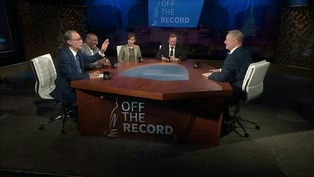
The panel discusses the impact of the auto strike on Michigan. The guest is the CEO of Anderson Economic Group Patrick Anderson. Panelists Chuck Stokes, Jordyn Hermani, and Craig Mauger join senior capitol correspondent Tim Skubick to discuss the week in Michigan government and politics.
Problems playing video? | Closed Captioning Feedback
Problems playing video? | Closed Captioning Feedback
Off the Record is a local public television program presented by WKAR
Support for Off the Record is provided by Bellwether Public Relations.
Sept. 15, 2023 - Patrick Anderson | OFF THE RECORD
Season 53 Episode 11 | 27m 45sVideo has Closed Captions
The panel discusses the impact of the auto strike on Michigan. The guest is the CEO of Anderson Economic Group Patrick Anderson. Panelists Chuck Stokes, Jordyn Hermani, and Craig Mauger join senior capitol correspondent Tim Skubick to discuss the week in Michigan government and politics.
Problems playing video? | Closed Captioning Feedback
How to Watch Off the Record
Off the Record is available to stream on pbs.org and the free PBS App, available on iPhone, Apple TV, Android TV, Android smartphones, Amazon Fire TV, Amazon Fire Tablet, Roku, Samsung Smart TV, and Vizio.
Providing Support for PBS.org
Learn Moreabout PBS online sponsorshipWelcome back with the auto strike on Patrick Anderson is here to discuss the impact on Michigan government on the panel, Chuck Stokes, Jordyn Hermani, and Craig Mauger discuss that lead story so that with us as we get the inside out off the record.
Production of off the record is made possible in part by Martin Waymire, a full service strategic communications agency partnering with clients through public relations, digital marketing and public policy engagement.
Learn more at Martin Waymire dot com.
And now this edition of Off the Record with Tim Skubick.
Thanks very much.
Welcome two off the record as we take a look at the auto strike.
We've not been here for a while.
Jordyn, what's your take?
Well, so we have a strike on our hands, but not as big of a strike as we could have.
Potentially the big three are for the first time and the UAW is 80 years.
They're striking all three at once, but they're striking them in controlled small strike instances.
So we have one strike in Michigan, one strike in Ohio, and a third strike in Missouri.
The thought being that if they can do these targeted, smaller, controlled strikes, they can strike for longer and they can potentially wear the big three down into getting the demands that they're looking for, which is ultimately better wages, a shorter workweek, pensions back, and a litany of things that are on the UAW demand list.
Yeah, if you're a bean counter in the governor's office, you're going, let's see, 3300 employees is not as much as 100,000 being out.
Well, that's absolutely true.
And the governor, I'm sure, along with so many other leaders, are cautiously watching this.
But in her statement, I thought was very carefully worded in which it wasn't taking a side either way necessarily, which was probably the smart thing to do at this particular juncture.
The real test is going to be how long does this go on?
Everybody's posturing at this point.
You get, you know, certain politicians out on the line with them today showing that they have the support.
But if this gets passed, a couple weeks, then that's when the real money crunch starts coming in.
And then we'll see.
Does John Thain end up out of this whole thing looking like a Westminster show dog or does he look like the backyard skunk?
And he's talking a lot.
We'll have to see.
He appears to have his rank and file with him at this particular juncture.
But time is going to test this one.
Watching all this happens, happen.
It just seems like the political world is not ready for the potential implications of what's ahead.
You read some of the statements that are very neutral and then you listen to the UAW, you listen to Shawn fan, and you hear what he says.
He says This is going to be a defining moment in history.
This is not just about these auto factories for the UAW.
This is about changing the dynamics between workers and the people that run these companies, the shareholders who invest in these companies, and the ripple effects that could pour out across the entire economy if other unions start seeing what the UAW has done and say, we're going to do that, too, because it might work for them.
This could affect every industry.
This could reach well beyond autos.
And it's going to be fascinating to watch.
Bernie Sanders is coming into Michigan later today, on Friday.
What does he say?
What's the message?
And I don't think it's going to be just about autos.
Well, I'm going to guess his words will not be quite as measured as the governor's knowing, though certainly.
Not by any stretch of.
This one.
And hit a home run, right?
Yeah, totally.
And then you also have this idea that's looming over all of this.
It's not just about this battle between the people who work the factory jobs and the people that run the factories.
It's about the transition to electric vehicles.
And these are two things.
How do you resolve this in just a couple of weeks?
How does the auto industry transition to electric vehicles in a way that protects all the jobs and protects the workers?
Can that be done?
If you listen to Donald Trump right now, he's saying that can't be done.
You listen to some of the Democratic leaders like Governor Whitmer.
They're encouraging this transition, but they're not addressing what could be lying ahead for the average auto worker here.
And you can physically see the stark contrast.
All of this is happening as the International Detroit Auto Show is opening up downtown and if you walk into that show, as I did yesterday, you look out on the showroom floor, Ivy is everywhere and that's the future.
And if you listen to the automakers, they say that's what we're competing with worldwide.
That's where we have to go.
Can't be as dependent as we have been on these gas guzzling cars and trucks.
And then you look out on the street and you see the autoworkers say, yeah, but you got to get there through us, the workers, and you're going too fast, too soon, and we're not being protected in that process.
Well, that's the problem for the autoworkers that are working on these bad roads are not unionized.
They are in southern states.
And so part of the negotiation is to try to get them under the tent, which may be a tough sell because the carmakers say we have to be competitive with Tesla, who owns this market.
So far, 60% of the market.
So that's a challenge.
It absolutely is.
But I mean, like Chuck just said, I mean, you cannot get to point B unless you first solidify a point.
So the workers have, you know, a decent case to be made on their hands.
If you want to be able to compete in this market, pay us give us a fair workweek, give us back pensions or the like.
So it's it's going to remain to be seen what happens here.
These small strikes, though, they're going to enable them to continue striking longer, harder, you know, and we'll see whether or not that actually does end up making a dent in the big three's pockets and make them listen.
And they gave up the workers gave up an awful lot in 2007, twice when they when the auto industry was on its knees.
And now the auto industry is doing well.
They want to say, don't forget the sacrifices we made.
It's time for you all to pay up.
Well, the other part of the equation here is the the unions are looking at the profit margins that the cars and car companies are doing pretty well.
Yeah, they are.
And I think just to talk about how big this could be and kind of the issue that you're bringing up here, what else happened this week?
Quietly, much more quietly than the UAW in the auto industry.
You had blue Cross Blue Shield workers in Michigan go on strike, too, over a lot of similar issues.
How wide is this going to get?
And you're not hearing the Democratic leaders, they are putting out statements saying they have the majorities right now in Michigan and they're putting out statements saying, hey, we stand with the workers.
Well, how far does that go?
How far are they willing to stand with the workers if this goes on for a month?
If the suppliers start laying off workers and a large not in large numbers at their plants, how are the Democrats going to respond to this?
This is quickly emerging as the biggest political issue to shape 2024.
Well, let's let's bounce off of that, because what are the political implications?
How does the voting public look at a union which has the potential to shut down the economy or make a big dent in it?
How does that play out long term, do you think?
I think it's going to be fascinating to watch and I don't have the answer.
You can see, though, the Sean Frame thing is framing this entire thing about this is not just about the UAW in auto plants.
This is about the relationship between the workers and the people that run the plants.
And that that is a way of framing it, that it impacts everyone.
Everyone can relate to what he's talking about right now.
Now, if this goes on for months and there are layoffs and the economy starts tanking, will people still sympathize with that?
I don't know.
If I think Craig has framed it.
Absolutely right.
One thing that's working for Sean Fain in the UAW, workers on their side right now with the average person is the cost of these vehicles.
If you walk in the showroom right now, the price to buy these cars is.
Most people feel it's ridiculous.
Well, how do you wish?
That's the.
Point.
So the public is not sympathetic from that standpoint.
They're like, we want to buy new cars, but we're not going to buy them at these rates.
Yes, it's.
With the electric vehicles, too.
I mean, specifically with this, when you're talking about the government of Michigan giving away hundreds of millions of dollars to build these plants for electric vehicles, and electric vehicles are not accessible to the wide majority of people in the state.
I mean, they don't feel financially they can upgrade the power in their house and then buy the vehicle.
It's a conversation that you just wonder how the average voter relates to this.
And someone who is often with their finger on the pulse of the average voter is Donald Trump.
And what is he saying over and over again?
The electric vehicles are going to kill the auto manufacturing in this state.
All right.
So we're looking at the political implications of that.
Let's look at the political implication of this story on campus with the Mel Tucker story.
What's been the official or kind of temperature in the legislature, governor's office in response to this story?
Well, Whitmer herself has put out a statement saying that the allegations have shock and disgust.
But, you know, other than that, it's been pretty muted.
It's been the legislature has largely stayed out of it.
You've seen some local politicians who represent parts of MSU start to chime out and say one thing or another regarding the Title nine investigation.
But so far it's been pretty muted and it's been pretty just relative to Matthew's campus.
You had Senator Sam Singh, who is from the East Lansing area, give the possibility of hearings into this for Chuck.
What's what's been the reaction politically?
I think the reaction has been, well, first of all, it's absolutely national coverage.
Every major media organization has been reporting this.
So it is not look good from that standpoint and is not a position that Michigan State University wants to be in.
After all of the Larry Nassar stuff in the history of there in this area, clearly I think people have said regardless of what he said and what she said, and there's certainly disagreement about who did what.
It's been poor judgment on the part of Bill Tucker.
Yes, he has to get his due process.
So does Mr. Casey.
And I think that's why people are being very cautious, because we still have these hearings coming up on early October to see exactly what happened.
And we'll get the phone records and all those sorts of things.
But when you are coach of a major university football team and you are a role model, you have to act that way.
I think back to when we made him our Newsmaker of the Year 1072 years ago in 2021 with Coach Harbaugh and I sat down and did an interview with him.
In part good portion of the interview was him talking about the responsibility of being a role model, being African-American, making the kind of money he was making in that position that that comes with a price tag and you can't forget that.
Yeah, well, I think, too, one of the big things that can't be overlooked here is Brenda Tracy came out and said that her story was leaked to USA Today.
Title nine investigations are meant to be kept wholly confidential until the entire process is through, done over with, adjudicated and resolved.
This has far bigger implications because of that.
Now this effectively sends a message saying No matter who you are, no matter who is, your information could be leaked.
And especially if you're dealing with somebody who is a very established part of the university.
If I am Brenda Tracy, who has unfortunately given her background as a sexual assault survivor, you know, she's an advocate for sexual assault prevention.
That's why she was on Amnesty's campus working with Mel Tucker to teach on that.
If you know, Cheek can't even get a modicum of privacy here, what does that say for a smart student, for God sakes, who ends up filing a Title nine investigation against maybe a more established football player?
You know, the elephant in the room with all of this is that we have this university system in Michigan where these boards that run these universities are independent of the legislature.
The legislature has very little ability to.
Force them nuts.
But but it should drive a lot of people nuts because you have these people on these boards who are essentially insulated from any oversight, insulated from anyone stepping in and saying, well, show us the document, show us what you did.
The attorney general has tried to get some documents out of this Nassar situation and the MSU board still won't release them.
I mean, how do we get the facts of what's going on in this situation when there's little transparency and they're insulated from oversight from the legislature?
Well.
Go ahead.
You still have the question of what exactly did the university know?
When did they know it?
How long did they know it?
While Mel Tucker was making millions of dollars, even during this period when investigation was going on, the cash was still coming in to this account.
So these are questions that have to be sorted out along with, as you said, the bigger question of sexual assault and on a college campus and making sure that people who attend, who drop their kids off at this university feel as though they are in a safe environment and not being abused or used in any type of way that they should.
Why has the response been so muted in a political arena where stories like this have national attention?
Isn't there a temptation to jump on to that story and get some coverage?
You would think so.
You would think so.
And I think people should note that there has been muted, muted responses from their elected leaders.
And probably one of the reasons is that they can't do much about this because of the way the boards are set up.
And another part of this is who's on the board?
It's a bunch of democratic elected political figures make up the board.
Let's talk about the other strike with Patrick Anderson.
Mr. Anderson, nice to have you back on off the record.
Good to see you.
You're your popular guy this week.
So when you woke up this morning and found out that only 3300 workers in Michigan were on the picket line, did you say that was close?
No.
In fact, I. I counted this out last night in as you identified, the UAW was very careful and you saw a level of strategy and logistics on the part of this UAW president that I think really kind of set the rest of the industry back.
They carefully picked these plants, three different states, three different automakers, three different segments, actually.
I mean, they got the Jeep, obviously, the iconic Chrysler brand.
They they unusually I thought the Waynesville plant where they were are mostly business oriented, big vans.
And, of course, the Michigan assembly where you got the Bronco, which they've got a big waiting list.
And so they really thought this through.
I think Sean Faine, to your point, very clearly articulated what he wanted.
Some of what he wants is not tenable and I'll identify what that is.
But in terms of wage demands, he already has all three of these companies giving them not double digit wage increases, but 20% wage increases plus extra days off.
Those are already on the table.
So I have to say that the UAW effort at this point, although we've entered a phase now here, that's combustible and has risks to both sides, clearly has been of it and asking for big wage increases and getting them offered to them.
We're just combustible mean.
Combustible means it could blow up.
And you're you know, there's almost all the news media reporting up.
We only got 13,000 and there are only at this plant.
No, you don't, you don't have a contract.
Mm.
And if you listen really carefully, the UAW leadership and the UAW, the UAW website says you don't have a contract.
These are murky rules legally.
There's a lot of risk on both sides, including what do you think these automakers are going to do after you get a weekend and they can't operate these plants?
You think they're going to continue running them?
I mean, those are a really combustible mix.
So it's no secret, though, the big three is not as big as they used to be.
So what are we looking at here in terms of an actual economic impact, not just of Michigan, but perhaps the country?
Should these strikes drag on?
You're asking the right question, and it's the question that I think the UAW and the automakers have to keep front and mind not back in mind.
American consumers have lots of alternatives here.
Alternatives built in Georgia and Alabama and Texas and California by maybe nonunion assembly plants.
Honda.
Toyota.
Honda, Tesla and others.
Plus those made in South Korea, those made in Japan, those made in Europe.
We have lots of alternatives to American consumers, and there's a lot of American content and some of that and some of them some of those products, there's not so much North American content.
So this is the goal that I have to keep reminding folks.
The goal isn't to avoid a strike.
By the way, we didn't.
The goal is to have a sustainable, profitable set of automakers that can go through a recession because one will come and the kind of wage increases and job security that the union wants.
And that's that's what we haven't grasped yet and come to an agreement on.
But that's what everybody needs to keep in mind, because consumers have other choices.
Patrick Anderson, President Biden has always described himself as a Blue Dog Democrat, supported unions, too, and through he came up through a union oriented family.
But as you look at this and his strong push for EVs, is he talking out of both sides of his mouth?
You're asking a good question.
And it's one that actually I posed on May 9th, interestingly enough, in the Detroit News, May 9th, there's an editorial for me saying Electric vehicle investments by the taxpayers.
Huge bet we're making when it's still less than 7% of the market.
And a lot of these plants are paying low wages, very low wages in some cases, embarrassing low wages in some of them.
That's a big risk.
Same day Sean Fain writes an editorial, By the way, we don't normally compare notes before we write, but saying almost exactly the same things and this is exactly the has been described as the elephant in the room.
I've described as the wild card back there.
The unionized autoworkers have every right to ask the question that I think taxpayers should be asking.
And shareholders should be asking how much to invest in plants that are building product that I drove would be here.
But still, 90% plus of Americans don't buy them.
They cost more.
And generally they take fewer workers to to assemble in North America.
It's a risky bet, and it's a completely different group than the as you say, you know, union car guy constituency that Joe Biden has historically said he represents.
As you you study the economy, you study risk to the economy.
What is the risk to the economy that you see the percentage chance that these strikes spread across other sectors of the economy?
Because that is what Sean Fain is talking a lot about, too.
This is a defining moment in history.
Yes.
I mean, what is the percentage chance of that happened?
Is it small or large?
The chance of strike spreading.
Is anybody's bet that the chance of the sense spreading is 100%.
It's already spread.
And and you see, the strategy that the UAW has pursued came after a very successful effort by the Teamsters to get significant wage increases from UPS.
And you see, I think this it's 100% it's here now and there's reason for it.
I mean, I entirely understand the frustration that people have.
A lot of this is frustration with inflation, which the workers didn't create.
I mean, it's not the fault of rank and file workers that we have inflation.
That responsibility rests entirely in Washington, D.C. And they're they're saying, hey, we need we need to have wage increases that's already here.
And it's going to be more what the the part that's populist.
And you you're right.
Again, Donald Trump is late to this party because if you read some of the things that we've been pointing out for the last two or three years, there's a serious risk about the investments.
And these cars are overwhelmingly purchased by affluent or wealthy people, often with two cars already, which is perfectly fine.
But the question is raised, why are we subsidizing those cars and not cars for people who need the car to get to work or pick up their kids?
So if you're the state budget director, what numbers are you looking at potentially on the drain on the state?
If you look at our Anderson Economic Group August report, that's dead on and you just take a fraction of that.
And basically we're going to look at this on Monday again and say, see, what are the automakers going to do?
Because, again, you can you can listen, as I did to Jon Faine last night, and say we've got this limited targeted.
You know, we've never done it with only three.
It's not only three.
We have an integrated assembly system across North America.
There's no way to shut down one plant and not affect a whole cascade of suppliers.
And you've got a lot of people out there that are at plants that don't, say, Ford or GM on them.
They say, you know, Smith manufacturing and they're they're they're family owned supplier businesses or midsize businesses employ a lot of workers.
And they're wondering what's going to happen to their parts.
Give me some numbers.
I mean, is it bigger than a breadbox hit on the treasury?
We said $5.6 billion direct wage losses in the auto industry, a very large fraction of that concentrated in Michigan, northern Ohio, Indiana like that.
That was for a ten day strike against all three automakers.
That's a pretty solid number.
In fact, it's probably an underestimate and this will be some fraction of that if it continues.
And I'm going to need to look at what the automakers do to to give you a what fraction of that it is.
So let's do that.
If you're Sean Faine, what is it you really want out of those demands?
What's the most important on the wages?
They say at 40% they're not going to get 40%.
But where does he settle in?
What number does he walk away to his membership and say it's a win and what do the automakers do and how far up can they go?
I've been calculating that the last 48 hours.
And, you know, right now they have offers that are 20% wage increases from all three of these automakers.
If you add it up, it's already 20%.
That is, I think, doable.
I mean, and I think that's going to be a win for them in terms of wages.
They've already got one or two extra days off.
They already have some other things that are that are acceleration on what they call progression.
But there are two things out there that are still in the demands that are.
Striking with 20% offers.
So obviously they want to go above 20%.
Well, there are a couple of things that are still on the table from the UAW demands that I think are just untenable.
One is a return to the jobs bank.
I mean, those of you who've been around, I remember like we had a jobs bank.
It was one of the things that drove GM and Chrysler to bankruptcy and and made the rest of the country, you know, just disdainful of.
Detroit leaving people's jobs without a job.
That's right.
That's still in there.
They don't call it that.
They call it community service.
And the second one is a defined benefit pension plan.
It's that's something that's a bankruptcy risk.
That's a bankruptcy risk that we see now.
We have pensioners around Michigan who used to work for the city of Detroit, for Chrysler and GM, who aren't getting their pension now because they were promised a defined benefit pension plan.
The entities went through bankruptcy and they couldn't find them.
So those are bankruptcy risks.
And that's what we've pointed out.
And as of yesterday, Jim Farley said the word bankruptcy risk.
We're going to do an overtime segment with.
So we're going to get just a couple more here before we hang it up.
Bringing it to the state political level.
It's been no secret this term that the Democrats so strongly align themselves with unions.
We're talking about, you know, obviously the repeal of Right to Work.
What what does it mean or how do politicians at this point interact with this strike?
Like, should we expect to see Whitmer down there on the lines?
I know that we've seen a couple of more outspoken House members out there.
But I mean, when when do we start to see sort of like the big dogs weigh more heavily in on this?
Are you have a standard operating practice that's been going on for a while and as long as the UAW is asking for wage increases.
I mean, of course, you had they're exactly what you'd expect in terms of political support.
You had exactly what you thought you'd get out of the White House and what you how you get out of a Democratic governor.
But now you're talking about actually costing jobs.
And, you know, the first people who lose wages in a strike are the striking workers.
So I sometimes have to remind people, guess what happens when you go on strike?
You lose your wages and you lose your health care.
You lose a lot.
A lot.
And those are the people who suffer, not, you know, parading politicians that show up with their staff at a picket line to say they have solidarity.
So we got people that are losing their wages today.
I don't want to miss that.
And I don't want to miss the fact that you have suppliers.
You know, often family owned businesses where right now they're right now they're not watching the show because they're trying to figure out how they're going to pay their workers next week.
And they don't have a UAW strike fund.
They don't know whether GM or Chrysler, Ford is going to pay them for product that they don't know what they're going to ship.
Those are the people who I really feel for because they didn't have a vote on this and they're suffering.
Am I supposed to wrap this up?
Guys, we've lost our clocks.
It's a terrible thing.
All right.
Okay.
Go to wkar.org for the overtime segment with Mr. Anderson.
Production of Off the Record is made possible in part by Martin Waymire, a full service strategic communications agency, partnering with clients through public relations, digital marketing and public policy engagement.
Learn more at Martin Waymire dot com.
For more off the record, visit WKAR.org.
Michigan public television stations have contributed to the production costs of off the record.
Sept. 15, 2023 - Patrick Anderson | OTR OVERTIME
Clip: S53 Ep11 | 13m 49s | After the episode taping concludes, the guest and panel continue to chat. (13m 49s)
Providing Support for PBS.org
Learn Moreabout PBS online sponsorship
- News and Public Affairs

Top journalists deliver compelling original analysis of the hour's headlines.

- News and Public Affairs

FRONTLINE is investigative journalism that questions, explains and changes our world.












Support for PBS provided by:
Off the Record is a local public television program presented by WKAR
Support for Off the Record is provided by Bellwether Public Relations.