
Sept. 22, 2022 | NewsDepth 2022-2023 | Episode 2
Season 53 Episode 2 | 26m 46sVideo has Closed Captions
The CDC approved an updated Covid booster. Natalia speaks with a “fun-gi.”
In this week’s episode, the CDC approved an updated covid booster. We hear about these underwater organisms spawning. Natalia speaks with a fungi on this week’s Spot on Science And we step it up celebrating Hispanic Heritage Month.
Problems playing video? | Closed Captioning Feedback
Problems playing video? | Closed Captioning Feedback
NewsDepth is a local public television program presented by Ideastream
Sept. 22, 2022 | NewsDepth 2022-2023 | Episode 2
Season 53 Episode 2 | 26m 46sVideo has Closed Captions
In this week’s episode, the CDC approved an updated covid booster. We hear about these underwater organisms spawning. Natalia speaks with a fungi on this week’s Spot on Science And we step it up celebrating Hispanic Heritage Month.
Problems playing video? | Closed Captioning Feedback
How to Watch NewsDepth
NewsDepth is available to stream on pbs.org and the free PBS App, available on iPhone, Apple TV, Android TV, Android smartphones, Amazon Fire TV, Amazon Fire Tablet, Roku, Samsung Smart TV, and Vizio.
Providing Support for PBS.org
Learn Moreabout PBS online sponsorship(upbeat music) - [Gabriel] Coming up next on News Depth, the CDC approved an updated COVID booster for anyone 12 or older.
We heard about these underwater organism spawning.
Natalia speaks with a fun guy on this week's Spot on Science.
And we step it up celebrating Hispanic Heritage Month.
News Depth is now.
(upbeat music) Approval has been made by the Centers for Disease Control prevention for a second booster shot.
Hello everybody.
I'm Gabriel Kramer, in for Rick Jackson.
Thank you all for joining us.
People ages 12 and older in the U.S. are now eligible to get an updated COVID-19 vaccine booster, but some people are still questioning whether to rush out and get the booster or to wait.
Mandy Gaither gets all the answers from a medical expert.
- [Mandy] They're updated boosters designed to target both the original strain of coronavirus and Omicron subvariants BA.4 and BA.5.
Dr. Leana Wen says reformulated vaccines like these could one day become routine.
- [Leana] It's something that's done for the flu vaccine every year that to predict the new emerging variants, new emerging strains, that there is an updated booster.
- [Mandy] The CDC recommends that everyone 12 and older get the updated booster as long as they've already had their primary series of shots.
But they should wait at least two months since their last vaccine dose.
People 18 and over can get either the updated Pfizer or Moderna shot, while those 12 and up are eligible for an updated Pfizer shot.
Wen says certain groups should go get the booster right away.
- It is individuals who are 50 and older with chronic medical illnesses.
Individuals who have not yet gotten any vaccine this year, they should absolutely go ahead and get that reformulated booster as soon as possible.
- [Mandy] Wen says, if you've just recovered from COVID, you can probably wait about three months before getting the updated booster, because the risk of reinfection in that time period is very low.
As for children under 12, who are not eligible the latest shot.
- [Leana] I'm sure that this reformulated booster is also going to be made available for younger children.
But at this point, I will not worry about kids under the age of 12.
- [Mandy] On the other hand, Wen urges parents with kids under 12, who haven't been vaccinated to go get those shots, even if your children have been recently infected with the coronavirus.
- Thank you, Mandy.
Getting the updated vaccine is up to each individual, but officials recommend being up to date on both Flu and COVID-19 vaccinations.
Last week for a poll, we asked you, what type of stories do you wanna learn about?
And we have the results.
27% of you said you wanted to hear technology stories.
20% of you said you like stories about the environment.
Third and fourth place are a tie.
14% of you want to learn about international affairs and another 14% of you like political stories.
Science stories come in at 11%.
9% of you are interested in health news.
And lastly, 5% of you voted for stories about the economy.
I think this week's episode has a little bit for everyone.
So let's keep going with this text story about video games being used for mental health.
As many as 23 million Americans have developed what's called long COVID.
Symptoms of the disease can persist for weeks, months, even years.
In today's Health Minute, Drew Macias has more on an experimental treatment for long COVID that uses a video game to improve symptoms of brain fog.
- [Drew] For those struggling with long COVID, the symptoms can take a heavy toll.
- Almost feel like long COVID has taken my life away.
And I want it back.
- [Drew] Right now, it's unclear why some get long COVID while others do not.
Symptoms vary, but can include fatigue, heart and respiratory problems like shortness of breath, joint and muscle pain, and neurological issues, including what's known as brain fog.
- Often people are complaining of memory problems.
And when you dig in, you find out the deficits are in attention.
- [Drew] Psychologist, James Jackson says the inability to pay attention is the underlying issue for brain fog.
So he decided to test an experimental treatment.
His patients play a video game.
- [James] When we opened the door to this research, when we invited patients to participate, there was a stampede.
- [Drew] There's even a dose prescribed, 25 minutes a day, five days a week for eight weeks.
Jackson says his long COVID patients are finding it helpful.
- Is it gonna translate into you being able to do your taxes?
Are you gonna be able to be organized?
Are you gonna be able to be driving?
And, when you stop the game, do all those benefits stop?
And we'll see at the end of the day, if this works, or not.
If it does, I think it opens the door to a lot of possibilities.
- Thank you, Drew.
California's beaches are home to many aquatic mammals, but lately there's been an uptick of them getting injured or sick.
The Channel Islands Marine and Wildlife Institute says it's been getting dozens of calls a day.
Most of the animals are getting sick from a naturally occurring toxin in the water.
John Palminteri dives in.
- Well, he's been out for a while now.
It's been well over an hour.
- [John] The phone rang multiple times for help when this sea lion was on Santa Barbara's West Beach with a terrible gash in its back.
Volunteers from the Channel Island Marine and Wildlife Institute received the calls, and arrived quickly.
They've been responding to calls about sick Marine life since August 15th, when there was a big jump in calls up to 50 to 100 a day about Marine life acting disoriented.
It's presumed, they were impacted by demoic acid, a naturally occurring issue from algae and some elements from the ocean food chain these marine animals were consuming.
It started in Ventura.
- Then it moved up into Santa Barbara.
And now we're seeing it as far north as Guadalupe, Jalama, the Southern part of San Luis Obispo County.
- [John] This sea lion did not have the demoic acid issue.
It had an injury.
The plan here was to come up on the sea lion with a net on one side, and a protective board on the other side.
It worked, but the animal was obviously upset.
(sea lion barking) The recovery was direct, and an injection was used to sedate the sea lion.
- The board is to protect the volunteer from the animal.
They can just move so quick and so fast.
And we just used it to control her.
- [John] Two passersby said they saw the sea lion earlier and called in the report for help.
- And we were talking to him a little bit, and we thought that he was just saying, "Help me, please".
And, I'm so grateful that they came and rescued him.
- The issue with the seals and sea lions became apparent about a month ago.
But you might recall earlier this year, we had a similar issue that was affecting pelicans.
What caught the volunteers a little off guard was the sea lion's remaining energy.
- [Ken] I would say this one has a chance, but that's a tough wound.
- The sea lion is being taken to the Channel Island Marine and Wildlife Institute.
In most of these cases, the animals recover and are then released back into their natural habitat.
Scientists say they've made a major breakthrough in the fight to save a species under threat in the Caribbean, the elkhorn coral.
It's a historic step forward.
The coral reefs are starting to spawn.
Spawning is a scientific term that means aquatic life is reproducing.
This is also good news for humans.
Coral reefs offer extra protection from the fury of future hurricanes.
Isabel Rosales reports.
(metal clanking) - [Isabel] Year after year, we pay the price in dollars and lives when hurricane season strikes.
(water gurgling) But under the waters, those storms gain their strength from, there's an unexpected layer of protection, coral reefs.
They break up large waves and guard coastlines from storm surge.
Spanning about 360 miles, Florida has the world's third largest barrier reef.
And right now it's at risk.
(water gurgling) - [Keri] You can't have the ocean running a fever every summer and not expect there to be impacts.
- [Isabel] But in this tank, a sign that hope is not lost for Florida's reefs.
You're looking at a major scientific breakthrough, elkhorn coral spawning.
The Florida aquarium says that it is now the first in the world to reproduce this threatened coral using aquarium technology.
- The first sense is just sheer relief.
(waves splashing) - [Isabel] Keri O'Neil is a Senior Coral Scientist.
She's also been dubbed, "The Coral Whisperer".
This spawning, produced a couple thousand baby elkhorn corals.
Her team has figured out how to spawn 13 other species.
Yet, elkhorn takes the top spot.
- It's really the most important.
- [Isabel] Name for its resemblance to elk antlers.
This coral lives right at the top of the reef crest, meaning it plays a big role in protecting Florida's coastline from devastating storm surge, which climate change is making even worse.
Problem is -- - Now there are so few left that there's just a few scattered colonies.
- [Isabel] In the race to restore the reefs, there's more work to be done.
This breakthrough only a first step.
In about two years, this lab spawned elkhorn coral will grow big enough.
Then scientists will scuba dive down, (water gurgling) and plant them into the coral reefs.
- We are really buying time.
We're buying time for the reef.
We're buying time for the corals.
(water splashing) - [Isabel] The goal is a breeding program, where they could ultimately breed more resilient coral capable of withstanding threats, like pollution, warming ocean waters, and disease.
- [Man] Three, two, one, dive.
(water gurgling) - [Isabel] Nature can then pick up the rest.
- [Keri] There is hope for coral reefs.
Don't give up hope.
All is not lost.
- [Isabel] I'm Isabel Rosales reporting.
- Thank you, Isabel.
Coral reefs are primary consumers.
Consumers are organisms that cannot make their own food.
Coral reefs consume algae for energy, producers or organisms who make their own food for energy.
Plants like algae are producers.
They make their own energy through a process called photosynthesis.
But there is a plant-like organism that does not fit in the producer category, and that's the mushroom.
Natalia Garcia explains in this week's Spot on Science.
(arcade game music) - What exactly are mushrooms?
Mushrooms are actually the reproductive structure of a fungus.
A fungus or plural fungi describes any plant-like organism that does not make chlorophyll.
Chlorophyll is the element that gives plants their green pigmentation, and it will help them convert sunlight into energy through photosynthesis.
Types of fungi includes molds, yeast, and mushrooms.
So if mushrooms are the reproductive structure of a fungus, how do they reproduce?
To find out, I visited Brandon Krystowski, the owner of Erie Shore Seed and Spore in Vermilion, Ohio.
He's a fun guy who grows gourmet mushrooms in an indoor farm.
- This is a bag of substrate that has been mixed in with, what's called grain spawn.
The substrate is hardwood, saw dust that has been pressed into pellets, and then it's supplemented with soybean hulls.
So, I mix it 50/50 of each.
I hydrate it with about two liters of water.
Everything goes in these bags, and then I drop in what's called grain spawn.
Grain spawn is milit what you find in birds seed and wheat berries.
And it has been inoculated with the fungus.
And then I will tumble everything together as evenly as I can throughout the bag.
And it goes into the dark room.
Fungus likes to have darkness to be able to grow the right way.
In here, I've given them all the nutrients and stuff that they like to grow on.
I've given them plenty of water.
So the fungus starts to creep off of the grain spawn and it starts eating up all the nutrients, breaking down the saw dust and soybean hulls, absorbing water, and it continues to grow.
So there's anywhere from two weeks to two months before they're ready to go into fruiting room.
Just depends on the strain of fungus and mushroom.
- What's so special about mushrooms?
besides being super cool to spot in the wild, mushrooms provide lots to the surrounding environments.
They act as decomposers.
Mushrooms partner with every plant on the planet by thriving off the nutrients fungi create.
Mushrooms create nutrients by decomposing or breaking down that plants and animals.
Decomposing is a necessary part to the food web, not only by providing nutrients to plants and animals, but also returning nutrients back to the ecosystem.
- [Brandon] In here is our fruiting room.
Right here is our golden oysters.
Now, this is actually a third flush Italian oyster mushroom, nice chocolate brown.
So here is a Shiitake block.
And this block will give me probably about, right around, two pounds of Shiitake.
- There are over 14,000 species of mushrooms.
But be careful, not every mushroom is safe to eat.
Over 70 of them are poisonous and deathly.
The safest way to find mushroom seed is by purchasing them from mushroom farmer like Brandon, or your local grocery store.
(earth swooshes) (earth bouncing) - Thanks, Natalia.
All right, I've got a question for you all.
Between consumers, producers, and decomposers, which one do you think has the most important role in the food chain, or maybe you think they're all equally important?
Head online to cast your vote.
All right.
Let's say you're working on a class project.
Where do you usually go to do your research?
Do you check out a book from the library?
That's what this former student did while working on a history paper, but he forgot to return it (laughs) for 77 years.
Reporter, Steve Overmeyer, cracks opened the story.
- [Steve] Bob Jablonsky is doing something most of us have done many times, returned an overdue book.
How late is that book?
- That book is 77 years late.
- [Steve] In 1947, Bob was a sophomore at James Ferris High School in Jersey City.
That's when he and this book first met.
- I don't know whether I stole it, (laughs) or it was inadvertently put in my backpack.
(laughs) (Steve laughs) - [Steve] He was assigned to do a book report on a country.
- And I picked Germany, because it was after the war.
- [Steve] The book is titled Hitler written in 1936.
It was an ominous warning about the dangers of his politics, but it's not the content that means so much to Bob.
It's the time period of when he got it.
- This book, is a remembrance of guys going down to the corner and sitting there after supper.
Those days are gone, and this book brings back a lot of those memories of downtown Jersey City.
This book had to go back.
I felt uncomfortable having it in my house, knowing that it was over due.
- [Steve] Overdue by 28,185 days.
The late fee would amount to about $3,000.
- Well, luckily we're fine free now.
So, that's the reason that we went fine free.
We want everyone to feel welcome to return the books even if they're 70 or 80 years overdue.
- [Steve] Back in the library's possession, it will now become part of Jersey City history.
An example to return your books with a clear conscience.
Do you plan on checking out any books today?
- No, I don't.
- You sure?
- Well, there's no fine.
So.
(laughs) - [Steve] You guys keep a pretty close eye on him.
(Kate laughs) - [Kate] Yes, Bob won't strike again.
He's welcome to check out a book.
We're happy to give him a card.
- [Bob] I may take a look around.
I'll come back in 77 years.
(people laughing) - And that brings us this week's question, we're wondering what happens at your school library if you return a book late?
You can ask a fellow classmate, a teacher, or go straight to the source, and ask your school's librarian.
Head online to share your library's return policy.
Last week, we asked you to tell us what you did over the summer.
Let's hear all about your summer fun experiences by opening up our inbox.
(upbeat music) (button click) Cole from Claggett Middle School, my hometown Medina.
Go bees.
He had a fun summer.
"Dear News Depth, My summer was crazy.
I went to Cedar Point once or twice every month.
I rode Gatekeeper, Millennium Force, the Super High Swings, Steal of Vengeance for the first time.
Then my family went to Tennessee, stayed in a cabin in the mountains.
In the morning, we saw a mama bear and a cub walking in front of the cabin.
Most of the summer, I hung up with my friends and swam in my pool."
Well hey, Cole, I went to Cedar point too this summer.
Lexi from Mason Elementary in Mason did some good this summer.
"Over the summer, me and my friend played at the creek by my house.
We noticed that there was trash in the creek, so we decided to clean up all the trash."
Henry from Silver Lake School in Silver Lake had an educational summer.
"Dear News Depth, over the summer, I went to Washington D.C. and we went to the Arlington Cemetery, the Jefferson Memorial, in a tour of the Capitol, it was really fun and my family and I rode around on the electric scooters.
I even got to control it for a little bit.
One of my favorite parts was the Metro, because we went past so many really cool places."
Gabriela at Botkins Elementary in Botkins celebrated a birthday.
"Dear News Depth, I went to several different parks during the summer.
I had my birthday during the summer.
I turned 10 years old.
Me and my family went to the pool.
But the best part was getting ice cream.
This is what I did during the summer."
And Lilia from Minster Elementary in Minster, made some underwater discoveries.
"Over the summer, I went to my uncle and aunts.
I got to go snorkeling, and we found shipwrecks.
That is one of the many things I did over the summer."
Thank you so much for your letters.
I always love reading about what they're all up to.
But now that summer's over, we can finally celebrate Hispanic Heritage Month.
(upbeat music) Hispanic Heritage Month runs from September 15th through October 15th.
It's a celebration for people in the U.S. with Hispanic background.
Hispanic countries are those who speak Spanish, including Mexico, Spain, and the Caribbean, and most of South America.
The first day of Hispanic Heritage Month is September 15th, because that is when Costa Rica, El Salvador, Guatemala, Honduras, and Nicaragua celebrate their Independence.
Mexico's Independence Day is September 16th, and it all wraps up after Columbus Day or DIA de la Raza, day of the races, October 12th.
People often celebrate by going to Hispanic owned restaurants or attending events organized by local groups or organizations.
One such organization we have right here in Northeast Ohio is Habre Paso, a pre-professional dance company that teaches a Spanish dance of flamenco.
Ideastream's Carrie Wise speaks to their founder.
Alice Bloomfield for the Sketchbook.
(book pages rattle) (pencil scribbling) (shoes thud) - [Carrie] Flamenco is expressive, it's percussive, and it's powerful both for the audience and the performer.
- [Alice] One of the things that I think makes it so empowering, and powerful, and intense, is the rhythms, and in just the posture itself.
(shoes thudding) - [Carrie] The dancing fuses with music, often singing and guitar.
Performing here in Northeast Ohio, Bloomfield says she's introducing many people to what it's all about.
- [Alice] Flamenco, first of all, comes from Spain.
It comes from the southernmost region of Spain, where there was a really interesting mix of cultures over the last several thousand years.
Flamenco itself is a very young art form.
So it's roots are very old, but it's very young.
- [Carrie] She was drawn to flamenco in her youth, growing up in New Mexico, where there's an annual flamenco festival, and a National Institute dedicated to the art form.
- [Alice] And I just became enraptured in the rhythm, and had what in flamenco we call, an experience of Duende, sort of an out of body experience.
And I just knew in that moment that this was it.
This is what I would dedicate my life to.
(flamenco music) - [Carrie] She went on to tour with national companies, and even studied flamenco in Spain for a little while.
But as time went on, she says she realized she wanted to find a way to tell her own stories through flamenco.
- I felt a lot of flamenco outside of Spain was just perpetuating the stereotype of those woman in a red dress.
And it's an image that sells.
It sells tickets to shows.
And there wasn't really a company that had space for the American artists to tell their stories.
And I was just like, there's so many artists here that have so much to say, why isn't there a company that's emphasizing that?
And, then I was like, well, duh, I can be the one to start that company.
(flamenco music) - [Carrie] She started a small pre-professional company called Habre Paso, which means opening a pathway.
Habre Paso dancers performed flamenco recently at Cleveland Public Theater's Annual Community Arts Event, Station Hope.
- [Alice] Splash.
So the beginning and end of the piece is movement to a poem that I wrote as part of a project called, The Soledad Project.
So Soledad is the flamenco form that comes from the word for solitude or loneliness in Spanish.
(shoes thud) - [Carrie] This performance mixed poetry and choreography centered around dignity.
- [Alice] I walk with dignity.
So I was thinking about that word and the way that flamenco allows for dignity and sort of re-empowers the individual to find dignity, if they have been dehumanized in some way.
(shoe pounced) So one of the really cool things about flamenco is that it attracts people from all different walks of life, different economic backgrounds, different ethnic backgrounds.
And I think that's because flamenco is a hybrid form to begin with.
It drew from many different cultures and histories.
So it still welcomes people from just so many different backgrounds and experiences.
And so, I just wanna give people the opportunity to when they need that expressive outlet, that flamenco is here for them.
And it takes the community of people to have flamenco, so that act of witnessing when you're expressing something very personal, I think is so important to healing and to building community.
(flamenco music) (earth swooshes) (earth bouncing) - Carrie, thank you so much.
You know, simple traditions with your family can lead to national recognition sometimes, and even a future career.
That is certainly the case for this Lakewood High student studying culinary arts at the West Shore Career Technical Center in Lakewood.
This week's A Plus Award goes to Reagan, who is currently a senior and recently placed third in the Family Career in Community Leaders of America National Competition in San Diego.
Reagan told us that she started cooking with her grandmothers at a young age.
Her family used to get together for the holidays in Columbus, because it was halfway between Cleveland and Indiana.
During the celebration, she would help out in the kitchen, and remembers being inspired by all of the delicious treats.
Reagan told us that some of her favorite treats were her grandmother's cookies and sausage balls, which she described by saying, "Oh my gosh, they were so good".
Sounds delicious, if you ask me.
She also remembers her other grandmother baking black bottom cupcakes with a cream cheese filling.
Ugh, this is making us all ready for lunch here at News Depth Headquarters.
Reagan's third place finish is pretty impressive.
She had to advance to regional and state competitions just to qualify for nationals, where she competed against 76 aspiring chefs.
She told us that the judges rated her in a number of categories.
Some of the categories that she was scored on were safety and sanitation, technique, organization, plating, which is what cooks call how the food looks, and of course taste.
We were surprised when she told us that the competitors were required to bring their own cooking equipment.
Luckily, they didn't have to bring a stove.
Reagan told us that some of the secrets of her success are being prepared, planning for the unexpected, and being ready to adapt and overcome.
Reagan's advisors, chef Corti and chef McGorray told us that they're always impressed with Reagan's ability to solve problems and think quickly.
This week's A Plus Award goes to Reagan for her award winning cooking.
And if you're wondering, her winning dish was sauteed chicken with fine herb sauce, garlic green beans, and rice pilaf.
Sounds delicious.
It's making me hungry.
But, you know who's always hungry?
News Cat, hungry for a good petting zoo story.
Let's see what she's cooking up for us.
(safari music) (News Cat meows) Hey, News Cat, what is that?
A lunch break?
Get back to work.
Okay.
Look at those paws go.
(button click) News Cat has found a story about a rooster crowing contest.
(rooster crows) I bet it got pretty loud in there.
- [Reporter] His job on competition day is to help all the birds competing feel more comfortable to crow as many times as they can in 30 minutes.
Volunteers from the crowd count how many times each bird squawks.
- [Bob] On competitions, sometimes they get shy and that's my job is to try to encourage them, and say it's showtime.
- [Presenter] Three, two, one, zero.
- [Reporter] Bob Lin is coaxing the roosters to make some noise.
- [Bob] Right on cue.
- [Gabriel] To find out which rooster took the crowing crown home, click the Petting Zoo button on our website.
(earth swooshes) (earth bouncing) Thank you, News Cat.
That's going to be it for this week's show.
And remember, we always want to hear from you.
There are plenty of ways to stay in touch.
You can send a letter.
We're at, 1375 Euclid Avenue.
That's Cleveland, Ohio, zip code 4 4 1 1 5.
You can email us at newsdepth@ideastream.org, or you can Tweet us.
Our handle is @NewsDepthOhio.
Plus, you can catch all of our special segments on YouTube.
Hit subscribe, if you're old enough, so you don't miss out on any of our new videos.
Thanks for joining us.
I'm Gabriel Kramer.
We'll see you right here, next week.
(upbeat music) - [Kid] News Depth has made possible by grant from the Martha Holden Jennings Foundation.
(upbeat music)
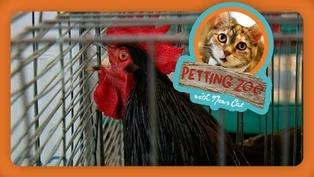
Petting Zoo: Rooster Crowing Contest
Clip: S53 Ep2 | 2m 20s | Petting Zoo: Rooster Crowing Contest (2m 20s)
Providing Support for PBS.org
Learn Moreabout PBS online sponsorship
- News and Public Affairs

Top journalists deliver compelling original analysis of the hour's headlines.

- News and Public Affairs

FRONTLINE is investigative journalism that questions, explains and changes our world.












Support for PBS provided by:
NewsDepth is a local public television program presented by Ideastream