
Sept. 30, 2026 - Full Show
9/30/2026 | 26m 49sVideo has Closed Captions
Watch the Sept. 30, 2026, full episode of "Chicago Tonight."
Some immigrants are set to lose Medicaid coverage this week — a look at the impact in Illinois. And can universities do more to support survivors of sexual assault?
Problems playing video? | Closed Captioning Feedback
Problems playing video? | Closed Captioning Feedback
Chicago Tonight is a local public television program presented by WTTW
WTTW video streaming support provided by members and sponsors.
Sept. 30, 2026 - Full Show
9/30/2026 | 26m 49sVideo has Closed Captions
Some immigrants are set to lose Medicaid coverage this week — a look at the impact in Illinois. And can universities do more to support survivors of sexual assault?
Problems playing video? | Closed Captioning Feedback
Where to Watch Chicago Tonight
Chicago Tonight is available to stream on pbs.org and the PBS app.

WTTW News Explains
In this Emmy Award-winning series, WTTW News tackles your questions — big and small — about life in the Chicago area. Our video animations guide you through local government, city history, public utilities and everything in between.Providing Support for PBS.org
Learn Moreabout PBS online sponsorship>> Hello and thanks for joining us on Chicago tonight.
I'm Brandis Friedman.
Here's what we're looking at.
Thousands of legal immigrant residents in Illinois are losing their Medicaid coverage this week.
assault on college campuses is in the spotlight.
A look at accountability measures and support for survivors.
>> First off tonight, another candidate in the race for Chicago school board president is bowing out, but his name will still appear on November's ballot.
Essential Rebel worry is seen here on the far right of your screen during our W T Tw News candidate forum 2 weeks ago.
In a statement today, he blamed, quote, special interest cash for blocking out the quills voices of real Chicagoans.
2 of the 3 remaining candidates in the race have each received.
The endorsement of the Chicago teachers union that eladio demandas and the service Employees International Union.
That's just bigs to watch our school board president for him with the candidates in English and Spanish.
You can visit our website.
Election Day is just under 5 weeks away.
But if you can't wait early voting in Chicago starts tomorrow into downtown locations.
October first, that is tomorrow at 09:00AM voters can cast their ballots at the Chicago early voting super site at 137 South State Street or the Board of Elections offices at 69 West Washington Street expanded early voting begins in all 50 wards on Monday, October 19th.
And if you're not registered to vote, you have until Sunday, October 18th to do so online or you can register same day at an early voting site.
Taking the bus through downtown or parts of downtown should get easier.
Once a new dedicated bus lane is installed on part of Michigan Avenue.
The Chicago Department of Transportation says it's installing a 1.5 Mile lane on northbound Michigan Avenue between Roosevelt Road and Wacker Drive.
Cdot says Michigan Avenue in the loop is one of the busiest spots in the CTA bus system with nearly 1500 buses on 21 different route, using at least part of the new bus lane carrying an estimated 22,000 passengers every weekday crews will begin installing new pavement, markings and signage overnight.
The work is expected to be done in the next 7 to 10 days.
Changes to Medicaid coverage for some immigrants take effect this week.
What to expect right after this.
>> Chicago tonight is made possible in part why the Alexander and John Nichols family.
The Pope Brothers Foundation.
And the support of these donors.
>> More than 9,000 immigrants in Illinois are expected to lose Medicaid coverage as a result of changes to federal law taking effect Thursday.
The affected groups include refugees, people granted asylum and survivors of human trafficking.
The policy change leaves health care providers and community organizations scrambling to help people find other ways to access care.
Joining us to discuss the local impact.
Our Ali Touro director of development and communications at the Syrian Community Network.
your B-day Sanchez, the wellness program, director of Refugee one.
And Mary say Dak director of care coordination at near North help.
We reached out to the Centers for Medicaid, Medicare services for comment but did not hear back.
Thanks to the 3 of you for joining us.
So as we mentioned, the changes in Medicaid eligibility, they're taking effect today.
They have they hold coverage for the groups that we just mentioned.
Maya, what's your reaction to these changes?
It has been a really heavy time for us.
There have been so many hits against our immigrant community and they seem to not stop.
So we have known about this.
I think we have >> hoped that there would be Hail Mary to say things.
And and now we're here.
So we have been prepping for it and has been a really just devastating time for so many of our families that know the impact of what this is going to be for them.
>> And I think there may be some confusion also about who this affects, right.
This is not about undocumented immigrants who we're talking about here rate in the grips you name.
So we're talking about folks who already have a slightly status refugees.
And these are groups of people who are highly vetted, who have gone through all the hoops and jump through all the things and done what they needed to do and really are here because there's nowhere for them.
And so I think the miss that are going around are about people who are here to take advantage of the system and are just coming over quickly and doing those things.
But that's not at all.
We're talking about for folks who may be rebuilding their lives in this country.
Ali, Medicaid's often, you know, their primary source, the primary access to health care.
>> What is losing that support mean for someone who's already navigating so many challenges?
>> So let me start with that and to shut your ideas.
How big is this number over around 10,000 people?
If you are Chicago Sky fan the plane Wintrust arena be confirmed that the stadium with numbers and mid the Kate.
And it's part off the, you know, refugees pack a I think through the U.S.
strict huge admission program, which is this month.
And now with this new administrations.
So he started If you do, when they arrive here to receive 3 months, severance has prompted our government, including Medicaid.
And based on the case you are seeing get are no cop.
And we know kids or know if I may OK that this said this the benefits are very right.
So but, you know, it's it's popped up.
The United States, no, a commitment to international organizations such as United Nations, right?
And sites pop up that state's it's part of a state make these 2 one note about populations right then and refuse you must apply for green card after an 11 months after settlement and that to continue to be eligible to Cancun, receive benefits, right?
So now that that green card process, it's taking even longer than people say, right?
It's likely had taken exactly.
So get his that and again, like myself.
>> apply for cards.
After 11 months could be with about can cause within a month or 2 months now we have cases that are that cause application is pending for 2 years, 3 years, for example, I'm working with the Monday right here to the U.S.
Refugee admissions Meagan that in time see benefits.
They have a really 6.
I'm so he's suffering found.
He's suffering >> sickness that requires really needs >> indicate said we says so in in warden language.
If doesn't receive toast say he would die.
So unfortunately he turned 19.
Okay.
Officially, he's an add-on to in the case.
Okay.
And are highly dependent indicate said we says and if they cannot afford note that for private health insurance, which they cannot, father to be in the cabinet He told that his son is going to die.
Very frightening.
Frightening time for that family.
And for many families experiencing this Mary.
>> How does this coverage has impact health care systems?
It overwhelms the system that's already under a lot of duress because these people will have very limited choices about where they can go.
>> there are people in the community who do take care of folks that don't have health health insurance or health coverage.
the numbers will quickly overwhelm the amount resources that are available.
What happens when a patient comes in needing treatment doesn't have insurance.
No it depends on the setting.
So at on your North House, where federally qualified health center and we take care of people like this all the time.
And so we will counsel them and find out what resources they do have what they need.
And then see if there's any programs that apply.
If there is some income, there's a sliding ski scale and then if not, then it's free.
Cook County health is another place with through their Caroline program that will provide services for people who are uninsured.
And that's both inpatient and outpatient care.
Maya, what are the options for folks who might be losing coverage?
I think a lot is like what mayor is saying.
We're working with a lot of folks and it's been for months of prepping for this of thinking about.
>> Can you go to your current provider and ask great the same programs that you're talking about?
What is available as option for for me to get care.
Otherwise we are starting to look at these other resources.
Some folks are switching to the clinics that you referred to as well that are serving folks who are underinsured are not insured.
Other people are looking for prescription savings programs, things like that.
Some folks might have options through work, but it's pretty limited.
I think all of us can attest to know how expensive insurance is.
So there's not a lot of options.
And I think people are doing really creative things and in the community can't make up that gap.
But something, you know, at refugee one.
And I think a lot of other organizations are doing is trying to think of what are the things we can do.
How do we raise money when there are these medication emergencies and folks can't afford a sliding scale fee for chemotherapy, for dialysis, for really lifesaving things like Ali was speaking about.
So that's a lot of what we're also thinking about it.
And what are the opportunities for our community?
2 help people stay alive and really show them that despite all the things coming against them, there are folks who really care about them and value their life here.
You mentioned a family that you're working with.
They have a 19 year-old son who's very ill.
What are the next steps for someone like that?
>> And then we are asking everyone to know.
And John and pro, I know some support show some support it feels like we are going back to 1969.
I Stockton the human 18, a large population people are receiving the public benefit by at that moment could be the secret churches, mosque and agent and a jump in and they tried to stop hoarding know families communities that this is this is one avenue.
And there have been, you know, we have to do you know, some advocacy work at the estate Linda, right?
And also the I've been you know, we have to ask for their government.
to reallocate the budget in stuff, cutting the programs, right, friends we know day.
they increase to the Pentagon budget, but more want reviewing dollar us so that to to find the Pentagon programs cutting the hour.
Humanitarians programs here.
>> very there's some other changes that are being made to Medicaid in the coming months.
What else is what else happened to the program?
The population of adults who are not Medicare age without dependents is also under review.
And there are multiple changes plan for that program that's known is that we call them the Affordable Care Act, adults So the 2 biggest ones that are going to it.
Multiple challenges are a work or volunteer education requirement.
That is 80 hours a month.
It's not clear how the record keeping is going to go on that.
And and then the other piece of it is the Reedy piece, which is re determination is basically re upping your eligible Bility for Medicaid and it was at current sorry at present only once a year and it's already a challenge for people.
They move.
They don't understand the letters don't get where they're supposed to get.
And without that letter, the process just stalls and then they want the first time they they figure it out when they go to the doctor's office and they're told they're not covered anymore.
And so they're increasing not from one year to 6 months to 6 months at.
But you also have to meet the stipulation around to maintain your coverage around work volunteer education requirements.
some people, though, they agree with this change in the Trump administration that Medicaid should only be for U.S.
citizens.
What would you say to that?
>> I have a lot of thoughts about that.
I think one with really scary and painful road to go down to start valuing what human life is.
Dignified unworthy of just surviving.
We're not even talking about thriving.
Health care is a really basic human need.
So I think on a very moral level, that is a really scary thing to think about.
And I think just a lot of what we're hearing couch unexplained as being these really economic choices and they're anything.
But we see it.
It is it is racism and it is trying to be mass to something else.
And that's something we should all be really scared about.
frankly, this is going affect all of us regardless of our status and of our coverage is changing.
This is going to be hurtful for everybody.
That's where we'll have to leave it.
At least 2 my interview.
your B-day Sanchez and Mary Fay tactics to all of you for joining us.
Thank you.
Thank you.
>> Up next, what is accountability look like for assault on college campuses.
assault on college campuses is making headlines across the country.
It comes as a former student at Cornell University filed a lawsuit earlier this month accusing the school and local law enforcement of mishandling her report alleging she was gang raped a fraternity house for hours.
The men are being dubbed the Cornell 7.
And according to the lawsuit, allegedly, they invited others in a fraternity group chat to join them.
The New York prosecutor has since reopened her case, but it has set off a firestorm of commentary about how universities in society at large respond to these cases and how survivors are supported.
Joining us now are and Kirchner a professor of criminal justice at Roosevelt University.
Note that Kay for Brewers Hoffer and and we have Kate, the Morris offer executive director of the Chicago Alliance Against Exploitation as well as Carry Ward executive director of the Illinois Coalition Against Assault.
Thanks to all of you for joining us.
So, Kate, the starting with you first on the topic of, you know, the lawsuit in the Cornell case, why is that legal action important?
It's incredibly important because thanks to the student journalists and the lawyer.
>> Who stood with this survivor and brought this case to the public's attention.
We are once again getting a window into how rape is mostly responded to by institutions like universities and the state itself.
Look, the survivors deserve better.
That survivor.
And if the cut deserve better, but what is happening, what is being revealed about her experience really is not the exception.
It is the epitome of what survivors go through for the one out of 4 women who are watching this program right now, her survivors of assault and the one out of 6 men for survivors of harm.
I can guarantee you that vanish Lee.
Few of them have seen any kind of response.
>> Outside of from rape crisis centers like those that are funded by the Illinois Coalition Against Assault mostly what survivors get is they're ignored.
They're rebuffed.
They are disbelieved and and our society institutions like universities failed to do the things they can like it is really not rocket science.
And in fact, we've recently had an example of how a university and a criminal legal system can react quickly when people on their Campus Inc engage in the grating conduct.
Just ask the the young men who were arrested expelled for engaging in hazing at the University of Bad of Wisconsin.
Madison.
Institutions have the capacity respond and we don't need cooler penalties.
We need more consistent repercussions and what challenges do people face with the title 9 process when they're reporting assault?
>> They face a myriad of challenges from, you know, having the reporting process not be very survivor centered and trauma informed.
But most of the time, it's the length of the process that really takes people.
You know, by surprise.
I think they think, okay, I've made this report.
Something's going to be done and let's say they do get a sympathetic, you know, title 9 coordinator who takes the report.
There are, you know, a lot of very sympathetic, very good people working title 9 office us.
I don't want to, you know, denigrate them.
However, the way the institution you know, as keep us as this is really, you know, throughout the whole higher education system, the way they have set up the process is too the sort of drag things out not take certain evidence.
Survivors report having fighting like a lot of mistakes in the paperwork that whatever they do, get access to things like that, that just show the survivor that the process is sort of the punishment and then it's not focused on their well-being.
It's more of compliance process.
It's more of sort of containing the problem.
we also know that, you what do we know actually about what how often cases reported?
>> They're extremely underreported.
I wanted to render, but, yes, they're extremely underreported.
I'm the majority of of survivors.
Do not report.
>> So that is that is always, you know, that's and I think that's been the case for a long time.
Now hasn't really changed.
Carrie, what resources does I casa coordinate for survivors of violence?
>> Sure.
So there are number of resources that are available through.
I cast a rape crisis centers.
So I causes a network of 31 rape crisis centers located throughout Illinois.
So there are primary offices and then many of those offices are expanded through satellite sites in neighboring counties, our communities all of those sites offer.
24 hour response to assault.
So someone goes to the hospital and wants to make a report.
Rape crisis centers can respond to that hospital, provide an advocate to help support the survivor through direct evidence collection kit can a system that they decide they want to make a report to law enforcement and it can also system through that law enforcement process.
If they want to report to the police and then they want to go forward with going through the court system and they can have an accompaniment through all of that.
And additionally, they can have counseling services, counseling and therapy and be available through rape crisis centers and also same kind of services available through community institutional prevention, education, professional training, institutional advocacy, working with institution to talk about the survivors that within their midst and what they can do as organizations to best serve survivors.
So it's not only the one-on-one assistance to survivors, but helping institutions respond to assaults their places as well.
All of those Paul under the auspices of what the work is, every crisis centers too.
Okay.
But what legal resources are available for survivors?
Well, in the state of Illinois, there's one legal services provider that provides free legal representation.
>> 2 student survivors who want a lawyer by their side as they seek to get their school to respond appropriately to assault.
And that is my organization case.
It is.
And we are one of the very few organizations in the nation that provide this kind of legal representation and it's it's heartbreaking because that that has prefer the professor has already indicated the length of time that universities take is extraordinary.
It is frequently the case that the clients that we serve.
Well, C 5 months are more pass between the time that they tell the school that they would like to see a process by which the school can determine, you know, did something that happened in should be do something about it.
And yet again, we know from the way schools respond to incidents of hazing that they have the capacity to very quickly go.
There is behavior here that does not meet the standard that we would like to see.
I find it continually distressing that we understand that that young people spend so much time and effort trying to prove that they're worthy of getting into an institution and then fact most institutions say that it's really hard to get in here.
And then the second they get in.
Well, you know, if they if they treat a fraternity brother badly, though they're probably out.
But it's the Wild West Schools are far too reluctant to remind there's their their students.
That being a student is a privilege and and losing your opportunity to be a student at the school is not and going to ruin their life.
I mean, we live in a country where it's very clear that credible and even proven allegations of assault heard just a speed bump on the road to the highest offices and most land.
So it we we we have seen some some people in some of the higher offices be accused of such instance instances and >> how can universities, though, improved their process for investigating assault?
>> Well, you know, I do think that some pretty radical change needs to happen to the processees.
I have seen better outcomes when faculty senates are involved or when it's more akin to like labor rights case.
Unlike with graduate employees and things like that, graduate students who are also working for the university and what those have in common, I think, is just more people.
Aware of the situation, putting their eyes on it and coming together to demand more from the university.
So I guess I'm actually not sure that universities.
We'll improve.
I just I think they've had a lot of time to do that.
And I do think that it just feels very deliberate at this point.
And so I think it might actually be more up to professors.
Students to demand more from their universities and to demand a better process.
>> so coming off of what we just heard and I'm not optimistic that universities will do better.
How can state laws protect victims of assault on college campuses?
>> tell you one thing that that because is working on along with a a wonderful group support legislators and allies and community partners is looking at an amendment to the preventing violence in Higher Education Act.
You know that at current currently exists, guiding universities and responding 2 students.
And one of the things that we're looking at is trying to create some additional protections within that law and what that's one of the ways that we can increase the accountability for universities, increase the safety for students.
And it's legislation that has had bipartisan support in the Illinois General Assembly that a version of the bill has passed in the House, a version of the of the amendment has passed in the Senate and we are hoping bring you know, opportunity perhaps through the work of the task force that continues to work on it right now.
Maybe be able to bring a version of that to veto session, be able to move that forward.
I think that's that continued effort at accountability to say it's not just a matter being aware of what's happening on campus, but it's doing something about it.
And I think that this is a campus focus issue, but I think it's also a societal and that we can turn our backs on what's happening, section legislation that that will be keeping an eye on and have you back.
If it's something to talk about.
That is where we'll have to leave it and Kirchner Kate, the Morris half are in Cary Thanks to all of you.
>> Its last.
Thank you.
And that's our show for this Wednesday night.
If you're looking for more context on the complicated issues that matter most to you, sign up for our e-mail newsletter, the Daily Chicago in.
>> You can do that at W T Tw Dot Com Slash newsletter and join us tomorrow night at 5, 30 10 now for all of us here Brandis Friedman, thank you for watching.
Stay healthy and safe and have a good night.
>> Closed captioning is made possible by Clifton and Clifford Law offices, Chicago, personal injury and wrongful death that supports inclusionary excellence
 New
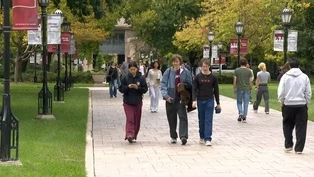
NewA Look at Accountability, Survivor Support in Sexual Assault Cases on College Campuses
Video has Closed Captions
A lawsuit alleging a woman was raped by seven men at Cornell University is sparking discussion. (10m 52s)
 New
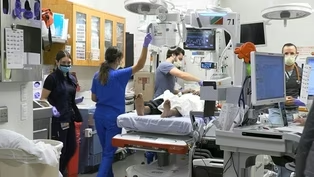
NewThousands of Legal Immigrant Residents in Illinois Set to Lose Medicaid
Video has Closed Captions
Changes to a federal law take effect Oct. 1, 2026. (10m 26s)
Providing Support for PBS.org
Learn Moreabout PBS online sponsorship New Episode
- News and Public Affairs

Top journalists deliver compelling original analysis of the hour's headlines.
 New Episode
- News and Public Affairs

Today's top journalists discuss Washington's current political events and public affairs.

 New Episode

 New Episode
 New Episode
 New Episode

 New Episode
 New Episode
Support for PBS provided by:
Chicago Tonight is a local public television program presented by WTTW
WTTW video streaming support provided by members and sponsors.