Vermont This Week
September 13, 2024
9/13/2024 | 26m 46sVideo has Closed Captions
EPA calls for major changes to how Vt. regulates water quality on farms | Broadband buildout in Vt.
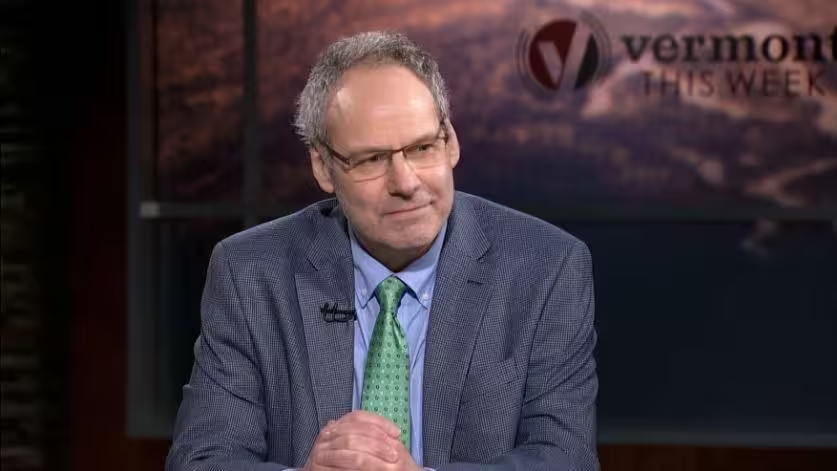
EPA calls for major changes to how Vt. regulates water quality on farms | Broadband buildout in Vermont | Urgent care center for mental health crises is opening in Burlington | Panel: Mitch Wertlieb - Moderator, Vermont Public; Kevin McCallum - Seven Days; Elodie Reed - Vermont Public; Howard Weiss-Tisman - Vermont Public.
Problems playing video? | Closed Captioning Feedback
Problems playing video? | Closed Captioning Feedback
Vermont This Week is a local public television program presented by Vermont Public
Sponsored in part by Lintilhac Foundation and Milne Travel.
Support provided by:


Vermont This Week
September 13, 2024
9/13/2024 | 26m 46sVideo has Closed Captions
EPA calls for major changes to how Vt. regulates water quality on farms | Broadband buildout in Vermont | Urgent care center for mental health crises is opening in Burlington | Panel: Mitch Wertlieb - Moderator, Vermont Public; Kevin McCallum - Seven Days; Elodie Reed - Vermont Public; Howard Weiss-Tisman - Vermont Public.
Problems playing video? | Closed Captioning Feedback
How to Watch Vermont This Week
Vermont This Week is available to stream on pbs.org and the free PBS App, available on iPhone, Apple TV, Android TV, Android smartphones, Amazon Fire TV, Amazon Fire Tablet, Roku, Samsung Smart TV, and Vizio.
Support the crew
Help Mitch keep the conversations going as a member of Vermont Public. Join us today and support independent journalism.Providing Support for PBS.org
Learn Moreabout PBS online sponsorshipThe EPA calls for major changes to how the state regulates water quality on Vermont farms.
Plus an update on efforts in the Green Mountain State to build out broadband access.
And an urgent care center for mental health crises opens in Burlington next month.
That, and more ahead on Vermont this Week.
From the Vermont Public Studio in Winooski.
This is Vermont this Week, made possible in part by the Lintilhac Foundation and Millne Travel.
Here's moderator Mitch Wertlieb.
Thanks so much for being with us.
I'm Mitch Wertlieb.
It is Friday, September 13th.
And joining us on the panel today, we have Kevin McCallum from Seven Days, Elodie Reed from Vermont Public.
And joining us remotely today, Howard Weiss-Tisman from Vermont Public.
Thank you all so much for being here today.
We've got kind of a hodgepodge of topics today.
They're all really interesting and we'll get right to it.
Starting with you, Kevin.
the Environmental Protection Agency has called on Vermont to change the way it regulates water quality on farms.
What are they specifically talking about here?
What kind of changes might have to be made?
Sure.
Well, this has been a long time in coming.
The, Environmental Protection Agency has been investigating how Vermont regulates, pollution off of farms in the state for almost a year.
The Conservation Law Foundation last year said, hey, we don't think that the state of Vermont is doing enough to prevent waste from flowing off of farms into the waterways of the state.
So, hey, EPA, you guys should really look into this.
This is a problem.
And so the EPA did an investigation and basically concluded that the state needs to clean up its act.
It said, look, you guys are not doing enough to make sure that the waterways of the state of Vermont are prevented from having manure, essentially from flowing into it.
And that's a big problem for for the state.
And so they basically concluded that the regulatory structure that Vermont has is just fundamentally flawed.
Now, that's interesting because it's the way it's being sort of overseen, I guess, is the problem.
the agency of natural resources, I think the EPA, correct me if I'm wrong, is saying they really know the most about this.
They should have the oversight of it.
But that's not exactly what's happening, right?
That's right.
So in Vermont, ever since the Clean Water Act was passed in 1972, the state has been allowed to regulate how that law applies to the state.
And in terms of farms, state agencies have divided how they regulate pollution off of farms.
You have the agency of agriculture, which says, now we know a lot about farms and how they operate and how many cows are here and what kind of permits are necessary.
And then you have the environmental regulars, regulators and the Department of Environmental Conservation who know a lot about other kinds of water pollution and other places.
And so they share responsibility for making sure that the pollution from Vermont farms is managed properly.
But what has happened is that over years, there's been a lot of tension between those two departments about who knows best, who knows who's in charge and what the solutions ought to be to the pollution that is discovered.
But are they working for the same goal?
I mean, why can't they work together on this?
What's the problem?
That's a little tricky.
I mean, apparently it has a little bit to do with, jurisdiction.
Right?
I mean, who's in charge or do you really want, you know, another group of regulators coming in and, you know, stepping on your turf, essentially.
And one of the observations some people have made over the years is that they feel that the agency of agriculture has a bit of a conflicted role here by virtue of promoting the dairy industry in the state of Vermont and then also regulating the pollution that comes off those farms.
So this, the EPA basically agreed with the Conservation Law Foundation that this this bifurcated structure, this overlapping jurisdiction is a problem.
It needs to be fixed.
It gave the state 90 days to come up with a solution.
And the threat that it held out there over the state's head is if you don't fix this, we will come back in and we will regulate the pollution off of farms.
And by implication, you're not going to like it.
I don't think either would like that to happen or the agency of AG.
But what would happen?
Let's say the 90 days goes by and they come up with a plan that the EPA says, you know, this, this isn't getting it done.
And I guess my biggest question is, is it going to be a situation where, because the Conservation Law Foundation thinks the agency of natural resources should be, completely involved or completely in control?
Is that is that a possibility where the AG could be taken out of the completely?
Yeah.
I think what is likely to happen is that the agency of natural resources is going to it's going to propose something to the regulator, said EPA.
And they're probably not going to say, okay, you're right.
We're really horrible at this.
We're going to consolidate it into one department and do everything as you describe.
They're probably going to come up with a half measure that says, okay, well, what if we do it this way?
What if we structure it this way?
What if we increase the number of permits that we require some big farms to get?
What if we do that?
Will that resolve your concerns?
And if those types of half measures don't resolve the EPA's concerns, then they're really going to have to look at doing something more substantial.
And it would be potentially a wholesale restructuring of the way that, regulation of dairy pollution in the state is conducted.
And it would have to be, according to the letter from the EPA under a single agency, and that would be the agency of natural resources.
This is tough for dairy farmers, too, isn't it, Kevin?
Because, you know, they're trying they you know, for years a lot of fingers get pointed at them for a lot of the pollution problems that we hear about specifically right now.
And you've been writing about this.
Biosolids on Vermont farms are becoming an issue.
Can you sort of explain what what that is, what these biosolids are and what the problem seems to be?
Sure.
And this is a this is a related but different issue.
Right.
Because what we were just talking about is the pollution that flows off of fields and barns and, and ponds, of cow manure.
That's essentially what the prob the other problem that we have, recently realized the state is kind of coming to grips with is the fact that a lot of the fertilizers that farmers are spreading on their fields come from wastewater treatment sludge, and then that is coming back from some new test results showing that there's contamination in that sludge.
Now, we need a little bit of explainer here.
What we're talking about here, wastewater treatment plants are the, the places where all the waste from all the communities that they serve gets concentrated.
And then the waste material, human waste material is stripped out through various chemical processes and biological processes, and it's creates this thick, nasty sludge that you have to do something with while the clean water goes into the river.
Hopefully the clean water flows.
Sure.
And so there's a huge volume of this material.
And the question is, well, what do you do with it?
And for years and years and years, decades really the state of Vermont and its, you know, rural state and farmers say that that is something that actually could be reused in a beneficial way.
It could be spread on fields.
It would allow farmers to not have to go out and and pay for chemical fertilizers.
And it will give the communities with this waste material a place to put it other than a landfill.
That all sounds good.
I feel there's a catch coming.
There is absolutely a catch because just like the human waste is being concentrated in these wastewater treatment plants, also the chemicals in our environment and are being concentrated there too, and a particular kind of chemical that everyone is starting to learn a lot more about in recent years called we just shorthand it to forever chemicals, these very durable fluoride, based compounds that don't, they don't they don't break down and break down in the environment and sunlight and wind and heat.
They just stay there and they build up.
They build up in your body.
If you're using a product that's made with PFAs, they build up in the waste and they build up in the soil.
So Vermont started to do some testing about five years ago, and they realized, wait a minute, the places where we're spreading, allowing to be spread, this fertilizer, this sludge on farm fields, when we go and test that soil, elevated levels of PFAs.
Oh, boy.
So regulators say, well, yeah, it's not great, but it's not horrible.
Like it's not as bad as Maine or it's not as bad as Texas and Michigan.
The New York Times just did a big, investigation a couple of weeks ago, which is what caused us to write a story about this, in Vermont, that it's really bad in some places where there's large, cities with huge volumes of this material.
And they've just for decades been putting sludge on farms in high concentrations.
It's coming back with really alarming high levels of these chemicals in those fields.
Vermont does not have that bad of a problem.
Vermont is not a very, an industrial state, essentially.
And so the levels in the soil, environmental regulators say, are manageable if you keep it away from wells, if you keep it away from riverbanks, if you are smart about how you apply it and don't dump it all in sort of a, you know, a huge amounts in a certain concentrated kind of then it's something they still want to allow to be done.
But environmental activists are just beside themselves.
They're like, what?
Why would you possibly continue to allow contaminated sludge to be spread on our precious agricultural fields?
And so the practice is coming under a greater and greater scrutiny.
There's an ongoing debate about it.
And, I think the end result is this is going to be harder and harder and harder to do in this state, given the new scrutiny that regulators are bringing to it.
Briefly, Kevin, before we move on, the problem seems to me that it has to go somewhere if they're not going to be spreading it on the fields and they're saying, you know, where is it going to go?
It has to go somewhere.
This material goes three places in the world, generally there in New England, let's say.
It goes either in a landfill, it goes, to be spread on farms or it gets incinerated and Vermont regulated, like, not really in Vermont, so much Connecticut and Rhode Island.
And those places tend to just throw it in a waste energy plant.
Vermont has been very hesitant to ban the use on farmland because they know that since we don't have any waste incinerators in Vermont, you know, that's almost certain to go to the Coventry landfill country landfill.
There's only one left in the state.
It's filling up fast.
There's all these other demands.
Why would we take a perfectly good waste material that could be benefiting our farmers, who need all the help they can get in many ways and truck it dozens and dozens of miles, depending on where you are in the state, to a landfill where you you pay all this money, right?
The community has to pay the money to send it.
There it goes in the landfill, and it's just sitting there and then actually, after heavy rainfall, it's slowly leaching out into the bottom of these landfills.
And they then they have to deal with that leachate they call it.
So there's no perfect solution.
Regulators think that spreading it on farmland, on balance, is still the best way to go.
Well, I sure appreciate you explaining all that because it's been a long going problem here in Vermont.
And we're going to shift now to another issue that's, something that Vermont has been grappling with for a long time.
And Howard West has been you have been reporting on this for a while, and that's getting everybody connected to high speed internet.
The broadband buildout.
There has actually been some good news on this with some money coming in.
What can you tell us about the latest on broadband?
Sure.
Well, there's a lot of good news.
You know, this has been going, lawmakers wrote the legislation almost ten years ago that set up these cuds, these communication union districts, which are groups of towns that are working together to lay this high speed fiber network where for profit companies weren't willing to do it because it never made economic sense in Vermont.
So the kids have been working.
they're really making progress across the state to varying degrees.
What we learned this week is that the Vermont, Community Broadband Board is going to use about $4 million to do what they're calling a long drop program.
And what that's going to do is, when houses are within 400ft of the high speed, high speed fiber network, they can get connected.
But if they are, deeper in the woods or this is a problem at, manufactured, mobile home parks, that they lay it underground.
It's very expensive.
It could be up to a couple thousand dollars per household.
So what?
The state, announced this week is that they're going to use this money to help these folks concentrating on low income customers, to help them hook up to the high speed fiber network.
And the reason this is important for a lot of, reasons, obviously, to hook up houses.
It's important, but it's a really important part of the economic model that they're building.
So if these kids are spending all of these millions of dollars to lay this high speed fiber network along the highways, and no one hooks up to it, they're going to be in worse shape than they are.
So really, every single household that that gets hooked up kind of benefits the whole economic model.
So they're going to, put together this long drop program and invest $4 million and hopefully, you know, the state says there's at least a thousand dresses across the state that could benefit from this, probably more.
So hopefully they're going to be able to do that.
And a thousand I'm sorry to interrupt our but that that thousand or so you're talking about a lot of those folks being further away, as you were explaining before, than that 400ft.
So it would be very difficult for them otherwise to get hooked up to the high speed.
Right?
Expensive and difficult.
And that's what this money is going to do.
And this is coming just as Vermont's about to get another pot of federal money, broadband equity access and deployment program or bid money, Vermont's gotten about $200 million from the federal government to get this moving.
And this speed money is just about to hit the state.
The state, is just putting together the application program.
Yeah, that graphic we're looking at is like, if you consider there's two parts, that's kind of the first half of the build out.
So the state spent 206 million.
They're about to get another 229 million.
So it's really working.
They are doing this.
there are skeptics that are wondering what the long term economic viability of this all is, but for now, they're spending a lot of money and they're laying a lot of fiber.
And households are getting hooked up.
Great to get some good news.
And Elodie Reed, I think you may have some good news, too, when it comes to helping people that are suffering through mental health crises, Burlington is going to get an urgent care center, for mental health crisis, openin explain what this is exactly.
And when I say urgent care, I think that's a little bit different than what we may consider or think about when we think about a mental health care, center.
Yeah.
so it's going to open October 28th, one South Prospect Street in Burlington.
And, it's really built as an alternative to the emergency department at UVM Medical Center.
four different organizations, UVM Medical Center, Howard Center, Pathways Vermont and Community Health Centers all came together and said, you know, we need to come up with a different solution because there are up to 20 people waiting for an inpatient bed at UVM Medical Center a couple summers ago.
And so, along with some funding from the Department of Mental Health, they are opening this urgent care center specifically for mental health crises.
And the idea is that it's where people can go, if they're not having some sort of like acute medical issue or needing inpatient psychiatric care, and they're essentially saying like, you should just come.
And if we can't provide you the care you need, we'll get you where you need to go, and we'll make sure that you get handed off to where you need to be.
And some of your reporting, too, has mentioned that folks who perhaps don't have English as a first language, they don't have to worry that they will be helped out as well.
Yeah, they're really, emphasizing access.
So they'll have interpreters on hand.
If English isn't a language you speak, they are welcoming people who have substance use issues who, might have intellectual disabilities, basically complex needs is how they put it.
And, they're especially wanting the center to be somewhere where people can go, if they're struggling with suicidal thoughts, they're they're looking at it as an extremely accessible, warm and welcoming, non non stigmatizing place.
So if people are having those thoughts, they can go and they'll be provided care by people who are trained specifically, to respond to that.
I mean there's so many good things about that.
And helping people out, taking some of the pressure off as well from from the big medical center to, as you said, and I was surprised to learn this is not the first kind of place in Vermont, though.
in Burlington.
Yes.
But there were some other places that have been already been operating.
Right.
There are.
Yeah.
There are three others, once in the Northeast Kingdom, once in US and county ones in Washington County.
And, from researching them a little bit, they're like kind of like a living room, like they're not a sort of like clinical medical facility.
Right.
And that goes back to the idea of stigma being the reason why people often don't seek out mental health treatment.
And, these centers are, are really working towards getting around that and helping people get the care they need.
Something else.
You've been reporting on, and I think people can relate to this.
given the, presidential debate we just saw, immigration obviously is a big issue.
and, you know, a lot of, a lot of news was made to talking about getting back to the withdrawal from Afghanistan.
That, was kind of a disaster when it happened for a lot of different reasons.
But Vermont is now calling for green cards for some Afghan refugees.
These are folks who helped out the United States and a really, really dire time.
I'm guessing there interpreters, other people that we're helping out.
tell us about this called for advocates are calling for these green cards for for Afghans.
Yeah.
So, back in August, it's the three year mark since Kabul fell to the Taliban and the US government fell.
and once that happened, anyone who was working with the United States who set off that government, was no longer safe.
And so, you know, no fewer.
So you remember the images of people just fleeing, you know, crowding into airplanes?
Yeah.
600 of those people ended up in Vermont.
And, so I was at this press conference, and there are a lot of different people there with different perspectives on this, on this immigration here.
And everyone basically said Vermont has been so welcoming, from employers to community members, to the state government, to these to these people and, basically what advocates were saying is you've been so welcoming.
Now continue your work by advocating for this policy.
It's called the Afghans Adjustment Act.
and it would give green cards to these people who are no longer safe in their home country.
They helps the US.
at the moment they're here, on a humanitarian parole status, which there's no path to lawful immigration, from that status.
And so it's basically giving these people who are kind of in limbo right now a path to making this.
Is that what the green card would do is give them that path to, to a more permanent, stable home.
Yes.
Okay.
And we're a lot of them settled in the Rutland area.
I'm trying to remember where a lot of these Afghan refugees came.
That's a good question.
I don't know that I actually know the map of the state.
but certainly, two of the people who came here, they're female judges, and there's actually been, a special effort, by former judge Patricia Whalen to get female Afghan judges out of the country.
I remember that story.
Yes.
There's been this long standing relationship, this cultural exchange that started happening, like, way back in 2004.
And they maintain those connections when, Kabul fell, Patricia Whalen got in touch with her other, like, fellow judges from around the world and said, like, what's happening?
How can we get these women out?
And like you said, it was kind of a mess.
The US government admits that.
And so, Patricia, well, and these other judges kind of just figured it out from their kitchen tables and they so, as of that press conference in August, they had evacuated 215 women judges, from Afghanistan with their families is over a thousand people, and they had 30 more, 39 more to go.
but they expected to get all of them out.
And two of those judges were at this event, and have been resettled here.
It's extraordinary.
I love good news.
Kevin McCallum, let's turn back to you.
There's more good news.
and I want you to sort of recap, a story for us that, you know, you seem to be using at first.
I'm not sure that's the right word.
Let's go back to what some folks were calling Watergate.
wet bagging.
Who were the two Vermont lawmakers involved in this incident?
What has happened since with an ethics panel getting involved?
For sure.
I think the word that generally comes to mind for me when reporting on this incident is bizarre.
Okay.
Fair enough.
It is amusing, but it's also bizarre.
Basically, you had a situation where two lawmakers, were in some sort of a dispute in the legislature this session, and one of them, Mary Morrissey of Bennington, was caught red handed on a spy camera pouring water in her colleagues tote bag over and over and over and over again.
And the lawmaker, Jim, Jim Carroll.
Jim Carroll.
Yeah.
Told his colleagues and friends that he didn't understand why his bag was was wet every day, and it was driving him nuts.
And so he set up this camera and he found that his colleague from also from Bennington was secretly pouring water in his back.
Now, we don't really know why this, was happening, what her motivation was, but it was a huge story.
Everyone couldn't believe it.
There was video evidence of it that got released because, you know, this just whole thing was shared with the with the police department there in Montpelier.
And so we asked for the records, we got the records.
And sure enough, there's the video that shows are doing it.
The ethics panel in this in the House was forced to sort of look into this and try to get to the bottom of it.
And you could tell, that they really just want to put this behind them.
It's been a few months.
They got a lot of bad publicity.
They got these two in a room, and they tried to have a type of restorative justice, with them to say, look, can you apologize for what you did?
How did this make you feel?
What's what's going on between the two of you?
and so they put out a press release a couple of weeks ago that said, we're done with this.
It's over.
She's apologized.
it was embarrassing.
It kind of negative, reflected, negatively, reflected on the integrity of the of the legislature or the House of Representatives.
So I think they're just happy to have that behind them.
Yeah.
Normally they'd probably deal with this internally, but because it made national news, they probably felt like they had to issue this press release to everybody's friends now.
Okay.
Thank you for updating us on that.
it is almost October, my favorite month.
Howard, that means leaf peeping season is coming up in Vermont.
that's always a good time for tourism, but there are some concerns.
What are those concerns?
There are concerns?
Yes.
Breaking news.
foliage is coming.
We can announce that here this week.
the Department of Tourism puts out a really cool, interactive map that will show you where they're expecting, foliage to be throughout time.
You can kind of move it back and forth.
they're saying that peak is expected right around October 10th.
some of the news coming out of this is that they are expect ING colors to be really good this year.
Last year, all of that rain created a lot of fungus on the trees, and it kind of muted the colors.
They're not seeing that this year or some of the other things important to talk about is after the flooding this year, a lot of towns are kind of walking this fine line.
towns in northeast Kingdom, Royal County, they're saying, we're open for business.
We want you to come, but you should check out where you're going before you're setting down some dirt roads, some of the flood impacted roads, are still closed or being worked on.
So they're not chasing people away.
These tourist dollars are so important to some of these small communities.
So, Vermont is open for business.
We're open for foliage.
and we want you to come, except, of course, that one road in Redding, which we have reported on, Janae Road, which is one of the most photographed roads in the state of Vermont.
the Selectboard there is once again closing that down to tourists, because the folks that live on that road say it's just gotten out of hand.
this social media viral thing where there are just thousands of photos of this one road, this one farm.
So Jenny Road in Redding is closed, but the rest of Vermont is open.
Want to make a quick note that we are remembering, Lydia Clemens, 101 years old.
Elodie.
yeah.
Lydia.
I'm sorry.
and.
Yeah, that's a that's, a Vermont icon.
Really?
She has.
Yeah.
She was 101 years old.
And just from the people I spoke to.
She at Clemens family farm, both she, as an individual and the farm and the legacy.
It has just created a refuge for black people in Vermont and still does.
And, yeah, I remember the incredible legacy.
And we're going to have to leave it there this week.
Thank you so much, everyone, for being here today.
Kevin McCallum, Howard Wiess-Tisman and Elodie Reed.
I'm Mitch Wertlieb, thank you so much for tuning in to Vermont this Week, and I hope to see you again next week.

- News and Public Affairs

Top journalists deliver compelling original analysis of the hour's headlines.

- News and Public Affairs

FRONTLINE is investigative journalism that questions, explains and changes our world.












Support for PBS provided by:
Vermont This Week is a local public television program presented by Vermont Public
Sponsored in part by Lintilhac Foundation and Milne Travel.