
September 15, 2026 | Carolina Impact
Season 14 Episode 1402 | 26m 13sVideo has Closed Captions
Sleep In Heavenly Peace Beds; Steeple People; Artist John Hairston; & From Broke to Business Owner.
A Facebook post sparked a mission to build beds for kids, including 10,000 in Charlotte; At 96, John Schafer’s 70-year steeple legacy still rises above churches across America; Charlotte artist John Hairston Jr. blends vibrant art, human rights and mentorship; & From line cook to vintage store owner: how a thrifting gamble changed everything.
Problems playing video? | Closed Captioning Feedback
Problems playing video? | Closed Captioning Feedback
Carolina Impact is a local public television program presented by PBS Charlotte
September 15, 2026 | Carolina Impact
Season 14 Episode 1402 | 26m 13sVideo has Closed Captions
A Facebook post sparked a mission to build beds for kids, including 10,000 in Charlotte; At 96, John Schafer’s 70-year steeple legacy still rises above churches across America; Charlotte artist John Hairston Jr. blends vibrant art, human rights and mentorship; & From line cook to vintage store owner: how a thrifting gamble changed everything.
Problems playing video? | Closed Captioning Feedback
Where to Watch Carolina Impact
Carolina Impact is available to stream on pbs.org and the PBS app.

Introducing PBS Charlotte Passport
Now you can stream more of your favorite PBS shows including Masterpiece, NOVA, Nature, Great British Baking Show and many more — online and in the PBS Video app.Providing Support for PBS.org
Learn Moreabout PBS online sponsorship- [Announcer] This is a production of PBS Charlotte.
- Just ahead on" Carolina Impact," how an organization helps people in need, get something many of us take for granted.
Plus, you have to look up to spot these landmarks.
Find out how a local company keeps steeples standing tall.
And broke to business owner.
See how one man turned a risk into a big reward.
"Carolina Impact" starts right now.
(upbeat music) Good evening, thanks so much for joining us.
I'm Amy Burkett.
There are many types of insecurity.
With housing, food, financial, employment, and healthcare just among the most common.
But there's another one which you probably wouldn't normally think about.
Carolina Impact's Jason Terzis is here with the details.
- It's something most of us take for granted.
We wind down after a day at school or work and settle in for the evening, ultimately winding up in our beds.
While there's no exact count for the number of Americans lacking a bed, it's estimated that 2 to 3% of American kids sleep nightly on couches, floors, or other shared spaces.
With a simple Facebook post, an organization was created to change all that.
(saw whirring) The saws cutting.
(saw whirring) The sanders smoothing.
(sander buzzing) The drills, spinning.
(drill chattering) Common scenes from just about any construction site, but this one was a little different.
- We bring people together.
They become friends, they become best friends in many cases, to do a very common but simple thing, which is to build a bed.
- [Jason] Building a bed, that's what this was all about, and what brought out thousands of volunteers recently to the Charlotte Convention Center.
- So we are delighted today to have about 3,500 of our Lowe's associates, and about another 3,000 of our community partners, our vendors, and members of the Charlotte community here to help us build these beds today.
- [Jason] Sleep in Heavenly Peace is a national organization based in Idaho that provides beds at no cost to children ages 3 to 17 who are sleeping on sofas, air mattresses, or even floors.
- People are inspired by the opportunity to solve a problem.
And child bedlessness is a real problem.
- Clearly sleep is near and dear to my heart as part of my professional career, and I think it's great when it's recognized that getting a good night's sleep, in whatever way we can help provide it, is important.
- [Jason] The organization's roots date back to 2012 with a simple social media post.
- Started like probably most charities, by accident.
Our founder, Luke Mickelson, decided to build a bed and posted that bed on Facebook and asked, "Does anyone know of any children that need beds?"
- [Jason] Jordan Allen was one of the many to see Luke's post, so he reached out to his old friend and asked how he could help.
- When Luke and I delivered our first bed to little Hailey, that little girl was sleeping in a nest of clothes and blankets in the corner of her room.
There was nothing else in her room.
And when we set that bed up in her room, she literally hugged the bed.
- [Jason] During its first few years, Sleep in Heavenly Peace grew organically, but then things really took off when a prominent television personality profiled the organization.
- By 2018, after a show we did with Mike Rowe called "Returning the Favor" on Facebook, we had a huge response of people wanting to do this in their town.
- [Jason] Fast forward to today, and Sleep in Heavenly Peace has nearly 400 chapters across the country, delivering more than 385,000 beds since its inception.
- I believe that when people understand that child bedlessness is a real problem, that causes them to want to do something about it.
And SHP provides the resources and the ability for people to solve a very real problem that might not be seen in their own town.
We make it easy.
- [Jason] Partnering with Lowe's and Bank of America, Sleep in Heavenly Peace held its first major Charlotte build last year, producing 5,000 beds.
- Who can sleep well knowing that there are children sleeping on the floor?
We are so committed to the work of Sleep in Heavenly Peace.
We not only do this event, but we do multiple events with Sleep in Heavenly Peace throughout the year.
- Depending on the age, school-aged kids need somewhere between 9 and 11 hours of sleep a night, and when they don't get it, they don't function well at school, they don't feel good, they aren't as healthy, they tend not to eat as well.
They're more depressed and more anxious.
- When you think about 140,000 right now on the wait list for Sleep in Heavenly Peace, this is what it's all about.
- [Jason] This year, the sight's set even higher.
10,000 beds during a 24-hour span, doubling last year's output.
- [Tanya] Because last year we did something amazing and this year we're going to be even more amazing.
- Never in a million years would I envision being here in Charlotte today, building 10,000 beds in 24 hours.
- [Jason] From above, the convention center looking more like a slew of worker bees, buzzing around doing various jobs.
It all starts with stacks of 2 x 4s measured out with dimensions marked.
Electric saws go to work.
A custom 3D-printed jig is used for the repetitive task of drilling holes for the screws.
Next stop, the sanders to smooth out all those rough edges.
Then it's time to drill in the hardware for the bed frame and all the headboards.
Big sections are then dipped into stain and sponged down before the Sleep in Heavenly Peace logo is branded.
Pieces are then stacked onto pallets and loaded onto trucks for shipping, with final assembly happening at specific delivery locations.
The beds built on this day are going to 110 chapters across 36 states.
- You know, who doesn't walk in and just be filled with joy?
It is such a tremendous thing that we're doing.
It's such a small amount of our time given the impact that it will have on a child's life.
- I get asked the question a lot, "Did you see SHP becoming what it is today?"
And simply, the answer is no, but that's what's so special about Sleep in Heavenly Peace, is it touches each of us.
- [Jason] And as experts attest, the benefits of a good night's sleep go well beyond just comfort.
- When we sleep well, we function better during the daytime, we are more emotionally regulated, and we are healthier.
So when you think about health, there are three pillars of health.
It is eating well, it's exercising, and it's good sleep.
And if any one of those pillars isn't so good, we're not in as good shape as humans.
So in this particular case, when we're talking about sleep, it is very essential to health to have a good night's sleep.
- [Jason] Something as simple as a bed to sleep in.
Sleep in Heavenly Peace positively impacting the lives of so many.
- Jason, I love stories that make you feel good.
And to know that this is something that's not just in Charlotte, it's across the Carolinas.
- It's across the Carolinas, it's across the country, and it's amazing how quickly they've grown just since 2012.
Since Charlotte is so large, there are actually two Sleep in Heavenly Peace chapters in town, one serving the northeast side of town, another in the south.
There are also chapters in Belmont, Mooresville, and Hickory, all part of 20 chapters across North Carolina.
South Carolina has seven chapters.
So it's crazy that a Facebook post in 2012, and boom, it's created this whole national organization where people are like, "Oh my gosh, I had no idea there were kids without beds.
Let's help them out."
- That's amazing, Jason.
Thanks for letting us know about it.
- Of course.
- Well, that organization builds beds to help children rest easier.
Another group has spent decades building something that reaches much higher.
For 70 years, one North Carolina company has built landmarks that most people only notice when they look up.
Schafer Manufacturing has made, repaired, and installed church steeples across the country, with a standard passed down from father to son.
Carolina Impact's Chris Clark, takes us inside the Troutman shop where the work continues mostly the same way it was when the company began.
(ladder rattling) - [Chris] Brian Schafer has spent most of his life looking up.
(grinder whirring) His father taught him to look even closer.
- The bees will see it, and God will see it, and I will see it.
So that means it's got to be all fixed properly.
- [Chris] From the ground, no one would ever notice the flaws Brian is fixing.
(sprayer hissing) Around here, that's never mattered.
- And that saved churches a lot of money.
- [Chris] That standard started with his father, John, who founded Schafer Manufacturing in 1956.
Back then, there were no steeples.
- Building five boats a day, I got done in because those people could build 50 a day.
So I said, "I'll go into something else."
(upbeat piano music) - [Chris] Then something else walked through the door.
- The guy brought in a steeple spire and said, "John, can you fiberglass over this wooden spire?"
And he said, "Yeah, I can do that."
- [Chris] One repair changed the business, and 70 years later, the company is still here, and so is the man who started it.
- My quality stays the same all the time.
That's why I'm still in business.
- [Chris] Brian started working here at 13.
John made sure staying was his choice.
- He really never encouraged us to go into the family business.
He wanted us to find our own way in life.
You know, if you want to do something else, go do it.
If you don't like it, the door's always open here.
- [Chris] Brian kept choosing the door that led back, and more than four decades later, he runs the company.
- You can't learn fiberglass off the internet.
- [Chris] Every steeple starts miles from the shop with a church, a roof line, and a tape measure.
(sander whirring) Back in Troutman, four layers of fiberglass become one solid piece.
Then comes the part no one on the ground will ever see.
Every pinhole found, filled, and checked again.
- And then we'll go over it again to make sure.
- [Chris] Building a steeple is one job.
Putting it where it belongs is another.
(upbeat banjo music) - I tell them I'm a steeplejack.
I help take off the steeples, put them on.
It's really entertaining to explain to them, look it up, show some pictures of what we've done.
And they're like, "You do that?"
And I'm like, "Yeah."
It blows their mind.
- [Chris] Mike Rank started here at 16 and there's only one problem with his chosen profession.
- Honestly, I'm terrified of heights.
- [Chris] The Schafers are believed to be the last steeplejacks on the East Coast still building, (tool whining) repairing, (sander whirring) and installing church steeples.
But not everything they build is meant to go up.
(upbeat guitar music) One creation was designed to go down.
- One of the guys at the church said, "Brian, you do fiberglass.
Why don't you build us a water slide?
We can put it up every year and go down."
I said, "Oh yeah, that'd be great.
I'll tell you what, I'll just put it on a trailer and we'll just back it right up and we'll just have a water slide."
- [Chris] For the slide going down is the point.
For this steeple, it meant something had gone terribly wrong.
- This came from Newland, North Carolina.
The hurricane took it off the roof and slammed it actually down the roof and was what we call banana'd.
So this whole spire was completely opened up all the way down to the windows.
The cross was stuck in the ground somewhere in the yard.
And they called me up and asked if I could rebuild it.
- [Chris] Brian saw the damage.
His crew saw the standard.
- If we mess something up, we fix it.
- [Chris] What if somebody else does?
- If it's messed up and somebody else messed it up, we fix it.
- Goes back to my dad.
You make it right, do it right.
Even this, this is not one of my steeples.
It leaves here like one of my steeples.
- [Chris] Once it leaves Troutman, the rebuilt steeple carries Shaffer's 20-year guarantee.
(grinder whirring) Daryl Walden started working here after graduating from high school in 1972.
He still remembers the day John found one tiny hole near the top of a freshly painted cross.
- I'll never forget it.
I was making steeples, and I painted them too, and it was a little dot at the top of the cross, like a little pimple, but it was a hole.
And John says, "You missed a spot right there."
And I said, "Well, nobody's going to see that way up there."
He said, "God'll see it."
So that's the last time that happened.
- [Chris] But what Daryl remembers most about John has little to do with steeples.
- He is a great example for a dad.
- [Chris] Darryl left the company in 1982, but what John built here was never just fiberglass crosses and steeples.
Some of it walked out the door with the people who worked beside him.
- I learned more from him in 10 years than I did working anywhere else.
- [Chris] 70 years of looking up has left Schafer Steeples across the country.
John can still spot his.
- I can recognize my steeples usually if I get up, you know, where I can see 'em because of the trim on 'em and the different things that nobody else does.
You have your own little thing, you know.
- [Chris] Brian has spent most of his life learning those little things.
Now he points them out to his own son.
- I said, "Look up there.
That's what I did."
So when I am gone from this world... (gentle music) Piece of me.
- [Chris] John built a company Brian now carries, but the part John cares most about can't be measured from the ground.
- What's important to me, number one, is this steeple business will be passed on.
- [Chris] At 96, John Shaffer no longer has to climb to see what he built.
He only has to look up.
For Carolina Impact, I'm Chris Clark.
- Thank you, Chris.
Schafer Manufacturing opened in 1956, and 96-year-old John Shaffer still keeps an eye on the work being done there.
The company says it's steeples top churches across the country, and each new one comes with a 20-year guarantee.
While that family flips craftsmanship into landmarks, our next story turns creativity into connection.
Art gives local artist John Hairston Jr.
more than a visual language.
It connects culture, history, and community, drawing inspiration from street art, expressionism, and the vibrant colors of hip-hop culture.
Hairston blends those influences into a style distinctly his own.
Producer Russ Hunsinger introduces us to the artist with many titles.
(relaxed jazz music) - My love of art was always there.
It's a part of me.
I was always a creative child.
My mother would always give me a pen and a pad, and I could just draw in church so it'd keep me from fidgeting.
I was taught to read by reading comic books, or that's what reinforced it, because in order for me to know what's going on, not only did I have the context clues of what was drawn on the page, but I was also reading things and I couldn't wait to read more of them.
So I was just a sponge for all that stuff.
And then like the Sunday funnies would come out, and I'd always read the Sunday funnies.
So my favorites were, of course, Garfield, the Peanuts, Family Circus.
I try to create the artwork that I want to see.
(upbeat funk music) When I started to go to college, I saw people working on canvas, (paint spraying) working on walls, doing all kinds of stuff, and I wanted to translate what I was doing in my sketchbook to a larger format.
I am an illustration professor.
I teach a graphic novels class.
I teach an animation class.
I teach commercial illustration.
I know that I would be a completely different person had it not been for someone taking the time to go ahead and work with me.
Your performance in the classroom makes your classmates' performances that much stronger.
Do you know that?
- He's just super experienced.
He is obviously out here in Charlotte.
He knows the community.
I'm a local student, so I'm lucky because I get to come out here and like see what local people are doing and then, during the summer, not just during the school year.
So I really appreciate that he's out and about doing things all the time.
- [John] I find the most joy in watching my students progress from being very timid artists to feeling very capable and growing into their more productive, more creative forms.
- Whenever people are struggling, he just puts so much mental energy into helping them to find a new path to get to where they want to go.
I've never spray painted before, but I'm here trying something out on someone else's work, which is usually kind of scary.
He's just like, "Yeah, just try something out."
- What do I tell a young person who is trying their hand at art for the first time?
First thing I'll tell them is that comparison is the thief of joy.
Don't compare yourself to other people.
Keep it fun and know that you're allowed to make bad artwork.
I'm very passionate about human rights.
I love taking my gifts, almost like a superhero, taking my gifts and trying to use them for good.
So I'm always trying to help people, either by working with nonprofits, charities, anti-gun violence.
I've done a couple Black Lives Matter murals.
I've lived a very fortunate life, and I try to give back in whatever way I can.
(upbeat funk music) - We're currently at Dupp & Swat, which has been a longstanding platform and hub for creatives and artists in the city of Charlotte.
We devote space, provide platform to artists.
Crown Keepers, our nonprofit arm, is devoted to education and arts.
We want to inform those that are artists, give them an opportunity to learn and grow as creatives, understanding that you can be an entrepreneur.
- With Crown Keepers, we have this particular program called Imprint, and it's a workshop series.
John, he created one that taught various people how to create a mural, and so a step-by-step guide in doing that, and then they worked on one together as a community.
He has created quite a few murals for us, and of course we're standing on one currently.
So definitely a proponent and a champion of him and his work.
- John is a staple in the community, man.
Not just the art community, but to the city in general.
He does a lot of work to help younger creators.
He helps to give them insight that we didn't necessarily have when we were coming up.
He takes a lot of time to try to open up doors, explain things, connect people.
A big part of it is also him just taking the time to look at portfolios, show them things that he's learned over time.
- [Hannah] His personality is amazing.
He's very kind, and questioned, and he interacted with my son, which makes me very happy.
- I've never regretted helping anyone out.
So much good comes from just being there and showing up.
It's important to me to kind of pay it forward and, you know, also try to usher in a future generation of artists by sharing what I'm good at and hopefully, like, they can go ahead and share their thing, and maybe it inspires them to continue to beautify.
I can't complain about what's going on in the world if I don't take an active role in being able to build with young people.
(bright music) I hope that there's something that people see in my work and see a reflection of themselves, because everything that I'm making is kind of like a love letter to my humanity and the humanity of others.
- Thank you, Russ.
John has done artwork for the NBA, the NFL, the NCAA, popular music acts, and has received many honors.
Well, it's great to see he transformed his passion into purpose.
And our final story shows how another man turned a leap of faith into a livelihood.
What do thrift stores, estate sales, and a willingness to take a chance have in common?
For one local entrepreneur, they helped change the course of his life.
Producer John Branscum introduces us to the owner of Gabe's Good Goods.
(bright music) - [John] There's one thing about Charlotte's NoDa neighborhood.
There's a good chance you'll find something good.
And in the case of Gabe's Good Goods, that's kind of the point.
- The goods are good.
It's a very unserious name for a very unserious person.
- [John] Meet owner and self-proclaimed unserious person, Gabe Cartagena.
- It's good alliteration.
It's catchy.
The goods are, in fact, good.
- [John] Now, here are a few things that you might find in his 2,700 square foot retail space.
- [Gabe] Mid-century, post-modern furniture.
I have local artists that fill my walls.
Vinyl records, vintage books.
I do my best to keep it affordable.
- [John] And if you're wondering what Gabe is most drawn to- - Glass and pottery.
I love glass.
There's so much color, so much joy, so much vibrancy in depression era and post-war glass and pottery that just doesn't really exist much now.
And I just love to hold the things.
- [John] Beyond what he sells, Gabe says a lot of his decisions come down to what he believes should be preserved.
- I have a very strong passion for the preservation of rare and extinct materials.
To my right here beside you is a rosewood credenza, which has been, my entire lifetime, illegal to harvest.
Nothing in here deserves to be in a landfill, and it stresses me out sometimes when I walk into a store and I want to buy everything.
- [John] But before the retail space, this unlikely entrepreneur was on a completely different path.
Gabe grew up in Gastonia, where he says life came with a few challenges.
- My family spent a lot of time in thrift stores.
It was what we could afford, and that never really left me.
- [Jason] After high school, he attended the University of North Carolina at Charlotte, where let's just say things didn't go quite as planned.
- When I dropped out of business school, I needed a job, so I went to cooking.
- [John] For nearly a decade, Gabe followed a culinary path without any formal training, eventually working as a line cook in high pressure kitchens across Charlotte.
- It was a hard job, 10 or more hours, just cutting things and flipping saute pans.
- [John] Doing the same work and movement over and over took its toll on the young cook.
- I've got carpal tunnel in both my hands, and I got to the point where I literally could not feel anything with my right hand, and it was a turning point.
- [John] Unable to work in the kitchen while recovering from surgery, he returned to his thrift store roots.
- I enjoy the hunt of finding things, so it would be estate sales, auctions.
It starts small, starts with one thing, and then it becomes an addiction.
- [John] At first, he sold items on social media, and to his surprise- - There was actually no financial stress.
I was doing great, and that's what made me really realize that I should probably be doing something else.
- [John] That's something else, leaping feet first into entrepreneurship.
- I've had an incredible risk tolerance my whole life.
What's the worst that can happen?
I'm broke again?
I've been broke my whole life.
Let's go.
- [John] That level of risk, well, it took a turn in the fall of 2025.
- I had no clue that I was going to be in a retail space.
- [John] But before signing a lease- - I called my accountant and I said, "So how would you feel about me opening a brick and mortar store?
Is this, like, possible?"
And he said, "Absolutely not."
- [John] Meet the accountant, Eddie Hernandez.
- He was saying the business side I need some structure, I need some organization.
I told him, "Hey, write me a business plan."
And it was beautiful chaos.
That's the best way to describe it.
Read it through, and some fantastic ideas and was like, "Hey, do you want to do this together?"
- [John] So they came to an agreement.
- He's an artist, and you have to let him work, and that was our arrangement.
For me, though, when it comes to, like, the bookkeeping and, you know, the vendors and the contracts, I'll work on that.
- [John] January 1st of 2026, Gabe's Good Goods opened its doors for business, and he recognizes how important his staff is to his success.
- Left to my own devices, this place looks like a warehouse.
Like, I went a month without my merchandising manager.
He goes around and makes things pretty.
- [John] With his solid staff taking care of the day-to-day, Gabe says he can focus on his strengths.
- I go picking every day.
I cannot stop myself.
I love an auction.
I love to stand in a group of people and look around and see who wants the things that I want and go, "Yep," over and over and over again, not even really paying attention to how much money I'm spending.
- [John] For Gabe, it all comes back to value in things and in people.
- We did this.
I used to say I did this, but it wasn't just me.
It was a combination of everyone involved.
- For Carolina Impact, I'm John Branscum.
- What a great story.
Thank you so much, John.
His journey from broke to business owner proves that sometimes the biggest risk can lead to the biggest reward.
Well, thanks so much for joining us this evening.
We're out of time, but we always appreciate your time, and I look forward to seeing you back here again next time on "Carolina Impact."
Goodnight, my friends.
(upbeat music) - [Announcer] A production of PBS Charlotte.

The Charlotte Artist Turning Passion Into Purpose | Carolina Impact
Video has Closed Captions
Clip: S14 Ep1402 | 5m 8s | Charlotte artist John Hairston Jr. blends vibrant art, human rights and mentorship. (5m 8s)

From Broke to Business Owner: The Risk That Paid Off | Carolina Impact
Video has Closed Captions
Clip: S14 Ep1402 | 5m 15s | From line cook to vintage store owner: how a thrifting gamble changed everything. (5m 15s)

“God Will See It”: The 70 Year Story of America’s Steeple Builders | Carolina Impact
Video has Closed Captions
Clip: S14 Ep1402 | 6m 34s | At 96, John Schafer’s 70-year steeple legacy still rises above churches across America. (6m 34s)
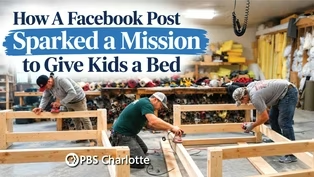
How A Facebook Post Sparked a Mission to Give Kids a Bed | Carolina Impact
Video has Closed Captions
Clip: S14 Ep1402 | 7m 5s | A Facebook post sparked a mission to build beds for kids, including 10,000 in Charlotte. (7m 5s)

September 15, 2026 Preview| Carolina Impact
Preview: S14 Ep1402 | 30s | Sleep In Heavenly Peace Beds; Steeple People; Artist John Hairston; & From Broke to Business Owner. (30s)
Providing Support for PBS.org
Learn Moreabout PBS online sponsorship New Episode
- News and Public Affairs

Top journalists deliver compelling original analysis of the hour's headlines.

- News and Public Affairs

FRONTLINE is investigative journalism that questions, explains and changes our world.

 New Episode
 New Episode
 New Episode
 New Episode
 New Episode
 New Episode


 New Episode
Support for PBS provided by:
Carolina Impact is a local public television program presented by PBS Charlotte