Vermont This Week
September 18, 2026
9/18/2026 | 26m 46sVideo has Closed Captions
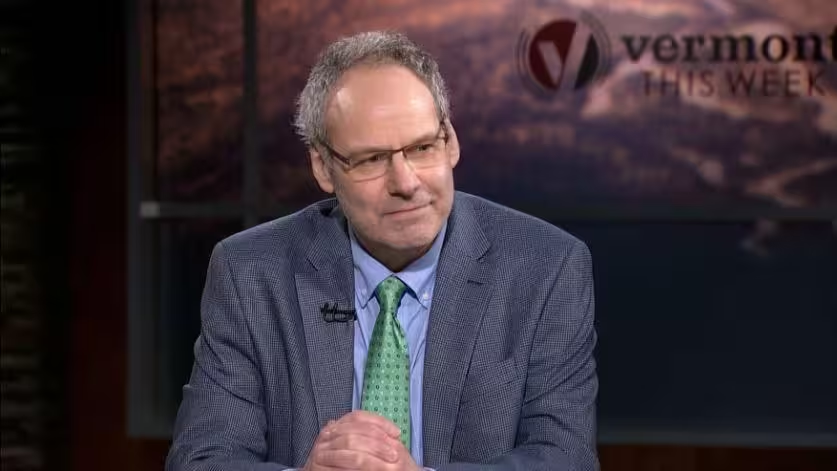
UVM Health will eliminate nearly 200 jobs | AOE tells school boards to only hire temporary leaders
UVM Health will eliminate nearly 200 jobs | AOE tells school boards to only hire temporary leaders | School budget in Barre fails for third time | Moderator - Mitch Wertlieb; Lola Duffort - Vermont Public; Alison Novak - Seven Days; Calvin Cutler - WCAX.
Problems playing video? | Closed Captioning Feedback
Problems playing video? | Closed Captioning Feedback
Vermont This Week is a local public television program presented by Vermont Public
Sponsored in part by Lintilhac Foundation and Milne Travel.
Support provided by:


Vermont This Week
September 18, 2026
9/18/2026 | 26m 46sVideo has Closed Captions
UVM Health will eliminate nearly 200 jobs | AOE tells school boards to only hire temporary leaders | School budget in Barre fails for third time | Moderator - Mitch Wertlieb; Lola Duffort - Vermont Public; Alison Novak - Seven Days; Calvin Cutler - WCAX.
Problems playing video? | Closed Captioning Feedback
Where to Watch Vermont This Week
Vermont This Week is available to stream on pbs.org and the PBS app.
Support the crew
Help Mitch keep the conversations going as a member of Vermont Public. Join us today and support independent journalism.Providing Support for PBS.org
Learn Moreabout PBS online sponsorshipCiting financial strain.
The state's largest health care provider, this week announced another round of layoffs, cutting nearly 200 jobs.
We are burning through reserves right now.
UVM Medical Center this year is going to lose more than $75 million.
Our reserves are only holding up right now because of the stock market.
Plus, the Vermont Agency of Education instructs school boards to hire only temporary leaders, and one of the state's lowest spending school districts fails to pass a budget for a third time.
All that and more ahead on Vermont This Week.
From the Vermont Public studio in Winooski.
This is Vermont this week, made possible in part by the Lintilhac Foundation and Milne Travel.
Here's moderator Mitch Wertlieb.
Hi, I'm Mitch Wertlieb.
It's Friday, September 18th, and with us on the panel today we have Lola Duffort from Vermont Public.
Calvin Cutler from WCAX and Alison Novak from seven days.
Thank you all so much for being here today.
Well, we're going to start right off with this very tough story as we heard at the top here, UVM health, the largest health network in Vermont, announcing a nearly 200 elimination of nearly 200 jobs.
Let's hear from the president of the nurses union about what this means.
We want to be super clear.
Our hospital, our members who run this hospital do not have the capacity to absorb these cuts.
We have already been sound in the alarm about staff and levels at the hospital.
We have already been concerned a Okay, so nearly 200 jobs being lost at UVM health.
Lowell Dufour, where does this leave the health network and why are these jobs being eliminated?
They are being eliminated because the hospital network is losing money.
It is on track to lose.
The last number I heard was roughly $75 million this fiscal year.
They are likely going to lose another 75 million next year, and that is because of a confluence of factors, some of which are larger than simply Vermont.
And we know this because Dartmouth Health, just across the Connecticut River the same day, also announced layoffs.
And some of it is because of Vermont specific factors, right?
Because of our really high health insurance rates, there is a ton of pressure, regulatory and political pressure on the network to find ways to rein in costs.
And this is one of the ways that they have chosen to do that.
One of the things we heard in that clip there was about the stock market we were talking about at the top.
I was reading that there was $1.5 billion in reserves that the hospital network has.
Why can't they use that money?
Well, they are using that money, right?
The argument they're making is like, yes.
And that is an important part of this conversation, right?
UVM health is still relatively financially robust and healthy, right?
Like, no one is worried that the University of the Medical Center is going to close down the way that we are about certain rural hospitals, for example.
Yeah, they have a runway.
The problem is they are they're using it and they are, you know, they are dealing with pretty steep operating losses right now.
And so that's the argument that they're making.
Right.
Is that okay.
Yes we have reserves but we are spending them down.
And also part of our financial health is a function of a really strong stock market that everyone is also kind of worried my crash and burn like tomorrow.
You can't predict that.
What does the Green Mountain Care Board been saying about all this?
They haven't.
Well, they haven't put out a statement since it's happened.
You know, I think at this point I'm, like, speculating a little bit.
That's okay.
Trying to make sense of all this as it happens.
But it was interesting how right before this happened, the Green Mountain Care Board voted on the medical center's budget.
All budgets in Vermont.
Sorry.
All hospital budgets in Vermont were voted on on Monday.
And a point of contention between members of the Green Mountain Care Board, which regulates hospital budgets, was sort of what to do about UVM.
MC right?
Because there is this consensus that prices and costs need to come down at UVM health, not the school.
But there is also concern about the impact of bringing those costs down.
Right.
Yeah.
You mentioned the financial situation and the political situation here.
There has been a very intentional and calculated game plan at the state level to give the Green Mountain Care Board more tools to bring down hospital costs.
And it's been agreed by by the governor and the democratically controlled legislature.
I'm wondering now that we are actually starting to see the fruition of some of these plans, and now this is hundreds of layoffs and who knows, maybe more to come.
I'm wondering if they might take the foot off the gas a little bit, you know, hearing from constituents and saying, wait a minute, like this is deeply unpopular.
Yeah.
I mean, to your point, right.
When they were voting on Monday, you had two members of the five member Green Mountain Care Board say, we're nervous about pushing as hard as we are.
You know, it was not a unanimous vote.
And we should be clear, the layoffs that happened on Tuesday were not tied very specifically to the vote that happened on Monday.
They were planned well in advance.
These were coming, is what you're saying?
These were one way or the other.
These were coming one way or another.
But but no one is denying that.
Like this larger context in which there is this political and regulatory expectation that the University of Medical that UVM health has to bring down costs is sort of what we are seeing here.
And so, yeah, I mean, I think there is sort of growing nervousness within decision makers that, you know, about what the balance is between trying to bring those costs down and also seeing a whole bunch of nurses laid off.
Can we talk about to that point, Lola, can we talk about some of the practical effects of this?
I mean, we haven't talked about specifically what jobs are being lost, but what's the ripple effect of this going to be, not just on on the nurses and the people who work these jobs, but also the patients that they care for?
Right.
Well, you know, we can't know for sure, but the people that were laid off, a lot of the people that were laid off on Tuesday are directly involved in patient care.
You know, I spoke to a nurse that works on a a unit that takes care of specifically older Vermonters who often have dementia and struggle with things like housing insecurity.
So we're talking about like Alzheimer's patients who are potentially homeless.
Right.
Does not get much more vulnerable than that.
And there was this unit.
There is this unit within the medical center that basically does kind of like dedicated, where it's all in one location, where you have case management and people are trying to figure out how to stabilize these patients, but also like what the game plan is for once they leave the hospital and the, you know, the medical center is saying they'll just be reabsorbed into the rest of the hospital.
But what we are hearing from the union is we we don't think that these patients are going to get the sort of extra attention, the dedicated attention that they need once they are sent into a hospital that now has less staffing in general that is stretched even more thin.
And so that's that's what we are hearing from impacted providers.
One more thing I want you to briefly mention, though, before we move on from the health care discussion, you talked about Dartmouth Health also same day announcing layoffs there, I think 124 job cuts at Dartmouth.
A lot of that is telehealth, right?
And that we're talking about limiting some telehealth programs.
And that means that in a rural area, it's going to be tougher for people to get some services.
Right?
Yeah.
We so sort of the only things that they mentioned in the press release that has to do with patient care is telehealth, but we don't really know what the whole universe is because to to be fair, Dartmouth Health was not very transparent about where these cuts are going to happen.
But yes, they are eliminating this telemedicine program that basically provided backup for, I think, over a dozen rural hospitals in the region.
And basically so what it would do is if you are an ICU patient or an emergency room patient in one of these hospitals providers, there could 24 over seven receive remote backup from specialists over a Dartmouth-Hitchcock.
And so it was this really crucial backup for for patients in more remote areas that might struggle to access that kind of specialty care.
And it's interesting.
I mean, like Dartmouth was touting this is this like innovative life saving program that was, you know, good for patients in places that are sort of the most neglected in the health system.
And this is what was on the chopping, which is gone.
So the idea that it would kind of tap into the expertise, the rural hospitals could tap into the expertise of Dartmouth.
Exactly.
Yeah, right.
So you often can't get these sorts of specialists.
I mean, one of the hospitals that it's serving is a hospital that doesn't have any doc.
Right?
They only have nurses in their E.R.. All right, well, things are going great in healthcare.
I you know, this boggles my mind.
I've said it before.
I'll say it again.
We're going to end up doing a show just about health care at some point, because these trends can't keep going this way.
Let's move on to education.
There's problems there, too.
Alison Novak, tell me why the agency of education is telling school boards to only hire temporary leaders for school superintendents for, for example, one year contracts.
Why are they making that instruction?
So the story I wrote this week pertains to three school districts.
So there's Mountain views, which is in the Woodstock area, Addison Northwest, as well as Washington Central.
There are all three school districts are looking for new superintendents.
All of them have been given the message by Secretary Saunders that they should only hire interim one year superintendents, and the reason she is giving is because of the education transformation underway.
And as I think viewers know, the education transformation underway will consist of these committees that will meet to discuss school district mergers.
They are voluntary mergers.
They are not mandatory.
That was a compromise that was reached at the end of the legislative session.
And so yeah, so that is why Secretary Saunders is saying basically we don't we only want you to hire a temporary superintendent because there's uncertainty about what districts will look like in the future.
I think the first thing I thought of when I read your article was, if you're trying to hire a superintendent, you say, hey, come to Vermont.
We know we've got this great school district and mature, oh, we can only hire you for a year.
Isn't that putting yourself behind the eight ball?
Because don't want people want at least some kind of maybe not long term job security, but more than a year.
Yeah, and that's exactly what school board chairs are saying.
They're saying that are the quality of our applicant pool would be severely diminished and lessened if we can only hire for and advertise for a one year position, a one year interim position.
I think the word interim is interesting, too, because I think that suggests like a very temporary position.
And so to put an ad out for an interim one year superintendent, I think, what kind of candidates are you going to get?
Are you going to get anyone who is really a high quality candidate?
Your point, I mean, and we can probably talk about this a little bit with the barre situation too, but where we will be drawing these lines and who is going to be a part of what facilitated merger group still remains anything but clear.
There were suggestions about where who should be dance partners with who, but we're already seeing multiple districts saying, I don't want to be your dance partner because I think you had it in one of your stories, like so-and-so can't pass a budget.
And so there really is the path to consolidation of governance units is still anything but clear.
Yeah.
And I think what's been really interesting in reporting this story is kind of this idea that, you know, at the end of the legislative session, Governor Scott said, you know what?
I'm willing to compromise.
I'm willing to accept voluntary mergers.
And everyone thought, oh, wow, you know, he came around to it.
But the way that the Secretary of Education and the governor are now treating this as is, as if mergers are going to happen and are mandatory.
So I think, you know, Margaret McLean, who is the kind of steering committee person for the Rural School Alliance, which is a pretty powerful group of kind of a coalition of rural school boards and select boards, said, you know, she feels that Secretary Saunders is getting a bit ahead of her skis here in terms of thinking that, you know, there's going to be a future state with all these merged districts when that's anything but certain right now.
And also, I'm sorry.
Lola, go.
Yeah.
It was just, you know, it feels like this is the governor saying like, okay, we said we'd do mergers on a voluntary basis.
You're going to do mergers though, right?
And school board saying maybe not like, you know, you gave us the choice, right.
Although, I mean, I think another interesting point your article made was, you know, these mergers, if they do happen big, if I'm not supposed to happen for another two years.
And so school districts were also like, why can't we even advertise for a two year position, right.
And to that point, you know, I think there's a question of whether Secretary Saunders actually has the legal authority to be able to.
Actually do this because it's an instruction.
It's not even a recommendation.
Right?
Right.
And also whether there's precedent for this and the AOA said there is precedent for the precedents for this.
They sent me some letters that former Secretary of Education Rebecca Holcomb had sent to a school district during kind of in the aftermath of act 46 that directed one year superintendent search.
But according to several people I talked to, that was a very kind of unique situation.
Whereas it seems like what the policy of the agency of education is right now is it's like kind of a blanket approach.
And across the board, like anyone looking for a new superintendent has to should hire a one year superintendent.
But, you know, one lawyer I talked to you who used to be the general counsel for the Agency of Education, said, you know, under state statute, it says that school boards can hire secretaries or sorry, superintendents with the advice of the advice of the secretary.
It doesn't say advice and consent.
And so that consent being left out, I think, in his mind, made it unclear whether she actually has the legal authority to do that.
Well, also this idea of let's have a one year sort of hiring mandate because, you know, we don't know where the education law is going.
Well, nobody knows where it's going, and we don't know what it's going to look like in a couple of years.
So so why make this decision now, I guess is my question, you know, for the governor.
Well, I mean, I think that they.
Are.
They would like to see these mergers happen.
And so that is one way, you know, in kind of being able to exert power in certain areas.
That is maybe one kind of pressure point they have in trying to make those mergers happen.
So, you know, I think yeah, I think that they're trying to put pressure on, on school boards to really consider these mergers seriously.
And I'll just one last point on it.
You know, I sat down with the governor this week for a campaign interview and still in his mind.
Property tax and education reform is still the number one issue, pressing the state, pointing to the cost burden on Vermonters and spiking property taxes.
So for him and Secretary Saunders, this is still a huge priority.
Yeah.
But is consolidation going to lower property taxes?
That's the right question.
Yeah, I think that's what we feel has not been has not been shown.
There's not.
It's not been shown that that is actually going to be the effect.
This was some of the hesitancy was all about right when people were talking about this.
It's like we have to study this more.
But then the governor was saying, we've got to take action.
Now, we don't know if the consolidation is going to bring down those costs.
And there is some research that shows pretty clearly that, like there's a sweet spot, right.
You do get more efficiencies if you go from like tiny tiny to mid-sized.
And then when you go from midsize to big, you start having like inefficiencies.
Yeah.
But once you are bigger, you can also just choose to use your efficiencies to add on a ton more programing.
Right.
I mean, what people keep bringing up to me though is the leveling up of salaries.
So if you merge districts and you have one district where the teachers are making a lot more than another district, teachers are not going to go down in salary, right?
You're going to have to level up.
And those could be pretty, pretty big costs.
And so I think that is one issue that could make it not necessarily as money saving as as maybe people think.
Do you know where this is going from here, Alison?
Because again, no legal challenges have been made yet.
But have you been hearing anything about that?
Well, Mountain Views has told me that they are going to go ahead and advertise for a two year superintendent.
Yeah.
They don't believe that Secretary Saunders has the legal authority to tell them that they can only hire a one year superintendent.
So that was their stance as of a couple of days ago.
And so we will see the other two.
I'm not I'm not quite sure about.
But you know, that could cause some friction between that district and the agency of education.
Perhaps.
But that is what they told me.
We will keep following your reporting on that.
Meanwhile, check out the article in seven days.
Fascinating stuff.
We're going to stick on education here as we talk about the school budget in Barrie.
Third time not the charm for Barrie Calvin Cutler.
They have voted down their school budget for a third time.
Let's hear what the chair of the Barrie Unified Union School District had to say.
There's going to be some really difficult decisions made ahead.
People will not be happy.
I'm not happy.
This whole situation is heartbreaking.
Sometimes it feels bigger than the school budget.
It feels like this is the only place I get to exercise any control.
And so I'm going to do it.
And that's what I think was in the mindset of a lot of folks.
The word heartbreaking.
Is that too strong a word what's happening here in Barrie with the district?
No, I mean, it was really divisive in the community.
I mean, there's a confluence of factors here and we can get into them.
There's a lot.
But I mean, this was a really tough vote for for the community.
It passed in Barrie City, but it failed in Barrie town.
And the way that the votes fell out, it failed for a confluence of issues.
I mean, there was a reappraisal recently in Barrie.
You know, people also are just cost and tax sensitive.
I mean, there really is a sort of concern about affordability out there.
And to to Garrett's point there in the sound bite, like this is one way that people feel like they can exert control or something like that over, you know, the budget.
And then there was also, Alison, you put in your story a lot of AI slop online, spreading what some described as misinformation about the budget and what it did and all of that.
So this was a $57 million budget.
It's about a 2% increase from last year.
So now the board's going to have to go back to the drawing board, make more cuts.
That could mean extracurriculars.
It could meet sports.
We don't know exactly what yet.
But I mean, this also just highlights this broader like this is the whole why to the education reform where you get the berries and the slate valleys.
And I think Kingdom Easter, there's some school districts that really struggle to pass their budget year over year.
And so they have to cut, cut, cut.
And then you get places like in Middlebury that just pass it on the first try.
And so that's that's the equity piece of this.
We can talk about Brigham and all of that.
But I mean, again, this this raises all kinds of questions about what is Berry going to do, but it's just a flash point of the broader where are we going with education reform?
Yeah, I mean, this is the price of local control, right?
Is that certain communities say no again and again to their school budgets, including Berry's one of the lowest spenders in the state consistently.
And it was this year again.
The only one of the 2.1% increase in their budget, right, that they they handed in this time.
I believe.
So I. Guess 1% from last year.
That was the first budget they tried to pass was like a 3.5.
And then they kind of whittled it down and yeah, yeah.
And also Barry has like one of the largest populations of vulnerable kids.
Right.
Like high poverty rates.
And it is also the district that can't pass a budget.
And so kids with the highest needs get way fewer resources than the kids in Montpelier, than the kids in Harwood, etc., etc.. And yeah, I mean, it's interesting.
And now people, you know, is there going through possible merger committees.
You have other central Vermont communities that are saying, well, we don't want to we don't want Barry on our dance card.
And so, you know, if Vermont sticks with its tradition of local control.
These will be one of the prices.
And I. Think it's important to also note, like what they can and can't cut at this point because.
So for example, three quarters of their of the budget is salaries and benefits.
That is all locked in.
That was locked in back in the spring when teachers, you know, returned their contracts so they don't have a lot of wiggle room for what they're going to cut.
And that's why they're saying, you know, we might have to cut sports, we might have to cut extracurriculars or transportation.
There's only a certain amount of things that we actually really have control over.
So at this point in the in the year.
And also in theory, I mean, so there's the the redistricting and consolidation piece of education reform, but then there's also the foundation formula, right.
That's going to be supposedly hitting in a few years to make sure that, you know, schools are paid like what it costs to educate a kid.
But I mean, there is still like you ask any Chittenden County lawmaker and they are very lukewarm on on the on the foundation formula.
We don't know what those rates are going to be.
I mean, there's just so much uncertainty of the framework that was passed and whether it's actually going to come to fruition and whether it's going to help the berries and the slate valleys and others of the world.
Well, it would and it wouldn't.
Right?
I mean, the thing with the foundation formula is it would raise spending in places like Barre, right?
Because you'd have a formula that's like, okay, this is how much it actually takes to educate a kid.
We're going to give it to you.
And it would probably lower spending in higher spending districts that we see in Shenzhen County, you know, Montpelier and Middlebury, etc.. And but also it would likely raise taxes in Barre, right, because taxes would be adjusted accordingly.
And so everyone's a winner and everyone's also kind of a loser.
Can we talk a little bit about this misinformation, though, that that Calvin referred to as I read in your article on this, Alison, that a lot of information was passed around us on Facebook, to your point about what can be cut, what can't be cut?
Where were these?
What were the messages that were being put out there that were sort of maybe giving people the wrong information to vote on?
Yeah, I mean, I think there was a lot of misinformation about, you know, how much that school board could actually control in terms of like, you know, administrator cost.
That's not something they're going to be able to cut at this point in the year.
There is also some interesting stuff about, you know, it's the Democrats in Montpelier that have led to this situation, and we're going to send them a message by voting no.
So kind of taking on this real kind of political, bigger than just the school district, very partizan bent.
You know, some of these messages were coming from an account called MAGA Vermont.
And I viewed a bunch of them.
And that was actually one of the first things that the school board chair said to me, that he felt that like that was a big reason that the budget failed.
This time.
He had put out a message in the day before the election that was like a myth busting message he had put on Front Porch Forum, trying to kind of come back like there were nine different points.
He was trying to combat myths and then kind of the facts that would refute them.
So he felt.
And then there was a forum to kind of talk about the budget and get people to come.
And only he said only 7 to 10 people came to that.
And so I think he was just feeling very disheartened about the community engagement or their engagement on social media, but their lack of engagement in real life.
Kelvin Cutler, very briefly, what happens if the budget doesn't get passed in Barrie?
Aren't they borrowing against money at a penalty point?
Yeah.
So under state law they now have the authority to borrow up to 80%, I believe, of.
87.
87% of last year's budget.
So they're taking a cut and they're also paying interest on it.
I think it's now 20, $22,000 a month that they're going to be paying.
So when's the next vote?
Do we know.
They're going to be meeting next week to go back to the drawing board to figure it out?
Okay.
We'll have to follow it from that point on.
A couple of notes I want to finish on here to let folks know about.
A federal judge has dismissed the U.S.
Department of Justice case against the state of Vermont for refusing to hand over voter data.
We got votes coming up.
Of course, the Supreme Court has affirmed states can be in charge of their elections.
This deals with mail in ballot and voting.
And, by the way, for ballots will be going out next week.
So look for those.
If you're not getting your ballots in the mail, contact your city clerk's office and make sure that you are able to vote.
We're gonna have to leave it there this week.
Thank you so much to our panel.
Lola Duffort from Vermont Public.
Calvin Cutler from WCAX and Alison Novak from seven days.
I'm Mitch Wertlieb, thank you so much for watching.
We'll see you next Friday right here on Vermont this week.
 New Episode
- News and Public Affairs

Top journalists deliver compelling original analysis of the hour's headlines.

- News and Public Affairs

FRONTLINE is investigative journalism that questions, explains and changes our world.
 New Episode
 New Episode
 New Episode
 New Episode
 New Episode
 New Episode
 New Episode
 New Episode
 New Episode
Support for PBS provided by:
Vermont This Week is a local public television program presented by Vermont Public
Sponsored in part by Lintilhac Foundation and Milne Travel.