Vermont This Week
September 20, 2024
9/20/2024 | 26m 41sVideo has Closed Captions
Towns urge state to provide options for unhoused residents leaving motels | Cyber scams in Vermont
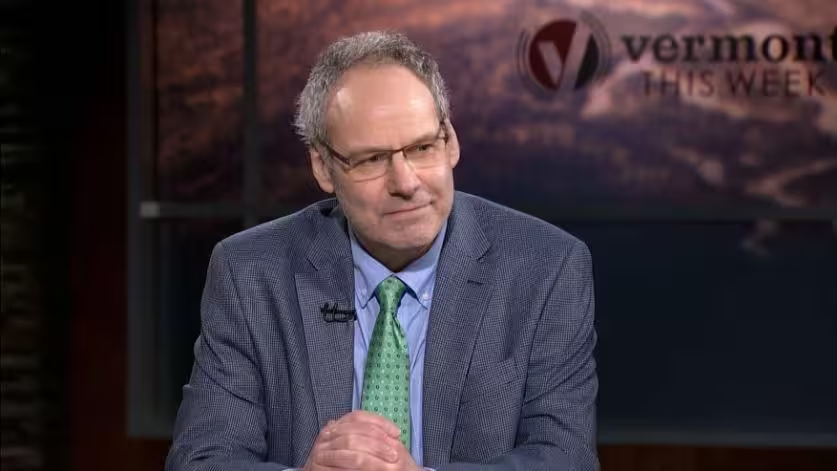
Towns urge state to provide options for unhoused residents leaving motels | Cyber scams in Vermont | Report advocates for dramatic changes to Vt.’s health care system | Panel: Mitch Wertlieb - Moderator, Vermont Public; Calvin Cutler - WCAX; Carly Berlin - Vermont Public/VTDigger; Derek Brouwer - Seven Days.
Problems playing video? | Closed Captioning Feedback
Problems playing video? | Closed Captioning Feedback
Vermont This Week is a local public television program presented by Vermont Public
Sponsored in part by Lintilhac Foundation and Milne Travel.
Support provided by:


Vermont This Week
September 20, 2024
9/20/2024 | 26m 41sVideo has Closed Captions
Towns urge state to provide options for unhoused residents leaving motels | Cyber scams in Vermont | Report advocates for dramatic changes to Vt.’s health care system | Panel: Mitch Wertlieb - Moderator, Vermont Public; Calvin Cutler - WCAX; Carly Berlin - Vermont Public/VTDigger; Derek Brouwer - Seven Days.
Problems playing video? | Closed Captioning Feedback
How to Watch Vermont This Week
Vermont This Week is available to stream on pbs.org and the free PBS App, available on iPhone, Apple TV, Android TV, Android smartphones, Amazon Fire TV, Amazon Fire Tablet, Roku, Samsung Smart TV, and Vizio.
Support the crew
Help Mitch keep the conversations going as a member of Vermont Public. Join us today and support independent journalism.Providing Support for PBS.org
Learn Moreabout PBS online sponsorshipCities and towns are urging the Scott administration to provide options for unhoused residents.
As roughly 230 households enrolled in the state's emergency housing program reach a new 80 day limit on voucher stays in children, 23 adults and children lose their homes.
It's a difficult situation to understand the point of view of the municipalities as well, but we don't have the resources either.
and so we're in the position we're at, plus how cyber scams are defrauding Vermonters.
And a new report advocates for dramatic changes to Vermont's health care system.
That and more ahead on Vermont this Week.
From the Vermont Public studio in Winooski, this is Vermont this Week, made possible in part by the Lintilhac Foundation and Milne Travel.
Here's moderator Mitch Wertlieb.
Thanks so much for being with us.
I'm Mitch Wertlieb.
It's Friday, September 20th, and joining us on the panel today.
We have Calvin Cutler from WCAX, Derek Brewer from Seven Days, and Carly Berlin from VTDigger and Vermont Public.
Thank you all so much for being here.
Carly.
We're going to start with some of your reporting on a really difficult issue.
And this deals with, folks who are now being told they must leave, Vermont's motel voucher program.
Some context here.
First, when did the folks using the motel housing program first sort of enter into it in this iteration we know of now?
And why are they being told to leave now?
Yes.
People have entered in at different times.
Right.
But this program expanded greatly during the pandemic.
We had an influx of federal money to, you know, put people up in hotel and motel rooms, allowed them to social distance from Covid.
The reason that they're leaving now is, you know, for years, state leaders have been, you know, fighting, grappling with how to scale this program back.
You know, we got to see during Covid our, you know, numbers of people experiencing homelessness in Vermont skyrocket.
There are a lot more people in this program now than ever utilize a prior version of it that existed before the pandemic.
And right now there are new limits kicking in, that lawmakers pass this past spring.
So there are two different ones.
there's a new limit on the number of rooms available in the program that kicked in this past Sunday.
And then there's a new limit on the number of nights people can have a voucher for.
So those vouchers will last for 80 days.
Those limits are kicking in this week.
Okay.
What's different about some of the population of people who are leaving now?
Right.
So, you know, over the last few years we've we've seen these mass exits from the program before.
You know, what's different right now is that lawmakers have extended motel stays for people who meet certain vulnerability criteria.
Families with kids, people with extreme disabilities, people who are elderly.
That's done now, you know, no one is protected from this new 80 day limit.
And so as people reach those, you know, starting yesterday, you know, we're seeing families with kids leave motels with nowhere else to go, nowhere else to go.
You've met some of these families.
What are some stories you've heard?
Yeah, I spent yesterday with a family of four in Shelburne, who has two kids with autism.
they have been in the program since late last year when they had a no cause eviction from their apartment in Burlington.
And, you know, they have tried to get into a shelter they called the family shelter in Burlington, which is full and has a long waitlist.
They actually have a housing voucher to help them pay rent, but they can't find anywhere to use it that will, you know, meet the the rent threshold that you need when you use one of those.
And so they have few options.
They don't have family that they can stay with.
You know parents have passed away.
And so, you know, people are leaving these hotels and motels with, you know, really no other option in front of them.
And nowhere to go.
Here's what a Good Samaritan haven outreach worker had to say about all this.
The priorities right now are going to be families with children, and then we're going to be going from there with the most vulnerable and just doing our best to help.
Because really, the congregate shelters are not the answer for most of the people that are in the motels, the congregate shelters.
She was talking about what what are those like?
What is she describing there?
Yeah, I think what she's describing is, you know, shelter spaces where you have, you know, one big room with cots with, you know, a bunch of beds together where people don't have a lot of privacy.
You know, the hotel program is the opposite of that.
People.
People have their their own room and, you know, a little bit of space to themselves, a place to sleep safely and feel okay.
so, you know, all of this is happening now and it's, it's it's really scary.
for a lot of people, the idea is that they can last till December when they have the option to, to come back to these motels.
Yeah, that's it's a little confusing.
So these two different caps I talked about the cap on the number of rooms the state is going to pay for this year and the number of nights people can have.
Both of those limits are going to lift during the winter months.
So the program is going to expand again.
You know, people who ran out there 80 day clock are going to be able to come back in.
There's not going to be this 1100 room threshold that the state needs to stay under.
so people need to figure out what, you know, if they're if they intend to come back in December, something to do in between.
you know, I have spoken to a lot of people who are finding tents and finding places to put them if they can now.
So this has led now to town officials urging, state officials to say, look, this is a serious deal here.
We have a real big homelessness problem.
They're saying something's got to be done.
So what was the fallout from all that?
Governor Scott was responding to some of this, right?
Yeah.
So the most immediate thing that the municipal leaders were calling for at this press conference they held this week was for the state to open up state buildings for shelters and state land for sanctioned encampments, that the state would then oversee.
You know, there was a version of this that happened this past March.
People might remember where the state opened up a couple of, you know, very barebones shelters across the state for people to go to.
When we had another round of exits from the program, very few people made their way to those.
And members of the Scott administration have said, you know, pointed to that, how few people came and said, you know, okay, perhaps people actually have somewhere else to go and use that as a rationale to, you know, not mount a similar response this time.
At the time, service providers were saying, no one's been notified that these shelters are here.
they don't have a way to get to them, you know, all of those things.
And so, you know, right now, there is no option to direct people toward when they're leaving.
Calvin, you've been reporting on this, too, right?
It's been really fascinating to see this program grow during the pandemic.
And here it is.
It's really painful for everybody involved to try to unwind this.
I remember when during Covid, during the, in the legislature, as they were extending it over and over and keeping, you know, a roof over people's heads.
I remember asking, you know, what's the plan?
What's the strategy?
What is our end goal here?
and as you know, during the pandemic, the state put in over half $1 billion.
It was about 500, maybe $600 million into affordable housing for developers, for Champlain Housing Trust and for, evernorth and others.
And I remember lawmakers telling me at the time, the goal is to use some of that money to build more affordable housing, more permanent housing, you know, shelters X, Y, and Z, right.
And so the idea was to build that housing, have that all come online so people could then get into that housing.
But the problem is, as well as we've seen over the past few years with labor shortages, inflation, you know, lending and pressure materials to, to build these types of materials.
Exactly.
And that, that has not materialized.
And so the hotel program being a bridge to more permanent housing, it's a plan that has really been been challenged.
And so now, you know, state leaders and, the people who are leaving these, these programs have to make these really, really difficult choices.
I want to mention one other thing to, Carly, that you've been reporting on.
It's not a side issue.
It's all connected.
But there has been this perception, I think, and correct me if I'm wrong, that a lot of people feel like, well, you know, the motel voucher program and things like that in Vermont, it's been kind of a draw for people who are unhoused, who are homeless from out of state to come to Vermont.
Take advantage of that.
You did some reporting on this for Brave Little State, a special episode on that.
and we're going to direct folks to that.
But, you know, you really dug into that issue to find out whether this is a myth or not, right?
I did, yeah.
You know, writing about homelessness, this was the number one question that prompted people to reach out to me.
You know, over the course of the last year, they were asking you that specifically, specifically, specifically, my inbox was full of these questions.
I decided to start calling people who had reached out with a to, to kind of probe, you know, what is leading you to to think this and, and ask me about it.
so that was the, you know, the catalyst for, for spending, you know, 40 minutes digging into to this question, for brave little states.
But it is it is worth a listen.
I really want to direct people to that episode of Brave Little State to find out the real information about what's going on with all these things.
I want to turn now to a story that is, not any more positive, I'm afraid.
Derek Brower, you wrote about this in seven days.
It is.
I don't know what to call it, really.
It makes you sad when you read it.
It makes you angry.
We're talking about cyber scams, that have really hit people in Vermont.
one woman in particular told her your story.
What is going on here?
Who's being affected?
Yeah.
You know, when I started reporting on this story, I thought I understood everything about scams.
You know, you get these alerts occasionally.
There's a new story every year or so.
And as I got into it and started talking to these, women for the story, I realized I did.
I knew so little about how these scams actually work and the impact that they have.
so what I focused in on was a couple of women who were victims of what's called a tech support scam.
So this is basically a pop up that comes on your computer.
In some cases, there's a loud screaming sound that tells you you've been hacked.
You need to call this number for support.
You call the number and it's often, an illicit call center in another country.
And those, the people who answer the phone are posing as tech support workers.
In some cases, Apple, Microsoft, it can be anybody.
And from there, they they've got your attention.
They have you scared, and they convince you that, to protect your finances from these hackers, they will coach you on how to move money into other accounts.
And the really astounding thing was that the scam can then play out over a period of weeks and months.
So the one night I spoke with they they told me they were on the phone with these scammers every day for a period of two months.
Up to one woman was in Bennington.
She was, it took her six months to move her entire life savings into these cryptocurrency accounts.
She ended up losing $950,000.
And that was her entire nest egg, her savings, everything.
Right that she'd built up over many years.
Yeah.
She had worked in human resources and marketing for a tech company.
She was able to retire at age 59, and she moved back to Bennington, where she remembered being the happiest in her life.
And so she was really well set.
But she was also alone and isolated, in this town where she, she didn't really know anybody, so she didn't have somebody to bounce this off of.
And, very quickly, once she was on the phone with these scammers, they, they, they coached her.
They said, you don't know who has hacked you.
You can't tell anybody about this.
Don't trust anyone.
You don't know who's behind it.
And and so they became first period of six months.
Really the only people this woman was was talking to.
She was even confiding with them.
They became the only people she could trust during this period of time.
That's another amazing thing about your story, because, we often think about elderly people being vulnerable here, and they are I mean, a lot of elderly people are targeted for these scams, but there was a quote in your article that said, it's sometimes it's not about who you are, but how you are and describing this woman.
It's where you are in your life.
And if you're vulnerable, you're isolated.
Often that can be a target for these scammers, right?
Yeah, absolutely.
And, that was from a fraud expert who worked with AARP.
And they did some surveys that found that, people who had experienced really stressful life events in the months before the scammer targeted them were more likely to to fall for the scam.
and, and in the case of both of the women I spoke with, they met that criteria.
They had gone through some difficult things.
and they were alone, like so many older Vermonters are.
So I think there is this is really important point, Mitch.
I think that there's this widespread misconception that you have to be gullible or stupid to fall for these.
And it's not true.
These scams are both really sophisticated.
And they they, they cost thousands and thousands of people.
They plant these the, this malware, these pop ups on almost everybody's computer and so, they're going to they're going to catch people.
And, and the thing is once, once they do have their hook in, it's it's not just the money that, the victims lose it is it is there there is so much shame associated with this.
and, and there is a sense of helplessness.
And I would think, too, that maybe we don't even know how many people are affected because of that shame that you're talking about.
Doesn't a lot of this go unreported because people just don't want to admit this happened to them?
Yeah.
That's right.
I mean, the FBI has I mean, there there are about 150 Vermonters a year, you know, give or take, who report this kind of theft to the FBI.
Last year, elders in particular reported losing almost $5 million in Vermont.
But that's really all indications are that's that's a lowball, that that many people, suffer silently with this.
They don't even tell their, their friends or family.
In fact, the woman who I, profile in the story, the scam happened three years ago, and, she still hasn't told her son or her brother, and she plan to actually give them the story once it published, as a way to finally tell them what she had been going through.
And briefly, there's a double whammy here, too, because there are tax implications, implications that come from the federal government, as I understand it.
Yeah, I was saying I thought I knew everything about scams and I didn't.
This was the biggest shock to me is that, because victims are so often are, coerced into or induced into withdrawing money from investment accounts, like for one case, according to the IRS, you stole a tax money on that.
So.
So this woman in Bennington who I profile, she was hit with over $160,000 in taxes afterward.
Now, interestingly, there there used to be a straightforward deduction on your tax return that you could take, to account for this kind of theft loss.
But in 2017, when Republicans in Congress passed the Tax Cuts and Jobs Act, they were looking for ways to to pay for their other tax cuts.
And so they pare down this deduction.
And now that is in the years since that has left victims, with, with little recourse to, to deal with this massive tax bill.
And there is still a way you can get it reduced, but it involves a ton of work that is beyond the capability of, of some people, especially when they're so distraught.
and also there's no guarantees.
So this, this woman, who I met, who I'm talking about in Bennington, she ended up paying, just over, let's see, about $6,000 in taxes after the fact, which she had been left with $10,000 in her accounts.
And then more than half of that went toward settling her income and property taxes.
The last thing I'll say about this is people should read this story.
And also, one thing I appreciated is that at the bottom there at the end, you have, tips on how to try to avoid some of these things.
they're listed there.
And again, this is the kind of thing that a lot of people could fall for.
It's not just over elderly people.
So I appreciate you putting in those tips to try and avoid these things and what to do if you think this is happening to you.
So thank you for that reporting.
Calvin, I want to turn now to, a health care story that also has a lot of us concerned here in the state of Vermont.
the Green Mountain Care Board is approved.
Hospital budgets.
But what we're hearing is from an outside report that Vermont's hospitals are kind of going bankrupt.
Yeah.
Is that the truth?
Is this this conversation has been years in the making, and it's a challenge faced by Vermont, but also rural health care nationally.
Right.
And it's kind of gets back to this.
How do you deliver service in a rural state with a declining demographic and a declining, working age population?
So the Green Mountain Care Board this week, approved about 150 ish new, million dollars in new hospital spending across Vermont's 14 hospitals.
And that new spending is driven, by staff, wages, infrastructure costs, you know, administrative costs across all of our hospitals.
in recent years, especially since the pandemic, health care costs have really been going through the roof.
And so when you have hospital budgets that go up, commercial insurance premiums also increase.
In the past few years, those have increased by double digits for private insurance, Blue Cross Blue Shield MVP.
And when your health insurance rates go up that's your deductible, right?
That's you're you're paying more.
And that falls on small businesses.
And it pays on or falls on Vermonters.
So that's why people are potentially getting priced out here.
I mean that's that's the real concern is that people can't afford to pay their insurance company, so they forgo care, their conditions get worse and it gets more expensive to treat it later on.
maybe you have to take an ambulance or X, Y and Z.
So that's that's the risk you mentioned.
Our hospitals, especially rural ones, are bleeding cash.
It was really five years ago when Springfield Hospital declared bankruptcy, that this set off all kinds of alarm bells within the Green Mountain Care Board, within the legislature, the Agency of Human Services.
And they said, we need to do something.
So there's been, hospital sustainability work that they've been, hosting all kinds of, community forums and, you know, panels with hospitals and communities to try to get a sense of, like, where should our resources be?
What services should each hospital provide, and what should just the physical footprint of our hospitals look like?
You know, do we need 14 full service hospitals?
And there was a mammoth 144 page report that was issued this week from a consultant, Oliver Wyman, which brought forward some pretty, really, really challenging.
I think I'll say, recommendations that are going to be ahead.
I want to get to some of those recommendations in a moment.
Here's what, the consultant had to say about about the state of the hospitals.
Those hospitals are currently financially unsustainable.
And we project by 2028, 13 of the 14 will report even more, significant financial losses.
Hospitals will need to, reconfigure their services and the sites, where they deliver them so that more is done away from the inpatient units of the hospital.
Okay.
Reconfigure their services.
I've tried to imagine what that means.
Can you sort of bullet point or highlight some of the points in this consultant's report that makes recommendations for how Vermont must change?
Yeah, there's four hospitals that really are in the crosshairs of it, essentially cutting back services or closing hospital beds, closing overnight stays and shifting resources to, you know, more, you know, long term care and mental health, you know, senior care using some of those inpatient facilities for that, and taking more intense medical care and putting that to primary care or to, service providers elsewhere in the community, more, clinic based care as opposed to people getting their primary care at hospitals because hospital care is very expensive.
So that's what he kind of means.
But the big elephant in the room is, is closing beds, these, these hospitals, and this was why Springfield was such a wake up call.
These hospitals are huge employers.
I mean, Gifford, employs 500 people alone.
And it's not just, you know, the jobs, but it's the peace of mind as well.
Having a hospital, having an emergency room in your community, or.
And it's not just for Randolph.
If you're in Braintree, per se.
Are all these smaller Roxbury, smaller towns that, you know, really feed into, these, these hospitals?
So if you, you know, don't have a hospital, if you don't have an emergency room or you can't, you know, visit your, ObGyn, doctor in Randolph, you know, you might have to go and, can you get all the way to Dartmouth-Hitchcock or to UVM?
And we talk about vulnerable, Vermonters, you know, in a rural state where transportation is really challenged.
these are some of the these are going to be really tough conversations, very tough.
And, you know, you're talking about we talk about this almost every week, the aging demographic of Vermont.
And when people are older they need more medical care.
This is cost saving stuff.
But it doesn't seem to me like taking away beds for for a population that seems to need more of them is going to work.
Exactly.
And that's the thing is, it's this chicken in the egg sort of, cycle.
We get, you know, we need to grow our demographics.
We need to get out of this.
But yeah, but at the same time, if you can't grow your way out, that just the problem compounds and gets worse and worse.
It's this.
This merry go round of spiraling health care costs that we as a state just can't get off of.
I talked with the economic development folks in Randolph to see, like, what would this mean for what would this closure mean for you in the community.
And they say that, you know, this this hospital is too important for them to lose.
They say that they have employers with about 200 open jobs, and they also have lots that are ready to be built, hook up, hooked up to water and sewer.
They say they need the legislature in the state to take housing and allow for more housing to be built, and to continue that work, because they say we need to grow our way out of this.
And they say that these hospitals are worth fighting, fighting for.
So it's, it's, as I said, a lot of really difficult decisions ahead.
and these are going to be very passionate, just like the school funding.
You know, what should the future of our education system look like?
How do you deliver education in a rural state?
there's the stakes are going to be really high here.
And the timeline is very compressed, anywhere from 3 to 4 years, potentially, before some of these hospitals, really get into a challenging place.
I'm seeing connections here between the hospital problem and the housing problem.
Carley.
Are you seeing that, too?
Yeah, I absolutely am.
And, you know, one of the things you hear a lot about older Vermonters in particular is they're in these large homes that are aging, too and need a lot of maintenance that they can't keep up with.
And, you know, as our population shifts older, too, when, you know, older people have kids, those kids don't have places to move.
And then older people who who want to, you know, perhaps downsize into a smaller unit, you know, would be looking at really high mortgage rates and incredibly high prices if they wanted to move somewhere smaller to unlock that larger house for a growing family.
And so we have this gridlock in our housing market, too, that makes it hard for people already here to move around and really challenging for growth.
It's in housing.
It's in health care.
You know, you've got patients that need long term care or need mental health placements, but they can't because, beds are full and there's just no flow through the system.
Whether we're talking about, you know, a new family trying to get that missing middle starter home or if it's a senior or somebody, you know, looking to get into a detox bed or, you know, sober living facility.
It's it's a it's a big challenge.
And what are Vermont's political leaders saying about solutions?
Well, the governor, has talked about, number one, continuing to grow our economy, recruit more workers.
You know, I think his line is we need more tax payers, not more taxes, which is what he's what he said.
but he also acknowledged that, you know, we probably do need to be more strategic in where we put our resources and spending and, you know, rethinking whether some of these hospitals are the best use of our money.
and if we can actually afford 14 full service hospitals.
So that's sort of what the governor said.
I haven't actually checked in with any state lawmakers on this as of yet.
Most of the work here will be done by the Agency of Human Services.
the Green Mountain Care Board, there were a number of, policy prescriptions, including moving forward with payment reform, with the all payer model, you know, for the legislature investing in housing and continuing to move forward with that.
So, yeah, there's a lot there.
There is a lot here.
And, you know, my guests and I'm just going to make a prediction at some point, someone is going to talk about an idea that that then Governor Peter, someone had about a universal health care system, whether or not that is sustainable to happen.
But you remember that talk that.
Oh, yeah.
And and on Monday, actually, there is, you know, advocates, I think it's the, the Medicaid Army is, they've advocates of single payer are already, you know, voicing, their concern about this plan.
And I think we might start to see next session, you know, the universal Health Care Caucus, maybe getting out more in front of this.
So what's going to be interesting?
We'll follow that for sure.
I'm determined to go out on somewhat of a high note.
fans of pro basketball is coming back to central Vermont.
The Coyotes will be playing their games at Barry Auditorium.
This is the first team to be here since the Vermont Frost Heaves played at the odd.
And they won two national championships, by the way.
So good luck to the Coyotes as well.
When they start playing basketball.
They'll start recruiting next month.
They'll be a press conference about this and we'll have basketball back in central Vermont.
I want to thank our panel so much for being here today, Calvin Cutler, Derek Brower and Carly Berlin.
It's been wonderful having you and sharing your insights with us.
And thank you all so much for your reporting.
I'm Mitch Wertlieb.
but I really appreciate you watching and listening, and we will see you next week here on Vermont this week.
I hope you have a great week.
In the meantime.

- News and Public Affairs

Top journalists deliver compelling original analysis of the hour's headlines.

- News and Public Affairs

FRONTLINE is investigative journalism that questions, explains and changes our world.












Support for PBS provided by:
Vermont This Week is a local public television program presented by Vermont Public
Sponsored in part by Lintilhac Foundation and Milne Travel.