Compass
September 2021 Edition
Season 5 Episode 12 | 26m 46sVideo has Closed Captions
Watch the September 2021 Edition on Sept. 8 at 9 p.m. on Pioneer PBS or the PBS Video App.
The September edition of Pioneer PBS’s public affairs program Compass features a heartwarming story about caregiving, a new pergola in Milan, the Perennial Promise Growers Cooperative and Farmfest’s Woman Farmer of the Year.
Problems playing video? | Closed Captioning Feedback
Problems playing video? | Closed Captioning Feedback
Compass is a local public television program presented by Pioneer PBS
Compass
September 2021 Edition
Season 5 Episode 12 | 26m 46sVideo has Closed Captions
The September edition of Pioneer PBS’s public affairs program Compass features a heartwarming story about caregiving, a new pergola in Milan, the Perennial Promise Growers Cooperative and Farmfest’s Woman Farmer of the Year.
Problems playing video? | Closed Captioning Feedback
How to Watch Compass
Compass is available to stream on pbs.org and the free PBS App, available on iPhone, Apple TV, Android TV, Android smartphones, Amazon Fire TV, Amazon Fire Tablet, Roku, Samsung Smart TV, and Vizio.
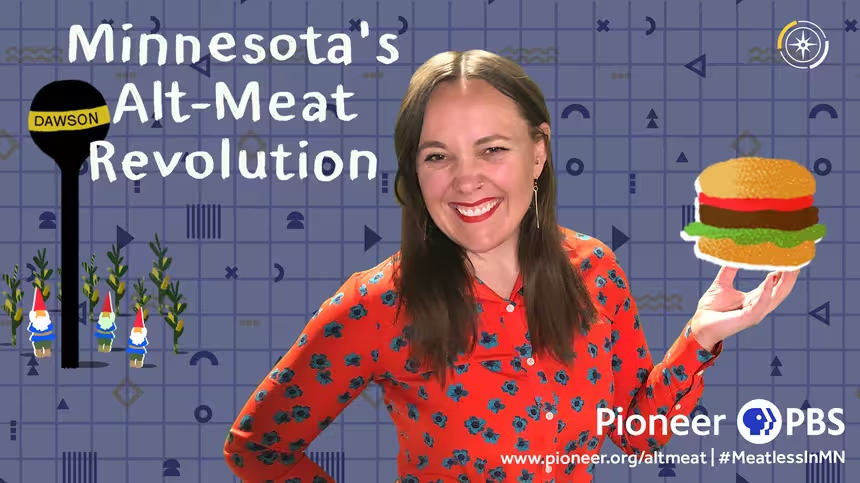
Minnesota’s Alt-Meat Revolution
“Minnesota’s Alt-Meat Revolution" is a year-long video and print journalism collaboration project, looking into the roots and impact of the plant-protein phenomenon that’s exploding across the globe.Providing Support for PBS.org
Learn Moreabout PBS online sponsorship(gentle music) - [Amanda] Funding for "Compass" is provided in part by the Otto Bremer Trust, (lively music) the McKnight Foundation, and Members of Pioneer PBS, thank you!
Hi, I'm Amanda Anderson.
Welcome to the September edition of "Compass," the regional public affairs show on Pioneer PBS.
Thanks to everyone who's been watching and engaging with our stories, both on-air and online.
This refreshed version of "Compass" is meant to be audience-centered.
We also regularly post stories when they're completed on our website and social media.
Head over there to see what we've been working on and to comment and tell us what you think of each story as you watch.
We start our program in Montevideo, where a groundbreaking event for a new veterans home took place on August 23rd.
Three new veterans homes will start construction in the State of Minnesota this year after receiving state and federal funding in 2018.
- They'll be coming from the area, the whole area around here.
It isn't just Montevideo, it serves the whole area.
And when we started talking about veterans home, there was 1,500 veterans in the state that weren't being served.
Yes, they went to nursing homes and things, but it's nice when you can have veterans together in their own home.
There's some camaraderie there.
We did fund raisings, Chippewa County pledged $3 million to it.
We raised over $5 million in our area.
And then you'll hear about it today, Jim William's brother, Steve, passed away, and he had said before he passed away, he wanted to contribute to the Montevideo Veterans Home, and he left $3 million for the project.
- So all of this is really, really exciting, and I just figure when our vets signed up to serve, there was a waiting line.
And when they need healthcare or a place to live, a bed to sleep in, there shouldn't be a waiting line in this area.
- And in Marshall, a press conference was held by the residents of Broadmoor Valley, a mobile home park, and Minnesota Attorney General Keith Ellison, where they announced a lawsuit against the property owner, Paul Schierholz.
- We're bringing the lawsuit because over the course of many years, the owner has done several separate things that are not lawful, one is that the owner has a duty and obligation to maintain the roads and the infrastructure.
We argue they have not done that by just letting the roads deteriorate, potholes, things like that, making it so that the school buses can't even come here.
That's part of the lawsuit.
Other part of the lawsuit is that the landlord has certain provisions in the documents, the leasing documents that are not lawful, having to do with a late payments and things like that.
Certain numbers of fees are capped.
He's exceeded the caps on what you can charge people for late fees, things like that.
So these are the very guts of it, we're alleging consumer fraud and things like that.
But basically it boils down to employee maintenance of the property, improper provisions in the leasing documents.
- The original problem with the roads was the buses would not come in here because he kicked them out.
So I wanna make that clear to everybody who's not from the park.
And then for those who are gonna see this present issue, we're not asking for fancy roads, we're not asking for nothing fancy, we're asking for what's right.
We're asking for those services to come back for our children.
And I don't know if you guys heard, our older residents mentioned safety many times.
That's our main concern.
Our main concern is the safety of our children and our families and the other really, and everybody that lives in this house.
- Watch "Compass" on social media and at pioneer.org/compass for both of these stories within the next month.
Our next two stories come from a partnership with the Minnesota River Area Agency on Aging.
We've been working on stories about programs in Southwest Minnesota designed to help people age with dignity.
First, Dean and Deanna Hoffman have been married since 1957, and Deanna has been a caregiver for Dean since 1983, with support from Wellspring Faith In Action in St. James.
(hopeful instrumental music) Wellspring Faith in Action is a nonprofit located in St. James.
Their office space is donated by Watonwan County and they offer various programs that help people as they age.
- [Kim] It started as an idea between a group of parish nurses, and they just thought that there were gaps of services where people weren't getting what they need.
- [Amanda] Kim Askeland, the program coordinator, works with one other colleague out of their perfectly-sized-for-two-people-but-no-more office space.
Wellspring also has independent contractors and volunteers to help staff their programs, including caregiver's support.
- [Kim] A lot of people don't realize they're caregivers and they exhaust themselves taking care of somebody, but they don't think they need help, they don't think they need resources until they themselves become sick.
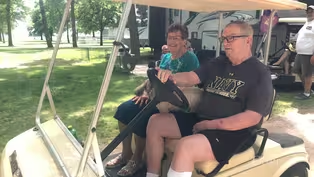
- [Amanda] One of the most common types of caregiver is a family caregiver, someone who takes care of a family member without pay, much like Deanna Hoffman, whom I met at her camper in Butterfield.
(bird chirping) - Deanna's been a caregiver for many years and she sought out caregiver support and started coming to the caregiver support group.
- [Amanda] Dean and Deanna Hoffman have been married since 1957.
They actually went to rival high schools.
- He graduated from St. James, I graduated from Madelia, and at that time they were (laughs) like oil and water.
- [Amanda] They kind of had to keep their budding love on the down low, and they actually broke up once, but not because of the rivalry.
- [Deanna] He was gonna be going into the Navy and he didn't want any ties.
I've told many people and it's just funny, but I said he's the only guy that I ever dated that broke up with me and he's gonna pay for it the rest of his life.
- I know.
(laughs) (Deanna laughs) - [Amanda] I prefaced with this to highlight their sense of humor and positive outlook.
Dean suffered a severe stroke in 1983 that left him paralyzed on the left side, which also caused aphasia, an impairment to the left side of the brain that impacts the ability to comprehend or formulate language.
Dean was driving the Mankato State basketball team in a bus to Marshall when he had his stroke.
- [Deanna] At that time, the buses were not automatic.
So he kept it on the road, but he could not pick up his foot to put because they were not automatic.
He had to do the clutch and he couldn't.
So then the buzzkill.
(sanguine music) - [Dean] I remember, and all of a sudden, lights, really big lights and everything, and just about death.
And then all of a sudden, floated down.
- [Amanda] So you had like an out-of-body experience?
- Yeah.
- [Amanda] The word Dean uses a lot to describe this time is frustrating.
- Yup, really frustrating.
Why me?
Why me?
And I cried, frustration and everything.
But why me?
And then all of a sudden, why not me?
Hmm, okay.
(sanguine music continues) No more crying.
- Well, he said he figured out he could either laugh or he could cry for the rest of his life, and he didn't wanna cry for the rest of his life.
- [Amanda] And Deanna suddenly found herself needing to navigate a new role as a caregiver.
- [Deanna] And you know, it's a learning experience for me as well as for him.
No, we didn't know what we were facing.
You just kind of figure out as you go, what needs to be done and try to find ways to do it.
- [Amanda] And over the years, Deanna has learned how to be the best caregiver she can, which includes allowing space for Dean to work through challenging tasks.
- [Deanna] As hard as it gets sometimes, I think a caregiver needs to encourage their person to take pride and do the things that they are capable of doing for themselves.
(sanguine music continues) - [Amanda] Deanna has also found outlets for self-care when major source of respite for both her and Dean is spending weekends in Butterfield at Voss Park Campground.
Their dog Teddy also loves it - Hi, Teddy.
- [Amanda] because he gets all the special golf cart rides.
Yeah, and that camper is so important to them.
It's their little getaway all summer long.
Deanna also regularly attends Wellspring's caregiver support group.
Wellspring is funded by grants from the Minnesota River Area Agency on Aging and the Minnesota Department of Human Services and by donations.
- The thing with camp to Wellspring, you realize that you're not alone, other people are doing the same thing you're doing.
So that's a help.
- [Amanda] Because Askeland said, "Ultimately, what caregivers want is to keep their loved one at home for as long as possible.
And to do this, caregivers need caregivers too."
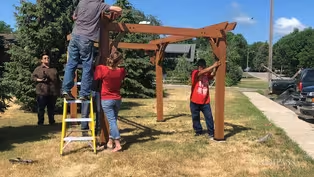
(birds chirping) The second story tonight from our partnership with the Minnesota River Area Agency on Aging features a new pergola in Milan that's been built for people of all ages to sit down and build community.
(catchy music begins) - [Ron] Right now, we're erecting a pergola that we received a grant money for to purchase.
The aging citizens of Milan, they wanna sit after going to the post office or walking or do visiting.
(catchy music continues) - It's in a public space, so hopefully it will encourage people of all ages to gather and share time together.
(catchy music continues) These projects, the intent of the projects were to improve the lives of people of all ages in Milan, especially older people.
So we formed a committee of members of the community of all ages and backgrounds and we did a community-wide survey.
And luckily, on our committee, we had two young women from the Micronesian community in Milan and they were able to translate part of the survey so that it reached far and wide, people could fill it out.
And so from that survey, we established some certain needs in Milan.
(catchy music continues) - Yeah, this is a colony of immigrants now, this is the beauty of the city, and (indistinct).
Just know your neighbor, maybe.
- [Ann] I think it provides another meeting space for people, Milan's a very young community actually, and so the more public spaces we have available, the better I say, you know.
And it's close to the post office, so it's kind of nice if you get your mail and stop here and have a little rest, especially for an older person.
It might lead to some other community engagement.
(catchy music continues) - Next, the newly formed Perennial Promise Growers Cooperative has an eye towards marketing perennial crops.
Kernza, a perennial grain to start, that also provide ecosystem services.
The Perennial Promise Growers Co-op became an official cooperative on July 28th when they met at a field day event in Goodhue.
The group has 15 current members, but the organization's president, Carmen Fernholz, expects that number to swell over the next year.
During their July 28th gathering, Fernholz's at Madison and the organization's vice president, Ben Penner of St. Peter, signed the group's articles of incorporation after 18 months of organizing and planning.
- We have just launched our growers cooperative and we are in the process of building out and scaling out an organization that will market and sell Kernza and other climate positive and Forever Green Initiative crops.
- [Amanda] This new co-op will provide two types of farmer support, agrinomically and with product marketing.
Agronomic support is coming from a relationship with the Forever Green Initiative, the University of Minnesota and USDA Agricultural Research Service that's working to address environmental challenges to soil, water, and climate.
Colin Cureton, Director of Adoption and Scaling for the Forever Green Initiative, said it also aims to provide new economic and social opportunities to growers.
- So what we're doing is developing what we call continuous living cover crops and cropping systems that will keep a living root in the soil year around and the soil covered year around.
And really address those environmental challenges while also bringing new crops to landscape and new agricultural products into the marketplace.
Our agronomists are committed to working closely with the Perennial Promise Growers Cooperative.
As that co-op thinks about how are they gonna support growers to succeed in producing these crops, we have our breeders and our agronomists in close communication with them because really, it's a two-way street, you know.
Growers know things that we don't know, and our breeders and scientists have spent a lot of time developing these crops.
(steady acoustic music begins) - [Amanda] In 2019, the University of Minnesota released the world's first Kernza variety called MN-Clearwater.
Kernza is a perennial grain, not a type of wheat.
The name Kernza is actually a trademarked name for the intermediate wheatgrass grain owned by the Land Institute based in Salina, Kansas.
Fernholz, who actually retired in 2020 after 47 years of farming, 45 organically, planted his first Kernza crop in 2011.
- [Carmen] And for me, the number one mission has always been to compensate the farmer adequately for the ecosystem services that Kernza and eventually in the future, these other Forever Green Initiative crops that will be developed because I don't think a lot of people appreciate what it takes to really provide those ecosystem services, that soil health, that clean water.
- Ecosystem services is really just the notion of what benefits does the crop bring to the landscape.
- [Amanda] Penner said one of those benefits is Kernza's eight-foot deep, sometimes more, root system, much deeper than most annual crops.
- [Ben] So it's basically the idea that the crop itself, in and of itself as a growing entity is a service to the planet, not to mention the carbon sequestration that it has potential to happen within the soil and within the roots.
(steady acoustic music continues) - [Amanda] Kernza is a relatively new crop and about 1/3 of the world's Kernza is grown in Minnesota.
Because it's so new, another focus of the co-op will be to help farmers market their product.
Fernholz said that right now, farmers have to focus on answering the agrinomic questions.
- How to plant it, how to grow it, how to harvest it, how to store it.
And they don't have the time to seek the markets, which in fact are just being developed.
And we will have individuals probably to begin with, just one or two individuals building interest in and then ultimately selling the crop to these buyers.
- [Amanda] The Perennial Promise Growers Cooperative took a big step in signing their articles of incorporation.
They're official.
The next step is (catchy music begins) to assess Minnesota's Kernza production rate and quality - So that we can talk to buyers with that one unified voice.
So getting a strong handle on what that supply is, we can communicate very clearly with customers, what they have available and what quality it is, what different differentiation it has from one lot to another.
It's going to be critically important.
- [Carmen] What I want this co-op to be able to do is provide a venue, provide an opportunity for farmers to really know that they will be able to hand off that farm to their children and their grandchildren without having to expand the acreage or the coverage.
And I know it's a totally different paradigm, but if we're going to really enhance our food system and enhance our environment and our social structures, I don't think we have a choice.
I think we have to go in that direction.
(catchy music continues) - Next, the Woman Farmer of the Year Award was announced at Farmfest on August 5th.
"Compass" attended to see who won the award.
- First off, I am very humbled.
- [Amanda] This year at Farmfest, Jane Goplen won the Woman Farmer of the Year Award, the second year that the award has been presented and the first year that the award was presented in person.
- My name is Jane Goplen and I am from Prairie Lane Farm in Canby, Minnesota.
- [Amanda] The 2021 Farmfest, what many people call the State Fair for Farming, was held on August 3rd through 5th in person, and the Woman Farmer of the Year Award was presented in the Wick Building.
Before the finalist was announced, the assembled audience heard from panelists who addressed topics important to women in agriculture.
- To get back to the question that you asked for encouraging young women, I think as women get into agriculture, it's not just that we want you here, we want you in leadership positions here in agriculture.
I know Minnesota has a fabulous program called MARL.
I had a coworker that I could just see she has so much potential to do great things and serve in leadership positions in agriculture, and she's just hungry for those kinds of things.
And even though she's young, I said, "You need to do this program."
And I recommended her for the program, and I will do that over and over again for women that are going to be in great positions down the road, whether it's president of her own bureau or vice president, or whether it's of corn or soybean, or just as a CEO of Land O'Lakes, we know we have a female CEO, you know.
So all those different places where women should be represented, we have to start now with those young women.
- [Amanda] One of five panelists represented, - Such awesome nominees and (crosstalk drowns out speaker).
- [Amanda] Erica Sawatzke from Farwell, Jessica Blair from Starbuck, Wanda Patsche from Welcome, Pam Weiers from Henderson, and of course, Jane Goplen from Canby.
- And this year's 2021 Farmfest Woman Farmer of the Year is Jane Goplen.
(audience cheers) - I gotta tell you, every step of this has been a surprise to me.
First off, being nominated by my husband, before it was like, "Oh, that just is such a nice thing and such a surprise, and you're on your own when you're writing about me."
And then to be one of the five was as good as it gets, until today.
And so I am just overwhelmed with just a lot of appreciation for the people who've thought of this platform because I really believe that women have a vital role in agriculture.
- [Amanda] Goplen is a corn and soybean farmer and works closely with the farm's finances.
She appreciated this recognition because it honors people who aren't always recognized in farming and also helps people visualize their community.
- I just would encourage anyone that has a woman involved in their farming, in their operation to nominate them because I'm living proof that anything can happen.
I have always been encouraged and have kind of tucked in my heart a saying that I heard years ago, "Always have more behind the counter than is on display."
And I think that exemplifies a farm, a woman in agriculture, a man in agriculture, a farmer.
They are so multifaceted and are an extraordinary people.
- Congratulations, Jane.
Finally, I've been hosting regular virtual conversations on Facebook with area reporters about stories they're covering.
I recently spoke with Josette Ciceron from the Definitive Woman Magazine about her most recent article.
In your experience as a rural journalist, a rural storyteller, as a rural human being, I'm wondering what unique opportunities there are or opportunities and challenges to telling these types of stories about diversity in rural spaces.
- I think for me, this is a personal choice that I've made to be part of these conversations, to be part of this movement, so to speak, of awareness and acceptance and allyship and inclusivity.
It's really an honor to be part of these conversations.
For me, it's a double-edged sword.
It brings me a sense of comfort to know that I'm a part of something, to be part of helping those around me, gain understanding, those sharing my experiences because I know that sharing that experience is going to help someone else down the road.
But it's also hard because you're putting yourself in a vulnerable position all the time, but you're always learning and it helps me evolve, it helps me truly different perspectives, even in doing the story.
While I'm not a lesbian woman, I was able to understand their love, understand their experiences, just connecting to what it's like to be treated differently or to be treated lesser than or to not be accepted right away and have to kind of have to work for that acceptance in a way.
It's something as much as we have, as many things as we have that are different.
We are also connected in those ways where we're all struggling to be ourselves and to be live on a life authentic to us.
And I think that being able to be part of these conversations constantly and bringing them to light, it's a great thing for me personally, it's rewarding, but it's also gives me the opportunity to help others learn and constantly learning through the process myself.
- Do you have any tips for people who want to start telling their stories or want to start doing this sort of storytelling or reporting, ways to do this work in an inclusive, helpful way?
- I think for me, it was just about being willing to put yourself out there.
You know, start with what you have access to.
Find out what's going on in your community.
Find out where there are opportunities to learn and to be part of inclusion.
I am lucky to be part of the Inclusion Network Organization here in Alexandria.
I'm a board member of the Inclusion Network (audio fading drowns out speaker).
- Check out our Facebook page to watch the full conversation.
Thank you for watching the September edition of "Compass".
We encourage audience interaction and feedback, so head over to our social pages and website and interact with us.
And a heads up, the October edition of "Compass" will air on October 14th on Pioneer PBS.
See you then.
Funding for "Compass" is provided in part by the Otto Bremer Trust, (lively music begins) the McKnight Foundation, and Members of Pioneer PBS, thank you!
(lively music continues)
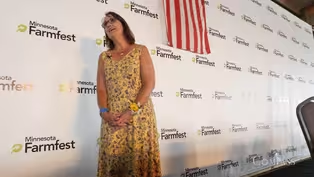
Jane Goplen, the Minnesota Woman Farmer of the Year
Video has Closed Captions
Clip: S5 Ep12 | 3m 36s | Jane Goplen won the second annual Woman Farmer of the Year award at Minnesota Farmfest. (3m 36s)
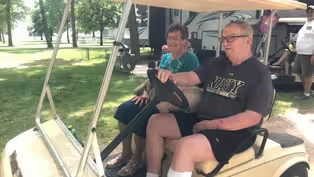
Preview: S5 Ep12 | 35s | Watch the September 2021 Edition on Sept. 8 at 9 p.m. on Pioneer PBS or the PBS Video App! (35s)
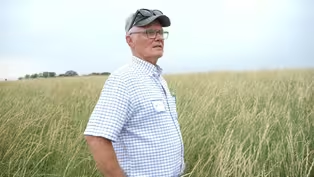
Perennial Promise Growers Cooperative
Video has Closed Captions
Clip: S5 Ep12 | 5m 40s | Learn about the newly formed Perennial Promise Growers Cooperative. (5m 40s)
Aging with dignity: caregiving
Video has Closed Captions
Clip: S5 Ep12 | 5m 27s | Hear Dean and Deanna Hoffman's personal story of caregiving. (5m 27s)
Aging with dignity: Milan pergola
Video has Closed Captions
Clip: S5 Ep12 | 2m 17s | Milan has a new age-friendly pergola! (2m 17s)
Providing Support for PBS.org
Learn Moreabout PBS online sponsorship
- News and Public Affairs

Top journalists deliver compelling original analysis of the hour's headlines.

- News and Public Affairs

FRONTLINE is investigative journalism that questions, explains and changes our world.












Support for PBS provided by:
Compass is a local public television program presented by Pioneer PBS