
September 2021: Florida Kids and Alcohol
Season 2021 Episode 9 | 26m 47sVideo has Closed Captions
Discussing factors in substance abuse with child psychiatrist Dr. Christian Thurstone.
In this annual program, we take a look at current events and social pressures that drive youth to alcohol and substance use. On this year's Florida Kids and Alcohol Up Close Special, we sit down with renowned child psychiatrist Dr. Christian Thurstone, who specializes in youth substance use and addiction.
Problems playing video? | Closed Captioning Feedback
Problems playing video? | Closed Captioning Feedback
Up Close With Cathy Unruh is a local public television program presented by WEDU
September 2021: Florida Kids and Alcohol
Season 2021 Episode 9 | 26m 47sVideo has Closed Captions
In this annual program, we take a look at current events and social pressures that drive youth to alcohol and substance use. On this year's Florida Kids and Alcohol Up Close Special, we sit down with renowned child psychiatrist Dr. Christian Thurstone, who specializes in youth substance use and addiction.
Problems playing video? | Closed Captioning Feedback
How to Watch Up Close With Cathy Unruh
Up Close With Cathy Unruh is available to stream on pbs.org and the free PBS App, available on iPhone, Apple TV, Android TV, Android smartphones, Amazon Fire TV, Amazon Fire Tablet, Roku, Samsung Smart TV, and Vizio.
Providing Support for PBS.org
Learn Moreabout PBS online sponsorship(upbeat music) - [Announcer] This is a production of WEDU PBS, Tampa, St. Petersburg, Sarasota.
- [Advertiser] Pinch A Penny Pool Patio and Spa, a proud supporter of WEDU and PBS and their efforts to educate Florida families about the dangers of alcohol and underage drinking.
Publix Super Markets Charities, devoted to the highest standards of families and community involvement.
As demonstrated by our founder, George W. Jenkins.
The Bernard F. and Mary Ann Powell Foundation, providing community funding and support for social services, animal welfare, and environmental assistance.
Drug Free America, where our vision is a world where all people live free of the burden of drug abuse.
- Change, uncertainty, stress, they are a fact of life for many as the pandemic continues and young people may be especially vulnerable.
How does that impact substance use and addiction among youth?
Hear from renounced psychiatrist, Dr. Christian Thurstone along with the local student and expert who share their perspective, coming up next.
(upbeat music) Welcome to an annual Up Close special: Florida's Kids and Alcohol, I'm Cathy Unruh.
The pandemic has had a tremendous impact on our society.
As we taped the 2020 edition of this special, we were all learning about the novel coronavirus and finding our way in what was called a new normal by some.
This program explore the ways those changes impacted adolescents and their exposure to drugs and alcohol.
This year, we continue that conversation as we've learned much more about the virus, as some of its social impacts over the last 18 months.
We'll focus now on mental health and how that may be driving substance use and addiction among our youth.
We welcome renounced psychiatrist, Dr. Christian Thurstone, whose research focuses on youth substance abuse and addiction.
Dr. Thurstone is a clinician, as well as a professor of psychiatry at the University of Colorado in Denver.
Also what, this is Maddie Horn, she's a sophomore at Gulf High School, in New Port Richey.
Jason Dorr is the director of More2Life, an organization serving youth in Tampa Bay through free presentations.
Welcome, everyone, thanks for being here.
Dr. Thurstone, let's start with you.
You're one of our relatively small group of board certified psychiatrist working with youth and their addiction issues.
And you've been recognized by a white house office for your work around drug use and substance addiction.
Tell us what you do, on a day to day basis in working with youths.
- I'm a child psychiatrist.
I'm also an addiction psychiatrist, and I run about eight substance treatment programs for youth with substance issues.
So, we have eight that are in, actually seven clinics that are in, school-based health centers, and then one that's on the main campus of the hospital.
- Thank you, and of course, we're going to get into a little bit more later about what you're actually seeing with our youth right now.
Jason, More2Life, engages youth through presentations that focus on drug and alcohol use.
How does that work?
- Yes, so we are invited in by schools, both public and private and also summer camps throughout the summer.
And we come in and we talk about, variety of different topics and it's all done in a prevention type style.
And so one of the things we focus on is substance abuse, typically on alcohol, drug, and marijuana, because we wanna help students to prevent them from going down that path of engaging in those drugs.
And a lot of those drugs are the starter drugs as the gateway drugs.
And so our job is to educate by presentations, through engaging, energetic, and interactive programs that help students make the right choices and abstain from drugs and alcohol.
- And Maddie, you are a sophomore in high school, as we said, and you're also the vice-president of a group called Stand, which is part of the Alliance for Healthy Communities.
Tell us what Stand does.
- We are agents of change.
We wanna make sure our community is a safe place for us, and then our future generations.
And we want to make sure that all of us youth, have a safe place to go so that our first step is not to go to reach drugs.
Our first step is not to go towards alcohol, not to start vaping, not to start smoking, nothing like that.
We want to have healthy alternatives for those things.
And we also want to educate those, who are currently using drugs, who are currently, you know, turning towards those unhealthy substances.
- Dr. Thurstone, can you tell us, this is a broad question, but is it answerable?
What changes you have seen, in substance use and abuse among young people, since before the pandemic to now?
- So young people most often do what adults tend to do and things kinda trickled down to young people.
And so it's too soon to have, you know, fancy statistics in terms of pre-post substance use rates among youth, but there's, we clearly know that sales of alcohol are up pre-post pandemic issues with respect to fentanyl are up pre-post pandemic, and opioid overdoses are up pre-post pandemic.
So that's very clear, we have a pretty clear data related to that.
In terms of what we're personally seeing, we are seeing more youth being referred for opioid use disorder and especially with fentanyl use.
And we're clearly also seeing an increase in referrals related to alcohol and marijuana use, as well.
- So the alcohol is somewhat easy to understand, it's not that hard to get your hands on alcohol.
But how are these kids getting all these opioids?
- Yeah, that's a great question.
So opioids come from a number of different sources, but it's thought that one of the main new sources is the internet, and that people are ordering things off the internet and they're coming in from other countries through the mail and other ways like that.
- Okay, 'cause we talked last year about when kids stay home more, they have access to medicine cabinets in their parents' bars and that sort of thing.
Is that also a contributing factor?
- Absolutely, so the first place that teenagers frequently get their first exposure to substances is in the home through cigarettes or vaping devices that are left at home through the family refrigerator in the case of alcohol.
And then through the medicine cabinet in the case of substances, and like prescription substances.
- And Jason with your organization More2Life, you've been working with kids for many years and that was in person, but you've had to make some changes in the way you work with kids now, too.
- Yes, for years it's always been in person, being at the schools, being at the summer camps, but 2020 hit the pandemic hit.
And we had to take a step back because obviously presentations were canceled.
And so we started exploring new ways to do our presentations, and of course, one of the ways is through virtual and through Zoom.
And so throughout, most of last summer into the school year, we did most of our presentations virtually, and the students were able to, we were able to interact with them online.
And at first it was a little awkward, but then once we got the handle on it, it was just an amazing thing.
And, you know, with the chat box and with having our presentation up on the screen.
And so that's one avenue and of course another avenue is prerecorded presentation.
So that a teacher wanted to show her presentations at another time, they can have those links to show their students and present them, you know, with their timing and when they want to show those students so they can have their own personal interaction with the students through the recorded, prerecorded presentations.
- Do you find that kids are really interested in this or adults like saying, "Do this."?
- Oh, absolutely, parents are definitely onboard with what we do, and want their students to know as much as they can about substance abuse so that they can make the right choices and abstain from going down that path of trying drugs and experimenting with drugs.
- And one of the things that More2Life does is try to provide some clues to things that give you a natural high.
What are some of those things?
- Yeah, so one of the things we reintroduced this summer, was talking about natural highs and, you know, students, obviously when they're bored or when they're depressed or anxious, they will, they may gravitate the drugs, but we try to communicate things to them that there are other ways to deal with that anxiety, that depression, that boredom.
And so we talk about natural highs, and kind of gave them some examples of what that is.
Something that-- - [Cathy] What are they?
- For example, sports.
- [Cathy] Mm-hmm.
- Would be one, if you like sports, something that would make you feel alive while you're doing it and it doesn't harm you.
So sports would be one.
One of our co-workers brought up horseback riding, that's something that she engages in.
So something that is fun, that makes you feel alive, and gives you that high in a sense, in a natural way without the consequences of drugs and alcohol.
So, and it turned into a good conversation and we got some ideas from them, as well.
- Maddie, you are in school.
You're one of the youth that we're talking about, what are some of the stressors that kids are experiencing right now?
- Well, there's like the normal, like teenage stressors.
So, you know, you're changing, everybody else around you is changing.
You don't know how to deal with life.
You know, you have to think about colleges and you have to think about what you want to do when you grow up, I guess.
And then there's also that kind of like, so there's possibility that I could get sick.
There's a possibility I can get others around me, sick.
I have to wear this mask or might have to get vaccinated.
And then there's like, "Oh, I might have to do online school.
I might have to go in person.
You know, how are my teachers going to teach if they have both online and in person."
You know, all of those kinds of things, and then, you know, obviously high schools now are kind of, you know, you have to kind of practice social distancing, and then you're also kind of like crammed in the same classroom, like you're elbow to elbow with everybody.
And then they're still like, "Oh, kind of practice social distancing."
But you're, you know, elbow to elbow with everybody.
So it's like kind of stressful doing that, too.
So, those are a lot of very stressful things, right now.
- Dr. Thurstone, I'm sure you hear about all those issues and more in your work.
Are there other things?
- Yeah, so I think this is a great point here.
So we know from national service that clinically significant depression has doubled among teenagers pre-post COVID.
So about one in four teenagers, has clinically significant depression, right now.
That rate is gone up from about 10% to 20%.
I'm sorry, from about 13% to 25%.
And then a clinically significant rates of anxiety have also doubled pre-post COVID from about 11% to 20%.
And it makes sense that youth are disconnected from their peers.
We talked about natural highs.
I think connection, true connection with peers and with people you care about is a really important natural high.
And people have been really separated from that.
And then coming full circle, there is clearly a connection between mental health, and distress, and substance use and people using substances as a way to escape or avoid feelings, they'd really rather not have.
- I wanted to really get into that.
Substance use can lead to mental health issues.
Mental health issues can lead to substance use.
It works both ways, correct?
- It absolutely works both ways.
So we know that about 80% of youth who were in substance treatment have a co-occurring mental health issue.
And it works both ways.
We know, especially with nicotine, for example, that that changes the chemicals in the brain that then can lead to depression.
And then we know that people with depression are more like (crackling drowns out speaker) in the first place.
And I think another important factor here is that, the statistics I mentioned are getting worse for every month that we were in the pandemic.
So we're having a little bit of a snowball effect where teen depression and anxiety rates, are going up, and up, and up the longer the pandemic last.
- And what do we do to mitigate that?
Because we're all uncertain, adults don't know how long it's going to last either.
- Right, these are a little bit scary times.
And so that's why the work that Jason and Maddie are doing are critical.
Relationships are critical.
And then, there was a very famous psychiatrist during the Holocaust, he was a Holocaust survivor himself, who said that, "People can survive anything when they're connected to their meaning and purpose."
And so staying connected to each other, staying connected to your meaning and purpose, are two of the most important resiliency factors we can have.
- Maddie, would you say that that's what you do with Stand?
Do you focus on meaning and purpose?
- Oh, absolutely, we are-- (clears throat) We kind of go like to the point where it's, so we know how you're getting these substances.
We know how you're using them, and now we need to know like, why.
Why are you doing this?
Why, like what are the triggers for this?
And then, you know, we kind of work on, I mean, they don't say like 'we', because we as youth, we don't work with other youth who are struggling with substance use disorders, but we kind of like share with, you know, like a general.
So we go to like a high school or a middle school and we'll say, "Hey, this, this and this."
So like, divorced parents or parents who are going through separation, this can cause you to gravitate towards certain substances.
This can cause you to do that.
And so we kind of like work with, so if this happens to you, instead of going to alcohol, instead of going to drugs, instead of going to prescriptions, you can work with your friends.
You can, you know, have a day of the week.
So it's like on Tuesdays, you guys wanna go and get ice cream after school, you guys wanna go to a coffee shop instead of, you know, going and drinking alcohol after school.
- Tell me this, are kids receptive to that?
Our kids who are using and or abusing, are they receptive to your suggestions?
- It depends on the person.
I know a lot of times, a lot of kids are like, "Oh, it's just weed, it's natural."
Or, you know, "It's alcohol, everybody drinks alcohol."
And then there's the other kids who are like, "Oh, my gosh, like, this is something that's gonna happen to me?"
We kinda like, try like the scare tactic, where it's like, oh, if you do this, like, you know, this is what happens to your brain, your lungs, like we show you what happens to your, like parts of your body when you do certain things.
And a lot of them are like, "Oh my goodness, like this is actually happening to my, like, it's happening to me right now."
And so they're kind of, they're more open to it.
And then there's other kids who are like, "Eh, it's natural, it's just weed, it's, you know, it's just alcohol.
I'm 15, I don't need to worry about that."
And so we're like, we kind of tell them, "This is, you're 15, your brain's still developing.
So if you're putting these substances into your body, your brain is gonna think, "Oh, I need that."
Your brain is gonna like, automatically like, "Oh, I need that give me more, give me more, give me more."
And so they kind of like, don't realize that, I guess.
- Jason, I'm sure that you hear a lot of the same things.
And one of your focuses I believe is to just try to build healthy, positive relationships that help you work through these issues.
Can you tell us how you do that?
- It's very important that students do build healthy relationships.
You know, when they're going through a crazy times with the pandemic with again, depression, anxiety, boredom, it's very key to have those relationships.
And so one of the things is we talk about how to have, how to build those healthy relationships.
And because some students may not have those close, you know, they may have acquaintances and people that they joke around with and laugh with.
But do you have someone you can confide in, you have somebody that can mentor you, somebody that can really, you know, pour into you when you were going through that.
And so we talk about healthy relationships, how to build those relationships, how to have better relationships, social skills, communication, which is key.
And so having those in your life are, is what really was gonna help you during the process.
And hopefully that person is gonna be a great, enough influence to steer you away from drugs and alcohol and things that would bring you further from your goals, and your dreams, and your purpose, so... - And as everyone here knows, not every young person, not every person has that kind of relationship.
So there's a couple of things I wanna come to you about on that, Dr. Thurstone, if you don't have anybody like that in your life, what do you do?
And two on sort of the same subject, the decline in the ability to see a therapist in person during the pandemic, how has that affected mental health?
- Yeah, it's such a great question because we also know that emergency department visits for suspected suicide among teenagers is up about 40% pre-post COVID.
Those are some data from the CDC released recently.
And this is especially, this is sending all teenagers, but especially teenage girls, disproportionately.
And so I think the message is, it's okay to not be okay.
It's okay to reach out to people like Maddie and Jason for help.
It's okay to reach out to school counselors for help.
None of us are completely in our right minds, right now, during this pandemic.
And so I just encourage people to use the resources that they do have.
- And what if you're a parent, what do you look for in your child?
Where do you go if you sense that your child is having an issue?
- It's such a great question.
So a lot of times teenagers, children, they present with misbehavior, quote, unquote misbehavior when they feel stress or depression and parents will be understandably attempted to punish that behavior.
And so, I've been encouraging parents to be slow for discipline and quick to listen.
That is the single biggest mistake I see among parents, especially during the pandemic, I'm encouraging parents to listen, to understand and not to be quick to fix the problem either, but to really listen and say a lot of things like, "Yes, that is difficult.
That must really be hard.
I can understand why you'd be upset about that."
But statements like that, are really gonna help parents connect with their teenagers more than fixing their problems or telling them not to feel a certain way.
- Maddie, do you hear or talk among your peers about being unhappy more so than pre-pandemic?
- For sure, a lot of our issues are, you know, it's hard to see our friends.
A lot of our parents are understandably, like worried about like, "oh, do I want them going out in public?"
You know, those kinds of questions.
And so, it's hard for us to like really see our friends that we'd did before the pandemic.
And some of us lost a lot of friends during the pandemic.
So it's hard to like regain those relationships.
- You lost friends in that they were sick and went away or you mean distance came between you?
- Distance came between us, yeah.
- Because... - You know, we would see each other every single day at school.
And then after, you know, we went online school and then some of us just like kind of lost touch.
- And Dr. Thurstone, you see more of what's going on nationally.
All of this is true across the board or is there any variation by geography that's truly significant?
- This is true across the board.
There are two exceptions to that.
Girls being disproportionately affected and older teenagers.
So teenagers 16, 17, 18 being disproportionally negatively affected.
- Why would that be?
- That's a great question.
I don't think we know exactly why that is.
- Are we still seeing the trend that substance use is younger and younger and younger, though?
- We are seeing people starting to use substances younger, younger, younger.
Generally, nationally, we're also seeing a trend towards decreased perceived harmfulness of substances.
So people just not viewing them, especially marijuana as harmful as they did before.
- Jason, do you see this kind of differential depending on age?
- Yeah, we see... Yeah, 'cause we protect, we work with middle and high school students.
And so yeah, we're seeing more younger and younger gravitating to drugs and alcohol just because of culture and influence and media.
So, yeah, we see younger ones still struggle with that, as well as the older ones.
It is more predominant with like the high school, but middle schoolers and maybe even younger, but middle schoolers do, are peer pressured and influence to try, or attempt to, you know, take drugs, or vapor or any of those.
So yeah, we do see it, absolutely.
- Another broad question, Dr. Thurstone about what our educational systems doing to help this issue, deal with this issue?
- Yeah, a couple things.
I think returning to normalcy, as much as possible is a great thing.
If you're a junior in high school right now, for example, you're experiencing your first home coming and your high school career right now, which is pretty hard to believe.
So return to normalcy, number one.
Number two, 70% of mental health services that adolescents receive are through schools, now, and through school-based settings.
And so schools are doing more and more direct mental health prevention and intervention, which is a great thing to improving access to care.
- And I think what I'd like to ask each of you, as we move toward a close is speak to whichever constituency you would like, the schools, the kids, the parents, whichever, speak to them, the core of your message that you would like to get across.
Jason, let's start with you.
- Yes, our program More2Life, our tagline is 'Your choices affect our future.'
And so one of the things is we help students to see the bigger picture because you know, a lot of them, they're just kind of living for the moment, they're not looking ahead.
So we've kind of paint a picture for them to see their goals, their dreams, the things they wanted to do in life and focus on that, make that the focus of their life.
And when you do that and you're gung ho, and aiming to those goals, it helps you to think about your choices a lot differently.
And so you wanna make choices that bring you closer to your goals and not further away.
And so obviously, drugs and alcohol in, you know, pursuing those for your life is gonna bring you further away.
So we just try to help them see the bigger picture and just know the choices that you make today matter, and they can affect your future and bring you further.
So we want to see you succeed.
We don't wanna see anything, bring you further from that.
And so, think about your life, think about your choices, and aim towards your goals.
- And Maddie.
- I think, as like Stand as a whole, we've been really focusing on like schools and mental health.
And so, if our schools can kind of understand more of what we're going through and what we're experiencing, we might have a better chance of getting through to the students who are more closed off who are, you know, basically just a brick wall.
And so, if the school is kind of like realized, "Hey, this is happening."
And they kind of reached out to a students, 'cause we are the main, you know, we're the main thing right now.
We are, you know, they have to talk to us to figure out what's going on with us.
So if the school kind of reach out more towards, to us, then they might be able to get through easier.
- Dr. Thurstone.
- I think these are all great points.
Mother Teresa said, "The world is full of a lot of suffering, it's also full of the overcoming of suffering."
So I wanna offer people hope that we will get through this, and we will get through this together.
- Thank you, that's a great note to end on.
Thank you all for being with us, and for the work that you're doing.
For more information and additional resources on drug and alcohol prevention, visit drugabuse.gov.
And you can also learn more at drthurstone.com.
For more about More2Life visit m2l.org.
This episode of Up Close, maybe viewed in its entirety on wedu.org.
I'm Cathy Unruh, thanks for watching, and we'll see you next time on Up Close.
(upbeat music) - [Advertiser] Pinch A Penny Pool Patio and Spa, a proud supporter of WEDU and PBS and their efforts to educate Florida families about the dangers of alcohol and underage drinking.
Publix Super Markets Charities, devoted to the highest standards of families and community involvement.
As demonstrated by our founder, George W. Jenkins.
The Bernard F. and Mary Ann Powell Foundation, providing community funding and support for social services, animal welfare, and environmental assistance.
Drug Free America, where our vision is a world where all people live free of the burden of drug abuse.
(upbeat music)
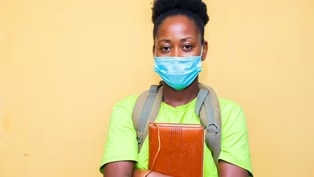
Preview: S2021 Ep9 | 30s | Looking at current events and social pressures that drive youth to substance abuse. (30s)
Providing Support for PBS.org
Learn Moreabout PBS online sponsorship













Support for PBS provided by:
Up Close With Cathy Unruh is a local public television program presented by WEDU