
September 25, 2026 - PBS News Hour full episode
9/25/2026 | 57m 46sVideo has Closed Captions
September 25, 2026 - PBS News Hour full episode
September 25, 2026 - PBS News Hour full episode
Problems playing video? | Closed Captioning Feedback
Problems playing video? | Closed Captioning Feedback
Major corporate funding for the PBS News Hour is provided by BDO, BNSF, Consumer Cellular, American Cruise Lines, and Raymond James. Funding for the PBS NewsHour Weekend is provided by...
September 25, 2026 - PBS News Hour full episode
9/25/2026 | 57m 46sVideo has Closed Captions
September 25, 2026 - PBS News Hour full episode
Problems playing video? | Closed Captioning Feedback
Where to Watch PBS News Hour
PBS News Hour is available to stream on pbs.org and the PBS app.
Providing Support for PBS.org
Learn Moreabout PBS online sponsorshipGEOFF BENNETT: Good evening.
I'm Geoff Bennett.
AMNA NAWAZ: And I'm Amna Nawaz.
On the "NewsHour" tonight: The Supreme Court allows states to use a controversial federal database to verify voter eligibility.
GEOFF BENNETT: The Trump administration removes hundreds of thousands of people from the Affordable Care Act at a time of rising health care costs.
LARRY LEVITT, Executive Vice President For Health Policy, KFF: There is fraud, and the administration is taking efforts to eliminate that.
At the same time, millions of people, real people, are also losing their health insurance.
AMNA NAWAZ: And Mexico's foreign minister talks trade agreements with the U.S.
(BREAK) AMNA NAWAZ: Welcome to the "News Hour."
The Supreme Court revived a controversial voter citizenship database today just two months ahead of the midterm elections.
GEOFF BENNETT: In the ruling, the court sided with the Trump administration as it looks to use the Department of Homeland Security's so-called SAVE database to review state voter rolls for potential noncitizens.
Joining us now is Jessica Huseman, editor in chief of Votebeat, which has been covering this issue.
Jessica, it's always great to speak with you.
So walk us through exactly what the Supreme Court did today.
What can the Trump administration and states do today that they couldn't do yesterday?
JESSICA HUSEMAN, Editorial Director, Votebeat: That's a really complicated question to answer because of the timing of the November election.
So the Supreme Court stayed a lower courts of June ruling that blocked the 2025 modifications of the SAVE database that allowed states to use them to mass-check people for citizenship status on their voter rolls.
And so states can begin to do that.
The problem for the Trump administration is that we are in a 90-day period required by the NVRA, which is a federal voting law, that prevents people from being removed from the rolls ahead of a federal election.
So while this is really going to be a sea change for election administrators going forward, I don't think voters will see any real effect right now for this election, given that -- given that parameter.
GEOFF BENNETT: And this database, this SAVE database, it wasn't originally designed to police voter rolls.
How has the Trump administration transformed it?
And why has this become a central part of its election strategy?
JESSICA HUSEMAN: Right, absolutely.
I think that people are really confused about what the SAVE database is, what's in it, what it was created for.
And really this is a database to track noncitizens or to sort of have an accounting of noncitizens in the country that DHS knows about, right?
And that's a pretty clear distinction between I think what people think that it is, which is a magical database with every noncitizen who happens to be in the country living on it, right?
That is not the list that exists.
And even the list that they're using have significant problems.
We are seeing pretty bad mismatch problems.
We saw that repeatedly in Texas, for example.
So it's not a perfect database.
And Trump has allowed states to use this to batch search people who are on the voter rolls.
Previously, states could only search one person at a time.
Now they can use it much more broadly.
And the database is tied into several other databases that DHS maintains.
So, theoretically, it's a much more powerful tool than it used to be.
The problem is that it's still returning a lot of errors.
GEOFF BENNETT: Well, on that point, Justice Ketanji Brown Jackson, she warned in her dissent that states might cancel the voter registrations of at least some recently naturalized citizens.
So how does an eligible voter get wrongly flagged by this system?
And has that actually happened before?
JESSICA HUSEMAN: It has happened and it's happened frequently.
We've reported about it in Texas.
So I think that people assume that government databases all talk to each other and they automatically track you through your citizenship process.
It does not, right?
This is a database that is largely maintained by human beings who have to enter the information into the database on time and when required of them and as you expect them to.
And we know from history that that doesn't often happen.
I think that it's important for people to know that this isn't the last check, right?
If your county chooses to use this process, if your state chooses to use this process, your county election administrator is still the one that is ultimately responsible.
for removing you from the rolls.
And Votebeat knows from our reporting that these county clerks tend to be much more careful with these matches than the federal government or even many state governments are.
And they are doing those second-level checks to make sure that people who are flagged are not unnecessarily removed in most cases.
GEOFF BENNETT: Jessica Huseman, you make the confusing crystal clear.
Thanks for helping us make sense of all this.
We appreciate it.
JESSICA HUSEMAN: Thanks so much.
GEOFF BENNETT: And, moments ago, the Supreme Court issued another ruling striking down the Trump-backed congressional maps in Missouri with weeks until the election.
The order blocks a map that could have added another Republican district.
AMNA NAWAZ: We begin the other day's headlines in Washington, where Chinese President Xi Jinping wrapped up a three-day state visit that was heavy on pageantry, light on policy announcements.
Trump and Xi met this morning at the White House for tea, along with their spouses.
The event was covered by the White House press pool as it resumed providing TV coverage after a standoff over Mr.
Trump's banning of three media outlets.
He later took Xi to the National Archives to view America's founding documents like the Constitution.
Mr.
Trump spoke briefly to reporters about their nation's histories.
DONALD TRUMP, President of the United States: We are just comparing.
Ours goes 250 years, which is great, and we are proud of it.
But theirs goes 6,000 years.
So, there's a little difference between 6,000 and 250, but we're are proud of our 250.
AMNA NAWAZ: Over the course of the visit, the two sides agreed to an extension of a trade truce.
But, otherwise, there was little progress on issues including AI, the Iran war, or U.S.
support for Taiwan.
The leaders agreed to meet twice again this year, once in China and later in Florida.
Tens of millions of people along the East Coast from the Carolinas to Cape Cod could see flooding, rough surf, and high winds this weekend due to a powerful nor'easter.
In some places, the storm's impacts are already being felt.
Massive waves pummeled the Outer Banks and along Virginia's coast.
High surf spilled into neighborhoods.
Farther north, Ed Sheeran's Boston area concerts have been canceled due to weather.
And in New York, beaches are being fortified.
Transportation officials there say the focus will be on damaging wind gusts, which could top 60 miles an hour.
JANNO LIEBER, Chair and CEO, Metropolitan Transportation Authority: Right now, the wind is by far our biggest concern.
The forecast is that the amounts of rain are several inches, but it looks like it's going to be happening over time.
So the risk of those torrential rainfall flooding impacts is reduced.
But we are hearing about the wind from the forecasters.
AMNA NAWAZ: Meantime, Hawaii is bracing for Hurricane Nolo, which could become a major hurricane this weekend.
The storm is expected to remain south of the islands as it heads West this weekend.
But forecasters warn that Nolo will bring tropical storm conditions to the Big Island with up to 25 inches of rain and the possibility of life-threatening floods and mudslides.
New Jersey's Lieutenant Governor Dale Caldwell stepped down today amid accusations of sexual harassment and ethics violations.
His boss, Democratic Governor Mikie Sherrill, had given him until Friday to do so.
GOV.
MIKIE SHERRILL (D-NJ): In my administration, we are committed to doing what is right, not what is politically expedient.
AMNA NAWAZ: Sherrill was facing increasing political pressure after a law firm she had hired found Caldwell used sexually charged language and recommended someone he was dating for a promotion.
He has denied any wrongdoing.
Ukrainian President Volodymyr Zelenskyy says he asked President Trump this week at the U.N.
to urge China's leader for help in ending the war with Russia.
Zelenskyy told reporters he's still waiting on a response.
In the meantime, both sides carried out new attacks.
In Ukraine, officials say Russian strikes overnight and into today killed at least five people across multiple regions.
One struck a residential building in Kyiv, killing a 14-year-old boy, while another hit this food warehouse, which is used by restaurant giant McDonald's.
Meanwhile, in Western Russia, regional authorities say at least one person died, and more than 20 were wounded in multiple long-range Ukrainian strikes.
Pope Leo kicked off a four-day visit to France by warning of the risks of artificial intelligence.
He was welcomed at the Elysee Palace by French President Emmanuel Macron and used his remarks there to urge people not to lose their humanity in the face of what he called a paradise of machines.
Leo also urged restraint against a nuclear arms race and spoke about the scourge of war in the Middle East.
He then addressed an audience at UNESCO headquarters, where he said the U.N.
and other international organizations are undergoing a -- quote -- "crisis of effectiveness."
POPE LEO XIV, Leader of Catholic Church (through translator): In the face of these missteps, we must promote a virtue as rare as it is desired, trust, trust that differences do not necessarily pose a threat, trust that sincere dialogue can bring about a greater good than what any one of us could achieve alone.
AMNA NAWAZ: Pope Leo also led a prayer service at the restored Notre Dame Cathedral today, making him the first pope to visit since a devastating fire in 2019.
On Wall Street today, stocks ended higher as oil prices eased.
The Dow Jones industrial average rose nearly 500 points.
The Nasdaq added roughly half-a-percent.
The S&P 500 also closed out the week with a solid gain.
And grab your coat of many colors and pour yourself a cup of ambition.
It is Dolly Parton Day.
Millions are honoring the late country music icon on this September 25, or 9/25, a playful nod to her hit song and film.
From musical performances to movie screenings and much more, it's a day to celebrate Parton's life and legacy, including her dedication to literacy.
Her Imagination Library charity has provided more than 300 million books to young children around the world.
Fans are encouraged to mark the day by enjoying her songs, carrying out acts of kindness, or by wearing pink.
GEOFF BENNETT: For Dolly, of course.
AMNA NAWAZ: Still to come on the "News Hour": an Iranian-American journalist remains detained in Iran after two years -- we speak with his lawyer; David Brooks and Jonathan Capehart analyze the week's headlines; and a Syrian dancer reflects on his journey, from escaping ISIS to the San Diego Ballet.
Talks slated for Monday to review the U.S.-Mexico-Canada trade agreement, or USMCA, were postponed.
That's a deal that President Trump struck in his first term and threw out in his second.
While the trade war with Canada unfolds, Mexican leaders are taking a different approach, even as Trump had harsh words for America's southern neighbor this week.
I spoke earlier today with Mexico's foreign minister, Roberto Velasco Alvarez, who joined us from his New York mission.
Mr.
Secretary, welcome to the "PBS News Hour."
Thank you so much for joining us.
ROBERTO VELASCO ALVAREZ, Mexican Foreign Minister: Hello, and thank you for the invitation.
AMNA NAWAZ: So you and I are speaking as the United Nations General Assembly is coming to a close.
As you saw, that included some searing comments from President Trump about Mexico.
He called Mexico the epicenter of cartel violence.
What's your response to those remarks from President Trump?
ROBERTO VELASCO ALVAREZ: Well, what I can tell you is that in the past two years of the Sheinbaum administration, we have seen a decrease of over 50 percent of the homicide rate in Mexico.
All the different crimes that we have in the country are also in a downward trend.
So we're seeing excellent progress.
This is historic progress.
And it's the most important progress that we're seeing against crime in the whole region of Latin America.
AMNA NAWAZ: At the same time, we should underscore there is still significant security challenges in Mexico.
I know there's warring factions of the Sinaloa cartel in particular.
The murder rate for women there is at the highest rate in 14 years.
And, as you know, the Trump administration has designated eight Mexican cartels as foreign terrorist organizations.
They're using that framework to justify and threaten potential military action.
What do you believe?
Do you think that this president might actually make good on that promise for military intervention in Mexico?
ROBERTO VELASCO ALVAREZ: Well, what I can tell you is that we have a very important security cooperation with the United States.
But this cooperation is based in the principles of paying respect to our sovereignty and, of course, also to our territorial integrity, and naturally also to what we call cooperation without subordination.
AMNA NAWAZ: I hear you saying territorial integrity.
Do I take that to mean that President Sheinbaum has made it clear to President Trump that U.S.
military action would not be welcome in Mexico?
Is that right?
ROBERTO VELASCO ALVAREZ: Naturally, there are activities in our country that only correspond to Mexican authorities to have - - this is previewed in our Constitution, and we have to respect our own laws and our own legal framework.
AMNA NAWAZ: I'd like to ask you about the trade talks as well between the two nations, because that ongoing review of the USMCA, or the U.S.-Mexico-Canada agreement, those talks were supposed to begin next week.
They were postponed.
It's been reported likely in October.
Can you tell us why they were postponed and whether or not they have been rescheduled?
ROBERTO VELASCO ALVAREZ: There is nothing to worry about.
We continue to work very closely with the United States trade representative.
We continue to have conversations both in the USMCA review and about the tariffs that the U.S.
has implemented.
We have made progress.
We don't have an agreement yet, but we continue to engage constructively on all these issues.
AMNA NAWAZ: We have also seen Prime Minister Carney consider now becoming an associate member of the E.U.
as a trading block.
You recently convened a number of Latin American countries with your Southeast Asian counterparts to discuss trade.
Is it fair to assume that Mexico is looking for other trading partners?
You feel you may not be able to rely on the U.S.?
ROBERTO VELASCO ALVAREZ: Well, Mexico is one of the most open countries in the world for trade.
We have free trade agreements covering over 60 countries in the world.
It is a normal thing for us to continue to communicate with this and other partners.
But that does not mean that we will not continue to have a close and respectful relation with the United States, and particularly on trade, given that we are each other's number one trading partner.
AMNA NAWAZ: I do want to ask you finally about the immigration crackdown in the U.S., because your government has said it's going to take legal action in relation to the deaths of 17 Mexican nationals in ICE custody or raids under this administration.
I know you filed complaints with state prosecutors.
You have sent cease-and-desist letters to detention centers.
Has there been any response on the U.S.
side?
ROBERTO VELASCO ALVAREZ: Well, this is an issue that, of course, worries us very importantly.
The human rights of our citizens in all of the world are one of our primary responsibilities.
And, of course, we're always looking for ways to protect them.
This is a very important part of our dialogue with the United States.
And in the case of the Mexican citizens that have died under is custody or during ICE operations, we have, as you mentioned, taken a series of measures.
We have received an indication that there are ongoing investigations.
Of course, we expect to have more information on that.
And we will continue to make the case that it is extremely important to make sure that the conditions that led to these deaths do not continue to exist.
AMNA NAWAZ: Mr.
Secretary, 17 Mexican nationals have died in ICE custody or raids.
Do you believe that the U.S.
is committing human rights violations?
ROBERTO VELASCO ALVAREZ: What I can tell you is that each case is different, and there needs to be investigations on each of these.
That's what we're looking for, and obviously to have justice when there was any case that -- where there was any legal violation.
AMNA NAWAZ: That is the foreign secretary of Mexico, Roberto Velasco Alvarez, joining us tonight.
Mr.
Secretary, thank you so much for your time.
It's good to speak with you.
ROBERTO VELASCO ALVAREZ: Thank you very much.
GEOFF BENNETT: The midterm elections are closing in, and once again, health care costs, including loss of insurance coverage through the Affordable Care Act, are at the center of a political debate.
According to national data, enrollment in the marketplaces created by the ACA dropped by roughly three million people this year.
That's mainly due to the expiration of enhanced federal tax credits last year.
And it's leading to an average premium payment surge of 114 percent for many enrollees.
This week, Vice President J.D.
Vance announced plans to cancel coverage for nearly 760,000 more people who get insurance through Obamacare, citing claims of widespread fraud.
J.D.
VANCE, Vice President of the United States: We expect that most of these people are fraudulently enrolled.
But we're going to do some additional verification on about 419,000 people.
We're going to make sure that they're, first of all, legal residents of the United States of America.
And, second of all, we're going to make sure that they actually meet the income threshold requirements in order to receive these Obamacare benefits.
GEOFF BENNETT: For more on what this could mean for those relying on Obamacare for coverage, we're joined now by Larry Levitt, executive vice president for health policy at KFF.
That's a nonprofit health policy research organization.
Thanks for being with us.
LARRY LEVITT, Executive Vice President For Health Policy, KFF: Thanks for having me.
GEOFF BENNETT: So when Vice President J.D.
Vance says this move will save taxpayers $2.2 billion, and it's all aimed at rooting out abuse, what evidence is there that thousands of people were improperly enrolled?
LARRY LEVITT: Well, I think the reality is that there is fraud in the Affordable Care Act or Obamacare marketplaces that is mainly perpetrated by rogue insurance brokers who are either signing people up against their will or counseling people to mislead about their income or circumstances.
And I think the administration's efforts to root out this fraud are legitimate.
But at the same time, as you said, millions of people have lost coverage due to the expiration of the enhanced premium tax credits at the end of last year.
So there is fraud, and the administration is taking efforts to eliminate that.
At the same time, millions of people, real people, are also losing their health insurance.
GEOFF BENNETT: Is there an appeals process for people who have been dropped from their ACA coverage?
How does that work?
LARRY LEVITT: Yes, there is.
I mean, these are people who lacked a Social Security number or proof of their immigration status on their applications or on the federal data systems.
And they were given 30 days to -- after being notified by their health insurer to confirm their details.
Now, we all know we all let mail pile up.
We don't necessarily follow through on things.
So these people got dropped, but they will have an opportunity to get back on if they legitimately are eligible for health insurance coverage.
GEOFF BENNETT: We know that health care costs are a major concern ahead of the midterm elections.
And according to KFF polling this summer, it found that 51 percent of voters say it's extremely important for candidates to address this issue.
What is putting the most pressure on household budgets right now?
Is it premiums, deductibles, prescription costs, all of the above?
LARRY LEVITT: Well, if you even back up a little bit, I mean, we have asked people, when you say the cost of living or economic concerns are your biggest worry, and no doubt that is what is on voters' minds.
Health care and gas prices are the two household expenses that people are most worried about.
So it's not surprising that people want candidates to be talking about health care costs.
And it really is all of the above.
And it's not just people getting coverage through the Affordable Care Act.
It's people in employer plans.
That's over 160 million people.
They're seeing their premiums go up.
They're seeing their deductibles go up.
And that that's putting a crunch on household budgets.
I mean, people are going into medical debt.
There's over $200 billion in medical debt that Americans are holding, or they're cutting back on other household expenses.
GEOFF BENNETT: What's making employer-sponsored coverage more expensive?
What's driving that?
LARRY LEVITT: Well, people blame their insurance companies, and there is certainly plenty of blame that could be put on insurers for the problems people have in the health care system.
But the reality is, insurance companies are not the only problem here, and, in fact, they're not the biggest problem.
The vast majority of the reason that health insurance premiums are going up is that health care expenses are going up.
Health care prices are going up.
And that is mainly hospitals.
I mean, hospitals have driven 40 percent of the increase in health care costs in recent years.
I mean, the hospitals are merging, they're getting bigger, they're raising prices, and that's a big reason health care costs are going up.
GEOFF BENNETT: So, what then is a viable solution?
LARRY LEVITT: Yes, that's what elections are for, right... GEOFF BENNETT: That's true.
LARRY LEVITT: ... to see what the solutions are going to be.
And the parties are far apart.
I mean, we started talking about this health care fraud that the administration has been emphasizing.
In many ways, Republicans and Democrats are talking past each other.
I mean, Republicans are talking about fraud.
That certainly can increase federal government costs, but rooting out this fraud is not going to help people struggling to meet their household expenses, and including health care costs.
Democrats are putting forward a wide range of proposals.
Progressive Democrats are arguing for Medicare for all, a government system that would cover everyone.
Moderate Democrats are talking about more incremental steps, restoring those premium subsidies that expired at the end of last year, restoring the over $900 billion in Medicaid cuts that Republicans passed last year, capping hospital prices.
And if Democrats win the house or even win the Senate as well, President Trump will still be in the White House.
They may be able to get some things done, but they're not going to be able to implement their entire health care agenda.
GEOFF BENNETT: Larry Levitt, executive vice president for health policy at KFF, thanks again for your time this evening.
We appreciate it.
LARRY LEVITT: Thank you.
AMNA NAWAZ: This week marks two years that Iranian-American journalist Reza Valizadeh has been detained in Iran.
For a decade, he worked for Radio Farda.
It's an independent, but U.S.-government-funded Farsi language news service.
He resigned in 2022, returned to Iran in 2024 to visit family, then was arrested and sentenced to 10 years in prison for collaborating with a hostile government.
He's now being held in the notorious Evin prison.
I spoke with his attorney, Ryan Fayhee, yesterday.
So we have covered a number of cases of wrongfully detained Americans overseas.
You have even worked on Paul Whelan's case in Russia, for example.
But you say Reza's case in Iran is uniquely challenging.
Why?
RYAN FAYHEE, Attorney For Reza Valizadeh: Well, for a number of reasons.
First, Reza doesn't have any family here in the United States.
And so myself, alongside a couple of organizations, have stood in to serve that role the family would ordinarily serve as his advocate here in the Washington, D.C., area.
That's first.
Second, while I have had a number of challenging cases involving some of the U.S.'
adversaries.
I have never had one that's occurred in the midst of all-out war, certainly including a prison that's been struck by airstrikes by the Israelis late last June, as well as very close to the proximity of war in the neighborhood of Evin prison.
AMNA NAWAZ: You said Reza has a number of medical conditions that aren't being treated.
He's gone on several hunger strikes during his detention.
What can you tell us about his health today?
What do you know?
RYAN FAYHEE: I do know that he had a couple of preexisting conditions.
That airstrike I just referenced worsened them, obviously, a missile striking the prison.
He had to be evacuated.
When I have heard his voice in those rare occurrences between blackouts and the war, he sounds pretty terrible, very raspy, labored breathing and the like.
So I'm deeply concerned.
And I'm concerned about the conditions within the prison, overcrowding, absence of food.
He shared messages that diseases that had been otherwise eradicated are coming back, including tuberculosis.
So it just paints a pretty grim picture all the way around.
AMNA NAWAZ: I mean, the ongoing war in Iran, as you mentioned, complicates both his safety and his potential release, and I know he's watching that war unfold from the prison.
You're sharing with us today, I should mention, for the first time a new audio message you recently received from inside the prison from Reza recorded in the last week.
I want to share just a part of that here.
Take a listen.
REZA VALIZADEH, Held Prisoner in Iran (through translator): My 10-year prison sentence pales in comparison to the anguish of families who've had to unzip dozens or hundreds of body bags in search of their loved ones.
I could have avoided prison and enjoyed substantial rewards had I accepted the IRGC intelligence organization's tempting offer to entrap my colleagues and lure them back to Iran.
Instead, I chose prison.
And I will not beg for my freedom from anyone.
AMNA NAWAZ: Ryan, why did Reza want that message to get out?
RYAN FAYHEE: Well, I will tell you, first and foremost, he's a courageous journalist.
That's Reza as journalist from within the walls of Evin prison warning prominent Iranians, including Iranian Americans who live outside of Iran, against coming back to Iran.
The economy is in shatters, and we know that Iranian political leadership is desperate to get persons living outside Iran back.
And that's a stark warning not to come to avoid the trap that was set for him.
And that's the way he's spending his time, rather than advocating even for his own release.
AMNA NAWAZ: Can you say more on that?
We have reported on a number of dual citizens who have been detained by Iran.
Are you saying that there is a pattern you see there?
RYAN FAYHEE: Well, there's certainly a pattern of Iran detaining outsiders, including American citizens.
What I think Reza is referencing there is, there's this desire to bring money back into Iran.
Obviously, the war has had already an even greater detrimental effect on the Iranian economy.
And he's warning those Iranians, including Iranian Americans, to not come.
AMNA NAWAZ: Reza has been officially designated as wrongfully detained by the U.S.
government.
Just this week, we should note too, there was a bipartisan group of lawmakers who sent a letter to Secretary of State Rubio saying that they're -- quote -- "extremely concerned" that Iranian authorities could take sudden arbitrary actions to endanger his life.
From your conversations or what you know, do members of this administration or people negotiating with Iran like Steve Witkoff, Jared Kushner, do they share those concerns?
RYAN FAYHEE: Yes, I believe they do.
The Trump administration has been engaged on Reza's case now since all the way back to March of last year, when he was officially found by Secretary Rubio to be wrongfully detained.
That puts this machinery within the hostage enterprise into motion.
Second, the day before the war began, Secretary Rubio designated, using these new authorities, Iran as a state sponsor of wrongful detention.
I have been all over Capitol Hill and at the State Department.
I believe the administration takes the case seriously.
What I want for Reza and what Reza wants for himself is for the administration to prioritize it in the discussions with Iran.
We shouldn't wait until the whole war is resolved and all our differences put aside.
This should be the very first thing that's mentioned in the course of every engagement between the two sides, because it's the easiest to accomplish.
The Iranians want people to return to Iran and feel safe to spend money, to build an economy.
They cannot hold an American citizen for being a journalist.
And that's the only reason he's being held.
AMNA NAWAZ: If his name is not raised during these negotiations, what do you worry will happen?
RYAN FAYHEE: Well, it would be deeply disappointing.
It would mean that the administration doesn't value Reza in the way that they tell me, they assure me that they do.
That's what I have been told over and over again.
So I'm very hopeful.
AMNA NAWAZ: That is Ryan Fayhee, attorney for journalist Reza Valizadeh, joining us today.
Thank you so much for your time.
RYAN FAYHEE: Thank you.
Thanks for having me.
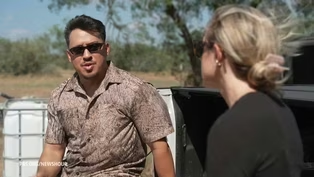
GEOFF BENNETT: Texas Republicans redrew the state's congressional map last year, making a bet that Latino voters who broke for President Trump in 2024 could be the foundation for victory in 2026.
But, as Liz Landers reports, in South Texas, immigration crackdowns and rising everyday costs may be splintering the GOP's new coalition.
MARIO GUERRERO, South Texas Buildings Association: Hi.
Good morning.
LIZ LANDERS: We meet Mario Guerrero at the entrance to his weekend escape.
MARIO GUERRERO: My dad was -- is a big hunter, and his dream was always to purchase a ranch.
LIZ LANDERS: A new family hunting lodge on the outskirts of Encino, Texas.
Guerrero, who heads a regional builders association, says federal immigration policy is holding back local businesses like his that rely on immigrant labor.
MARIO GUERRERO: The construction industry has been terrorized with these raids that are currently happening.
When you have fear and you can't get people to show up to job sites to do work, it affects the whole wheel of the economy when it comes to construction.
LIZ LANDERS: Do you think that this area of Texas will vote red this election cycle?
MARIO GUERRERO: Right now, if you're a Republican candidate, at least in South Texas, a lot of the people that I speak to, which are business owners, if you have the stamp of a Republican on you, it doesn't look very good.
LIZ LANDERS: At the ballot box, Latinos account for almost a third of the eligible electorate and 45 percent of potential young voters in Texas.
Trump's share of the Texas Latino vote grew each time he ran from about a third in 2016 to 55 percent in 2024.
Have you supported President Trump in the past?
MARIO GUERRERO: Yes, ma'am.
LIZ LANDERS: How many times have you voted for him?
MARIO GUERRERO: I voted for President Trump every time he was on the docket.
LIZ LANDERS: Last summer, Republicans counted on keeping their electoral gains with Hispanic voters like Guerrero as they redrew districts in an effort to win more seats in Washington.
But a recent poll from The Cook Political Report and TelevisaUnivision found just a third of Hispanic voters in the state approve of the job the president is doing.
Nearly two-thirds say they're less likely to back a candidate who supports his deportation policy.
REP.
MONICA DE LA CRUZ (R-TX): Well, good afternoon, Texas!
(CHEERING) LIZ LANDERS: Guerrero's Congresswoman, Republican Monica De La Cruz, touts the president's efforts to secure the border and backs Border Patrol, but on immigration enforcement: REP.
MONICA DE LA CRUZ: I have spoken with leadership.
I believe that enforcement should be on the criminals and the cartels.
I have said this over and over again.
LIZ LANDERS: That is not good enough for Guerrero.
He is voting for her Democratic opponent, Bobby Pulido, this fall.
MARIO GUERRERO: I vote Bobby.
To his face, I'm going to keep track of what you're doing, and I'm going to keep track of how you're voting, because we're expecting for you to vote in the best interest of your people, and not in the best interest of your party.
LIZ LANDERS: Pulido is a Tejano music star who left the stage to run for office and began turning quinceaneras into campaign stops.
BOBBY PULIDO (D), Texas Congressional Candidate: We feel like we are inspiring a lot of people to go vote and be engaged that don't normally get engaged.
So I really think people are more split-ticket voters and they want to believe in the candidate.
I think they're disillusioned with both parties, to be honest with you.
LIZ LANDERS: Engagement is the concern for Daniel Garza.
He leads The LIBRE Initiative, a conservative group that courts Latino voters.
His fear, that Latinos might stay at home as races across the country are decided by fractions of a percent.
DANIEL GARZA, Executive Director, The LIBRE Initiative: That right word shift that happened with the Latino community, don't take that for granted.
We are almost transactional voters in a very real way.
The Latino vote, leaning it one way or the other can actually define the outcomes of these races.
LIZ LANDERS: The Cook poll found Texas Hispanics ranked the economy as their top concern.
That's what we heard at this homecoming football game in Floresville just outside San Antonio.
Can you afford day-to-day things right now?
CHEZARE PEREZ, Texas Voter: Yes, with multiple jobs.
So, I mean, that's the way a lot of Americans probably feel right now.
We own a couple of businesses ourselves and have a full-time job, so it's very difficult.
So, the affordability is really real right now.
LIZ LANDERS: Hispanic voters who spoke with us here had a favorable view of their incumbent congresswoman, Republican Monica De La Cruz.
CHEZARE PEREZ: Have I supported her in the past?
I have, yes.
LIZ LANDERS: But this year, they can't.
State mapmakers drew them and 60 percent of her current constituents out of the district, forcing De La Cruz to introduce herself to new voters.
Both she and Pulido argue that winning over Hispanic voters in South Texas only happens if you win the pocketbook issues.
REP.
MONICA DE LA CRUZ: I know what a stack of bills looks like on the kitchen table.
BOBBY PULIDO: I think a lot of people, especially in the Hispanic communities, we don't come from generational wealth.
So we respond a lot to an economic message.
LIZ LANDERS: For his part, Guerrero sees the economy and immigration as intertwined.
He voted for a secure border and safer communities.
He didn't expect indiscriminate immigration raids and the resulting impacts on the social and business communities.
DONALD TRUMP, President of the United States: I will launch the largest deportation program in American history to get the criminals out.
LIZ LANDERS: Even though Trump said on the campaign trail he wanted mass deportations, you're still surprised?
MARIO GUERRERO: Yes, ma'am, very surprised.
I think that the enforcement that has been placed by this administration has gone way above and beyond that we -- anybody ever expected.
LIZ LANDERS: It's a dynamic that could reverse recent Hispanic voting trends and reshuffle the odds of victory up and down the ballot.
For the "PBS News Hour," I'm Liz Landers in Encino, Texas.
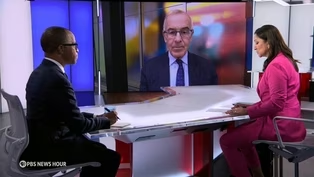
AMNA NAWAZ: Chinese President Xi Jinping wrapped up his visit to Washington today after a warm welcome from President Trump and high-stakes talks at the White House.
In the same week, Trump banned some journalists from the White House, citing reports he says threatened national security.
Their access was restored temporarily by a federal judge.
To discuss all that and more, we turn now to the analysis of Brooks and Capehart.
That is "The Atlantic"'s David Brooks and Jonathan Capehart of MS NOW.
It's great to see you both.
Jonathan, let's start with Chinese President Xi Jinping's visit.
He toured the National Archives today with President Trump before his departure.
But when he first arrived, Trump literally rolled out the red carpet for Xi.
There was a rare planeside greeting for the Chinese president, a lavish state dinner.
At the White House, we know they talked about trade and AI and Taiwan, but there wasn't much substance out of those meetings.
We haven't had a readout from the White House.
So, look, experts tell us it's good that they met, it's good they continue to talk.
If stability was the goal, was this mission accomplished on this visit?
JONATHAN CAPEHART: I mean, maybe.
It'd be great to read those, the readouts of those meetings and what they actually talked about and what plans they might have put in place for when they meet again.
I believe it's in no in November in China.
But it seems to me the President Xi came to Washington on very strong -- with very strong footing, in the sense that the president of the United States rarely, if ever -- and someone reported that it's usually for the pope that the president leaves the White House to go greet a foreign.. AMNA NAWAZ: Planeside on the tarmac.
JONATHAN CAPEHART: Planeside on the tarmac.
It's usually the chief of protocol or someone from the Protocol Office.
And I know this because my husband used to be assistant chief of protocol during the Obama administration.
And so for -- it's one thing for the president to literally roll out the red carpet.
It's another for him to do that and be at the airport.
So I wonder, going into these meetings, who had the stronger hand?
And it's quite sad that I can't say the United States really went in there and argued hard on -- argued hard on AI, Ukraine, Iran, trade.
It's a whole host of things to talk about.
And I have no confidence that the United States is any better -- in a better position now than before President Xi got here.
AMNA NAWAZ: So, David, Jonathan is articulating some concerns we heard from other regional watchers and experts.
They say the pageantry and the fanfare has them believing that the U.S.
is treating its adversaries better than it's treating its allies.
How do you see it?
DAVID BROOKS: Well, it is the most important relationship in the world right now.
So I'm sort of glad Trump went out there and met him at the airport, standing up on -- there on the other side of TSA with a name card thing.
(LAUGHTER) DAVID BROOKS: But I -- like Jonathan, I worry that this is all just a spectacle.
And then this is the problem with the no -- Trump policy process.
This is the most important relationship, and yet are we making progress on trade?
Are we making progress on economy?
Are we making progress in Taiwan?
And, to me, the most urgent issue is AI.
We only regulate AI if China and America come together and issue some joint regulations.
And yet I'm very dubious we're going to be able to do that.
And the independent journalist Derek Thompson did some reporting on this, and he wanted to know what -- in the Chinese community, what do they think about AI?
Are they as alarmed as we are?
And the answer tends to be no.
The Chinese scientists and the Chinese community is not as interested in AGI, artificial general intelligence, as we are, and they're not as much freaked out about it.
They're also not as freaked out about it as recursive self-improvement, which is that -- when the bots begin to train themselves.
That's when they really get out of control.
And I think, since the Hugging Face thing, that's what Americans are really concerned about.
Apparently, the Chinese community is not as worried about that.
And so we may not -- it may not only be a leadership thing.
It may be the two communities are not seeing the situation in the same way.
And if we don't get together on AI, in my view, that's tremendously bad news for the world.
AMNA NAWAZ: I also want to underscore, Jonathan, this was the same week that President Trump banned reporters from three outlets, CNN, Politico, and your outlet, MS NOW, from the White House.
JONATHAN CAPEHART: Right.
AMNA NAWAZ: He said White House access is a privilege.
He cited national security concerns.
They sued.
A judge sided with them.
I believe some still had trouble getting back into the White House on Thursday morning.
But Peter Baker of The New York Times called it a surreal week in Washington.
He wrote this: "The president of the United States barred American reporters because he labeled them a threat to national security, while welcoming Chinese reporters who answer to the communist dictatorship in Beijing."
How did you look at all this?
(LAUGHTER) JONATHAN CAPEHART: Everything is upside down, Amna.
One, covering the White House, access to the White House is a right.
It is a public facility.
The press is the only profession protected in the Constitution because of our role of informing the citizenry.
And so this is another example of the president sort of warping what it means to be in the White House, to be president of the United States.
Our journalists, all journalists should be there.
And I was actually very heartened to see the White House press pool leave - - excuse me -- in solidarity.
So -- and I'm glad that our network, CNN, Politico, and others pushed back again against this.
But the other thing that I found fascinating is that the president chose to pick this fight with the press in probably one of the most consequential weeks for him in his presidency.
He had the unveiling of his new helipad that he would have loved to have had pool coverage.
Then he went to New York for the United Nations General Assembly, and no press pool around him to chronicle him being a leader on the world stage.
Then he comes back for the state visit of President Xi.
Now, there was some maneuvering and the reporters got back.
But this is a president who lives on television.
He's watching it.
He wants to see himself on it.
And this is a moment -- this was a moment when pictures, television would have been supreme for him, and this was just a cell phone, what he did.
AMNA NAWAZ: David, how did how did you look at this?
We should note Trump at one point praised the Chinese-controlled press as the friendliest press as well.
Did that split-screen moment strike you?
DAVID BROOKS: Yes, I'm sure he'd love to have a state-controlled press in this country just as much.
Yes -- and I Jonathan mentioned it's a -- it's our house.
It's not his house.
And so the public should have a right to choose.
And then, most importantly, this is a democracy.
You have to have some respect for the people.
And if people want to watch MS NOW or CNN or anybody else, and you want to talk to the people, you have got to have those outlets.
And so it's just ridiculous and outrageous that he would ban these places.
But if I could vent one pet peeve about us, starting in 2015, we in the mainstream media learned that, if you bash Donald Trump, the clicks go up, the ratings go up.
It became the business model.
And I'm not saying we're -- we play it straight.
We do our job, but it's become the business model.
And I get -- we get to go, or at least to dinners, sometimes off-the-record dinners between journalists, columnists, and politicians.
And I would say, over the last two years, used to be, when you were at a dinner, an off-the-record dinner with the Democratic politician, there was distance between the journalists and the Democrats, because they're politicians.
Our job is to keep some distance.
In my view, at many places and in many of the dinners I have been to, there's no distance anymore.
And that is a problem for the media.
And that is our problem.
We have got to reestablish some distance from the Democratic Party.
These are people we cover.
They're not people we root for.
They're not people we're spin doctors for.
They're people we cover.
And I do think we have done a not ultimately excellent job at maintaining as much distance from the Democrats as we keep from the Republicans.
AMNA NAWAZ: There's a whole lot there I hope to unpack in more conversations.
I know we need to talk about this a lot more.
But before both of you go, I do want to put to you some of the new findings from our new PBS News/NPR/Marist poll that was out this week.
We saw some expected divides there when it comes to how people are voting for their congressional members, a lot of MAGA Republicans saying they're voting to support Trump, Democrats voting to oppose him.
Jonathan, it was the independents number that struck me.
More than half of independents said they're planning to cast their congressional vote to oppose the president.
And when we asked about the issues specifically, Democrats now have the advantage on every issue we asked about.
That includes the economy and immigration.
What do you take away from that?
JONATHAN CAPEHART: Well, the president said in South Carolina a few weeks ago to his supporters, pretend I'm on the ballot.
Just pretend I'm on the ballot.
And we have seen poll after poll after poll, including this one most starkly, that, yes, people think that he's on -- he is on the ballot.
And they don't like what they see, and they're letting pulse the pollsters know.
AMNA NAWAZ: David, we have got about 30 seconds left.
I will give you the last word here.
What do you take from these numbers?
DAVID BROOKS: Three quick lessons.
First, when the electorate turns against the party in power at the last minute, it tends to turn really hard, way more than the polling shows.
And that's what's happening, turning against Donald Trump.
Second, when the economy is bad six months out, it's bad for the for the president, and that's what's happened.
And, finally, you look at Texas, Talarico's doing really well.
You look at Michigan, El-Sayed is doing really well.
I think we're looking at a wave.
AMNA NAWAZ: David Brooks, Jonathan Capehart, great to see you both.
Thank you so much.
JONATHAN CAPEHART: Thanks.
GEOFF BENNETT: You're about to meet a ballet dancer of unusual grace and grit.
Ahmad Joudeh was born stateless in a Palestinian refugee camp in Damascus, Syria.
He's traveled far since on the power of his dreams.
AMNA NAWAZ: We recently met him at his new home in San Diego after surviving a traumatic childhood, much of Syria's civil war, and constant threats of execution by ISIS.
Here he is to tell his own story.
AHMAD JOUDEH, Syrian-Palestinian Ballet Dancer: Living my life as a stateless refugee taught me that the concept of home is the way you feel.
So, for me, my body is my home.
Wherever I go, wherever I dance, it is home.
And I learned how to belong.
My name is Ahmad Joudeh.
I am a dancer.
I was born in Syria in a refugee camp for stateless refugees in Damascus, Syria.
Stateless means you don't have a nationality and you don't have an I.D.
or rights.
Growing up in a camp was a bit challenging.
I wanted to become a dancer after I saw dance for the first time.
The girls school were performing ballet.
I was 8 years old.
I brought dance home, but secretly first.
I was, like, going to my room, locking the door, and just, like, dance by myself, until my mother found out.
She told me this was ballet, and she gave me my first stretching exercises.
Since then, I just love ballet.
But my father had a different idea.
He used to beat me up and he used to tell me: "You have one choice, study or dance."
And my response to him was: "It's dance or die."
So he could not accept that.
And when we left the house, and me and my mom and my brother and sister, I felt always guilty, and I felt like I broke the family.
And it was just dark, and everything was falling apart around me.
I was 17, so I tried to take my own life, and that was very hard.
But being in that moment, it taught me a lot.
It taught me how I could be my own person.
Like, why do I have to die if I don't?
Why don't I just live my own life the way I want?
I used to teach children dance in Syria and in Europe.
I love teaching dance, but especially in Syria in refugee camps, where these children they don't have parental care.
They are disprivileged children.
When I was a refugee little kid, I was dreaming of someone to come teach me something.
I just wanted to be this person that I dreamed of having when I was a child.
In Syria, when I used to give children dance classes, especially in the SOS Children's Villages, I received these threats a lot, but still I went there.
When the war has started in Syria, and all these extremists came to the country, I was still dancing and I was the principal in the company, and my posters all over the city, in theaters and on TV.
These extremists knew about me and they wanted my head.
So they used to send me threats to my phone, post my pictures on Facebook.
But what bothered me most was when, they used to call from anonymous numbers and just say that they want to cut my head.
I decided to take a tattoo on my neck.
It says "Dance or die," because I wanted to carry my life on my neck.
I live the way I want, or I don't want this life.
Dance took me to Amsterdam, and I worked with the Dutch National Ballet, who brought me from Syria and they saved my life literally 10 years ago.
But the country I was born in, they still don't like me.
They still don't like that I am a free person who is Pride ambassador for Amsterdam, Pride, who is a dancer who's performing almost everywhere.
So dance brought me to Amsterdam, but love brought me to San Diego.
I came here following my heart.
And, of course, wherever I go, I look for my artistic home.
I found this company, Golden State Ballet, and since then, I learned that dreams can still be true.
So, this year, I also performed in an opera, actually world premiere opera called "Gilgamesh."
Gilgamesh is a leader, and he decided to be a brutal leader for his people.
The gods want to change him.
So they created Enkidu, who's a companion for him.
So Gilgamesh found love, and love changed him.
His love for his friend made him become a better leader.
I think that's a message for our leaders in the world.
Maybe that's the answer.
I don't think anyone in the world who feels loved would hurt anybody else.
So try to love yourself, so you can love others, and try to find your own freedom within so you can accept other people's freedom.
GEOFF BENNETT: Be sure to tune into "Washington Week With The Atlantic" later tonight right here on PBS, Jeffrey Goldberg and his panel assess President Trump's power over Washington with the midterm elections just weeks away.
AMNA NAWAZ: Well, at the U.N.
this week, Secretary of State Marco Rubio joined others warning that Russia's war on Ukraine could spread.
This week on "Compass Points," Nick Schifrin speaks with former ambassadors about those concerns.
KURT VOLKER, Former U.S.
Special Representative for Ukraine: If Rubio is concerned about this war metastasizing, then we should stop it, OK?
That should be... (CROSSTALK) NICK SCHIFRIN: He says he's trying.
And that's what he says.
KURT VOLKER: No, no, we're not trying.
This war is happening because Vladimir Putin has decided to try to take over Ukraine and subjugate it as part of a Russian empire.
He's not going to stop.
So we have to stop him.
And Ukraine is leading the edge here.
They are ready to do this.
They need support.
And we could have ended this three years ago.
We could have ended it two years ago.
We should still do it now, especially if we're worried about it getting bigger.
AMNA NAWAZ: And on "Horizons" this weekend, William Brangham and his panel discuss the widespread surveillance of Americans and the right to privacy.
You can catch "Horizons" and "Compass Points" on our YouTube channel, wherever you get your podcasts, or on your PBS station.
Check your local listings.
GEOFF BENNETT: And that is the "News Hour" for tonight.
I'm Geoff Bennett.
AMNA NAWAZ: And I'm Amna Nawaz.
On behalf of the entire "News Hour" team, thank you for joining us.
Have a great weekend.
Brooks and Capehart on Trump's warm welcome for China's Xi
Video has Closed Captions
Brooks and Capehart on Trump's warm welcome for China's Xi Jinping (10m)
GOP's bet on Texas Latino voters could backfire in midterms
Video has Closed Captions
GOP's big bet on Texas Latino voters could backfire in midterms (5m 50s)

Health care costs a concern for voters ahead of midterms
Video has Closed Captions
Health care costs a major concern for voters ahead of midterms (6m 34s)
Mexico's foreign secretary on Trump and U.S. trade talks
Video has Closed Captions
Mexico's foreign secretary on Trump, cartel violence and U.S. trade talks (6m 13s)

News Wrap: Xi wraps up 3-day state visit with Trump
Video has Closed Captions
News Wrap: Xi wraps up 3-day state visit with Trump (6m 30s)

Syrian dancer escaped ISIS and found freedom through ballet
Video has Closed Captions
Syrian dancer reflects on escaping ISIS and finding freedom through ballet (5m 37s)

What Supreme Court's SAVE database ruling means for midterms
Video has Closed Captions
What the Supreme Court's voter-citizenship database decision means for the midterms (4m 24s)
Wrongfully detained journalist still jailed in Iran
Video has Closed Captions
Wrongfully detained Iranian American journalist remains jailed in Iran after 2 years (6m 6s)
Providing Support for PBS.org
Learn Moreabout PBS online sponsorship New Episode
- News and Public Affairs

FRONTLINE is investigative journalism that questions, explains and changes our world.

- News and Public Affairs

Today's top journalists discuss Washington's current political events and public affairs.



 New Episode

 New Episode



 New Episode
Support for PBS provided by:
Major corporate funding for the PBS News Hour is provided by BDO, BNSF, Consumer Cellular, American Cruise Lines, and Raymond James. Funding for the PBS NewsHour Weekend is provided by...