Vermont This Week
September 27, 2024
9/27/2024 | 26m 45sVideo has Closed Captions
Pressure builds for Gov to intervene on motel program evictions
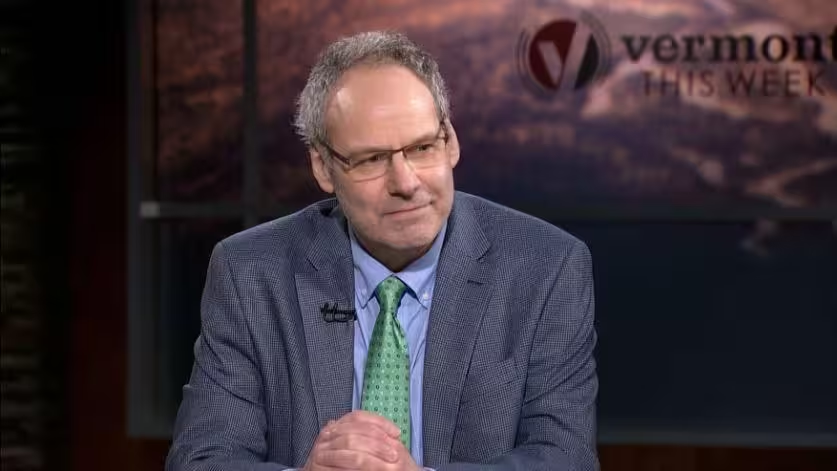
Pressure builds for Gov to intervene on motel program evictions | FEMA's plodding bureaucracy exacts financial toll on Vermont towns | Environmental group sues, says state not doing enough to reduce emissions | Panel: Mitch Wertlieb - Moderator, Vermont Public; Pete Hirschfeld - Vermont Public; Calvin Cutler - WCAX; Tim McQuiston - Vermont Business Magazine.
Problems playing video? | Closed Captioning Feedback
Problems playing video? | Closed Captioning Feedback
Vermont This Week is a local public television program presented by Vermont Public
Sponsored in part by Lintilhac Foundation and Milne Travel.
Support provided by:


Vermont This Week
September 27, 2024
9/27/2024 | 26m 45sVideo has Closed Captions
Pressure builds for Gov to intervene on motel program evictions | FEMA's plodding bureaucracy exacts financial toll on Vermont towns | Environmental group sues, says state not doing enough to reduce emissions | Panel: Mitch Wertlieb - Moderator, Vermont Public; Pete Hirschfeld - Vermont Public; Calvin Cutler - WCAX; Tim McQuiston - Vermont Business Magazine.
Problems playing video? | Closed Captioning Feedback
How to Watch Vermont This Week
Vermont This Week is available to stream on pbs.org and the free PBS App, available on iPhone, Apple TV, Android TV, Android smartphones, Amazon Fire TV, Amazon Fire Tablet, Roku, Samsung Smart TV, and Vizio.
Support the crew
Help Mitch keep the conversations going as a member of Vermont Public. Join us today and support independent journalism.Providing Support for PBS.org
Learn Moreabout PBS online sponsorshipAdvocates and state leaders continue to put pressure on Governor Scott to intervene on motel program evictions.
They are seniors.
They are families with children.
They are people with disabilities.
They are people fleeing domestic violence.
and thought that the state of Vermont is just going to let this happen.
Is just unconscionable.
This is a policy failure that requires immediate action.
Call a special session of the legislature to remove the cap on the motel rooms and the number of nights available to eligible participants, plus how FEMA's plodding bureaucracy is exerting a financial toll on Vermont towns and an environmental group has sued Vermont, saying the state is not doing enough to reduce emissions.
That and more ahead on Vermont this week.
From the Vermont Public studio in Winooski, this is Vermont this Week, made possible in part by the Lintilhac Foundation and MilneTravel.
Here's moderator Mitch Wertlieb.
Thanks so much for being with us.
I'm Mitch Wertlieb.
It's Friday, September 27th and joining us on the panel today, we have Tim Mcquiston from Vermont Business Magazine, Calvin Cutler from WCAX and Pete Hirschfeld from Vermont Public.
Thank you so much all for being here today.
And we don't get to do this too often, but we have some breaking news as we're going to tape today.
This decision came down just today, Friday.
Vermont Superior Court Judge Robert Mello has dismissed a lawsuit.
Now, this was brought against Governor Phil Scott by two Vermont lawmakers challenging his appointment of interim Secretary Zoe Saunders to be the secretary of education.
Mello, siding with the Scott administration here, saying that there is no standing for this, allowing the secretary to remain the interim secretary.
So it's a victory for the Scott administration.
We don't know yet if there might be an appeal, but this could end up going to Vermont's Supreme Court.
remind us, Pete, the controversy over Zoe Saunders, becoming the education secretary in Vermont.
Lawmakers were really against this in the Senate, in fact, voted her down.
Yeah.
That's right.
There was a real outcry from the public education, education community in Vermont that was concerned about Zoe Saunders because of her history working with a company that ran for profit charter schools and a lot of Vermont education advocates worried that, this was going to be some kind of, nefarious path to the expansion of a voucher system in Vermont that would see for profit schools come in here and siphon away those critical tuition dollars from public schools.
the Senate decided that, they weren't comfortable with Zoe Saunders, in part because of those concerns.
And they rejected her.
I think it was maybe 30s after that vote happened, Calvin, that we right after we all started buzzing, you got, got an email from the Scott administration saying that he had appointed, Saunders on an interim basis.
hence the lawsuit.
And it sounds like a judge has decided that, what the governor did is allowable under Vermont Constitution.
Yeah.
Details.
You know, more will come out, but what?
Below, the Judge Mello is saying here is basically that because I think she's an interim appointment, this is not a permanent appointment.
So he's saying, you know, the governor has the authority to do this.
The governor technically can make this appointment.
That's what he did.
Calvin, it does seem, though, that, in other situations, the legislature has stepped in to create laws to stop this sort of thing from happening.
Maybe this could happen again in this case.
Yeah, potentially.
I mean, you know, we'll see where this goes on the legal front.
Will it go to the Supreme Court?
We'll see.
And I think it's an open question of whether the state legislature will, you know, pass a law or try to tackle, this in this coming legislative session because really, what this is in there's the political angle to all of this, but also this is a disagreement between two separate and co-equal branches of government as well, between the legislature and the, the the executive branch.
And the concern from Senator Tanya and Dick McCormick was essentially, if this appointment or interim appointment were to go through, it could, create what their lawyers described as a Groundhog Day where you just keep appointing and appointing, appointing and you serve an interim basis in perpetuity.
sort of like what we saw with, in Burlington with the police chief, John Murad.
So I think what's, this is going to be, you know, there's the legal recourse to this, but also, will we see something, bubble up in the legislative session, bill wise with this is something we're going to be keeping a close eye on.
It's going to be a tricky legislation, because what are you going to do, outlaw interim, appointments?
Because otherwise, if you knew you had a controversial appointment, you just say, right, well, I'm not even going to take it to the Senate.
I'm just it's going to be interim.
And at some point, it's just going to be interim in, in perpetuity.
So it'll be tricky legislation anyway.
And the ugliness from this is not going to go away.
Probably until Phil Scott steps down and he's running again, of course, for governor and is expected to win.
So it's going to be we're going to be going through this thing for a couple more years.
And there is precedent.
The legislature passed a law after the formation of the Green Mountain Care Board that said, if a, gubernatorial appointee is rejected by the Senate, then the governor cannot appoint that person, on an interim basis to serve as chair of the Green Mountain Care Board.
So they have some, draft legislation.
I'm sure that's still sitting there on the shelf that they might try to dust off.
Yeah, it'll be interesting to see if that becomes like a blueprint for creating a new law here.
But, again, that breaking news happening, a victory, at least temporarily.
Now for Governor Phil Scott with that appointment, interim appointment of Zoe Saunders as education secretary.
as we alluded to at the top of the show, big news that we've been talking about for a while now, these these motel evictions are underway.
and here's what, Senator, excuse me, representative Dion Langford and Mayor Mulvaney Stanek of Burlington had to say about the situation.
Vermonters are in danger.
And this was a flood.
There'd be a press conference every day for some folks are out of compassion fatigue level.
however, it is imperative that elected leaders not give up.
That is not an acceptable answer.
Saying this is going to be our new normal.
Calvin, the situation is really dire.
And a lot of folks, you know, as you're being sent out with tents, they've got kids.
some of these folks.
What are some of the things that are being suggested, for the Scott administration to do at this point, to offer some kind of relief?
Well, by all accounts, the legislature is not in session right now.
That was a meeting of the Joint Fiscal Committee that we saw right there.
And they can only do so much, and they can't really tackle the General assistance Program advocates, service providers, municipalities, lawmakers and others are calling on the Scott administration to stand up temporary state run shelters, on state buildings, to provide a place for people to go, stay warm, to shelter over people's over their heads, declare a state of emergency, which will give the state more flexibility in doing this and call a special session of the state legislature, call lawmakers back, and, to to revisit the hotel program to expand this cap.
I believe it's, 84, 85 days and also 1100 rooms is what the, cap is.
And so, you know, I think a lot if there's a lot of, of soul searching happening right now at the state house of how do we, accommodate for and how do we serve and, you know, basically serve, some of the folks, the vulnerable in society, the governor's team, has said that a state of emergency special session, those aren't needed.
In fact, even Senate President Pro Tem Phil Ruth told me those might not be as effective as a tool as they think or in something.
there does seem to be somewhat of a, you know, an openness to standing up some of these shelters like we saw back in March.
But it's important to note that those were very poorly intended, I think fewer than just a few people went went to those.
Well, that's what Governor Phil Scott was saying about that.
But the pushback on that was the a lot of people weren't informed.
They didn't even know that those, you know, temporary shelters existed.
Exactly.
And these are congregate shelters, too, right?
I mean, advocates, Brenda Siegel, who's a long time advocate of, homeless Vermonters, you know, called this the abandoned building plan, where essentially you're opening up a warehouse or a building and setting up cots.
And we mentioned, you know, these are there's families, there's kids.
these are people with really high acuity medical needs.
Wheelchairs, oxygen tanks, something very challenging, decisions to be made for state leaders ahead.
And I don't think anybody has has the answer right now.
That was a really remarkable hearing, with the Joint Fiscal Committee, because this is really where all of the money in many ways and all the Covid money has come from to put toward homeless, homeless housing, but also affordable housing and all of the money that that we've invested in recent years.
And I think it was Representative Emily Kornheiser who had said, you know, they really wish that they could have, you know, moved the needle on, on this more, so it was a real, real reckoning, I think, for for many state lawmakers, but also, advocates.
Sue.
Yeah.
yeah.
You know, there were a lot of things that Republican Governor Phil Scott and Democratic lawmakers disagreed on during this past legislative session.
The decision to impose these caps, the the decision to create hard caps on the number of days that households can stay in these motel rooms, that was not one of the things they disagreed on.
The legislature cosigned that proposal, and approved it by by strong majorities in both chambers.
so all elected officials own what's happening right now.
And it's interesting, you heard Calvin talked about advocates calling for a special session saying, look, we've got to do something between now and December 1st when they get call, exactly when they can get back under cold weather conditions.
I have yet to hear anybody of note in the legislature saying, we need to take emergency action, right now to increase funding so that we can get these families back in.
and it's an interesting departure from what we've seen in the in times past when when the moment of reckoning came, the legislature sort of swooped in and said, not under our watch.
We've got to do something.
We can't let this happen.
And it looks like this time it might be a little bit different.
Yeah.
Of course.
Yeah.
Pete's referring to there were like 17 lawmakers last year that said that they were going to vote to sustain the governor's veto on the state budget over concerns about, you know, funding running out for this, this program.
And yeah, it is really interesting that we haven't seen that push this time around.
And I think to that that sound bite that was played from Mayor Mulvaney Stanek, you know, she said it was a that was my question to her was about that.
And she said it was really a matter of political will.
you know, for, for some state lawmakers and that, of course, the biggest thing is that the funding is so expensive.
And it's and when you look at the numbers, it's absolutely not sustainable.
But there is money available.
If you wanted to say, all right, we're going to do this short term through the winter, and then we're going to tackle it this session.
Well, as as you've meant, as you've laid out very accurately, they had that chance to do something not radical, but, you know, make a statement that this is what we're going to do going forward.
We're going to make sure this doesn't become the disaster that it looks like it's becoming.
We're going to push this money that we have, you know, tucked away for other things, fund it through the winter and then move forward.
But they don't have a plan.
It's like, well, we're just we're just passing it on again.
And the larger issue is still with us of unhoused people.
And that's going to be around pass this.
I mean, even these concrete shelters we've been talking about, these are stopgap measures and something more permanent has to be dealt with.
We need to move on to another story about vulnerable Vermonters and Pete Herzfeld.
You've been, really doing some amazing reporting on this.
You've talked about FEMA's lack of efficacy.
Let's say, for individuals getting assistance.
these are from the summer flooding of two years now.
but you've also been reporting on now how towns and the towns that need it most are also not getting the help they need from FEMA.
Yeah.
So to illustrate this issue by example, right.
Let's make it as real as possible.
I went to Stanford and I visited with a select board member there.
Stanford is still waiting on more than $400,000 in public assistance reimbursement.
That that's enormous money for this little municipality in Caledonia County, 208 residents there.
one of the things that's holding up them getting this money is that FEMA says it needs to know the dimensions of riprap that were used to rebuild the road after the 2023 floods.
They need to know the size of the stones that were put in the roads.
Why those?
Well, you know, FEMA, FEMA did not respond to a request for an interview, so I wasn't able to put that question to them specifically.
The point is, these are stones that are buried under several feet of Phil at this point, and they can't get their money until they're able to say what size these stones were.
So these sorts of things are happening in municipalities across the state, municipalities are seeing their program delivery managers and FEMA employees that they're supposed to work with to figure out how to get the money.
Those program delivery managers are changing for five, six, seven times, in some instances over the course of their their application process.
And each time they get a new one, they want a different set of information.
They want it presented differently.
what this means is that, nearly 60% of the towns that have applied for public assistance funding have yet to get those applications approved, have yet to get that money.
It's forcing them into debt.
It's creating some very real financial stress for these municipalities.
And Vermont's congressional delegation says it's come to the conclusion that this is not working.
We have to do something different.
You've been describing this in your reporting as FEMA's plodding bureaucracy.
And that sounds about right.
What you're describing here with this frankly ridiculous notion of trying to measure stones that are underground.
So I want to get to more of what the, congressional delegation is saying here.
They're talking about a massive overhaul, about the way FEMA does their job, basically.
Right?
That's right.
right now, FEMA is spending, you know, untold hundreds of millions of dollars to administer the federal government's disaster response, apparatus.
they say we don't need a Washington based bureaucracy to be making these sorts of granular decisions about who gets what in Vermont right.
Send a bunch of money to the state, let state and local leaders determine who's eligible for what, who needs what.
And then you have accounting and oversight, right, to ensure compliance with federal regulations.
So they want to see this process localized as much as possible.
Have the money come to the state, let the state disburse it.
that's going to take a lot of time though.
you know, that's that stuff that requires an act of Congress.
You can't just institute a reform like that on a dime.
so so this is going to be a long term project if they're going to pull it off.
you mentioned that you're trying to get, you know, FEMA to respond to you, but has there been any kind of reaction to this letter that was sent by the congressional delegation to talk about these issues?
Yeah.
So, I mean, I'm having conversations with people at FEMA, off the record and on background, and they're keenly aware of some of the difficulties these towns are facing.
And they are they are as frustrated, in many cases by these hoops that they're holding as the people that have to jump through them.
So, I think there are a lot of people at FEMA that acknowledge they're not able to get this recovery assistance out as quickly and as nimbly as they want to, and would be more than open to changing things so that they can they can serve the people their mission requires them to much better than they are now.
Is there at least some good news, Pete, in that the state is now starting to distribute, financial assistance to businesses?
Yeah.
That's right.
I mean, this is $7 million that, the, the emergency board, allocated last month.
that money has begun to find its way to businesses or a lot of businesses that are still in the pipeline, you know, damage financial losses to businesses related to this summer's floods are tens of millions of dollars.
And so they're going to need some, some aid in order to, to stay afloat.
Okay.
A lot of this is wrapped up, of course, in climate change.
And, Calvin, I know that there is an environmental group that a lot of Vermonters may be familiar with suing the state now saying they're not doing enough to reduce emissions.
What can you tell us about that?
Well, the Conservation Law Foundation two months ago put the state on notice saying that they were planning on filing a lawsuit under the Global Warming Solutions Act, which essentially sets really strict benchmarks, requirements of carbon reduction and pollution reduction into state law.
Or we could be sued.
The Conservation Law Foundation is alleging that the Agency of Natural Resources is using a different data set, or looking at our data differently than, than and it actually is to make it look like we are, curbing pollution and that we're going to meet that make it look like we're going to meet the first benchmark, which is 26% below 2005 levels, by 2025, which is, what's coming up?
the first deadline is coming up.
And so Conservation Law Foundation says that this is the state holding itself accountable, that they need that the state needs to be moving the needle on climate change, and carbon reduction, of course, because of of catastrophes.
Like Pete just talked about, the agency of natural resources, stands by their numbers, but they acknowledge we may not meet the, 2000, 30 or the 2025 or the 2030 deadlines.
And so it really kind of highlights this broader question, that state lawmakers has have been really grappling with in recent years is how many state dollars and how many resources or how many, how much resources should we be putting toward pollution reduction, getting EVs, cold climate, heat pumps, etc., minimizing our carbon footprint in a state of about 600,000 or so people versus making ourselves more resilient to climate change.
Building bigger bridges, bigger culverts, you know, lifting up our utilities above the floodplain and the like.
So this we'll see where this, this lawsuit goes.
you know, there is Cliff says that there is still time to settle the lawsuit.
but this is also the first of what could be several lawsuits under the Global Warming Solutions Act.
And of course, it's going to cost the state money.
And, Tim, the question, no matter what happens here, we're looking at a time when the administration, the Scott administration, is asking state departments to keep their budgets tight.
Is that right?
Keep them tight for the next fiscal year.
The current one only started July 1st.
So they're they're talking they're looking ahead to the next legislative session, as you guys would be knee deep in, keeping, the budgets as tight as possible because, you know, they'll, you know, the the budget gets big fight every year, right?
so they're looking ahead.
There are some, right now that the state's tax revenues are very strong, but there is there is some weakening things.
And we we could talk about this, now with the, the revenue report which came out, the other day.
And if you look at the personal income tax, which is by far the most important tax that is that is really humming along, we we understand why this is and it's related to, wage increases that they're coming out of the pandemic so that that should, stay strong.
The item, the line item you should focus on, on this is the rooms and meals tax and the rooms and meals tax has been very, very strong for many years, going back even through the Great Recession.
It's been the tax they've leaned on.
In fact, they've pushed about a third of it into the education fund to reduce the property tax.
And by the way, there's going to be a suggestion that they want to push the entire rooms and meals tax into the into the education fund to reduce the property tax.
That would be the easiest thing to do if you wanted to reduce the property tax or take the edge off of it, that would be a big thing.
The rooms and meals tax is a big line item.
It has been soft the last few months though, and so that's a little concerning.
And I've talked to tourism officials and they said, you know, it.
Maybe it's the floods we've gone through.
they're just not sure that one of the things that that's very clear, though, that the US dollar is so strong that people are going overseas.
And when you get overseas, the stuff is cheaper than than it is here.
So that is absolutely been a factor in the and this is this is sort of across the US too.
There's been some softening of of local tourism dollars.
We'll have to see how the how the state does it.
But yeah.
Adam, Gretchen sent out a letter to the, the departments.
He's the finance director for the state for, the Scott administration saying, you know, you know, tighten your belts.
Things aren't going to get noticeably better, even though the consumption tax, the sales tax is doing very, very strongly to the gasoline tax was up, which is which is kind of an odd thing which has been suffering in recent years because of, fuel efficiency and electric vehicles and that sort of thing.
But, yeah.
So they're, they're, they're looking ahead already, you know, anticipating that there's going to be a new legislatures, a lot of new bodies going to be in there.
You know, what are the new fights that are going to be involved.
You know, they're going to deal with the the the homeless crisis and who knows what what what will come of that?
you know, one of the things about the, the, global warming issue, the carbon reduction issues, is that there is there going to be the workforce to support the things they want to do as well and just.
Yeah, yeah, just just run out of people to, to install this thing.
Even if you had the money and the will, the political will to do it.
Yeah.
I mean, who knows what kind of economy we're going to be looking at 12 months from now.
Right?
JP Morgan just increased the risk of a recession before the end of 20 calendar year 2024 to 35%.
they put it at 45% by the end of 2025.
So potentially precarious times ahead for this state.
And I think the argument you're going to hear that Scott administration making is we got to be ready for that.
we don't know when it's coming, but we're pretty sure it's coming.
And if we don't hunker down now, we're going to be way overexposed when when we do get hit.
Oh, we did see that to go ahead.
Yeah.
There's there's nothing to say to tell us that the property taxes are going to go down either.
We've seen this this double digit increases.
Yeah.
Well what's going to bring it down.
There's not there's no low hanging fruit there to to reduce the property tax.
Well I'm hoping that maybe the meals and rooms taxes will come back up with a good fall foliage season.
Or is that naive to think something a little bit?
Foliage is actually, even though it's sort of our biggest brand, it's actually not that large a revenue source.
Interesting.
The ski season is is very, very big.
The summer season because it lasts so long is also yeah, is also very big.
So the you know see how you know, pray for snow don't we always in Vermont.
Calvin, you have an interesting story you've been following about, thousands of older Vermonters who are going to lose their Medicare Advantage plans, next year.
What is the story there?
Yeah, this is a pretty big deal for about 6000 Vermonters.
So Medicare Advantage plans were created a few years ago.
This one was a partnership between MVP and UVM Health Network, essentially, it's run by a private company, but they receive, federal Medicare funds.
So this is for Americans 65 and older.
instead of going on traditional Medicare, you can take a private run plan which might have other benefits or, you know, have different offerings.
as we've talked about like last week with, you know, national challenges with health care, you know, coming out of the pandemic, especially in Vermont, lots of older Vermonters are accessing more expensive care more often.
Plus, on the federal level, Medicare reimbursement rates have also come down from the center for Medicare and Medicaid Services, or CMS.
And so that has, put UVM and NVP in this position where they are going to be discontinuing this product, throwing about 6000 people back into either the commercial insurance marketplace where they can buy off the health exchange or go back on to regular Medicare.
and you know, what's what's really interesting about these plans to not not just this plan specifically, but Medicare Advantage plans have really come under fire in recent years, and they're very controversial on the national stage for finding savings by denying certain procedures as well.
there was a push to switch over state employees a few years ago to a Medicare advantage plan, which they pushed back very hard on, and that that never happened.
So this, but I think what really matters here is there's about 6000 people that next year are going to have to be looking for new insurance plans.
That's what I was going to ask briefly.
Calvin, what can they do?
Can they reapply?
Can they go somewhere else?
Yeah, they they can they can reapply.
They can go somewhere else.
They can look for other plans.
There's still subsidies and lot of opportunity on the Vermont Health Connect.
and also there's going to be a grace period, for the next year to get back onto state or federal Medicare so they won't have to pay a penalty.
But it's going to be a challenge if they want to remark that, early voting is underway in Vermont.
If you've not received your ballot, all registered voters in Vermont get one.
If you don't get it by October 5th, contact your town clerk and you can get one there.
I'm afraid that's all we have time for today.
I want to thank our panel today so much for being here.
Tim Mcquiston from Vermont Business Magazine, Calvin Cutler Wcax and Pete Hershfield with Vermont Public.
Thank you so much.
And thanks everybody at home for watching and listening.
We'll see you next week on Vermont this Week I'm Mitch Wertlieb and I hope you have a great week.

- News and Public Affairs

Top journalists deliver compelling original analysis of the hour's headlines.

- News and Public Affairs

FRONTLINE is investigative journalism that questions, explains and changes our world.












Support for PBS provided by:
Vermont This Week is a local public television program presented by Vermont Public
Sponsored in part by Lintilhac Foundation and Milne Travel.