
September 28, 2023 - PBS NewsHour full episode
9/28/2023 | 57m 46sVideo has Closed Captions
September 28, 2023 - PBS NewsHour full episode
Thursday on the NewsHour, Speaker McCarthy rejects a Senate effort to avoid a government shutdown while House Republicans hold their first impeachment hearing. GOP presidential hopefuls take the debate stage to make the case for themselves as alternatives to Trump. Plus, thousands of ethnic Armenians flee after Azerbaijan violently takes control of the breakaway republic of Nagorno-Karabakh.
Problems playing video? | Closed Captioning Feedback
Problems playing video? | Closed Captioning Feedback
Major corporate funding for the PBS News Hour is provided by BDO, BNSF, Consumer Cellular, American Cruise Lines, and Raymond James. Funding for the PBS NewsHour Weekend is provided by...
September 28, 2023 - PBS NewsHour full episode
9/28/2023 | 57m 46sVideo has Closed Captions
Thursday on the NewsHour, Speaker McCarthy rejects a Senate effort to avoid a government shutdown while House Republicans hold their first impeachment hearing. GOP presidential hopefuls take the debate stage to make the case for themselves as alternatives to Trump. Plus, thousands of ethnic Armenians flee after Azerbaijan violently takes control of the breakaway republic of Nagorno-Karabakh.
Problems playing video? | Closed Captioning Feedback
How to Watch PBS News Hour
PBS News Hour is available to stream on pbs.org and the free PBS App, available on iPhone, Apple TV, Android TV, Android smartphones, Amazon Fire TV, Amazon Fire Tablet, Roku, Samsung Smart TV, and Vizio.
Providing Support for PBS.org
Learn Moreabout PBS online sponsorshipGEOFF BENNETT: Good evening.
I'm Geoff Bennett.
AMNA NAWAZ: And I'm Amna Nawaz.
On the "NewsHour" tonight: Speaker McCarthy rejects a Senate effort to avoid a government shutdown, while House Republicans hold their first impeachment hearing into President Biden, despite no concrete evidence of wrongdoing.
GEOFF BENNETT: GOP presidential hopefuls take the debate stage to make the case for themselves as alternatives to the absent and leading candidate, former President Donald Trump.
AMNA NAWAZ: And thousands of ethnic Armenians flee after Azerbaijani forces violently take control of the breakaway republic of Nagorno-Karabakh.
LUIS MORENO-OCAMPO, Former Prosecutor, International Criminal Court: Stopping their food and all the essentials to the people in Nagorno-Karabakh, that is classic genocide-inflicting conditions.
(BREAK) AMNA NAWAZ: Welcome to the "NewsHour."
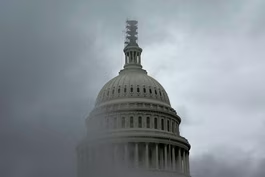
Federal workers were put on notice today that a shutdown is imminent.
Millions of government employees and active-duty military members could stop being paid in just three days' time.
GEOFF BENNETT: The U.S. Senate has been working in a bipartisan manner to prevent a shutdown, but the holdup is with House Republicans, some of whom are refusing to support any short-term measure that would buy Congress more time to act.
Congressional correspondent Lisa Desjardins is on Capitol Hill following all the twists and turns.
Lisa, Congress now has less than three days to reach a deal.
The House and Senate appear to be moving in different directions.
What is the latest this evening?
LISA DESJARDINS: Right.
This deadline is quite serious, and it is approaching more quickly now.
However, things at the Capitol are becoming more complicated, and it feels almost as if slowing down.
First of all, let's talk a little bit about the Senate, which has a compromise idea.
However, a single senator, Rand Paul of Kentucky, is saying he will not allow that to proceed any more quickly than according to Senate rules, because he objects to Ukraine funding in that bill.
Geoff, what that means, essentially, is that we are on track for the Senate to be able to vote on its compromise spending plan no sooner than Monday.
Something would have to change.
So, let's review where we are.
Right now, the shutdown would start for most government agencies Sunday morning at 12:01, just after midnight on Sunday morning here in the country, in America.
And then we know, as I said, that the House, the Senate right now is on track to have a final vote no sooner than Monday.
Now, the House, we don't know what their plan is.
We're waiting to see it.
House Speaker Kevin McCarthy has said he would have one.
He wanted to have a vote on it tomorrow.
But we're waiting to see.
There are so many details up in the air right now, but I think -- think of it in terms of two pivot points, Geoff.
One is tonight.
The House of Representatives will try to pass a yearlong funding bill, possibly two, for a few agencies.
That will be a test if Republicans can agree on anything in the House.
The other pivot point is Saturday.
That's when some senators are going to try and amend that Senate bipartisan deal.
That may be changing.
We will see how many votes there are on Saturday.
We will also see if the deadline itself makes the Senate move a little more quickly.
GEOFF BENNETT: Lisa, you mentioned Ukraine funding.
Remind us of what other issues are at play here.
LISA DESJARDINS: Ukraine funding has been a major factor in both chambers right now.
But we are seeing the rise of Republicans talk more and more about border security.
Initially, the reason we were not able to see spending bills pass in the House and the reason we got to this point was overspending amounts, the idea of the national debt, holdouts saying there had to be lower spending levels than even Republicans themselves agreed to just a few months ago.
That was the real reason we got here, but now we're hearing more and more Republicans say, we also have been concerned about border security.
We want more border security provisions in any kind of temporary deal, and we're hearing that conversation among Senate Republicans as well.
That's what I mean by saying this has become more complicated, not less, as we get toward the shutdown.
GEOFF BENNETT: And there was other news on Capitol Hill today.
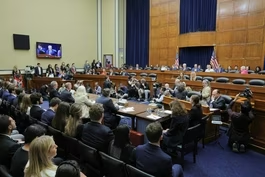
You attended the first House Republicans' impeachment inquiry.
Tell us about it.
LISA DESJARDINS: That's right.
For months, House Republicans have been investigating the Biden family.
Today, that effort entered a new phase.
REP. JAMES COMER (R-KY): The Committee on Oversight and Accountability will come to order.
LISA DESJARDINS: In a relatively small hearing room, big questions and profound politics.
REP. JAMES COMER: The American people demand accountability for this culture of corruption.
LISA DESJARDINS: For Republicans led by House Oversight Chairman James Comer, the top question is whether they will move to impeach President Joe Biden.
In a 30-page memo released last night, Republicans outlined their accusation, writing they have evidence suggesting that President Biden knew of, participated and profited from his family's international business activities.
In other words, the suggestion is influence peddling.
REP. JAMES COMER: As we all know, the Bidens had nothing to sell except the brand, which was Joe Biden.
Hunter Biden sold the brand well, making the Biden family millions from China and elsewhere.
LISA DESJARDINS: Republicans are looking at millions of dollars made by Hunter Biden, the president's son and, James Biden, his brother, especially in 2019 and 2020, for consulting with foreign businesses, including in Ukraine and China.
They have charts of shell companies and spoke of texts and phone calls between Biden family members.
But, in all of that, Democrats repeatedly pointed out there is no direct evidence of payments to or influence peddling by Joe Biden.
REP. JAMIE RASKIN (D-MD): If the Republicans had a smoking gun or even a dripping water pistol, they would be presenting it today, but they have got nothing on Joe Biden.
REP. JAMES COMER: Do you all solemnly swear?
LISA DESJARDINS: Republican witnesses were broad experts in law and investigation, and they raised broad questions.
Forensic accountant Bruce Dubinsky: BRUCE DUBINSKY, Founder, Dubinsky Consulting: Why were members of the Biden family and close business associates receiving millions of dollars of payments from foreign entities and individuals?
What services, if any, were being provided?
LISA DESJARDINS: He concluded: BRUCE DUBINSKY: Much more information is still needed in order to be able to answer these questions.
LISA DESJARDINS: None said they have seen enough to add up to a crime.
Law professor and conservative commentator Jonathan Turley.
JONATHAN TURLEY, Constitutional Attorney, George Washington University: This is a question of an impeachment inquiry.
It is not a vote on articles of impeachment.
In fact, I do not believe that the current evidence would support articles of impeachment.
LISA DESJARDINS: This is the first step in an inquiry initiated by House Speaker Kevin McCarthy earlier this month under pressure from hard right members of the House.
Republicans argue there is real concern about the Biden family.
Democrats have fired back, charging this as an attempt to distract from the criminal charges now against former President Donald Trump and making a point in this hearing by reversing their laptops to show ticking clocks, that a shutdown is just two days away.
REP. KWEISI MFUME (D-MD): Why in the hell are we playing this game?
And why don't we be honest?
If it was so important, it could wait.
This is what is important, protecting this government and protecting the people who pay taxes here.
But we want to play games with all of this.
LISA DESJARDINS: Democrats' sole witness, law professor Michael Gerhardt, stressed the stakes.
MICHAEL GERHARDT, University of North Carolina: An impeachment inquiry is deadly serious.
It is, again, just about the most serious thing any House committee ever undertakes.
LISA DESJARDINS: Republicans expect more impeachment hearings as soon as next month.
And, today, speaking with House Republicans, there is divide.
Some say these impeachment hearings were necessary, but I spoke to more than one House Republican who said it was actually an embarrassment.
They are concerned about the evidence connecting the dots, even though there are a lot of documents.
They say they're still waiting for more evidence and perhaps this hearing should have waited itself as well -- Geoff.
GEOFF BENNETT: Lisa, thank you.
Let's turn now to our White House correspondent, Laura Barron-Lopez, here with us in the studio.
So, Laura, we heard in Lisa's report that the GOP's handpicked witnesses said that there's no evidence to support articles of impeachment.
How is the White House responding to what was this hours-long hearing today?
LAURA BARRON-LOPEZ: Well, that fact, Geoff, that the same -- that the Republican witnesses said that there is no evidence is exactly what the White House is seizing on.
They put out statements quoting the Republican witnesses saying that there is no evidence for impeachment.
They also had their own shutdown clock.
They issued a statement every 30 minutes as this hearing was playing out over the course of the day to say that there's only this many hours left before a shutdown occurs, and essentially highlighting and focusing on the fact that House Republicans have been unable to come to an agreement amongst themselves on how to fund the government and the impact that would have on food assistance programs, on payments to active-duty military members and the like across the board.
That is what the White House is focusing on right now.
GEOFF BENNETT: And as this hearing was happening, President Biden, he was actually in Arizona.
He was paying tribute to his late friend the GOP senator, former GOP Senator John McCain, and it gave President Biden a chance to talk about what he sees as the threats to democracy, right?
LAURA BARRON-LOPEZ: That's right.
This is -- at this speech in Arizona, President Biden specifically gave his most detailed remarks to date about what he sees as a really present and clear threat from not just Donald Trump, but also from other Republican candidates that are running for the presidential nomination.
He focused on the fact that a number of those candidates, including Trump, have said that they want to overhaul the federal agencies, that, if they were to have the presidency, if they were to have the Oval Office, that they want to gut federal agencies, that they want to install loyalists across all the different departments, specifically the Justice Department.
And the president said that this is not normal and this is something that Americans need to pay attention to.
JOE BIDEN, President of the United States: Seizing power, concentrating power, attempting to abuse power, inciting violence against those who risk their lives to keep Americans safe, weaponizing against the very soul of who we are as Americans, this MAGA threat is a threat to the brick and mortar of our democratic institutions.
But it's also a threat to the character of our nation.
LAURA BARRON-LOPEZ: So those are some of the most specific remarks that the president has given to really say that if Republicans were to take power, if they were to take the presidency in 2024, that the federal agencies that you have known for -- since America's existence would not exist.
And he also talked a lot about John McCain, the late senator, and really struck this contrast, Geoff, to say that John McCain was a Republican who was willing to put the country first and was willing to call out what he saw as wrongdoing, was willing to stand up to Donald Trump, and that he doesn't see that anymore amongst Republicans.
He also addressed the fact that no Republicans or a majority of Republicans have remained silent after the former president issued a death threat suggesting that General Mark Milley, the chairman of the Joint -- the outgoing chairman of the Joint Chiefs of Staff, should be executed.
GEOFF BENNETT: Should we expect to hear more about this from President Biden as this campaign moves forward?
LAURA BARRON-LOPEZ: We will.
So this is the fourth speech that the president has given to date on threats to democracy, and the campaign has made clear that this is something that he is going to be talking about aggressively heading into the election cycle.
GEOFF BENNETT: Laura Barron-Lopez, thanks so much.
LAURA BARRON-LOPEZ: Thank you.
AMNA NAWAZ: For more perspective on today's impeachment hearing and the legal basis for the inquiry, we're joined by Frank Bowman.
He's professor emeritus at the University of Missouri School of Law and author of "High Crimes and Misdemeanors: A History of Impeachment for the Age of Trump."
Professor Bowman, welcome, and thanks for joining us.
I want to begin with your reaction to that impeachment hearing today.
What were some of the key takeaways for you?
What new information did you learn?
FRANK BOWMAN, University of Missouri: Well, regrettably, very little.
I think it's certainly true to say that no impeachment inquiry of an American -- of a U.S. president should begin unless there is at least significant proof that the president did engage in some sort of wrongdoing.
And that's been the case in every prior presidential impeachment.
The difficulty, I think, for the Republicans is, on the one hand, they have the advantage of dealing with Hunter Biden, the president's son.
And I think the one uncontested point that everybody can agree upon is that Hunter Biden has spent his entire life being in the profession of being the son of Joe Biden, in the sense that he's gained a lot of advantages, in terms of getting jobs and later on in his life inducing people to invest in his companies by virtue of the fact his last name is Biden.
No doubt about that.
But that's not a crime, even as to Hunter Biden.
It's certainly not an impeachable offense as to Joe Biden without a good deal more.
And the problem is that the Republicans launched this impeachment investigation without any material evidence that President Biden has done anything that's either criminal or impeachable.
And I think it's worth remembering that we don't come into this inquiry about Hunter and his relationship with his father anew, as if this is suddenly a new thing.
This is something that's been investigated by multiple authorities since 2018.
David Weiss, the Trump-appointed U.S. attorney in Delaware and now special counsel, has been investigating Hunter Biden since then.
A Senate committee investigated Biden and Burisma in 2020 and issued a report.
The House has been investigating all of this since the beginning of this year.
And so far, although we still know that Hunter Biden has been trading on his father's name, they have got no evidence, and none was presented today.
AMNA NAWAZ: Professor, let me ask, if I may.
I mean, even Republicans we speak to will say, yes, this is a fact-finding mission.
We believe we have a lot more questions.
Where there is smoke, there is fire.
And they say this inquiry, these hearings are a means to get to some of that specific evidence that you are saying they haven't shown yet.
Could it be, as a result of these hearings, they do uncover that?
FRANK BOWMAN: Oh, sure, in theory.
But I think it's profoundly unlikely.
And given the exhaustive investigations by Republicans over the past five years of these very same transactions that have failed to produce the evidence they say they're looking for, I think the Republican legislators whom your correspondent quoted as saying, we really need more before we take the greatest step of having an actual formal impeachment inquiry, they're right.
And nothing happened today, I think, to dispel that concern.
AMNA NAWAZ: So what are the possible outcomes then from this hearing?
If they do find evidence of impeachable acts, they could move forward with articles of impeachment, or it could be they reach the end of these hearings, we don't know how many, and just say, never mind, nothing to see here?
FRANK BOWMAN: Sure.
I mean, one is at least disposed to suspect that the purpose of these hearings is not really an ultimate impeachment vote, but simply to keep the name Hunter Biden in the news associated with his father to maintain the suspicion that something is amiss, and to carry that public concern forward into an election year.
Now, perhaps I'm wrong.
Perhaps everything that the Republicans are doing here is being done in an entire good faith.
But one, I think, has to doubt that's the case, given the doubts that are being expressed by this process even by members of their own party.
AMNA NAWAZ: So we have heard a lot about some of the arguments laid out, some -- the overarching idea of influence peddling, this idea of shell companies being created as well.
From a legal perspective, what is the bar Republicans have to meet here, from your expertise and your view?
FRANK BOWMAN: Well, they want to try to show that Joe Biden committed an impeachable offense, and they want to show that it basically sounds - - in corruption.
Today, they have adopted the phrase influence peddling.
That was a particular favorite of Professor Turley.
It sounds bad, and I suppose, in a broad sense, it's bad generically.
But if you want to make a crime or an impeachable offense out of it, you have to show that someone in public office, in this case, then-vice president, now-President Biden, actually offered or gave or performed some sort of official action or at least intimated that he would engage in some official action in response for payment either to himself or someone else.
And there's no evidence of that at all.
They're going to have to show that.
Maybe they can.
Maybe some smoking gun will emerge.
But, at this point, there's no indication of that.
And it is telling, I think, that they began this hearing, this momentous process, with no evidence.
AMNA NAWAZ: That is Professor Emeritus of the University of Missouri School of Law Frank Bowman joining us tonight.
Mr.
Bowman, thank you so much.
Good to speak with you.
FRANK BOWMAN: Thank you.
AMNA NAWAZ: In the day's other headlines: The Pentagon confirmed that an American soldier who ran away to North Korea in July has returned to the United States.
Early-morning video showed Private Travis King exiting a plane at Lackland Air Force Base in San Antonio, Texas.
He was taken to an Army hospital.
A day earlier North Korea sent King to China, where he was handed over to U.S. authorities.
NATO Secretary-General Jens Stoltenberg urged the allies today to provide Ukraine with more air defense systems.
Stoltenberg visited Kyiv to meet with President Volodymyr Zelenskyy.
He said, the stronger Ukraine gets, the sooner Russia's aggression will end.
Meantime, Russian drones attacked the Mykolaiv and Odesa regions in Ukraine, as well as the Kirovohrad area.
There were no reported casualties.
For the second time in less than a month, a major storm is pounding Central Greece.
Authorities say hundreds of people have been evacuated from the region and most of the city in Volos is without power.
Debris clogged an overflowing river today, and water gushed into the city streets.
Many of the flood victims blamed government mismanagement.
GIORGOS, Volos, Greece, Resident (through translator): We couldn't believe our eyes, what we were seeing.
In the last two weeks, they came only four or five days to clear the debris from the river from the previous catastrophe.
And, at about 5:00, the river was blocked up again from debris under the bridge.
AMNA NAWAZ: That earlier storm killed 16 people in Greece and caused more than $2 billion in damage.
In Switzerland, scientists sounded an alarm today on rapidly melting glaciers caused by record low snowfall and extreme summer heat.
A new report said Swiss glaciers have lost 10 percent of their ice volume in the past two years alone.
That equals the total melt of the 30 years between 1960 and 1990.
Back in this country, the United States Senate now has an official dress code.
A bipartisan resolution passed last night requires business attire for all members on the Senate floor.
It was prompted by Pennsylvania Democrat John Fetterman, who routinely wears a hoodie in shorts, although not on the Senate floor.
Last week, Majority Leader Chuck Schumer had said members could wear what they want.
Fast-food workers in California will make at least $20 an hour starting next April.
That became law today, guaranteeing one of the highest minimum wages in the country.
As part of the deal, fast-food corporations agreed to remove a referendum on wages from next year's ballot.
And on Wall Street, stocks recouped some losses, as oil prices eased, along with interest rates on Treasury bonds.
The Dow Jones industrial average gained 116 points to close at 33666.
The Nasdaq rose 108 points.
And the S&P 500 was up 25.
And Michael Gambon, who gained global fame as Harry Potter's wise wizard headmaster, has died in Britain.
Jeffrey Brown looks at his long career.
MICHAEL GAMBON, Actor: Help will always be given at Hogwarts, Harry, to those who ask for it.
JEFFREY BROWN: He was known to millions as the bearded, long-robed, wise wizard Professor Dumbledore, appearing in six of the eight "Harry Potter" films, taking over the role in 2004 following the death of actor Richard Harris.
But Michael Gambon had long established himself as one of the great actors of his time, first on the London stage, as a member of the prestigious National Theatre, eventually winning three Olivier Awards.
In films and television, he played everything from gangsters... MICHAEL GAMBON: For my personal approach.
JEFFREY BROWN: ... to greats like Winston Churchill in "Churchill's Secret."
His comic turn role as the father in an adaptation of Jane Austen's "Emma" earned an Emmy nomination.
MICHAEL GAMBON: So, what's the story?
What's the dame?
JEFFREY BROWN: And he took home a BAFTA, the British Film and TV Award, for his 1986 performance as a mystery writer struck with a debilitating disease in "The Singing Detective."
Whether as supporting actor or lead, Gambon commanded attention throughout a career spanning nearly 60 years.
He died last night following a bout of pneumonia.
Michael Gambon was 82 years old.
For the "PBS NewsHour," I'm Jeffrey Brown.
AMNA NAWAZ: And still to come on the "NewsHour": residents in Maui return to destroyed communities as investigations into wildfires continue; an international sports tribunal considers evidence in the Russian figure skater doping scandal; and musician Nat Myers uses the blues to amplify his message about modern-day America.
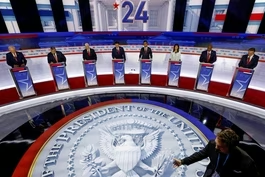
GEOFF BENNETT: Last night in Simi Valley, California, seven Republican presidential candidates took the stage for the second primary debate held at the Ronald Reagan Presidential Library.
On full display, the party's unequivocal transformation since the Reagan era.
White House correspondent Laura Barron-Lopez is back with our report on the night.
LAURA BARRON-LOPEZ: At times combative and unfocused, seven GOP presidential hopefuls desperately tried to steal the spotlight away from former President Donald Trump.
NIKKI HALEY (R), Presidential Candidate: This is where President Trump got it wrong.
LAURA BARRON-LOPEZ: Some risked new jabs at the party's standard-bearer, including Florida Governor Ron DeSantis in center stage.
GOV.
RON DESANTIS (R-FL), Presidential Candidate: You know who else is missing in action?
Donald Trump is missing in action.
He should be on this stage tonight.
(APPLAUSE) GOV.
RON DESANTIS: He owes it to you to defend his record, where they added $7.8 trillion to the debt.
That set the stage for the inflation that we have.
LAURA BARRON-LOPEZ: But early attacks against the absent front-runner flopped.
FMR.
GOV.
CHRIS CHRISTIE (R-NJ), Presidential Candidate: You're ducking these things.
And let me tell you what's going to happen.
You keep doing that, no one up here is going to call you Donald Trump anymore.
We're going to call you Donald Duck.
LAURA BARRON-LOPEZ: And faded.
(CROSSTALK) VIVEK RAMASWAMY (R), Presidential Candidate: Excuse me.
Excuse me.
Thank you for speaking while I'm interrupting.
LAURA BARRON-LOPEZ: Chaos reigned among the candidates, who are trailing Trump on average by 40 points.
Former South Carolina Governor Nikki Haley landed a blow against businessman Vivek Ramaswamy.
NIKKI HALEY: Honestly, every time I hear you, I feel a little bit dumber.
LAURA BARRON-LOPEZ: Not long after, she got into it with Senator Tim Scott over curtains.
NIKKI HALEY: ... do your homework, Tim, because Obama bought those curtains.
SEN. TIM SCOTT (R-SC), Presidential Candidate: Did you send them back?
NIKKI HALEY: And it's in the press.
SEN. TIM SCOTT: Did you send them back?
NIKKI HALEY: It's the State Department.
SEN. TIM SCOTT: Did you send them back?
NIKKI HALEY: Did you send them back?
You're the one that works in Congress.
LAURA BARRON-LOPEZ: DeSantis defended Florida's African American studies curriculum, which claims that some enslaved people benefited from slavery.
GOV.
RON DESANTIS: These are great Black history scholars, so we need to stop playing these games.
LAURA BARRON-LOPEZ: African American history scholars dispute that, and so did Scott.
SEN. TIM SCOTT: There is not a redeeming quality in slavery.
It's why I can say I have been discriminated against, but America is not a racist country.
LAURA BARRON-LOPEZ: Fights over race and gender identity, now cornerstones of the modern GOP, came into play as well from former Vice President Mike Pence.
MIKE PENCE (R), Presidential Candidate: And we're going to pass a federal ban on transgender chemical or surgical surgery anywhere in the country.
We've got to protect our kids from this radical gender ideology agenda.
LAURA BARRON-LOPEZ: Gender-affirming care surgery for minors is rare.
And Pence's position is opposed by every major medical association in the country, which say such care for minors is effective and safe.
NIKKI HALEY: Defund sanctuary cities.
LAURA BARRON-LOPEZ: On the most frequent topic of the night, immigration, Ramaswamy promoted ending birthright citizenship for children of undocumented immigrants born in the United States, a right enumerated in the Constitution.
VIVEK RAMASWAMY: Well, if the kid of a Mexican diplomat doesn't enjoy birthright citizenship, then neither does the kid of an illegal migrant who broke the law to come here.
LAURA BARRON-LOPEZ: The moderators largely avoided asking about Trump, with no question on the mounting indictments or recent extremist statements, including suggesting last week that Chairman to the Joint Chiefs of Staff Mark Milley should be executed.
Trump again counterprogrammed with his own event, though his opponents were on his mind.
DONALD TRUMP, Former President of the United States: Now they're all job candidates.
They want to be in the -- they want to -- they will do anything, secretary of something.
They even say V.P.?
I don't know.
Does anybody see any V.P.
in the group?
I don't think so.
LAURA BARRON-LOPEZ: In Michigan, where the United Auto Workers union is on strike, Trump rallied supporters at a non-union facility, and made direct appeals for labor's support.
DONALD TRUMP: Do me a favor.
Just get your union guys, your leaders, to endorse me.
But your leadership should endorse me, and I will not say a bad thing about them again.
LAURA BARRON-LOPEZ: But with Trump comfortably leading the debate participants, the two-hour spectacle appeared unlikely to change anything.
For the "PBS NewsHour," I'm Laura Barron-Lopez.
AMNA NAWAZ: Today, the government of Nagorno-Karabakh said it would dissolve, formally ending more than 30 years of separatist rule for the ethnically Armenian enclave inside Azerbaijan.
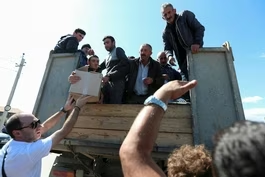
As Ali Rogin reports, this comes after Azerbaijan launched a lightning offensive last week that has triggered a massive humanitarian crisis, with more than half of Nagorno-Karabakh's population fleeing to neighboring Armenia.
ALI ROGIN: A massive exodus visible from space, the only road connecting Nagorno-Karabakh to Armenia now an escape corridor for a traumatized population, jammed with thousands of cars, as people try and flee.
They arrive in Armenia hungry and scared.
NARINE SHAKARYAN, Nagorno-Karabakh Refugee (through translator): We ran away to survive.
It was horrible.
Children were hungry, and they were crying.
ALI ROGIN: That is a reference to Last week's artillery attack.
Karabakh residents ran for cover after Azerbaijani airstrikes set buildings on fire.
Azerbaijan called it an antiterrorist operation and released video of drone strikes on what they said were Armenian defense positions.
The 24-hour offensive ended in a Russian-brokered cease-fire, forcing separatist Karabakh troops to dissolve their formations and disarm.
Azerbaijani soldiers ripped out the Armenian flag and raised their own in villages they say they have liberated.
Azerbaijani President Ilham Aliyev declared victory.
ILHAM ALIYEV, President of Azerbaijan (through translator): As a result, Azerbaijan has restored its sovereignty.
RICHARD KAUZLARICH, Former U.S.
Ambassador to Azerbaijan: I think his objective is to erase Karabakh.
ALI ROGIN: Richard Kauzlarich is a former U.S. ambassador to Azerbaijan.
RICHARD KAUZLARICH: It wasn't that long ago that he was talking about pushing Armenians, not only out of Karabakh, but out of Armenia itself.
ALI ROGIN: Last week's attack was short-lived, but the damage inside Nagorno-Karabakh ran deep.
On a trip to the region this week, USAID Administrator Samantha Power pledged $11.5 million in aid, but food and medicine are still scarce, and the offensive exacerbated an already dire humanitarian crisis.
For 10 months, Azerbaijan blocked the Lachin corridor, the only road connecting the enclave with Armenia, cutting off the region from essential supplies.
LUIS MORENO-OCAMPO, Former Prosecutor, International Criminal Court: Stopping the food and all the essentials to the people in Nagorno-Karabakh, that is classic genocide-inflicting conditions.
ALI ROGIN: Luis Moreno-Ocampo was chief prosecutor for the International Criminal Court.
He says Azerbaijan uses starvation as a weapon, even after the International Court of Justice this year ruled the blockade -- quote -- "may have a serious detrimental impact on the health and lives of individuals, which Ocampo says proves Baku's genocidal intent.
LUIS MORENO-OCAMPO: President Aliyev took the decision to blockade, fully blockade the Lachin corridor after the International Court of Justice said to him that blocking the Lachin corridor created the risk of death.
So he knew, and he did it willingly.
ALI ROGIN: Today's crisis isn't new.
Nagorno-Karabakh first declared its autonomy within Azerbaijan during the Soviet Union.
But, for the past 30 years, intermittent violence plagued the region.
RICHARD KAUZLARICH: What did happen in the breakup of the Soviet Union was that you had a group of Armenian nationalists who wanted to make it an independent entity.
ALI ROGIN: When the Soviet Union collapsed, the enclave was seized by Armenian separatist forces backed by the Armenian military in a war that ended in 1994.
Then, in 2020, Azerbaijan launched a brutal 44-day war and regained most of its previously lost territory.
The fighting left tens of thousands of Armenians living in the region without a plan for peace, but under the protection of 2,000 Russian peacekeepers.
Armenian President Nikol Pashinyan said they failed to ensure security.
NIKOL PASHINYAN, Armenian Prime Minister (through translator): The responsibility for these developments will be completely on Azerbaijan, who adopted an ethnic cleansing policy and Russian peacekeepers in Nagorno-Karabakh.
ALI ROGIN: But Moscow says its peacekeepers evacuated civilians and that Armenians' accusations are unfounded.
In a statement, Russia's Foreign Ministry said -- quote -- "The Armenian leadership is making a huge mistake by deliberately attempting to sever Armenia's multifaceted and centuries-old ties with Russia."
RICHARD KAUZLARICH: The idea in itself should be a cause of concern about what role a Russian peacekeeping operation can play, having basically attacked one party in the conflict.
What Russia is trying to do is -- part of what it's been trying to do is to make sure that these countries do not resolve their conflict without Russia being the key actor.
ALI ROGIN: After several rounds of talks, today, Nagorno-Karabakh's government said it will cease to exist, ending its three-decade bid for independence.
This week saw another player with a historic relationship in the region, Turkey's Recep Tayyip Erdogan, who wants to create a land corridor between Turkey and Azerbaijan through Armenia.
But, despite monthslong talks brokered by the E.U., and U.S. and other efforts to forge a deal, a peace settlement between Yerevan and Baku now seems elusive, Kauzlarich says.
RICHARD KAUZLARICH: What will be difficult to happen is to recreate the environment before this fighting broke out where the U.S. and the E.U.
in particular have been trying to mediate a peace agreement.
ALI ROGIN: From the U.S. so far, calls for calm.
In the last week, Secretary of State Antony Blinken has spoken twice with Azerbaijan's President Aliyev to prevent further violence and maintain the cease-fire.
MATTHEW MILLER, State Department Spokesman: We think it's important that the cease-fire be maintained, that the humanitarian needs be addressed.
ILHAM ALIYEV (through translator): The people living in the Karabakh region are Azerbaijan citizens, regardless of their nationality.
Their safety, security, well-being will be ensured by the state of Azerbaijan.
ALI ROGIN: But how Azerbaijan treats its own citizens is also questionable.
President Aliyev has concentrated power and weakened any form of opposition or dissent.
Independent organizations say there are as many as 200 political prisoners, including journalists and activists, among them, world-renowned academic Gubad Ibadoghlu, who faces up to 12 years in prison under counterfeiting charges, allegations he denies.
His youngest son, Emin Bayramli, lives in the U.S. EMIN BAYRAMLI, Son of Gubad Ibadoghlu: He was a economist first and civil right defender second, and that made him very powerful.
ALI ROGIN: Over the years, Ibadoghlu investigated corruption inside the Azerbaijani government, including in Nagorno-Karabakh.
He's now on pretrial detention, where he's been denied access to food and medicine to treat his diabetes.
EMIN BAYRAMLI: As he's in prison, it creates a domino effect where civil society in the country has been completely abolished.
And this seems to be the reality, where people are scared to talk.
ALI ROGIN: But his children talk, even as they're intimidated.
Emin sent us these photos of his ransacked room in New Jersey by what he suspects are Azerbaijani officials.
EMIN BAYRAMLI: They use social media against us.
They put pictures of my sister.
And we do feel threatened, but our love and our dedication for our father and our country is greater.
ALI ROGIN: A country torn apart by decades of war and trauma, with a rift that grows as tens of thousands continue to flee into an uncertain future.
For the "PBS NewsHour," I'm Ali Rogin.
GEOFF BENNETT: Children can return to schools in Lahaina, Hawaii, next month, and tourists will also be allowed back into parts of West Maui weeks after the devastating fires there.
Officials are trying to help restart an economy that ground to a halt on parts of the island.
William Brangham is in West Maui and has been talking with residents about these plans.
William, it's good to see you.
On Tuesday, you and the team gave us a glimpse of how people are still dealing with the aftermath of these fires nearly two months on.
Officials there are now putting out some more concrete plans, as I understand it, for when places will start to reopen.
What exactly are they proposing?
WILLIAM BRANGHAM: Well, Geoff, as you mentioned, schools will reopen the middle of next month.
And since this inferno tore through this community, thousands of students have either been having to go to school in other counties or doing remote schooling or not going to school at all.
And that just puts an incredible stress on the parents who are also dealing with all the other aspects of disaster recovery.
So there were four schools in Lahaina.
One of them burned so badly it cannot be recovered.
The other three were damaged.
And so they think that they can reopen those.
So they have been cleaning them, doing all sorts of safety testing on the soil and air and the water to make sure it's OK for the kids to come back.
And that is supposed to happen starting next month.
On this issue of tourism, October 8 is the date that the governor set.
And so local officials have been trying to figure out what that really looks like.
And so they have got this phased-in plan where hotels will start to be opened, not immediately in Lahaina, but in areas adjacent to it.
And tourists will be able to start to come back in.
And the hope is, is that more jobs, more money will start to flow into this economy, which desperately needs it.
GEOFF BENNETT: What do local residents there make of these plans?
Are they prepared for tourists to return?
WILLIAM BRANGHAM: The residents that we have heard from are not happy with this at all.
Yesterday, we attended the Maui County Council meeting, and hundreds of people showed up.
It was standing room only, many people expressing a sense of anger and frustration and grief and solidarity.
This was local Hawaiians and native Hawaiians, many of them speaking native Hawaiian language in this.
And they were expressing all manner of things, that they don't want to keep feeling like second-class citizens in their own community, that they don't want to feel like they are subservient to a tourist economy.
They argue that they don't have to rely solely on tourism here, that you can diversify this economy.
They want to be more in control of the decisions that are being made about how we go forward.
And that is how they feel is not the case right now.
I want to play a little bit of sound of what we heard yesterday.
This is Tiare Lawrence.
She is a community organizer in the area.
Here's what she had to say.
TIARE LAWRENCE, Community Organizer: I keep thinking that I ran out of tears.
I -- it just keeps coming, but I'm asking the council to do whatever it takes to keep Lahaina in Lahaina.
I know, for myself, I live in Pukalani because I couldn't afford to live at home.
And I would love so much to be able to move back home one day.
And I know a lot of my family feel the same sentiment.
So, I'm asking you guys to stand behind the people, the multigenerational families, most importantly.
WILLIAM BRANGHAM: So it was just a very, very powerful meeting, lots of expressions like that.
And, in some ways, Geoff, it reminded me of other tragic, galvanizing experiences that I have covered.
I think of things like Katrina or Newtown or Standing Rock, where a tragedy falls on a community and people feel galvanized to action by that.
And that is absolutely what it feels like is happening in Lahaina right now.
GEOFF BENNETT: What's the response been from local officials to that prevailing sentiment, William?
WILLIAM BRANGHAM: Well, on this very specific issue of tourism, I talked to the mayor earlier this week, the mayor of Maui County, and he is very sensitive to the idea that tourists would come here and treat the burned devastation of Lahaina as another tourist attraction.
He does not want to see that.
In fact, as you drive around here, you will see miles and miles of black fabric that they have strung up to try to create a privacy screen, so that tourists do not stop and take pictures of the devastation.
The governor has similarly argued that tourism, done respectfully, can honor the people who are still dealing with this tragedy every single day, but can also bring people back to help boost this economy.
I mean, it is estimated that $13 million a day have been lost since this fire swept through this area.
But despite those arguments, the community does not seem sold on it.
I think it's something like 9,000 people signed a petition saying, please delay the reopening.
But officials are not heeding that call.
They're going forward.
GEOFF BENNETT: William Brangham reporting for us tonight from West Maui, alongside "NewsHour" producers Sam Lane and Maea Lenei Buhre.
William, thank you.
WILLIAM BRANGHAM: Thanks, Geoff.
AMNA NAWAZ: Nineteen months after the Winter Olympics ended in Beijing, one medal ceremony for the U.S. figure skating team has still not been held.
It all goes back to a doping scandal that erupted during the games back in February of 2022.
Russian figure skater Kamila Valieva, then 15 years old, helped lead her team to a gold medal with a stunning performance.
The U.S. team won silver and Japan won bronze.
But as the athletes prepared for the medal ceremony, news suddenly broke that Valieva had tested positive for a banned performance-enhancing heart medication months earlier.
Valieva claims the medicine was her grandfather's and she accidentally ingested some of it.
The Olympics medal ceremony was indefinitely delayed.
Since then, it's been tied up in a long appeals process.
And it's the subject of a hearing this week in Switzerland by an international sports tribunal.
Christine Brennan is there covering it for USA Today.
She joins us now.
Christine, it's good to see you.
Thanks for joining us.
CHRISTINE BRENNAN, USA Today: My pleasure.
Thank you, Amna Nawaz.
AMNA NAWAZ: So, this positive test from Valieva was nearly 600 days ago.
The hearing is just starting this week.
And now we understand it's been delayed even further.
Why is this dragging out so long?
CHRISTINE BRENNAN: That's a great question.
It's the question these athletes in particular would like to know.
They won those medals.
Look, winning a gold medal or silver or bronze is the highlight of one's career.
And you want to actually have that medal.
This is unprecedented.
Never before has there been an Olympic event held and no medal ceremony.
And the fact that it will be 600 days on Saturday is absolutely extraordinary.
And it's one of those things that is the loveliest and really the simplest of all events and things at the Olympics, is to give out that gold medal to that deserving athlete.
So, what has happened is that there have been, as you mentioned, delays.
And, this week, the Court of Arbitration for Sport, which is the Supreme Court, so to speak, for international sports, has been meeting, and I have been covering it.
I have not been in the meeting room.
It's a closed hearing.
And as they were ready to basically, we thought, finish their deliberations and then start with the actual decision-making process over the next month or two, they abruptly adjourned, and they said they need more documents.
And that really surprised everybody, because as you said, almost 600 days and you still need another document?
Infuriating news for the U.S. figure skating team and the others as well.
AMNA NAWAZ: So what are the possible outcomes from this hearing?
What could we possibly see end up when all this is said and done?
And when do you expect this to be ending?
CHRISTINE BRENNAN: Right.
Well, there's two options, really.
Kamila Valieva, you mentioned, 15 years old, she's a protected person, otherwise known as a minor.
So she might get a slap on the wrist and leniency just because of that.
But if she is found innocent, then the order of the medals would stay the same, Russia -- presumably, Russia, U.S. and Japan.
But if she is found guilty, then one would assume -- and, again, who knows what this story -- I have never seen anything quite like this.
But you would presume then that the U.S. would move up, Russia would be disqualified, because of using this athlete who would then deemed to be using a performance-enhancing drug and doping.
U.S. would move up to the gold, Japan would move up to the silver, and then Canada, which finished in fourth place, would move up to the bronze.
You asked when this could happen?
Well, obviously, if the event, if the hearing had stopped today, they would take between one and three months to then render the verdict.
Now that the hearing is being postponed for six weeks -- there's a lot of numbers and a lot of Alphabet soup with all these organizations - - but the Court of Arbitration for Sport now will come back on November 9 and look at this new documentation that they wanted to see.
So, then, from that point, the clock starts again, and it would be between one and three months.
So now we're pushing it into 2024.
And, basically, a decision probably, Amna, that will not be made until the two-year anniversary of those Olympic Games, February of 2022.
AMNA NAWAZ: It's just remarkable.
And, Christine, what about how other skaters are viewing this?
I mean, most of the members, I understand, of the U.S. team have been relatively quiet.
Male single skater Vincent Zhou issued a lengthy, frustrated statement saying, in part: "Justice delayed is justice denied.
My teammates and I will never get back the chance to stand before the world to celebrate a lifetime's worth of hard work culminating in a career-defining achievement."
Is that, Christine, sort of the sentiment among most of the athletes you're talking to?
CHRISTINE BRENNAN: It certainly is.
There are nine members of the U.S. figure skating team.
This is a team competition, not the individual competition we're so used to in figure skating.
And all nine of them wrote a letter a month ago to the Court of Arbitration for Sport, CAS, where I am this week in Lausanne, and asked, could they have a seat at the hearing?
Could they just sit there and be one of them, one representative?
And they were told no.
No, you can't come.
Again, this is a closed hearing.
But, in this case, I thought they were incredibly classy and dignified when they said, could we come and watch this?
Because, of course, this is determining our fate as either silver medalists or gold medalists, which also can impact the earning potential for those athletes.
And, as I said, the Court of Arbitration for Sport said, no.
No, it's closed.
And if Kamila Valieva had wanted the U.S. team to be able to have a representative or wanted this to be a public hearing, then it would have been a public hearing.
So this was Kamila Valieva and her lawyers basically deciding, no.
No one can see this.
And, in fact, she, irony of all ironies, while the U.S. wanted to come, she did not show up.
And she did testify on Tuesday via video, which is allowed.
AMNA NAWAZ: Just a remarkable turn of events.
And, still, this process is not over.
Christine Brennan of USA Today covering this hearing for us and joining us tonight.
Christine, thank you.
It's always good to see you.
CHRISTINE BRENNAN: Amna, my pleasure.
Thank you.
GEOFF BENNETT: The blues guitar legend Buddy Guy once wrote -- quote -- "Funny thing about the blues.
You play 'em cause you got 'em.
But when you play 'em, you lose 'em.
The blues chase the blues away."
For many, that's still as true in the 2020s as it was in the 1920s.
And its perhaps especially true for 32-year-old Kentuckian Nat Myers.
Special correspondent Tom Casciato the story for our arts and culture series, Canvas.
And a warning that some racial slurs Myers was called are named in this piece.
(MUSIC) TOM CASCIATO: "Everywhere I have been, somebody's been abused," sings Nat Myers in his song "Yellow Peril."
"Never going to win, some of us are born to lose.
The song has what NPR Music deemed a swagger that leaps out of the speaker.
It's Nat Myers' reaction to the racism, particularly the anti-Asian hate crimes, that he observed during the pandemic lockdown.
NAT MYERS, Musician: My thing about this song is, anything that tries to insert itself and breaks apart what it means to be a minority or a person of color in America, we ain't going to let that happen, you know?
TOM CASCIATO: But Nat Myers' relationship to the blues goes back a long time before that, all the way back to the beginning.
NAT MYERS: I had like a pretty archetypical, just, like, American childhood, I guess, you know?
Put my hand on my heart every day, said the pledge, like, watched Disney stuff.
TOM CASCIATO: The son of a mom from South Korea and a white dad from Indiana, he was raised in a mostly white part of Northern Kentucky.
NAT MYERS: My parents didn't really kind of instill in me a sense of my own identity in terms of me being Asian.
I look at younger pictures of myself, and I look at a kid who really thought he was white.
TOM CASCIATO: He speaks of a certain sadness growing up.
NAT MYERS: I didn't have a very happy childhood.
I got picked on a lot, you know what I mean?
I don't want to use the terminology, but, like, but maybe I should, being called chinky, being called gookie, people pressing their eyes at you, buck-teething at you.
It's all real, you know what I mean?
TOM CASCIATO: He took solace in skateboarding and the folks he met doing it.
NAT MYERS: The people I skated with showed me what true friendship was.
And when I started hanging out with these cats, maybe it helped that they were two years older than me, though, but people stopped bullying me.
And skateboarding helped me survive.
TOM CASCIATO: Another thing that helped him, poetry.
NAT MYERS: I was real young, when I -- I didn't know what a poet was, but I wanted to be a poet.
Everything in my body wanted to be a poet.
It's like, write about the green grass and the blue skies, you know?
TOM CASCIATO: He loved the classics, Homer and Shakespeare.
But nothing nourished his soul like the lyric and musical poetry of the prewar blues.
NAT MYERS: I listened to all of these kinds of music when I was growing up, but when I started listening to, like, old blues, and particularly when I think I started getting deep into Patton.
TOM CASCIATO: Charley Patton.
NAT MYERS: Yes, Charley Patton, I think the feeling I'd ever experienced for any music before was dwarfed by the feeling and the emotion I got from listening to the -- that old music.
And, to me, it's the only kind of stuff I have ever wanted to play.
TOM CASCIATO: And play, he did, putting his own poetry to music.
Meanwhile, he soaked up the works of artists like Furry Lewis, Big Bill Broonzy, and Mississippi's Robert Petway and Tommy McClennan.
NAT MYERS: Just in terms of the sheer ferocity of their playing and their singing, Tommy McClennan sounds like he's been smoking unfiltered cigarettes for 80 years and is still able to keep a note.
TOM CASCIATO: But as Myers developed his own craft, he did so in private.
NAT MYERS: Playing music was something I did purely to myself and to annoy my roommates.
It was something that I kept completely to myself.
TOM CASCIATO: It was when he came north to New York City in 2015 to study poetry at The New School that the idea of performance took root.
NAT MYERS: What you really discover is how many cats are playing music out here on the streets, whether it be on the block, whether it be down on the subways.
I just started looking at them cats and was just like, what?
What am I doing right now?
And I remember just going out on the block.
I played for like 10 hours or something like that.
I made like maybe $20.
But, to me, back then, I remember that was the first money I'd ever made as a poet.
People paid me to do this stuff.
Maybe they Were paying me to keep quiet.
You know what I mean?
But it was kind of a revelation, in terms of like, oh, man, this is where the bread's at.
TOM CASCIATO: Soon came COVID-19, and, like lots of musicians, all he could do was post his work online.
That's when this video on Instagram caught the eye and ear of an instant admirer.
NAT MYERS: I got this random e-mail one day.
It was like: Hello, this is Easy Eye Sound, the record label owned by Dan Auerbach.
TOM CASCIATO: Dan Auerbach is one-half of the superstar duo the Black Keys.
It sounded like a joke.
NAT MYERS: I was just like -- I almost deleted the e-mail.
TOM CASCIATO: Fortunately, he returned the e-mail.
And, soon, he was writing songs with noted Nashville songwriter Pat McLaughlin, as well as Dan Auerbach himself, and recording right in Auerbach's Nashville home.
The result?
His debut album, "Yellow Peril," 10 bluesy tracks, he, says that owe an enormous debt to the prewar artists he so admires.
The songs also perform a key function this music has provided for over a century.
You tweeted in the summer: "On the road, I'm happy and blue.
Off the road, I'm just blue."
NAT MYERS: Yes.
I think I'm just -- I'm just a low-down fellow all the time.
You know what I mean?
I'm just a sad person generally.
Being by myself is something -- it's a crippling kind of loneliness.
And when out on the road, life gets so simple.
You are just trying to get from A to B in one piece.
And when you get from A to B, just making sure that you're in, like, an energy type enough to be able to do your job, you know?
TOM CASCIATO: You say you're not a happy person, but when you perform music, and you see that that's making people happy, does that make you happy?
NAT MYERS: Oh, no doubt.
A lot of people say they play music for the fans or they make the music for these people, like, we do this all for you.
I don't abide that, because I do this music because, like, literally, I'd die if I weren't playing this stuff.
And so the fact that I can bring joy to other folks, it's such an impossible thing that I have been given the privilege to do, you know?
TOM CASCIATO: For the "PBS NewsHour," I'm Tom Casciato in Brooklyn, New York.
AMNA NAWAZ: There's a lot more online, including a look at the impetus behind this year's surge in labor union strikes, including the ongoing autoworkers strike and what it means for working Americans.
That's at PBS.org/NewsHour.
GEOFF BENNETT: And join us again here tomorrow night for a look inside comedian and actor Cheech Marin's museum for Chicano art.
And that's the "NewsHour" for tonight.
I'm Geoff Bennett.
AMNA NAWAZ: And I'm Amna Nawaz.
On behalf of the entire "NewsHour" team, thank you for joining us.
GOP holds first hearing of the Biden impeachment inquiry
Video has Closed Captions
Clip: 9/28/2023 | 13m 21s | What happened during the first hearing of the Biden impeachment inquiry (13m 21s)
GOP hopefuls try to take spotlight from Trump at 2nd debate
Video has Closed Captions
Clip: 9/28/2023 | 4m 11s | GOP presidential hopefuls try to steal spotlight from Trump during 2nd debate (4m 11s)
Half of Nagorno-Karabakh's population flees after takeover
Video has Closed Captions
Clip: 9/28/2023 | 7m 55s | More than half of Nagorno-Karabakh's population flees after Azerbaijan takeover of region (7m 55s)
House Republicans reject Senate effort to avoid shutdown
Video has Closed Captions
Clip: 9/28/2023 | 3m 8s | Government shutdown imminent as House Republicans reject latest Senate effort (3m 8s)

Musician Nat Myers on the healing power of the blues
Video has Closed Captions
Clip: 9/28/2023 | 6m 52s | Musician Nat Myers on the healing power of the blues (6m 52s)

Sports tribunal to hear Olympic figure skating scandal
Video has Closed Captions
Clip: 9/28/2023 | 6m 8s | Sports tribunal to hear evidence in Olympic figure skating doping scandal (6m 8s)
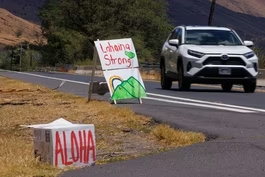
West Maui residents speak out as officials look to reopen
Video has Closed Captions
Clip: 9/28/2023 | 5m 2s | West Maui residents ask to delay reopening as officials look to restart tourist economy (5m 2s)
Providing Support for PBS.org
Learn Moreabout PBS online sponsorship
- News and Public Affairs

FRONTLINE is investigative journalism that questions, explains and changes our world.

- News and Public Affairs

Amanpour and Company features conversations with leaders and decision makers.












Support for PBS provided by:
Major corporate funding for the PBS News Hour is provided by BDO, BNSF, Consumer Cellular, American Cruise Lines, and Raymond James. Funding for the PBS NewsHour Weekend is provided by...