September 29, 2026 | Carolina Impact
Season 14 Episode 1404 | 26m 55sVideo has Closed Captions
Deep Roots Farm; The Healing Power of Nature; Swim Across America; & Pedals & Possibilities
Deep Roots Farm grows fresh produce for Gaston County students and people who need it most; Black Girls Do Hike builds community, wellness, and healing through nature; Providence Day student Drennan Shall is a two time cancer survivor, and is now helping others; & Charlotte’s Learn to Ride helps new cyclists find balance, confidence and their first ride.
Problems playing video? | Closed Captioning Feedback
Problems playing video? | Closed Captioning Feedback
Carolina Impact is a local public television program presented by PBS Charlotte
September 29, 2026 | Carolina Impact
Season 14 Episode 1404 | 26m 55sVideo has Closed Captions
Deep Roots Farm grows fresh produce for Gaston County students and people who need it most; Black Girls Do Hike builds community, wellness, and healing through nature; Providence Day student Drennan Shall is a two time cancer survivor, and is now helping others; & Charlotte’s Learn to Ride helps new cyclists find balance, confidence and their first ride.
Problems playing video? | Closed Captioning Feedback
Where to Watch Carolina Impact
Carolina Impact is available to stream on pbs.org and the PBS app.

Introducing PBS Charlotte Passport
Now you can stream more of your favorite PBS shows including Masterpiece, NOVA, Nature, Great British Baking Show and many more — online and in the PBS Video app.Providing Support for PBS.org
Learn Moreabout PBS online sponsorship(bright music) - [Announcer] This is a production of PBS Charlotte.
(bright music fading) - Just ahead on "Carolina Impact," a local farm plants seeds of change, helping Gaston County schools.
Plus, discover how one woman uses hiking to find more than just a good workout.
And a free bike program puts people on wheels, helping them move forward.
Carolina Impact starts right now.
(upbeat music) Good evening, thanks so much for joining us, I'm Amy Burkett.
One local farm grows more than fresh food.
It strengthens communities.
Deep Roots Farm delivers produce to seniors and others who need it most, while teaming up with Gaston County Schools to grow fresh produce at the district's central kitchen.
Carolina Impact's Heather Burgiss and videographer Doug Stacker show us how the effort puts fresh, locally grown food on more tables, including those in school cafeterias.
(gentle music) - [Heather] Tomatoes on the vine, cucumbers ready to pick, carrots still covered in dirt.
This isn't produce on a commercial farm tucked away in the countryside.
It's growing on a small plot of land beside Gaston County Schools, Central Kitchen and Lowell.
- This is about an acre farm, and it's just been an evolving labor of love and passion for getting locally grown produce into our school nutrition programs, so that our kids have access to the healthiest, freshest, most local product that we can get to them.
- [Heather] The district began developing the farm several years ago with North Carolina Cooperative Extension, but growing food on a school bale schedule takes expertise.
That's where farmers Cherie and Wisdom Jzar of Deep Roots CPS Farm come in.
- We really need a farmer who understands how to grow things to come onto the land to grow.
And so then they basically contract it with us.
- [Heather] Deep Roots Farm works with the school nutrition team to plan seasonal crops.
And when the produce is ready, it doesn't have to travel far.
- We want produce to come in our doors and out our doors and onto plates as quickly as possible because we all know that local and fresh is the best.
- [Heather] Inside the central kitchen, the harvest moves quickly from field to food service.
Carrots can be shredded onto salads, cucumbers and tomatoes sliced for lunch trays, and lettuce cleaned and headed back out to schools.
- You just can't duplicate the taste from a produce that you just picked steps away from where you're going to consume it.
- [Heather] Each harvest is divided among different schools throughout the county.
A few hundred pounds of cucumbers might go to about 15 schools one week, with the next harvest headed somewhere else.
- With 56 school cafeterias, where we're serving kids every day, we can't produce enough here yet.
(bright music) - We just did okra and tomatoes, and this is a Japanese variety.
I teach people about tossing it in some olive oil, putting a little salt and pepper, and eating it raw, like a snack.
- [Heather] Cherie and Wisdom started Deep Roots in 2019, growing on small plots around Charlotte.
That eventually led to this seven acre farm in North Charlotte, just minutes away from uptown, where growing food and teaching people how to enjoy it go hand in hand.
- We can talk about broiling it or baking it, or just julienne and do a sear.
You gotta try it.
- Mmm, very good.
- It's not bad.
- I've never done that.
- And you might even taste like a little sweet on it.
- It is sweet, yeah, that is good.
For Cherie and Wisdom, moments like this are part of what farming is all about.
But as demand grows, so does the need for more land.
- Our mission is very deeply tied to community.
We want to be the gap that we see, right?
So, we started the farm with the intention of reaching more residents in Charlotte and then specifically trying our best to reach those who lack access.
- All that money and to land cost, you're not left with much to run an operation.
- [Heather] That need led to a partnership with the Conservation Fund's Carolina Farms Project.
Deep Roots became the first farm in its Charlotte region effort, expanding onto 44 acres in Monroe, land that will remain in agricultural production and can eventually be purchased by the farmers.
- Our program is Farmer First.
We connect with next generation, oftentimes first generation farmers, We also like to lift up black and brown farmers who have not traditionally had access to farmland at an affordable rate.
And so, we're working with this next generation of farmers to understand their needs.
- [Heather] And school cafeterias are just one place that food is going.
At Charlotte's West Recreation Center, Deep Roots brings fresh produce directly to seniors who may face barriers like transportation, mobility or cost.
- It has been a great blessing because of the prices of food going up every week.
So it's been like a godsend to have the fresh fruit and vegetables come here.
- It's a freshness.
To bring it fresh, it's a plus.
- [Heather] And sometimes what comes out of this bag is more than dinner.
It's a favorite recipe, a memory.
- Okra.
- A connection to foods people grew up growing and cooking themselves.
- It makes me feel really good to know that people care enough about seniors to want to make sure that we're eating right.
- When they get these ingredients, all you start hearing is the stories.
- We had strawberries growing out here last year.
- [Heather] Back on the Gaston County School Farm, there are big plans to expand.
The district is preparing for a permanent greenhouse where lettuce can be grown hydroponically, creating a more dependable local crop throughout the school year.
- That's my real dream is to have this fresh stuff every single day, 180 school days a year.
That's my dream and then from then, I want to have it more than once a day.
And then who knows, maybe we'll even have produce on the breakfast tray as well.
(gentle music) - Whenever we started this, first of all, is to be a resource to our community.
So that's the greatest vision.
So, outliving us so our children can continue to steward and work in this space to be of service to the community.
- [Heather] And as the farm grows in reach, it shortens the distance between fresh food and the people who need it most.
For Carolina Impact, I'm Heather Burgiss.
- Thank you so much, Heather.
With acquisition of additional land, Cherie and Wisdom at Deep Roots Farm hope to continue to expand their production with more deliveries across the Charlotte region, especially to vulnerable communities that lack fresh food access.
For one local woman, nature provided another path to wellness.
A lot of people find that hiking offers a good workout.
But for Malika White, a walk in the woods became something much bigger, a path toward healing.
After losing her job and battling serious health challenges, she found her footing outdoors.
What started as her personal wellness journey grew into a thriving community that connects black women to nature and each other.
Carolina Impact's Rochelle Metzger and videographer John Branscomb have the story.
(bright music) - [Rochelle] A walk in the woods turned into something much bigger.
- Everything that I went through this week, I'm leaving it here on the trails.
- [Rochelle] For Malika White, nature became a lifeline.
After spending 15 years in banking, she was unexpectedly laid off.
Around the same time, she was also dealing with health challenges.
(birds chirping) Looking for a way to heal, she returned to something that had always brought her peace: walking outside.
Soon, those walks turned into daily hikes.
Somewhere between the trees and the trail, she began finding herself.
- Every time I went out there, I just reconnected with who I was.
You know, in this moment of thinking that I lost everything.
You know, I'm reconnecting with the most important part of my life, myself.
- [Rochelle] That healing journey eventually led to a new purpose.
She created a Facebook group for women who loved the outdoors, but didn't want to go alone.
- I just started getting all these requests to join.
The numbers kept increasing.
And what's your name?
- Benita.
- Benita, nice to meet you.
(group chattering) No bears, I don't think so.
- [Rochelle] Today, Black Girls Do Hike hosts regular hikes across the Charlotte region.
Building a community rooted in wellness, connection and representation.
- I didn't realize how much this space was needed for black women.
- [Rochelle] For hikers like Miriama Bah, the community was easy to find.
- I found a video on YouTube of them doing a hike.
I said, "Oh, that looks pretty cool."
And then I found them on Instagram.
And saw that they were going to be doing this hike.
So I signed up, and here I am.
- [Rochelle] And the benefits go far beyond exercise.
The Japanese practice known as shinrin-yoku, or forest bathing, encourages people to slow down and immerse themselves in the sights, sounds and smells of nature.
A 2026 Harvard Health article on the benefits of forest bathing found that engaging all your senses while spending time outside can reduce stress and lower blood pressure and heart rates.
- This is where your beautiful oxygen comes from.
This is where your nervous system settles down.
This is where you breathe more easily.
- [Rochelle] Angie Stegal is a certified forest therapy guide.
- We can come out here and we eliminate all the input that can really stimulate our obsessive thinking.
That allows us to just become present to what is.
And that alone is an incredibly healing action.
- [Rochelle] Stegal says the natural environment provides numerous health benefits, citing a 2026 study by North Carolina State University.
Researchers found that participants exposed to forests and birdsong reported lower stress, fewer negative emotions and greater feelings of well-being than those in urban environments.
(group chattering) - I think women need the bonding, the conversation, the dialogue, the connection.
I think it's almost cathartic and therapeutic for us.
- [Rochelle] That sense of community is what keeps many of these women coming back.
- At that time, I was first diagnosed with breast cancer.
And I felt by myself.
And I needed to build a community.
And I found a wonderful community with this group to help me through that.
There are women out there that want to hike.
They just don't want to do it by themselves.
- [Rochelle] For college student Denaijah Daniel, the group also challenges stereotypes.
- I don't see a lot of people that look like me going out in nature and really reconnecting.
- [Rochelle] And that's exactly why Malika White started it.
To create a space where women of color feel seen, safe, and welcome in the outdoors.
- When they show up, we're complete strangers.
When our boots start moving, it changes.
It changes completely.
By the end of the hike, we are like we've known each other forever.
Do not let fear stop you from being who you were meant to be.
- [Rochelle] From a season of loss to a movement of healing, one step, one trail, and one new friendship at a time.
For Carolina Impact, I'm Rochelle Metzger.
- Thank you, Rochelle.
Black Girls Do Hike typically hosts one or two hikes each month across the Greater Charlotte area.
You can find more information about the growing outdoor wellness movement and a schedule of upcoming hikes at WTVI.org.
Well, we've seen how finding the right kind of movement can make a difference in someone's life.
Now, another form of exercise helps a young cancer survivor give back.
In 2005, more than two million Americans were diagnosed with some form of cancer.
Breast cancer is the most common type for women.
Colon cancer for men.
Skin cancer is the most common overall.
But there are so many others, some you may have never heard of before.
Carolina Impact's Jason Terzis joins us now with our story.
- It's called rhabdomyosarcoma, a rare type of cancer that starts as a growth of cells and soft muscle tissues and is most commonly found in children and young teenagers.
We came across a young man who dealt with this very disease as a baby, but now does what he can to help others.
(upbeat music) It's a scene repeated countless times.
- And we train six days a week.
- [Jason] Drennan Shall going to Swim Mac Carolina.
- We are in the pool for two hours most days.
- Tossing on his cap- - And then workouts for an hour after practice most days.
- [Jason] And leaping into the pool.
(water splashing) - Every day that I come to practice, it's really fun.
It might be challenging, but very fun.
- [Jason] The water, a place Drennan is pretty comfortable in.
- My passion continues to grow each day, and my love for the sport continues to flourish.
- [Jason] But the 16-year-old's journey to this place has been anything but ordinary.
- My husband and I just knew that there was something off.
So, one night my husband took him to the ER and they ended up doing a CT scan and saw a large mass in his left pelvis.
And that's honestly when our world changed.
At just 11 months old, Drennan was diagnosed with a rare form of cancer.
- A rhabdomyosarcoma pediatric tumor at the time when he was diagnosed did not have a great prognosis.
- [Jason] For the next year and a half, it was rounds of chemotherapy, surgery, and radiation.
- I mean, of course, I have vague memories of being in a hospital surrounded by who knows what, kind of in the cancer treatment areas.
- [Jason] And just when doctors thought Drennan was out of the woods- - And then at his 12-month scan, they saw something.
And we knew at that point what that something was.
- The cancer had returned.
- The second round, he was around three and a half, and so that required surgery, chemotherapy, and radiation again.
So that was another year to 15 months of therapy until we kind of then again transitioned into surveillance scans.
And those continued for five years.
And admittedly, every scan was a huge anxiety point for our family because we knew that there was always a chance of recurrence.
- [Jason] Maybe it was his age or his disposition, but through it all, Drennan kept an incredibly positive outlook.
- [Amanda] He helped us get through it.
- [Jason] To the point it rubbed off on everyone around him.
- Drennan was always the type of kid who all the nurses wanted to care for because he was not afraid.
- But something that kind of repeats in my mind and kind of I'm reminded of constantly, is just the constant support of people in the community.
whether it was the doctors, the nurses, the staff, my parents, family members, friends, just the entire community just kind of rallying behind me.
- [Jason] In remission since 2013, Drennan is now living a normal life.
- Having kind of our perspective now, I think all those experiences of course, shaped who he is, his resiliency, his courage, his need to give back, his open heart, you know, all of his characteristics, I think of course, are shaped by the 16-year journey up to this point.
- [Jason] Through it all, Amanda Shall has kept the faith, wearing a bracelet that says, "Expect miracles."
She's had it on ever since Drennan was first diagnosed 15 years ago.
- I hope that it gives hope to other families.
- [Jason] The only lingering effects Drennan has is a weaker left foot and leg.
but thanks to a good orthotic and a brace, he gets along just fine.
- I have a fused ankle and it's a little bit harder for me to do certain things with ankle flexibility and different kind of mobility things.
I don't think there's really a clear reason why my leg is a little bit weaker.
It could have been something because of surgery, something because of chemotherapy, but that's not really the fault of the doctors and nurses who did an incredible job of kind of helping me through my treatments.
So, when I put my brace on in the morning, I don't think Why am I wearing a brace?
It's just kind of a part of who I am today.
And I think while of course, no one can expect to really be joyed by cancer, I think knowing my story and having what I have now gives me an appreciation of life.
- He continues to just embrace all the challenges.
- [Jason] These days, Drennan swims on the varsity team at Providence Day and competes as a Paralympic swimmer with Swim Mac Carolina.
- From as soon as I got in the water until now, it's just really a huge passion that I have.
- There has not been a single day where he said he doesn't want to come to practice.
- [Announcer] Good afternoon, swimmers, volunteers, spectators, special guests.
I'd like to welcome everybody to Swim Across America, Charlotte!
(crowd cheering) - [Jason] Drennan also serves on the Swim Across America Junior Advisory Board.
Swim Across America is a national nonprofit raising money for cancer research and treatments.
In less than 10 years, its Charlotte branch has donated more than $1 million.
- Swim Across America is a wonderful national organization.
Kind of our local chapter has embraced Drennan and our family.
- [Jason] In August, they'd honor Drennan by having him serve as the official drummer for the Carolina Panthers "Keep Pounding" drum.
- I mean, I remember being down on the field and surrounded by so many fans, and it was such a cool feeling.
But I think just the "Keep Pounding" tradition of being resilient and kind of continuing that legacy is just so important to the Panthers, and I think, Swim Across America and all of the patients and staff at Atrium Health really embody that spirit.
All of the money raised in Charlotte stays in Charlotte.
So it's a very community-focused kind of event even though they have national swims.
It's such an awesome organization.
It's such a great close-knit community.
Remember the junior advisory board, a group of like teenagers in the Charlotte area who kind of help organize and advertise and fundraise for the annual swim.
It's just really, it's awesome to know that there's so many people out there that really come together and support not only myself and my family, but also so many cancer patients across the US, across the world and it's awesome to know that there are organizations like Swim Across America who really support these people fighting through things that are life-changing.
- [Jason] Battling through cancer, beating it not once, but twice, and now doing what he can to help others.
Pretty inspiring for anyone, let alone a 16-year-old high school junior.
- I just love his optimism, Jason.
What else should we know about Drennan?
- Yeah, you kind of got a glimpse of that in the piece there.
He just has this wonderful mindset and attitude and now wants to help others.
Well, Drennan will be one of roughly 300 swimmers taking part in the Swim Across America Open Swim.
That's set to take place at Camp Thunderbird at Lake Wiley on Sunday, October 4th.
It will benefit Atrium Health Levine Cancer and Levine Children's Hospital.
So all the funds that they're trying to generate are going to go back into the community.
And they love the fact that it all stays right here in the area.
- Good to know.
Thanks so much, Jason.
Well, from swimming with a purpose to riding toward independence, our final story tonight shows how another physical activity can change lives.
For a kid, there are few moments that feel bigger than the first time somebody lets go of the back of their bike, and you realize you're riding all on your own.
But learning that skill doesn't always happen at the same age or in the same way.
A free Charlotte program helps kids, adults, and riders with special needs find their balance and the confidence that comes with it.
Carolina Impact's Chris Clark shows us why two wheels can open up a whole new world.
- [Chris] They say you never forget how to ride a bike.
- I'm not gonna let go yet until you feel like you okay.
- [Chris] But what if you never learned?
- When you feel like you got it, you let me know, okay?
- Aliyah's big brother already rides without training wheels.
- Me and him tried to teach her and it was just not working out.
- You're just gonna stay balanced, all right?
You can follow me?
- [Chris] So today, someone else takes a turn at Arbor Glen Outreach Center.
- I would take these small ones and just put them over there.
- [Chris] Learn to Ride offers free lessons.
- The Learn to Ride program is open to like all ages.
So we've had, folks as old as 67, I believe, all the way to three years old.
- High five.
- So the young and the young at heart, it's never too late to learn how to ride a bike.
- The most important aspect is the relationship and the atmosphere that we're creating.
That's why these events are successful.
- [Chris] For Dana Dina, it's another chance.
- I never did it before, I was always scared.
I mean, I tried, my husband tried to teach me, but I was always scared.
- Everyone's scared of falling and getting hurt.
And the nice thing about our method is you build that relationship with them, you speak with them, but truly, you take the elements and really knock it down.
- [Chris] The idea is to learn one thing at a time.
- We take the pedals off the bike.
to kind of create a balance bike, and then you're just trying to teach somebody that physical sensation of balancing on a bike.
- [Chris] Feet on the ground first.
- There you go.
- Then a glide.
- There you go, oh, oh- - Without the pedals, I was speeding.
- [Chris] Once they're comfortable balancing, the pedals go back on.
And eight-year-old Dennis Hill is putting his to good use.
- Mommy said speed up.
I'm speeding up!
- [Chris] His dad, Sam Hill says he arrived on training wheels, a little unsure of himself.
- Put the pedals back on and we are good to go.
And he's a fighter pilot.
How fast can you go on this thing?
- I think probably about, hang on... I think 20 miles per hour.
You seeing this, people?
Hey, DC.
- My man.
- [Chris] Sam remembers the huffy he got for Christmas.
- Thunder, I think it was, and it meant everything.
I mean, at that point, I was a Knight Rider.
I was Air Wolf.
- I'm not going to say.
I have a girlfriend, which I do.
- [Chris] He says parents hold their kids a little closer these days.
- I want him to do the things that I felt free to do, cruise the neighborhood with a transistor radio taped to his handlebars and all that stuff.
- [Chris] DC remembers another reason to get on his bike.
- It also meant employment, too, because I got a paper route.
I'm old enough to where that was a thing.
(chuckles) So, like, not only could I visit my friends, neighborhoods away, but then I got a job out of the deal.
- [Chris] Aliyah's instructor, Jacorey Alston, is doing a bit more than steadying her ride.
Barbie is real.
You never seen the Barbie movie?
- She's a bit hard-headed.
And I think learning from somebody else, she doesn't give that rebuttal.
- [Chris] This is his first time teaching anyone to ride a bike.
- Look at you.
Oh, no, no, no, don't turn.
You had it.
Her confidence is starting to build up more and more and more as she got comfortable.
And then she trusts me.
And that was the biggest thing of all.
She trusts me that I could be there for her.
You know what?
What we gotta do?
We gotta stay on the?
- Right.
- [Chris] Now comes the part he can't do for her.
- Don't look at it, look where you going.
Hold on.
Oh!
Oh!
There we go!
- Oh my God, I was over here screaming up and down.
I was like, you see her?
Let's go.
- You got it, there we go.
Look at that.
- I was excited.
- Look at that.
- [Chris] Recreation manager Gabe Hackney has watched a lot of first rides.
- Going through that journey and walking them through and being a real part of them and their memory in their life, it's extremely rewarding.
- When they finally get it and they make the achievement and they've learned I can do this.
- Anybody that's ever passed on a transferable skill.
- Wait long, come on, there you go.
- It is, man, it'll bring tears to your eyes.
- [Chris] Dina, who we met earlier, has kept at it.
- It's like I'm more confident, and I think I can do it.
I'm telling myself, yes, you can do it because I started good and I did it.
- [Chris] Aliyah's mom is already thinking about the next ride.
- We like to ride bikes at home as a family.
And so, she has one with training wheels at home, but it's a little harder for her to keep up with us.
So I was like, we're gonna get you on a bike with just two wheels, that way you can feel like you're keeping up with us.
- [Chris] For other children, the next step is having a bike to call their own.
At the Charlotte Recyclery, Eric and the Trips for Kids Charlotte team helped donated bikes find their next riders.
- When we go through the bike, we'll go through everything to make sure it's mechanically sound, to replace parts that need to be replaced to make sure that they're safe as well.
- [Chris] Through Earn-a-Bike, children complete six hours of lessons and receive a bicycle and safety gear, all of it free.
And for Eric, it's personal.
- So, I didn't learn how to ride a bike till I was 14.
So, definitely a late bloomer and this is actually something that happens quite often in schools, like you might not know.
But biking is a life skill.
I learned how to ride a bike just because my sister learned how to ride a bike first, and I wanted to, you know, share in that experience.
- [Chris] They say you never forget how to ride a bike.
- Give me a high five, there we go, girl.
- [Chris] Just maybe you never forget who helped you learn, either.
- I am happy to do it.
I can do it, I can ride with my girls.
- [Chris] For Carolina Impact, I'm Chris Clark.
- Thanks so much, Chris.
Organizers say the goal is simple: Give anyone who wants to ride a bike the opportunity, the instruction, and the confidence to do it.
Because sometimes, a little balance can lead to a lot more independence.
Before we leave you tonight, I'd like to say thank you to the folks from the Preston House Memory Care who were part of our studio audience today.
They were fantastic and I loved having them here.
But we're out of time now, so thank you for joining us.
We always appreciate your time and I look forward to seeing you back here again next time.
Good night, my friends.
(bright music) (bright music fading) (bright music) - [Announcer] A production of PBS Charlotte.
(bright music fading)
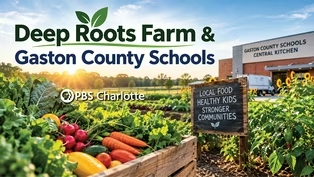
Deep Roots Farm & Gaston County Schools | Carolina Impact
Video has Closed Captions
Clip: S14 Ep1404 | 6m 6s | Deep Roots Farm grows fresh produce for Gaston County students and people who need it most. (6m 6s)
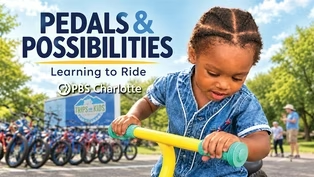
Pedals & Possibilities | Carolina Impact
Video has Closed Captions
Clip: S14 Ep1404 | 6m 20s | Charlotte’s Learn to Ride helps new cyclists find balance, confidence and their first ride (6m 20s)
September 29, 2026 Preview | Carolina Impact
Video has Closed Captions
Preview: S14 Ep1404 | 30s | Deep Roots Farm; The Healing Power of Nature; Swim Across America; & Pedals & Possibilities (30s)

Swim Across America | Carolina Impact
Video has Closed Captions
Clip: S14 Ep1404 | 7m 7s | Providence Day student Drennan Shall is a two time cancer survivor, now helping others. (7m 7s)
Wilderness Walks: The Healing Power of Nature | Carolina Impact
Video has Closed Captions
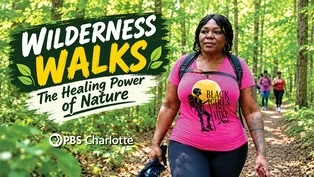
Clip: S14 Ep1404 | 5m 10s | Black Girls Do Hike builds community, wellness, and healing through nature. (5m 10s)
Providing Support for PBS.org
Learn Moreabout PBS online sponsorship New Episode
- News and Public Affairs

Top journalists deliver compelling original analysis of the hour's headlines.
 New Episode
- News and Public Affairs

FRONTLINE is investigative journalism that questions, explains and changes our world.

 New Episode
 New Episode
 New Episode
 New Episode
 New Episode
 New Episode


 New Episode
Support for PBS provided by:
Carolina Impact is a local public television program presented by PBS Charlotte