
September 4, 2023
8/18/2023 | 55m 37sVideo has Closed Captions
Barack Obama; Hager Eissa; Binette Seck; Summer Keliipio
President Brack Obama sits down to discuss the future of democracy in America and around the world. Obama Foundation leaders Hager Eissa, Binette Seck and Summer Keliipio join the conversation with President Obama to talk about the new generation's engagement in the struggle for democracy.
Problems playing video? | Closed Captioning Feedback
Problems playing video? | Closed Captioning Feedback
September 4, 2023
8/18/2023 | 55m 37sVideo has Closed Captions
President Brack Obama sits down to discuss the future of democracy in America and around the world. Obama Foundation leaders Hager Eissa, Binette Seck and Summer Keliipio join the conversation with President Obama to talk about the new generation's engagement in the struggle for democracy.
Problems playing video? | Closed Captioning Feedback
How to Watch Amanpour and Company
Amanpour and Company is available to stream on pbs.org and the free PBS App, available on iPhone, Apple TV, Android TV, Android smartphones, Amazon Fire TV, Amazon Fire Tablet, Roku, Samsung Smart TV, and Vizio.
Watch Amanpour and Company on PBS
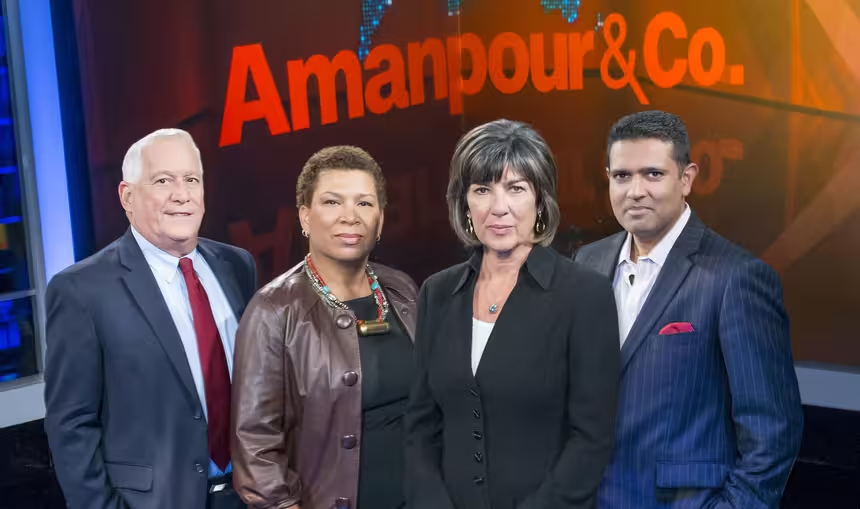
PBS and WNET, in collaboration with CNN, launched Amanpour and Company in September 2018. The series features wide-ranging, in-depth conversations with global thought leaders and cultural influencers on issues impacting the world each day, from politics, business, technology and arts, to science and sports.Providing Support for PBS.org
Learn Moreabout PBS online sponsorship[authoritative music] - Hello everyone, and welcome to Amanpour and Company from Greece.
Here's what's coming up.
- I do believe that democracy will win if we fight for it.
- [Christiane] My exclusive interview with President Barack Obama.
We explore global threats to democracy, including war in Europe and racial division in America.
Then... - We're hope people, I think.
You can't be in this work and not wake up every day hopeful for the future.
- [Christiane] We sit down with a new generation of democratic voices, three Obama Foundation Leaders, working to tackle critical challenges today.
[authoritative music continues] - [Announcer] Amanpour and Company is made possible by: the Anderson Family Fund; Sue and Edgar Wachenheim, III; Candace King Weir; Jim Atwood and Leslie Williams; the Family Foundation of Layla and Mickey Strauss; Mark J. Blechner; Seton J. Melvin; Bernard and Denise Schwartz; Koo and Patricia Yuen, committed to bridging cultural differences in our communities; Barbara Hope Zuckerberg.
We try to live in the moment to not miss what's right in front of us; at Mutual of America, we believe taking care of tomorrow can help you make the most of today.
Mutual of America Financial Group, retirement services and investments.
Additional support provided by these funders, and by contributions to your PBS station from viewers like you.
Thank you.
- Welcome to the program, everyone.
I'm Christiane Amanpour, in Athens.
On this PBS program, we're committed to exploring democracy, documenting efforts to both protect voter participation and those efforts that undermine democratic principles, which is why we're coming to you from the heart of Athens where democracy was born; and where I sat down with President Barack Obama, whose post-presidency is devoted to strengthening the Foundations of democracy now and in the future, at home and abroad.
Obama previously came to Athens back in November, 2016.
It was barely a week after Donald Trump won the election that would succeed him, and he came to reassure the world that the system would prevail.
- As long as we retain our faith in democracy, as long as we retain our faith in the people, as long as we don't waiver from those central principles that ensure a lively open debate, then our future will be okay, because it remains the most effective form of government ever devised by man.
- Now, six years on, there's compelling evidence that democracies are wavering.
The gap between rich and poor keeps widening, fueling economic anxiety.
Authoritarianism is on the rise, Europe is at war, and the global rule of law is under threat.
Barack Obama is trying to raise the alarm from the battlefields of Ukraine, to the ballot boxes of Texas; and he's celebrating, also, the next generation of democratic leaders who are learning from his Foundation.
And later in the program, you'll hear our conversation with them.
But first, will democracy claw its way back?
I spoke exclusively with President Obama in Athens at the SNF Cultural Center, which itself is devoted to civil society and discourse.
Mr. President, welcome.
- It is wonderful to be with you.
- Can I ask you about your commitment to democracy right here in Athens?
You did give a speech, your last speech as president about a week after President Trump won, and you talked about your faith in the solidity of the democratic ideals.
A lot has happened still since then.
Right?
- [chuckles] That's true.
- Do you still feel that way?
Do you feel democracy will win?
- I do believe that democracy will win if we fight for it.
And one of the themes of that speech, I then, a year or so later, at the centennial of Nelson Mandela's birthday in Johannesburg, gave a speech about democracy as well.
And it's obviously continued to be an obsession of mine with the Foundation.
Democracy is not self-executing.
It depends on the engagement of citizens and an active mobilization of people around the belief, not just in any particular issue, but the belief in self-governance and rule of law, and independent judiciary, and a free press, all the civic institutions that go into making a democracy work.
And I think it is indisputable that a combination of forces have put enormous strains on democracy, and that we've seen a backlash against democratic ideals around the world.
It's not unique to any one place.
It's happened in Europe, it's happened in the United States, it's happened in this part of the world, around the Mediterranean.
It's happening in Asia.
The reason I'm optimistic is because I believe, particularly as I meet young people around the world, there is still a fundamental belief in the dignity and worth of individuals and their agency in determining what their lives are like.
I think that's what young people want.
But our existing democratic institutions are creaky, and we're gonna have to reform them.
- So, let's ask about the creaky, or not, institutions in the United States.
The spectacle of a former president being federally indicted: How is the rest of the world, the democratic world, maybe even the non-democratic world, meant to interpret that indictment?
And indeed, the fact that a federal indictee is running, is able to run for the highest office in the land, maybe even the world?
- It's less than ideal.
[chuckles] Right?
But the fact that we have a former president who is having to answer to charges brought by prosecutors does uphold the basic notion that nobody's above the law.
And the allegations will now be sorted out through a court process.
And...
I think I'm more concerned when it comes to the United States with the fact that not just one particular individual is being accused of undermining existing laws; but that more broadly we've seen, whether it's through the gerrymandering of districts, whether it's trying to silence critics through changes in legislative process, whether it's attempts to intimidate the press, a strand of anti-democratic sentiment that we've seen in the United States.
It's something that is right now most prominent in the Republican party, but I don't think it's something that is unique to one party.
I think there is a less tolerance for ideas that don't suit us.
And it's sort of the habits of a free and open exchange of ideas, and the idea that, we all agree to the rules of the game, and even if the outcomes aren't always the ones we like, we still abide by those rules; I think that's weakened since I left office, and we're gonna need to strengthen them again.
- So, I do need to ask you then a follow up on that, because what happens if Donald Trump wins again?
It's said that the institutional guardrails of American democracy was strong enough to survive a one term presidency.
Are they strong enough to survive if that kind of personality wins again?
- I won't speculate on the outcome of a future election.
Obviously, I'm a Democrat, I've got a deep-- - I mean the institutions.
- Interest in the outcome.
- But I'll make a general statement, which is, having been president of the United States, you need a president who takes the oath of office seriously.
You need a president who believes not just in the letter, but in the spirit of democracy.
And the essential spirit of democracy is that as president of the United States, you are just one representative of the people in a series of co-equal branches.
There are checks and balances to the system.
You are subject to those checks and balances.
You cannot ignore them.
You cannot make your own rules.
You cannot view the Justice Department as your personal law firm.
You cannot ignore norms and guardrails that have been put in place to assure that your self-interest isn't what drives these institutions, but is rather the interests of the American people.
And so, if you have anybody who's occupying that office, who disregards that higher purpose, then you're gonna have problems.
The good news is that through the mechanism of voting, the American people are gonna have the opportunity to reaffirm their belief in American democracy.
And the other thing, Christiane, I do think that what happens in the United States matters around the world.
And the thing, sometimes I'm asked, what surprised you about being president?
And I said, "I knew I was gonna be busy.
"And I knew that obviously the United States "is an extraordinarily powerful country."
The idea of America, the idea of a, the possibility of a multi-racial, multi-ethnic, multi-religious, large, big, complicated country still being able to function as a democracy, that is an important idea for the world.
And when it looks like America's democracy is teetering or breaking down, then I think it emboldens those who do not believe in democracy around the world, and it worries and weakens democratic forces in other places.
- So, President Biden, a man who you know extremely well, has made the defense of democracy the sort of centerpiece of his administration.
It just so happens that right now there's also not just threats to democracy by dictatorships and autocrats, but also illiberal democracy as well.
He has called the president of China, a dictator, and they're sticking with it.
He's also hosting, as we speak, the prime Minister of India, Modi, who is considered autocratic or at least illiberal democrat.
What is the point, I guess, or how should a president engage with those kinds of leaders, either in the naming of them or in the dealing with them?
- Look, it's complicated.
The president of the United States has a lot of equities.
And when I was president I would deal with figures in some cases who were allies, who, if you pressed me in private, do they run their governments and their political parties in ways that I would say are ideally democratic, I'd have to say no.
- Do you wanna name names?
- No, of course not.
But you had to do business with them because they're important for national security reasons.
There are a range of economic interests.
I dealt with China to get the Paris Accords done, I dealt with Modi to get the Paris Accords done, because I think climate change is something that transcends any particular momentary issues.
It's a problem that humanity's gotta deal with over the next several decades in a serious way.
I do think that it is appropriate for the president of the United States, where he or she can, to uphold those principles and to challenge, whether behind closed doors or in public, trends that are troubling.
And so, I'm less concerned about labels than I'm concerned about specific practices.
I think it is important for the president of the United States to say that if you have Uyghurs in China who are being placed in mass camps and reeducated, quote unquote, that's a problem, that's a challenge to all of us, and we have to pay attention to it.
I think it is true that if the president meets with Prime Minister Modi, then the protection of the Muslim minority in a majority Hindu India, that's something worth mentioning because... And by the way, if I had a conversation with Prime Minister Modi, who I know well, part of my argument would be that if you do not protect the rights of ethnic minorities in India, then there is a strong possibility India at some point starts pulling apart.
And we've seen what happens when you start getting those kinds of large internal conflicts.
So that would be contrary to the interests, not just of Muslim India, but also Hindu India.
I think it's important to be able to talk about these things honestly.
You're never gonna have a, things are never gonna be as clean as you'd like, because the world is complicated.
- So, the world is complicated, as you say.
President Biden is, as we all know, running for reelection.
- Yes.
- Everybody's talking about his age, people are talking about his polls.
Even there's some challenges within the Democrats, maybe somebody who might start to try to primary him, et cetera.
But what I would like to know is, many say that his policies and his legislatives and his wins, frankly, since 2018, '20, 2022, should speak for themselves.
And yet, according to Way to Win, it's a Democrat-leaning company, firm, only some 22% of Latino voters, 33% of black voters can actually identify something that they say he's done to specifically make their lives better.
What would you say to that?
And how would you advise him to connect in a reelection?
- I think Joe Biden has done an extraordinary job leading the country through some very difficult times.
I do not think that there's gonna be any kind of serious primary challenge to Joe Biden.
I think the Democratic Party is unified.
There was a lot of talk, you'll remember, when he was first elected, because Bernie Sanders had run, that somehow there was this huge split between progressive Democrats and more centrist Democrats.
And the truth is, is that partly because of how Joe has governed, those divisions have been bridged.
I think what's true in American politics generally is until you get to campaigns, people aren't paying much attention.
People have gone through a difficult time because of Covid and the pandemic and lockdowns; because of inflation, primarily the result of both the war in Ukraine and rising energy prices, as well as supply chain issues.
And so people have memories about the, "Okay, eggs got more expensive and gas was more expensive," and they haven't been paying as much attention to the fact that, for example, the African-American unemployment rate is lower than it's been in decades.
The campaign will allow President Biden to make those arguments.
And I think that in a media environment that's so cluttered, it's very hard to break through until you get to election time.
You'll recall when I ran for reelection in 2012, my poll numbers weren't that great, and we ended up winning comfortably.
Part of that was just we started campaigning and we were able to get a message out and people said, "Yeah, you know, "that policy or this policy or this thing left undone, "that irritated me a little bit, "but overall, I think he's done a good job."
And I think that's what they're gonna conclude about Joe Biden as well.
- When Russia started its illegal invasion, the second invasion of Ukraine, I believe you said that democracies, it's a clarion call, it's a wake up call, democracies are getting flabby and feckless.
Where does Ukraine, in your view, stand in the fight to preserve democracy?
- I think it's vital.
It's interesting, before I left office, I gave speeches not just here in Athens, but also in Hamburg and in London.
And one of the arguments I've made is, do not take for granted the extraordinary achievement of the European Union; and the fact that a continent that was wracked by war and bloodshed for centuries was now as prosperous and as peaceful as any in history.
And then now we've seen the first war on European soil in recent memory, and I think it was a wake up call to Europe, and I think it was a wake up call to the West and to democracies around the world that the old ways of thinking: might makes right, big countries can do what they want to small countries, that people cannot independently determine their futures, that those forces have to be confronted.
Watching the Ukrainians themselves with such courage and bravery fight back, I think that reminded Europe of who they were.
And I've been impressed by the degree to which, in not easy circumstances, Europe has stood up.
It has provided the aid that was necessary.
I think the Biden administration has very deftly managed maintaining that alliance to support Ukraine.
And I believe the stakes are high to send a message to somebody like Putin that they are not going to just be able to willy-nilly determine the borders of other countries.
- So obviously hindsight is a great thing, 2020 vision is a great thing, but you experienced, while you were in office, Putin's first invasion, the annexation of Crimea.
And many people said neither you nor the Western allies stood up and put enough red lines around him around that.
- Yeah.
- So what's your reaction to that?
And I want to just add also, your friend, your good friend and colleague Angela Merkel is under very serious criticism right now.
I know you've just met with her recently.
Should she have leveraged Germany's economy, energy, on the addiction to cheap energy in Russia?
Was that a mistake?
- Well, I think the Ukraine of that time is not the Ukraine that we're talking about today.
There's a reason why there was not an armed invasion of Crimea, because Crimea was full of a lot of Russian speakers.
And there was some sympathy to the view that Russia was representing its interests.
The Rada at the time, the Ukrainian parliament itself still had a number of Russian sympathizers.
And the politics inside Ukraine were more complicated.
And part of what happened was, both myself but also Merkel, who I give enormous credit for, had to pull in a lot of other Europeans kicking and screaming to impose the sanctions that we did and to prevent Putin from continuing through the Donbas into the rest of Ukraine.
So, I actually think that given both where Ukraine was at at the time and where the European mindset was at the time, we held the line.
And part of what happened was, over time, a sense of Ukrainian identity separate from Russia, and a determination to push back against Russia, and an ability to prepare both militarily and civically to resist Russian pressure, that they built up those muscles.
And that's part of the reason why they were able to respond the way they did when you actually saw what was, in my view at least, an incredibly misguided, not to mention illegal and incredibly cruel, incursion by Russian forces.
- Do you think Putin should have been challenged more then?
- I think that we challenged Putin with the tools that we had at the time, given where Ukraine was at the time.
- How do you think it'll end?
- I don't think any of us know.
And I think anybody who speculates, I think would be making it up.
- Okay, back to the United States, and actually to the world.
You said recently in a speech that, if we keep having these terrible differences that we have, "we will destroy each other.
"We have to find a way how to live together."
- Yeah.
- I spoke to one of the Republican candidates, former governor Asa Hutchinson of Arkansas, who said to me about various name calling and tribalism, he said, "Give the candidates a chance "to talk about the issues "that the Americans are concerned about.
"Let's use appropriate language.
"Let's be clear that we have differences of policy; "but that doesn't always make the person on the other side "an evil person or somebody that doesn't love our country."
- Right.
- Do you think the Republicans will coalesce around that kind of message?
- No.
[chuckles] There's no evidence that that's where their head is at right now.
Now, that doesn't mean that that's not attainable over time.
Look, it wasn't that long ago that I got a lot of Republican votes.
It wasn't that long ago, where John McCain was the Republican nominee and actively shut down a speaker at a town hall who was saying that I was an illegal alien bent on imposing Sharia law on the United States.
And there are still a bunch of folks who are more politically conservative than I am on social issues, on economic issues, but who I consider good people, thoughtful people who I learn from and who I enjoy conversations with.
So, the polarizations that we've seen in our national politics is not identical to what's happening on the ground.
But what is true is that partly because of where people are getting information these days, the siloing of information.
If you are watching Fox News, I've said this before, if you're watching Fox News or following some right-wing radio host, or getting Facebook feeds within that bubble, your reality is different than if you read the New York Times or watch your program.
And when people are getting such fundamentally different facts, or what they think to be facts, and their worldviews are so skewed in one direction or another, then it's very hard for democracy to work.
So, this is the reason why I've been spending a lot of time, both in the Foundation and in other work, talking about these problems of misinformation.
Not just the kind of misinformation that we see Putin engaging in in the Ukraine situation, not just during election time, but just this constant demonization of the other side, making people fearful of each other.
And unfortunately, I think that's gonna be a problem that gets even more pronounced with the advent of AI and deep fakes and all these challenges.
- And we wanna talk about that a lot with the leaders in the second part of this program.
And I just wanted to ask you before I got to them finally.
Race.
- Yeah.
- You're the first black president.
When Trump was elected, somebody who used to work for you and now is an analyst, Van Jones said, "White lash.
"It was the white lash against a black presidency."
Do you think the white lash is receding?
And I guess combined with that, how do you interpret two candidates of color, Nikki Haley, former governor of South Carolina, Tim Scott, senator of South Carolina, who is saying that Obama wants to keep, essentially, race as part of the equation, a part of the conversation; and you don't believe that everybody has an equal chance in the United States, no matter what their color?
- Well, look, I won't comment on what Republican candidates say.
I'm not running, so they can, [chuckles] they can find other ways to occupy their time.
I think race has always been the fault line in American life, in American politics.
That's not original to me.
I think any observer of America would say that.
And by the way, that historically has not been a one-sided partisan issue.
My favorite president, Abraham Lincoln, did an awful lot to advance the cause of freedom.
And conversely, the Democratic Party was where the Dixiecrats resisted civil rights and progress for years, and imposed Jim Crow.
So, it is something that America has had to grapple with for centuries.
I think we have made real progress.
Although I was always skeptical that my election somehow signified a post-racial America.
If you look at any speech I gave throughout my presidency, I was always someone who reminded the country of the progress that was possible.
That was my brand.
That's part of the hope and change thing.
But what I've also always said about hope was it can't be blind hope.
It can't be a willful ignorance to our history.
We reckon with our history: that's how we then get better, that's how we perfect our union; in the same way that Germany got better when it looked squarely at what happened during World War II and came to terms with that.
And that's part of why it is a thriving, stable, and increasingly diverse society.
And that's part of the argument that I think all of us, not just in the United States or in Europe, but around the world, have to come to terms with.
Humans have a strong desire to coalesce, particularly during times of stress, around tribe, clan, race, whatever our religious preferences are.
And politicians have a good way of exploiting that.
And if we don't resist it, then we're gonna have problems.
And by the way, it's not just, that us-them dynamic is not just around race.
I would argue that in the United States, and I suspect in Europe as well, changing gender roles have fueled at least as much of a backlash as the racial backlash.
There's enormous fear among men, and those who like the traditional structures and hierarchies and patriarchy, get very nervous when you have women suddenly being outspoken and thinking that they should have the same rights and power as men do.
And when you have people of different sexual orientations saying, "I'm here, I want a seat at the table," that has been very threatening.
And there's one last ingredient that I'd be remiss if I didn't mention, 'cause I think this is also part of our democracy, I'll talk about this a little bit in a plenary session at this conference we're at.
And I've mentioned this before, I do think there's an economic element to our democracy that we have to pay attention to.
Our democracy is not going to be healthy with the levels of inequality that we've seen generated from globalization, automation, the decline in unions, obscene inequality.
You think about news of the day, generally we're not talking about news of the day, but right now we have 24 hour coverage, and I understand it, of this submarine, the submersible that tragically is right now lost at the bottom of the sea.
At the same time, right here just off the coast of Greece, we had 700 people dead: 700 migrants who were apparently being smuggled into here.
It's made news, but it's not dominating in the same way.
And in some ways it's indicative of the degree to which people's life chances have grown so disparate.
It's very hard to sustain a democracy when you have such massive concentrations of wealth.
And so part of my argument has been that unless we attend to that, unless we make people feel more economically secure, and we're taking more seriously the need to create ladders of opportunity and a stronger safety net that's adapted to these new technologies and the displacement that are taking place around the world, if we don't take care of that, that's also going to fuel the kind of mostly far right populism, but it can also potentially come from the left, that is undermining democracy, because it makes people angry and resentful and scared.
- And we are going to talk about that in the second part of this program with the Obama Foundation Youth Leaders and yourself.
- I look forward to it.
- [Christiane] And just to note, we had that conversation just before news broke that the submersible suffered a catastrophic implosion and all the crew had been lost.
Obama is particularly proud of the mentorship that his Foundation is providing.
And when three of those youth leaders joined us, we heard how those members, who are an emerging generation, are engaging in the struggle for democracy at this crucial time.
Hager Eissa comes from Sudan.
Her country, like Ukraine, is a fledgling democracy which is threatened by war.
Hager has worked in refugee camps in Darfur, fostering peaceful reconciliation.
And she is founder of a nonprofit organization that helps women of color worldwide.
Summer Keliipio is a consultant in Hawaii, developing leadership skills to strengthen vulnerable populations.
And Binette Seck is co-founder of an Ethiopian-based tech training program, which has taught thousands of people coding skills.
They've all spent this week here in Athens for the culmination of their training program, including a visit to The HOME Project, which cares for children whose lives are wrecked by war and persecution.
The leaders talked to us about the moment they were selected.
- But I was in shock.
I never had known anyone that looked like me going through this process before.
- I would love to see my community flourishing and having all the freedom and all the human rights and the women rights.
- Sometimes the work that we do is really difficult and it feels quite lonely.
But in meeting them, I realized, "Ah, there's so many of us "that go through the same journey."
- These Obama Foundation graduates joined our conversation with their perspectives on how collectively to strengthen democracy by forging solutions on threats like climate change, the AI upheaval, and women's empowerment.
All right, Mr. President, welcome back, and leaders, Hager, Summer, and Binette.
We were talking just before the break about the pervasive misogyny and, frankly, physical attacks on women around the world.
I just wanna first start by asking you, Mr. President, what is the effect on democracy when essentially half the globe's population is kept down, and it still is?
- Well, you've answered your own question.
If you've got half the population that is being suppressed, often violently, then by definition democracy is not functioning the way it should.
And what is also true is, is that when women are not empowered, typically they're the ones who are the caregivers, which means children are not empowered.
And the kinds of issues, whether it's healthcare or education, kitchen table issues, those are not being attended to.
And so, we are depriving ourselves of a set of perspectives that are vital to making democracy work.
And when you look at countries that are successful, they are countries in which women are empowered.
And countries that are less successful, that stagnate, that are more likely to engage in conflict and are more violent, are typically ones in which women are suppressed.
- So, there's a new report that's just come out in the last several days, the UN Gender Index, and it shows that some 9 out of 10 people are biased against women in about 80 countries where they surveyed.
About half say that men make better leaders, political leaders, men are better business leaders.
And a quarter of the respondents say that they accept men beating their wives.
I mean, a quarter of the respondents!
Let me ask you, Hager, because you come from Sudan, you're living back and forth in Europe, and you've experienced war and refugee status.
Tell me how it affects you and in your community building this oppression of women still.
- Well, stepping into that and going back to how Sudan works, especially when it comes to women rights, Sudan has been facing this massive wave of having this explaining to women that they cannot do anything.
We have always been told that you cannot vote.
Who's gonna take your vote?
You cannot participate in anything.
You are not as equal as men are.
So having all of those challenges that are being faced by women, it reshaped half of the women in Sudan into not knowing what kind of leaders they can actually be, so the power that they actually have in them.
And it took us ages to realize that women are actually strong and they can empower and they have the right to vote, they have the right to have a voice, and they have the right to be respected as well.
Stepping into respect.
It has always been a challenge for Sudanese women to be respected, especially when it comes to be respected by men.
Because for them it's always like, "We are the leaders.
"We rule the family.
"It's only us, nobody else."
And for me especially, I have always been challenged by it.
But luckily I grew up in a family that always taught me that you have the right to do whatever you want, as long as you know what you're doing, and we trust you enough.
So as my part, I wanted to reflect that in my own way.
It took me a lot of time.
I went back to Darfur.
We've all heard about Darfur.
- It was the scene of the genocide in the early 2000s.
- Yeah, exactly.
It was massively and so unfortunate.
I went back to Darfur.
I sit down with families in refugee camps, trying to explain to them the importance of how they should actually let the girls go to school.
I was the enemy when I started talking about that.
They didn't know that I was actually trying to help.
They were like, "No, you're working against culture."
So here we see how culture is playing a main role in shaping even the community that we are around.
- We have you three women leaders here.
I'm sure the Obama Foundation has some male leaders as well.
But here we are the three women leaders, and I am glad we do, because I want to ask you about what you get from the Foundation, and what the Foundation is designed for in terms of getting information from each other, sharing experiences, community building.
- Just to add one thing that is really key when it comes to the women right issue, it has to do with representation.
What do we see represented?
And across the board, I think we have an issue of having female leaders that we actually can see ourselves represented in.
We have a lack of communities and organizations that are led by women.
We also have an issue of networking, having a space, a safe space where you can connect with other women, or men even.
And one of the things that the Obama Foundation and the Obama Leadership has given me, as a leader, is truly the networking, the role models I really needed.
Growing up in Tensta, it's one of the most vulnerable areas in Sweden, and I would sit in a bus, travel from Tensta all the way to Kista, which is the Silicon Valley of Europe, looking out the window, seeing these amazing companies, it's a tech hub, it's a tech mecca basically, and sitting in the bus, holding in my hand a device.
So, throughout my entire life as a 14 year old or as a 25 year old, I've always been connected with technology in my hand.
But looking out the window, I made a decision as a young girl, I will never, ever get a job in tech.
And the main reason is, if you don't see yourself represented, what will you become?
So, I never saw a woman that looked like myself that was in tech.
- For you, a fellow Hawaiian, climate must be a huge issue, right?
And so many young people vote on climate, and that's a huge concern for them.
What do you think you all can do to move this in a way that will actually make change while governments are still unable to show the full political will?
- Such a great question.
For me and for all of the other Pacific Islands that are quickly losing landmass because of climate change, it's so important now more than ever to be able to tell our stories and to reach out to people around the globe, to our new colleagues in the network, and to be able to find opportunities for connecting and helping them to understand what we're going through on a daily basis.
The storms are bigger, the surges are bigger, our reefs are disappearing, the fish are not there.
People cannot survive anymore.
And so, the leadership and the network provides us an opportunity to get help.
And so what we like to say in the Pacific Islands is, our islands are, it's not a sea of islands, not islands in the sea, but a sea of islands.
And so we wanna make those connections across the globe with everyone else.
- And are you still hopeful on the climate?
Because it's been said, and we sort of touched on it, that this world, in fact the head of the IMF told me, our world has the technology, it has the knowledge, has the money, has the ability, just not the will, essentially, to solve just about every problem we have.
Are you hopeful?
- Always; always hopeful.
We're hope people, I think.
You can't be in this work and not wake up every day hopeful for the future.
You find something else to do because the problems are so hard.
But we look in each other's eyes and we ask for help and we look for other solutions.
And in meeting all of the other leaders, we found a family that we didn't know we were missing, because these are the folks who are gonna help to grease the wheels and to make change across sectors and across nations.
- Well, and part of, you talk about climate change.
Some of the leaders in our network have led mass movements, including some of the big protests among young people and students in Europe.
Some are working to create a conservation corps to prevent deforestation in Southeast Asia.
And they're working in relative anonymity, village by village, trying to teach new forestry practices.
Some of them are creating clean energy programs in sub-Saharan Africa, working with villagers to create easily solar charged batteries, or to create networks that can leapfrog old dirty fuel style development and go straight to clean energy development.
What happens is when they all talk to each other, they suddenly realize, "Oh, what I'm doing in Germany "is connected to what I'm doing in Vietnam, "and actually directly connects "to what is happening in Sudan."
And then even across issues, now they suddenly start talking to somebody who's working on the migrant crisis, and they say, "Oh, this displacement is in part "because people can't grow food on their land "and that's causing conflict in countries "that are then sending people "looking for a place to survive, "so we've gotta deal with that as well."
Creating those kinds of networks, exchanges of ideas, that I actually think fuels optimism.
We get cynical, we despair when we feel as if we're alone.
When we're together, then suddenly we say to ourselves, "Oh, maybe we can figure this out."
And climate change is an example of something that, yes, it's not happening as fast as we'd like, but I constantly remind our young leaders, we've actually made enormous progress.
When I came in in 2008 during the financial crisis, the entire clean energy industry was about to collapse in the United States.
It is now booming.
And the cost of clean energy relative to old fossil fuels has evened out because of technological progress.
It's these outstanding leaders who are gonna then force us to make even faster progress than the-- - [Christiane] And have to clean up our mess, as they say.
- As usual.
- Yes.
Our kids are gonna, you are gonna have to do that.
And it's vital work.
Can I just potentially end with a good discussion on AI?
You just did a Netflix series on work.
And at one point you said, the most work that most Americans do, essentially in service, fairly low paid, it's not so much a foothold, but it's a treadmill; that they don't really have a way to get any further.
So that's one thing.
The other thing is AI; and how does one convince workers, young leaders, that AI can help them and improve their, and enhance their work opportunities rather than eliminate their work?
I don't know, President Biden is... Well, first let me ask you: are you afraid that AI is going to eliminate us as workers, as, some people would say, the human race?
- I am afraid of the digital illiteracy, not only in Europe, but all over the world, especially when we connect that to the first question that you had concerning women and rights.
There is no tech industry anymore.
It's within every single industry, whether it's fashion or makeup, or production and media, it's literally everywhere.
There are millions, the latest number was 20 million, but I would say there are millions of people missing in the tech scene, which often also refers to the need for competence.
And it's because of the rapid development that we've seen within technology.
The rapid development of things that we don't understand makes us afraid.
So the literacy of technology is crucial, making sure that the younger generation, the next coming generation understands that it's not enough to have a competence, to have an education on a high level.
What you need to do is continue learning.
What is AI today might not be AI tomorrow.
- President Biden has been to the west coast to talk to the AI leaders, to talk to them about regulation.
And it seems to be commonly agreed, I don't know whether you agree with this, that it has to be regulated.
Do you believe that?
And what is your worst nightmare situation if it's not regulated, AI?
- This is a powerful technology and it's coming fast.
And if it goes into the wild, the way social media did, without us thinking through the consequences, we could have bigger problems with AI.
We will have bigger problems with AI: national security problems, job displacement problems, misinformation problems that undermine our democracy.
And so yes, we're gonna have to regulate it in an intelligent way.
Now, there is enormous potential.
You think about the incredible work that Hager's doing to try to empower people who have very little access to education.
If harnessed correctly, you can have AI teachers that much more cheaply are delivering a very good education to people in remote areas.
That's a powerful thing.
And by the way, if you have villages where girls have trouble getting to school, but you can get them a device and they can learn on their own, that can break down barriers as well.
So that's the upside.
The danger is that if it's weaponized, it can be a very powerful tool for mischief.
And so, there's an entire national security element around this.
The job displacement is going to be significant.
Binette is absolutely right that we need to train our young people to not just be consumers of this technology, but to understand and produce and shape how this technology works.
But the potential for people who are in jobs that can be done remotely, to be replaced entirely by machines, I think that is something that's gonna happen fairly quickly.
And that means that we've gotta work more creatively around the sorts of things that machines can't do.
Machines can't care for each other.
Machines can't tend to somebody who's ill.
They can't teach, with joy, a child and inspire them.
And a lot of those, by the way, are traditionally women's work that is undervalued and underpaid.
Part of what we're gonna have to do, is not just regulate the technology, but also recognize that we've gotta reshape our society to lift up and reassess what is most valuable in the human experience.
And a lot of it is the kinds of work that women do often uncompensated, but that makes life worthwhile.
- And I guess finally, 'cause we're out of time, it's said that Greece believes, since we're in Greece, that democracy is only as healthy as the willingness of citizens to engage and to sacrifice, to defend the democracy and to do the work.
How do you feel about that?
Are enough people of your generation willing to do that?
Not just go shopping and "Me, me, me," capitalism.
We talked about the capitalism and the inequality, and that's part of this as well.
- Well, I believe that's totally correct, and as also like this program proves to me, how we are all together as one, as a community, willing to actually shape even democracy.
I met a lot of amazing leaders as we're working in democracy.
And I feel, I was at some point feeling like I was alone, but in seeing this, it made me feel like we are all in this together.
So yeah, I totally agree to that.
- Great.
- Summer.
- The slide to chaos is real, and that's a real challenge.
To get people organized and motivated to invest in democratic values is really tough.
And at the same time, I think what we saw during the pandemic was once it starts to hit lots and lots of people, then I think everybody starts to pay a little bit more attention.
And I think, for sure, we're either at or past that breaking point.
And I think more people will start to pay attention to the need to protect a right to education, a right to prosperity, and some degree of peace and security; all of those things we need in order to survive as a people, as a human people.
And that, I think, will fuel motivation to make progress towards these democratic values.
- What I'm really looking forward to is the next coming generation that are informed, empowered, engaged.
And I think one of the ways is to build communities where you can find your safe space, you have someone to look up to, where you can grow in your network; you can go pass the knowledge and build your competence in order to really believe that you're worthy of a better life.
Because once you do believe that, we have seen in our organization, that's when you create a better life for someone else.
- Brilliant.
- And one last thing I'll say about young people and democracy.
And I mentioned this, I think, in one of the meetings we had with the group.
In almost every country, young people vote at lower levels than older people.
And it's understandable.
They're worrying about careers, school, getting a job, romance, starting families, so there are a lot of distractions.
And democracy can seem like some abstraction that they don't have time to worry about.
But what I've increasingly seen is that young people recognize the existing institutions aren't working for them.
It is our job, yours, mine, I'm much older than you, Christiane, but it is our job [Christiane chuckles] to give the opportunity for young people to lead.
Because it turns out that when you, when you are willing to cede some power, when you are willing to say, "All right, what ideas do you have?
"Let's put you in charge of this.
"How would you reorganize this?"
They will seize that opportunity.
And I think part of the message that we have at the Foundation is, it is time for us to pass that baton, to pass that torch.
They're ready to run the race, and they're already running it.
Sometimes it's old heads like me that are getting in the way.
But I'm confident and hopeful that you guys are gonna clean up our mess, as you put it.
- Well listen, thank you all so much.
Binette, Summer, Hager, and President Obama, thank you very much for being with us.
- Thank you so much for taking the time.
- Thank you.
- Thank you for having us.
- And that's it for this special edition of Amanpour and Company on PBS.
Thank you for watching, and goodbye from Athens.
[authoritative music]

- News and Public Affairs

Top journalists deliver compelling original analysis of the hour's headlines.

- News and Public Affairs

FRONTLINE is investigative journalism that questions, explains and changes our world.












Support for PBS provided by: