Vermont This Week
September 6, 2024
9/6/2024 | 24m 55sVideo has Closed Captions
Vermont Housing Finance Agency’s needs assessment
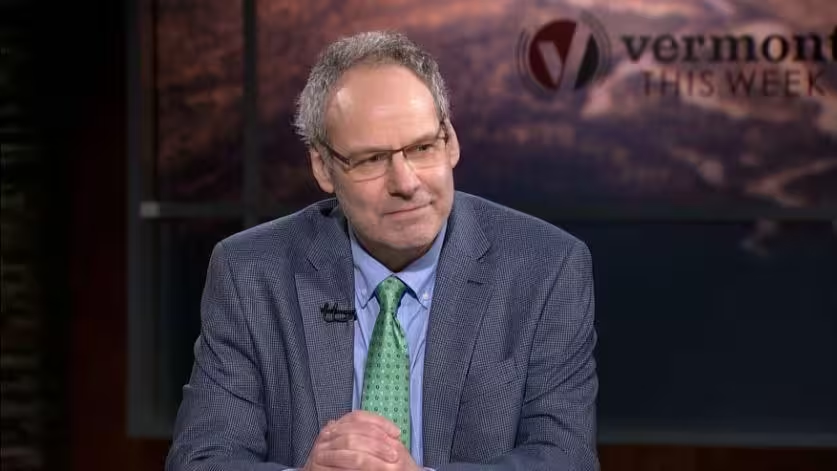
Vermont Housing Finance Agency’s needs assessment | Gov hopes temporary Act 250 exemptions will spur housing growth | ‘Free-speech’ advocate in Stowe | Panel: Mitch Wertlieb - Moderator, Vermont Public; Peter Hirschfeld - Vermont Public; Erin Petenko - VTDigger; Aaron Calvin - Stowe Reporter/News & Citizen.
Problems playing video? | Closed Captioning Feedback
Problems playing video? | Closed Captioning Feedback
Vermont This Week is a local public television program presented by Vermont Public
Sponsored in part by Lintilhac Foundation and Milne Travel.
Support provided by:


Vermont This Week
September 6, 2024
9/6/2024 | 24m 55sVideo has Closed Captions
Vermont Housing Finance Agency’s needs assessment | Gov hopes temporary Act 250 exemptions will spur housing growth | ‘Free-speech’ advocate in Stowe | Panel: Mitch Wertlieb - Moderator, Vermont Public; Peter Hirschfeld - Vermont Public; Erin Petenko - VTDigger; Aaron Calvin - Stowe Reporter/News & Citizen.
Problems playing video? | Closed Captioning Feedback
How to Watch Vermont This Week
Vermont This Week is available to stream on pbs.org and the free PBS App, available on iPhone, Apple TV, Android TV, Android smartphones, Amazon Fire TV, Amazon Fire Tablet, Roku, Samsung Smart TV, and Vizio.
Support the crew
Help Mitch keep the conversations going as a member of Vermont Public. Join us today and support independent journalism.Providing Support for PBS.org
Learn Moreabout PBS online sponsorshipA new state agency report indicates that Vermont's projected housing needs will continue to rise over the next five years.
The economic reality is that we need more units.
We're actually inhibiting our own workforce growth and population growth by not providing enough places for people to come and move to the Scott administration in hopes temporary act 250 exemptions will spur housing growth.
Plus, postal staff and police in Stowe are subjected to a so-called free speech audit.
That and more ahead on Vermont this week.
From the Vermont public studio in Winooski, this is Vermont this week, made possible in part by the lINTILHAC Foundation and Milne Travel.
Here's moderator Mitch Wertlieb.
Thanks for being with us.
I'm Mitch leave it is Friday, September 6th.
And joining us on the panel today, we have Pete Hirschfeld from Vermont Public, Aaron Calvin from the Stowe reporter, and Erin Petenko from VtDigger.
Thank you so much, everyone, for being here today.
We're going to start with a big topic around Vermont that's affecting everybody.
It is housing.
There is a great need for it.
Aaron, you were just writing about this in Vtdigger.
And you know, we have been saying for a long time now we need more people to come to Vermont.
We've got to grow the population.
Come here.
We've got a great, living style for you, but the housing is short and what is there is expensive.
Tell us about the housing needs in Vermont right now.
How much demand is there and what does it need to be met by?
What time frame are we looking at?
Yes.
So according to this report, which was put together by the Housing and Finance Agency as part of a like requirement from the U.S. federal government to receive a dollars, they, they looked at all the different needs in the state from, you know, renters who are paying too much for their rent to people who are unhoused, to people who can't afford to buy a new home in the state that are waiting in an apartment to buy one.
And they said, based off of that, we're probably going to need 24,000 to 36,000 new homes built in the next five years to keep up with demand.
Now, that is higher than it would have been if we didn't have the pandemic happen.
But even if you look at the chart that's up on the screen, you can see that we would have still needed a lot more housing.
But with new pandemic migration people coming in, people, you know, seeking pandemic safety or a lower cost of living in Vermont, you know, they're saying now that we're going to need even more homes built to accommodate that.
So at least 24,000 units within five years.
I mean, that sounds pretty daunting.
And Pete Hirschfeld, I guess that's why Governor Scott is saying we've got to take advantage now of this act.
250 exemption.
It's sort of a two year time frame.
What's he talking about with that two year time frame there?
So, this two year exemption, applies to downtowns, other densely populated areas and village centers.
And what it does is it will, remove act 250 oversight for projects, in some cases, of up to 75 units, so that they can move through purely just the local zoning process.
And they don't have to worry about this added layer of state oversight.
Governor Phil Scott, we should be clear, vetoed the bill that created this provision.
He was looking for much broader exemptions in the bill.
He had some concerns with aspects of the legislation that he says amount to conservation efforts that are going to make it even more difficult to build in certain areas of Vermont, notwithstanding that opposition, you know, Democrats overrode to veto.
So the law is the law now.
And he says there is this thing in it that we can benefit from.
but we need to act now if Vermont doesn't get its stuff together, if municipalities don't band together, if private developers don't come to the table and this window is going to pass us by without any added benefit, so they're really trying to ramp up the pressure on communities to, identify housing needs now and use this temporary time period to really make some headway.
So how communities will respond is going to be a big issue.
And Aaron Calvin, I know you've been writing a lot about the issues in Stowe going on with here.
And, around other places in Vermont too.
So I'm sure that there are developers and people who want to get housing done, but there's opposition as well.
What can you tell us about what's happening in stone?
Some other places?
Sure.
In Stowe, the Planning Commission is really focused right now on authoring a town plan, which will help guide the needs to, development in the future.
town plan is a document that is often used in the act 250 process.
And, by the development review boards to basically ensure that developments are, being built in a way that the town has broadly, affirmed.
right now, the Planning Commission is also contemplating certain things like, a big part of the active act 47 Home Act, that has that was passed last summer and 2023, that was, intended to encourage or make it easier, to build and to build densely in certain places.
And, part of that is to allow greater density in developmental areas where, these new homes can connect to, municipal water and sewer.
Now in Stowe, that's quite an extensive area because it connects all the way from the village, down the mountain road to the resort and, up to traps, family Lodge as well.
So there's a lot of places where developers could potentially take advantage of this density.
Now, homes and still are very expensive.
After the most recent assessment, the average still home is about $1 million.
So, you know, these houses are going to be more dense there.
These developments are going to be potentially more dense, but they're also going to continue to be expensive.
So that's just one way in which the the Home Act might be having effects that maybe weren't intended or, weren't the specific goals of that legislation.
But again, the Planning Commission is trying to determine what those areas are firmly going to be.
That can take advantage of that, because it's more complicated than just connecting to water and sewer.
There are some areas where maybe, you know, a an extender could connect you to, the sewer system.
and they're going to decide, you know, is it just that qualify for the density bonuses?
And one great example of this going on right now, that's being that's going into the review process is, development by the Stowe Country Club.
And they're trying to build, over 70 units of new housing, over it and two different sort of developmental areas.
And it'll be interesting to see, whether or not that comes to fruition.
and the, they didn't take advantage of the Home Act bonuses that were on the table.
and it's not clear why.
but, you know, any kind of attempt to take advantage of the home Act could potentially, set off some legal review and, getting set off like a sort of, like, legal, battle that could lead to greater precedent around the Home Act.
Well, Pete Hirschfeld, when the legislature gets back to its work in reconvening, are there going to be more housing bills coming up that may be dealing with some of this stuff?
Yeah, absolutely.
Phil Scott has made it abundantly clear that he doesn't think legislators have done nearly enough on the land use reform side of things.
there are a lot of legislators that say land use policy is not the main reason, by far, that we're experiencing this housing shortage.
that if you want housing, you need to invest public funding in it.
we saw a bill that passed the House this year that would have raised approximately $80 million to year, a year via, a 3% income tax surcharge on high earners in this state.
they said more money equals more housing.
That's that's the equation you need here.
and Phil Scott says, no, if you can get rid of some of these regulatory hurdles, this is going to happen on its own.
you know, this policy debate is going to continue to play out with a Republican governor and a legislature that's heavily controlled by Democrats.
At least it appears that's going to be the scenario heading into the next legislative biennium.
and in the meantime, this housing needs assessment sort of lays bare some of the tensions that Vermonters are dealing with.
we've seen the rate of homelessness triple in this state between 2019 and 2023.
Three years ago, I think it was 32% of renters had an income necessary to purchase a median priced home in this state.
As we stand here today, that number has dropped to 6% because home prices have increased so much.
half of Vermonters, I believe, are spending more than 30% of their income on rent.
A quarter of Vermonters are spending more than half of their income on rent.
So the problem isn't getting better.
notwithstanding all the work that's gone into this, into the legislature so far, so definitely it's still on the table is one of the main issues they have to tackle, and not to mention legal challenges that could come up locally when there is local opposition to building some of this density.
this is happening in Shelburne, right, Erin?
I mean, yeah, my, colleague at the Shelburne News has written extensively about, a development that's going on right now.
That's pretty much the biggest thing being discussed in that town that is, you know, in the recent past, had, strong contingent of residents strongly opposed to almost any kind of new development.
This development would be dense.
It would take advantage of act 47 in order to get that density bonus.
And it is located right on the border of, there are municipal utilities.
So again, you see this sort of gray area where towns are being asked to interpret the act.
And at this stage, the Shelburne municipal government has been in negotiations with the developers.
They're sort of trying to use that as leverage to, require the developers at affordable housing have certain kind of setback buffers, stuff like that.
but they're having these public forums in which citizens are weighing in, and I would strongly expect there to be, even if the town allows the development to go forward and take advantage of these density bonuses.
I would expect it to be some kind of legal challenge.
So I think, again, we're going to we're going to be seeing some some legal precedents being set here through the courts around, how this legislation works.
And, Aaron, pachinko, when you were writing about this Vermont, housing needs Assessment and you spoke with officials about this, I mean, was there a general feeling of were they saying to you, this is doable?
This, at least again, at least 24,000 units needed?
Or were they saying this is really a steep hill to climb?
I didn't hear a note of optimism, per se.
I think that, realistically, what people expect is to try to do as much as possible to lower the burden.
and, you know, every little bit counts.
You know, if it goes from 50% of people spending more than their their income to 40% or whatever, you know, that's better than nothing, right?
there, you know, there are also questions of, are we sure that the, you know, any new housing built will truly benefit, you know, the lowest income Vermonters?
of course, many policymakers are trying to design any new initiatives around that assumption that those people are going to need those things.
but yeah, I get very much get the sense that this is, this is a pie in the sky goal for the state to aim for.
Well, we'll keep following your reporting on this issue.
That certainly is not going to go away anytime soon.
I want to pivot to something, quite different now and something that, you were writing about.
Aaron Calvin, this is an interesting story.
I'm putting that, in quotes.
There is someone who's calling himself a free speech advocate, who has been apparently going to a bunch of different places and you tell me if I'm mis, labeling this here, harassing people, to make a point about free speech, what can you tell us about this person and what's been going on, especi well, last week, this person showed up at the Stowe post office and began filming somebody who was loading packages outside, just doing their job.
Just doing their job.
a postal worker, an older man came out and said, hey, you can't do that.
But the whole reason why that individual was at the post office was to assert, his constitutional right to be able to do that.
It's not just free speech, but he calls it, the freedom of the press.
He considers himself a journalist, albeit an unconventional one.
I've personally never showed up at the post office and harassed the workers there to prove a point.
but he proceeded to, try to obstruct the postal worker from reentering the post office after he tried to leave the situation, started screaming at him that he was assaulting him.
for doing that.
The police were called.
He listened to the police on the scanner that he had and called in his own alleged assault.
police arrived.
and, you know, I we're a local paper.
I write up the the police blotter every week for Stowe.
And if you follow that blotter closely, you'll see that most situations resolve themselves before police get there or the police show up.
They de-escalate the situation or they arrest somebody.
When the police showed up and realized that none of those options were on the table, and this person, when their whole objective was to, try to get a rise out of them, I think their first reaction was confusion, which, you know, I think is understandable.
Sure.
and so the police, you know, a detective came, he tried to say that he was maybe being detained, but I don't think that was very serious.
and, you know, the the guy, he was filming this his whole intention was to reaffirm his rights as an American citizen.
And he was doing it by trying to be as obnoxious as possible.
He has been arrested several times.
He is based in New Hampshire.
but he's part of this broader, countrywide movement of, people who go around and try to instigate people and try to get them to violate their rights in order to prove a point that, you know, these municipal servants or police officers are not respecting their rights.
And, and he puts this stuff up on a YouTube channel and he tries to get money through that.
We're not going to show any of that.
Because, you know, again, to me, that feels like somebody tries to run on a baseball field, you know, and get attention for that.
And they don't show those people.
Have you ever seen any.
So I mean, have you ever heard of anything like this before?
Yeah.
I remember somebody came into this in Brattleboro, I believe was last year or the year before.
And they call themselves First Amendment auditors.
Right.
it's clear, by the way they conduct their work that a lot of them are content creators or YouTube content creators.
Some of them have massive followings.
They're monetizing this work in ways that can be pretty lucrative in some instances for them.
and it's become something that happens often enough that the Vermont League of Cities and Towns actually issued guidance to municipalities in 2020 to really know what to do with one of these people shows up at your municipal office and they, they, they say to municipalities, do not negatively engage with the auditor, do provide information that is a public record and do identify public employees, but don't make negative comments or try to stop a legal audit.
An audit with no controversy is the best audit for the municipality.
So I think as more towns see what happened in Stowe, they're going to maybe understand.
Well, this individual showed up at the town hall, the town offices and try to engage them there, but they responded for the guidance of, of the law.
And they, and none of that footage made it into their, their video because they didn't react.
Yeah.
Makes for pretty boring content.
Exactly.
Yeah.
And more power to them for not reacting.
But again, you have to feel for these people who are just, you know, life is hard enough.
You wake up in the morning and you got to go to work, you're doing your job and you're getting harassed by somebody who's trying to make a point about free speech.
I mean, I don't know, it just seems remarkable that they would have to go through that.
And I mean, you know, you you can imagine, you know, people that are trying to do their jobs having to do this.
But the idea is to not engage, not get involved with these people.
But I'm also wondering, what do you think the point is that he's trying to make about free speech that people wouldn't already know.
I mean, I think that, I think that a lot of people don't realize how much time journalists spend ensuring the transparency and accountability of our government institutions without having to resort to unprofessional behavior.
I mean, many journalists routinely attend public meetings, routinely, request record for public documents and keep an eye on many things happening in the public eye without having to make YouTube videos where they make a point of trying to antagonize the people they are asking these things from.
I mean, free speech is important.
Well, and I fear that some of those government officials perceive us to be as annoying and obnoxious as they did this particular individual.
But so it goes.
In this line of work, I also do have to wonder just how much time this particular gentleman has on his hands that he can come from New Hampshire, go to Stowe, other places that you said Brattleboro, and to do these things.
Apparently he has the time to do so, in any event.
and again, we're not showing that YouTuber, his channel or any of that because I don't think that he needs the extra attention.
Let's move on to something else about, some good news.
A bit of good news here.
Aaron, you were writing about this Vermont State University is seeing an uptick in enrollment.
Is that right?
Yes.
So, good news, because, Vermont State University has had some financial and enrollment challenges over the past few years.
So this is a very encouraging sign that because of their new merger or some of the changes that they made, or maybe it's just part of post-pandemic kind of trends in enrollment, they are starting to see a kind of rebound a little bit.
I think it was about 14% higher than last year of, of students choosing to enroll in, in this, you know, university.
and, I believe that, you know, this is, you know, not necessarily going to completely erase the trends of the previous decade or so in terms of enrollment decline.
but considering that, you know, they've just been through this big merger, they're really trying to make a push to show their worth to the state and any kind of public investments that they could get from that.
you know, they're very encouraged to see that students are kind of responding and choosing to go here.
Yeah.
And also the interim president now staying on, is that correct?
Yes.
So for those, you know, remembering back to, 2023, there was a bit of, leadership change where the existing president resigned after making some controversial announcements about cuts to library and to athletics.
they brought in a new temporary person, Mike Smith.
He was gone, after November 2023.
And then the current person, David Berg, came in in November and has been in charge since.
So they have decided to extend his contract for an additional year.
And what they say is right now with all of the, you know, kind of frantic ness of all the changes, not just the merger, but they've also made a lot of they have made a lot of cuts to faculty and programs.
they really want kind of a consistent person in charge for as long as possible to give people some assurance that at least that's not going to change.
Okay.
And we're going to pivot now to everybody's, well, one of the least favorite insects I can think of that would be mosquitoes.
Of course, everybody has been, really upset about this news about eastern equine encephalitis and the incidents that have happened.
There was a gentleman who died from this in New Hampshire.
there was a video that we produced here, at Vermont this week, which we'd like to show you now.
out in the woods with, health official explaining about what's going on with these mosquitoes.
Let's take a look.
So I was here yesterday, and I set up, what's called a light trap in the woods.
So collecting mosquitoes overnight in a trap?
That's an active trap that sucks them in.
And I'm also going to be vacuuming out or passive traps, which are resting box traps, that just sit in the woods all season long.
We usually vacuum them out, once a week.
But, given that we are finding Tripoli in the northwest of the state, we have doubled up our efforts.
So our program is really the the sensing, device or tool that the state has to determine if there is, West Nile virus or eastern equine encephalitis in the mosquito population.
Hopefully before it reaches the mammalian populations.
Last year, 2023, we had to remember how many.
I think we had 14 positive mosquito pools in this year already at 66.
So chances are it's going to continue to go up.
We will find more of this year we can have on any given week, you know, 10,000 specimens that we have to go through occasionally, like this summer when things are really we're really backed up.
We get, help from the CDC in Fort Collins.
But, this adds a level of stress, because when we get into the point where we are, concerned for public health and our work helps to inform the Vermont Department of Health, the pressure is on for us to really get it right, as right as we possibly can.
I want to thank, Joey Palumbo for producing that video.
And, Peter, I believe that was our colleague Howard West has been in the in the netting there.
You couldn't see his face.
It was out there with Patty Casey.
Aaron Botanical, you've been writing about this.
There are a lot of concerns about eastern equine encephalitis encephalitis, but we really don't know the risk.
it's very odd.
How do you assess whether or not you could be at risk of really getting a serious illness from this?
Yes.
So actually, what we just saw was one of the ways that the the health department tries to help assess that risk, right, because they have dozens of testing centers across the state.
So I hear people ask like, how do I know it's not in Montpelier where I live?
It's because they're testing those mosquitoes and they're not finding the virus, but they have found the virus in the towns where they recommended that people take precautions.
And in those towns they're seeing, you know, AA5 percent ish, of mosquitoes are testing positive for the virus.
Now, of those mosquitoes, if they go and bite a person, even if you get the virus, most people don't even show symptoms.
and then even of the people that show symptoms, most of them get flu like symptoms.
It's only a relatively small percentage of people that go on to get the severe instance of the disease, the encephalitis.
It's a bit of a misnomer because you hear eastern equine encephalitis.
You think that everybody gets no, that's not necessarily the case.
I'm really glad you explained that, because we were talking all about this before the show even came on it.
It's very confusing.
Also, when you hear about one town, you know where you have to take more precautions.
We were saying mosquitoes don't know the town borders.
They're going to go where they go.
Yeah, I mean, I guess we all just have to make decisions for ourselves based on a lot of unfiltered information.
Yeah, right.
And that's how we're going to have to leave it for there.
Do want to mention very quickly that, Vermont Olympian Ilhan Omar has been picked for dancing With the stars.
We wish her the best of luck.
We want to thank our panel today, Pete Hirschfeld from Vermont Public, Aaron Callvin from the Stowe Reporter, and Erin Pentenko from VtDigger.
Thank you all so much for being here today.
I'm Mitch Leave.
I hope you tune in next week for Vermont this week as well.
Have a great week.

- News and Public Affairs

Top journalists deliver compelling original analysis of the hour's headlines.

- News and Public Affairs

FRONTLINE is investigative journalism that questions, explains and changes our world.












Support for PBS provided by:
Vermont This Week is a local public television program presented by Vermont Public
Sponsored in part by Lintilhac Foundation and Milne Travel.