September 8, 2026 | Carolina Impact
Season 14 Episode 1401 | 27m 45sVideo has Closed Captions
9-11 NYFD Survivor; Healing Art; Original Chicken & Ribs Legacy; & Building Confidence.
A New York Firefighter shares his story of working after the terrorist attacks of 9-11-01; A Charlotte art program uses creativity and connection to help combat loneliness; A Charlotte family keeps history, flavor and legacy alive at The Original Chicken & Ribs; & Middle schoolers build trade skills, confidence and new possibilities at Camp Build.
Problems playing video? | Closed Captioning Feedback
Problems playing video? | Closed Captioning Feedback
Carolina Impact is a local public television program presented by PBS Charlotte
September 8, 2026 | Carolina Impact
Season 14 Episode 1401 | 27m 45sVideo has Closed Captions
A New York Firefighter shares his story of working after the terrorist attacks of 9-11-01; A Charlotte art program uses creativity and connection to help combat loneliness; A Charlotte family keeps history, flavor and legacy alive at The Original Chicken & Ribs; & Middle schoolers build trade skills, confidence and new possibilities at Camp Build.
Problems playing video? | Closed Captioning Feedback
Where to Watch Carolina Impact
Carolina Impact is available to stream on pbs.org and the PBS app.

Introducing PBS Charlotte Passport
Now you can stream more of your favorite PBS shows including Masterpiece, NOVA, Nature, Great British Baking Show and many more — online and in the PBS Video app.Providing Support for PBS.org
Learn Moreabout PBS online sponsorship- [Narrator] This is a production of PBS Charlotte.
- Just ahead on "Carolina Impact," we remember 9/11 25 years later through the eyes of a firefighter who survived and shares his memories of that tragic day.
Can Art heal?
We take you inside a local program putting the idea into practice and changing lives along the way.
And from summer camp fun to career exploration, these kids build confidence.
Carolina Impact starts right now.
(upbeat music) Good evening, thanks so much for joining us, I'm Amy Burkett.
It's what scientists refer to as a flashbulb memory, a moment so powerful the brain takes mental image and keeps it sharp for decades.
For the greatest generation, it was the Depression and D-Day in World War II.
For the silent generation and baby boomers, the JFK assassination.
And for Gen X and millennials, it's the terrorist attacks of September 11th, 2001.
Carolina Impact's Jason Terzis joins us now with the story of a retired New York City firefighter.
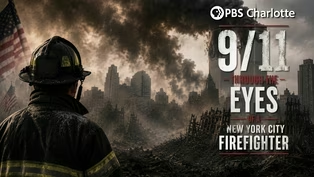
- Well, for so many of us, it's simply hard to believe it's been a quarter century since September 11th, not believing our eyes with what we were witnessing unfold on live television and the realization that America was under attack.
343 firefighters died that day, but since then, more than 400 have succumbed to 9/11 related illnesses.
David Forland has dealt with some of those very same illnesses, but he's fortunately still around to talk about it.
- I'm pounding.
- [Jason] It's a Sunday afternoon at the Forland house.
Danielle, Eric, and sons Remy and Jace, playing a game of how many times can we keep this inflatable ball in the air?
Grandpa Dave then inflates an even larger beach ball.
He and wife RuthAnn then join in on the fun.
Retirees, the Forlands moved to Charlotte from New York in 2013.
RuthAnn worked in real estate.
- I did that for 15 years.
- [Jason] Dave in public safety, first with the New York State Police.
- When I was in the state police, I ended up getting transferred down to the World Trade Center.
- [Jason] Where he worked on Governor Mario Cuomo's security detail, but starting a family, Dave jumped from the police force over to fire.
- I just felt like the fire department would be a better choice for my family.
- I actually liked the fact that he was a fireman and I wasn't really afraid of the safety issue of it.
(siren blares) - [Jason] With Dave working at Engine 307, Ladder 154 in Jackson Heights, Queens, RuthAnn would occasionally bring their three young kids to visit dad at work.
- It was just great.
Like at the Christmas party, they'd go to the firehouse and then sometimes maybe we would take a trip in there, if we were going in the city, we'd stop in.
- [Forland] My son, I would take him to the firehouse on occasion.
- [Jason] As a first responder, it wasn't just about fighting fires, it was dealing with just about everything.
- And some nights, we would have over 20 runs on a night tour.
I once had somebody who was delivering a baby on the toilet.
It's not a great call to be on.
- [Jason] But Dave loved the day-to-day of the firehouse, preparing meals together and bonding with the guys.
- [Forland] There's a lot of camaraderie and ribbing.
- [Jason] In early 2001, a side job brought him back to the World Trade Center.
- I was working with my brother-in-law and we were putting up smoke screens down in the subway.
- [Jason] But just a few months later.
- I saw the plane hit and I was like, "What?"
- I was listening to the radio at that point and they said, "Recalling all New York City firemen."
- Then Dave called me, says, "I'm heading back in."
I said, "I know."
I went up and I picked up the kids from school.
- [Jason] With the tragic events of the day unfolding and the Twin Towers ultimately collapsing, Dave and most of his firehouse spent the day on standby at Shea Stadium waiting their turn.
- The people from the kitchens and stuff like that, they started making hamburgers and stuff like that and feeding us.
And I kind of felt like I shouldn't be eating.
There's people underneath the concrete, waiting for us to be down there to help them get out.
But then I thought to myself, I was like, "Are they feeding us because this is our last meal, when we go down there?"
- [Jason] Making it down to ground zero on September 12th, Dave couldn't believe what he was actually seeing.
- It was just so quiet.
That was the thing I remember, it was just like eerily quiet.
- [Jason] He describes being on the pile as nothing but steel and rubble.
- Just searching for whatever we could find whatever we could dig with our hands basically and some tools.
I said to this cop, I said, "We could use some buckets, some five gallon buckets."
And that's when we started with the bucket brigade.
It was like 72 hours before I actually got a break, and that was when the president came down there.
- And the people who knocked these buildings down will hear all of us soon.
(people cheer and applaud) - I mean, he really inspired the firemen.
- [Jason] From there, it was 48 hours on, one day off, repeat over and over.
- I remember feeling like he was never home, and when he did come home, he went to sleep.
- I just took some pictures of what we had encountered.
We didn't feel like we could take any pictures of each other because we were not heroes, the heroes were dead, they were underneath the ground.
- And then after that, it was, the funerals that we had to go to.
And we had a friend from our church who passed away in 9/11 and he was expecting his first baby and his wife gave birth the day of his funeral.
- This is a medal that they gave us for responding on 9/11, but I don't wear any medals on my jacket because I don't feel like I need a medal for doing what I did.
- [Jason] But little did those at ground zero know then is that they were working at what can only be described as a toxic wasteland, the effects of which are still being felt all these years later.
- I remember coming down with rashes pretty much all over my body.
I have issues with breathing, sinuses, all of that.
Asthma, sinusitis, GERD, and then cancers, various cancers.
I've had like 10 operations related to my service, orthopedic operations, prostate, different things.
- And yes, he's had cancer three times and yes, it's been hard, it was a hard thing to walk through.
Shoot.
But you get through it, you just get through it.
Any way you can, you do.
- [Jason] Dave says he feels pretty good overall, and the medical care he receives from the fire department has been excellent.
And despite everything he and so many others went through, he says he would do it all over again.
- I mean, I would never shy away from going back and doing what I did, and I would say all my brothers in the fire service would say the same thing.
Well, this is the fire department patch.
- [Jason] In his home, Dave has tons of pictures and mementos from his nearly three decades with the New York City Fire Department.
- I'm glad that you asked me to do this because it gave me the opportunity to go through and get some of the stuff together that has been tucked away for a while because we don't want the story to die because it was a big sacrifice, many lives.
- [Jason] Today, three of four of Dave and RuthAnn's children are living in the Charlotte area.
The only one not here, son Josh, where after visiting his dad at the firehouse as a kid so many times is now following in his father's footsteps, working in the very same Jackson Heights Queens Fire Department his father once did.
They even gave Josh his dad's old locker.
- I'm very proud, I'm very proud of him.
When he came there and proved himself, then one of the commissars deeded it to him, which is kind of cool.
- I hope that one day he'll be able to hang up his precious photos in there too, you know?
- [Jason] Passing the torch from father to son, one generation to the next, and honoring the sacrifices of those that came before.
25 years is a long time, but will forever remain in the hearts of so many.
- It's hard to hear him talk about it because I remember my son was just a few months old at that time, and when I got to race and pick him up from daycare, from work, it just didn't seem real, but this is a man who lived it firsthand.
I'm so grateful he would share his story with us.
- Yeah, happy to share his story and just as he reiterated a couple times, he doesn't look at himself as a hero, he feels that it's his comrades who died that day, who are the real heroes, even though he's still dealing with some of the effects.
But there's actually a good amount of alumni, New York City Fire Department alumni in the Carolinas.
And David gave me one of these little coins here that they've been passing around.
On the one side, it talks about the, it mentions, you see the picture there, it just talks about the New York City firemen and the 343 guys who died that day.
And on the backside, it's got North and South Carolina.
They do things over at Romare Bearden Park They do a couple things at the... So New York alumni here in the Carolinas all get together for bonding and especially on 9/11.
- Thank you, Jason, for sharing it.
Can't believe it's been 25 years.
- No, nuts.
- Well, the wounds we carry aren't always visible, and the path to healing isn't always found in a doctor's office.
Here in Charlotte, art is being used in a different kind of prescription, one designed to connect people, combat loneliness, and improve wellbeing.
The idea has even caught the attention nationally of the PBS News Hour.
Our producer, Doug Stacker, shot the story the same day they were in town.
He takes us to the Bechtler Museum of Modern Art to see how creativity is becoming part of the healing process.
- I'm always so impressed by people's willingness to share their stories, to tell us really personal things.
I'm Diane Lincoln Estes, I'm a producer at the PBS News Hour.
(upbeat music) This is a particularly visual story.
Point your camera at the right place and just let this do the talking.
I think a lot of our viewers don't know much about what social prescriptions are, and so we were looking around and we saw that there's this program that's fairly new right here in Charlotte, North Carolina, using visual arts to help address some things that people are dealing with.
- So about a year and a half ago, we launched a program that we work with Novant Health and we work with individuals that are suffering from social isolation and loneliness, and they're literally referred to their prescribed art as medicine.
And instead of going to the pharmacy, they have their prescription filled, they come to the Bechtler and we create a series of programs for the visual arts.
They attend performances at Three Bone Theater in Charlotte Ballet, they create sculpture at Playworks, all the while discussing the arts, experiencing it with other people that they don't know, and in the end, forming friendships and removing some of the social isolation that they are feeling.
- My name is Alisha Bigby, I live in historic Belmont neighborhood here in Charlotte.
Back in 2024, just within three weeks, I wound up losing both parents and two older brothers.
They passed away just abruptly, all within that short time period, and I just basically disassociated with everything.
I lost my voice.
My therapist felt like this was another way to express myself and that I could probably get some wonderful benefits from the Art on Prescription program.
- Well, the feedback has been remarkable.
People have really seen a dramatic increase in their connection.
There've also been a variety of people in the program.
We have almost 100 people in the program ranging in age from in their 20s well into their 70s, and it's just a way for people across all the spectrum to come together.
- [Alisha] It allowed me the permission that I can feel.
I don't have to feel embarrassed about how I feel whenever I see art.
I know that the artists were feeling whatever they felt whenever they created it.
So sometimes, you don't always have to have your voice whenever you are expressing your emotions.
- We saw a strong need in the community to combat loneliness, but we also saw something important for the arts to celebrate, and that is what brings us together as humans, and that is the creative process.
(gentle music) - I think what drives so many people that we talk to is that they really wanna help other people.
They want other people who are maybe watching or listening or reading online, they want them to know that they're not alone and that there are these universal things that we're all dealing with.
What really brings it to life are people like Alisha.
- So whenever I look at that painting, it just really makes me think about my mom.
I just get this smile on my face.
She collected paintings of African American Union soldiers.
And so as soon as I came here and I saw that painting, I just really thought, look, that's Maddie Mae right there.
With the Art on Prescription program, I'm with other people, and other people are interpreting whatever they're interpreting at that particular moment, and they're also feeling vulnerable and okay with saying, "It's okay for me to also feel whatever I'm feeling right now, and I don't have to pretend, it's okay."
- Thanks so much, Doug.
To be accepted into the program, a participant must be referred by a Novant Healthcare professional.
80% of participants have seen success in how they deal with social isolation and loneliness.
Art can create connection and so can a meal shared across generations.
One local restaurant has been serving up much more than chicken and ribs.
Its story is woven into local Black history, the Green Book, and generations of one family.
It's an original.
Carolina Impact's Heather Burgiss and videographer Doug Stacker take us inside the original Chicken n' Ribs.
- [Heather] On Beatties Ford Road in Charlotte, the fries stay busy.
Orders move quickly and familiar faces keep coming through the door at the original Chicken n' Ribs.
- It's a family thing, it's a family thing.
- [Heather] The story of this small restaurant across from the historic Washington Heights neighborhood reaches far beyond what's on the plate.
For more than six decades, people have come here hungry for chicken wings, hot dogs, barbecue, and most importantly, community.
Because it's like you all were one of the originals.
- Yes, you can try to, but you can't tell it without us.
- For owner Jermaine Blackman, that story begins with his grandfather Otis and Grandmother Lucinda, who owned a restaurant that would become part of both his family's story and Charlotte's Black history.
- Yeah, Green-Book is a big deal.
Like we say we didn't know we was being part of history and I'm happy and glad to be a part of it and I'm proud.
The Green-Book is just a African American travel guide.
It's a Google where we could travel safe, eat safe, haircuts, sleep, fuel, lodging, place to club, where we can go out and enjoy our nightlife.
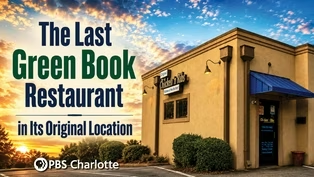
- [Heather] Chicken n' Ribs appeared in the Green-Book through 1963 to 1967, one of dozens of Mecklenburg County businesses listed as places Black travelers could safely stop during segregation.
- We're the last one that's still in the same family, same location, same name, we're the last one.
- Jermaine's mother, Dolores Lois Miller, became part of the story long before she became part of the family.
She was just a teenager when she started showing up for work.
- We live right where Villaville School used to be on the cone, so I just... We just started working.
I would walk up here and sit on the crate and wait on somebody to come to open up, and it just started from that.
At that period of time, we had a curb service where people, the girls would go out, hop curbs, and we had a delivery service, and people came in to order.
- [Heather] Eventually, the girl waiting on customers would marry the owner's son, her high school sweetheart, Jermaine's father, and all these years later, Lois is still showing up.
- Yeah, she gets here at six o'clock every day.
When I say every day, every day.
Yeah, that's my heart, man, she's real special to me.
- [Heather] And around here, family is how the restaurant runs.
Mom, brother, sister, and cousins coming together to make sure every order happens.
- The family part is the most important part.
For us to lean on each other, have the same goals, going the same direction.
This is my right-hand man right here, this is my cousin Edward, I couldn't do it without him.
- [Heather] And after all these years, much of the food is still made the same way, by hand, from scratch, and only after somebody orders it.
- [Jermaine] We cut our own greens, we make our own coleslaw.
We have our secret seasoning for our chicken.
- [Heather] And then there's the sought after, and somewhat notorious specialty.
- It's called a fat boy, and basically it just makes you fat.
And originally, my grandfather started it, and he just put everything he had on it.
It came with lettuce, tomato, chili, slaw, tartar sauce, ketchup, and mustard.
On a busy Friday night, which is our busiest night, it's about 30 minutes sometimes but they wait, no complaint.
- [Heather] Because they know it's going to be good.
- [Jermaine] Yep.
- [Heather] Forget the wait, you better believe some customers are willing to even travel a lot farther than 30 minutes for their food.
- I used to live in this neighborhood about 26 years ago, and now we live in Kannapolis, which is like an hour away, but the chicken wings, they keep bringing you back.
And that good old lemonade and all this, everything will bring you back.
You never forget your roots.
- I like the hot dog, I like pork chop, and I like barbecue.
And chicken wings, and I got to go.
(laughs) - Yeah, it's still a special place for a lot of people around here.
People remember from me from growing up to now.
It's really touching to see a lot of my seniors, I mean, 80-year-old seniors that still come and still remember, still remember my grandfather, my dad, my mom.
- [Heather] And just outside the restaurant, a beautiful reminder of his family's legacy, including Jermaine's grandfather, grandmother, and people whose stories belong to the whole neighborhood.
- Like see on the mural, you'll see my grandmother out there as well.
She just passed three years ago.
We thought she was 100, but we found out that she was 103.
Mr.
Bullock is on the right.
He was the photographer for all the family portraits and things like that.
Those are our roots right there.
I just, 30, 40 years from now, still going, still having an impact on the community that we do.
I just want us to still have that same kind of footprint in the community.
- [Heather] And that footprint runs deep through one family, one neighborhood, and generations of Charlotte's history.
For Carolina Impact, I'm Heather Burgiss.
- Thank you so much, Heather.
The original Chicken n' Ribs family recipe still wins fans.
The restaurant's legacy takes to the streets with its new Hustling Hen food truck, which took home a 2026 Best of Taste Award at the Taste of Charlotte for its fried chicken.
And that just sounds really good right now, making me hungry.
Rounding out tonight's show, that family built a legacy across generations.
Now, young people are building skills that could shape their futures.
For a lot of kids, middle school is when they start figuring out what they're good at, and sometimes, all it takes is getting a chance to try something they've never done before.
Carolina Impact's Chris Clark shows us how in Huntersville, a summer program gave students that chance while also opening their eyes to careers they may not have considered.
- [Chris] For a lot of kids, summer camp means a pool, a ball field, and maybe a little sunscreen.
Here in Huntersville, it means safety glasses, power tools, and a quick lesson in just how heavy wet concrete can be.
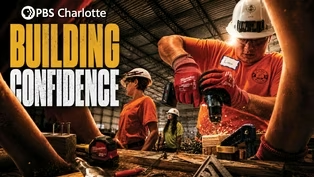
24 middle schoolers spent a week at Camp Build, learning construction one project at a time.
And for some, just getting through the door was the first project.
- I didn't really wanna go to it because only thing I like building is like Legos, so I didn't think I would enjoy this camp.
But then like when I got here and we started doing the activities, it was really fun.
- [Chris] Concrete was the first thing to win Nixon over.
Serenity came in facing a different hurdle.
Before camp, she barely used more than a drill.
- I'm a little nervous about everything because I'm in a new environment and I'm meeting new people.
- [Chris] Around here, nerves are almost part of the curriculum.
- The biggest thing we see right off the get-go is just the social anxiety, the apprehension of doing something they've never done before.
- [Chris] And the quickest way past that fear is simple: Pick up the tool.
Monday, they mix, pour and finish concrete.
Then plumbing turns pipes and fittings into something no textbook could compete with: Marshmallow launchers.
- Very cool.
Getting to play like basically marshmallow and dodgeball.
- [Chris] After that, the serious stuff starts flying.
Drills, saws, wiring, carpentry, a new skill every day, and another chance to find out what fits.
- We're looking to reshape the culture around trade skills.
You have to start young.
- [Chris] Apparently, plenty of kids are ready to start.
Organizers say 160 applied for just 24 spots.
And somewhere between the first cut and the next project, something changes.
The nervous kids who walked in start disappearing.
- We make them put their cell phones in little bags and zip them up and they put them in a bin in front of the classroom.
Usually by the end of the day, Wednesday, they forget to take their cell phones home.
- [Chris] Middle schoolers forgetting their phones might be the best review a summer camp can get.
For Serenity, this was the moment the week really clicked.
- When we were using wires, we started twisting the wires together.
- [Chris] By the end of the week, she wasn't just more comfortable, she found her lane.
- I like drills, I like saws.
I know that's two different things from electricians, but that's what I prefer.
- [Chris] No one is asking Nixon to map out his future in middle school, but after this week, the map has at least one more road on it.
- I would say it's like a new opportunity for later in life, so you have like different options.
- [Chris] And even if construction never becomes the job, knowing how to build, fix, and figure things out is something they can carry long after camp ends.
- When we think about how AI is impacting the workforce, I don't think this is the kind of thing that's gonna go away.
And so whether or not he goes to college, having this skillset is something that he's, I think, going to be very benefited from.
- [Chris] For Troy, the payoff isn't measured in perfect cuts or straight lines.
It's the moment a kid realizes, "I made that."
- Usually by Wednesday or Thursday, they are grinning from ear to ear.
It's the pride of when their parents pick them up and they say, "Hey, Mr.
Troy, can we take him back and show him what we built today?"
"Absolutely."
Just seeing them exude that pride that they have makes me extremely proud and makes me think, "You know what?
This may actually, we may actually be making a difference."
- Serenity.
(students applaud) - [Chris] By Friday, every camper made it to graduation.
One by one, all 24 are called to the front, but the biggest surprise is still waiting.
Every camper graduates with a toolbox, containing more than a thousand dollars worth of equipment.
Not toys, the real thing.
- A 12 volt impact and a 12 volt drill driver with everything on the apprentice tool list.
- [Chris] And Troy makes one thing very clear.
- These are not your dad's, they're not your mom's, they're not your brother's or sister's, these are yours.
And if you take care of your tools, your tools will take care of you.
- [Chris] Nixon came in thinking Legos might be about as far as he wanted to take this.
A week later, he's leaving with projects he built himself, a few more possibilities for whatever comes next, and a toolbox of his own.
- I'm thankful so I don't have to use my dad's tools.
- [Chris] Dad apparently heard that less as a promise and more as an opportunity.
- I haven't peeked into it yet, but things might disappear.
- [Chris] They came here to learn what they could build with a toolbox.
A week later, they leave knowing a little more about what they can build with their own two hands.
For Carolina Impact, I'm Chris Clark.
- Oh my gosh, I think it's awesome that those kids got to take home a thousand dollars worth of tools.
Thank you so much for sharing their story, Chris.
Organizers say that early exposure matters, especially as the demand for skilled workers continues to grow.
Their hope is that even if these kids don't choose careers in the trades, they leave knowing they're capable of so much more than they thought possible.
Well, do you know someone or something that deserves the spotlight?
We would love to hear about it.
Email us your story ideas at stories@wtvi.org.
Well, that's all the time we have this evening.
We always appreciate your time, and I look forward to seeing you back here again next time on Carolina Impact.
Goodnight, my friends.
(upbeat music) - [Narrator] A production of PBS Charlotte.
(upbeat music)
9/11 Through the Eyes of a New York City Firefighter | Carolina Impact
Video has Closed Captions
Clip: S14 Ep1401 | 9m 43s | A New York Firefighter shares his story of working after the terrorist attacks of 9-11-01 (9m 43s)
Building Confidence | Carolina Impact
Video has Closed Captions
Clip: S14 Ep1401 | 5m 13s | Middle schoolers build trade skills, confidence and new possibilities at Camp Build. (5m 13s)
The Green Book Restaurant Still Serving Charlotte After 60 Years | Carolina Impact
Video has Closed Captions
Clip: S14 Ep1401 | 5m 46s | A Charlotte family keeps history, flavor and legacy alive at The Original Chicken & Ribs. (5m 46s)
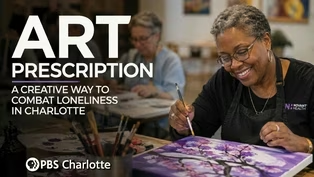
How Art Is Helping Charlotte Fight Loneliness | Carolina Impact
Video has Closed Captions
Clip: S14 Ep1401 | 4m 31s | A Charlotte art program uses creativity and connection to help combat loneliness. (4m 31s)
Providing Support for PBS.org
Learn Moreabout PBS online sponsorship New Episode
- News and Public Affairs

Top journalists deliver compelling original analysis of the hour's headlines.

- News and Public Affairs

FRONTLINE is investigative journalism that questions, explains and changes our world.
 New Season
 New Episode
 New Episode
 New Episode

 New Episode


 New Episode
Support for PBS provided by:
Carolina Impact is a local public television program presented by PBS Charlotte