Settling In
Settling In: Immigrants & Cultures That Built Mid-Michigan
Special | 1h 27m 49sVideo has Closed Captions
Examine how different ancestral groups shaped Mid-Michigan.
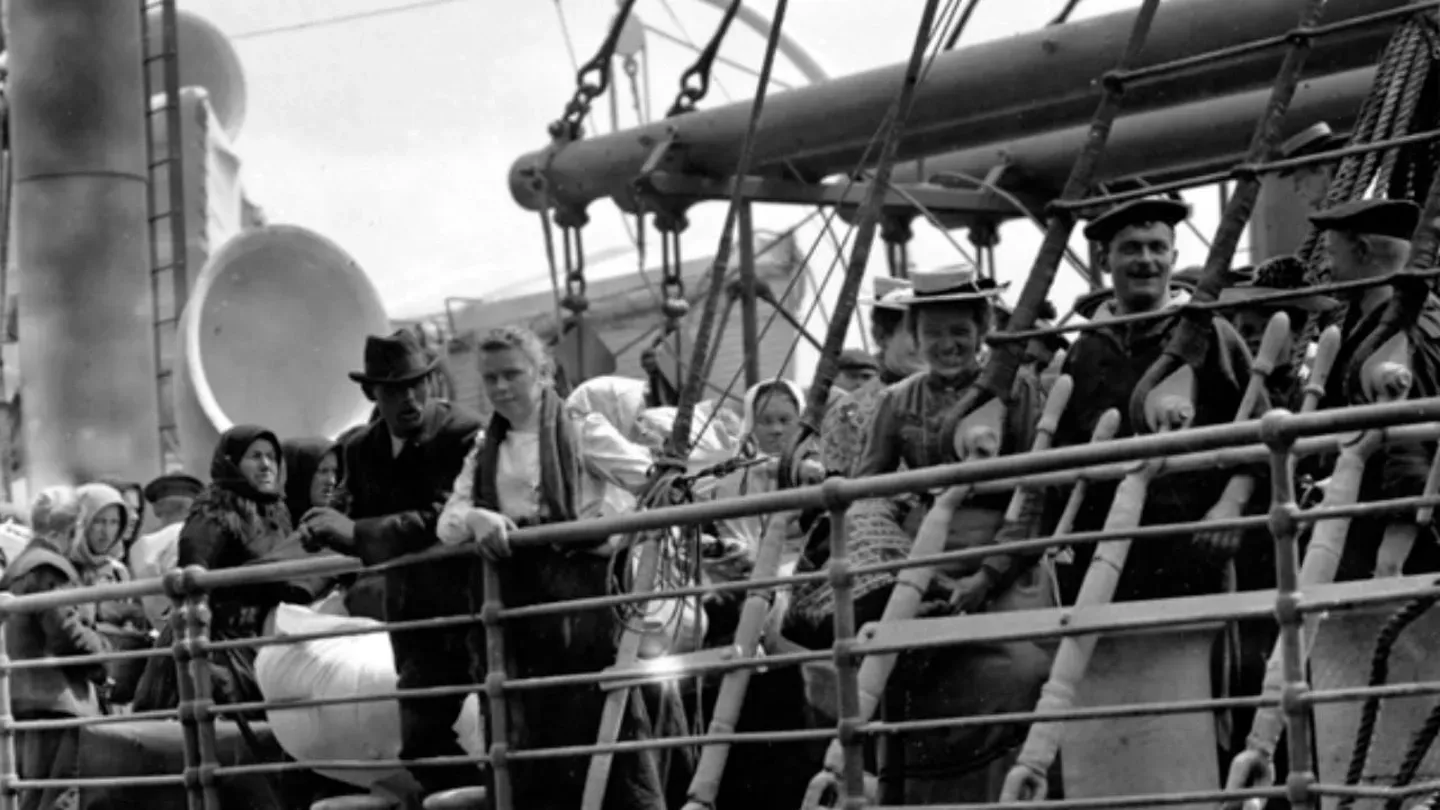
The Great Lakes Bay Region is home to many diverse ethnic groups. How did they all get here? What challenges did they face? How has each group affected the area? Settling In: Immigrants & Cultures That Built Mid-Michigan immerses its audience into the various cultures of our region, revealing the answers to these questions and exploring how Michigan's diverse cultural landscape will continue.
Problems playing video? | Closed Captioning Feedback
Problems playing video? | Closed Captioning Feedback
Settling In is a local public television program presented by Delta Public Media
Settling In
Settling In: Immigrants & Cultures That Built Mid-Michigan
Special | 1h 27m 49sVideo has Closed Captions
The Great Lakes Bay Region is home to many diverse ethnic groups. How did they all get here? What challenges did they face? How has each group affected the area? Settling In: Immigrants & Cultures That Built Mid-Michigan immerses its audience into the various cultures of our region, revealing the answers to these questions and exploring how Michigan's diverse cultural landscape will continue.
Problems playing video? | Closed Captioning Feedback
Where to Watch Settling In
Settling In is available to stream on pbs.org and the PBS app.
Local production seen on Delta College Public Media are made possible with support from viewers like you.
Thank you.
Since Michigan's establishment in 1837, the state has seen a rich and diverse heritage of people from many different ethnicities, nationalities and cultures.
The frontiers of Michigan beckoned immigrants to start a new life, to cultivate the land, to establish cities and towns, and to develop business and industry.
They struggled and prospered with the strength of hard work, perseverance, and conviction.
Their impact on their communities has been immeasurable, and their contributions continue to shape Michigan's culture and identity.
Before the first European explorers set foot in Mid-Michigan, there were the first peoples.
Over 10,000 years ago, the Anishinaabe, a nation of native inhabitants with the same language group, lived along the Atlantic seaboard from present day Nova Scotia to the Carolinas.
They migrated west to the Great Lakes and settled in the region around 900 AD.
The descendants of the Anishinaabe people were here to observe the arrival of the Europeans to Mid-Michigan.
The Anishinaabe established the Three Fires, three tribal groups that included the Ojibway or Chippewa, the Odawa or Ottawa, and the Potawatomi.
In September 1819, Lewis Cass, the governor of the Michigan Territory, negotiated a treaty which required the Ojibwe, Ottawa, and Potawatomi tribes to relinquish more than 6 million acres of Michigan land to the United States.
The contract became known as the Treaty of Saginaw.
This massive tract of land extended to the southwest near Kalamazoo and northeast to Alpena.
The Thunder Bay River marks the northern boundary, which extended east to Lake Huron.
Our ancestors knew that a wave of change was upon us, and with that wave of change would be thousands of people coming into our national territory.
And with that would be a change of life for us.
And so negotiating through the treaty of 1819 was really understanding that this wasn't going to stop, no matter if we resisted, kept saying, no, we don't want this.
So therefore, how can we reserve as much of our way of life?
Still see that our needs are being met and thinking of the future of our people?
For 6 million acres of land, the Ojibway were paid $3,000 in silver coins and an annuity of $1,000 to be paid annually forever.
The payment, however, was stopped by 1864.
In a series of treaties between 1819 and 1864.
The Ojibwa ceded all of their land to the federal government, with the exception of present day reservations.
The land that was made available by the Treaty of Saginaw opened the door for early settlers to begin the development of the Mid-Michigan frontier.
Frenchmen and French speaking Canadians from Quebec were the first descendants of European settlers to explore Mid-Michigan.
They were fur traders and were later employed in the fishing and lumber industries.
The first wave of French Canadians came to Michigan between 1660 and 1796, when the U.S.
established a government in Michigan in 1796.
French Canadians made up roughly 80% of the European-American population.
Canada was primarily French at the time and of course, the Canadian fur trade, and this was the logical place to move.
As those resources became depleted in Canada, they moved into this area.
And of course, they then helped create the first economy in this area, which was the fur trade.
Brothers Joseph & Mader Trombley were considered the first definitive settlers of Bay city.
In 1832, they purchased a 312 acre tract of land along the Saginaw River with an idea and hope of developing the area.
Leon Trombley was the first Trombley to come into the area, but he didn't stay very long.
His nephews Mader and Joseph, on the other hand, did come here with the intention of staying.
They brought cattle with them.
They built a house in 1839 on the 24th, and water that was to be a permanent residence and a fur trade home.
But ultimately they did more land speculating than they did fur trading, as they bought a parcel of property, and they ended up selling those parcels of property off to other people, which became basically created the community Built around 1839... the Trombley home is regarded as one of the oldest standing frame houses in Bay city.
Originally located on 24th and Water Streets, the house was relocated to Veterans Park in 1981.
Shortly after the relocation in 1982.
Archeologist name Earl Crawl went in and actually did a community wide dig, on the site, the original site, and contrary to what the popular belief that it was a fur trade hub, he didn't find anything really related to the fur trade.
And you would expect to find certain things.
And they weren't there.
What they did find was a lot of inexpensive china that would lead someone to believe that it was more of a boardinghouse than anything else.
And the Trombley brothers only lived there for about five years before they sold the house to James and Owen McCormick, who actually used it as a boardinghouse after that.
So that archeological dig really changed the way that we look at the history of the house.
In many early Bay City, settlers established ethnic neighborhoods which attracted others of their own kind.
The village of banks is the oldest west side settlement in Bay city, platted and promoted by Joseph Trombley.
It was settled by French fishermen.
A thriving French community was developed and maintained.
The French also settled in an area north of Woodside Avenue called Frenchtown.
By the 1880s, almost 90% of the population living along both shores near the mouth of the Saginaw River spoke Canadian French.
The French were drawn to those areas where the natural resources were such that they could make a living.
And obviously, at the mouth of the river you have fishing in the bay, and they could make a living off of fishing.
And that was actually one of those occupations they were drawn to.
They also were closer to the woods so they could go into the woods.
And their prowess with an ax and a saw was legendary, you know.
French-Canadian was considered the true chanty boy, or a true lumberjack as we know them today.
Beginning in 1845, German Lutherans came to settle Mid-Michigan from Franconia in the Kingdom of Bavaria, in what is now modern day Germany.
Under the guidance and leadership of Reverend Wilhelm Lohe for German Franconian missionary colonies were established in the Mid-Michigan area.
The Colony of Frankenmuth, meaning the courage of the Franconian, was the first of these.
In 1845, Pastor August Kramer arrived in Saginaw County with the first group of German settlers looking for religious and political freedoms.
They built Saint Lorentz Evangelical Lutheran Church, which became the center of the community.
Franconian settlers then established Frankentrost, which translates to Franconian Trust in God.
In 1847, Frankenlust, which means Franconian Joy of life, was founded in 1848, in Bay County and Frankenhilf, now known as Richville, was established in 1851.
The name translates to God's help to the Franconian, as the first four colonies had the support of the church behind them, and that helped with the travel expenses and with getting started.
At first, closer gave them a psychological support that most emigrants coming to America with by themselves did not have.
Establishing a new life in the Saginaw Marsh lands and wilderness was a difficult and laborious process for early immigrants.
In 1851, Friedrich Karl, who gave his name to coach Bill Township, wrote An Immigrants Guide and he estimated that you would need $400 in their money at that time in order to get through that first year.
In 1848, under the leadership of Reverend Ferdinand Sievers, German settlers of the Frankenlust colony established Saint Paul Lutheran Church in Bay city.
It is one of the oldest churches in Bay County.
The 16 colonists or immigrants that came from Germany, of whom Johann George Helmrich, right, m great great grandfather was one, traveled from Germany to New York, then from New York.
They traveled to eventually Detroit.
From Detroit,a few of them walked up toward the Bridgeport Frankenmuth area, and then the rest of them traveled by boat up Detroit River, Lake Saint Clair, Lake Huron, and through the Saginaw Bay and Saginaw River.
The 13 founding families came by way of Awakening Creek to disembark along the marshlands near the area of what is now M 84.
The first night on their new land was spent under the stars on July 4th, 1848.
There was nothing there.
They had to start from scratch.
They had to clear the land they had to build.
And it's unbelievable to me.
The strength they had, the inner strength they had, and the resilience to do all that work day after day to battle the elements, the cold, the heat, whatever.
Throughout that first year, even to survive, it was unbelievable how strong they were.
By the 1890s and early 1900s, German Americans were the largest immigrant group living in Michigan and in the United States.
The growth of the Franconian colonies was due to chain migration.
Immigrant families wrote letters back to the home country encouraging others to follow them.
Frankenmuth served as the starting point from which significant numbers of German immigrants reached East Saginaw and formed a new Germania there.
One cannot underestimate the importance of a support network in establishing oneself in a new community for the German community.
There were churches, but there were also separate clubs and organizations.
The Germania started in the 1850s, which was organization with the largest German language library in the state of Michigan.
There also was a German Workingmen's Society.
The Arbeiter interest rates and good for Rhine.
All of these formed a support network that could help establish new immigrants into the community, and also help their children and their children's children really take leadership roles within the community of East Saginaw.
Many of German heritage in the Great Lakes Bay area can trace their roots back to those German ancestors who settled Mid-Michigan and helped grow the Franconian communities.
By thesecond generation in Frankenmuth, they were running out of farmland again, and they had to look further afield to send their children off and get their own starts.
Also, Frankenmuth is a city of 4000.
People would have thought when there was only 13 that we would grow to be this great considering.
During the late 19th century, Polish refugees sought to escape Prussia and the civil unrest within its borders and look to the freedoms of America.
New Polish immigrants who settled in Bay city formed a church community in 1874 under the patron saint, Stanislaus Kostka of Poland.
About 200 Polish families formed an ethnic enclave in the South End.
Many worked in the sugar beet fields and lumber mills.
Saint Stanislaus Parish is the heart and soul of the Polish people in the south end of Bay city.
There were so many Polish people living in that area that we just we stuck together and we wanted to keep our heritage.
The congregation quickly outgrew their original wooden church building, and by 1890, parishioners planned for a new edifice.
By 1892, a grand new church was completed, showcasing beautiful Gothic style architecture.
A dedication was held on July 17th, 1892, which included a street parade and much fanfare.
Roughly 7000 people were there.
Similar to the early Germans of the Franconian colonies.
The poles gathered together to live in the south end of Bay city, within a few blocks of Saint stands parish there.
Religious and community center.
My grandparents spoke just Polish and we had to make sure that we learned Polish.
The neighborhood was of all Polish descent, so I don't remember any other nationality that lived near us.
Polish neighborhoods in the south end of Bay city harken back to a time when life was simple and large.
Families lived within several blocks of one another.
In my mom's family, there were five siblings.
They lived with maybe three blocks of each other, but the neighborhood had about 30 children, and everyone watched each other and it was very close.
And we done things together.
They knew each other and it seemed it was a much happier time.
By 1900, Bay city had the largest concentration of poles outside of Detroit.
Many of Polish descent still reside in the area, and the celebration of Polish culture continues to this day.
Established in 1872, Saint Joseph Catholic Church in Saginaw, also called the Rainbow Parish, is known for its diverse community of parishioners.
The church first served early Irish immigrants who settled in the area of Saginaw, known as the first Ward.
As the Irish began to move into other parts of the city, the black and Mexican-American population slowly increased in Saginaw, with many settling in the first Ward.
Saint Joseph has thus evolved into the new home, parish, and community center for a predominantly Latino and African-American congregation from the surrounding neighborhoods.
Sometimes geography and looking at a map tells us an awful lot about the history of the neighborhood in the people who lived there.
In the case of the first Ward, it's an area hemmed in by marshes, the river, of which, of course means there would be sawmills and the railroad tracks.
It was perhaps not the most desirable place to build a house, but it was a place that were available for people who worked in the factory where they could either rent or build a home.
And it really became a neighborhood.
The diverse congregation is representative of the changing community as neighborhoods evolve through the years.
The first Ward neighborhood has been one of fluidity and change.
Saint Joseph Parish has been a constant, reflecting the changing dynamics and ethnicity of the community and adjusting accordingly.
By the 1850s, the lumber industry was expanding quickly.
Pine lumber was an essential building material for the construction of a growing nation.
As the country looked to Michigan for its abundance of wood resources, the Saginaw Valley was the heart of the logging and lumbering activity.
Many job seekers were attracted to the opportunities found in promising new lumber towns.
The industry also drew immigrants from diverse ethnic groups who journeyed to Mid-Michigan looking for employment in the felling of the white pine.
By the late 1880s, 71% of the immigrant population in Bay city were either French, Canadian, German, or Polish, or a smattering of other ethnicities thrown in.
Yes, there were language barriers, obviously.
However, I think a lot of them were drawn to specific sawmills or specific places of employment where a common language was spoken.
So it might have had a one that was primarily French.
You may have had one that was primarily Polish, at least at first.
Later, I think it diversified a bit more from, from what I've read that.
But it really what it boils down to is if you could do your job and there was a common language of the the professions, so to speak.
And in the 1860s and 70s, many Canadians, French Canadians and Germans found work in the sawmills of the Saginaw Valley.
Immigrants who arrived later from Scandinavia, Poland, Ireland and Scotland also gained employment as mill workers and loggers, or chanty boys, as they were known.
The workforce in Saginaw was perhaps less diverse than that in Bay County.
It was predominantly German and French Canadian, and for many, English was not their first language, maybe even not their second language or in the lumber mills.
This was really a time when people were exposed to other people, and it was part of their entrance into the new communities that were being formed.
A steady labor force was difficult to sustain.
Lumber work was seasonal, as well as work in the sawmills, which lasted only six months of the year.
Working in the sawmill was a hard life.
The common laborer would have a 12 hour work day, 15 minute break in the morning, 15 minute break in the afternoon where they would sharpen the saws half an hour for lunch.
Oh, they did that all for about $1.31 a day.
That really wasn't enough to make a family living.
So the rest of the family would have to chip in.
For instance, the wife might have to take in laundry or work as a domestic, and that was what they had to do to survive.
An interesting thing about the Germans who come over to the Saginaw Valley region to work in the lumbering industry, is that they were actively recruited by the state of Michigan.
The state had a recruitment ambassador, so to say, and he would go over to the East Coast and see the immigrants who were coming in off the ships to kind of handpick who might want to come work in Michigan.
And then he also sent out pamphlets.
And so the pamphlets were written in German, and they talked about the wonders of the Saginaw County region.
In 1870, Saginaw, an immigrant population, made up about 40% of the city's residents.
Of that immigrant population, 42% were Canadian, mostly French speaking.
39% of immigrants were German.
Saginaw became home to the largest concentration of Germans in the state outside of Detroit.
10% of the immigrant population were from Great Britain and Ireland.
Polish and Scottish immigrants made up 3% of the lumber workforce, and African-Americans made up less than 1%.
One of the most difficult things for the immigrants was how do you settle into the new area?
And so one thing that they would do is to try to bring over those previous traditions, the Germans they brought with them, then their breweries and their bakeries and their furniture making.
And the French were great hoteliers, and they brought over a brick laying in brick making.
And they really gave the basis that for Saginaw.
By the 1880s, the two Saginaw cities experienced phenomenal growth due to the lumber boom.
At the beginning of the decade, the population of the cities was over 24,500.
By 1884, the Michigan census recorded a population of nearly 43,000.
In the two Saginaw immigrants not only provided the workforce needed for the sawmills and lumber camps, they were the driving force, the entrepreneurs and their reinvestment in their community really are what made Saginaw thrive.
The Saginaw, I should say, were to become Michigan's third largest city, and it was the of and reinvestment in the community by immigrants that made it that.
Thomas Merrill, son of a main lumbering family, began a number of logging companies in Michigan in the 1860s.
In 1886, he employed his son in law, Clerk Ring, and formed the Merrill and Ring Lumber Company, headquartered in Saginaw.
Later, after the death of his wife, ring employed African-American Weston Nash and his family in 1921 to become household service staff.
My grandfather was Western Montgomery Nash.
He was and his family were.
They were the firstservice staff for the basically the blue bloods of Saginaw of that time.
Everyone back before that time was probably either German, Irish or even Asian, but they were the first black waitstaff for a major, major lumber baron in Saginaw.
Well, my grandfather and my grandmother were very close to Mr.
Ring because Mr.
Ring was widowed and all of his children were out of the house, so he left.My grandfather and grandmother basically have the run of the house, and they weren't segregated into the white areas.
Only they could go to the library.
They could go to the dining room.
They could, you know, run around the.
He even had a little swimming pool that my father and my aunt actually played with, with the neighbor kids.
So it was not a it was not a role of them just being his help.
They were like his adopted family in a way.
And actually, the ring family helped my grandfather secure a home on Saginaw, a segregated West Side, in about 1937.
So they they helped my family as much as they could.
And actually, it I Mr.
ring actually did leave some money from my father to go to college.
In 1946, Clarke Ring's home was donated to the City of Saginaw to be used as the Saginaw Art Museum.
The home is considered the grandest piece of the museum's permanent collection.
It's still a resident of Saginaw.
When I drive by the museum, I still think about my family being connected to the museum.
And I really I'm I'm very proud that they were.
And actually, a few years ago, I actually got to go to an upstairs part of the museum where my father's bedroom was and actually got to go into the bedroom that he, you know, lived in for 12 years or had for 12 years.
And his bedroom overlooked the fantastic gardens that that the rings had.
By 1870, the foundation of a growing black community began to take shape in Saginaw.
The census of that year records 270 citizens of African descent living in East Saginaw and Saginaw City.
Of that figure, nearly 50% of black settlers listed their place of birth as Michigan or Canada.
The frequent listing of Canada as a place of origin is a testament to the success of the Underground Railroad, and the number of former slaves given refuge north of the border.
As the Saginaw has thrived during the great lumbering boom.
African-Americans were drawn to Saginaw with the opportunities to work in the sawmills, but also possibilities for entrepreneurship to open the wrong businesses or to work in other businesses in the community.
No immigrant or person of color during this time period, however, found as much success as that of African-American lumber baron William Q Atwood.
William Atwood was an ex-slave born in Wilcox County, Alabama in 1839.
He settled in East Saginaw in 1861 and found work as a timber cruiser.
In time, he invested in timberland and with his acute business sense, expanded his timber holdings in a true rags to riches story.
Atwood opened his own successful sawmill along the Saginaw River in 1874, and became one of the richest men of any race in the area, with a net worth totaling more than $100,000.
William Q. Atwood was a man of profound accomplishment, and his accomplishments are made all the more remarkable when one considers the racial prejudice and boundaries which he had to overcome to become both a successful businessman and community leader.
With a mansion on South Jefferson Avenue in Saginaw.
Like William Atwood, the Goodridge brothers of Saginaw were prominent black pioneers in the photography business.
Wallace and William Goodrich arrived in East Saginaw in 1862 from Pennsylvania.
They opened a studio in East Saginaw and achieved success capturing images of the life and activity of logging camps, lumbermen, and chanty boys.
After the lumber era, the brothers maintained their photography business by turning their camera lenses to capture Saginaw.
Its society, people, and industries.
Recognized as the oldest black photographers in Michigan.
Their work spanned over a half century.
The Goodridgebrothers have given us a unique gift a window into the past.
It is one which for which we are truly grateful, and it's one that few other communities have.
Their photographs document Sagin During.
and after both World Wars, Michigan continued to see growth in the black population.
The Great Migration began in approximately 1915 and stretched to about 1930.
Then that 15 year period, we see approximately 2 million African-Americans migrating from the south to the north.
The large influx of black migrants into cities like Detroit, Flint, and Saginaw contributed enormously to the region's urban and industrial growth.
When it comes to explanations for the Great Migration, we talk often in terms of push and pull factors.
So factors that would push were motivate, mobilize African-Americans to leave the South, but then pull factors that would motivate or mobilize African-Americans to come to the North.
In the South, we see push factors that would include mechanization of agricultural labor that would displace workers.
We would see Jim Crow segregation, racial oppression, violence, inequality, injustice, brutality, lynching.
All these factors helped motivate African-Americans or pushed African-Americans out of the South.
On the other hand, we see in the North.
Additional factors such as immigration restrictions during the First World War, immigration restrictions in 1921, in 1924 that again create a labor shortage in these urban northern industrial centers.
And they seek out, new workers.
And they find these workers among African-Americans in the South.
But then we see a new migration, in the 1940s, in which approximately 1.5 million African-Americans again moved from the South to the north.
And this continued through the 1950s, when we see about another 2 million African-Americans in the 1950s moving from the South to the north.
Agriculture developed in parallel with the booming lumber industry.
However, the decline and eventual collapse of lumber in the late 1800s helped bring about the birth and success of the sugar beet industry in the Saginaw Valley.
After loggers cleared pine forest, the land was unusable due to the vast number of tree stumps left behind.
State and local leaders needed to replace the lost jobs and money generated by the now departing lumber barons.
Following the success of sugar beet farming in Germany.
Farm testing began in Michigan in 1884, when 1,500 pounds of seeds were distributed to farmers across the state.
The results showed that three crops of beets, grown in three successive years were worth as much as one crop of pine trees, which required 100 years to mature.
Stump lands were suddenly brought back into productivity, as farmers were now encouraged to clear the stumps and better utilize their valuable acreage.
The sugar beet became a primary cash crop for many immigrant families.
The sugar beet fields and sugar production are certainly an important post lumbering chapter of the valley's rebound from lumbering.
However, farming was not new.
Concurrent with Saigon, its great lumber boom was the development of farms throughout the region.
A classic immigrant story was working in the lumber camp, saving enough money to buy your own farm and to permanently settle into the Saginaw Valley.
In fact, one side of my family that is their story.
A consortium of German farmers living in Mid-Michigan formed the German-American Farmers Cooperative and built their first factory in Bay city.
The German American Sugar Company began operations in October 1901.
It would eventually become the Monitor Sugar Company.
The German-American cooperative was comprised of roughly 400 farmers from what is now the Salzburg area of Bay city.
It was formed with an initial investment of $300,000.
All profits would be reserved exclusively for co-op farmers, and company stock could only be owned by beet growers.
The sugar beet was the perfect crop to introduce to the state of Michigan our growing season and the proper soil.
And there were multi generations of immigrant families that had this crop that they could now rely on.
And of course everybody wants sugar.
It's something that's in almost everything that we eat.
And it's an industry that even to this day thrives.
As thesugar beet was an important crop to early German farmers.
So too did it play a role in the migration of Mexicans to the Mid-Michigan area.
Mexican American migrant workers from the southwest were recruited by sugar companies in Michigan, and were given contracts to work in the sugar beet fields of the Saginaw Valley and the thumb.
In 1949, the Michigan Sugar Company recruited Alfredo Santos and his Mexican-American family from Laredo, Texas, to work in the fields of Elkton, Michigan.
We all piled in in Laredo, and a day and a half later, the trucker says, you are in Sebewaing Michigan.
During the journey, we stayed under the truck, under the tarp.
They did have they did have a, a pail for us to, go to the bathroom.
I guess that's what it amounts to.
And because the truckers, they wanted to make more trips to bring more people, and they were in a hurry.
So we just journey for a day and a half or a night, and that was it.
That's how we got to Michigan.
A further influx of Mexican migrant workers to the state resulted from a labor shortage in the 1940s.
During World War Two, farm workers left the fields for military service and to work in factories and plants for the war effort.
Due to the massive labor shortage, the U.S.
looked to Mexico to fill the demand for labor in agriculture.
In 1942, the program was enacted between the United States and Mexico, also known as the Mexican Farm Labor Program.
The labor agreement allowed Mexican nationals to take on temporary agriculture work in the U.S.. Rosaura was a Spanish term meaning those who work with their arms were skilled agricultural laborers and experienced farmers.
The arrival of the braceros in Mid-Michigan or throughout the United States, actually, was very important.
And I say that because really, I don't think the braceros are giving their due credit.
They truly were the backbone of this country at a time when they were needed.
They were the ones that gave Americans, the ability to put food on their table, meaning salads, lettuce, tomatoes.
They were the ones that made it possible to have sugar in your coffee.
So the American story is really, has to include the braceros of Mexico because they really were the backbone of our of our country.
The Brazil program established migration routes traveled by native Mexicans to farming communities in the United States, including those in Michigan.
Mexican-American families also traveled the same migratory trails from the southwest.
Once we got to Michigan, we did.
Came to work in the fields, for the sugar company.
And therefore the whole family, had to work.
I was 12 years old, and my job was to, thin the bits and take out the plants that were not needed.
At that time, there was no, child labor laws or they were not enforced.
So everybody buddy had to work, and, we were happy.
We did it heavily.
The Santos family worked for three years during sugar beet season.
Like many migrant families, they also traveled to other farms, sometimes in other states, to supplement their income.
As a family, we, as migrant workers had to go to different places to find work.
One of them was in Ohio, the other one was in Traverse City... And at the end of the summer, we decided that we were going to stay in Michigan & went back to Alpena, Michigan,br/the place where we started.
Migrant families often could not make enough to save.
Hardly breaking even with the expenses they incurred for subsistence living.
My father was a very hardworking, honest man.
And at the end of the season, we wound up on the company money because the weather was not good.
But he wanted to come back and pay you for that.
So in the fall, we came back to work for a Michigan sugar company again, and he paid its debt in full by the end of the program in 1964.
Agribusinesses and railroads hired more than 4.5 million Mexican workers to meet the labor demands in the United States.
What was supposed to be a temporary agreement to last only the duration of World War Two continued for 22 years.
It became the largest U.S.
contract labor program in history.
From what I understand, many of the men saw the opportunity of America, saw the good life of the Americans, and chose to stay in the areas.
Braceros and Mexican-American migrant workers played a significant role in Latino American history and the American economy.
They forever changed the agricultural industry and contributed to the culture of the United States within their communities.
We came to America without any money, and I have very little money yet.
But I do belong to the country club in my town.
Can you just imagine that I belonged to the golf club in my town?
And who would think that from the age of 12 to what I am now, I would be in that position I go golfing, and that's something that Mexicans hardly ever did.
So it's been a good journey.
And I love America.
Manuel and Valeriano Rodarte also began their life in Michigan as Mexican-American migrant farm workers.
They traveled 1600 miles on the migratory trails from Uvalde, Texas, to work on farms in Mid-Michigan.
I came to Michigan with my family in 1941, and we were, my mother had been contacted by this man from San Antonio to come to Michigan to work in the sugar beets.
The reason was because he was left alone with seven children and she had to find a way.
To to feed the children.
And I believe that's the reason that she took a chance on coming to Michigan with minimal education and nothing more than their strong work ethic, immense ambition, and a dream they carried from the fields.
They established Rodarte to Builders, a construction contracting business.
They constructed their first home in Saginaw in 1957 and became very successful building affordable housing in Mid-Michigan.
The first house they were built was for Mr.
Joe Watson.We got paid with groceries for the work we have done for him on building the house at the height of their career, Rodarte builders constructed more than 2000 homes a year.
The homes are still standing throughout Mid-Michigan in Saginaw, Flint, pigeon, Bad Ax, and in other areas of the thumb.
In America.
In Saginaw.
Minorities weren't given opportunities.
There were many minorities, African-American, Hispanic that weren't able to afford houses to own their own and were dirty builders made that possible for them.
But to do what they did when...you know To do what they did, when the city council of Saginaw had no minorities and most businesses had very few minorities sitting on the boards or making the decisions.
How did these two men establish a company that made millions?
They never forgot their humble beginnings and the struggles their family faced to survive as migrant workers.
The hardships of working in the fields instilled a great drive to succeed, and they continued to share that success with those who were less fortunate.
After the success of road builde my father and my uncle gave back to the community by giving to the Hidden Harvest.
There wasn't food available for the community.
They gave back to the churches Many clothes for the migrant workers, & they were involvedbr/heavily with Health Delivery in, giving that organization, the ability to help the migrant workers that were currently working on the fields.
When you look some kids out in the field working like you did, why not help them?
They don't have, things that you have that other people have.
Why can't you?
If you can do it, why not?
Help them as much as you can?
Maybe someday... They will.
Same thing for somebody else.
Life for early Franconian settlers in the wilderness and swamps of mid Michigan was arduous.
After a long day of farming and clearing stumps, building houses or running businesses in the Bavarian villages.
German immigrants relaxed with a stein of lager and beer was an important tradition in German culture.
The first Bavarian brewery was built on South Main Street in Frankenmuth in 1857.
This may have been the first commercial brewery in Mid-Michigan.
Johann Martin Foglia.
He was German, a Bavarian with a French last name, started the first licensed brewery in Frankenmuth and called it the Franklin Furnace.
As far as we can tell, you must bring smaller batches for his use and for sale in a tavern.
Brewing became an important industry in the Saginaw Valley as breweries grew to meet the demands of increasing numbers of German immigrants looking for their favorite drink.
By 1873, Saginaw had ten breweries.
Three large breweries were producing beer in Bay city, including the Kolb Brothers Brewery.
The first Saginaw brewery was founded in 1866 by John G. Shim Sham Brewery was located on North Hamilton Street in Saginaw City.
In 1887, the brewery was producing 7000 barrels a year.
By 1905, the company was brewing 50,000 barrels annually.
It grew to be the largest and last operating brewery in Saginaw.
When prohibition brought about the demise of brewing companies in Mid Michigan when they were faced with prohibition, the breweries had to decide what they were going to do for a living.
10 to 20% of the Frankenmuth community depended on the breweries, either by producing materials used in the process or actually working in the breweries, or working in the taverns or the stores where the beer was sold.
That was a significant loss to the community.
So the Geier brothers played around with the idea of making vinegar in their brewery, but they quickly dropped that idea and decided that malt extract was a much better product.
Malt extract is a baking ingredient.
So it was legal?
Yeah.
Just coincidentally happened to be an ingredient in home brewed beer.
You added water, grain and hops, and you had the start of home grown.
With the arrival of Bavarian German immigrants to the area.
Many also long for the pastry shops and bakeries from the regions and villages of their motherland.
In 1871, two brothers, George and John Spotts, arrived from Germany with a beloved bread recipe from their father, a well known German baker.
The spot's family has been in the baking business for over 150 years.
When Bernard Spotts died in 1981, his son showed on the apron and has continued the family baking heritage ever since.
The recipe for spices bread was handed down through generations.
We can date the loaf from bread back to, 1854.
It's been a family business, and I'm the fifth generation.
I've been here for 36 years.
I learned everything my dad taught me.
And you go from there.
Despite the popularity of sponsors baked goods, the bakery has stayed small and never expanded.
With only 13 to 16 employees, spots bakery mixes and churns out thousands of loaves and pastries each week.
In a week, we're doing 14,000 to 16,000 loaves of bread.
10 to 12 racks of bread, per day.
And each rack of bread has 288 loaves of bread on it.
And then we, bake, six days a week.
Spot's a signature product.
Is there famous white bread.
A key factor in their success lies not only in a winning recipe which uses no preservatives, but also a baking process that hasn't changed their history.
They still implement old world baking techniques, including a loaf shaping machine that's over 100 years old.
While the reason why we didn't change the machinery is that I didn't want to change the loaf of bread to fit the machines, I had to go in and actually buy a machine from Holland.
Not Holland, Michigan, but Holland.
So I could, fabricate the same loaf of bread without changing any of the recipes.
Lifelong customers and loyal fans who left Mid-Michigan have been known to pack their travel bags with loaves, or have them shipped across the country.
I really think that we're an icon, and we've been consistent for so many years that they know what to expect.
A good loaf of bread.
Settlers who travel to begin a new life came with very little furniture or household belongings.
What furniture they built was often crude and rudimentary and made from wood found on the farm.
Quality furniture was not readily available in the Great Lakes Bay area until the arrival of German immigrant cabinetmakers, who brought their fine craftsmanship and skill to the art of woodworking and custom furniture making.
After honing his skills as a master cabinetmaker in New York, German immigrant Engelhart Feige arrived in East Saginaw and opened the very first furniture store in Michigan in 1854.
As the only furniture store in the area, he sold custom made furniture directly to customers.
In 1867, Engel, Hertz four sons took over the family business.
The store and factory were renamed Foege Brothers and became well known throughout Michigan and the country for its quality and craftsmanship.
In 1878, the Feige Brothers were contracted to build furniture for the Supreme Court and the Lansing State Capitol building.
The company, now known as Fisher's Interiors, still operates in Saginaw.
When lumber was king, salt production flourished as a spin off industry, and the Saginaw Valley was among the nation's leading salt providers.
Salt deposits were located throughout Mid-Michigan, and salt springs often seeped to the surface.
The springs were also found along the Saginaw rivers.
Salt was extracted and processed in a building known as a salt block.
Leftover scrap wood, sawdust, and other cheap lumber waste from the sawmills were used to fuel fires.
They boiled and evaporated brine water in giant iron kettles in vats to extract salt crystals.
The salt was then purified and packed in wooden barrels.
By 1860, lumberman and sawmill operators saw the profit potential and established the Saginaw and Bay City Salt Company, later with other salt co-operative associations.
They formed the Michigan Salt Association.
Production in the first year resulted in over 10,700 barrels of salt.
In five years time, nearly 530,000 barrels of salt were produced in 1880.
Salt production reached 2.7 million barrels, with 48 salt operations in Saginaw and 28 salt operations in Bay city.
By 1883, it was reported that one half of the salt in the United States was produced in the Saginaw Valley.
Brine wells were drilled in Saginaw, Bay city, Carlton, Milwaukee, and Midland.
A well in Midland was drilled to 1300 feet.
It brought up such rich brine that it became the foundation for the creation of the Dow Chemical Company.
Aside from the lumber industry, salt manufacturing employed more workers than any other local industry at the time.
A quarter of employees in the sawmills, including immigrant laborers, also worked to produce salt.
When the lumber industry dwindled in the 1890s, the golden era of salt also came to an end.
Salt was too expensive to produce without scrap wood byproducts.
The industry was no longer profitable when the cheap fuel supply from sawmills became unavailable.
In the 1890s, as the lumber industry waned, new industries like coal mining began to develop and flourish.
Mining recruiters looking to attract experienced coal miners enticed workers from Virginia, Pennsylvania and other eastern coal mining states to settle in Michigan.
Coal mines employed African Americans and Polish and Italian immigrants.
The area's first mine was opened in siblings in 1890 for the Saginaw, Tuscola and Huron Railroad.
The Saginaw mine was located on land that is now Saginaw High School.
In 1903, 11 coal mines were operating in Saginaw County and employed 1500 people.
By 1910, mines in Bay County employed 1600 men at 25 different locations.
My grandfather, Otto Greve, he worked in the coal mines, around Saint Charles for about 36 years.
He went into the mining when he was 14 years old.
He got his first job.
The mines are very dangerous places to work.
If you don't have a presence of mining and know the job Rochester is doing.
It was very easy to get, hurt, crippled or killed in the mine.
There was a lot of health conditions.
The mines were, around Saint Charles were damp, a lot of water.
It was very common for men to, injure their hands and their fingers.
Because a lot of this work, had to do with, pry bars, shoveling and peck work.
You could have slate falling on you.
You could have timbering collapse.
There there were cases where men were simply crushed.
It, not only had the life crushed out of them, but they everything about them was crushed.
So mine was a dangerous place.
And there was no, no OSHA back then?
No nobody.
You went in and you did your job interviews.
Lucky you went home the end of the day when owners refused to improve wages and the unsafe, deplorable working conditions in the mines, miners joined together to form an employee owned coal mine in Saginaw.
In 1905, the Caledonia Coal Company, also known as the Socialist Mine, was organized.
Caledonia mines were an experiment in worker owned mining.
The miners put up the capital to acquire their land to sink the shaft.
They paid the individual miners at a more favorable rate, and they reinvested their profits directly back into their minds.
They also went up against the more established corporations to offer coal directly to the consumers at a lower price.
By 1907, coal mines in Michigan were producing 2 million tons of coal annually.
The Saginaw Valley is the heart of Michigan's coal basin.
There are more mines recorded in the county of Saginaw than any other county in the state of Michigan.
There were years when the combined output of Saginaw and Bay counties was more than 90% of the coal mined in the state of Michigan because of poor coal quality, competition from coal mines and other states, expensive machinery upkeep, and the increased use of other fuel sources, the mines became no longer profitable.
The Swan Creek Mine, near Saint Charles in Saginaw County, was the last producing coal mine in the state.
It closed in April 1952.
The history for the village of Saint Charles for the coal mining use is just lost.
It's just not there.
The old miners have passed away.
They've taken the history with them.
And, maybe someday we will actually have a good history.
With its location at the mouth of the Saginaw River.
Bay City businesses relied heavily on water transportation to move vast amounts of freight.
Everything from lumber, wood products, salt and fish were moved by ship during the lumber era between 1879 and 1889.
An average of 4000 vessels cleared port annually.
As a result, there was a continuous demand for boats and ships of all sizes to maintain the high level of river commerce and shipbuilding became another important Bay city.
Industry and shipping industry began with the opening of the first shipyard by Samuel J. Tripp in 1856.
This firm and others built wooden tugs, barges, yachts and sailing vessels.
Two of the largest shipbuilders on the Great Lakes were James Davison and Frank Wheeler.
The companies collectively employed a total of 1500 men by the end of 1889.
At the heightof the shipbuilding era in Bay city, Davidson was building the longest, largest wooden ships on the Great Lakes, probably in the world, and men would be employed to do things like, you know, they would be a sawyer, and there would be cutting the lumber, working in the sawmill that he had on on hand.
They would be caulking ships, which is putting the women between the seams working on building the frames, you know, hammering, spikes and things like that.Whereas Wheeler, later in 1890, started building steel ships.
So Wheeler's workforce would typically have been doing things like riveting, steel framing and fabrication.
A very different skill set for each type of shipbuilding.
The Irish and Scottish, were drawn to shipbuilding because the skill set that they would have had in the motherland, where they had some large shipbuilding, industries in places like Belfast and Liverpool, and they would have found that they had the skill set they needed to work.
And in the shipyards of the city, the shipyards continued to operate well into the 20th century, when poor management, labor unrest and financial hardships forced the shipyards to downsize or close.
The Davidson Shipyards ceased operation in 1915.
Defoe shipbuilding, established in 1905, continued operations until 1976, ending the long local history of major shipbuilding on the Saginaw River.
Hazardous working conditions were common in most industries during the late 19th century.
Workers were treated as cogs in the vast production machine as newer technology, faster machinery, steam and electric power increased the industrial pace and work routine.
Yet little was done to ensure a safe working environments in the sawmills of the lumber industry.
Safe working conditions for employees were non-existent.
Those who worked in the mills could often be recognized by injured hands or missing limbs and fingers, due to moving saws that ran all day long.
Workplace accidents in salt production resulted in men who were burned or killed in salt boiler fires.
Wood product workers developed asthma and other breathing problems from inhaling wood dust particles daily.
Coal miners also suffered from asthma, black lung, and other chronic respiratory diseases.
Shipbuilders, hearing the incessant noise of driving nails or rivets, developed hearing loss or deafness over the course of many years.
Long hours, wage reductions and unsafe working conditions led to Michigan's largest 19th century labor protest, known as the Ten Hours or No Sawdust Strike of 1885.
With a reduction in wages, they were being paid infrequently, sometimes every other week, but sometimes once a month.
They were being paid, sometimes even in U.S.
currency.
They were being paid in scrip.
All these things combined together with a long, long workday, sometimes 12 hours or more, six days a week, made the workers unite together.
Then, under the auspices of the Knights of Labor, it's estimated that 3000 of the 7000 millions in the area were Knights Labor members, while sawmill workers agreed to the lower wage.
They began to demand a ten hour workday instead of the usual 12.
When the sawmill owners refused to consider the shorter hours, laborers in Bay city left the sawmills on July 6th, 1885, they proceeded down the waterfront, closing sawmills in their path.
Poles and Germans, usually the lowest paid workers in the mills, became the backbone of the movement, as strikers traveled by barge to Saginaw and shut down the mills along both sides of the river.
By nightfall of July 10th, all mills in the Saginaw Valley were silent.
It was primarily the Polish that were brought in as strikebreakers or scab laborers, as it commonly known, and they were looking for a job.
They really didn't seem to care that they were, you know, breaking the strike in this case.
What did lessen the strike is that the workers, out of necessity, went back to work.
They needed to get money so that they could make it through the long winter that was to come ahead.
On paper, it may look like the strike of 1885 was a failure.
However, I tend to think that it was, it was a pretty special strike because out of it came a really strong working class.
These men were unified, and they found that through solidarity, gains could be had, and they continued to fight for labor legislation that would then change their futures.
There was very little in the way of accident insurance or compensation to provide care for those injured or maimed on the job, and nothing was provided to the families that were left behind by loved ones caught in fatal workplace accidents.
These accidents were often viewed simply as carelessness on the part of the worker.
Appenzell Fifer is my great great grandfather.
He was born in a small town called Thomas Riker, which was in that at the time in Hungary.
And today it's a town called Rakosi and Romania.
He immigrated to the United States in 1907 with his daughter Suzanna, and they moved to, Cleveland, Ohio.
So after saving up for two years, my great great grandfather Venza was able to bring over the rest of the family from Hungary.
They left Hungary on March 20th, 1909, and they came across the ocean on the SS Slavonia.
It was a pretty extended family by that point in time, though.
It wasnot only just his wife, Barbara, but it included two daughters, his son, who was my great grandfather, and one of his daughters had been married by that point in time.
So she had a husband, and they also had a small son.
So it would be his grandchild.
So a large family.
After a nearly three week long voyage, they arrived at Ellis Island, New York, and took a train from New York to Cleveland, where they were finally reunited together as a family in April of 1909.
The story of my great great grandfather is actually really sad.
Within a week of reuniting his family together in Cleveland, he unfortunately was killed in a horrific accident on his job building a bridge in Cleveland.
What happened that day is he was on a girder of some sort, helping to build this bridge.
He was waiting for a bucket of cement to come up that he was going to pour, and the buckets hit him as it came up, and it knocked him off the girder, and he fell to his death below him.
So my great great grandmother, Barbara, benzos wife, is now left in this country with no one to take care of her, no one to provide for her and her family.
And she didn't speak the language, was not like she can easily go out and get a job to help support the family.
Fortunately for her, she knew through correspondence that one of her neighbors back in the old country, Peter Wint, had immigrated prior and his wife had recently passed away.
And so she makes the decision to really just take the entire family from Cleveland, where they had just settled in, and move them all to a small town in the middle of nowhere in Michigan, Pinconning.
And that decision brought the family here, and that's why I'm here today.
So in moving the family to Pinconning to marry, Peter went, Barbara really wanted to make sure her family had a chance to survive in this country because had she not made that decision after the death of her, of her husband Venzyl, she may have been destitute in Cleveland.
For women like Barbara Pfeiffer, who lost their breadwinner, the situation was quite bleak.
Those women had a lot of choices to make.
The employers wanted young, unmarried women, and so they had to find alternative methods in order to provide for their family.
There was no security for women in this time period.
There's nothing to fall back on.
If her husband passed away, there was no Social Security.
There wasnothing to provide any support from the government whatsoever.
And being a brand new immigrant in this country, she didn't know what options would have would be available even if there were options, but there weren't any.
So as a result, she did the best thing she she could think of, which was to marry somebody from her hometown would also have immigrated to the United States.
I think when I first heard the story about Venzel Phifer coming to this country and dying so tragically, with the family arriving shortly afterwards, I actually really broke down and cried.
I thought that was the saddest thing I'd ever heard in my entire life.
And to think of the struggles that he and the family had gone through to get where they were, and to suddenly have all these hopes and dreams suddenly dashed.
It just tore my heart apart.
And the fact that she was able to say, I'm going to provide for my family, I'm, I'm, I know somebody that I can get in contact with that can help me.
And it will require me moving again.
But if that's what I have to do, that's what I'll do.
You know, I think that's that's an incredible strength for immigrant women who could find employment.
They entered the workforce out of the need to survive and help supplement family income.
Women laborers received, on average, $0.80 a day, about half of what men were making.
Immigrant children were also used in the workplace.
Boys found jobs in sawmills, shingle mills, cigar shops and other industries.
Girls worked in match production, knitting and sewing factories.
They were paid 50 cents a day and often worked from sunup to sundown.
No family wanted to send their child into the workforce, but it was far preferable to starvation, which is what they were facing.
If they didn't have all members of the family out in earning wages, employers would take advantage of child labor.
It was a lower alternative cost of labor.
And furthermore, kids had nimble little fingers that could fit into the machinery, fix things easily, and and get it done at a faster rate.
In 1884, children made up one third of the workforce in the lumber and wood products industries.
Hiring women and children cut employer's labor cost in half, which made them a more profitable alternative to hiring men.
By 1885, Michigan legislators passed a law that said that children under the age of ten could not be employed in factories, workshops, or warehouses.
Children between the ages of 11 and 18 had to also have some additional schooling before they could work in those industries.
It was a small game, but it was a start in the right direction.
Throughout the years, the following legislators continued to amend that act, affording children more and more protections and finally abolishing child labor in Michigan.
Immigrants were not always well treated when they first entered the land of opportunity.
Throughout history, the most recent immigrant groups have almost always faced some form of discrimination.
Newly arrived immigrants have had to take on the most difficult and lowest paying jobs.
Many face challenges assimilating into society, as language barriers often hindered acceptance in their communities and work environments.
Jews and Italian immigrants arriving in the late 19th and early 20th century were subject to racism.
During this time, both groups were seen as non Anglo and even nonwhite.
Many ethnic minority groups experienced extreme racial violence as incidents of lynching occurred.
The vast majority of lynchings targeted African-Americans in the late 1800s.
Italian Americans were the second most likely ethnic group to be lynched, the largest mass lynching in American history involved 11 Italian immigrants murdered in New Orleans in 1891.
In the 19th century, workers clamored to get ahead as they tried to climb the economic ladder.
Sometimes they had to step on the heads of those below them on other rungs, and this formed a lot of competition then between the different ethnic groups.
And so job competition, housing competition, as well as just trying to be socially the fittest, you know, it was really a survival of the social fittest.
And so the certain groups would antagonize one another as one got a little bit of a leg up on the ladder, then they would feel the need to push the other one down in order to get ahead.
Prejudice and discrimination against Asian Pacific Americans have also been a common occurrence throughout history.
Passed in 1882, the Chinese Exclusion Act was the first major law restricting immigration to the United States.
On the West Coast, the Chinese were viewed as an inferior race and blamed for lack of jobs and declining wages, enacted in response to economic fears and racial bigotry.
Chinese immigration was halted for 20 years and then made permanently illegal in 1902.
The Chinese population in the U.S.
sharply declined as a result.
The law was finally repealed in 1943, when China was considered an ally during World War Two, but even then only limited numbers of Chinese were allowed citizenship.
The passing of the Immigration Act of 1965 finally allowed large scale Chinese immigration to begin again, after a suspension of over 80 years.
In another act of racial injustice against Asian Americans in 1942, after Japan's attack on Pearl Harbor, the US government ordered the relocation of Japanese-Americans to internment camps located throughout the western United States.
We know that some among them were potentially dangerous.
Most were loyal, but no one knew what would happen among this concentrated population.
If Japanese forces should try to invade our shores.
During World War Two, the executive order to intern Japanese-Americans resulted in the evacuation and confinement of approximately 120,000 people of Japanese heritage, the majority of whom were American citizens.
Fueled by anti-Japanese paranoia, the relocation of Japanese-Americans to internment camps was one of the worst violations of civil liberties in the history of the United States.
Latino Americans are increasingly becoming targets of race related crimes.
Attacks on Latinos have had a long history in California and throughout the southwest, and as the debate over undocumented immigrants continues.
Both longtime U.S.
citizens and new legal immigrants of Mexican descent are caught in the controversy, often blamed for social and economic problems.
Mexicans were looked at as people that just come to work, and maybe some not so, refined.
They drink too much, they fight a lot.
And sometimes when you went into the stores, they felt that they were going to shoplift because of the communist group in the store.
People would say, now you keep an eye on these people.
People of Middle Eastern or Arab descent have also experienced an increase in hate crimes, largely as a result of September 11th and the crises in the Middle East.
Arab Americans are often blamed for incidents to which they have no connection.
Hate crimes, which include beatings and even murder, were directed at Arab Americans solely because they shared or were perceived as sharing the same ethnic identity as the 911 hijackers.
It's hard to find, any Arab American post 911 that did not experience some sort of discrimination or prejudice, even if it was as something as simple as giving you the look at a grocery store or making some sort of a smart remark, to you or to your family members.
All of these things, are types of, you know, of racism, of, of prejudice, attitudes towards I have American immigrants.
I'm a very social person.
I've always been a social person.
And now when I try to make eye contact with people, oftentimes they'll avert their gaze.
They'll look the other direction.
If I smile at someone, the same response.
And it really hurts me that being a muslim, just wearing the scarf is enough to change people's reactions to me.
For Kurdish Syrian immigrant Chiam Hussein, the difficulty has been in finding employment.
When we first came to our state, I applied for Michigan work and they liked me to apply for a couple jobs and to how to do my CV.
But until now, no answer.
Just when... When..Please answer me.
But it was after one year at the time the chance was passed.
So I didn't get any chance to do any job at the state.
I applied for a couple of places.
I can tell you like Pizza Hut, McDonald's Besy Buy, Staples.
No one answered me.
Arab Americans have become an important part of Michigan's history.
The state is home to one of the largest and most diverseconcentrations of Arab Americans living in the U.S.. It is speculated that the first Arabic speaking person came to the Flint, the Greater Flint area, around 1855.
That's, at least according to the census.
However, you really haven't or we haven't really seen, a serious or significant trend in urban American immigration until early 1900s, between 1900 and perhaps 1929 is when you actually started seeing, more of Arab American immigration or immigrant trends, coming to Mid-Michigan after African-Americans and Latinos.
Arab Americans are the third largest ethnic population in the state, with an estimated 490,000 Arab Americans living and working in Michigan.
More than 80% of this population reside in Metro Detroit.
Arab Americans in Michigan practice both Christian and Islamic faiths and come from diverse countries of origin.
Opened in August 2011, the Islamic Center of Saginaw Township is a place of worship and community for a large number of Mid Michigan's American Muslims.
Members of the mosque are comprised of many nationalities, including Indian, Pakistani, Bangladeshi, Arab, and African Americans.
Built with its distinctive copper minaret and dome, the mosque welcomes anyone who might be curious, have questions or would like to visit.
You know, there's no they don't have any issue with people coming into their mosque or talking to them or, you know, even sitting in on just regular lectures at the mosque.
They don't have an issue with that.
They would be very welcoming.
People today continue to preserve their national heritage by sharing their beloved traditions, ethnic foods, cultural dances and songs with their local community in annual ethnic festivals and events.
They hope to maintain and pass on the knowledge of their ancestry and ethnic background to their children in hopes of keeping the rich family history alive for future generations.
The German community of Saint Paul Lutheran Church is doing just that, to honor those who have come before us in the faith and help us to, to honor your name and to show, the world that as Christians are proud of our heritage and I'm proud of our families.
Organized as an annual cemetery cleanup project.
Parish families work side by side to clean and maintain old gravestones covered by decades of soil and time.
Children become involved, unearthing buried stones like lost treasure and reconnect to those who came before them.
Like mine.
The other one over there is a 70 something.
The Greek Festival in Saginaw was born out of the need for Greeks to reach out and educate the community about their new church, Saint Demetrius, built in the architecture of the Byzantine style of Greek Orthodox churches.
They would question us and they would ask, what kind of a church is that?
Is that a temple?
Is it a mosque?
The leaders of the church felt that we had to do something to introduce the people of the tri counties to our religion.
The best way to do that was to start a Greek festival constructed in 1970s.
Saint Demetrius Greek Orthodox Church is the epicenter of spiritual and social life for the Greek community, living in mid and northern Michigan.
The parish was established in 1927 and served approximately 35 families.
The first church building was located on fifth and Lapeer Street in Saginaw.
The uniqueness of that area was how the people clustered together within a five block area, so they could support each other.
Today, the church has grown and serves Greek Orthodox parishioners living in the Saginaw Valley and throughout Northern Michigan, including alma, Clare, Gaylord, Mount Pleasant, Traverse City, and West Branch.
The growth of the church was due in large part to Reverend Gregory Economou, who served as parish priest from 1951 to 1975.
Reverend Economou traveled throughout the state to share his ministry and embrace new church members.
His leadership was instrumental in the church's success.
My father's goal was to bring out the ethnicity in, in the, in the community into the Greeks.
That that didn't set foot, in the church.
He felt that with enough functions, he would draw them into the church.
Since 1979, the Greek festival at Saint Demetrius has been an annual summer attraction, drawing thousands from surrounding areas and from out of state into the city of Saginaw to take part in a weekend of lively events and celebration.
It has been dancing traditional Greek dances since I was six years old, and I was still connected to the old country, and we've just passed down these dances from generations and generations.
Well, when I was growing up, my mother wanted to instill like, the Greek heritage in me by really, it's all around the church.
That's really where I learned a lot about my heritage.
And of course, it's you get to meet other people that are exactly like you, you know, I mean, being Greek around here, it's very it's a very limited group.
But that's kind of what makes it really cool to be a Greek-American is your your stand out.
The Japanese Cultural Center and Tea House in Saginaw brings the culture of Japan to Mid-Michigan.
Constructed in 1985, the tea House represents the friendship shared between Saginaw and its sister city, Tokushima.
In symbolic collaboration, the foundation of the tea house rests part on American soil and part on Japanese soil.
It's treasured as one of the most authentic tea houses in North America.
We bring the traditional culture, Japanese culture to Saginaw and introduce that to people of Saginaw or American people.
We have many, many people from outside of Michigan even coming to visit the tea house and learn about Japan.
So that was the mission.
Through the understanding of the culture, will become friendly with visitors to the tea house and strolling gardens can experience and share in the ancient art of Shinobu, the centuries old tradition of the Japanese tea ceremony.
The Ancient Order of Hibernians was a secret society, and is the oldest and largest Irish Catholic fraternal organization in the United States.
It was founded in America in 1836, but its European origins can be traced back to 1565 as defenders of the Catholic Church and Gaelic values.
When the Reformation went over Europe, the Irish Catholics were trying to hold on to their faith and the faith had to go underground.
And the Hibernians were formed to help, retain their faith, but also to foster culture, the arts, dance, the chapter of Ireland's.
Today, divisions of the Order and Hibernian Halls across the country, including its chapter in Mid-Michigan, continue to meet to preserve Irish culture.
Dance and music.
Our nation once again, a nation once again and Ireland long a province, be a nation once again.
A weekly event at the statehouse in Bay city.
Celtic Jam with Hoolie is a musical jam session and a gathering of local musicians and singers who are inspired to keep alive Celtic music, folksongs and traditions.
What I think is important about playing and preserving this music is so people can see it played.
It's not common.
You can't hear it on the radio.
Kids today are exposed only to popular music on the radio.
They'll easily see a guy playing electric guitar in a rock and roll band, or they'll see some crooner do a country song, but they'll hardly ever be able to see somebody play a tin whistle, or a bull run, or a squeezebox or the bagpipes.
I think it's so important that kids would be exposed to this, and adults too.
They are fascinated to see this music played live.
It's important to preserve the traditional music because it can be lost so easily.
And hopefullywe'll get some young people here where it will be able to be passed down from generation to generation as it has in the past.
In learning about our past, we learn something about ourselves, who we are and what we can become.
Those who have an understanding of their history can awaken a sense of identity comprised of family stories, traditions, and culture that can be passed down like heirlooms to be cherished and treasured by the next generation.
It's really important for Americans to know their past because our grandparents, our great grandparents, our great great grandparents worked so hard to get us where we are today.
But I think it's important for us to realize and appreciate those struggles and and be thankful for what they did to get us here.
I know my history.I know what my family has gone through, from my father to my grandparents until fleeing the Mexican Revolution.
There's always been challenges and struggles, and they always were searching for that better life.
To me,it's important to have strong family ties.
I think it's the core for strength that you know your heritage, but you also try to pass it on.
Immigration stories.
Migration stories reveal a complexity in humanity that strengthens relationships between one another.
So it's not that we have to give up our identities as immigrants are as first people here, it's that we can be unique.
We can have our own languages.
We can have our own belief systems.
And it's that collective ness that really is America's strength.
With each new generation, we will move forward with the strength of our ancestors and with the knowledge that those who came before us struggled yet persevered.
They did not merely survive, they thrived and enriched us with their histories and cultures that collectively define our community.
So when we look back at our past, it's so important to understand it because it's part of us.
None of us just live in a vacuum.
We are our ancestors.
We are the past.
















Support for PBS provided by:
Settling In is a local public television program presented by Delta Public Media