One-on-One
Shané Harris; Rochelle L. Williams, Ph.D.; Joey Gamba
Season 2023 Episode 2627 | 27m 14sVideo has Closed Captions
Shané Harris; Rochelle L. Williams, Ph.D.; Joey Gamba
Steve and his Co-Host Mary Gamba are joined by Shané Harris, President of The Prudential Foundation, to discuss philanthropy and leadership; Then, Rochelle Williams, Ph.D., Chief Programs & Membership Officer of NSBE, talks about supporting the aspirations of students in engineering and technology; Joey Gamba, NYU Class of 2027, highlights his passion for the arts and overcoming obstacles.
Problems playing video? | Closed Captioning Feedback
Problems playing video? | Closed Captioning Feedback
One-on-One is a local public television program presented by NJ PBS
One-on-One
Shané Harris; Rochelle L. Williams, Ph.D.; Joey Gamba
Season 2023 Episode 2627 | 27m 14sVideo has Closed Captions
Steve and his Co-Host Mary Gamba are joined by Shané Harris, President of The Prudential Foundation, to discuss philanthropy and leadership; Then, Rochelle Williams, Ph.D., Chief Programs & Membership Officer of NSBE, talks about supporting the aspirations of students in engineering and technology; Joey Gamba, NYU Class of 2027, highlights his passion for the arts and overcoming obstacles.
Problems playing video? | Closed Captioning Feedback
How to Watch One-on-One
One-on-One is available to stream on pbs.org and the free PBS App, available on iPhone, Apple TV, Android TV, Android smartphones, Amazon Fire TV, Amazon Fire Tablet, Roku, Samsung Smart TV, and Vizio.
Providing Support for PBS.org
Learn Moreabout PBS online sponsorship- [Narrator] Funding for this edition of One-On-One with Steve Adubato has been provided by RWJBarnabas Health.
Let'’s be healthy together.
PSEG Foundation.
Newark Board of Education.
New Jersey Institute of Technology.
NJIT makes industry ready professionals in all STEM fields.
The Port Authority of New York and New Jersey.
Moving the region through air, land, rail, and sea.
Johnson & Johnson.
Robert Wood Johnson Foundation.
Working for a more a healthier, more equitable New Jersey.
PSC.
Where your story is our business.
And by The North Ward Center.
Promotional support provided by NJ.Com.
Keeping communities informed and connected.
And by The New Jersey Business & Industry Association.
- This is One-On-One.
- I'm an equal American just like you are.
- The way we change Presidents in this country is by voting.
- A quartet is already a jawn, it'’s just The New Jawn.
- January 6th was not some sort of violent, crazy outlier.
- I don't care how good you are or how good you think you are, there is always something to learn.
- I mean what other country sends comedians over to embedded military to make them feel better.
- People call me 'cause they feel nobody's paying attention.
-_ It'’s not all about memorizing and getting information, it'’s what you do with that information.
- (slowly) Start talking right now.
- That's a good question, high five.
(upbeat music) - Hi everyone, Steve Adubato.
My colleague, Mary Gamba and I on our series, "Lessons in Leadership," interviewed Shané Harris, who is the president of the Prudential Foundation, vice president of Social Responsibility there.
What exactly is the Prudential Foundation?
Why does it matter?
What is the foundation's commitment to Newark, to the citizens of Newark, their commitment to creating economic opportunity, fighting against racial and social injustice, inequities, if you will?
We talked to Shané about a whole range of issues and also talk about the connection between her growing up in Newark and her commitment to the citizens in Newark and using philanthropy to make a difference.
That's about leadership.
It's about community development and involvement and helping people make a difference.
Shané Harris.
- We're honored to be joined by Shané Harris, Vice President of Social Responsibility and President of the Prudential Foundation.
Good to see you, Shané.
- Great to see you, Steve.
- We'll put up the information about Prudential Foundation, one of our longtime supporters of programming particularly focused on the city of Newark and its citizens and the needs of the citizens of Newark.
Prudential Foundation's mission is?
- Well, our mission is really to provide economic opportunity, particularly for those who have not had that opportunity or have had barriers to creating that opportunity.
And it's really centered around our purpose.
We believe as a company deeply that financial security should be within reach for everyone.
So our philanthropic work really helps to allow Prudential to realize that purpose.
- And you grew up in Newark?
- Yes, yes.
Newark native.
- Yeah, same here.
By the way, what neighborhood were you?
- So born in the North Ward, grew up in Vailsburg, and my family currently lives in the Central Ward, so I have all- - Yeah, you got three of the five wards covered.
So, Shané, let me ask you this, to what degree, again, this is a leadership focused, but also very much focused on the impact that you and your colleagues are having in Newark, to what degree for you as a leader in the philanthropic community has growing up in Newark, being a Newark native influenced and impacted your leadership approach to the work you do for the people of Newark?
- So, Steve, you're a Newark native, you know how protective Newarkers are of their city and how much we love the city and particularly have been fiercely protective of kind of the negative perception that the city has, you know, garnered over the years.
So I grew up in an environment that was very community focused, very nurturing, had a lot of love and support from community leaders, nonprofit leaders, which I think, you know, is very common in the city of Newark.
And I think with that support in nurturing and mentoring, there was also this instilling within young people that there was a responsibility, right?
Once they were in the position to do so, to give back to the community.
So I think that ethos really carries through in the leadership role that I play at Prudential.
But I think it's quite common for all the civic leaders in the city, this idea that when there's a platform and an opportunity that we not only help ourselves, but we also look to make sure that the city continues to strengthen and nurture the next generation.
- Newark pride is real.
Mary, jump in.
- Yeah.
And Shané, you're talking a lot about relationship building, the importance of convening.
How did that play out throughout the pandemic?
Meaning, obviously there were a lot of challenges.
What did that look like in term of the grit, the resilience that it took for everyone to come together and come out of the other side together as a unit?
- Well, I would say that, you know, the events during the pandemic starting with 2020 probably were some of the most challenging events that many leaders had to face.
And for us at Prudential, we immediately pivoted to making sure our partners were okay.
We knew that the pandemic would amplify and really magnify issues of inequity that we had addressed through our philanthropic strategy for decades.
But there was also an opportunity to raise up those issues, to actually work in collaboration with others to provide strategies to address those needs.
So for us, it was really making sure we were supporting organizations where residents were getting services that they desperately needed, but we also looked holistically, even internally within Prudential.
How do we make sure the small businesses and vendors that depended on us were able to stay afloat?
How do we make sure that our tenants and many of our properties were able to still operate?
So our response to the pandemic went well beyond philanthropy, and I'm really proud to say that the company stepped up, really looking at the things that we could do as a corporate anchor institution to support this community and make sure that we all got through this ok. Mary, one more quick question before we get out.
- Yeah, and, Steve, you and I share a brain, I was just gonna ask about wellness, but more so in the connection of grit because a lot of people think they're opposite side of a coin, that you can't be well if you're also grit and you're hustling all the time.
Talk about the importance of grit and resilience throughout the pandemic.
- Well, I think we had to channel a lot of resilience, you know, and many of us didn't know that we had the level of resilience in us, right?
Until we were confronted with challenges.
I think a couple of things.
One, I think to get to resiliency and grit, you have to be vulnerable as a leader.
There were times when I said, "Hey, I'm not quite sure how we move forward, but we're all gonna figure it out because we have to."
And that allows folks to lean into the problem solving, the creativity, and the collective action that is required to step forward.
And vulnerable leadership, authentic leadership, acknowledging that this is a learning journey for all of us were really important things that we were able to draw on so that we can come up with creative ways, right, to meet the needs of our constituents during this crisis.
- And as Shané shares that very honest response, I've often said, I won't get on my soapbox, that being a confident leader does not mean you're not scared, does not mean you're not fearful, does not mean you don't worry about the unknown or the impact of COVID, the economics of it.
It means that there's a degree of grit that helps you get through it, even if you are vulnerable.
By the way, before I let you go, Shané, do you believe, as I believe, that there is something to be said, now, Mary grew up in, I think, Fords, New Jersey, I'm still not sure where that is.
- Oh, stop.
(laughs) - It's part of the Woodbridge- - I know exactly where Fords is.
- Thank you, Shane.
That is where I grew up.
And Steve always bashes it.
Everybody's like, "It's Woodbridge."
It's not.
It's Fords.
- I just don't know where it is.
So here's the thing, Shané, are you with me on this that there's a level of Newark grit that helps us in particularly tough times?
- Oh, absolutely.
I mean, when you think about just how our mayor led lifting up community voices, making sure that, you know, places in the city were accessible to all, using arts and culture as a way to, you know, engender hope.
Yes, there was a grit, and it was a wonderful thing to see how the community came together, how folks made sure that families and children were connected.
So, yes.
I agree.
- Yeah, I'm sorry.
There is Newark grit, I believe in it.
I think I have some of it.
Shané's got a lot of it.
I'm sure there's Fords' grit, and Mary would cheer with that.
- Hey, my dad was born and raised in Brooklyn so he instilled the Brooklyn grit in me.
- That changes everything.
- And that's why between Fords and Brooklyn, that's me.
- Mary sounds a little defensive to me right now, but, Shané, we're gonna let you go.
Mary and I'll talk after this.
Shané, thank you so much and to the team at the Prudential Foundation.
Thanks, Shané.
- Thank you again.
Take care.
- Great job.
Stay with us, Mary from Ford's over here will be right back after this.
- [Narrator] To watch more One on One with Steve Adubato find us online and follow us on Social media.
Hi everyone, Steve Adubato.
More importantly, recently, my colleague on a sister program we do called "Lessons in Leadership," Mary Gamba.
Mary and I sat down and spoke with a compelling leader who's doing important work, Dr. Rochelle L. Williams with the National Society of Black Engineers, talking about the need to have more African Americans engaged in the world of engineering.
Why it matters, why creating opportunities for black engineers matter, the challenges black engineers face, and why society is better when we have a more diverse workforce engaged in engineering.
Dr. Williams tells us why.
Here she is.
- We're now joined by Dr. Rochelle Williams, Chief Programs and Membership Officer, National Society of Black Engineers.
Good to have you with us Dr. Williams.
- Thank you for having me.
- Our Honor.
And wanna make it clear, this is part of our Powering Equity and Social Justice series.
We'll put up the website of the National Society of Black Engineers, but tell folks exactly what it is and why the organization's so important.
- Yes.
So, we are almost a 50-year organization with a mission to increase the number of culturally responsible Black engineers who excel academically, succeed professionally, and positively impact the community.
This was started by collegiate students, like I said, almost 50 years ago on the campus of Purdue University who saw that there needed to be intentional focus on advancing Black people in engineering programs.
And their vision and legacy has lived on through the 20,000 plus members that we have today.
- Growing up, was... (Steve sighs) was becoming an engineer part of your professional dream?
- Yes, actually.
I was very fortunate and I recognized the privilege that I did have growing up where both of my parents were college educated.
They went to Southern University in Baton Rouge, Louisiana, which is where I'm from.
And my mom was really big on making sure we had a wide variety of experiences from sports to arts to math and science.
And I actually enrolled in a program that's still in existence today on Southern University's campus, which is called the Engineering Summer Institute.
I did that in third grade and it sparked my interest in engineering.
And I knew from that moment I was going to be an engineer and I accomplished it.
- Did you know you were gonna be a leader in the field of engineering and work to inspire and motivate others, particularly those who happen to be African American and having a hard time getting into this arena?
Did you know that?
- Absolutely not.
Absolutely not.
I didn't- - So, how did that happen?
- Yeah, I think it just comes along with saying yes to opportunities.
Not being afraid to challenge the status quo.
And honestly, I have to tip my head off to racism.
Like seeing the difficulties Black people face in this field, whether it's in the educational sector or in the corporate sector.
That's really what keeps me going, because I know life doesn't have to be like this.
There's no reason why I should be working in a nonprofit.
I should be working in the engineering field, in the workforce.
But when there's something that compels you to really make a difference, then your path changes.
So, no, I never had a clue that this would be the road I'd be on.
I always thought I'd be working for like BMW or somewhere building cars.
Like I love that, designing and building and manufacturing.
But this has called me and I feel like this is important work.
If we really do wanna see change in this society.
- Building BMWs may be important, but the work you're doing on a lot of level's way more important.
Mary, go ahead.
- Yeah, I would love to talk a little bit about the connection between leadership and mentoring, especially because that K-12, that vulnerable, it really comes down to whose role models are in their lives.
So, why is it so important to you personally and as well as with your organization to coach, mentor, and pretty much bring up and raise our young leaders of tomorrow?
- Yes, because it's so important that we not only spark the interest at a young age, but we sustain it.
So, the latest research is telling us that even girls in middle school, that's where they lose their interest in math and science.
That's where that change happens.
And even speaking to my own personal experience, that's when it could have happened for me had it not been for a math teacher who said, "You're gonna stay in school every day until you get pre-algebra."
- Who was that math teacher?
(Mary chuckles) - I was gonna say, it faded for me, because I hated math, but I wasn't good at it.
- Right.
(laughs) - Rochelle.
Doctor, who was that teacher?
We just have some obsession - It was... - about name of teachers.
- Right?
You never forget the teacher's names that make a positive impact.
Dr. Gwendolyn Scott at McKinley Middle Magnet School.
Ms. Scott was instrumental - Wow.
- in making sure (Steve clapping) I stayed the course in math.
And so, that pre-college time in middle school really... Had it not been for her saying, "You're staying until you get this concept," I think that's when I would've been lost, because I would've given up, right?
And so, think about me who had a parent who was an accountant who knows math.
What about all the children out there who don't have parents who are good in math that could really sit down and help them?
And so, that's why the mentoring piece is so important that we have people that can support them, not only in the social context, but also in the technical context as they go through their K-12 pathway.
- Let me switch gears a little bit here.
We're doing this on "Lessons in Leadership".
We're gonna share it with our broader audience, if you will, likely on "One-on-One".
But I'm curious, what is the most significant way in which you believe your leadership approach, your approach to leadership has been influenced, impacted by COVID three plus years in?
- Just a real intentional focus on people over policies.
- Oh, people over policies.
- Policies.
- Expand, please.
- Because when you think about how our organizations are structured, they are really structured to support the organization in moving forward.
And so, if we are facing a crisis where people are dying every single day, your staff's family members are dying or sick, or in hospitals, how do you not address the policies that prevent them from living, right?
From living, period.
So, it's really me being more intentional about making sure before we look at anything, we're looking at it through an equitable lens, in a lens that puts people before the policies that we've created or will create.
- Mary, got time for one more on your end.
- Yeah.
Definitely.
I wanted to talk just a little bit, I know you talked about the math and the challenges in STEM.
What other skills do you believe are essential for our young adults, especially as they're graduating high school, looking at colleges.
If there were one leadership skill in addition to getting the education, of course, what one leadership skill today would you say to your younger self, hey, this is what you really need to succeed in college and beyond.
- You know, I love Brené Brown's work and I think emotional intelligence is one of the biggest skills that we as a people, (Steve clapping) as a community, as a country, have to focus on.
Because if you don't have the emotional intelligence to guide people to know what people need, then how do we make sure our organizations are thriving?
And you can't unless you have emotionally intelligent leaders.
Dr. Rochelle L. Williams of the National Society of Black Engineers, I wanna thank you so much for joining us.
We appreciate it.
- Thank you.
I appreciate you having me.
- You got it.
Stay with us.
Mary and I will be right back.
- [Narrator] To watch more One on One with Steve Adubato find us online and follow us on Social media.
Recently, my colleague, Mary Gamba, in our sister series, "Lessons in Leadership," sat down with Mary's son, Joey Gamba and they were just like, "What, are we interviewing everyone's kid?"
No, Joey is a talented young actor.
He just got accepted into NYU, their School of the Arts over there, the drama class, the Tisch, NYU Tisch, drama class of 2027.
Why is it relevant?
We talked to Joe about the field of acting.
We talked about rejection and grit and staying in the game because we're doing, as part of our "Arts Connection" series, on One-on-One, interviewing young artists who are getting into the business at a very challenging time and so, we kick off our "Arts Connection," young artists mini series with Joey Gamba, Mary's son, but a lot more than that.
Check it out.
- Lessons in leadership.
Mary Gamba, it is not "Take Your Kid to Work Day".
It is not, it is time to have Joey Gamba on the show.
Mary, why don't you introduce that kid who you've known for 17 years.
- That's so funny.
Yeah, yeah, 17 years.
He's gonna be 18 on May 5th, so right around the corner.
Fun fact about Joey, he was born on May 5th, 2005.
So 05/05/05.
But unfortunately he was born at 5:03 PM so he couldn't have waited two more minutes, Joey.
That would've been another fun fact.
- That's on you.
Don't blame that on me.
(laughing) - Why don't you guys work out your stuff at home?
But here's the thing.
Joey is not on the show because of the birthdate and all that information.
Mary, tell everyone why we have Joe on.
- Yeah, so we've been doing a whole series on One-on-One, our sister series, it's called the Arts Connection, but it's also about leadership.
It's about youth leadership in the arts.
Joey just recently accepted an offer.
He committed to belong to NYU Tisch in New York City.
So we're super excited about that.
He is gonna be studying drama, so that was a really long process, and as Steve and I were talking, we said, Hey, you wanna know what let's do a feature, just, you know, on Joey, but about really what young artists are going through and the challenges they face and really why adults especially need to be supporting the arts.
- And it will be a whole range of younger folks in the arts as part of our Arts Connection series that our executive producer Georgette Timoney will lead the effort.
Joe, let me ask you, you make this decision to go to NYU, but there are a whole range of things Mary and I were talking offline.
We talk about you and your brother and our kids, my wife and our kids.
We talk about you behind your back all the time.
So here's the thing.
We know that in addition to filling out applications there are a lot of video auditions that had to be sent all over the place.
You've performed in all kinds of stage plays, all kinds, right, all kinds of things, yes.
The most recent include?
- So the most recent show I just finished up was Sunday in the Park with George, which was at my high school.
When did you know, Mary's tired of me here, and Georgette is as well, one-on-one.
I always ask actors, performers, artists, when did you know that the arts, that performing would be a part of your life?
- That's a great question.
I didn't begin actually doing theater until eighth grade which wasn't that long ago.
Only a little over four years ago.
But I had been doing little performance type things throughout my entire life.
But one thing I'll never forget is in my seventh grade yearbook, my public speaking teacher wrote in my yearbook 'cause he was also the director for the shows: "You better come do the show next year."
And so that's what motivated me to go and audition for that first show.
And also one other thing is for my birthday that year, my mom, thank you mom, got me tickets to go see Hamilton, which was the first Broadway show I remember seeing.
I saw The Lion King when I was like six.
But-- - What did Hamilton do for you?
- What was that?
- What did Hamilton do for you?
- When I watched Hamilton, I had a moment of just knowing that I wanted to do what they were doing.
I saw them and I am sitting in a seat in the mezzanine of the Richard Rogers Theater bawling my eyes out next to my mom in a theater of 800-plus people who are all being connected and brought together around this story that really occurred hundreds of years ago yet it still can impact us today.
- Well Joey, Joey put it in perspective just so people know.
So when you apply to go for a BFA, a Bachelor's of Fine Art and Acting, so just share how many applications, I mean just quickly, of course, 30 seconds or less, applications, interviews, pre-screens, et cetera.
- So I applied to 21 schools, which the normal amount is between 20 and 25 is normally the aim for BFA students.
I applied to three schools academically.
The other 18 were audition based.
So for all 18 of them, I had to audition for 15 of them.
I had pre-screens, I passed 14 of them.
So then I had 17 live auditions to go to.
I think about seven were of them were virtual and about 10 of them were in person.
So there were multiple times where I would take the train into the city by myself, go audition in front of a panel of four or five people, and then take the train back home.
- Joe, real quick, you mentioned the arts, you mentioned acting.
Rejection.
I ask every actor, every performer, listen, I tell Mary all the time, I lost count on the number of networks that fired me or told me, they're like, don't come back tomorrow.
- You're fired.
- Yeah, my contract wasn't, rejection.
A huge part of that world, you're ready to do this, Joe, to be rejected.
I'm not trying to be negative but rejection is part of the business.
It's not the exception.
It's the rule.
- It is.
And my answer to that would be, now I am.
You can ask my mom and she will attest to this.
When I was in eighth grade and I auditioned for my first show, I got ensemble.
And when I auditioned for my second show, I got ensemble.
And both times I'm bawling my eyes out that I didn't get a call back.
This is the end of the world.
Also, to be fair, after auditioning and getting ensemble twice, I tried convincing her to let me go to a performing arts high school.
But that's besides the point.
(laughing) But that rejection, and I know you used the word grit a lot, is what helped me build my own grit.
- Hey Joe, thank you.
We'll be having a whole range of conversations with other young artists.
We wish you nothing but the best and we're looking forward to seeing you wherever you're gonna be performing down the road.
You got a very bright future young man.
Thank you, Joe.
- Thank you so much.
Thank you very much for having me.
- That's Mary's kid.
That's Mary and Bill Gamba's kid, Joe.
- I made that.
(laughing) - Leave it alone.
All right, we'll see you next time.
- [Narrator] One-On-One with Steve Adubato has been a production of the Caucus Educational Corporation.
Funding has been provided by RWJBarnabas Health.
Let'’s be healthy together.
PSEG Foundation.
Newark Board of Education.
New Jersey Institute of Technology.
The Port Authority of New York and New Jersey.
Johnson & Johnson.
Robert Wood Johnson Foundation.
PSC.
And by The North Ward Center.
Promotional support provided by NJ.Com.
And by The New Jersey Business & Industry Association.
How do you create change?
By cultivating hope.
And we see that every day, in the eyes of our preschoolers, in the souls of the seniors in our adult day program, in the minds of the students at Robert Treat Academy, a national blue ribbon school of excellence, in the passion of children in our youth leadership development program, in our commitment to connections at the Center for Autism, and in the heart of our community, the North Ward Center, creating opportunities for equity, education, and growth.
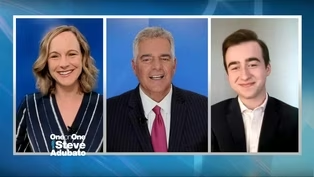
NYU Class of 2027 Student Talks About Overcoming Obstacles
Video has Closed Captions
Clip: S2023 Ep2627 | 8m 28s | NYU Class of 2027 Student Talks About Overcoming Obstacles (8m 28s)
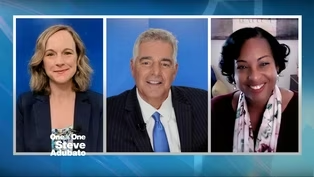
Supporting Collegiate Students in Engineering and Tech
Video has Closed Captions
Clip: S2023 Ep2627 | 9m 20s | Supporting Collegiate Students in Engineering and Tech Steve and Mary speak with Rochelle (9m 20s)
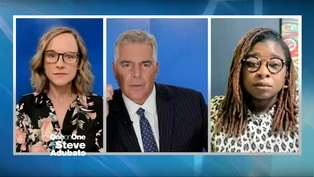
Why Philanthropy and Leadership is Necessary for Growth
Video has Closed Captions
Clip: S2023 Ep2627 | 9m 54s | Why Philanthropy and Leadership is Necessary for Growths (9m 54s)
Providing Support for PBS.org
Learn Moreabout PBS online sponsorship
- News and Public Affairs

Top journalists deliver compelling original analysis of the hour's headlines.

- News and Public Affairs

FRONTLINE is investigative journalism that questions, explains and changes our world.












Support for PBS provided by:
One-on-One is a local public television program presented by NJ PBS