State of Affairs with Steve Adubato
Sharon Levine; Sen. Joseph Cryan (D); Asm. Brian Bergen (R)
Season 10 Episode 11 | 27m 22sVideo has Closed Captions
Sharon Levine; Sen. Joseph Cryan (D); Asm. Brian Bergen (R)
Start Strong NJ Campaign Director Sharon Levine examines strengthening NJ's child care system. Sen. Joseph Cryan (D) – NJ, Chair of the Senate Higher Education Committee, discusses the value of higher education, AI data centers, and political civility. Asm. Brian Bergen (R) – NJ explores political leadership, tax reform, and the need for greater candor in politics.
Problems playing video? | Closed Captioning Feedback
Problems playing video? | Closed Captioning Feedback
State of Affairs with Steve Adubato is a local public television program presented by NJ PBS
State of Affairs with Steve Adubato
Sharon Levine; Sen. Joseph Cryan (D); Asm. Brian Bergen (R)
Season 10 Episode 11 | 27m 22sVideo has Closed Captions
Start Strong NJ Campaign Director Sharon Levine examines strengthening NJ's child care system. Sen. Joseph Cryan (D) – NJ, Chair of the Senate Higher Education Committee, discusses the value of higher education, AI data centers, and political civility. Asm. Brian Bergen (R) – NJ explores political leadership, tax reform, and the need for greater candor in politics.
Problems playing video? | Closed Captioning Feedback
Where to Watch State of Affairs with Steve Adubato
State of Affairs with Steve Adubato is available to stream on pbs.org and the PBS app.
Providing Support for PBS.org
Learn Moreabout PBS online sponsorship- [Narrator] Funding for this edition of State of Affairs with Steve Adubato has been provided by RWJBarnabas Health.
Learn More at RWJBH.org.
The Turrell Fund, a foundation serving children.
The Burke Foundation South Jersey Industries.
The parent company of South Jersey Gas, and Elizabethtown gas.
NJ Best, New Jersey’s five-two-nine college savings plan.
Lincoln Tech.
Horizon Blue Cross Blue Shield of New Jersey.
New Jersey Manufacturing Extension Program.
And by NJ Transit.
Promotional support provided by BestofNJ.com.
All New Jersey in one place.
And by Insider NJ.
[INSPRATIONAL MUSIC] - Hey, everyone, Steve Adubato.
We kick off the program talking about childcare with someone who knows the topic very well.
Sharon Levine is campaign director of a campaign called Start Strong NJ.
The website will be up right now.
Sharon, great to have you with us.
- Hi, Steve, thanks so much for having me on today to talk about childcare issues in New Jersey.
- And as folks know, we have been involved in a public awareness public education initiative for several years about the importance of affordable, accessible quality childcare, and Start Strong NJ is the initiative leading the way.
Tell everyone what the initiative is while the website is up so they log on and find out more.
- Yes, so these days it is just getting harder and harder to balance family and work.
You know, everything costs more than it used to, and there is just seemingly never enough time.
And for many families with young children, the largest expense that they face is childcare, sometimes costing more than their mortgage or their rent.
And that's really where Start Strong New Jersey comes in.
We are a statewide campaign uniting parents, early childhood educators and business.
And we're united by three core principles.
The first is that childcare must be both affordable and accessible for every family that needs it.
The second is that we really need to compensate our early childhood educators as the professionals that they are, right?
And finally, you know, we need the state of New Jersey to both recognize and fund childcare as essential economic infrastructure, because it enables people to work.
- So let's go back to, there are two parts of that that I wanna follow up on.
We'll talk about state funding and state support in a second because if you look at our interview with Governor Mikie Sherrill, look at our website right now, steveadubato.org, the big chunk of that conversation with the governor, was a full half-hour program on "State of Affairs," was about childcare.
And the governor was engaged in childcare issues as a member of Congress.
And now as governor, it's a very different position, but the challenge is still the same.
But one of the things you talked about, Sharon, was paying childcare professionals more.
Here's the thing that I'm trying to make sense of.
Clearly childcare professionals, educators, not paid enough.
If they get paid more, does that, in turn, wind up raising tuition and fees at childcare centers?
- So I think that is one of the challenges, right?
We need to look at the system as a whole.
It's very interconnected.
And while we absolutely wanna make childcare more affordable for families, you know, we need to keep that in mind about early childhood educators and raising wages and how that affects tuition.
I think one of the things we really need to do in New Jersey is dispel this concept that this is babysitting.
It is most definitely not babysitting.
Our early childhood educators are working with New Jersey children at a time in their lives where their brains are growing the fastest, they are learning so much, and they are trained and they are really setting the foundation for young children to go into both public school and then the rest of their lives.
I can tell you from my personal experience, my son went to childcare, and when we went to our first kindergarten parent-teacher conference with the teacher, she wanted to know where my son had been prior to public school, because he came in with such a leg up, with such a great foundation that was provided to him by the childcare center.
So we need to really elevate our mindset around this profession and really fund and pay our early childhood educators their true value.
- You know, Sharon, you mentioned your son and the opportunity your son had to be in a quality childcare center.
I've often said, as we do this programming around childcare, that we've been blessed and fortunate to be able to do that for kids.
And I often think, okay, so those, our kids are fortunate.
They have certain advantages.
They get this childcare, quality childcare, they're ready.
Talk to our audience about the challenges that children who do not have that opportunity to be in such a childcare center have when they get to kindergarten.
- Yes, so in childcare centers, you know, it isn't just changing diapers and feeding and those things.
Of course, it's that and keeping children safe, but it's so much more than that.
There's a curriculum, right?
They are learning emotional regulation, how to share, how to take turns, how to be independent.
Those are all such critical skills that you not only use in school, but you need for the rest of your life, right?
And our early childhood educators are really spending so much time each day with our children and having such a long-term impact on their future potential.
And children who don't go to childcare centers, you know, they may not be exposed to that prior to entering public school.
- Let's shift gears.
Let folks know what happens when a mom or a dad, disproportionately a mom, is not able to work because childcare is not accessible and affordable.
- When childcare is not affordable, a parent has to sometimes make that really tough decision of either reducing their work hours or dropping out of the workforce entirely, right?
And that's gonna have long-term impacts on their career advancement, on retirement savings, on, you know, promotions that they may have to turn down.
And so it hurts their financial stability and their ability to provide for their own family and their children.
- But doesn't it also impact the state and the rest of us?
Because if that mom or dad chooses not to work, very hard decision, right, that income tax revenue is not coming into the state.
- That is a great point, Steve.
So childcare is as essential to the economy as roads and bridges and public transportation.
Childcare is essential economic infrastructure and it's a public good.
And it enables people to work and businesses to thrive.
When parents make that difficult choice of reducing their work hours or dropping out of the workforce entirely, businesses then face staffing shortages.
They have reduced productivity.
They have slowed growth.
And the state of New Jersey loses $5 billion, just think about that, $5 billion annually in lost wages, reduced productivity and lost tax revenue that, Steve, you and I both know the state needs to fund important public services.
- Absolutely, before I let you go, Sharon, what is the Jenga, J-E-N-G-A, Advisory Council?
- So we have a Jenga Council.
We created it.
It's a group of childcare providers to make sure that the policy recommendations that Start Strong New Jersey is advocating for is really rooted in the lived experience of the childcare operators, right?
We wanna make sure that, as we move forward with our advocacy, that we are having that voice of childcare providers telling us about what they're experiencing, the challenges they're facing, and how we can advocate on behalf of them and the families who rely on them.
- Sharon, let me also make it clear that your support is not taxpayer dollars, correct?
- No, it is not.
- It's all private.
And two of the foundations, the Burke Foundation and the Turrell Fund, support Start Strong NJ, as well as other philanthropic organizations.
And they, the Burke Foundation and Turrell, support our programming, as well.
Sharon, I cannot thank you enough for joining us.
We'll have multiple conversations moving forward.
And we'll also check out our interviews with State Senator Teresa Ruiz, who is one of the leaders in the state legislature on childcare issues.
SteveAdubato.org, check out that and a whole range of other interviews connected to childcare.
Sharon, thanks so much.
We wish you all the best.
- Thank you, Steve.
Appreciate the chance to be on this morning.
- We appreciate you.
Stay with us, we'll be right back.
(grand music) - [Announcer] To see more State of Affairs with Steve Adubato programs, find us online and follow us on social media.
- We are honored to be joined by State Senator Joseph Cryan, who is the chair of the Senate Higher Education Committee in the Garden State.
Good to see you, Senator.
- Good to see you, Steve, as always.
- You got it.
Listen, you were part of a roundtable discussion at Stockton University on the future of higher ed.
What do you see, Senator, as the most pressing issues in the higher ed community right now in New Jersey?
- I think the most pressing issue is the actual determination of value for higher education.
I think families today are looking at the cost of higher education in New Jersey around the country and trying and making decisions as to whether or not it actually has the value that it needs for young people to move ahead.
I would say that's even more important than the financial pressures that are occurring in New Jersey.
As you know, we've had mergers, acquisitions, all sorts of things.
But the most fundamental pressing thing for me is that 62% of families in New Jersey value higher education, but many don't.
- Shift gears dramatically, the other end of education, if you will, more than education, our childcare series, you'll see a graphic on the screen, folks, for Start Strong NJ, which is a campaign that looks at the importance of affordable quality childcare.
Senator, you were also part of a round table discussion with Congresswoman MacGyver and others, including folks at the Union Township School District talking about childcare.
What are your greatest concerns about the childcare situation in our state right now?
- Well, it's affordable is one and we haven't provided the kind of access we need.
The school we toured with the Congresswoman and myself actually had open seats, but not the funding to work through it.
So the state needs to both from an education standpoint with local schools and from the state of New Jersey, provide opportunity and access for families.
It was one of the lessons learned from there.
It's one of the things we're fighting through in this budget.
And on a federal level, it's certainly got to be a priority.
Families, you know, Steve, childcare, we got to look at it a couple different ways.
I think the initial instinct is, okay, mom could go to work or families can provide other financial opportunities.
Reality of it is those young people at the earliest of ages become more educated, more socialized, and those benefits are proven and we're losing far too much when we don't provide that opportunity.
- And by the way, check out our website for previous childcare centric segments we've done in cooperation with the Start Strong NJ Initiative.
Senator, again, shift gears.
Could you make sense to our audience and for our audience, the situation as it relates to these data centers and AI?
What the heck are data centers and why is that?
This is a challenging and confusing situation, but it's tremendous policy implications and on the quality of life of people, not to mention the economics.
Please, Senator.
- Huge issue, my district.
A couple quick definitions.
A data center have been around, data centers have been around for 20 plus years.
All right I toured a data center in Piscataway that's been there for 12 years.
Others have been there for over 20.
AI data centers are more of the recent.
I smile only because it's been such a pressing issue.
In the 20th district, for example, in Kenilworth, there's a CoreWeave data center that's created quite a bit of concern among residents and quite a bit of passion among them as well.
An AI data center is a high processing, think Nvidia chip ability to utilize significant data in order to process AI, which demands the huge amount of data for our systems in order to process.
So the AI data systems are creating a significant amount of angst amongst among the public.
- I'm sorry for interrupting, Senator.
What are most folks worried about, concerned about?
- In the Kenilworth one in particular, the primary concerns are electric rates, the use of water, acoustics, use of noise, emissions, the idea that these things can create cancer, and in particular in the Kenilworth Center, there's been a huge tax credit provided by the state of New Jersey.
Given the amount of money CoreWeave makes, that has created a lot of animosity among folks as well.
- So I want to be clear.
- Sure.
- You believe there's a significant role for the state government to play as it relates to regulating data centers?
- I absolutely do, I think they, we ought to do the following, Steve.
First off, I'm not against them completely, even though I know the majority of the public is, but I do think they need to be regulated more.
And I'll give you an example.
They're permitted for, on air permits that they get tested on a regular basis.
Those should be more stringent.
Water, where there is a significant concern among the public that the, you know, the use of water by data centers is going to drain the water table, affect the quality of life.
There's videos of brown water, for example, those sort of things.
There should be more stringent water testing provided by the data companies, let me... The power usage, we are creating in New Jersey a two-tier system as you're, I'm sure, well aware of, with hundred megawatt users or more.
By the way, these data systems can use up to 250 megawatts, just to put that in perspective enough for 200,000 homes.
That there are two tiers in the bidding process again on the PJM so that the electric rates for a data center- - Are PJM the providers of energy?
- That's correct.
The electric grid that supports 13 states.
PJM meaning Pennsylvania, Jersey and Maryland.
It's 13 state cooperative.
And the idea is, is that the large users will bid against themselves for rates and not impact residential rates.
So folks are immensely concerned about their ability to stay in their homes, their ability to have their quality of life in their homes.
And I will tell you, people are offended at no level over the huge tax break that CoreWeave got.
- Okay.
I got a couple minutes left.
Senator, you and I, independently, but both of us are well aware of this, grew up in, let's say families that were engaged in politics, right?
You're laughing because you know.
And let's say the politics that we grew up around rough and tumble, aggressive, okay.
That being said, talk to us about, and you'll see a graphic on the bottom of our screen, you'll screen in democracy in danger.
Why, because it's my sense, Senator, and it's more important what you think, that the level of polarization is different from the past and the level of acrimony and political violence is different from the past, you say?
- I say absolutely.
There were, in the families we grew up in, there were at least limits.
There are no limits anymore.
And anything you can point to, the weaponization of the DOJ, to the incredible, I mean, just in our most recent discussions, investigating a governor's wife, what looks pretty- - Governor Newsom out in California.
- Correct.
Which looks pretty frivolous on its face.
You see those things, those kind of things that we'd like to think didn't happen before, but part of it's social media that we blame to, but part of it too is just this inability any longer to hold back in terms of what we're thinking and just kind of have a common civility.
It's part of the reason John Bramnick and I did the civility tour.
- That's right.
- Just to show that we could debate things in a civil manner.
But I am immensely concerned.
And Steve, it turns away, as you know very well, people from going into public life.
- That's right.
- And Senator makes reference to Republican State Senator John Bramnick, the civility tour with a Democrat, Senator Cryan, talking about disagreeing on policy and issues, but not being disagreeable and not making the other person the enemy.
State Senator Joe Cryan is chair of the Senate Higher Education Committee.
Senator, thank you so much for joining us.
We appreciate it.
- It's always a pleasure.
Thanks, Steve.
- You got it.
Stay with us, we'll be right back.
(grand music) - [Announcer] To see more State of Affairs with Steve Adubato programs, find us online and follow us on social media.
- He is back by popular demand.
He's State Assemblyman Brian Bergen, a Republican, and the minority whip.
That means he's a leader in the Republican Party in the legislature.
Good to see you, assemblyman.
- Thanks for having me, Steve.
- And by the way, remind folks of your military background because it matters in the context of what we're going to talk about.
- Yeah, so I was a West Point grad.
I graduated in 2001 and I flew attack helicopters doing a tour of duty in Iraq in 2005.
- I say this every time you join us, you can't say it enough.
Thank you and everyone who has served in the military protecting us.
Thank you.
- You're welcome, Steve.
- Hey, Delaney Hall, moving target.
We don't know.
I shouldn't use that term.
Things are moving quickly.
Question.
- Yeah.
- ICE is not a military organization.
I guess it's a paramilitary organization.
Help us understand the challenges that you believe the officers who represent our federal government, ICE, those ICE agents, what challenges do they face, A, and B, are they trained and prepared for that, assemblyman, for incredibly difficult situations?
Not just at Delaney, but at detention centers across the country?
- Well, I don't know exactly what their training is, but that's a difficult situation for any organization.
I mean, you saw the state police there, you saw the Newark police there in riot gear prepared and even they were having issues because an event that's that big, I mean, really, I can't even imagine having to deal with something like that.
So I don't know what their training entails, but I highly doubt that they're specifically trained for an event of that magnitude at one of their facilities because, I don't know, I don't think it happens every day or even quite frankly that often.
So it's a shame, and honestly, on the political side of this, I don't know if we're going to head in that direction or not.
- You head wherever you want.
- Yeah, so it's a shame that it turned into this, Steve.
I mean, really, there was a lot of political grandstanding that happened at Delaney Hall, which in my opinion, was a direct contributor to it accelerating into what it became now.
Now, do I think that those people, the governor being one of them, in hindsight, knowing what would've ultimately happen, would they have done it?
I highly doubt so, but they did.
They did.
They grandstanded, they politicized it.
They made it political theater, and then it kind of incited people to act more aggressively than I think they would otherwise have.
- So let me play devil's advocate.
- Sure.
- I'm not here to defend or represent the governor or Senator Kim.
Check out our in-depth interview with United States Senator Andy Kim, who was there as well and was pepper sprayed.
He had his own perspective.
You call it grandstanding.
What about if someone says, "What do you mean grandstanding?"
They were talking about the conditions that they believe are going on in Delaney Hall and they believe those conditions were inhumane and they were protesting.
You say what?
- I would say, come on.
I mean, give me a break.
There are a million ways to handle that.
If you're the governor of the state of New Jersey or a US Senator, there's a million ways to handle it besides the way that they did.
In my opinion, it was showmanship.
They were there, it was showmanship.
They're nothing else.
And I think it contributed to the situation that we had there.
That's my personal opinion.
If I was the governor of the state of New Jersey, I bet there's a million people I could call to deal with that situation without having to go in front of a mic, in front of protestors at Delaney Hall.
- And you what I love about having you on, assemblyman, is people pick sides and their positions publicly are often dictated by "What side they're on."
Not the case with you, so I'll ask you this question.
I've talked to you about this before.
I'm going to go back to January 6th, President Trump on a microphone.
Did he contribute to the chaotic situation of a group of people assaulting police officers and attempting to overthrow violently the results of an election in 2020?
Or did he help?
- Listen, here's the ironic part of it.
Back then and still to this day, the Democratic Party will point very clearly to that connection.
But then when I mentioned the things like I just mentioned about Governor Sherrill and US, and Senator Kim, they're like, "Whoa, whoa, whoa, couldn't possibly be".
Listen, was Trump a contributor on that day?
The answer is yes, because he could have stopped it more so than he did.
He could have been at that mic and said, "Don't do anything like that."
Or when it started happening, he could have been more aggressive in his "stop it" stance.
I'll tell you this though, I was the first person on that day in the state of New Jersey to condemn the actions that happened on January 6th.
I think that's awful.
But here's a key difference, and I think this is what makes people upset about January 6th on the Republican side or Trump supporter side, is that every single person who was there, regardless of their impact on what they were doing, was fully investigated by the full force of the FBI.
Every law enforcement agency was called in to find out every single detail and prosecute every single person.
Here we have people running roughshot on Delaney Hall.
- You mean at Delaney Hall?
- Yeah.
In Delaney Hall, standing in front of cars, causing chaos, and they're just allowed to do it day in and day out and people are making excuses for them.
The difference there is huge in my personal opinion.
- Real quick, I'll get off this, but it feels like a lot of, I don't want to call it... Well, it is hypocrisy to some, but there's inconsistency.
Can I get a quick answer to this?
Why can't we just be honest and call it what it is?
Obviously is versus, no, but I'm on that side, so I can't say whether it's a MAGA person or a far left person, Democrat.
What is that?
It's intellectually dishonest.
- It's awful.
It's the worst part about being in this business.
It pisses me off.
It is what it is, just say it.
Like I told you before, when January 6th happened, I said this should not happen.
Delaney Hall happens, I'm saying this should not happen.
It's not rocket science.
And honestly, Steve, in politics, 99% of the people are scared to lose an election.
That's why.
That's why.
That is their primary concern and they don't want to off their base or people in power in their party because of that risk.
That's why.
- I'm so sorry for getting into this because now I want to ask you about the, about the anchor and the Stay NJ tax relief program.
What's your concern about those?
- I hate them.
I hate them because they're... - Why don't you say what you really think?
- Well, Steve, I mean, they are gimmicks.
They're gimmicks.
They're taking money from you and me by taxes, by sales tax, income tax, fee tax, every kind of tax you can imagine to accumulate $5 billion the state government does not need to function.
And then they're returning that to selective taxpayers, in my opinion, in order to buy votes.
It's a disingenuous thing to do.
They should just not tax us $5 billion.
How about that?
To me, that would be a much better way to do it, because number one, you're pulling all that money out and you run it through all this bureaucracy, you're losing all this money to government employees before it gets back in the hands of the taxpayers.
It is, to me, it is crazy.
That's why I don't like it.
Tax rebates are gimmicks done by the government.
- Do you agree with mid-tenure census redistricting?
"Meaning, well, it's five, six years in.
We can redistrict and get some more Democratic members of the House.
Texas, we can get more Republicans."
Or should we wait for the census?
- No, they should wait for the census.
How stupid is it to do it any other time?
I mean, the whole point of this, the whole point of redistricting is to redistrict because of population shifts, and we determine that through the census.
Doing it any other time is just, I don't know, it's stupid.
- I love having State Assemblyman Brian Bergen, the minority whip.
- I'll be here.
- Well, we love having you because you say what you think and people can decide for themselves, but you never hold back.
Assemblyman, as always, it's an honor having you with us, thanks.
- Thanks, brother, appreciate it.
- You got it.
I'm Steve Adubato That's somebody who says what's on his mind.
You don't have to try to interpret it.
See you next time.
- [Narrator] State of Affairs with Steve Adubato is a production of the Caucus Educational Corporation.
Funding has been provided by RWJBarnabas Health.
Learn More at RWJBH.org.
The Turrell Fund, a foundation serving children.
The Burke Foundation South Jersey Industries.
NJ Best, New Jersey’s five-two-nine college savings plan.
Lincoln Tech.
Horizon Blue Cross Blue Shield of New Jersey.
New Jersey Manufacturing Extension Program.
NJ Transit.
And by these public spirited organizations, individuals and associations committed to informing New Jersey citizens about the important issues facing the Garden State.
Promotional support provided by BestofNJ.com.
And by Insider NJ.
- At the Turrell Fund, we know that all New Jersey families deserve access to affordable, high quality childcare.
Early childhood education supports healthy brain development and provides essential support to power the economy, enabling parents to work, businesses to operate, and communities to thrive.
The Turrell Fund is proud to be part of Start Strong NJ, a statewide initiative to put affordable, high quality childcare within reach of all New Jersey families.
Learn more at TurrellFund.org and StartStrongNJ.org.
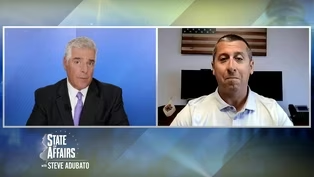 New
NewAsm. Brian Bergen explores the need for candor in politics
Video has Closed Captions
Clip: S10 Ep11 | 9m 25s | Asm. Brian Bergen explores the need for candor in politics (9m 25s)
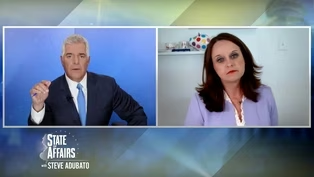 New
NewHow Start Strong NJ is strengthening NJ's child care systems
Video has Closed Captions
Clip: S10 Ep11 | 9m 51s | How Start Strong NJ is strengthening NJ's child care systems (9m 51s)
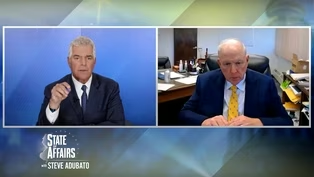 New
NewSen. Joseph Cryan discusses education, AI, and civility
Video has Closed Captions
Clip: S10 Ep11 | 9m 34s | Sen. Joseph Cryan discusses education, AI, and civility (9m 34s)
Providing Support for PBS.org
Learn Moreabout PBS online sponsorship New Episode
- News and Public Affairs

Top journalists deliver compelling original analysis of the hour's headlines.
 New Episode
- News and Public Affairs

Today's top journalists discuss Washington's current political events and public affairs.


 New Episode
 New Episode
 New Episode
 New Episode
 New Episode
 New Episode

 New Episode
Support for PBS provided by:
State of Affairs with Steve Adubato is a local public television program presented by NJ PBS