One-on-One
Shaun Ananko; Dale Caldwell; Shanique Holmes; Father Leahy
Season 2022 Episode 2509 | 27m 53sVideo has Closed Captions
Shaun Ananko; Dale Caldwell; Shanique Holmes; Father Edwin Leahy
Shaun Ananko talks about farming and climate change; Dale Caldwell discusses how positive influences dictate how we view entrepreneurship and innovation; Shanique Holmes discusses diversity, equity, and inclusion in the workforce; Father Edwin Leahy talks about issues with violence throughout the Newark community.
Problems playing video? | Closed Captioning Feedback
Problems playing video? | Closed Captioning Feedback
One-on-One is a local public television program presented by NJ PBS
One-on-One
Shaun Ananko; Dale Caldwell; Shanique Holmes; Father Leahy
Season 2022 Episode 2509 | 27m 53sVideo has Closed Captions
Shaun Ananko talks about farming and climate change; Dale Caldwell discusses how positive influences dictate how we view entrepreneurship and innovation; Shanique Holmes discusses diversity, equity, and inclusion in the workforce; Father Edwin Leahy talks about issues with violence throughout the Newark community.
Problems playing video? | Closed Captioning Feedback
How to Watch One-on-One
One-on-One is available to stream on pbs.org and the free PBS App, available on iPhone, Apple TV, Android TV, Android smartphones, Amazon Fire TV, Amazon Fire Tablet, Roku, Samsung Smart TV, and Vizio.
Providing Support for PBS.org
Learn Moreabout PBS online sponsorship- [Narrator] Funding for this edition of One-On-One with Steve Adubato has been provided by PSE&G, committed to providing safe, reliable energy now and in the future.
The North Ward Center.
The Healthcare Foundation of New Jersey.
Atlantic Health System.
Building healthier communities.
Investors Bank.
The Robert Wood Johnson Foundation.
The Fidelco Group.
Delta Dental of New Jersey.
Everyone deserves a healthy smile.
And by The Russell Berrie Foundation.
Making a difference.
Promotional support provided by Northjersey.com and Local IQ.
Part of the USA Today Network.
And by CIANJ, and Commerce Magazine.
- This is One-On-One.
- I'm an equal American just like you are.
- The way we change presidents in this country is by voting.
- I'’m hopeful that this is the beginning to accountability.
- Life without dance is boring.
- I don't care how good you are or how good you think you are, there is always something to learn.
- I did do the finale, and guess where my trailer was?
A block away from my apartment, it couldn'’t have been better!
- People call me 'cause they feel nobody's paying attention.
-_ It'’s not all about memorizing and getting information, it'’s what you do with that information.
- (slowly) Start talking right now.
- That's a good question, high five.
(upbeat music) - Hi everyone, I'm Steve Adubato.
We kick off the show, talking about important environmental issues, and we kick it off with Shaun Ananko, Who is director of agriculture and education at an organization called Grow It Green Morristown.
You'll see the website throughout the show.
Shaun, how you doing?
- I'm doing great today, Steve.
Thanks for having me.
- It's great to have you.
Tell us exactly what Grow It Green is.
- We're a small nonprofit located in Morristown, New Jersey.
We run an urban farm behind the Lafayette Learning Center which is a one-acre education farm focused on teaching kids about where their food comes from.
And we also host a community garden over on Early Street.
- How'd you get into this?
- I got into this by luckily getting into beekeeping.
A number of years ago, a family friend offered me a beehive and I got really interested in honeybees and how beekeeping works.
And that set me on a path to learn about agriculture and put me into being a farmer.
- Good stuff.
Now beekeeping will be another segment, but on this one (clears throat) I'm curious about this 50-foot greenhouse tunnel.
I'm reading about it.
I'm saying, "It does what?"
Explain what this is, 'cause also our friends at the PSEG foundation told us about you because you're part of their Neighborhood Partners Program.
Tell us what that is, that tunnel.
- Yeah.
So is an unheated high tunnel and is also movable on our farm.
So they call them caterpillar tunnels out in the agriculture field.
And what it does is it allows us to grow four seasons throughout the year and also increase production through the shoulder seasons of the spring and the fall.
So what's really interesting about this tunnel is that we're going to move all our tomato production into this tunnel, where we're gonna grow them on vertical trellises to increase our yields by like 15%, 20%, and at the same time, teaching people about how vertical growing and how agriculture is starting to change for smaller scales.
- Shaun, help me on this.
How does it actually impact the issues of food insecurity?
And, I don't know, in Morristown, there are food deserts all across this state and across this nation.
We're taping in New Jersey, but what does this have to do with people being able to get fresh healthy fruit and vegetables?
- Yeah.
So in the wintertime, we find that, especially here in this area, fresh produce, especially like greens, lettuce and kale aren't as easily available on a local scale.
So having tunnels like these, we're able to provide that produce throughout the winter and spring and fall.
- So what I'm curious about is, okay, so, you got the tunnel, now we're taping this program in February in 2022.
It's freezing, as we're doing this program.
Again as this program is repeated, it'll get warmer and et cetera.
So are you saying that the New Jersey climate and the temperatures here and what it's like here is not as relevant when you have such technology?
- That's correct.
Yeah.
What it allows us to do is start crops earlier in the season and push them later into the winter, so that we're having a continuous harvest throughout the growing year.
- So, connect farming to climate change.
- So, with what we have going on here and climate changing, farmers have to be resourceful with what weather patterns we're not able to predict anymore.
We can't just say like, "Oh, it's gonna..." The saying, April showers bring may flowers.
We may not get any rain in April, but all of the rain in May.
(chuckles) - That's right.
So these high tunnels allow us to kind of control the climate so that we are getting the product and produce that we're hoping to put out into the community - Before I let you go, gimme 30 seconds on educating students all about agriculture through Grow It Green Morristown.
- Yeah, I've been with Grow It Green for the past 11 years and educating these students from pre-K all the way through 12th grade has really inspired me as a farmer.
And it's inspired our community in Morristown to start taking agriculture and environmental science seriously.
- And you also have an apprentice program.
- Yes.
And we have an apprentice program where we're gonna start...
It was piloted last year and we're hoping to, over the years build that into where we can send young adults out into a trajectory of agriculture.
- It's important work.
- Thank you.
- Shaun, I wanna thank you for joining us.
And we've had the website for Grow It Green, New Jersey up for people to find out more about your organization.
Shaun, all the best to you and the team at Grow It Green Morristown.
Thanks, Shaun.
- Thanks, Steve.
Thanks for having me.
- You got it.
We'll be right back after this.
- [Narrator] To watch more One on One with Steve Adubato find us online and follow us on Social media.
He's back again.
He's Dr. Dale G. Caldwell Executive Director of the Fairleigh Dickinson University Rothman Institute of innovation and entrepreneurship.
Dr. Caldwell, thanks for joining us again.
- Yes I'm honored to be here, honored to be here.
- We did a much longer segment with Dr. Caldwell on a whole range of issues and you could check out our website to find that interview but we have a segment here.
I want a couple things I wanna cover in the few minutes we have.
My question is this, do you believe that entrepreneurship first is something that could be learned or do you believe it's within each one of us to be an entrepreneur or some are just not?
- Well, there's the entrepreneurial mindset and the entrepreneur.
And so I separate the two out.
The entrepreneur is someone that has a level of resilience that they can take all the nonsense they have to deal with to be successful.
The entrepreneurial mindset is really the innovator the person that thinks ahead.
So many people are great at number two not everybody's number one.
And so but that entrepreneurial mindset is so essential.
I don't care if you're working in a big company.
I don't care if you're working in a nonprofit and government, you know, that idea of really thinking about how do we do things better and not waiting for someone to tell you what to do.
So I separate the two.
So everyone has that entrepreneurial mindset in them but not everybody has the resilience to be successful.
- And when it comes to the innovation part of the equation for those who resist change who actually believe they can stay where they are.
And the other segment I did with you, we talked about the status quo not really being a realistic option particularly in the age of technology, dramatically moving things in a certain direction.
And also COVID, we're doing this two years plus into the pandemic.
To those who resist change because they actually believe they can stay where they are.
What would you say to them right now who are watching?
I just I'm comfortable with, just leave me alone, I'm comfortable the way I am.
- Well but one of the things, so you see this red book behind me, so I wrote this book called "Intelligent Influence" and I found that we're all products around- - "Intelligent influence."
- Intelligent influence.
And so we do what we do think the way we think and accomplish what we accomplish because of influence.
And so often, I mean, again I knew your dad and you know, what an amazing guy.
And so and you're amazing.
- He was an innovator, an entrepreneur and he never held back telling me what he thought when he believed I wasn't doing the right thing.
Let me just say that.
- Well he never held out telling anybody that, he was a dynamo.
I was a young deputy commissioner at DCA and I met him and I was just so impressed.
- I hear you.
- But those influences early on, you know there's some people who that, they have moms that say, well, that's a great idea.
But if it was gonna work someone else would've done it before.
So they grew up in that environment of innovation is risk.
And so, but others grew up in an environment where they pushed you.
They threw you off the bridge to do that.
And so you, the influences can help people become more entrepreneurial but your early influences can really dictate how you view innovation.
- It's so interesting.
I never said this on the air but I'll say right now.
This is how my dad taught me how to swim.
We went out to Suntan Lake back in the day it was a lake that up on 23 in New Jersey it was where a lot of frankly poor kids from our neighborhood went and there was this, he swam out I was on his shoulders.
We swam out to this big, wasn't a barge but you climbed up on it.
And this is what he did this is a true story.
He just threw me off.
And I was going up and down, up and down.
And he just said, swim.
And I didn't swim.
And he finally jumped in and got me.
So I told you to swim and he did it again until I learned how to swim.
Now listen, DYFS wasn't around at the time.
(laughs) - I just wanna put that out there.
- Yeah, but Steve, the best speech I ever heard was Sidney Poitier at the National School Boards Conference in California who said the exact same thing.
His dad did the exact same thing to him and really forced him to be, and look how successful you are and he is that's not everybody has that kind of push.
- I'm never going to category with the great Sidney Poitier.
Listen, thank you so much, Dr. Caldwell check out our other interview with Dale which is much longer and more detailed.
All the best doctor thanks for joining us.
- Thank you so very much Steve, and keep doing the great stuff you're doing.
- You got it.
Be right back after this.
- [Narrator] To watch more One on One with Steve Adubato find us online and follow us on Social media.
- We're now joined by Shanique Holmes, who is Program Director of Workforce Diversity, Equity, and Inclusion at the Port Authority of New York and New Jersey.
Good to see you, Shanique.
- Good to see you, Steve.
- Let's break this down.
People often lump diversity, equity, inclusion all together.
Let's take them in pieces.
Diversity, your definition of it, not just at the Port Authority, but for any large organization or any organization.
- Sure, so diversity is reflecting the communities that you serve, so it's people from all different backgrounds, different experiences, different education levels sort of bringing all of their dynamic backgrounds to the organization and the organization valuing from it.
- Yeah, well said, and by the way, as we do this program on the seventh of February, this'll, I'll be dating myself, but United States Supreme Court, there have been 118 members of the United States Supreme Court that have been not just nominated but approved.
115 of them are white men.
That would not be diversity, I would argue, in most people's minds.
So that's diversity.
Let's deal with the question of inclusion.
- Mm-hmm, so inclusion is really all those individuals from the various backgrounds that we mentioned coming to the workplace and feeling like their voice matters, their opinion, their perspective, matters, and that their contribution to the organization is of tremendous value.
- Could you push this a little bit?
A concrete example of that, what does it look like?
- Sure, so coming to a department where I have a different background than others.
As you mentioned in your example, maybe all white men are in that specific example, but I feel like because I'm a black woman, and my unique experience and how I was brought up and my education level, I have a different way of seeing maybe the very same project, let's say, and so I bring that lens, and so maybe our customer base has grown because of that because I'm able to provide that background and that experience in different work scenarios.
- And let me say the Port Authority in New York and New Jersey, one of the many supporters of what we do, and I know that there, if I'm not mistaken, there's 7,000 people employed by the Port Authority?
- That's correct.
- So when it comes to the issue of equity in an organization, whether it's the Port Authority or any other large organization, how do you work to ensure equity, workplace equity?
- So equity is really looking at, again, you know, the opportunity for those individuals to feel like they can have the experience and they can aspire to reach the goals that they have for their selves, their careers.
Their job skills have developed just as they had planned it within an organization regardless of the background that they have.
- So let me ask you, sometimes there are things that happen in the news.
Well, they happen in life, and they're reported in the news, and so the murder of George Floyd on camera in front of the world, a case that proceeded... That followed up, and we saw what happened to those officers.
Question: what impact did the George Floyd murder have on the work of you and your colleagues?
- Tremendous impact, so immediately after the murder of George Floyd, particularly at our organization, the leadership, our Executive Director, Rick Cotton; our Chairman, Kevin O'Toole, they instituted what they called the Leadership Steering Committee, which were 10 very senior individuals across the entire organization to really take a look at race dynamics within the organization, so as part of that effort, those 10 individuals, they heard from about a third of the workforce.
They offered listening sessions and opportunities for people to engage, to hear what their thoughts were about race dynamics and what they thought about, in particular, that situation having to do with George Floyd and how it resonated with many people, and so as a result of that, we heard quite a few people say, and employees share, that they wanted to see change and that they wanted to do some things to help the organization to evolve and to bridge the gap when it came to policies and practices that the organization had engaged in.
So the Leadership Steering Committee worked with a number of employee volunteers to come up with 25 separate initiatives that have been implemented and that are in the process of being implemented to this very day, and so there are things such as new diversity and inclusion and unconscious bias training for leaders and managers to help managers and leaders to understand, you know, what it's like and the tools that they need to manage and lead diverse teams and diverse employee groups to mitigate unconscious bias where there may be, you know, unconscious bias dynamics, and other things- - Can I, I'm sorry.
I'm sorry for interrupting, Shanique.
You've used the term unconscious bias a few times.
Could you differentiate between unconscious bias and bias?
- Sure, so unconscious bias is really, again, unique perspectives that we all bring to the table based on our background, our upbringing, perhaps things that we've seen in the news, social media, and oftentimes, many of us, if not all of us, will have an experience that we will have a quick decision or a quick response to, right, which is called sort of an unconscious bias.
So something that's kinda of, not something that we're necessarily aware of all the times, but we have over time developed a response rate or way of responding to certain people or dynamics based on our experiences that we've had over a very long period of time, so that would be something that's called unconscious bias.
Conscious bias would be just deliberate, you know, decision-making for or against something.
- Before I let you go, why is this work around diversity, equity, and inclusion so personal for you?
- It's personal because, you know, I grew up in a situation where my father experienced something that was not positive.
He was injured, quite frankly, because of something that he, a place that he was, where others felt that he did not belong, being an African American male.
- Because of race.
- Because of his race, that's correct, and so it's very important to me to ensure that I constantly make others aware, that I help them to develop, that I bring, I serve as a conduit where necessary for leadership and for employees and help bring them along and help them to work together and advance a specific cause, an organization, and continue to advance in this space.
- Shanique Holmes is Program Director of Workforce Diversity, Equity, and Inclusion at the Port Authority of New York and New Jersey.
Ms. Holmes, I wanna thank you so much for joining us.
We appreciate it, Shanique.
- It was a pleasure.
Thank you, Steve.
- You got it.
We'll be right back right after this.
- [Narrator] To watch more One on One with Steve Adubato find us online and follow us on Social media.
- Yes, we have him, right outside of St. Benedict's Preparatory school.
He is Father Edwin Leahy, the Headmaster at St. Benedict's Prep in beautiful Newark, New Jersey, Brick City.
Good to see you, Father Ed.
- Good to see you, Steve.
- By the way, the Gray Bees that chyron, that's the name, they're St. Benedict's Prep Gray Bees, right?
- Correct, that's correct.
- And sports is a big deal, but so is academics over at St. Benedict's Prep.
Today, I wanna heavily focus on an initiative that I saw on CBS news, about the fact that your students interacting with state police personnel, trying to have more of a dialogue.
Describe it as we show some footage from that report.
- So, we had the, a couple of people that worked with us on our, not on our board but are friends of ours.
After all these violence in cities and with, especially people of color getting shot and troopers being under duress, and when they make stops.
Is there a way where we can begin to get people to talk to each other, to understand each other's realities?
So we took a crack at it.
We have a group that we work with called Victory Road, which is our consultants.
And they had done some work with this state police as well.
And the state police were more than willing to participate with us.
And that's kind of how it began.
We started with a couple of evolutions out in our property in Sussex county, and then have done two of them here on the property.
Actually here on the property, I think much more helpful because everybody in the school can see it and meet the troopers when they come in in the morning.
So as to try to get the troopers to understand the stresses of young people in the city, and to get the the young people to understand what the, these happen to be troopers, we wanna do it with everybody, with police officers in municipal situations as well.
- What are you hearing from your students, Father Ed?
- You see, it's interesting because when the kids sit down with the troopers at the end of the day around the table and talk about who they are, what their experiences are.
You begin see walls fall down.
It's actually interesting to watch because the ones that we do here the kids are paired with a trooper.
So they're with them all day, trying to achieve these various challenges and competing against one another.
So to be under duress and have to depend on each other, you begin to see mutuality start to happen rather than division.
And I think that's been a revelation both to our kids and I think to the troopers.
- So I'm curious about this.
For those who don't know exactly where St Benedict's Prep is, describe its location and its surroundings.
- So St. Benedict's Prep is on King Boulevard in Newark.
My guess is, if you were to draw a circle around the city of Newark, the largest city in our state, you'd probably put the compass point on our roof.
So we're right in the middle of the city of the downtown area just a block to our east.
And then the Central Ward to our west going towards Irvington on Springfield Avenue.
So we're right in the middle of downtown.
And the business community is around us as well as a lot of the challenges that folks have who live in the city to our west.
- Your students, the demographics, that population?
- Yeah, mostly our students are or young people of color, from the African dispersion as well as from Latin America.
We go from Grade 5 through Grade 13, really.
So there's five year olds.
We go from kindergarten to Grade 13.
We have five year olds through 19 year olds here in school about just under 1,000 of 'em.
- Let me disclose a couple things.
Usually it's about an underwriter of our programming but I'm gonna disclose that my son, Steven Gregory has been teaching at St. Benedict's Prep for several years in the areas of religion and theology.
And my father very much involved at St. Benedict's Prep for a long time, my late dad.
And also Father Ed, you don't like me to disclose this but you are the spiritual advisor to our family.
- (laughs) Yeah, well, I mean, and your father was an interesting influence on us here.
It was not uncommon to go to church in the morning for our first prayer of the day and find your father sitting in the choir with the monks.
Or on the other end of the day, to go to dinner at six o'clock and to find your father sitting at the table with the Abbot.
Because he just felt at home here, I think, and was in and out frequently.
And then as it turned out, and this is how I believe how the divine works, that when he was beginning to think about Robert Treat Academy.
- A charter school that my dad found and one of the first in the country, go ahead, Father Ed.
- Correct, and the first one in Newark.
- That'’s right.
- Noel your nephew was a student which brought your father to school a lot of days with Noel.
So he'd be sitting in our morning meeting, watching the meeting and when they started Robert Treat Academy in the north that morning meeting I think came out of his experience of our meetings here, that the kids at Robert Treat do even today.
So the secret of all of this, even with the police is to understand the reality and the sufferings of the other.
And that's the biggest problem we have in the country right now.
An inability to be willing to understand the suffering of the other person and the reality the other person lives with.
And that's what we're trying to do with this building bridges.
And that's, I think that's the secret to life, frankly but.
- Father Ed, before I let you go, gimme a minute.
The new Girls' Prep Division in August of 2020 started real quick, young women there as well.
- Yeah, they broke in Steve.
I had nothing to do with it.
We had no plans to have girls in school.
The girls, the teenage girls, eight of them, actually broke in because they connived with our guys and created a situation where it was impossible for me to say no to them.
So it had nothing to do with adults other than for the adults to give in to what these kids wanted to do.
It was all teenage girls, and then in cooperation with teenage guys - That's leadership.
- That's, yeah, that's what's possible in the city with kids, if we unleash them and let them use their creative abilities and to give 'em a voice.
That's the biggest, most important thing, give them a voice and have people listen.
I had nothing to do with it.
I tried to stop it in fact, unsuccessfully.
- Good, I'm glad you were unsuccessful.
By the way, Father Edwin Leahy, he's the Headmaster of St. Benedict's Prep in Newark.
You became the headmaster, when you were at the ripe old age of 26, if I'm not mistaken, correct?
- Correct, yes.
- And I remember that I was at Essex Catholic.
And a school around the corner, it doesn't even exist anymore.
St. Benedict's Prep closed for one year, open back up.
There's a whole nother story there, by the way, check out the documentary.
Real quick, first thing, what's the documentary called?
- There's one called The Rule.
Then there was this, The Rule is one.
And then there's one called Benedict's Men it's more recent one around the basketball team.
And there is this 60 Minutes piece.
- Yeah, oh yeah, 60 Minutes, so what do we chopped liver?
(Father Ed laughing) Thanks Father Ed.
Father Edwin Leahy, Headmaster at St. Benedict's Prep in Newark.
Thank you, Father Ed.
(Father Ed laughing) - 60 Minutes.
- You know who I am?
You know who I am?
(laughs) - You know who I am.
To quote that he's, now you're quoting my father, I'm not going there, we gotta end the show.
This is my show, you don't get to close it.
That's Father Ed.
See you next time.
(laughs) - [Narrator] One-On-One with Steve Adubato has been a production of the Caucus Educational Corporation.
Funding has been provided by PSE&G, The North Ward Center.
The Healthcare Foundation of New Jersey.
Atlantic Health System.
Investors Bank.
The Robert Wood Johnson Foundation.
The Fidelco Group.
Delta Dental of New Jersey.
And by The Russell Berrie Foundation.
Promotional support provided by Northjersey.com and Local IQ.
Part of the USA Today Network.
And by CIANJ, and Commerce Magazine.
- [Young Girl] I was diagnosed with Cystic Fibrosis when I was two.
It's hard to grow up with CF.
But I have an awesome care team at Goryeb Children's Hospital.
Helping me do the things I want to do, like play lacrosse.
And now, I've been recruited to play in college.
- Where you go for pediatric care matters.
- [Announcer] Atlantic Health System, because every moment is a moment that matters.
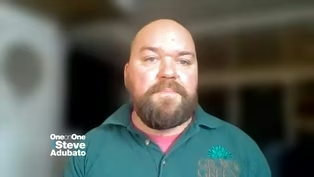
The Connection Between Farming and Climate Change
Video has Closed Captions
Clip: S2022 Ep2509 | 6m 12s | The Connection Between Farming and Climate Change (6m 12s)
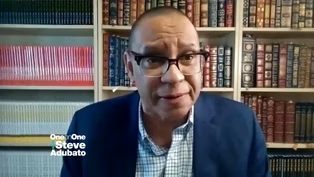
The Connection Between Innovation and Leadership
Video has Closed Captions
Clip: S2022 Ep2509 | 5m 20s | The Connection Between Innovation and Leadership (5m 20s)

The Issues with Violence Throughout the Newark Community
Video has Closed Captions
Clip: S2022 Ep2509 | 9m 40s | The Issues with Violence Throughout the Newark Community (9m 40s)
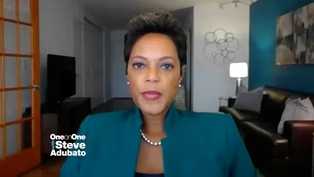
Recognizing Diversity and Inclusion in the Workforce
Video has Closed Captions
Clip: S2022 Ep2509 | 8m 19s | Recognizing Diversity and Inclusion in the Workforce (8m 19s)
Providing Support for PBS.org
Learn Moreabout PBS online sponsorship
- News and Public Affairs

Top journalists deliver compelling original analysis of the hour's headlines.

- News and Public Affairs

FRONTLINE is investigative journalism that questions, explains and changes our world.












Support for PBS provided by:
One-on-One is a local public television program presented by NJ PBS